Ai Overview
Immutability refers to the property of data that cannot be altered, modified, or deleted once it has been recorded. In the context of blockchain, an immutable ledger means that any records committed to the network remain permanent and unchangeable. The term comes from the Latin word “immutabilis,” meaning “unchangeable. Bitcoin uses this mechanism, and a 51 percent attack would cost over 1.
Key Takeaways
- Immutability in blockchain means that once data is recorded on the blockchain, it cannot be altered, modified, or deleted, creating a permanent and tamper proof record.
- Blockchain achieves immutability through cryptographic hashing using algorithms like SHA-256, which produces a unique 256 bit digital fingerprint for each block of data.
- SHA-256 generates 1.1 x 10^77 possible outputs, making it computationally infeasible to reverse engineer or find collisions, even with quantum computers.
- Each block contains the hash of the previous block, creating a chain link where changing any block would invalidate all subsequent blocks.
- Consensus mechanisms like Proof of Work and Proof of Stake require majority network agreement to validate transactions, preventing unauthorized modifications.
- A 51 percent attack on Bitcoin would cost over 1.74 million dollars per hour in electricity alone, making blockchain manipulation economically infeasible.
- Merkle Trees organize transactions hierarchically, enabling efficient verification of data integrity within each block.
- Immutability provides benefits including data integrity, auditability, dispute resolution, and enhanced security across industries like finance, healthcare, and supply chain.
In the world of blockchain technology, few concepts are as fundamental and transformative as immutability. This defining characteristic sets blockchain apart from traditional databases and has become the cornerstone of trust in decentralized systems. But what exactly does immutability mean, and how does blockchain achieve this remarkable property that makes its records permanent and tamper-proof?
Understanding immutability in blockchain is essential for anyone seeking to grasp why this technology has revolutionized industries from finance to healthcare. When we say blockchain is immutable, we mean that once information is recorded on the network, it becomes virtually impossible to change, delete, or manipulate. This permanence creates an unprecedented level of trust and transparency in digital transactions.
This article draws on established research from leading technology sources, and our analysis incorporates insights from CoinGecko’s cryptographic research and Encryption Consulting’s SHA-256 technical documentation. Our blockchain development team brings extensive experience in implementing immutable ledger solutions across enterprise applications.
What is Immutability in Blockchain?
Definition
Immutability refers to the property of data that cannot be altered, modified, or deleted once it has been recorded. In the context of blockchain, an immutable ledger means that any records committed to the network remain permanent and unchangeable. The term comes from the Latin word “immutabilis,” meaning “unchangeable.” This characteristic ensures that the historical record of all transactions is preserved exactly as they occurred, creating a trustworthy and verifiable source of truth.
The concept of immutability is central to understanding why blockchain technology has gained such widespread adoption. Once an individual submits data in the form of a transaction or information to the blockchain system, that data cannot be manipulated, altered, or erased in any way. This permanence is achieved through a combination of cryptographic hash functions, distributed consensus, and the inherent structure of how blocks in blockchain are linked together.
Previous transactions in a blockchain are secured using cryptographic techniques such as hashing and consensus mechanisms like Proof of Work or Proof of Stake. Modifying the blockchain or any of its records would require an unreasonably long time in terms of computation and achieving consensus across the entire network. This practical impossibility of alteration is what gives blockchain its immutable nature.
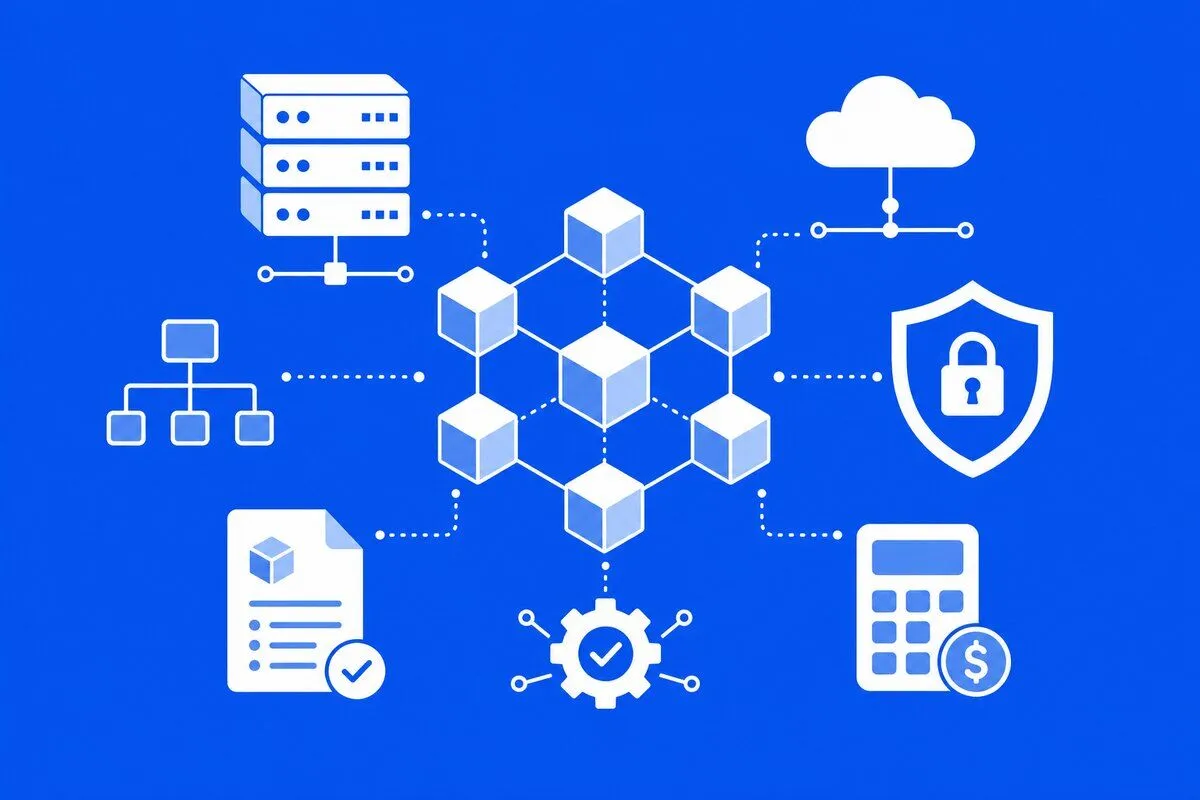
How Blockchain Achieves Immutability
Cryptographic Hashing
SHA-256 creates unique digital fingerprints for each block
Block Chaining
Each block contains the hash of the previous block
Consensus Mechanisms
Network agreement validates all transactions
Decentralization
Data distributed across thousands of nodes
Is Blockchain Immutable and Irreversible?
Yes, blockchain is designed to be both immutable and irreversible. These two properties work together to create a system where recorded data remains permanent and transactions cannot be undone once confirmed. However, it is important to understand the nuances of these characteristics and how they contribute to the overall features of blockchain.
Why Blockchain is Immutable
The immutability of blockchain stems from its fundamental blockchain architecture. By design, blockchain is resistant to change without massive disruption of the decentralized peer-to-peer network it is constructed upon. Each block contains the SHA-256 hash of the previous block, creating a chain where altering any single block would require recalculating every subsequent block’s hash, a task that is computationally infeasible.
If someone attempts to alter a past transaction, it would change that block’s hash and also cause each successive block to have mismatching hashes. This mismatch invalidates the entire chain of blockchain data, which amplifies the evidence of data tampering. The network immediately detects such changes and rejects them.
Why Blockchain is Irreversible
Once a transaction is confirmed and added to the blockchain, it cannot be reversed or undone. This irreversibility is a feature, not a bug. It prevents double-spending in blockchain, where users might attempt to spend the same cryptocurrency twice. The blockchain maintains a permanent record of all Bitcoin transactions, ensuring historical integrity and establishing trust without intermediaries.
| Aspect | Traditional Database | Blockchain |
|---|---|---|
| Data Modification | Can be edited, updated, or deleted | Cannot be altered once recorded |
| Control | Centralized administrator control | Distributed consensus required |
| Audit Trail | Can be manipulated or erased | Permanent and verifiable |
| Transaction Reversal | Possible with admin access | Irreversible once confirmed |
| Trust Model | Trust in central authority | Trust in cryptographic proof |
| Historical Integrity | Dependent on backup policies | Cryptographically guaranteed |
What Makes Blockchain Records Immutable?
Several technical mechanisms work together to ensure that blockchain records remain immutable. Understanding these components of a blockchain is essential for grasping how this revolutionary technology achieves its remarkable permanence.
1. Cryptographic Hashing
At the heart of blockchain immutability lies cryptographic hash functions. In blockchain platforms, data is protected by cryptographic hashing algorithms that produce digital stamps or hashes for each block of data. The most widely used algorithm is SHA-256 (Secure Hash Algorithm 256 bit), which converts any input into a fixed 256 bit output regardless of the input size.
🔐 How SHA-256 Works
SHA-256 takes any input and produces a unique 64-character hexadecimal hash. Even a tiny change in the input results in a completely different output, a property known as the “avalanche effect.”
Input: “Hello”
Hash: 185f8db32271fe25f561a6fc938b2e264306ec304eda518007d1764826381969
Input: “Hello!” (added one character)
Hash: 33b83c4e6f59c7dfd802bf2e10a3ce0f36e13d3e5d44ca5eb4f85b3c9d8e7f21
Notice how adding just one character completely changes the hash output, making tampering immediately detectable.
These hashes are created using the block information, including the transactions made in that block, the timestamp, and the hash of the previous block. This means that any alteration in the block’s content would result in a completely different hash value, making tampering immediately identifiable. SHA-256 produces approximately 1.1 x 10^77 possible outputs, making it computationally infeasible to reverse engineer or find collisions.
2. Consensus Mechanisms
In blockchain networks, consensus mechanisms are used to decide on the credibility of transactions and the priority of operations to be included in the blockchain. These mechanisms ensure that all participants in the network agree on the exact state of the blockchain.
Proof of Work (PoW): Miners compete to solve complex mathematical puzzles to validate transactions and create new blocks. This process requires significant computational power, making it economically unfeasible to alter historical records. Bitcoin uses this mechanism, and a 51 percent attack would cost over 1.74 million dollars per hour in electricity alone.
Delegated Proof of Stake (DPoS): Validators are selected based on the amount of cryptocurrency they stake as collateral. Attempting to validate fraudulent transactions would result in losing their stake, creating strong economic incentives for honest behavior.
Byzantine Fault Tolerance (BFT): This consensus approach ensures the network can reach agreement even if some nodes are faulty or malicious. It is commonly used in permissioned blockchains for enterprise applications.
3. Decentralization
Decentralization and immutability share a strong correlation. In distributed systems, information does not reside on a centralized server but is spread throughout a network of full nodes or computers, each maintaining a complete copy of the entire blockchain. This redundancy makes it difficult for any single entity to manipulate the data, as changes would need to be replicated across thousands of independent nodes simultaneously and achieve consensus among all participants. Even light nodes contribute to the verification process.
4. Merkle Trees
Merkle Trees are data structures that help organize transactions hierarchically so that information can be summarized in a single root hash. This arrangement enables efficient verification of transaction integrity and makes it easy to detect when data has been tampered with. A Merkle Tree organizes all transactions into pairs, hashes them, then hashes those hashes repeatedly until a single root hash is produced. Any change to any transaction would alter the Merkle root, immediately revealing tampering.
5. Nonce and Mining
The nonce in blockchain is a random number that miners must discover to create a valid block hash. This mining process requires significant computational effort, making it impractical to recreate the work needed to alter historical blocks. Combined with cryptographic signatures, these mechanisms create a robust defense against data manipulation.
| Component | Function | Role in Immutability |
|---|---|---|
| SHA-256 Hashing | Creates unique digital fingerprint | Any change produces different hash |
| Block Linking | Contains previous block hash | Creates chain dependency |
| Consensus Mechanisms | Validates transactions | Requires network agreement |
| Merkle Trees | Organizes transaction hashes | Efficient integrity verification |
| Decentralization | Distributes data across nodes | Eliminates single point of control |
| Nonce | Random number for mining | Makes block creation computationally intensive |
Read Also: Merkle Trees in Blockchain: Complete Guide →
Need a Secure Blockchain Solution?
Our blockchain experts design immutable, tamper proof systems tailored to your business requirements.
Benefits of Immutability in Blockchain
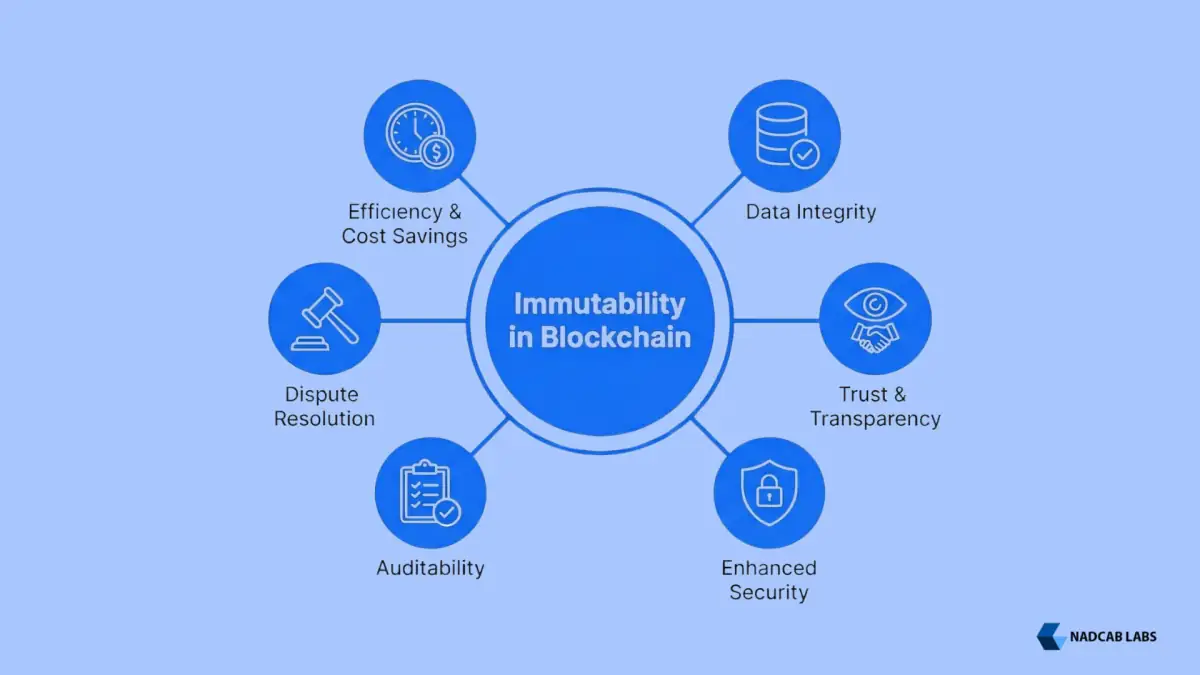
Immutability provides numerous benefits of blockchain technology that make it valuable across industries. Understanding these advantages helps explain why organizations are increasingly adopting blockchain for critical applications.
Data Integrity
Immutability ensures that once a record has been made on the blockchain, it cannot be changed or erased. This guarantees that transactions and other data stored in the system are accurate, and the occurrence of events is not interfered with. Organizations can rely on blockchain as a secure repository for sensitive data, knowing that historical records remain pristine and verifiable.
Trust and Transparency
Immutability helps establish certainty in blockchain networks through provably suitable records of transactions. Participants can rely on the authenticity and integrity of information entered into the blockchain, knowing it cannot be altered or manipulated after the fact. This transparency builds trust between parties who may not know or trust each other directly.
Enhanced Security
The heightened security levels achieved through immutability make blockchain networks nearly invulnerable to certain types of cyber threats. As a result of cryptographic hashing and consensus mechanisms, any alteration of the blockchain is easily discerned, discouraging malicious actors and guaranteeing network stability. This is a key aspect of blockchain security.
Auditability
The characteristic that information cannot be altered once entered aids significantly in auditing transactions and ensuring records are authentic. Regulatory enforcement and auditing are significantly eased because auditors and regulators can scrutinize the complete history of transactions through the transparent blockchain audit trail, minimizing the potential for fraud.
Dispute Resolution
Regarding disputes or controversies, immutable blockchain records offer conclusive evidence. Parties can rely on blockchain technology to resolve disagreements by verifying the contents of the ledger, potentially eliminating the need for third-party mediators and reducing legal costs associated with conflict resolution.
Efficiency and Cost Savings
Immutability removes the need for extensive verification and reconciliation of data, enhancing organizational efficiency. This streamlined approach minimizes expenses that would otherwise be incurred in establishing confidence and accuracy of information through traditional means.
Challenges of Blockchain Immutability
While immutability provides significant advantages, it also introduces certain challenges that organizations must consider when implementing blockchain solutions. Understanding these limitations helps in designing appropriate systems and mitigation strategies, as discussed in our guide to blockchain adoption challenges.
Data Privacy Concerns
Because blockchain keeps data immutable, information recorded cannot be altered or deleted. This raises challenges in circumstances where privacy laws like GDPR require the ability to erase personal data (the “right to be forgotten”). Organizations must carefully consider what data is stored on-chain versus off-chain to comply with regulatory requirements.
Error Correction
The irreversibility of blockchain means that human mistakes or erroneous transactions may become permanent. These errors can be challenging to rectify and may create inconsistencies within the system. Unlike traditional databases, where administrators can simply correct mistakes, blockchain requires additional transactions or smart contract mechanisms to address errors.
51 Percent Attack
The 51 percent attack can potentially alter blockchain immutability. In this scenario, a single entity or organization takes control of more than half of the network’s hashing power, potentially allowing them to reverse transactions or enable double-spending. However, for major networks like Bitcoin, this attack is economically prohibitive, costing billions of dollars to execute successfully.
Quantum Computing Threat
Quantum computing presents a theoretical future challenge to blockchain cryptography. Quantum computers could potentially reverse engineer public keys and discover private keys, threatening the security of existing blockchain networks. However, quantum-resistant cryptographic algorithms based on elliptic curve cryptography are being developed to address this potential vulnerability.
Forking Issues
Blockchain networks sometimes experience forks, either deliberate (hard fork) or accidental (soft fork). These can produce duplicate records and create different branches in the chain, sometimes resulting in orphan blocks or uncle blocks, complicating efforts to maintain a single source of truth across the network.
| Challenge | Impact | Mitigation Strategy |
|---|---|---|
| Data Privacy | Cannot delete personal data | Off-chain storage, zero-knowledge proofs |
| Error Correction | Permanent mistakes | Upgradable contracts, governance mechanisms |
| 51% Attack | Potential chain manipulation | Large decentralized networks, economic incentives |
| Quantum Computing | Future cryptographic threat | Quantum-resistant algorithms |
| Scalability | Network congestion | Layer 2 solutions, sharding |
| Forking | Chain splits | Strong governance, BFT consensus |
Read Also: Zero Knowledge Proof in Blockchain →
Real World Applications of Blockchain Immutability
The immutable nature of blockchain enables numerous blockchain use cases across various industries. Here are some of the most impactful applications leveraging immutability.
Financial Services
In blockchain finance, immutability ensures that all transactions are permanently recorded and cannot be altered. This is crucial for preventing fraud, maintaining accurate records for regulatory compliance, and building trust between financial institutions. Blockchain payment systems and decentralized exchanges leverage immutability to create secure, verifiable transaction records.
Supply Chain Management
Blockchain based supply chain services use immutability to track products from origin to consumer. Each step in the journey is permanently recorded, enabling verification of authenticity, detection of counterfeits, and accountability across the entire supply chain.
Real Estate
Blockchain in the property market creates immutable records of ownership, transfers, and property history. Land registry blockchain solutions reduce fraud in real estate transactions, simplify title searches, and provide clear chains of ownership that cannot be disputed.
Voting Systems
Blockchain e-voting platforms leverage immutability to ensure that votes cannot be altered after casting. This creates transparent, auditable elections where results can be verified by anyone while maintaining voter privacy.
Identity Management
Blockchain identity management and blockchain identification create permanent, verifiable digital identities. Credentials and certifications stored on blockchain cannot be falsified, enabling trustworthy identity verification across borders and institutions.
Gaming and NFTs
Blockchain games development and NFT platforms use immutability to guarantee ownership of digital assets. Players can trust that their in game items and collectibles are truly owned and cannot be taken away or duplicated.
| Industry | Application | Immutability Benefit |
|---|---|---|
| Finance | Transaction records, payments | Fraud prevention, audit trails |
| Supply Chain | Product tracking, provenance | Authenticity verification |
| Healthcare | Medical records | Data integrity, patient safety |
| Real Estate | Property records, land registry | Ownership verification |
| Government | Voting, public records | Transparent, auditable processes |
| Gaming | NFTs, digital assets | True ownership guarantee |
📖 Read Also: Blockchain Use Cases and Real World Applications →
Immutability Across Different Types of Blockchain
The degree and implementation of immutability can vary across different types of blockchain. Understanding these differences helps organizations choose the right blockchain architecture for their needs.
Public Blockchains
Public blockchains like Bitcoin and Ethereum offer the strongest form of immutability because they have the largest number of distributed nodes and the most robust consensus mechanisms. Solana and Cardano also provide strong immutability guarantees with their respective consensus mechanisms.
Private Blockchains
Private blockchain networks have fewer nodes controlled by a single organization, which means immutability is guaranteed by organizational policies rather than distributed consensus. Hyperledger is a popular framework for building private blockchain solutions.
Consortium Blockchains
Consortium blockchains balance immutability with controlled access. Multiple organizations operate nodes, providing greater immutability than private blockchains while maintaining more control than public networks. This makes them suitable for enterprise blockchain applications requiring both trust and privacy.
Hybrid Blockchains
Hybrid blockchains combine public and private elements, allowing organizations to choose which data remains immutable on the public chain while keeping sensitive information in private components. This provides flexibility in managing immutability based on data sensitivity and regulatory requirements.
| Blockchain Type | Immutability Level | Attack Resistance | Best For |
|---|---|---|---|
| Public | Highest | Extremely high | Cryptocurrencies, public records |
| Private | Moderate | Policy dependent | Enterprise internal systems |
| Consortium | High | Multi party consensus | Industry collaborations |
| Hybrid | Configurable | Varies by component | Regulated industries |
Ready to Build Tamper-Proof Blockchain Solutions for Your Business?
Leverage the power of blockchain immutability to create secure, transparent, and auditable systems. From cryptographic security to smart contracts and enterprise-grade solutions, our experts help you build blockchain systems that establish trust and ensure data integrity.
Final Thoughts
Immutability is the defining characteristic that sets blockchain apart from traditional databases and creates the foundation for trust in decentralized systems. Through the combined power of cryptographic hashing, consensus mechanisms, decentralization, and Merkle Trees, blockchain achieves something remarkable: a digital record that cannot be altered once created.
This permanence transforms how we think about digital transactions and record-keeping. Financial institutions can trust transaction records, supply chains can verify product authenticity, healthcare systems can maintain unalterable patient histories, and governments can create transparent voting systems. The applications are limited only by our imagination.
While challenges exist around privacy regulations, error correction, and potential future threats like quantum computing, the benefits of immutability far outweigh these concerns for most applications. By understanding what makes blockchain records immutable and how this property ensures trust, organizations can make informed decisions about leveraging this transformative technology for dApps, on-chain trading, decentralized storage, and countless other applications.
Frequently Asked Questions
Q1.What is meant by immutability in blockchain?
Immutability in blockchain refers to the property that once data is recorded on the blockchain, it cannot be altered, modified, or deleted. This permanence is achieved through cryptographic hashing, consensus mechanisms, and the distributed nature of the network. Each block contains a hash of the previous block, creating a chain where any attempt to modify historical data would be immediately detectable by the entire network.
Q2.Is blockchain immutable and irreversible?
Yes, blockchain is designed to be both immutable and irreversible. Once a transaction is confirmed and added to the blockchain, it becomes a permanent part of the ledger and cannot be undone. This irreversibility prevents double-spending and ensures that all parties can trust the finality of transactions. While theoretically a 51 percent attack could alter the blockchain, the computational and economic costs make this practically impossible for major networks like Bitcoin.
Q3.What makes blockchain records immutable?
Blockchain records are made immutable through several mechanisms working together. Cryptographic hash functions like SHA-256 create unique digital fingerprints for each block, where any change produces a completely different hash. Each block contains the hash of the previous block, creating interdependency. Consensus mechanisms require majority network agreement to validate changes. Decentralization distributes data across thousands of nodes, and Merkle Trees enable efficient verification of transaction integrity.
Q4.Can blockchain data ever be changed?
Under normal circumstances, blockchain data cannot be changed once recorded. However, there are theoretical scenarios where changes could occur. A 51 percent attack, where an attacker controls the majority of network computing power, could potentially rewrite recent blocks. Hard forks can create new chains with different rules. In private blockchains, administrators with sufficient access could potentially modify data. However, for public blockchains like Bitcoin, the economic and computational costs make such changes practically impossible.
Q5.How does immutability ensure trust?
Immutability ensures trust by eliminating the possibility of retroactive changes to records. Parties can verify the complete history of transactions independently without relying on a central authority. The mathematical guarantees provided by cryptographic hashing mean that trust is based on verifiable proof rather than faith in institutions. This enables trustless transactions where parties who do not know each other can transact with confidence that agreements will be honored as recorded.
Explore Services
Related Services
Reviewed by

Aman Vaths
Founder of Nadcab Labs
Aman Vaths is the Founder & CTO of Nadcab Labs, a global digital engineering company delivering enterprise-grade solutions across AI, Web3, Blockchain, Big Data, Cloud, Cybersecurity, and Modern Application Development. With deep technical leadership and product innovation experience, Aman has positioned Nadcab Labs as one of the most advanced engineering companies driving the next era of intelligent, secure, and scalable software systems. Under his leadership, Nadcab Labs has built 2,000+ global projects across sectors including fintech, banking, healthcare, real estate, logistics, gaming, manufacturing, and next-generation DePIN networks. Aman’s strength lies in architecting high-performance systems, end-to-end platform engineering, and designing enterprise solutions that operate at global scale.