Ai Overview
A hybrid blockchain is a type of blockchain architecture that combines elements of both public and private blockchains into a single unified system. While preserving the ability to interact with external parties, a hybrid blockchain operates in a closed environment that cannot be targeted by 51% attacks from outsiders. This cost efficiency makes hybrid blockchains economically viable for high-volume business applications.
Key Takeaways
- A hybrid blockchain combines the best features of both public and private blockchains, offering controlled access while maintaining transparency, security, and decentralization where needed.
- Organizations can customize which data remains private and which transactions are made public, providing flexibility that neither purely public nor private blockchains can offer.
- Hybrid blockchains are immune to 51% attacks because hackers cannot access the private network component to carry out such attacks.
- Transaction costs in hybrid blockchains can be as low as $0.01 per transaction because fewer nodes are required for verification compared to public blockchains.
- Leading hybrid blockchain platforms include XinFin (XDC Network), Dragonchain, Ripple, and IBM Food Trust, each serving enterprise-grade applications.
- Key use cases span banking and finance, healthcare, supply chain management, government services, IoT applications, and real estate.
- Unlike consortium blockchains controlled by multiple organizations, hybrid blockchains can be managed by a single entity while still offering public blockchain benefits.
- The hybrid approach enables enterprises to comply with regulations requiring data privacy while maintaining the audit trail and transparency benefits of blockchain technology.
The evolution of blockchain technology has given rise to multiple architectures designed to address different organizational needs. While public blockchains like Bitcoin and Ethereum offer complete transparency and decentralization, and private blockchains provide controlled access and privacy, neither solution alone can satisfy the complex requirements of modern enterprises. This is where hybrid blockchain emerges as a revolutionary approach that combines the best of both worlds, offering organizations the flexibility to maintain private data while still benefiting from the security and transparency of public distributed ledgers.
This comprehensive guide draws upon extensive research into blockchain architecture, real-world enterprise implementations, and insights from leading hybrid blockchain platforms, including XinFin, Dragonchain, and IBM Food Trust. The information presented reflects current industry practices and technical specifications documented by blockchain development consortiums and enterprise adoption studies. Our analysis incorporates findings from implementations across banking, healthcare, supply chain, and government sectors where hybrid blockchain solutions have demonstrated measurable improvements in operational efficiency, data security, and regulatory compliance. Understanding hybrid blockchain architecture is essential for technology leaders, enterprise architects, and business decision makers evaluating distributed ledger solutions for their organizations.
As organizations increasingly recognize that a one-size-fits-all blockchain approach cannot address their diverse requirements, hybrid blockchains have emerged as the preferred choice for enterprises seeking a balance between transparency and privacy, decentralization and control, openness and security. This guide explores every aspect of hybrid blockchain technology, from fundamental concepts to advanced implementation strategies.
Also Read: What Is Hybrid Cloud?
What is Hybrid Blockchain?
Definition
A hybrid blockchain is a type of blockchain architecture that combines elements of both public and private blockchains into a single unified system. It allows organizations to establish a private, permission-based network alongside a public, permissionless system, enabling selective control over which data is kept confidential and which information is shared publicly on the distributed ledger.
The hybrid blockchain architecture is distinguishable from other types of blockchain by the fact that it is not entirely open to everyone, but still offers the beneficial features of public blockchains such as integrity, transparency, and security. In a hybrid blockchain, members can decide who can participate in the network and which transactions are made public, bringing the best of both worlds and ensuring that organizations can work with their stakeholders in the most effective way possible.
Unlike a purely public blockchain where all data is visible to anyone and decisions are decentralized across all participants, or a private blockchain, where a single organization maintains complete control, a hybrid blockchain provides a middle ground. Organizations can keep sensitive business data on the private network component while recording verification hashes or summary information on the public component, creating an immutable audit trail without exposing confidential details.
Key Components of Hybrid Blockchain Architecture
A hybrid blockchain essentially has two interfaces working together: a private blockchain with its own ledgers where confidential transactions are processed, and a public blockchain that aids in data verification between the private blockchain ledgers. The private network component handles sensitive operations requiring speed and privacy, while the public component provides transparency and trust for external stakeholders.
The architecture includes public nodes that operate similarly to those in permissionless networks, allowing anyone to participate in certain activities and view specific data. Private nodes, on the other hand, are in charge of validating and checking transactions and are governed by specific organizations or individuals. This dual node structure enables hybrid blockchains to process transactions more rapidly and with greater privacy using private nodes, while public nodes provide decentralization and transparency simultaneously.
How Does Hybrid Blockchain Work?
Understanding how hybrid blockchain works is essential for organizations considering this technology for their operations. The hybrid blockchain operates through a sophisticated interplay between its private and public components, creating a seamless system that delivers both privacy and transparency.
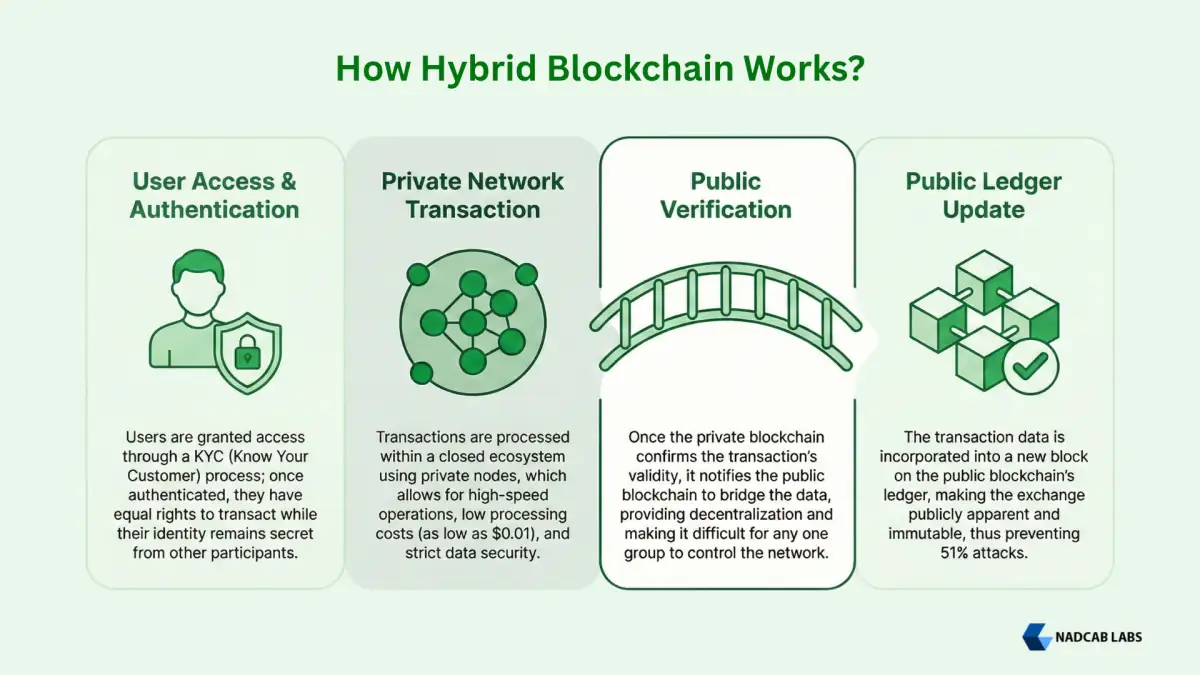
Step-by-Step Process
Step 1: User Access and Authentication
Once a user is granted access to the hybrid blockchain platform, they can fully participate in the blockchain activities. Users share equal rights to perform transactions, view them, or even append and modify transactions based on their permission levels. Companies and organizations typically carry out KYC (Know Your Customer) processes to ensure proper identification before granting access.
Step 2: Transaction Processing on Private Network
When a company wishes to conduct a private transaction, the operation is processed using the private blockchain component. A digital record of the exchange is created and its validity is confirmed by the private blockchain nodes. The identity of users is kept secret from other participants unless they are directly involved in the transaction.
Step 3: Public Verification and Recording
Once a transaction has been confirmed on the private blockchain, it notifies the public blockchain that a transaction has occurred. The transaction data from the private blockchain is incorporated into a new block created on the public blockchain. This step creates an immutable record while protecting sensitive details.
Step 4: Public Ledger Update
The transaction becomes publicly verifiable when the new block is added to the public blockchain ledger. External parties can verify that a transaction occurred without accessing the confidential details stored on the private network.
| Step | Action | Network Component | Outcome |
|---|---|---|---|
| 1. Access | User authentication and KYC verification | Private Network | User granted appropriate permissions |
| 2. Transaction | Private transaction processing | Private Network | Confidential data recorded securely |
| 3. Notification | Transaction hash sent to public chain | Bridge Layer | Public verification initiated |
| 4. Recording | Block added to public ledger | Public Network | Immutable audit trail created |
Key Features of Hybrid Blockchain
Hybrid blockchains possess several distinctive features that set them apart from other blockchain architectures and make them particularly suitable for enterprise applications.
1. Dual Data Management
A fundamental feature of a hybrid blockchain is its dual data management capability. The system can process sensitive data on a private network ensuring confidentiality and faster transactions while using public blockchains for transparency and trust verification. This architecture allows organizations to comply with regulatory requirements without compromising on security, making it ideal for industries handling sensitive information.
2. Enhanced Data Security
When compared to standalone private or public blockchains, hybrid blockchains offer stricter data security protocols and greater flexibility. The advantage of data security is significant because it allows organizations to keep their activities private without worrying about unauthorized access. Critical data points remain off the public network, preventing external parties from viewing sensitive information while still maintaining blockchain security benefits.
3. Controlled Access with Transparency
Hybrid blockchain enables organizations to establish customizable access levels. The members can decide who can participate in the blockchain and which transactions are made public. This selective transparency ensures that businesses can share necessary information with stakeholders, regulators, or the public while keeping commercially sensitive data protected.
4. Closed Ecosystem Protection
While preserving the ability to interact with external parties, a hybrid blockchain operates in a closed environment that cannot be targeted by 51% attacks from outsiders. This protection comes from the private network component, where malicious actors cannot gain the majority control needed to manipulate the ledger, making hybrid blockchains significantly more secure against common blockchain vulnerabilities.
5. Flexible Rule Configuration
Companies thrive on change, and hybrid blockchains accommodate this need by allowing rule modifications when necessary. Organizations can adjust the degree of decentralization, security protocols, and accountability requirements based on evolving business needs. However, core elements like land registry or identity verification records maintain their immutability to preserve data integrity.
6. Interoperability
Hybrid blockchain systems are designed to integrate with existing enterprise applications and other blockchain networks. This interoperability ensures that blockchain can be embedded into broader IT ecosystems, including ERP and CRM systems, providing a unified data framework. Platforms like XinFin enable interoperability with private blockchains such as Corda, Hyperledger, and Quorum through specialized relayers.
| Feature | Description | Business Benefit |
|---|---|---|
| Dual Data Management | Private and public data layers | Regulatory compliance with transparency |
| Enhanced Security | Critical data kept off the public network | Protection from external threats |
| Controlled Access | Customizable permission levels | Stakeholder-specific data sharing |
| 51% Attack Immunity | Closed ecosystem protection | Enterprise-grade security |
| Flexible Rules | Adaptable governance settings | Business agility and scalability |
| Interoperability | Integration with existing systems | Seamless enterprise adoption |
Benefits and Advantages of Hybrid Blockchain
The hybrid blockchain architecture offers numerous benefits of blockchain technology combined with additional advantages specific to its dual nature. Organizations across industries are recognizing these benefits as compelling reasons to adopt hybrid solutions.
High Speed Operations
When compared to public blockchains, hybrid blockchains provide significantly faster operations and are simpler to manage. The private network component can process transactions rapidly without waiting for verification from thousands of nodes. For example, XinFin Network achieves 2000 transactions per second with 2-second finality, making it suitable for high-frequency enterprise applications.
Reduced Transaction Costs
Another significant benefit is dramatically lower transaction costs. Because only a limited number of nodes are required to verify transactions on the private network, processing expenses are minimized. Transaction fees can be as low as $0.01 per transaction compared to the variable and often high fees on public networks like Ethereum. This cost efficiency makes hybrid blockchains economically viable for high-volume business applications.
Privacy with External Communication
While private blockchains excel at privacy, they have limited means of communication with the external world. Hybrid blockchains solve this limitation by allowing organizations to keep sensitive information secure while still enabling communication with shareholders, partners, and the public through the public network component. This balance is essential for businesses that need both confidentiality and stakeholder transparency.
Flexible Infrastructure
One of the main advantages of hybrid blockchain is its versatility in terms of infrastructure services. Unlike other blockchain types that offer rigid structures, hybrid blockchain provides a flexible strategy for tailoring the ledger to organizational needs. The degree of decentralization, security levels, and accountability requirements can be adjusted based on specific use case requirements.
Regulatory Compliance
For industries operating under strict regulatory requirements, such as banking, healthcare, and government, hybrid blockchains offer the ability to maintain compliance while leveraging blockchain benefits. Organizations can implement KYC enforcement on validator nodes, ensure data privacy as required by regulations like GDPR, and maintain audit trails for regulatory reporting.
Enterprise Grade Scalability
Hybrid blockchains are designed to scale with enterprise requirements. The architecture supports adding new nodes, integrating additional data sources, and expanding network capacity without compromising performance. This scalability ensures that organizations can support future growth and remain agile in rapidly changing markets.
Hybrid Blockchain vs Public vs Private vs Consortium: Complete Comparison
Understanding how hybrid blockchain compares to other blockchain types is crucial for selecting the right architecture for your specific use case. Each type has distinct characteristics that make it suitable for different applications.
Public Blockchain
Public blockchains like Bitcoin and Ethereum are completely open and allow anyone to join and participate without permission. They offer maximum transparency and decentralization but suffer from slower transaction speeds, higher costs, and complete exposure of all data. Public blockchains are ideal for cryptocurrency and applications where full transparency is desired.
Private Blockchain
Private blockchains are controlled by a single organization and restrict access to approved participants only. They offer faster transactions, lower costs, and complete privacy but sacrifice decentralization and external trust. Examples include Hyperledger Fabric and R3 Corda. Private blockchains suit internal enterprise applications where external transparency is not required.
Consortium Blockchain
Consortium blockchains (also called federated blockchains) are controlled by a group of organizations rather than a single entity. Multiple organizations share the responsibility of validating transactions and maintaining the network. While similar to hybrid blockchains in having private and public characteristics, consortium blockchains differ in their governance structure, where decision-making authority lies with a predetermined group.
Hybrid Blockchain
Hybrid blockchains combine public and private elements, allowing a single organization or small group to control which data is private and which is public. Unlike consortium blockchains, where multiple organizations jointly govern the network, hybrid blockchains can be managed by one entity while still offering public blockchain benefits for transparency and verification.
| Characteristic | Public | Private | Consortium | Hybrid |
|---|---|---|---|---|
| Access | Open to all | Invitation only | Selected organizations | Mixed public and private |
| Governance | Fully decentralized | Single organization | Multiple organizations | Flexible control |
| Transparency | Complete | Limited to members | Selective among members | Customizable levels |
| Transaction Speed | Slow (7 to 15 TPS) | Fast (1000+ TPS) | Fast | Fast (2000+ TPS) |
| Transaction Cost | Variable, often high | Low | Low | Very low ($0.01) |
| Security | High (decentralization) | Moderate | High | Very high (dual layer) |
| 51% Attack Risk | Possible | Very low | Very low | Immune |
| KYC Required | No | Yes | Yes | Yes |
| Incentive Model | Token rewards | Not required | Optional | Optional |
| Best Use Cases | Cryptocurrency, public apps | Internal enterprise | Industry collaboration | Regulated enterprises |
Need Help Choosing the Right Blockchain Architecture?
Our blockchain experts can help you evaluate whether hybrid, private, consortium, or public blockchain best fits your business requirements.
Hybrid Blockchain Use Cases
Hybrid blockchains are finding applications across diverse industries where the combination of privacy and transparency provides unique value. The following use cases demonstrate how organizations are leveraging hybrid blockchain architecture to solve real-world challenges.
1. Banking and Financial Services
The banking industry presents an ideal use case for hybrid blockchain technology. Financial institutions must protect user information and resolve problems internally while still maintaining regulatory transparency and audit trails. Hybrid blockchains enable banks to process confidential transactions on private networks while recording verification hashes on public ledgers for regulatory compliance. The blockchain payment system capabilities make cross-border transactions faster and more cost-effective. XinFin Network, for example, focuses specifically on global trade finance with its hybrid architecture combining Ethereum and Quorum.
2. Healthcare
Healthcare organizations handle extremely sensitive patient data while needing to share certain information with insurers, researchers, and regulatory bodies. Hybrid blockchain enables hospitals to store encrypted patient records on a private blockchain while granting controlled access to authorized parties through smart contracts. Research data can be made available on the public component to advance medical knowledge without compromising individual privacy.
3. Supply Chain Management
Supply chains involve multiple stakeholders with varying transparency needs, making hybrid blockchain particularly suitable. Blockchain-based supply chain solutions using hybrid architecture allow organizations to keep supplier pricing and proprietary processes private while making product provenance and quality certifications publicly verifiable. IBM Food Trust exemplifies this approach, improving food supply chain efficiency while maintaining business confidentiality. Walmart, farmers, wholesalers, and distributors all participate in this network.
4. Government Services
Governments can use hybrid blockchain for numerous applications, including voting systems, public identity databases, humanitarian aid distribution, and complex data storage. For these applications, hybrid blockchains are required because they allow general public access while providing the necessary control to government authorities. Fully private or fully public blockchains are ineffective because they either limit user access excessively or disclose too much information.
5. Internet of Things (IoT)
Managing IoT devices with a public blockchain makes them vulnerable to hacking. Hybrid blockchain allows efficient IoT management by placing devices requiring security on a private network while making relevant data publicly accessible when needed. Organizations can share sensor data for transparency while protecting device control mechanisms. This hybrid approach helps handle many IoT security problems effectively.
6. Real Estate
Property records can be made transparent for verification purposes on a public blockchain while sensitive financial transactions, contracts, and personal information of buyers and sellers remain private. This approach enables efficient property transfers with clear ownership records while protecting commercially sensitive details of each transaction.
7. Enterprise Services
Businesses in industries like aviation, logistics, manufacturing, and retail can use hybrid blockchain to automate services and improve reliability, confidence, and transparency for both internal stakeholders and external customers. The hybrid approach allows companies to maintain operational confidentiality while demonstrating compliance and quality to partners and regulators.
| Industry | Private Component Use | Public Component Use | Key Benefit |
|---|---|---|---|
| Banking | Customer data, transaction details | Audit trails, compliance records | Regulatory compliance |
| Healthcare | Patient records, treatment data | Research data, certifications | Privacy with data sharing |
| Supply Chain | Supplier pricing, contracts | Product provenance, certifications | Transparency with confidentiality |
| Government | Citizen data, internal processes | Voting results, public records | Controlled public access |
| IoT | Device control, configuration | Sensor data, status updates | Security with data access |
| Real Estate | Financial details, contracts | Property ownership, history | Verified transactions |
Real World Hybrid Blockchain Examples
Several pioneering platforms demonstrate the successful implementation of hybrid blockchain architecture in production environments. These examples showcase the diverse applications and proven capabilities of hybrid blockchain technology.
XinFin (XDC Network)
XinFin is an open-source hybrid blockchain platform founded in 2017 in Singapore. It combines the best attributes of both private and public blockchain, making it suitable for highly regulated industries and commercially sensitive data. The platform uses the XDC01 protocol and XDC tokens for real-time payment and settlement. XinFin achieves 2000 transactions per second with 2 second finality, implements KYC enforcement on Masternodes for enterprise adoption, and supports interoperability with Corda, Hyperledger, and Quorum through relay bridges. It has established partnerships with R3 and TFD Initiative for global trade finance applications.
Dragonchain
Originally developed at The Walt Disney Company, Dragonchain provides a flexible hybrid blockchain platform for businesses to rapidly deploy advanced applications and integrate quantum safe capabilities with existing systems. The platform enables organizations to maintain private business logic while leveraging public blockchain for verification. Dragonchain serves applications in financial services, supply chain tracking, and healthcare, including privacy-first testing and vaccination applications.
IBM Food Trust
IBM Food Trust represents a notable illustration of hybrid blockchain in supply chain management. The network aims to increase the effectiveness of the complete food supply chain, with farmers, wholesalers, marketers, and retailers participating. Walmart is an active participant in this project. The hybrid approach allows participating organizations to maintain commercial confidentiality while providing consumers with transparent product provenance information.
Aergo Enterprise
Blocko, a South Korean startup backed by Samsung, developed Aergo Enterprise as a hybrid blockchain system. The platform uses Merkle Bridges to facilitate asset exchanges between blockchains, including data, virtual products, and supply chain registries, while enhancing internal and external security, scalability, and efficiency. Blocko has provided migration services to numerous enterprise clients utilizing this hybrid approach.
Ripple
While Ripple began as a more centralized cryptocurrency, it has the adaptability to function as a hybrid blockchain network. The platform serves financial institutions for cross-border payments, maintaining private transaction processing while providing public verification for regulatory compliance. Ripple demonstrates how established platforms can transition to hybrid architectures when business requirements demand greater flexibility.
| Platform | Focus Area | Key Features | Notable Users |
|---|---|---|---|
| XinFin (XDC) | Trade finance | 2000 TPS, KYC enforcement, cross-chain | R3, TFD Initiative |
| Dragonchain | Enterprise applications | Quantum safe, rapid deployment | Healthcare, finance |
| IBM Food Trust | Supply chain | Product traceability, multi-stakeholder | Walmart, food producers |
| Aergo Enterprise | Enterprise migration | Merkle bridges, Samsung-backed | Blocko clients |
| Ripple | Cross-border payments | Fast settlement, bank integration | Financial institutions |
Challenges and Limitations of Hybrid Blockchain
While hybrid blockchain offers significant advantages, organizations should be aware of certain challenges and limitations before implementation.
Technical Complexity
The dual-layer architecture introduces complexities in management and integration. Organizations must invest in skilled developers who understand the intricacies of hybrid systems, which can increase initial development and operational costs. Designing the interaction between private and public components requires sophisticated technical expertise.
Governance Challenges
Determining governance models within hybrid blockchains can be challenging. Stakeholders need to establish clear rules and responsibilities for both layers, which can lead to conflicts if not managed properly. Decisions about what data remains private versus public require careful consideration and ongoing management.
Interoperability Concerns
While hybrid blockchains are designed to be interoperable, ensuring seamless communication between different blockchain protocols poses significant technical challenges. Organizations must address these issues to fully realize the benefits of hybrid systems, particularly when integrating with legacy enterprise systems.
Limited Decentralization
Because hybrid blockchains often rely on a limited number of nodes for the private network component, they may face trust issues with potential clients, particularly enterprises and governments that value full decentralization. For example, XinFin relies on 108 nodes for block verification, which while efficient, represents comparatively fewer verifiers than public networks.
Upgrade Complexity
Upgrading hybrid blockchain networks requires careful coordination between public and private components. Any changes to one layer may impact the other, requiring comprehensive testing and potentially causing service disruptions during migration periods.
| Challenge | Impact | Mitigation Strategy |
|---|---|---|
| Technical Complexity | Higher development costs | Partner with experienced developers |
| Governance Issues | Stakeholder conflicts | Clear policies and documentation |
| Interoperability | Integration difficulties | Use established bridge protocols |
| Limited Nodes | Trust concerns | Implement additional verification |
| Upgrade Complexity | Service disruptions | Thorough testing and planning |
The Future of Hybrid Blockchain
The future of hybrid blockchain technology looks promising as more organizations recognize the value of combining public and private blockchain capabilities. Several trends are shaping the evolution of this technology.
Enterprise Adoption Acceleration
As regulatory requirements become more complex and organizations demand both privacy and transparency, hybrid blockchains will see accelerated enterprise adoption. Industries including banking, healthcare, and government are particularly poised to benefit from hybrid solutions that meet compliance requirements while delivering blockchain benefits.
Quantum Safe Development
With quantum computing advancing, hybrid blockchain platforms are proactively addressing security concerns. XinFin and Dragonchain are among platforms exploring quantum resistant cryptographic algorithms to safeguard their networks against future threats, ensuring long term security for enterprise applications.
Enhanced Interoperability
Future hybrid blockchain systems will feature improved interoperability with both legacy enterprise systems and other blockchain networks. This evolution will enable seamless data exchange across organizational boundaries while maintaining appropriate privacy controls, creating more connected and efficient business ecosystems.
Industry Specific Solutions
We will see the emergence of more industry-specific hybrid blockchain solutions tailored to the unique requirements of sectors like healthcare, trade finance, and supply chain. These specialized platforms will incorporate domain expertise and regulatory knowledge into their architecture.
How to Choose Between Blockchain Types
Selecting the appropriate blockchain architecture depends on several factors specific to your organization and use case. Consider the following criteria when making your decision.
Choose Hybrid Blockchain When:
- You need to balance privacy requirements with external transparency
- Your industry has regulatory compliance requirements that demand audit trails
- You want to maintain control over sensitive data while benefiting from public blockchain verification
- Transaction speed and low costs are critical for your operations
- You need to communicate with external stakeholders while protecting commercial secrets
Choose Public Blockchain When:
- Complete transparency is desired or required
- You are creating a cryptocurrency or a public application
- Maximum decentralization is a priority over transaction speed
Choose Private Blockchain When:
- All operations are internal with no external transparency needs
- You need maximum control over all network operations
- Speed and efficiency are paramount, with no public verification requirements
Choose Consortium Blockchain When:
- Multiple organizations need to collaborate on shared data
- Industry-wide standards and governance are being established
- Shared responsibility for network maintenance is preferred
Ready to Build Hybrid Blockchain Solutions for Your Business?
Choose the blockchain development services that match your hybrid blockchain goals. From private public architecture to smart contracts and enterprise integration, our experts help you build secure, scalable, and compliant blockchain systems.
Final Thoughts
Hybrid blockchain represents a significant evolution in distributed ledger technology, offering organizations the best of both public and private blockchain worlds. By combining the transparency, security, and immutability of public blockchains with the privacy, speed, and control of private networks, hybrid blockchain addresses the complex requirements of modern enterprises across banking, healthcare, supply chain, government, and numerous other sectors.
The key advantages of hybrid blockchain, including immunity to 51% attacks, dramatically lower transaction costs, high-speed operations, and flexible governance, make it particularly suitable for regulated industries that must balance compliance requirements with operational efficiency. Real-world implementations by XinFin, Dragonchain, IBM Food Trust, and other platforms demonstrate the practical viability and diverse applications of this architecture.
As blockchain technology continues to mature and enterprise adoption accelerates, hybrid blockchain will play an increasingly important role in enabling organizations to leverage distributed ledger benefits while maintaining necessary controls over sensitive data. For businesses evaluating blockchain solutions, understanding the unique capabilities and use cases of hybrid blockchain is essential for making informed decisions that align technology choices with strategic objectives.
Frequently Asked Questions
Q1.What is hybrid blockchain?
Hybrid blockchain is a type of blockchain architecture that combines elements of both public and private blockchains into a single unified system. It allows organizations to establish a private permission-based network alongside a public permissionless system, enabling selective control over which data is kept confidential and which information is shared publicly. This approach offers the benefits of both blockchain types while minimizing their individual limitations.
Q2.How does hybrid blockchain work?
Hybrid blockchain works through two interfaces: a private blockchain with its own ledgers for confidential transactions and a public blockchain for verification. When users are granted access, they can perform transactions on the private network where their identity remains protected. Once transactions are confirmed on the private chain, the system notifies the public blockchain and incorporates transaction hashes into new blocks, creating an immutable audit trail without exposing sensitive details.
Q3.What is the difference between hybrid blockchain and consortium blockchain?
While both have private and public characteristics, hybrid blockchains can be managed by a single entity with flexible control over public and private data, whereas consortium blockchains are governed collectively by multiple predetermined organizations. Hybrid blockchains offer more flexibility for individual organizations, while consortium blockchains emphasize collaborative governance among known participants. Consortium blockchains distribute decision-making authority among the group, while hybrid blockchains allow centralized control with optional public components.
Q4.What are the benefits of hybrid blockchain?
Key benefits include high-speed operations with 2000+ TPS, very low transaction costs (as low as $0.01), immunity to 51% attacks, flexible infrastructure settings, privacy with external communication capabilities, regulatory compliance support, and enterprise-grade scalability. Hybrid blockchains also offer enhanced security through dual-layer architecture and the ability to customize which data is public versus private based on business needs.
Q5.What are examples of hybrid blockchain platforms?
Notable hybrid blockchain platforms include XinFin (XDC Network) for trade finance with 2000 TPS capability, Dragonchain originally developed at Disney for enterprise applications with quantum safe features, IBM Food Trust for supply chain transparency, Aergo Enterprise backed by Samsung for enterprise migration, and Ripple for cross border payments. Each platform demonstrates different applications of hybrid architecture for specific industry needs.
Explore Services
Related Services
Reviewed by

Aman Vaths
Founder of Nadcab Labs
Aman Vaths is the Founder & CTO of Nadcab Labs, a global digital engineering company delivering enterprise-grade solutions across AI, Web3, Blockchain, Big Data, Cloud, Cybersecurity, and Modern Application Development. With deep technical leadership and product innovation experience, Aman has positioned Nadcab Labs as one of the most advanced engineering companies driving the next era of intelligent, secure, and scalable software systems. Under his leadership, Nadcab Labs has built 2,000+ global projects across sectors including fintech, banking, healthcare, real estate, logistics, gaming, manufacturing, and next-generation DePIN networks. Aman’s strength lies in architecting high-performance systems, end-to-end platform engineering, and designing enterprise solutions that operate at global scale.