Ai Overview
As decentralized applications scale to serve millions of users across the USA, UK, UAE, and Canada, the demand for provable confidentiality has reached an inflection point. The result is a dramatic compression of on-chain footprint, enabling thousands of transactions to settle with the gas cost equivalent to a single on-chain interaction. For Zero-Knowledge Proof (ZK) dApps, rollups solve the fundamental tension between privacy, scalability, and cost.
Privacy is no longer optional in the blockchain world. As decentralized applications scale to serve millions of users across the USA, UK, UAE, and Canada, the demand for provable confidentiality has reached an inflection point. Zero-Knowledge Proof (ZK) dApps have emerged as the most technically sound answer to this challenge, enabling applications to execute with cryptographic integrity while keeping sensitive user data entirely private.
With over eight years of hands-on experience building blockchain-powered applications, our agency has witnessed the evolution from rudimentary smart contracts to the sophisticated ZK proof systems that power today’s most advanced Web3 protocols. Zero-Knowledge Proof (ZK) dApps are not simply a technical upgrade; they represent a fundamental shift in how trust is established on decentralized networks.
This guide offers a comprehensive walkthrough of ZK dApps, covering the cryptographic foundations, real-world deployment patterns, the best frameworks for building dApps with ZK capability, and the industries most primed for adoption. Whether you are an enterprise evaluating blockchain integration or a builder selecting tools for building dApps, this resource will equip you with the authoritative knowledge required to make informed decisions.
Blockchain technology was originally celebrated for its transparency, but that same transparency has become a significant liability in enterprise and consumer contexts. When every transaction is publicly visible on-chain, businesses and individuals face real risks: competitive intelligence exposure, regulatory non-compliance, and targeted financial surveillance. For institutions in regulated environments like UK financial services or UAE government contracts, raw blockchain transparency is simply incompatible with operational requirements.
Zero-Knowledge Proof (ZK) dApps address this problem at the protocol level. Rather than obscuring data through centralized intermediaries or encryption layers that must eventually be decrypted, ZK proofs allow the network itself to validate correctness without ever accessing the underlying information. This is a cryptographically guaranteed form of privacy, not a policy-based one.
In Canada and the USA, data sovereignty regulations and consumer privacy laws create additional pressure on blockchain practitioners to architect solutions that minimize data exposure. A blockchain framework for dApps that ignores privacy capabilities is increasingly unfit for production-grade deployment. The industry has recognized this: venture investment in ZK-focused protocols surpassed $725 million in 2023 alone, signaling that institutional confidence in privacy-preserving blockchain infrastructure is firmly established.[1]
Real-World Example
A UK-based digital bank piloting blockchain settlements discovered that full transaction visibility allowed competitors to monitor their institutional trade flow. By migrating to a Zero-Knowledge Proof (ZK) dApp architecture, they maintained settlement integrity on-chain while making all counterparty and amount data cryptographically unreadable to external observers.
3. What Are Zero-Knowledge Proof (ZK) dApps?
Zero-Knowledge Proof (ZK) dApps are decentralized applications that integrate ZK cryptography into their core transaction and state-validation logic. The term “zero-knowledge” refers to the mathematical property by which a prover can convince a verifier that a given statement is true without revealing any information beyond the truth of that statement. Applied to blockchain, this means an application can confirm a user has sufficient funds, is a verified identity, or meets a specific condition without ever exposing the actual figures, identity documents, or condition parameters.
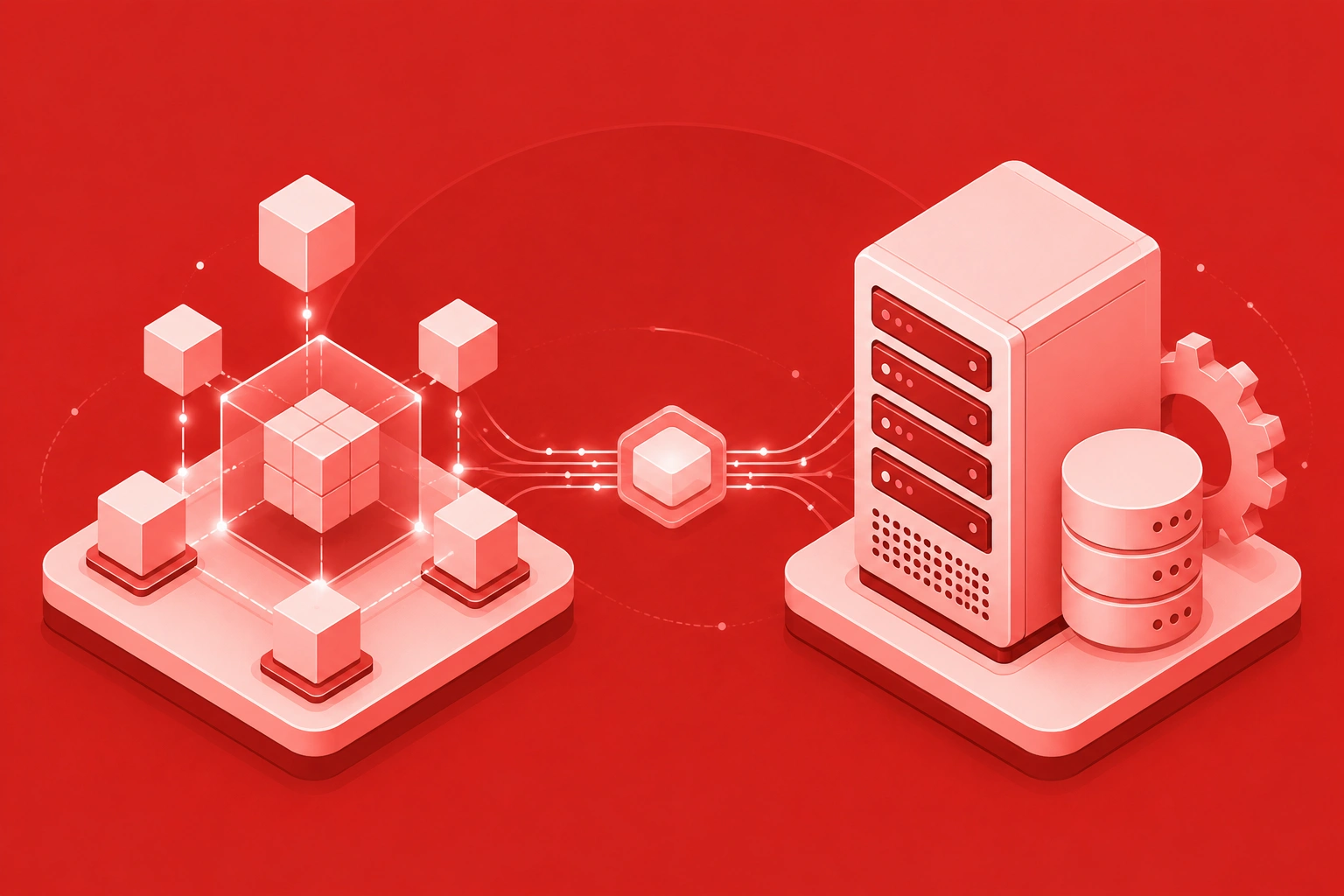
The architecture of a ZK dApp typically consists of three layers: the proof generation layer (where the prover computes a cryptographic proof off-chain), the verification contract layer (a smart contract on-chain that verifies the proof’s validity), and the application logic layer (which acts on the verified result). This structure ensures that the blockchain network only ever processes and stores proofs, never the raw sensitive data itself.
📘 Want to understand what are dApps? Read our complete guide →
For builders selecting blockchain frameworks for dApps with privacy requirements, ZK dApps offer a uniquely powerful combination: the trustlessness of blockchain verification and the confidentiality of enterprise-grade encryption. They represent the most technically rigorous approach to privacy in the Web3 ecosystem and are increasingly considered the gold standard for any application handling sensitive financial, medical, or identity-related data.
How a ZK dApp Transaction Flows
Step 01 – User Action
The user initiates a private transaction or sensitive action within the ZK dApp interface.
Step 02 – Witness Generation
The user’s client generates a “witness” — the private input data required to compute the ZK proof off-chain.
Step 03 – Proof Computation
A ZK proving circuit processes the witness and circuit constraints to output a compact cryptographic proof.
Understanding how Zero-Knowledge Proofs work requires grasping three foundational properties that every valid ZK system must satisfy. These properties have been formalized in cryptographic literature and serve as the bedrock of every ZK dApp in production today.
Completeness
If the statement is true, an honest prover can always convince an honest verifier of this fact.
Soundness
A dishonest prover cannot convince the verifier of a false statement except with negligible probability.
Zero-Knowledge
The verifier learns nothing beyond the truth of the statement itself, with no sensitive data exposed.
In practice, the ZK proof generation process involves converting a computational problem into an arithmetic circuit. This circuit defines the relationships between public inputs (things the verifier knows), private inputs (the witness), and the output (the proof). The prover evaluates this circuit using their private inputs and generates a proof that can be validated by the verifier smart contract in milliseconds.
For blockchain frameworks for dApps, the key engineering challenge is designing circuits that accurately encode the application’s logic while keeping proof generation time within user-acceptable bounds. Modern ZK proving systems have made remarkable advances in this area, enabling complex financial applications, identity systems, and gaming logic to be proven with practical efficiency.
5. Types of Zero-Knowledge Proof Used in dApps
The two dominant proof systems deployed in production Zero-Knowledge Proof (ZK) dApps today are ZK-SNARKs and ZK-STARKs. Each carries distinct architectural trade-offs that directly impact the choice of blockchain frameworks for dApps and the overall system design.
ZK-SNARKs (Succinct Non-interactive Arguments of Knowledge) produce extremely small proof sizes and enable fast on-chain verification. A SNARK proof can be as small as a few hundred bytes, making it ideal for gas-constrained environments on Ethereum. The primary limitation is the requirement for a trusted setup ceremony, which involves generating cryptographic parameters that must be disposed of properly. Protocols like Zcash and Groth16 have pioneered the use of SNARKs at production scale. For teams using Web3 frameworks to build applications with frequent user interactions, SNARKs remain the most practical choice due to their verification efficiency.
ZK-STARKs (Scalable Transparent Arguments of Knowledge) were designed to address SNARKs’ trust dependency. STARKs require no trusted setup and are post-quantum resistant, making them significantly more robust from a long-term security perspective. StarkNet and StarkEx by StarkWare are the primary production deployments of STARK technology, having processed billions in transaction volume. The trade-off is larger proof sizes, which translate to higher on-chain verification costs. For high-throughput enterprise applications in UAE or Canadian financial markets requiring maximum transparency and auditability, STARKs present a compelling architectural choice.
ZK Rollups are arguably the most immediately impactful application of ZK technology in the current Web3 ecosystem. They function as Layer 2 scaling solutions that execute transaction batches off the main chain, then submit a single compressed proof to the Layer 1 network as evidence of valid execution. The result is a dramatic compression of on-chain footprint, enabling thousands of transactions to settle with the gas cost equivalent to a single on-chain interaction.
For Zero-Knowledge Proof (ZK) dApps, rollups solve the fundamental tension between privacy, scalability, and cost. Without rollup infrastructure, ZK proof verification on Ethereum mainnet would be prohibitively expensive for end users. ZK Rollups internalize the proof generation overhead off-chain while preserving Ethereum’s security model as the settlement layer. This architecture is what makes consumer-grade ZK dApps economically viable today.
📘 Want to understand how decentralized applications work? Read our complete guide on dApp architecture →
Leading ZK rollup platforms include zkSync Era (developed by Matter Labs), StarkNet, Polygon zkEVM, and Scroll. Each has made different design choices around EVM compatibility, proof system selection, and decentralization roadmap. For enterprises in the USA and UK evaluating blockchain frameworks for dApps at scale, zkSync Era and Polygon zkEVM offer the strongest EVM compatibility, reducing migration complexity from existing Solidity-based codebases.
ZK Rollup Platform Comparison
| Platform | Proof System | EVM Compatible | Best Use Case |
|---|---|---|---|
| zkSync Era | ZK-SNARKs (PLONK) | Full | DeFi, payments, NFTs |
| StarkNet | ZK-STARKs | Partial (Cairo VM) | High-throughput gaming, DeFi |
| Polygon zkEVM | ZK-SNARKs | Full | Enterprise, cross-chain apps |
| Scroll | ZK-SNARKs (halo2) | Full | Open-source, research-grade |
7. Key Benefits of ZK dApps
The value proposition of Zero-Knowledge Proof (ZK) dApps extends far beyond simple privacy. When implemented correctly using the right tools for building dApps, ZK architecture delivers compounding advantages across security, scalability, compliance, and user experience dimensions.
Cryptographic Privacy
Sensitive data never appears on-chain. Validity is proven mathematically, eliminating any reliance on data masking or obfuscation techniques.
Scalability via Rollups
ZK Rollups batch thousands of transactions into single proofs, achieving throughput levels that rival centralized payment processors.
Regulatory Compliance
ZK proofs can confirm KYC compliance, age verification, or accreditation status without transmitting or storing personal data on-chain.
Trustless Interoperability
Cross-chain bridges using ZK proofs can verify state transitions between networks without requiring either chain to trust the other.
Reduced On-chain Cost
Proof compression reduces the on-chain data footprint, translating directly into lower gas fees and better economics for end users.
Censorship Resistance
ZK dApps inherit the censorship resistance of their underlying Layer 1 networks while adding an additional layer of data opacity.
Industry Authority Statement
Zero-Knowledge Proofs are not merely a privacy feature but an architectural paradigm. Any application handling user-sensitive data on a public blockchain that does not use ZK cryptography is operating with an inherent structural vulnerability, regardless of the quality of its smart contract logic.
The theoretical elegance of Zero-Knowledge Proof (ZK) dApps translates into concrete, high-impact applications across multiple sectors. The following use cases represent deployments either already live in production or in advanced pilot stages across major global markets.
💳 Private Payments
Private payment protocols powered by ZK dApps allow users to transact on public blockchains without exposing sender addresses, receiver addresses, or transaction amounts. Tornado Cash (prior to regulatory intervention) and Zcash’s shielded transactions were early demonstrations. More recently, zkMoney and Penumbra have introduced privacy-preserving payment rails designed to comply with AML regulations by using ZK proofs to attest to compliance without exposing the underlying transactional data. For cross-border remittance corridors between UAE and South Asian markets, this technology could dramatically reduce both cost and data exposure for millions of users.
🪪 Identity Verification Systems
ZK-based identity systems allow users to prove attributes about themselves, such as age, citizenship, professional licensing, or credit score, without transmitting the actual documents or data. Polygon ID and zkPass are leading implementations of this architecture. In the UK, where digital identity frameworks are actively being standardized by the government, ZK identity dApps offer a privacy-preserving path to compliance. Canadian financial regulators have shown particular interest in ZK identity proofs as a mechanism for satisfying KYC requirements in decentralized finance without creating centralized data repositories vulnerable to breach.
📊 Confidential DeFi Transactions
Traditional DeFi protocols on public blockchains expose all positions, trading strategies, and collateral details to the market. This creates systematic MEV (Maximal Extractable Value) exploitation, where bots front-run large trades to the detriment of regular users. ZK dApps in DeFi, such as Aztec’s private DeFi infrastructure and Penumbra’s shielded AMM, allow liquidity positions and trade intentions to remain private until settlement. For institutional investors in the USA managing large on-chain positions, this privacy layer is a prerequisite for meaningful participation in decentralized finance without telegraphing strategy to the entire market.
🗳️ Anonymous Voting Platforms
On-chain governance has long suffered from a transparency paradox: fully public votes enable vote-buying, coercion, and strategic manipulation, while opaque voting undermines verifiability. Zero-Knowledge Proof (ZK) dApps resolve this by enabling cryptographically anonymous yet publicly verifiable elections. MACI (Minimum Anti-Collusion Infrastructure) by the Ethereum Privacy and Scaling Explorations team uses ZK proofs to prevent vote-buying by making individual votes unknowable to bribe operators while maintaining a verifiable tally. This architecture is being explored by UAE government digital services programs as a model for transparent public consultations with guaranteed voter privacy.
9. Industries That Can Benefit from ZK dApps
Zero-Knowledge Proof (ZK) dApps are not domain-specific innovations. Their applicability spans virtually any sector where data sensitivity, regulatory compliance, and verifiable trust intersect. The following industries represent the highest-value deployment targets based on our agency’s client work and market analysis.
| Industry | ZK Application | Primary Market |
|---|---|---|
| Healthcare | Private patient credential verification | USA, UK |
| Financial Services | Compliant private transactions, KYC | UAE, Canada, UK |
| Government | Anonymous voting, identity services | UAE, UK |
| Supply Chain | Provenance without exposing supplier data | USA, Canada |
| Gaming / NFT | Provably fair mechanics, hidden game state | USA, UAE |
| Insurance | Claim validation without exposing records | UK, Canada |
Choosing the right network is one of the most consequential decisions in any ZK dApp project. The blockchain frameworks for dApps that teams select must align with proof system compatibility, ecosystem liquidity, tooling maturity, and the target user geography. Below we profile the leading networks actively supporting ZK technology.
Leading Networks for ZK dApp Builders
Ethereum + Layer 2s
The foundational ecosystem for ZK dApps. zkSync Era, Polygon zkEVM, Scroll, and Linea all settle proofs on Ethereum mainnet. Maximum developer tooling and DeFi liquidity.
StarkNet
StarkWare’s permissionless network using ZK-STARKs. Cairo language enables highly scalable applications with no trusted setup dependency.
Aztec Network
Purpose-built for private smart contracts using the Noir language. Ideal for confidential DeFi applications requiring full programmable privacy.
Mina Protocol
The world’s lightest blockchain, using recursive ZK proofs to maintain a constant-size chain state. Particularly effective for mobile and IoT-integrated ZK dApps.
Near Protocol / Aurora
NEAR’s sharding architecture combined with EVM-compatible Aurora offers a scalable environment for ZK dApps targeting emerging markets in Canada and Asia-Pacific.
Polygon (zkEVM)
Polygon’s zkEVM provides the broadest Ethereum bytecode compatibility among ZK rollups, making it the preferred choice for teams migrating existing Solidity dApps to ZK architecture.
ZK Framework and Network Selection Criteria
Selecting the best framework for building dApps with ZK capabilities requires systematic evaluation across three critical dimensions. This model selection criteria framework is used by our agency when scoping projects for clients in the USA, UK, UAE, and Canada.[2]
Criteria 1: Proof System Alignment
Evaluate whether the application’s throughput, cost tolerance, and trust assumptions align with SNARK or STARK characteristics. High-frequency consumer apps favor SNARKs; enterprise auditability requirements often favor STARKs.
Criteria 2: Tooling and Audit Maturity
Assess the availability of circuit-writing tools (Circom, Noir, Cairo), testing frameworks, and audit firms with relevant expertise. Unaudited ZK circuits present catastrophic risk regardless of proof system quality.
Criteria 3: Ecosystem Liquidity and Growth
ZK dApps require liquidity, user bases, and composability. Evaluate total value locked (TVL), active wallet counts, and protocol integrations before committing to a specific blockchain framework for dApps.
Despite the transformative potential of Zero-Knowledge Proof (ZK) dApps, building them presents significant technical and operational challenges that practitioners must confront directly. Our experience working across multiple ZK projects has surfaced eight consistent friction points that teams must plan for.
01
Circuit Complexity
Writing arithmetic circuits requires translating application logic into mathematical constraint systems. This is an order of magnitude more complex than standard smart contract coding and requires specialized expertise not widely available in the general Web3 developer pool.
02
Proof Generation Time
Generating ZK proofs is computationally intensive, particularly for complex circuits. Without hardware acceleration (GPU/FPGA provers), user-facing proof generation can introduce latency that degrades experience in consumer applications.
03
Immature Debugging Tooling
Debugging ZK circuits is significantly harder than debugging conventional code. Errors in constraint systems often manifest as silent failures at proof generation or verification, with minimal diagnostic feedback from current tooling.
04
Audit Scarcity
The pool of auditors with ZK circuit expertise is extremely limited globally. Firms capable of auditing Circom or Cairo circuits are scarce, creating both scheduling bottlenecks and elevated audit costs for production deployments.
05
Trusted Setup Risk (SNARKs)
SNARK-based ZK dApps require a one-time trusted setup ceremony. If the ceremony is compromised or improperly conducted, an attacker could generate fake proofs indefinitely without detection. This risk requires rigorous multi-party computation protocols.
06
Regulatory Uncertainty
Privacy-preserving blockchain applications occupy a legally ambiguous space in many jurisdictions. USA regulators, the UK FCA, and UAE authorities continue to develop frameworks for privacy-preserving protocols, creating compliance uncertainty for builders.
07
UX Complexity
Abstracting ZK proof mechanics into seamless user experiences requires significant frontend engineering effort. Users should not need to understand ZK cryptography to benefit from ZK dApps, yet many current implementations expose excessive technical complexity at the interface layer.
08
Cross-chain Proof Portability
ZK proofs generated for one network are not automatically portable to another. Building multi-chain ZK dApps requires either standardized proof formats or redundant circuit implementations, significantly increasing scope and cost for cross-chain applications.
ZK dApp Compliance and Governance Checklist
| Compliance Item | Required | Notes |
|---|---|---|
| ZK Circuit Audit | ✓ Yes | Mandatory before mainnet. Use specialist ZK auditors. |
| Trusted Setup Ceremony Record | ✓ Yes | For SNARKs: multi-party ceremony logs must be publicly verifiable. |
| AML/Sanctions Screen Compatibility | ✓ Yes | Ensure ZK proofs can attest compliance without data disclosure. |
| Verifier Contract Audit | ✓ Yes | On-chain verifier smart contract requires independent review. |
| Proof System Documentation | Recommended | Full circuit specification for regulatory inquiry responses. |
| Upgrade/Governance Mechanism | Recommended | Define process for circuit updates without compromising existing proofs. |
12. Future of Zero-Knowledge dApps in Web3
The trajectory of Zero-Knowledge Proof (ZK) dApps in Web3 points toward a future where ZK cryptography is not a specialized feature but a baseline expectation for any serious blockchain application. Several converging trends are accelerating this timeline significantly.
zkEVM technology is maturing rapidly, with multiple teams achieving full equivalence with the Ethereum Virtual Machine. This means any existing Solidity-based application can be migrated to a ZK execution environment with minimal code changes, dramatically lowering the barrier to ZK adoption. Within 24 to 36 months, it is our agency’s projection that the majority of high-value DeFi protocols will operate on ZK rollup infrastructure rather than Ethereum mainnet directly.
Recursive proof composition is another pivotal advancement. Systems like Halo2 and Nova enable proofs to verify other proofs, creating “proof trees” that allow entire blockchain states to be compressed into single verifiable artifacts. Mina Protocol’s 22KB blockchain is the most extreme implementation of this principle today, and similar techniques will increasingly be applied to application-layer ZK dApps.
Forward-Looking Perspective
The integration of ZK proofs with AI verification systems represents the next frontier. As AI-generated content proliferates, ZK proofs will be used to attest to computation provenance, model integrity, and output authenticity without revealing model weights or proprietary training data. This convergence will open entirely new categories of ZK dApps beyond current financial and identity applications.
Hardware acceleration for ZK proof generation is also accelerating. Dedicated ZK proving chips from companies like Ulvetanna and Ingonyama are reducing proof generation times by orders of magnitude. As this hardware becomes commoditized, the latency barrier that currently limits consumer-grade ZK dApps will be substantially eliminated, enabling real-time ZK applications in mobile and IoT contexts relevant to emerging markets in UAE and Canada.
For teams evaluating the best frameworks for building dApps with ZK capability today, the landscape will look substantially different in 36 months. Investing in ZK tooling expertise now positions organizations to lead rather than follow the inevitable mainstream adoption wave.
Zero-Knowledge Proof (ZK) dApps represent the most significant architectural advancement in blockchain technology since the introduction of programmable smart contracts. They resolve the fundamental tension between blockchain’s inherent transparency and the privacy requirements of real-world application deployment, enabling a new class of applications that are simultaneously trustless, verifiable, and confidential.
For organizations across the USA, UK, UAE, and Canada evaluating blockchain integration, the question is no longer whether ZK technology will become standard but how quickly their teams can build the expertise required to leverage it effectively. The tools for building dApps with ZK capabilities are maturing, the blockchain frameworks for dApps supporting ZK are proliferating, and the ecosystem liquidity required for production deployment is firmly established.
With eight years of specialized experience in this space, our agency has observed that the organizations that invest in ZK architecture during this formative period consistently achieve durable competitive advantages in their respective sectors. Privacy is not a feature that can be bolted on after the fact; it must be engineered into the application’s foundations. ZK dApps provide precisely that foundational guarantee.
The future of Web3 is private by default, verifiable by design, and built on ZK cryptographic foundations. Whether your application handles financial data, identity credentials, supply chain provenance, or governance decisions, Zero-Knowledge Proof (ZK) dApps offer the architecture to build with confidence in an increasingly privacy-conscious regulatory and user landscape.
Ready to Build a Privacy-First ZK dApp?
Partner with our ZK-specialized team to architect, audit, and launch production-grade Zero-Knowledge dApps that meet enterprise standards.
Frequently Asked Questions
Q1.What are Zero-Knowledge Proof (ZK) dApps?
Zero-Knowledge Proof (ZK) dApps are decentralized applications that use cryptographic techniques to validate transactions or data without revealing the underlying information. In a ZK dApp, one party (the prover) can convince another party (the verifier) that a statement is true without disclosing any sensitive details. This makes ZK dApps highly valuable in privacy-sensitive use cases like identity verification, confidential payments, and secure voting systems across Web3 ecosystems.
Q2.How do Zero-Knowledge Proofs work in blockchain applications?
Zero-Knowledge Proofs work by allowing a prover to generate a mathematical proof that confirms the validity of information without exposing the actual data. In blockchain applications, this means transactions can be verified on-chain while keeping user data completely private. The process involves computationally generating a proof, submitting it to a smart contract, and having the contract verify it instantly. This eliminates the need for trust between parties while maintaining full transparency of execution.
Q3.What is the difference between ZK-SNARKs and ZK-STARKs?
SNARKs (Succinct Non-interactive Arguments of Knowledge) produce small proof sizes and enable fast verification, making them efficient for blockchain use. However, they require a trusted setup ceremony, which introduces a potential security assumption. ZK-STARKs (Scalable Transparent Arguments of Knowledge) eliminate the need for this trusted setup and offer higher scalability, but generate larger proofs. Both are used in ZK dApps, and the choice depends on the specific application’s security and performance requirements.
Q4.What are ZK Rollups and why are they important for dApps?
ZK Rollups are a Layer 2 scaling solution that bundles multiple transactions off-chain and submits a single validity proof to the main blockchain. They are critically important for dApps because they dramatically reduce gas fees, increase throughput, and maintain the security guarantees of the underlying Layer 1 network. Unlike optimistic rollups, ZK Rollups do not require a challenge period, meaning finality is near-instant. Networks like Ethereum rely on ZK Rollups to handle high-volume decentralized application traffic efficiently.
Q5.Which blockchain networks best support ZK dApp building?
Several leading blockchain networks support Zero-Knowledge Proof technology for dApp builders. Ethereum remains the most prominent, with Layer 2 solutions like zkSync, StarkNet, and Polygon zkEVM built on top of it. Aztec Network focuses specifically on private smart contracts. Near Protocol and Mina Protocol also offer ZK-friendly environments. For teams in the USA, UK, UAE, and Canada looking to build privacy-focused applications, these networks offer mature tooling, active developer communities, and growing institutional adoption.
Q6.What are the main challenges in building ZK dApps?
Building ZK dApps presents several technical challenges. Writing ZK circuits requires deep mathematical knowledge, and debugging proofs is significantly harder than traditional smart contract work. Computational overhead during proof generation can be intensive, requiring specialized hardware. Developer tooling, while improving, is still maturing compared to standard Web3 frameworks. Additionally, auditing ZK circuits for vulnerabilities is a specialized field with limited experts. These factors make partnering with experienced ZK-focused agencies or using established frameworks essential for production-grade applications.
Q7.What industries benefit the most from Zero-Knowledge dApps?
Industries handling sensitive data benefit the most from Zero-Knowledge dApps. Healthcare organizations can verify patient credentials without exposing medical records. Financial institutions in regulated markets like the UK and UAE can conduct compliant transactions without revealing client information. Government agencies can enable anonymous yet verifiable voting systems. Supply chain networks can confirm product authenticity without revealing proprietary sourcing details. The gaming and NFT sectors also leverage ZK proofs to enable provably fair mechanics without exposing game logic or player strategies on-chain.
Explore Services
Related Services
Reviewed by

Aman Vaths
Founder of Nadcab Labs
Aman Vaths is the Founder & CTO of Nadcab Labs, a global digital engineering company delivering enterprise-grade solutions across AI, Web3, Blockchain, Big Data, Cloud, Cybersecurity, and Modern Application Development. With deep technical leadership and product innovation experience, Aman has positioned Nadcab Labs as one of the most advanced engineering companies driving the next era of intelligent, secure, and scalable software systems. Under his leadership, Nadcab Labs has built 2,000+ global projects across sectors including fintech, banking, healthcare, real estate, logistics, gaming, manufacturing, and next-generation DePIN networks. Aman’s strength lies in architecting high-performance systems, end-to-end platform engineering, and designing enterprise solutions that operate at global scale.