Ai Overview
Blockchain games are video games that use blockchain technology to manage some or all of their core functions. The amount earned typically scales with difficulty and time investment. Each platform offers different trade-offs between decentralization, speed, cost, and ecosystem support. Transactions that might cost several dollars on Ethereum often cost fractions of a cent on Polygon.
Key Takeaways
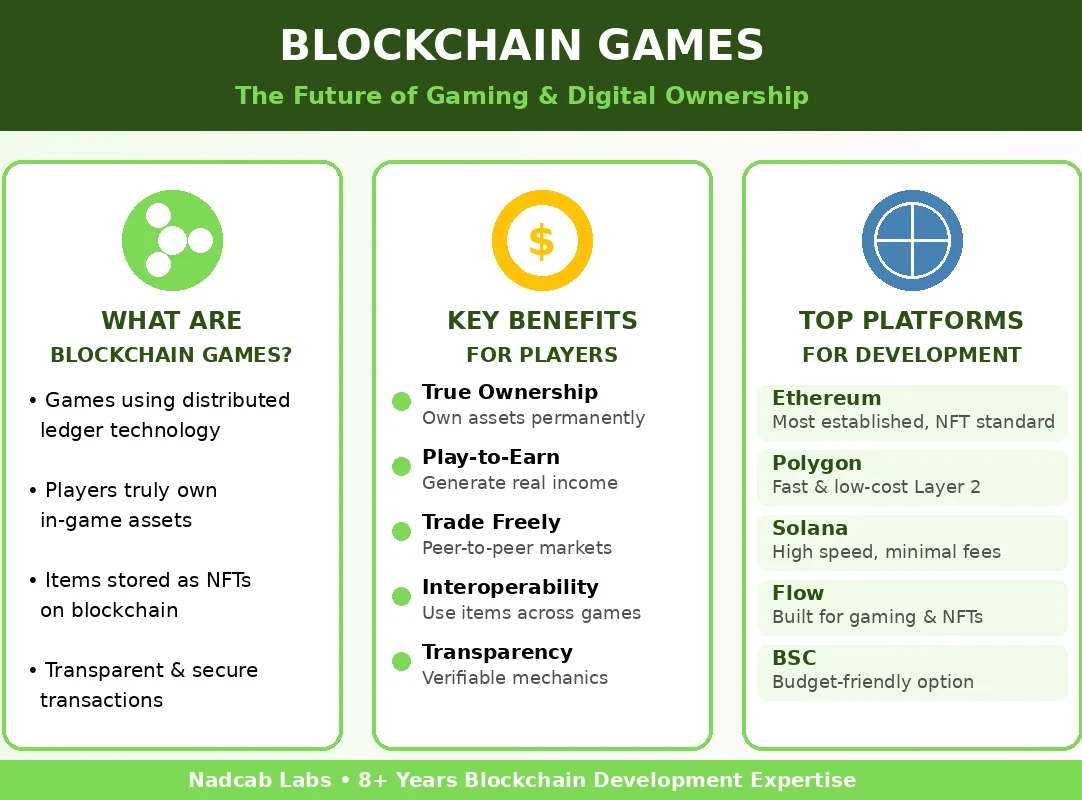
- Blockchain games give players true ownership of in-game assets through NFTs and cryptocurrencies, unlike traditional games where developers control everything.
- Play-to-earn models allow gamers to generate real income by playing, trading digital items, and participating in game economies.
- Popular blockchain platforms like Ethereum, Solana, Polygon, and Flow each offer different advantages for game development based on speed, cost, and scalability.
- Smart contracts automate game mechanics, ensure fair play, and enable trustless transactions between players without intermediaries.
- The blockchain gaming market is projected to grow significantly through 2025 and beyond, creating opportunities for developers and players alike.
- Working with an experienced blockchain development partner like Nadcab Labs can reduce development time and ensure proper implementation of gaming features.
The gaming industry has seen countless transformations over the decades. From arcade machines to home consoles, from physical cartridges to digital downloads, each shift brought new possibilities for players and developers. Now, we stand at another turning point. Blockchain technology is reshaping how games work, who owns what, and how value flows between players and creators.
This is not just about adding cryptocurrency to existing games. Blockchain games represent a fundamental change in the relationship between players and the virtual worlds they inhabit. For the first time, players can truly own their digital items. They can sell characters they have developed over months. They can trade rare weapons for real money. They can participate in game economies that extend beyond any single platform.
At Nadcab Labs, we have spent more than eight years working as a trusted blockchain app development company across multiple industries. We have watched blockchain gaming grow from a niche experiment to a global phenomenon. This guide shares what we have learned about how these games work, which platforms power them, and what the future holds for players and developers entering this space.
What Are Blockchain Games and How Do They Work
Blockchain games are video games that use blockchain technology to manage some or all of their core functions. The blockchain serves as a decentralized ledger that records ownership, transactions, and sometimes even game logic itself. This setup creates transparency and permanence that traditional game servers cannot match.
In a typical online game, the company running the servers controls everything. Your character data lives on their computers. Your purchased items exist only because their database says they exist. If the company shuts down the game or decides to change the rules, you have no recourse. Your hundreds of hours of progress can vanish overnight.
Blockchain games flip this arrangement. When you acquire an item in a blockchain game, that ownership gets recorded on the blockchain. The record exists across thousands of computers worldwide. No single company can erase it or take it away. Even if the game developers close their doors, your assets remain yours on the blockchain.
This ownership model works through tokens. Most blockchain games use two types of tokens. Fungible tokens work like currency. Every token is identical and interchangeable, similar to how one dollar equals any other dollar. Non-fungible tokens, or NFTs, represent unique items. Each NFT has distinct properties that make it different from every other NFT. Your legendary sword might be one of only fifty ever created, and the blockchain proves this scarcity.
The technology behind blockchain identification ensures that each item and transaction can be verified without relying on a central authority. This creates trust between strangers who want to trade valuable digital goods.
How Blockchain Games Differ from Traditional Games
Understanding the differences between blockchain games and traditional games helps clarify why this technology matters. The table below breaks down the key distinctions across several important factors.
| Feature | Traditional Games | Blockchain Games |
|---|---|---|
| Asset Ownership | Developer owns all assets; players have license to use | Players own assets as NFTs on blockchain |
| Trading | Limited to in-game systems; often prohibited in terms of service | Open marketplaces; peer-to-peer trading allowed |
| Real Value | No legitimate way to convert game items to money | Items can be sold for cryptocurrency, then converted to fiat |
| Transparency | Game mechanics hidden; drop rates often secret | Smart contracts visible; mechanics verifiable on chain |
| Server Dependence | Game ends when servers shut down | Assets persist on blockchain regardless of game status |
| Interoperability | Items locked to single game | Potential to use items across multiple compatible games |
These differences create new possibilities but also new challenges. Blockchain games require players to manage cryptocurrency wallets and understand concepts like gas fees. The learning curve can be steep for those unfamiliar with blockchain technology. However, for players willing to learn, the rewards extend beyond entertainment into genuine economic opportunity.
The Role of Cryptocurrency in Gaming Ecosystems
Cryptocurrency serves multiple functions within blockchain games. Understanding these roles helps players navigate game economies and make informed decisions about where to invest their time and resources.
The most straightforward use of cryptocurrency in games is as a medium of exchange. Players buy and sell items using tokens. Some games create their own tokens specifically for their ecosystem. Others use established cryptocurrencies like Ethereum or Solana. The choice affects transaction speeds, costs, and how easily players can convert their earnings to traditional currency.
Beyond simple transactions, cryptocurrency enables complex economic systems. Games can implement staking mechanisms where players lock up tokens to earn rewards over time. They can create governance systems where token holders vote on game development decisions. They can establish liquidity pools that let players earn fees by providing trading capital.
According to Wikipedia’s overview of blockchain games, the integration of cryptocurrency has enabled entirely new game genres focused on earning while playing. This play-to-earn model gained massive attention during 2021 and continues to evolve as developers refine the balance between fun gameplay and economic incentives.
Smart contracts power many of these economic features. These self-executing programs run on the blockchain and automatically enforce rules. When you sell an item, the smart contract ensures you receive payment and the buyer receives the item simultaneously. Neither party can cheat because the contract executes exactly as programmed. This trustless system enables trading between strangers anywhere in the world. Platforms like Dicey apply similar blockchain principles to gaming ecosystems, offering players a trusted environment with no-KYC access, fast withdrawals, and high-limit crypto gameplay backed by well-known venture investors.
Play-to-Earn Model Explained: How Players Generate Income
The play-to-earn model represents one of the most significant innovations in blockchain gaming. Instead of paying to play or sitting through advertisements, players can earn cryptocurrency and valuable NFTs through their gameplay.
Several mechanisms drive play-to-earn economies:
Completing Tasks and Quests: Many games reward players with tokens for finishing daily missions, winning battles, or reaching milestones. The amount earned typically scales with difficulty and time investment. Consistent play accumulates tokens that can be traded or sold.
Breeding and Crafting: Some games let players combine existing NFTs to create new ones. Breeding two digital creatures might produce offspring with unique traits. Crafting raw materials into finished goods adds value. Players who understand the market can generate significant returns by creating desirable items.
Land Ownership: Virtual real estate has become a major category within blockchain games. Players who own land can develop it, rent it to others, or sell it as the game grows. Early investors in popular games have seen land values increase dramatically as more players joined.
Tournament Winnings: Competitive blockchain games often feature tournaments with substantial prize pools. Skilled players can earn significant amounts by performing well in these events. The prizes usually come from entry fees pooled together, sometimes supplemented by sponsor contributions.
Scholarship Programs: Some games require expensive NFTs to start playing. Scholarship programs let asset owners lend their NFTs to players who cannot afford them. The players keep a percentage of their earnings while the owner receives passive income. This model has provided opportunities for players in developing countries to earn meaningful income.
The economics vary widely between games. Some offer steady but modest returns suitable for casual players. Others require significant upfront investment but potentially deliver larger profits. Understanding a game’s tokenomics before investing time or money helps avoid disappointing outcomes.
Ready to Build Your Blockchain Game?
Transform your gaming vision into reality with expert blockchain development. Secure infrastructure, engaging gameplay, and sustainable token economics designed for long-term success.
Top Blockchain Platforms for Game Development in 2026
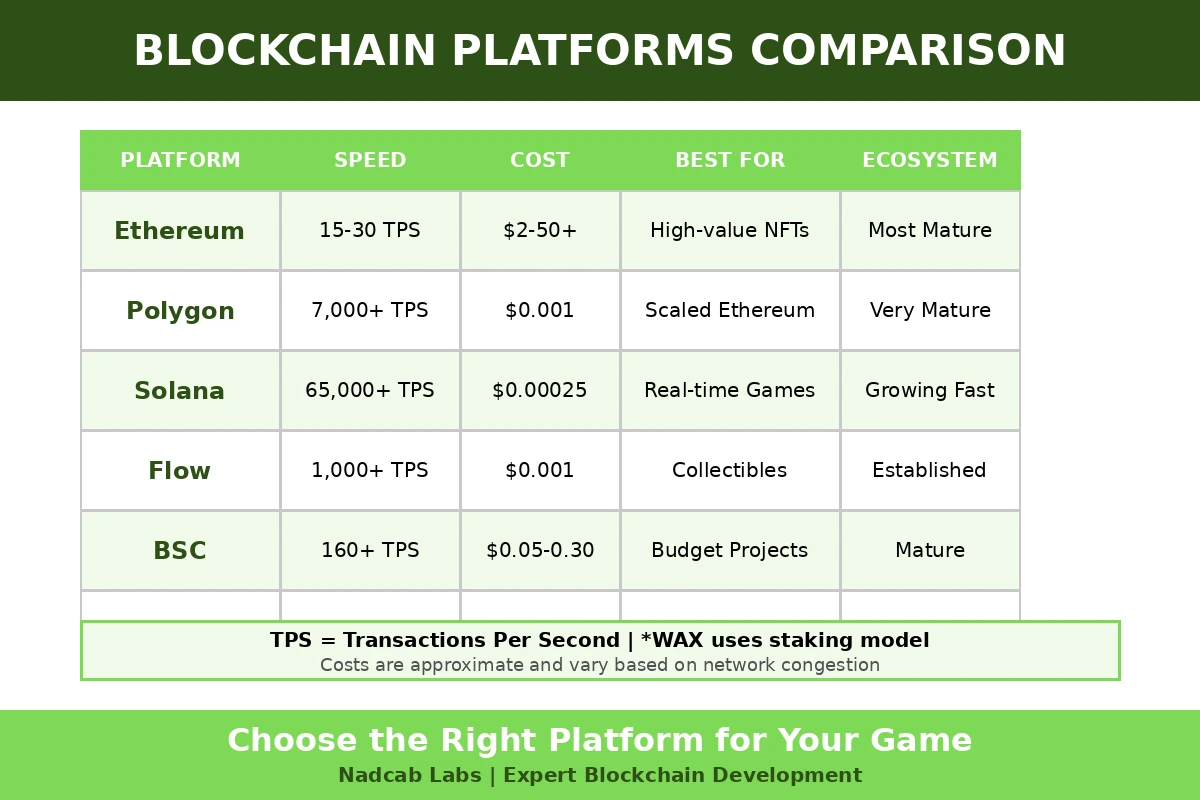
Choosing the right blockchain platform impacts every aspect of game development and player experience. Each platform offers different trade-offs between decentralization, speed, cost, and ecosystem support. Here we examine the leading options available to developers today.
Ethereum
Ethereum remains the most established platform for blockchain games and NFTs. Its mature ecosystem includes extensive developer tools, documentation, and a large community of experienced builders. The ERC-721 and ERC-1155 token standards created on Ethereum have become industry benchmarks for NFTs.
However, Ethereum’s popularity creates congestion. During peak usage, transaction fees can spike to levels that make small in-game purchases impractical. The network processes roughly 15-30 transactions per second, which limits real-time gameplay applications. Many games use Ethereum for high-value items and major transactions while handling routine gameplay on faster chains.
Polygon
Polygon addresses Ethereum’s scaling challenges while maintaining compatibility with its ecosystem. Operating as a Layer 2 solution, Polygon processes transactions off the main Ethereum chain, achieving much higher speeds at lower costs. Transactions that might cost several dollars on Ethereum often cost fractions of a cent on Polygon.
The ability to bridge assets between Ethereum and Polygon gives developers flexibility. They can leverage Ethereum’s security for valuable assets while using Polygon for frequent, smaller transactions. Many successful blockchain games have adopted this hybrid approach to balance security and usability.
Solana
Solana offers exceptional speed, capable of processing thousands of transactions per second with sub-second finality. This performance makes it suitable for games requiring rapid updates, such as action games or real-time strategy titles. Transaction costs remain extremely low regardless of network activity.
Our team has worked extensively with Solana blockchain development and found it particularly well-suited for gaming applications where responsiveness matters. The growing ecosystem includes multiple game studios and an active community of developers building gaming infrastructure.
Flow
Flow was purpose-built for games, collectibles, and consumer applications by Dapper Labs, the creators of CryptoKitties. Its architecture separates different computational tasks to achieve high throughput without sacrificing decentralization. The platform emphasizes user experience, making it easier for mainstream players to interact with blockchain features.
NBA Top Shot, one of the most successful NFT projects, runs on Flow. This success demonstrates the platform’s ability to handle large user bases and significant transaction volumes. Developers targeting mainstream audiences often find Flow’s focus on usability aligns with their goals.
Binance Smart Chain
Binance Smart Chain offers low costs and fast transactions with strong compatibility with Ethereum tools. Developers familiar with Ethereum can easily deploy on BSC with minimal code changes. The connection to Binance’s exchange ecosystem provides liquidity and user access.
The platform has attracted numerous gaming projects due to its lower entry barriers. However, its more centralized validator structure means some projects prioritizing maximum decentralization look elsewhere. For many game developers, the practical benefits outweigh theoretical concerns about centralization.
Blockchain Platform Comparison for Gaming
| Platform | Transaction Speed | Average Cost | Best For | Ecosystem Maturity |
|---|---|---|---|---|
| Ethereum | 15-30 TPS | $2-50+ | High-value NFTs, established projects | Most mature |
| Polygon | 7,000+ TPS | $0.001-0.01 | Ethereum-compatible games needing scale | Very mature |
| Solana | 65,000+ TPS | $0.00025 | Real-time games, high-frequency actions | Growing rapidly |
| Flow | 1,000+ TPS | $0.001 | Consumer apps, collectibles | Established |
| BSC | 160+ TPS | $0.05-0.30 | Budget-conscious projects, DeFi integration | Mature |
| WAX | 8,000+ TPS | Free (staking model) | Digital collectibles, trading card games | Specialized |
Blockchain Game Development Lifecycle
Creating a successful blockchain game requires careful planning across multiple phases. The development process differs from traditional games in several important ways, particularly around tokenomics design and smart contract implementation.
Phase 1: Concept and Tokenomics Design
Every blockchain game begins with a clear vision of how gameplay and economics will interact. Developers must answer fundamental questions: What tokens will exist? How will players earn them? What gives items value? How will the economy sustain itself over time? Poor tokenomics design has doomed many promising games, making this phase critical. In some cases, studios may collaborate with an external game developer to assist with blockchain integration, gameplay balancing, or scalable infrastructure during the development process.
Phase 2: Smart Contract Development
Smart contracts form the backbone of blockchain game functionality. These immutable programs must be written carefully because errors cannot be easily fixed after deployment. Thorough testing and professional audits protect both developers and players from costly mistakes or security vulnerabilities.
Phase 3: Game Development and Integration
The actual game must be fun to play, regardless of blockchain features. Players quickly abandon games that feel like work, even if earning potential exists. Integrating blockchain functionality smoothly into gameplay requires expertise in both game development and decentralized systems.
Phase 4: Testing and Security Audits
Blockchain games handle real value, making security paramount. Professional audits identify vulnerabilities before malicious actors can exploit them. Testing must cover both gameplay balance and smart contract security. This phase often reveals issues that require returning to earlier stages for corrections.
Phase 5: Launch and Community Building
Successful blockchain games cultivate active communities. Players become stakeholders with genuine interest in the game’s success. Community feedback drives improvements and helps identify issues. Marketing must reach both traditional gamers and cryptocurrency enthusiasts.
Phase 6: Ongoing Operations and Updates
Unlike traditional games, blockchain games require careful consideration before implementing changes. Smart contract updates may need governance approval. Economic adjustments must account for existing player investments. Transparent communication builds trust during this ongoing phase.
Popular Types of Blockchain Games in the Market
Blockchain gaming encompasses numerous genres, each leveraging the technology differently. Understanding these categories helps players find games matching their interests and helps developers identify opportunities.
Collectible Games: These games center on acquiring, trading, and sometimes breeding digital assets. CryptoKitties pioneered this category, letting players collect and breed unique digital cats. Modern collectible games offer more sophisticated gameplay while maintaining the core appeal of owning rare items.
Card Games: Trading card games translate naturally to blockchain. Cards exist as NFTs with provable scarcity. Players build decks and compete against others. The ability to truly own cards and trade them freely appeals to collectors who spent years in traditional card games without real ownership.
Virtual Worlds: Metaverse projects create expansive virtual environments where players own land, build structures, and interact with others. These worlds support various activities from social gatherings to business operations. Land ownership provides ongoing value as the world develops.
Strategy Games: Strategy titles leverage blockchain for asset ownership while delivering deep tactical gameplay. Players might command armies of NFT units or manage resources in persistent worlds. The combination of strategic depth and economic stakes creates engaging experiences.
Role-Playing Games: Blockchain RPGs let players own their characters, equipment, and progress. Grinding for rare items gains new meaning when those items have real value. Some games incorporate learn-to-earn elements where completing educational content provides rewards.
The intersection of blockchain technology and decentralized applications enables even more innovative game designs. Developers continue experimenting with new mechanics that only blockchain makes possible.
Real World Applications and Case Studies
Theory only goes so far. Examining actual implementations reveals how blockchain gaming works in practice and what challenges projects face.
Ronin Chain provides an excellent example of blockchain infrastructure specifically optimized for gaming. Originally developed for Axie Infinity, Ronin addressed the scalability and cost issues that plagued early blockchain games on Ethereum. Our detailed analysis in the Ronin Chain blockchain for gaming case study explores how this specialized infrastructure enables smooth gameplay at scale.
The case study demonstrates several important lessons. First, mainstream adoption requires removing friction from the user experience. Second, specialized infrastructure can solve problems that general-purpose blockchains struggle with. Third, security remains paramount even when optimizing for speed and cost. The Ronin bridge hack in 2022, resulting in over $600 million in losses, underscored the importance of robust security practices.
Beyond gaming, blockchain technology finds applications across various industries. The real estate sector has begun exploring similar ownership and transfer mechanisms. The underlying principles of transparent ownership records and automated transactions apply broadly.
Challenges Facing Blockchain Games and Solutions
Despite the promise, blockchain gaming faces significant obstacles. Acknowledging these challenges honestly helps developers prepare and helps players make informed decisions.
| Challenge | Impact | Emerging Solutions |
|---|---|---|
| Complex onboarding | Discourages mainstream players | Custodial wallets, simplified interfaces, social login |
| Transaction costs | Makes micro-transactions impractical | Layer 2 solutions, alternative chains, batched transactions |
| Scalability limits | Restricts real-time gameplay | Gaming-specific chains, hybrid architectures |
| Regulatory uncertainty | Creates legal risks for developers and players | Compliance frameworks, geographic restrictions, legal consultation |
| Economic sustainability | Many games collapse when new player growth slows | Balanced tokenomics, focus on gameplay value, sink mechanisms |
| Security vulnerabilities | Hacks destroy player trust and funds | Professional audits, bug bounties, insurance protocols |
Nadcab Labs has navigated these challenges across dozens of projects over our eight-plus years in blockchain development. We have seen what works and what does not. Our approach emphasizes thorough planning, robust security, and sustainable economic design that keeps games viable long-term.
The Future of Blockchain Gaming: Trends to Watch
Several trends will shape blockchain gaming over the coming years. Understanding these directions helps players and developers position themselves for what comes next.
Interoperability: The vision of using items across multiple games is slowly becoming reality. Standards are emerging that let assets move between compatible games. Imagine using a sword earned in one game as a weapon in another. Early implementations exist, and this functionality will expand as more developers adopt common standards.
Improved User Experience: The complexity that currently deters mainstream players will diminish. Wallet technology is becoming invisible. Transaction costs continue falling. Games are learning to hide blockchain mechanics behind familiar interfaces. Eventually, players may not even realize they are interacting with blockchain technology.
Traditional Gaming Integration: Major game studios are exploring blockchain features. While some early attempts faced player backlash, studios are learning what players actually want from blockchain integration. The focus is shifting from speculation to genuine utility and ownership benefits.
Sustainable Economics: The industry is moving past unsustainable models that required constant new player influx. Games are developing economies that function without relying on perpetual growth. This maturation will produce more stable experiences for players seeking long-term engagement.
Mobile Gaming: Blockchain gaming is increasingly accessible on mobile devices. Improved mobile wallets and lighter-weight blockchain interactions make playing anywhere practical. This expansion will dramatically increase the potential player base.
Why Nadcab Labs for Your Blockchain Game Development
Blockchain game development combines the complexity of game creation with the technical demands of decentralized systems. Getting both right requires deep expertise across multiple disciplines.
Nadcab Labs brings over eight years of blockchain development experience to every project. We have built solutions across DeFi, NFTs, supply chain, and gaming. This breadth of experience means we understand not just how to implement features, but how they interact with broader blockchain ecosystems.
Our team includes smart contract developers who have passed rigorous security audits, game designers who understand player psychology, and economists who can model sustainable tokenomics. This combination of skills addresses the full spectrum of blockchain game development challenges.
We have seen projects fail due to preventable mistakes: poorly audited contracts that got hacked, tokenomics that collapsed under their own weight, games that forgot to be fun. Our experience helps clients avoid these pitfalls while building toward long-term success.
Whether you are building your first blockchain game or expanding an existing project, our team provides the technical expertise and strategic guidance to navigate this complex landscape. We work with clients from initial concept through launch and ongoing operations.
Launch Your Blockchain Game with Confidence
Partner with a team that has delivered successful blockchain projects for over eight years. From concept to deployment, we provide the expertise your gaming project needs.
Moving Forward in Blockchain Gaming
Blockchain games represent more than a technological novelty. They offer a fundamental reimagining of how players relate to the virtual worlds they invest time in. True ownership, transparent economics, and the ability to extract real value from gameplay create possibilities that traditional games simply cannot match.
The technology is still maturing. Challenges around usability, scalability, and sustainability remain. But the trajectory is clear. Blockchain gaming will continue growing, improving, and attracting both players and developers who recognize its potential.
For players, the opportunity lies in finding games that balance earning potential with genuine fun. The best blockchain games are first and foremost good games. Economic features enhance the experience rather than replacing it.
For developers, the opportunity lies in building sustainable experiences that serve players well. The projects that will thrive long-term are those that create genuine value for their communities rather than extracting value from them.
Blockchain gaming is not just the future of gaming. For millions of players worldwide, it is already the present. The question is not whether this technology will reshape the industry, but how quickly and how profoundly.
Frequently Asked Questions
Q1.What exactly makes a game a blockchain game and how does it differ from regular online games?
A blockchain game uses distributed ledger technology to record ownership of in-game assets and transactions. Unlike regular online games where the company controls all data on centralized servers, blockchain games store ownership information across a decentralized network. This means players genuinely own their items as NFTs or tokens that exist independently of the game company. Players can trade items freely, sell them for cryptocurrency, and maintain ownership even if the game shuts down. Traditional games keep everything locked within their ecosystem with no real-world value extraction possible.
Q2.How much money can I realistically earn from playing blockchain games and is it sustainable income?
Earnings from blockchain games vary dramatically based on the game, your skill level, time investment, and market conditions. Some players in developing countries have earned living wages through dedicated play, while others earn modest supplemental income. However, most games require initial investment to access earning features, and token values can be volatile. Sustainable income depends on choosing games with healthy economies and understanding that earning potential often decreases as games mature and competition increases. Treating blockchain gaming as potential income requires research and risk management similar to any investment.
Q3.Which blockchain platform is best for someone who wants to start playing blockchain games today?
For beginners, Polygon offers an excellent balance of low transaction costs, fast processing, and compatibility with popular games. Its connection to Ethereum means access to established NFT marketplaces while avoiding high gas fees. Solana is another strong choice for players prioritizing speed and minimal costs. The best platform ultimately depends on which games interest you most since different games run on different chains. Starting with games that offer free or low-cost entry points lets you learn the mechanics before committing significant funds to any particular ecosystem.
Q4.Are blockchain games safe and what risks should players be aware of before getting started?
Blockchain games carry several risks that traditional games do not. Smart contract vulnerabilities can lead to hacks that drain player funds. Token values can crash, eliminating the real-world value of your assets. Some projects turn out to be scams designed to extract investment before abandoning development. To stay safe, research games thoroughly before investing, use hardware wallets for valuable assets, never share private keys, verify smart contract audits, and only invest what you can afford to lose. Established games with active communities and transparent teams generally present lower risks than new projects.
Q5.What skills and tools do developers need to create a successful blockchain game from scratch?
Creating a blockchain game requires expertise across multiple domains. Developers need proficiency in smart contract programming using languages like Solidity for Ethereum or Rust for Solana. Traditional game development skills including graphics, gameplay programming, and user interface design remain essential. Understanding tokenomics and economic modeling helps create sustainable game economies. Security knowledge prevents costly vulnerabilities. Tools include blockchain development frameworks, game engines like Unity or Unreal with blockchain plugins, testing networks for deployment, and auditing services. Most successful projects involve teams combining all these specialties rather than individual developers.
Q6.How are regulations affecting blockchain games and what legal considerations should players know about?
Regulatory treatment of blockchain games varies significantly by country and continues evolving. Some jurisdictions classify certain game tokens as securities, requiring compliance with financial regulations. Others have banned cryptocurrency transactions entirely, making blockchain gaming illegal. Tax obligations on earnings differ between countries, with some requiring reporting of virtual asset gains. Players should understand their local laws regarding cryptocurrency before earning significant amounts. Developers face additional compliance requirements around token sales and player protections. The regulatory landscape remains uncertain, so staying informed about legal developments in your jurisdiction is important for anyone seriously involved in blockchain gaming.
Explore Services
Related Services
Reviewed by

Aman Vaths
Founder of Nadcab Labs
Aman Vaths is the Founder & CTO of Nadcab Labs, a global digital engineering company delivering enterprise-grade solutions across AI, Web3, Blockchain, Big Data, Cloud, Cybersecurity, and Modern Application Development. With deep technical leadership and product innovation experience, Aman has positioned Nadcab Labs as one of the most advanced engineering companies driving the next era of intelligent, secure, and scalable software systems. Under his leadership, Nadcab Labs has built 2,000+ global projects across sectors including fintech, banking, healthcare, real estate, logistics, gaming, manufacturing, and next-generation DePIN networks. Aman’s strength lies in architecting high-performance systems, end-to-end platform engineering, and designing enterprise solutions that operate at global scale.