Ai Overview
Blockchain technology is considered one of the most secure technologies today because of its key features. Public blockchains like Bitcoin and Ethereum operate across 10,000+ nodes worldwide, making it effectively impossible for attackers to take down the network or manipulate transaction records. Traditional international payments involve multiple intermediaries (correspondent banks, clearinghouses, regulators) that charge fees at each step, creating a fee chain that can consume 5-15% of transaction value.
Key Takeaways
- Immutability ensures that once data is recorded on the blockchain, it cannot be altered, deleted, or tampered with, creating a permanent and trustworthy ledger.
- Decentralization removes single points of failure and control, distributing network authority across thousands of nodes that collectively maintain the system.
- Enhanced cryptographic security uses mathematical algorithms to protect data, making blockchain resistant to hacking, fraud, and unauthorized access.
- Distributed ledgers enable all network participants to maintain identical copies of transactions, eliminating the need for centralized intermediaries.
- Consensus mechanisms allow thousands of independent nodes to agree on transaction validity without requiring a central authority or trusted third party.
- Smart contracts automate agreement execution, eliminating manual processes and enabling complex transactions to execute transparently and autonomously.
- Transparency combined with privacy enables selective data visibility where authorized parties can verify information without exposing sensitive details.
- Scalability improvements and interoperability features enable blockchains to support high transaction volumes and interact with other blockchain networks seamlessly.
Blockchain technology has evolved from cryptocurrency infrastructure into a transformative enterprise solution deployed across financial institutions, supply chains, healthcare systems, and government agencies. However, many professionals misunderstand blockchain’s true value by focusing exclusively on cryptocurrency applications. The revolutionary potential emerges from the fundamental features and characteristics that distinguish blockchain from traditional databases and centralized systems. Understanding these core features enables organizations to evaluate whether blockchain solves their specific business challenges or whether alternative technologies would prove more efficient.
Recent studies highlight blockchain’s rapid global adoption, with over 283 million users worldwide and wallet ownership growing by 700% since 2016. Beyond usage growth, research also shows strong enterprise value, as organizations implementing blockchain in financial audits reported a 55% fraud detection rate compared to 24% in non-blockchain firms, alongside transparency improvements rising from 20% in 2020 to 60% in 2024, demonstrating blockchain’s increasing role in strengthening security, transparency, and operational reliability. The blockchain market report indicates that the industry is expanding at an estimated CAGR of 44.98%, with the global market size expected to reach approximately $42.37 billion by 2026.
This comprehensive guide explores blockchain’s defining features in depth, examining how each characteristic creates value for enterprises and explaining the technical mechanisms enabling these revolutionary capabilities. Whether evaluating blockchain adoption for your organization, developing blockchain solutions professionally, or seeking to understand how distributed ledger technology transforms industries, this guide provides the detailed knowledge required to comprehend blockchain’s architectural advantages and implementation considerations.
Features of Blockchain Technology
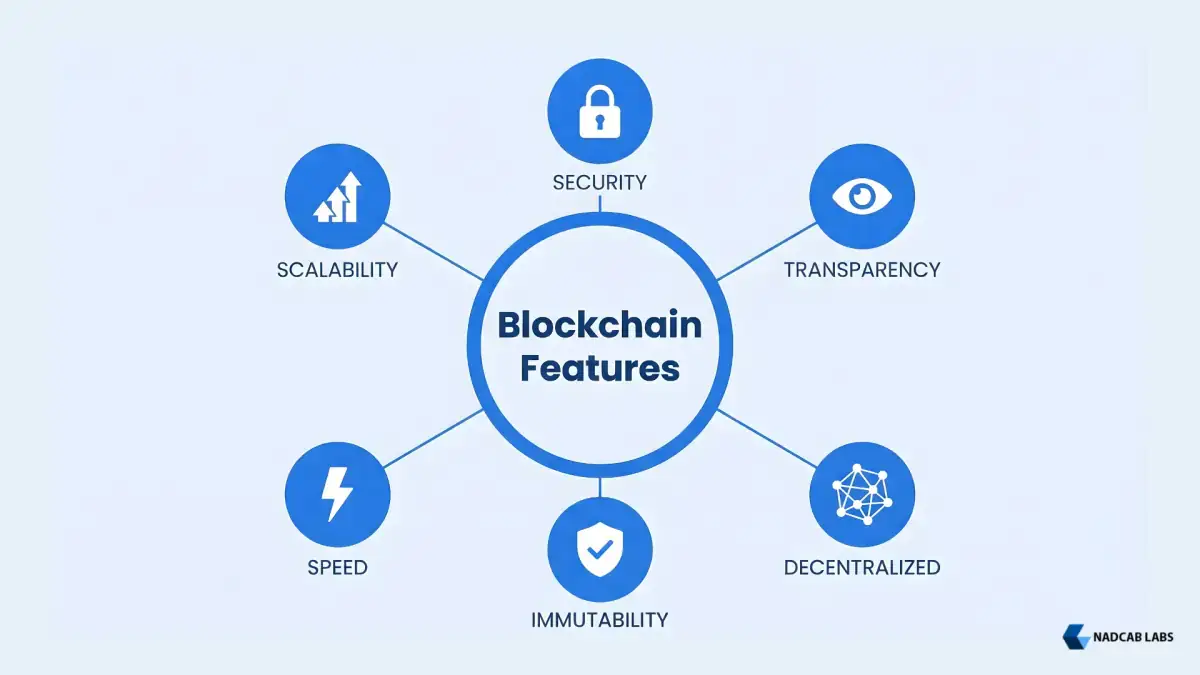
Blockchain technology is considered one of the most secure technologies today because of its key features. After adopting blockchain, the following characteristics make it secure, scalable, and reliable:
- Immutability
- Decentralization
- Cryptographic Security
- Distributed Ledgers
- Consensus Mechanisms
- Transparency
- Smart Contracts
- Cost Efficiency and Transaction Speed
- Interoperability
- Supporting Enterprise Transaction Volumes
- Autonomy and Programmability
Let us understand these features carefully to see their importance in blockchain technology.
Read Also
What is Blockchain and How Does It Work in Real-World Applications?→
Blockchain Use Cases: 17 Applications, Examples & Real Companies?→
1. Immutability: The Foundation of Blockchain Trust
Immutability represents blockchain’s most fundamental and powerful feature. Once a transaction is recorded and added to the blockchain ledger, it becomes virtually impossible to alter, delete, or modify. This characteristic emerges from how blockchain architecture chains cryptographic hashes sequentially. Each block contains a unique hash identifier derived from its transaction data plus the hash of the previous block, creating an unbreakable chain linking every transaction to its predecessors.
The immutability mechanism functions through cryptographic hashing, where any attempt to modify historical transaction data would change that block’s hash value. Since subsequent blocks contain references to the previous block’s hash, modifying any historical transaction would break the cryptographic chain, alerting all network participants to the tampering attempt. To successfully alter a historical transaction, a malicious actor would need to recompute the hash for every subsequent block faster than the legitimate network adds new transactions, a computationally infeasible task on established networks.
This immutability creates unprecedented trust in transaction records. Financial institutions use blockchain immutability to prevent transaction reversal fraud. Supply chain companies leverage it to create tamper-proof product provenance records. Healthcare organizations use immutable records to ensure medical data integrity. Government agencies implement it for permanent public records that cannot be corrupted by officials or bad actors. The immutability feature eliminates the need for expensive auditing processes since transaction history cannot be altered retroactively.
2. Decentralization: Removing Single Points of Failure
Decentralization fundamentally restructures how networks operate by distributing control and data across thousands of independent nodes rather than concentrating authority in centralized institutions. Unlike traditional systems where a single company or government agency controls infrastructure, blockchain networks enable any participant to operate a node, validate transactions, and maintain network records independently.
This distributed architecture creates massive resilience advantages. Public blockchains like Bitcoin and Ethereum operate across 10,000+ nodes worldwide, making it effectively impossible for attackers to take down the network or manipulate transaction records. If attackers compromise one node or one data center, thousands of other nodes continue operating normally. This contrasts sharply with traditional systems, where attacking a few critical servers can compromise entire networks.
Decentralization also eliminates gatekeepers and intermediaries. In traditional banking, a few large institutions control payment systems and charge substantial fees for intermediation. Decentralized blockchain networks enable peer-to-peer transactions without intermediaries, reducing friction, lowering costs, and enabling financial inclusion for populations excluded from traditional banking infrastructure.
3. Enhanced Cryptographic Security
Blockchain implements sophisticated cryptographic security mechanisms that protect data from unauthorized access, tampering, and fraud. Every piece of information on the blockchain is encrypted using mathematical algorithms that transform readable data into an encrypted form that only authorized parties with proper cryptographic keys can decrypt.
The security architecture relies on hash functions that convert input data of any size into fixed-length encrypted values. These hash functions are cryptographically secure – meaning even tiny changes to input data produce completely different hashes, enabling instant detection of tampering. Additionally, blockchain uses public-key cryptography where each participant maintains a public key (shareable address) and private key (secret access credential). Transactions signed with private keys create digital signatures proving authenticity without revealing private keys.
This multi-layered security makes blockchain far more resistant to hacking than traditional databases. While theoretical attack vectors exist (like 51% attacks), achieving them requires more computational power than hackers typically command, making attacks economically irrational for established networks.
4. Distributed Ledgers: Shared, Identical Records
A distributed ledger is a database replicated and maintained across multiple computers simultaneously, with every node holding identical copies of all transactions. This contrasts with traditional systems where a single centralized database holds the authoritative record, creating vulnerability if that database is compromised.
When a transaction occurs on a distributed blockchain ledger, every node receives notification and validates the transaction independently using the same rules. Once sufficient nodes confirm validity, the transaction is recorded on all ledgers simultaneously. This means millions of people maintain identical records – if one person’s record is corrupted, thousands of other copies remain unaffected. In consortium blockchains where multiple organizations operate the network, each organization maintains identical ledger copies, enabling transparency while preventing any single organization from manipulating records.
This distributed nature eliminates the need for centralized institutions to maintain authoritative records. In supply chains, this enables transparency where all parties (manufacturers, distributors, retailers, customers) can verify product information. In finance, this enables settlement between parties without requiring clearinghouses to maintain the official transaction record.
5. Consensus Mechanisms: Enabling Agreement Without Central Authority
Consensus mechanisms enable thousands of independent, mutually distrustful nodes to agree on transaction validity and ordering without requiring a central authority to decide. This represents one of blockchain’s most revolutionary features – solving the Byzantine Generals Problem, which mathematicians thought unsolvable for decades.
Different blockchain implementations employ different consensus mechanisms, each with distinct tradeoffs. Proof of Work requires miners to solve computationally difficult mathematical puzzles, with puzzle-solving difficulty adjusted so new blocks are created at consistent time intervals. This approach provides exceptional security but consumes substantial energy. Proof of Stake requires validators to stake cryptocurrency as collateral, with economic incentives ensuring honest behavior – validators who validate fraudulent transactions lose their stakes. Other mechanisms, including Delegated Proof of Stake, Byzantine Fault Tolerance, and Proof of Authority, provide different security and efficiency characteristics.
The consensus mechanism creates economic incentives for network security. In Proof of Work, miners earn rewards for validating blocks, creating financial motivation to acquire and operate mining equipment. The computational cost of mining creates “economic skin in the game” – if miners misbehave, their equipment becomes economically unprofitable. Similarly, in Proof of Stake, validators risk losing their cryptocurrency stakes if they validate fraudulent transactions, creating powerful incentives for honest behavior.
6. Transparency with Selective Privacy
Blockchain enables unprecedented transparency – all network participants can independently verify transactions and audit the complete transaction history. This transparency creates accountability and enables rapid detection of fraud or irregularities. However, transparency doesn’t mean complete privacy loss. Different blockchain types balance transparency and privacy differently.
Public blockchains like Bitcoin provide full transparency – anyone can view all transactions and balances. However, addresses are pseudonymous rather than identified, providing some privacy. Private blockchains restrict access to authorized participants only, maintaining confidentiality while enabling transparency among authorized parties. Consortium blockchains implement channel architecture enabling different member subsets to maintain separate transaction visibility, allowing organizations to collaborate on some matters while keeping sensitive negotiations confidential.
Advanced privacy technologies like zero-knowledge proofs enable proving transaction validity without revealing underlying data. This allows organizations to demonstrate compliance with regulations or agreement validity without exposing sensitive business information.
7. Smart Contracts: Autonomous Agreement Execution
Smart contracts are self-executing programs deployed on blockchain that automatically enforce agreement terms when predefined conditions are met. Instead of relying on intermediaries to execute agreements, smart contracts execute autonomously according to programmed logic, eliminating intermediaries, reducing costs, and ensuring transparent execution.
In traditional insurance claims, customers submit claims, insurers investigate, and payments take weeks or months. Smart contracts can automate this process, if weather data shows rainfall exceeded a threshold, parametric insurance automatically triggers payment without requiring a claims investigation. In supply chains, smart contracts automatically execute payments when goods arrive at designated locations, as verified by IoT sensors and oracles feeding data to the blockchain.
Smart contracts eliminate manual processing, reduce errors, and ensure transparent execution. Once deployed, contracts execute exactly as programmed without human intervention or discretion, creating unprecedented certainty in complex business processes.
8. Cost Efficiency and Transaction Speed
Blockchain significantly reduces costs compared to traditional infrastructure by eliminating intermediaries who previously extracted fees for facilitating transactions. Traditional international payments involve multiple intermediaries (correspondent banks, clearinghouses, regulators) that charge fees at each step, creating a fee chain that can consume 5-15% of transaction value.
Blockchain enables direct peer-to-peer transactions with minimal intermediaries, dramatically reducing fees. International settlements are complete in seconds on the blockchain rather than taking 3-5 business days through traditional banking. This speed advantage creates competitive benefits, faster settlements reduce working capital requirements, and enable more rapid financial flows.
Modern blockchain networks process thousands of transactions per second, approaching or exceeding traditional payment network capacity while maintaining decentralization benefits.
9. Interoperability: Cross-Blockchain Communication
Interoperability enables different blockchain networks to communicate and exchange value seamlessly. Initially, blockchains operated in isolation – Bitcoin transactions couldn’t transfer value on Ethereum, and neither could exchange assets with private enterprise blockchains. This fragmentation limited blockchain utility.
Modern blockchain infrastructure increasingly enables interoperability through bridges that enable cross-chain asset transfers, oracles that bring external data onto blockchains, and standardized interfaces enabling different chains to communicate. This interoperability is essential for real-world adoption – businesses operate across multiple blockchain networks and need seamless cross-network functionality.
Layer 2 solutions that build on top of primary blockchains are increasingly enabling interoperability between scaling solutions and main networks, expanding blockchain utility beyond individual chain limitations.
10. Scalability: Supporting Enterprise Transaction Volumes
Early blockchain implementations like Bitcoin processed approximately 7 transactions per second, far below Visa’s 24,000 transactions per second capacity. This scalability limitation initially restricted blockchain to niche applications. Modern blockchain improvements have addressed scalability dramatically.
Layer 2 scaling solutions process transactions off the main blockchain, then periodically settle batches on-chain, enabling 1,000+ transactions per second on some networks. Sharding architectures partition the blockchain into parallel chains that process transactions simultaneously, multiplying throughput. Consensus mechanism improvements enable faster block times and higher transaction density.
Ethereum scaling improvements have reduced per-transaction costs from dollars to cents, making blockchain economically viable for high-volume applications like financial services, supply chain, and healthcare.
11. Autonomy and Programmability
Blockchain enables autonomous systems that operate without human intervention once deployed. Smart contracts can execute complex business logic, make decisions based on data inputs, and transfer assets automatically. This autonomy extends beyond individual contracts. Decentralized Autonomous Organizations (DAOs) enable groups to organize and coordinate without central management.
The programmability feature enables blockchain to express complex business rules that execute transparently and deterministically. Lending protocols can automatically adjust interest rates based on market conditions. Insurance platforms can automatically trigger claims based on verified data. Tokenized asset platforms can implement sophisticated ownership transfer and dividend distribution logic.
This autonomy eliminates manual processes and human discretion, creating unprecedented certainty in how systems behave while enabling complex transactions at scale.
| Feature | Description | Business Value | Use Cases |
|---|---|---|---|
| Immutability | Permanent, unchangeable transaction records | Prevents fraud, enables trust | Audits, legal evidence, and financial records |
| Decentralization | Distributed control across nodes | Eliminates single points of failure | Critical systems, resilience infrastructure |
| Cryptographic Security | Encryption and digital signatures | Protects sensitive data | Financial transactions, healthcare records |
| Distributed Ledgers | Identical records across participants | Eliminates reconciliation needs | Supply chains, banking networks |
| Consensus Mechanisms | Agreement without central authority | Enables trustless systems | Payments, settlements, voting |
| Smart Contracts | Autonomous agreement execution | Eliminates intermediaries | Insurance, escrow, automated payments |
| Transparency | Verifiable transaction records | Enables auditing and accountability | Government, supply chain, compliance |
| Scalability | High transaction throughput | Enterprise-grade performance | Payment networks, retail systems |
Real-World Applications Enabled by Blockchain Features
The practical impact of blockchain features becomes apparent when examining real-world implementations across industries. Supply chain organizations use immutability and distributed ledgers to track products from manufacture to consumer, enabling counterfeit prevention and rapid recall management. Walmart’s implementation reduced product tracing time from 7 days to 2 seconds – a dramatic improvement enabled by blockchain’s transparency and distributed nature.
Financial institutions leverage decentralization and consensus mechanisms to settle international payments instantly instead of taking 3-5 business days. JPMorgan’s blockchain settlement network processes billions in value daily, demonstrating that blockchain features enable enterprise-scale financial infrastructure.
Healthcare providers use privacy features and distributed ledgers to enable patients to control medical data while granting healthcare providers instant access when needed. The immutability feature creates permanent, auditable records of medical history and prescriptions, improving care coordination and preventing medication errors.
How Blockchain Features Compare to Traditional Databases
While traditional databases offer excellent performance and reliability for centralized applications, they lack blockchain’s distinctive features. A traditional database administrator can modify or delete historical records, creating potential for fraud or data manipulation. Blockchain’s immutability makes this impossible – no single administrator can alter records without detection.
Traditional databases typically have single points of failure – if the primary server fails, the database becomes unavailable. Blockchain’s decentralization means thousands of nodes maintain identical copies, ensuring continued operation despite widespread failures. Traditional databases require users to trust the database operator – if the operator is compromised or malicious, data could be corrupted. Blockchain eliminates this trust requirement through consensus mechanisms, ensuring agreement among independent parties.
However, traditional databases excel in performance and efficiency for centralized, trust-based scenarios. If a single trustworthy organization maintains authoritative records and users accept trusting that organization, traditional databases offer superior performance and lower operational costs than blockchain.
Future Evolution of Blockchain Features
Blockchain features continue evolving as the technology matures. Privacy enhancements using zero-knowledge proofs will enable greater confidentiality while maintaining transparency. Scalability improvements will enable blockchain to match or exceed traditional system throughput. Cross-chain interoperability protocols will enable seamless asset and data exchange between different blockchains.
Integration with emerging technologies will amplify blockchain’s value – artificial intelligence analyzing blockchain data for fraud detection, IoT sensors feeding verified data onto blockchains, and quantum-resistant cryptography protecting blockchain against future computational threats. As these enhancements mature, blockchain’s competitive advantages will intensify.
Build Enterprise Blockchain Solutions Leveraging These Features
Our expert team designs and implements custom blockchain solutions that harness immutability, decentralization, and smart contracts to solve your organization’s most complex business challenges with transparent, secure, and efficient infrastructure.
Final Thoughts
Blockchain’s distinctive features – immutability, decentralization, cryptographic security, distributed ledgers, consensus mechanisms, transparency, smart contracts, cost efficiency, interoperability, scalability, and autonomy – create unprecedented capabilities for organizations seeking to solve specific business challenges. These features enable trust between parties without requiring centralized intermediaries, create permanent audit trails resistant to tampering, and enable transparent, autonomous systems that execute agreements exactly as programmed.
Organizations evaluating blockchain should assess whether their specific challenges align with blockchain’s strengths. If requirements include immutable transaction records, trustless operation between mistrustful parties, elimination of intermediaries, or autonomous agreement execution, blockchain features provide exceptional value. If requirements demand centralized control and absolute performance optimization for a trustworthy single operator, traditional databases may prove more efficient.
Understanding blockchain features enables informed decision-making about blockchain adoption, implementation strategy, and technology selection. The most successful blockchain implementations target use cases where the technology’s distinctive characteristics directly address critical business needs, creating measurable competitive advantages.
FAQs
Q1.What are the main features of blockchain?
The main features of blockchain include immutability (permanent transaction records), decentralization (distributed control), enhanced security (cryptographic protection), consensus mechanisms (agreement without central authority), smart contracts (autonomous execution), and transparency (verifiable records) combined with selective privacy.
Q2.What is immutability in blockchain and why is it important?
Immutability means blockchain transactions cannot be altered, deleted, or modified once recorded. It’s important because it creates permanent audit trails, prevents fraud through cryptographic chaining where each block links to the previous one, eliminates corruption risks, and enables trust in transparent financial and supply chain systems without requiring intermediaries.
Q3.How does decentralization work in blockchain?
Decentralization distributes network control across thousands of independent nodes instead of centralizing it in one organization. Each node maintains identical ledger copies and validates transactions independently. This creates resilience (no single point of failure), eliminates intermediaries, prevents censorship, and enables peer-to-peer transactions without trusting a central authority.
Q4.What is the difference between blockchain security and traditional database security?
Blockchain security uses cryptographic hashing, digital signatures, and distributed validation across thousands of nodes, making it resistant to hacking. Traditional databases rely on centralized security, where one breach compromises entire systems.
Q5.How does blockchain provide transparency while maintaining privacy?
Blockchain provides transparency through distributed ledgers where all participants can independently verify transactions, but maintains privacy through pseudonymous addresses and selective visibility. Private blockchains restrict access to authorized members only. Consortium blockchains implement channel architecture enabling different member subsets to maintain separate transaction visibility. Zero-knowledge proofs enable proving transaction validity without revealing underlying sensitive data.
Explore Services
Related Services
Reviewed by

Aman Vaths
Founder of Nadcab Labs
Aman Vaths is the Founder & CTO of Nadcab Labs, a global digital engineering company delivering enterprise-grade solutions across AI, Web3, Blockchain, Big Data, Cloud, Cybersecurity, and Modern Application Development. With deep technical leadership and product innovation experience, Aman has positioned Nadcab Labs as one of the most advanced engineering companies driving the next era of intelligent, secure, and scalable software systems. Under his leadership, Nadcab Labs has built 2,000+ global projects across sectors including fintech, banking, healthcare, real estate, logistics, gaming, manufacturing, and next-generation DePIN networks. Aman’s strength lies in architecting high-performance systems, end-to-end platform engineering, and designing enterprise solutions that operate at global scale.