Ai Overview
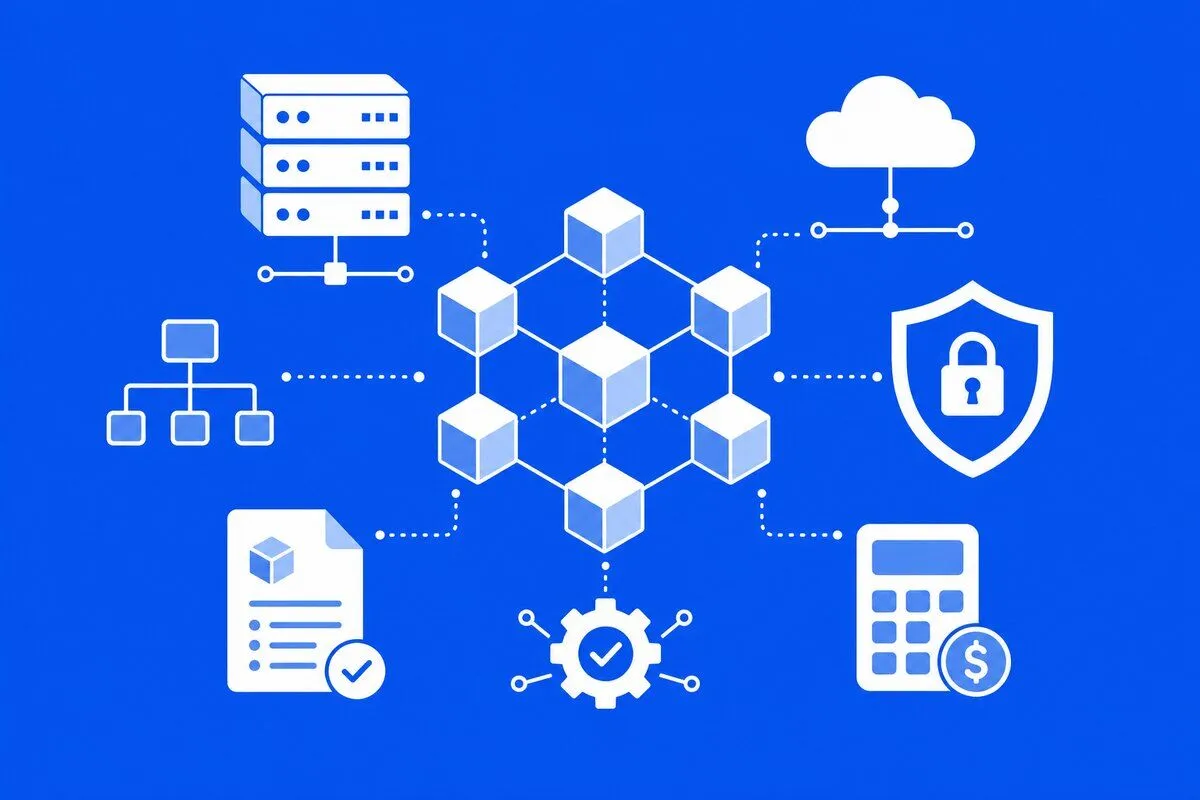
A consortium blockchain is a type of permissioned blockchain where control is shared by a group of trusted organizations instead of a single owner. Only approved members can access the network, validate transactions, and manage data, making it secure, efficient, and ideal for collaboration between multiple businesses. A consortium blockchain is a restricted, privately operated blockchain network where multiple pre-selected organizations collectively own, operate, and govern the infrastructure.
Key Takeaways
- Consortium blockchains are federated networks where multiple pre-approved organizations collectively control and govern infrastructure without any single entity dominating decision-making authority.
- Unlike public blockchains (permissionless, fully decentralized), consortium blockchains restrict access to approved members while maintaining transparency and immutability across the network.
- The primary distinction between private and consortium blockchains is governance: consortium networks distribute control democratically among organizations, while private blockchains concentrate authority in single entities.
- Enterprise adoption drives consortium blockchain growth, with applications spanning cross-border payments, supply chain tracking, healthcare data sharing, and regulatory compliance infrastructure.
- Consortium blockchains balance decentralization with enterprise requirements by offering scalability, regulatory compatibility, selective transparency, and efficient governance structures.
- Major platforms, including Hyperledger Fabric, R3 Corda, and Quorum, implement consortium architecture, enabling organizations to build industry-specific networks without technical blockchain infrastructure expertise.
The blockchain landscape has evolved dramatically since Bitcoin’s introduction, revealing that one-size-fits-all architectures cannot address diverse organizational needs. While public blockchains championed complete decentralization and private blockchains offered single-entity control, a third paradigm emerged to address a critical gap: what happens when competing organizations must collaborate while maintaining governance autonomy? Consortium blockchains answer this question by enabling multiple independent organizations to operate shared infrastructure collectively, creating trust mechanisms between entities that don’t necessarily trust each other individually. This architectural innovation has become the preferred choice for enterprises seeking blockchain benefits without surrendering organizational control or exposing sensitive business data to public networks.
Enterprise blockchain adoption statistics reveal the magnitude of consortium blockchain growth: approximately 74% of organizations implementing blockchain technology select consortium or private architectures rather than public blockchains, according to recent surveys from IBM and Deloitte. Major financial institutions have deployed consortium networks processing over $1.5 trillion in transaction value annually, with implementations spanning JPMorgan’s interbank payment networks, Maersk’s supply chain collaborations, and healthcare consortiums coordinating across hospital networks. Industry analysts project that consortium blockchain platforms will capture 82% of enterprise blockchain spending through 2027, reflecting institutional confidence in federated network models for real-world business coordination and regulatory compliance.
This comprehensive guide explores consortium blockchains from foundational concepts through advanced implementations, examining their architecture, governance structures, and real-world applications. Whether evaluating blockchain solutions for enterprise use, understanding infrastructure options for multi-party collaboration, or assessing consortium platforms for industry initiatives, this guide provides the detailed knowledge required to understand how federated networks enable trust, transparency, and efficiency across organizational boundaries.
Understanding Consortium Blockchains: Definition and Core Concepts
Definition
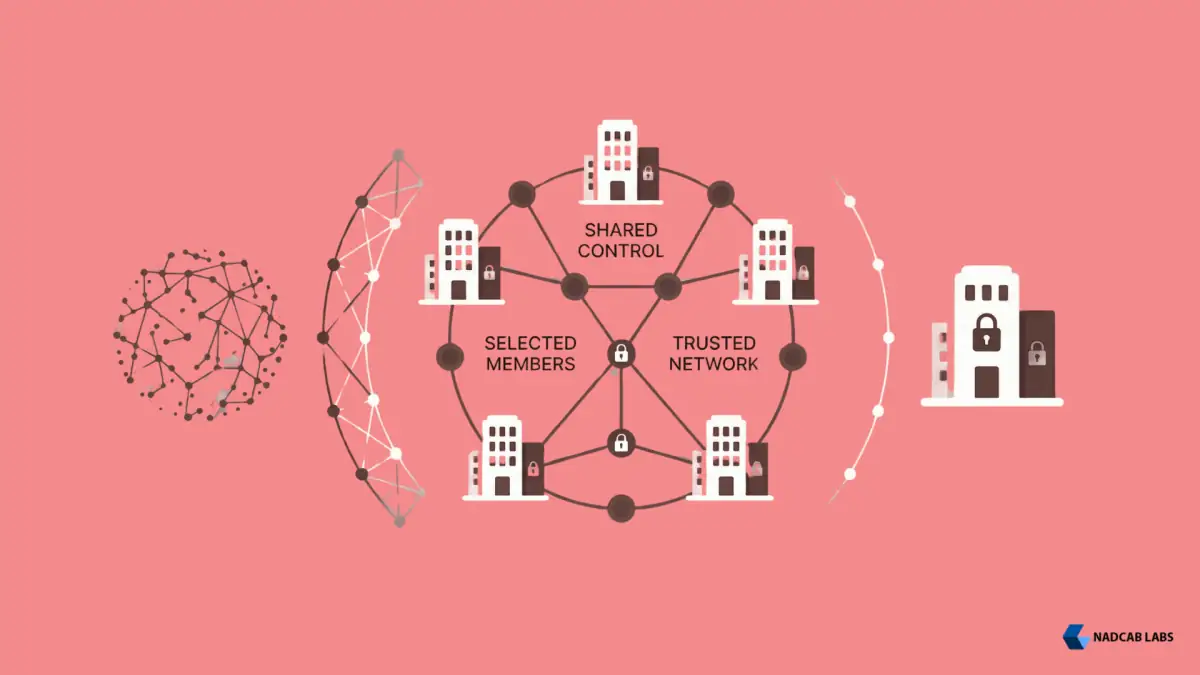
A consortium blockchain is a type of permissioned blockchain where control is shared by a group of trusted organizations instead of a single owner. Only approved members can access the network, validate transactions, and manage data, making it secure, efficient, and ideal for collaboration between multiple businesses.
A consortium blockchain is a restricted, privately operated blockchain network where multiple pre-selected organizations collectively own, operate, and govern the infrastructure. Unlike public blockchains like Bitcoin and Ethereum, where anyone can participate as a node operator or validator without permission, consortium blockchains require explicit approval from existing consortium members before organizations can join. Unlike private blockchains controlled by single entities, consortium networks distribute governance authority among member organizations operating as peers with equal voting rights on critical decisions.
The term “consortium blockchain” is synonymous with “federated blockchain” – both describe identical network architectures where governance authority is distributed across multiple organizations forming an alliance. The name “federated” emphasizes the confederation structure similar to federal political systems, where independent states unite under shared governance frameworks. In practice, each member organization typically operates at least one validator node responsible for confirming transactions, participating in consensus mechanisms, and voting on network governance matters, including protocol upgrades, fee structures, and admission of new consortium members.
Consortium blockchains implement restricted access through a permissioned network architecture requiring identity verification and explicit approval before participation. The network maintains a formal registry of approved participants, enforced through cryptographic mechanisms preventing unauthorized access attempts. This permissioning enables organizations to share confidential business data, execute sensitive transactions, and coordinate across organizational boundaries while maintaining strict control over who accesses network infrastructure and data visibility.
Also Read: What is Blockchain Technology and How its works?
How Consortium Blockchains Compare to Other Blockchain Types
To better understand where consortium networks fit within the broader ecosystem, it is important to compare them with other types of blockchains. Each blockchain type, public, private, and consortium is designed for different use cases based on factors like access control, governance, transparency, and performance. The comparisons below clearly show how consortium blockchains differ from public and private models in structure, functionality, and real-world application.
Consortium vs Public Blockchains
Public blockchains operate as completely open networks where anyone with an internet connection can join as a full participant, validate transactions, and create new blocks. This permissionless architecture achieves decentralization through massive global distribution, where thousands of independent nodes operated by unknown parties collectively maintain network security and consensus. All transactions and data become publicly visible on a transparent ledger accessible to anyone, creating immutable audit trails but also exposing transaction details globally.
Consortium blockchains fundamentally restrict access to pre-approved member organizations, eliminating the permissionless participation defining public blockchains. Sensitive corporate data remains visible exclusively to consortium participants rather than broadcast across public internet infrastructure. Where public blockchains achieve security through thousands of independent nodes competing through energy-intensive consensus like Proof of Work, consortium blockchains employ controlled, known validators using efficient algorithms like Byzantine Fault Tolerance or Proof of Authority, requiring minimal computational resources.
Transaction costs differ dramatically: public blockchains charge fees proportional to network congestion and global demand, creating unpredictable expenses during peak usage periods. Consortium blockchains allow member organizations to negotiate fixed or predictable fee structures, enabling accurate cost forecasting for enterprise financial planning. Public blockchain transaction finality requires confirmation by thousands of independent validators, taking minutes or hours. Consortium blockchains achieve rapid finality within seconds through controlled consensus between member validators.
Consortium vs Private Blockchains: The Critical Distinction
This distinction represents the most crucial comparison for understanding consortium blockchains. Private blockchains are operated and controlled by a single organizations that own all infrastructure, operate all validator nodes, and make all governance decisions unilaterally. A corporation might deploy a private blockchain for internal record-keeping, employee verification, compliance tracking, or supply chain management within its own organization, maintaining complete authority over all systems.
Consortium blockchains distribute control among multiple independent organizations operating as equal partners. No single organization can unilaterally impose changes or control network operations. Major decisions affecting the consortium – protocol modifications, membership admission, fee adjustments, governance rule changes – require consensus or voting approval from member organizations. This governance distribution prevents any single member from dominating others, creating a balance similar to shareholder voting in corporations or democratic processes in governmental federations.
Private blockchains maximize control, customization, and efficiency for single organizations but lack trustlessness between different entities. Consortium blockchains sacrifice some centralized control to gain the ability to establish trust between organizations that don’t inherently trust each other, enabling genuine collaboration without requiring trusted intermediaries. This makes consortium architectures ideal for industries where competing organizations must collaborate – banking sectors coordinating on interbank settlement, retailers and manufacturers sharing supply chain data, and healthcare providers exchanging patient information.
| Feature | Public Blockchain | Consortium Blockchain | Private Blockchain |
|---|---|---|---|
| Access Control | Permissionless, anyone can join | Permissioned, pre-approved only | Fully closed, single organization |
| Governance Model | Decentralized community consensus | Distributed multi-organization voting | Centralized single entity control |
| Data Transparency | Fully public, global visibility | Restricted to consortium members | Internal organization only |
| Validator Count | Thousands worldwide | Dozens of known organizations | Single entity validators |
| Transaction Speed | Slower, global consensus | Fast, controlled participants | Very fast, centralized |
| Regulatory Compliance | Difficult, decentralized nature | Good, known participants | Excellent, single control |
| Consensus Algorithm | PoW, PoS | PBFT, PoA, BFT variants | Delegated PoA |
| Energy Consumption | High | Minimal | Minimal |
Build Your Consortium Blockchain Network Today
Our expert team specializes in designing and implementing consortium blockchain solutions that enable multi-party collaboration, secure data sharing, and enterprise governance across your organization and partners.
How Consortium Blockchains Work
Consortium blockchains operate through a carefully orchestrated process where multiple member organizations collaborate to validate transactions, maintain records, and enforce governance decisions while maintaining control over network participation and data visibility.
- Organizations submit transactions to the consortium network, where each submission includes cryptographic signatures from the initiating member proving transaction authenticity and authorization.
- Validator nodes operated by consortium members validate each transaction against predetermined rules, smart contract logic, and permission constraints before accepting it into the network.
- Consensus mechanisms like Byzantine Fault Tolerant algorithms enable validator nodes to reach agreement on transaction validity and ordering, typically achieving consensus within seconds rather than minutes.
- Once consensus is achieved, transactions are bundled into blocks and cryptographically chained to previous blocks, creating an immutable, auditable record that all consortium members can independently verify.
- Smart contracts enforce business logic automatically, executing conditional logic, payments, or multi-step processes identically across all member nodes without requiring centralized coordination.
- Permissioning controls operate at multiple levels, restricting which organizations can access specific data channels, execute transaction types, or participate in governance decisions.
- All transactions are permanently recorded in the distributed ledger, where each member maintains identical copies, enabling independent verification and preventing any single organization from manipulating historical records.
Key Benefits of Consortium Blockchains
Organizations adopting consortium blockchains gain significant advantages in collaboration, efficiency, regulatory compliance, and security that are unavailable in public or private blockchain alternatives.
- Organizations establish trust between parties without relying on centralized intermediaries, enabling competing entities to collaborate on shared infrastructure while maintaining governance autonomy and organizational independence.
- Sensitive business data remains visible exclusively to consortium members rather than being broadcast publicly, protecting confidential pricing, negotiations, and operational details from competitors and the general public.
- High transaction throughput and rapid finality enable processing thousands of transactions per second with confirmation times measured in seconds rather than minutes, making consortium blockchains suitable for large-volume transaction processing.
- Known and accountable consortium members satisfy regulatory requirements for identity verification, transaction tracing, and compliance auditing, enabling implementation of KYC and AML protocols at network entry points.
- Efficient consensus mechanisms requiring minimal computational resources reduce operational costs compared to energy-intensive public blockchain alternatives, enabling sustainable long-term operation without excessive infrastructure expenses.
- Democratic governance structures distribute control among member organizations through voting mechanisms, preventing any single entity from dominating decisions and ensuring fair treatment of all consortium participants.
- Industry-wide standardization enabled by consortium participation facilitates interoperability between companies and development of common protocols, reducing fragmentation and enabling ecosystem-wide innovation.
- Organizations maintain data ownership while benefiting from distributed validation and cryptographic immutability, retaining control over sensitive information while gaining security guarantees that single-entity systems cannot provide.
Architecture and Technical Implementation
Permissioning and Access Control
Consortium blockchains implement multi-layered permissioning, ensuring only authorized organizations participate. Network-level permissions control which organizations can operate validator nodes and participate in consensus. Transaction-level permissions determine which consortium members can execute specific transaction types or access particular data channels. Some consortium platforms implement role-based access control where different member categories have different capabilities – for example, founding members might have voting rights while associate members participate as validators without governance authority.
Smart contracts enforce business logic while respecting permission constraints. A contract might restrict execution to specific organizations, require approval from multiple members, or implement conditional logic based on member roles. Advanced platforms like Hyperledger Fabric employ channel architecture, enabling separate transaction streams where different member subsets maintain isolated ledgers visible only to those participants.
Consensus Mechanisms
Because consortium validators are known, identified organizations with reputation and financial incentives to maintain network integrity, consortium blockchains employ efficient consensus algorithms unsuitable for public blockchains, where some validators might be malicious. Byzantine fault-tolerant algorithms allow networks to reach consensus even if certain validators fail or behave dishonestly, as long as honest validators constitute a supermajority. Practical Byzantine Fault Tolerance (PBFT) enables hundreds of transactions per second compared to Bitcoin’s seven transactions per second.
Proof of Authority variants designate specific trusted validators who vouch for transaction validity. These validators stake reputation and potentially financial collateral, creating strong incentives for honest behavior. Hybrid approaches combine Proof of Authority with voting mechanisms where validator selection and parameters are determined through democratic consortium processes.
Selective Transparency and Privacy
While maintaining transparency within the consortium, consortium blockchains keep business information hidden from external parties. Advanced implementations employ channel architecture where different member subsets maintain separate transaction channels visible only to participating members. This enables organizations to collaborate publicly on some matters while keeping sensitive negotiations, price discussions, or confidential partnerships hidden from competitors.
Privacy technologies like zero-knowledge proofs enable proving transaction validity without revealing underlying data. Members can verify that transactions satisfy regulatory requirements or compliance rules without exposing sensitive details. These cryptographic techniques maintain blockchain’s transparency advantages while protecting legitimate privacy needs.
Key Characteristics Enabling Enterprise Adoption
Governed Membership: Organizations seeking consortium membership must meet predetermined criteria, undergo verification, and gain formal approval from existing members. This controls membership quality and ensures participants share a commitment to network governance and regulatory compliance. Member registries enable accountability – organizations cannot hide behind anonymity as they can on public blockchains.
Democratic Governance: Major decisions require consensus or voting among consortium members, preventing any single organization from imposing unilateral changes. Governance mechanisms address protocol upgrades, fee structures, new member admission, rule modifications, and resource allocation. Some consortiums implement weighted voting where larger members have proportionally greater influence, similar to shareholder voting in corporations.
Regulatory Alignment: Consortium blockchains accommodate regulatory requirements more naturally than public blockchains because member organizations are identifiable and legally accountable. Regulators can verify participant identities, establish audit trails, enforce compliance, and verify reserve balances. Organizations implement know-your-customer (KYC), anti-money laundering (AML), and sanctions screening at network entry points.
Scalability Efficiency: With controlled participant counts and efficient consensus mechanisms, consortium blockchains achieve high transaction throughput and rapid finality. Networks process thousands of transactions per second compared to Bitcoin’s seven transactions per second, making consortium architectures suitable for high-volume financial transaction processing.
Leading Consortium Blockchain Platforms
Hyperledger Fabric: Maintained by the Linux Foundation, Hyperledger Fabric is the most widely deployed consortium blockchain globally. Fabric’s modular architecture enables organizations to select consensus mechanisms, identity providers, and storage systems appropriate for specific requirements. The platform’s channel architecture supports separate transaction streams for different member subsets, addressing scenarios where competing organizations collaborate without exposing all data to all parties. Major financial institutions, supply chain networks, and government agencies operate Fabric-based consortiums.
R3 Corda: Specifically designed for financial services, R3’s Corda platform emphasizes privacy through point-to-point messaging rather than broadcasting transactions to all network participants. Smart contracts operate independently on different nodes, with consensus limited only to parties directly involved in transactions. This privacy-first design makes Corda particularly suited for banking consortiums and financial infrastructure networks where transaction privacy is paramount.
Hyperledger Besu: An enterprise-focused Ethereum client, Hyperledger Besu implements the Ethereum Virtual Machine while adding privacy, permissioning, and consortium features. Organizations deploy Besu-based networks compatible with Ethereum tooling and ecosystem while gaining consortium-specific capabilities like transaction privacy and member permissioning, enabling ecosystem compatibility with public blockchain infrastructure.
Quorum: Developed by JPMorgan and maintained by ConsenSys, Quorum provides Ethereum-based infrastructure with private transaction support and consortium features. Quorum enables organizations to execute transactions privately with specific parties while broadcasting other transactions to the broader network, combining selective privacy with transparency.
Real-World Applications and Industry Use Cases
Banking and Interbank Settlement: Major financial institutions have deployed consortium blockchains for cross-border payments, trade settlement, and interbank communications. JPMorgan’s JPM Coin operates on Quorum infrastructure, enabling instant settlement between participating banks. Consortium arrangements maintain regulatory compliance while reducing settlement time from days to minutes and eliminating intermediary settlement banks that previously took transaction fees.
Supply Chain and Logistics: Supply chain consortiums enable manufacturers, distributors, retailers, and logistics providers to share product tracking, origin verification, and quality assurance data. Products recorded on consortium blockchains create immutable provenance records enabling counterfeit detection and rapid recall management. Maersk and other logistics leaders operate consortium platforms where multiple parties contribute data – manufacturers log production, logistics partners record shipment locations, retailers confirm receipt – creating comprehensive audit trails.
Consortium blockchains address supply chain challenges, including product authentication, regulatory compliance verification, and dispute resolution through shared, immutable ledgers accessible only to authorized supply chain partners.
Healthcare Data Sharing: Healthcare providers, insurers, and medical researchers form consortiums to share patient data for research and coordinated care while maintaining HIPAA and privacy law compliance. Consortium blockchains enable patients to control who accesses their medical records through granular permission controls. Researchers access anonymized data for clinical studies without centralizing sensitive health information in single repositories vulnerable to breaches.
Trade Finance and Loan Syndication: Financial consortiums use blockchain for letter of credit issuance, trade finance coordination, and loan syndication. Multiple banks participate in consortium networks that reduce document processing time, eliminate intermediaries, and provide transparent status tracking. Organizations implement smart contracts, automating payment execution when conditions are met, reducing manual coordination and settlement delays.
Challenges and Limitations
Consortium blockchains sacrifice some decentralization compared to public blockchains with thousands of independent validators. If sufficient consortium members collude or behave maliciously, they could manipulate the network in ways impossible with global validator distribution. Participants must trust consortium governance processes and fellow members to maintain network integrity.
Complex governance structures required to manage multiple organizations create operational overhead compared to single-entity private blockchains. Building consensus on protocol changes, fee structures, and membership decisions takes time when organizations have conflicting interests. Starting consortiums requires recruiting sufficient members to achieve critical mass and meaningful value creation.
Restricted membership prevents permissionless innovation, enabling global network effects. Consortium blockchains cannot reach the scale of public blockchains, limiting ecosystem development and external innovation.
The Future of Consortium Blockchains
Emerging trends indicate continued consortium blockchain evolution and enterprise adoption expansion. Interoperability between consortiums is increasing – different industry-specific consortiums are developing mechanisms to exchange data and settle transactions across network boundaries. Central bank digital currency (CBDC) infrastructure increasingly leverages consortium blockchain architecture, with central banks, commercial banks, and payment providers collaborating on shared digital currency networks.
Tokenization of real-world assets is driving consortium adoption as enterprises digitize securities, real estate, commodities, and intellectual property. Enhanced privacy technologies including zero-knowledge proofs are being integrated into consortium platforms, enabling cryptographic proof of compliance without revealing underlying transaction details. Integration with public blockchain infrastructure is advancing, with consortiums leveraging public chains for certain functions while maintaining private transaction processing.
Final Thoughts
Consortium blockchains represent the optimal architectural approach for enterprise scenarios where multiple independent organizations must collaborate while maintaining governance autonomy and controlling sensitive data. Unlike public blockchains that prioritize permissionless access and maximum decentralization, or private blockchains that concentrate control within single entities, consortium blockchains distribute governance authority among member organizations operating as peers. This design enables trust between entities that don’t necessarily trust each other individually, supporting use cases from banking networks to supply chains to healthcare data sharing.
The distinction between consortium and private blockchains centers on governance distribution – consortium networks share control democratically among multiple member organizations while private blockchains concentrate authority in single entities. This seemingly subtle difference has profound implications for organizational dynamics, regulatory compliance, innovation velocity, and the ability to coordinate across industry competitors. As enterprise blockchain adoption accelerates globally and organizations increasingly recognize blockchain’s value for multi-party coordination, consortium architecture continues proving its effectiveness for industries seeking blockchain’s transparency and immutability while maintaining the control, privacy, and regulatory compliance that modern enterprises require.
Frequently Asked Questions About Consortium Blockchains
Q1.What is another name for consortium blockchain?
Consortium blockchains are commonly called “federated blockchains” – the terms are fully interchangeable. The name “federated” emphasizes the alliance of independent entities that create and govern the network together, similar to federal governmental structures where independent states unite under shared frameworks. You might also encounter references to “permissioned blockchains” in broader discussions, though this term encompasses both private blockchains (single organization) and consortium blockchains (multiple organizations). The distinguishing characteristic is distributed control among multiple independent organizations operating as peers rather than a single-entity authority.
Q2.What is the difference between private and consortium blockchain?
The critical difference lies in governance authority and organizational control. Private blockchains are controlled by single organizations that operate all nodes, make all decisions, and maintain complete authority. A private blockchain might be deployed by a corporation for internal record-keeping, compliance tracking, or supply chain management within that organization’s boundaries.
Consortium blockchains distribute control among multiple independent organizations operating as equal partners. No single organization can unilaterally control the network or impose decisions on other members. Protocol modifications, membership decisions, and governance rule changes require consensus among consortium members.
Q3.Are consortium blockchains truly immutable?
Consortium blockchains maintain technical immutability – cryptographic properties prevent altering historical transactions without detection, identical to public blockchains. However, governance mechanisms theoretically enable consortium members to collectively agree to reverse or modify the ledger, unlike public blockchains, where technical immutability cannot be overridden by any governing body. Practical immutability depends on consortium governance rules and member integrity. Most consortiums implement policies treating the ledger as immutable for audit and compliance purposes.
Q4.How do consortium blockchains ensure security?
Consortium blockchains employ multiple security mechanisms. Identity verification and reputation systems create accountability – validators are known organizations with financial and reputational stakes in network security. Byzantine Fault Tolerant algorithms ensure consensus despite some validators failing or behaving dishonestly. Cryptographic signing creates audit trails enabling transaction origin verification. Access controls and permissioning restrict data visibility to authorized members. However, security fundamentally depends on the honesty and competence of consortium members, unlike public blockchains where security emerges from economic incentives and cryptographic certainty.
Explore Services
Related Services
Reviewed by

Aman Vaths
Founder of Nadcab Labs
Aman Vaths is the Founder & CTO of Nadcab Labs, a global digital engineering company delivering enterprise-grade solutions across AI, Web3, Blockchain, Big Data, Cloud, Cybersecurity, and Modern Application Development. With deep technical leadership and product innovation experience, Aman has positioned Nadcab Labs as one of the most advanced engineering companies driving the next era of intelligent, secure, and scalable software systems. Under his leadership, Nadcab Labs has built 2,000+ global projects across sectors including fintech, banking, healthcare, real estate, logistics, gaming, manufacturing, and next-generation DePIN networks. Aman’s strength lies in architecting high-performance systems, end-to-end platform engineering, and designing enterprise solutions that operate at global scale.