Ai Overview
Blockchain cold chain compliance transforms how pharmaceutical manufacturers, food distributors, and biotech firms maintain regulatory-grade temperature records throughout the supply chain. Total first-year implementation cost: approximately $420,000. These soft costs can add 20-30% to the total project budget. Building contracts with upgradeable proxy patterns and maintaining a regulatory change reserve (10-15% of annual budget) mitigates this risk.
Blockchain cold chain compliance transforms how pharmaceutical manufacturers, food distributors, and biotech firms maintain regulatory-grade temperature records throughout the supply chain. By combining permissioned distributed ledgers with IoT sensors and smart contracts, organizations create tamper-proof audit trails that satisfy FDA 21 CFR Part 11, EU GDP, and WHO PQS requirements while reducing spoilage claims by up to 30% and cutting audit preparation time in half.
Key Takeaways
- Permissioned blockchain architectures (Hyperledger Fabric, Quorum) enable multi-stakeholder visibility with granular data privacy controls for cold chain logistics
- Smart contracts automate temperature threshold alerts, compliance triggers, and stakeholder notifications with cryptographically verified audit trails
- IoT sensor integration via MQTT/CoAP protocols delivers real-time temperature logging while edge computing reduces on-chain transaction costs
- Blockchain features directly map to FDA 21 CFR Part 11 electronic records requirements, EU GDP audit trails, and WHO vaccine distribution standards
- Implementation costs range from $150,000 to $800,000 depending on network scale, with ROI timelines of 18-36 months driven by spoilage reduction and insurance premium savings
- Platform selection depends on use case: Hyperledger Fabric for pharmaceutical HIPAA compliance, Polygon for consumer-facing food traceability
What blockchain architecture components enable tamper-proof cold chain monitoring?
A robust blockchain cold chain compliance system requires three foundational architectural layers: a permissioned network design, smart contract logic for automated compliance enforcement, and data oracle patterns for validating off-chain sensor inputs. Each component addresses specific challenges in multi-stakeholder logistics environments where data privacy, regulatory audit trails, and real-time alerting must coexist.
Permissioned blockchain networks like Hyperledger Fabric and Quorum provide the necessary foundation for cold chain monitoring. Unlike public blockchains, these platforms allow consortium members—manufacturers, distributors, carriers, and regulators—to share temperature data selectively through channel-based architectures. In Hyperledger Fabric, each stakeholder operates a peer node with role-based access controls, ensuring that a pharmaceutical manufacturer can verify temperature compliance without exposing proprietary shipment volumes to competing distributors. Quorum, built on Ethereum’s codebase, offers private transaction capabilities where only authorized parties decrypt sensitive temperature logs while maintaining a shared consensus on data integrity. For organizations requiring Logistics Software Development expertise, selecting between these platforms depends on existing infrastructure: Fabric integrates more easily with enterprise Java systems, while Quorum suits teams with Ethereum development experience.
Smart contract logic transforms blockchain from a passive ledger into an active compliance enforcement system. A typical cold chain smart contract defines temperature thresholds (2°C to 8°C for vaccines, -20°C for mRNA therapeutics), monitors incoming IoT sensor data, and triggers automated responses when violations occur. For example, a Solidity-based contract on an enterprise Ethereum network might include a function that compares each temperature reading against predefined limits, logs the timestamp and geolocation, and immediately notifies the carrier’s quality assurance team via webhook if a breach persists beyond a grace period. These contracts also maintain immutable chain-of-custody records, cryptographically linking each temperature event to the responsible party’s digital signature—a critical feature for FDA audit trails. Organizations implementing smart contract architecture for supply chain applications often deploy modular contract designs where core compliance logic remains upgradeable through proxy patterns, allowing regulatory requirement updates without redeploying the entire network.
Data oracle patterns bridge the gap between physical IoT sensors and on-chain smart contracts, addressing the “oracle problem” where blockchain cannot natively verify off-chain data authenticity. In cold chain systems, oracles validate temperature sensor inputs before writing them to the ledger, filtering out anomalies like sensor malfunctions or transmission errors. A common implementation uses Chainlink-style decentralized oracles where multiple independent nodes query the same sensor API, aggregate readings through a median calculation, and only submit the consensus value to the blockchain if agreement exceeds a threshold (e.g., 80% of oracle nodes report within 0.5°C variance). This redundancy prevents a single faulty sensor from corrupting compliance records. For edge cases like complete sensor failure, the oracle contract can flag missing data and trigger manual verification workflows, ensuring the audit trail documents both normal operations and exception handling. Advanced implementations incorporate RPA architecture design patterns to automate the reconciliation of blockchain temperature logs with legacy warehouse management systems during monthly compliance reviews.
Cold Chain Blockchain Process Flow
IoT sensor reads temperature
Edge gateway validates & batches data
Oracle nodes verify reading consensus
Smart contract logs to blockchain
Automated alert if threshold breach
Network topology decisions significantly impact system performance and compliance auditability. A hub-and-spoke model where a pharmaceutical manufacturer operates the ordering service (consensus coordinator) and regional distributors run endorsing peers suits centralized supply chains, while a fully decentralized mesh topology with rotating consensus leaders better serves multi-vendor food logistics consortia. Transaction throughput requirements also drive architecture choices: vaccine distribution networks handling 50,000+ temperature readings per hour typically deploy Hyperledger Fabric with Raft consensus (3,500+ TPS) rather than Proof-of-Authority Ethereum (300-500 TPS), though the latter suffices for smaller biotech sample transport operations. Storage optimization becomes critical when retaining years of temperature data for regulatory compliance—many implementations use on-chain hashes of aggregated hourly summaries with full granular logs stored in off-chain IPFS or enterprise databases, retrievable via the blockchain’s content-addressed pointers during audits.
How do IoT sensors integrate with blockchain networks for real-time temperature logging?
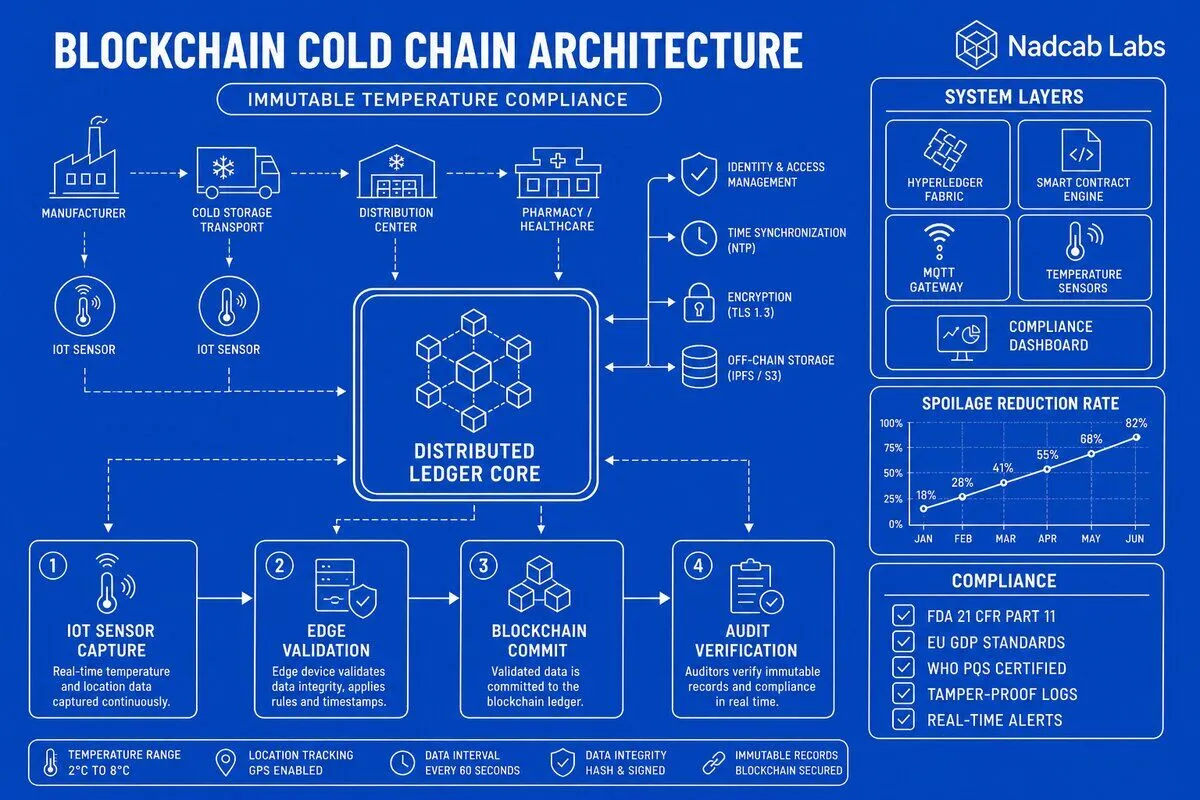
Effective IoT blockchain integration cold chain systems require lightweight communication protocols, edge computing pre-processing, and API gateway architectures that connect legacy enterprise systems to distributed ledger nodes. These integration patterns balance the need for real-time temperature visibility with the practical constraints of bandwidth costs, battery-powered sensors, and blockchain transaction fees.
MQTT (Message Queuing Telemetry Transport) and CoAP (Constrained Application Protocol) serve as the primary protocols for sensor-to-blockchain communication in cold chain deployments. MQTT’s publish-subscribe model allows temperature sensors to push readings to a central broker every 30-60 seconds with minimal overhead—a typical MQTT message containing timestamp, sensor ID, temperature, and GPS coordinates consumes just 50-100 bytes. The broker then forwards data to blockchain nodes via WebSocket connections, maintaining sub-second latency for critical threshold violations. CoAP, designed for resource-constrained IoT devices, operates over UDP and consumes even less power, making it ideal for battery-powered sensors in refrigerated containers where replacing power sources mid-transit is impractical. A pharmaceutical cold chain tracking 10,000 vaccine vials across a distribution network might deploy MQTT for warehouse-based sensors with reliable power and CoAP for mobile reefer containers, with both protocols feeding into the same blockchain network through protocol-agnostic edge gateways. Organizations exploring Web3 infrastructure layers for supply chain applications often implement MQTT-to-blockchain bridges using Node-RED or custom microservices that translate IoT messages into smart contract function calls.
Edge computing pre-processing reduces on-chain transaction costs while maintaining data granularity for compliance audits. Rather than writing every sensor reading directly to the blockchain—which would generate millions of transactions daily and incur prohibitive gas fees even on permissioned networks—edge gateways aggregate readings into statistically significant summaries. A common pattern batches 15-minute intervals of temperature data, calculating mean, minimum, maximum, and standard deviation values, then submits a single blockchain transaction containing these aggregates plus a cryptographic hash of the raw dataset. The full granular logs remain stored locally on the edge device or uploaded to encrypted cloud storage, with the blockchain hash serving as a tamper-proof seal. If a regulator requests detailed temperature records during an audit, the organization retrieves the raw data and proves its authenticity by recomputing the hash and comparing it to the on-chain value. This approach cuts blockchain storage costs by 95% while satisfying FDA requirements for “complete, accurate, and readily accessible” electronic records. Edge gateways also filter sensor noise—if a temperature probe reports an implausible 150°C reading due to electrical interference, the gateway’s outlier detection algorithm flags it for manual review rather than triggering false compliance alerts.
API gateway architectures connect legacy warehouse management systems (WMS) and transportation management systems (TMS) to blockchain nodes through standardized REST or GraphQL interfaces. Most pharmaceutical distributors and food logistics providers operate mature enterprise systems (SAP, Oracle, Manhattan Associates) that cannot directly interact with blockchain networks. An API gateway acts as a translation layer: when a WMS registers a new pallet of temperature-sensitive biologics entering cold storage, the gateway converts the WMS’s internal data format into a blockchain transaction that initializes a smart contract instance for that shipment. Similarly, when a carrier’s TMS updates a delivery status, the gateway appends this event to the blockchain’s chain-of-custody record, linking it cryptographically to the preceding temperature log entries. Hybrid cloud-blockchain deployment models are common, with the blockchain network running on enterprise Kubernetes clusters (Azure AKS, AWS EKS) while the API gateway operates as a serverless function (AWS Lambda, Azure Functions) that scales automatically during peak shipping periods. This architecture supports private blockchain architecture design patterns where sensitive business logic remains in traditional databases while only compliance-critical data propagates to the immutable ledger.
| Integration Component | Technology Options | Typical Latency | Cost per 1M Transactions |
|---|---|---|---|
| IoT Communication Protocol | MQTT over TLS, CoAP over DTLS | 200-800ms sensor to gateway | $50-$150 (cloud broker fees) |
| Edge Gateway | AWS Greengrass, Azure IoT Edge, custom ARM devices | 5-15ms local processing | $200-$400 (compute + storage) |
| Blockchain Write | Hyperledger Fabric SDK, Web3.js for Quorum | 2-5 seconds (block finality) | $800-$2,000 (node operation) |
| API Gateway | Kong, AWS API Gateway, Apigee | 50-200ms routing overhead | $100-$300 (gateway licensing) |
| Legacy System Connector | MuleSoft, Dell Boomi, custom microservices | 100-500ms transformation | $400-$1,200 (iPaaS fees) |
Real-time versus batch data logging trade-offs depend on product risk profiles and regulatory requirements. High-value biologics like CAR-T cell therapies or COVID-19 mRNA vaccines justify real-time blockchain writes every 60 seconds due to their extreme temperature sensitivity (±2°C tolerance) and replacement costs exceeding $100,000 per dose. In contrast, frozen food logistics for retail distribution can batch hourly temperature summaries without compromising compliance, since acceptable temperature ranges are wider (-18°C ±3°C) and individual product values are lower. Hybrid approaches are common: critical threshold violations (temperature exceeding safe limits) trigger immediate blockchain transactions with automated stakeholder notifications, while normal-range readings batch every 15-30 minutes. This tiered logging strategy optimizes blockchain transaction costs—a vaccine distributor might spend $0.02 per real-time alert transaction but only $0.001 per batched summary, reducing annual blockchain operation costs from $180,000 to $45,000 for a network processing 50 million temperature readings yearly.
Data synchronization challenges arise when IoT devices operate in connectivity-limited environments like ocean freight or remote distribution centers. Edge gateways implement store-and-forward patterns, caching temperature readings locally when blockchain nodes are unreachable and uploading them in chronological order once connectivity resumes. The smart contract validates timestamp sequences to detect gaps, flagging any period where temperature data is missing for manual review. Cryptographic timestamping using trusted time sources (GPS, NTP servers with blockchain-anchored time proofs) prevents backdating of temperature records, ensuring the audit trail reflects actual cold chain conditions rather than post-facto data manipulation. Organizations implementing modular blockchain architectures often deploy separate consensus layers for different geographic regions, allowing local temperature logging to continue even if inter-regional network links fail, with cross-region reconciliation occurring during scheduled synchronization windows.
Which regulatory compliance requirements does blockchain satisfy for pharmaceutical cold chains?
Blockchain pharmaceutical cold chain systems directly address electronic records regulations, temperature documentation mandates, and chain-of-custody requirements across FDA, EU, and WHO frameworks. The technology’s inherent immutability, cryptographic audit trails, and access controls map cleanly to regulatory clauses that traditionally required extensive manual documentation and periodic third-party audits.
FDA 21 CFR Part 11 governs electronic records and electronic signatures for pharmaceutical manufacturing and distribution in the United States. The regulation requires that electronic records be “accurate, reliable, and generally equivalent to paper records,” with controls preventing unauthorized access, alterations, or deletions. Blockchain satisfies these requirements through several architectural features. Part 11’s requirement for audit trails (§11.10(e)) that record “the date and time of operator entries and actions” maps directly to blockchain’s timestamp-ordered transaction logs, where every temperature reading, threshold violation, and corrective action is permanently recorded with millisecond precision and cryptographically linked to the responsible party’s digital signature. The regulation’s mandate for “validation of systems to ensure accuracy, reliability, and consistent intended performance” (§11.10(a)) aligns with smart contract formal verification processes, where mathematical proofs demonstrate that compliance logic executes correctly under all input conditions. Access controls (§11.10(d)) requiring “authority checks to ensure that only authorized individuals can use the system” are enforced through permissioned blockchain networks where role-based access policies, managed via Hyperledger Fabric’s Membership Service Provider or Quorum’s Tessera privacy manager, ensure that only licensed pharmacists can approve temperature deviation reports while allowing regulators read-only audit access. Organizations developing blockchain KYC AML compliance architecture for financial services apply similar identity verification and access control patterns to cold chain networks.
EU Good Distribution Practice (GDP) guidelines and WHO Prequalification of Medicines Programme Performance, Quality, and Safety (PQS) standards impose specific temperature documentation requirements for vaccine and pharmaceutical distribution. EU GDP Chapter 9.3 requires that “temperature mapping studies should be conducted to identify potential weak spots in storage areas” and that “temperature monitoring equipment should be positioned in areas that are likely to show the greatest temperature variations.” Blockchain cold chain monitoring automates this compliance by deploying IoT sensors at strategic locations identified during initial temperature mapping studies, with the blockchain ledger maintaining permanent records of sensor placement, calibration dates, and reading frequencies. WHO PQS standards for vaccine cold chain equipment (E003/E004) mandate continuous temperature monitoring with data loggers that record readings at intervals not exceeding 30 minutes and retain data for at least one year. Smart contracts enforce these requirements programmatically: a contract managing WHO-compliant vaccine storage automatically rejects sensor configurations with reading intervals exceeding 30 minutes and maintains immutable logs accessible for multi-year audits. The blockchain’s distributed architecture also supports WHO’s requirement for “independent verification of temperature data,” as multiple stakeholders (manufacturers, distributors, national immunization programs) can independently query the same ledger to confirm compliance without relying on a single custodian’s potentially manipulable database.
Tamper-proof chain of custody for vaccine distribution addresses a critical vulnerability in traditional paper-based systems: the ability to alter or fabricate temperature records after a cold chain breach has occurred. During the COVID-19 vaccine rollout, several high-profile incidents involved temperature excursions where manual logs were allegedly modified to hide compliance violations, resulting in administration of potentially compromised vaccines. Blockchain eliminates this risk through cryptographic verification that replaces manual documentation. Each custody transfer—from manufacturer to distributor, distributor to regional hub, hub to vaccination clinic—is recorded as a blockchain transaction signed with the transferring party’s private key. If a temperature violation occurs during a specific custody period, the blockchain’s immutable record definitively identifies the responsible party, reducing dispute resolution time from weeks (traditional paper trails with conflicting claims) to hours (cryptographic proof of custody timing and temperature logs). This capability directly reduces audit preparation time: a pharmaceutical distributor preparing for an FDA inspection can generate a complete, verifiable cold chain compliance report in minutes by querying the blockchain, whereas traditional systems require weeks of manual document gathering, cross-referencing paper logs, and reconciling discrepancies between different parties’ records. Organizations implementing HIPAA compliant blockchain architecture for healthcare data apply similar cryptographic chain-of-custody patterns to protect patient information while enabling authorized access for treatment and billing.
Regulatory Compliance Mapping
FDA 21 CFR Part 11 §11.10(e): Blockchain transaction logs provide immutable audit trails with cryptographic timestamps for all temperature readings and compliance events.
EU GDP Chapter 9.3: Smart contracts enforce continuous temperature monitoring at validated sensor locations with automated deviation alerts.
WHO PQS E003/E004: Blockchain retains multi-year temperature data with programmatic enforcement of 30-minute maximum reading intervals.
FDA 21 CFR Part 11 §11.10(d): Permissioned network access controls restrict system functions to authorized personnel via cryptographic identity verification.
EU GDP Chapter 5.2: Blockchain chain-of-custody records provide cryptographic proof of responsible parties during temperature excursions.
Automated compliance reporting capabilities transform blockchain from a passive record-keeping system into an active regulatory intelligence platform. Smart contracts can generate real-time compliance dashboards showing current cold chain status across all active shipments, historical compliance rates by carrier or route, and predictive alerts for shipments at risk of temperature violations based on weather forecasts or equipment maintenance schedules. When a regulatory inspection is scheduled, the blockchain system automatically compiles all required documentation—temperature logs, deviation reports, corrective action records, equipment calibration certificates—into a standardized audit package with cryptographic proofs of data authenticity. This automation reduces compliance personnel workload by an estimated 60-70%, allowing quality assurance teams to focus on process improvement rather than manual data compilation. The blockchain’s ability to provide regulators with read-only access to real-time compliance data also enables a shift from periodic inspections to continuous regulatory oversight, a model that FDA and EMA are increasingly exploring for high-risk pharmaceutical products. Cold chain regulatory compliance blockchain systems thus position organizations ahead of evolving regulatory expectations while reducing current compliance costs.
What are the implementation costs and ROI timelines for blockchain cold chain systems?
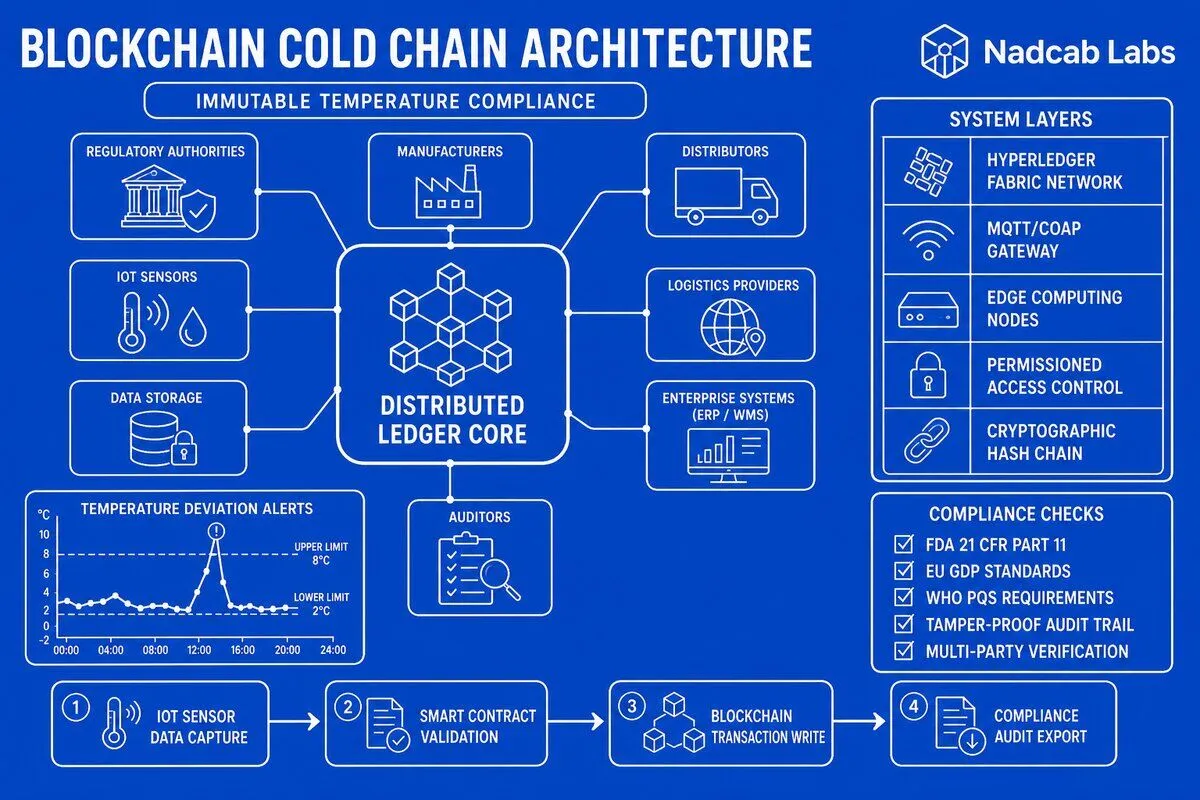
Deploying a blockchain cold chain compliance system requires capital investment in permissioned network infrastructure, IoT sensor retrofitting, smart contract development, and ongoing maintenance, with total costs varying significantly based on network scale and deployment model. Understanding the cost breakdown and phased rollout strategies helps organizations build realistic business cases and secure stakeholder buy-in for blockchain pilots.
Infrastructure costs for permissioned blockchain nodes depend on whether the organization deploys on-premises, in public cloud, or through blockchain-as-a-service (BaaS) platforms. A mid-sized pharmaceutical distributor implementing Hyperledger Fabric across 5 regional distribution centers might incur the following first-year costs: $80,000 for cloud infrastructure (AWS EC2 instances or Azure VMs running peer nodes, ordering service, and certificate authority), $120,000 for IoT sensor hardware (200 temperature sensors at $400 each, 50 edge gateways at $800 each), $150,000 for smart contract development and integration (6 months of blockchain developer time at $25,000/month), $40,000 for security audits and penetration testing, and $30,000 for training and change management. Total first-year implementation cost: approximately $420,000. Annual maintenance costs typically run 15-20% of initial implementation, around $65,000-$85,000, covering cloud hosting, sensor calibration and replacement, smart contract updates for regulatory changes, and ongoing support. Larger enterprises managing global vaccine distribution networks with 50+ nodes and 5,000+ sensors can expect implementation costs of $1.2-$1.8 million, while smaller biotech firms piloting blockchain for a single high-value product line might spend $150,000-$250,000. Organizations leveraging existing Blockchain Identity Management infrastructure for stakeholder authentication can reduce implementation costs by 10-15% through shared identity services.
Phased rollout strategies mitigate risk and demonstrate value before committing to enterprise-wide deployment. A typical implementation follows four phases over 18-24 months. Phase 1 (Pilot, months 1-6) focuses on a single distribution route or product line: a pharmaceutical company might implement blockchain temperature monitoring for one high-value oncology drug shipped from a single manufacturing site to 10 regional hospitals. This pilot validates technical feasibility, identifies integration challenges with existing WMS/TMS systems, and generates initial ROI data. Costs during this phase are $80,000-$150,000. Phase 2 (Regional Expansion, months 7-12) extends the network to all products within a geographic region, adding more sensors and stakeholders (additional carriers, warehouses). This phase tests the blockchain’s scalability and multi-stakeholder governance model, with incremental costs of $120,000-$200,000. Phase 3 (Enterprise Deployment, months 13-18) rolls out the system across all distribution centers and product lines, requiring significant change management and legacy system integration. Costs for this phase range from $200,000-$450,000 depending on organizational complexity. Phase 4 (Optimization, months 19-24) focuses on advanced features like predictive analytics, AI-driven route optimization based on historical temperature data, and integration with insurance claim systems for automated spoilage reimbursement. This phase typically costs $100,000-$200,000 but generates the highest incremental ROI through process improvements beyond basic compliance.
| Cost Category | Small Deployment (1-10 nodes) | Mid-Size (10-30 nodes) | Enterprise (30+ nodes) |
|---|---|---|---|
| Blockchain Infrastructure | $40,000-$60,000 | $80,000-$150,000 | $250,000-$400,000 |
| IoT Sensors & Gateways | $30,000-$50,000 | $120,000-$200,000 | $400,000-$700,000 |
| Smart Contract Development | $50,000-$80,000 | $150,000-$250,000 | $350,000-$500,000 |
| Integration & Migration | $20,000-$40,000 | $80,000-$120,000 | $200,000-$350,000 |
| Training & Change Management | $10,000-$20,000 | $30,000-$50,000 | $80,000-$150,000 |
| Total First-Year Cost | $150,000-$250,000 | $460,000-$770,000 | $1,280,000-$2,100,000 |
| Annual Maintenance (Years 2+) | $25,000-$40,000 | $70,000-$115,000 | $190,000-$315,000 |
Quantified ROI metrics demonstrate that blockchain cold chain investments typically achieve payback within 18-36 months through multiple value streams. Spoilage claim reduction represents the most significant savings: a pharmaceutical distributor handling $500 million in annual temperature-sensitive product shipments with a historical spoilage claim rate of 0.8% ($4 million annual losses) can reduce claims to 0.3% ($1.5 million) through improved real-time monitoring and faster corrective action, saving $2.5 million annually. Insurance premium savings add another 15-25% reduction in cold chain insurance costs as insurers recognize blockchain’s superior risk management—a company paying $800,000 in annual cold chain insurance premiums might negotiate a $150,000-$200,000 reduction after demonstrating one year of blockchain-verified compliance. Audit cost decreases stem from automated compliance reporting: replacing 400 hours of annual audit preparation labor (at $75/hour loaded cost) with automated blockchain report generation saves $30,000 yearly, while reducing third-party audit fees by $50,000-$80,000 through faster, more transparent data access. Compliance penalty avoidance is harder to quantify but potentially the largest benefit—a single FDA warning letter for inadequate temperature monitoring can trigger $200,000-$500,000 in remediation costs and months of enhanced regulatory scrutiny, risks that blockchain’s tamper-proof audit trails effectively eliminate. Summing these benefits, a mid-sized distributor investing $500,000 in blockchain implementation can expect annual savings of $2.8-$3.2 million, achieving full payback in 15-18 months and generating $2.3-$2.7 million in net value annually thereafter.
ROI Timeline Visualization
Hidden costs and risk factors warrant careful consideration during business case development. Integration complexity with legacy systems often exceeds initial estimates—if a distributor’s 15-year-old WMS lacks modern API capabilities, custom middleware development can add $80,000-$150,000 to implementation costs. Stakeholder onboarding across multi-party supply chains requires significant coordination: convincing 20+ independent carriers to install IoT sensors and participate in a blockchain network involves legal negotiations (data sharing agreements, liability clauses), technical support (training carrier IT staff), and sometimes financial incentives (subsidizing sensor costs for smaller carriers). These soft costs can add 20-30% to the total project budget. Regulatory uncertainty also poses risks—while current FDA and EU guidelines align well with blockchain capabilities, future regulatory changes could require smart contract modifications or additional compliance features. Building contracts with upgradeable proxy patterns and maintaining a regulatory change reserve (10-15% of annual budget) mitigates this risk. Organizations should also plan for vendor lock-in risks: selecting open-source blockchain platforms like Hyperledger Fabric over proprietary solutions ensures long-term flexibility and avoids dependency on a single vendor’s roadmap or pricing changes.
How do different blockchain platforms compare for perishable goods logistics use cases?
Platform selection for cold chain monitoring depends on privacy requirements, regulatory certification needs, transaction throughput, and whether consumer-facing traceability is required. Each major blockchain platform offers distinct architectural trade-offs that suit different segments of the perishable goods logistics market.
Hyperledger Fabric dominates pharmaceutical cold chain implementations requiring HIPAA-level privacy and fine-grained access control. The platform’s channel-based architecture allows a vaccine manufacturer to create separate data channels for different stakeholders: one channel shared with distributors containing temperature logs and custody transfers, another channel shared only with regulators containing full compliance audit trails, and a third channel for internal quality assurance with detailed sensor calibration records. This granular privacy control is essential for pharmaceutical companies that must protect proprietary formulation data and competitive shipment volumes while demonstrating regulatory compliance. Fabric’s pluggable consensus mechanisms also support consortium governance models where no single party controls the network—a vaccine distribution consortium might use Raft consensus with rotating leader nodes from different member organizations, preventing any single company from manipulating temperature records. The platform’s mature enterprise features (integration with existing identity providers via LDAP, support for complex business logic in chaincode, extensive monitoring and management tools) reduce implementation risk for large pharmaceutical companies with conservative IT governance. Fabric’s transaction throughput of 3,500+ TPS with optimized configurations handles the data volumes of global vaccine distribution networks, though this performance requires careful network tuning and high-performance storage backends. Organizations implementing Fabric for cold chain applications often leverage its integration with Multi-Chain ICO patterns when tokenizing temperature-controlled logistics capacity or creating tradable compliance credits for carbon-neutral cold chain operations.
Polygon and enterprise Ethereum variants suit food logistics use cases where public verifiability and consumer-facing traceability applications are priorities. A fresh produce distributor implementing farm-to-table traceability might deploy smart contracts on Polygon’s proof-of-stake network, allowing consumers to scan QR codes on packaging and view the complete cold chain history—harvest timestamp, refrigerated transport temperature logs, warehouse storage conditions—all verified on a public blockchain. Polygon’s low transaction costs (fractions of a cent per transaction) make consumer-scale traceability economically viable, whereas Hyperledger Fabric’s permissioned model would require building separate consumer-facing APIs that query private channels. Ethereum’s extensive developer ecosystem and standardized smart contract interfaces (ERC-721 for unique product identifiers, ERC-1155 for batch tracking) accelerate development and enable integration with third-party logistics apps, food safety certification platforms, and carbon footprint calculators. The trade-off is reduced privacy—while Polygon supports private transactions through zero-knowledge proofs, the default model assumes all temperature data is publicly visible, which works for consumer goods but not for pharmaceutical products with proprietary distribution networks. Enterprise Ethereum platforms like Quorum offer a middle ground, combining Ethereum’s developer tools with private transaction capabilities suitable for food industry consortia where competitors collaborate on food safety standards while protecting competitive business data.
| Platform | Best Use Case | Transaction Throughput | Finality Time | Storage Cost (per GB/year) | Regulatory Certifications |
|---|---|---|---|---|---|
| Hyperledger Fabric 2.5 | Pharmaceutical cold chain, HIPAA-compliant vaccine distribution | 3,500-20,000 TPS (optimized) | 2-5 seconds (Raft consensus) | $180-$250 (on-chain CouchDB) | SOC 2, ISO 27001 compatible |
| Quorum 23.4 | Multi-stakeholder food logistics, private consortia | 400-700 TPS (Istanbul BFT) | 3-8 seconds | $120-$180 (LevelDB) | GDPR-compliant private transactions |
| Polygon PoS | Consumer-facing food traceability, farm-to-table transparency | 7,000+ TPS (L2 scaling) | 2-3 seconds (PoS checkpoints) | $15-$30 (IPFS off-chain storage) | Public audit trails, no specific certifications |
| Corda Enterprise | Financial settlement for cold chain insurance claims | 500-1,200 TPS (point-to-point) | Immediate (no global consensus) | $200-$300 (H2 database) | ISO 20022 financial messaging |
| VeChain | Retail food supply chain, anti-counterfeiting | 10,000 TPS (PoA 2.0) | 10 seconds (block time) | $8-$20 (native storage layer) | DNV GL food safety certification integration |
Performance comparisons reveal significant differences in transaction throughput, finality time, and storage costs that impact real-world cold chain operations. Hyperledger Fabric’s high throughput (3,500+ TPS in production deployments, up to 20,000 TPS in optimized lab tests) supports enterprise-scale vaccine distribution where hundreds of thousands of temperature readings per hour must be logged across global supply chains. However, this performance requires substantial infrastructure—a 20-node Fabric network processing 10,000 TPS consumes approximately 200 GB of storage daily, necessitating careful data retention policies and off-chain archival strategies. Polygon’s Layer 2 architecture achieves even higher throughput (7,000+ TPS) with much lower storage costs by batching transactions and anchoring proofs to Ethereum mainnet, but this introduces a trust assumption in Polygon’s validator set that may not meet pharmaceutical regulatory requirements for fully auditable systems. Finality time affects how quickly stakeholders can respond to temperature violations: Fabric’s 2-5 second finality with Raft consensus means a refrigerated truck’s temperature spike triggers automated alerts to the carrier and shipper within seconds, whereas Polygon’s 2-3 second checkpoint finality plus mainnet confirmation (15-30 minutes for full Ethereum finality) may delay critical notifications. Storage costs compound over multi-year regulatory retention periods—a pharmaceutical company maintaining 7 years of temperature data on Hyperledger Fabric at $200/GB/year spends approximately $1.4 million annually on blockchain storage for a network generating 10 TB yearly, versus $150,000-$300,000 for the same data on Polygon with IPFS off-chain storage.
Regulatory certification status varies significantly across platforms and influences adoption in highly regulated industries. Hyperledger Fabric and Quorum have achieved SOC 2 Type II compliance through major cloud providers’ managed blockchain services (AWS Managed Blockchain, Azure Blockchain Service before its discontinuation), demonstrating that the platforms meet security and availability standards required for pharmaceutical supply chains. Fabric’s compatibility with ISO 27001 information security management systems and its support for audit logging that maps to FDA 21 CFR Part 11 requirements make it the de facto choice for pharmaceutical cold chains. Polygon and other public blockchain platforms lack specific regulatory certifications but offer public auditability that satisfies different compliance needs—a food safety regulator can independently verify temperature data on Polygon without requiring special access credentials, whereas Fabric requires the regulator to join the permissioned network. VeChain has pursued industry-specific certifications, partnering with DNV GL to integrate food safety standards directly into its blockchain protocol, which appeals to food logistics companies seeking turnkey compliance solutions. Corda Enterprise’s focus on financial services compliance (ISO 20022 messaging standards, integration with SWIFT networks) makes it ideal for cold chain insurance claim settlement but less suitable for core temperature monitoring. Organizations selecting platforms should align regulatory certification requirements with their industry: pharmaceutical companies prioritize HIPAA and FDA compliance (Fabric), food distributors prioritize public transparency and consumer trust (Polygon), and insurance-heavy use cases prioritize financial settlement standards (Corda).
Hybrid and multi-chain architectures are emerging as practical solutions that combine the strengths of different platforms. A pharmaceutical company might use Hyperledger Fabric for sensitive temperature monitoring and regulatory compliance while anchoring cryptographic proofs of compliance to Polygon for public verifiability and integration with consumer health apps. This approach maintains HIPAA-compliant privacy for detailed patient-level vaccine distribution data while allowing public health authorities and consumers to verify aggregate compliance metrics. Cross-chain bridges and interoperability protocols like Polkadot’s XCM or Cosmos IBC enable temperature data recorded on one blockchain to trigger smart contract actions on another—a temperature violation logged on a Fabric network could automatically initiate an insurance claim smart contract on Corda, with cryptographic proof of the violation passed between chains. These multi-chain patterns add architectural complexity and introduce new security considerations (bridge vulnerabilities, cross-chain consensus assumptions) but offer flexibility for organizations operating in multiple regulatory jurisdictions or serving both B2B and B2C cold chain markets.
Blockchain cold chain compliance systems represent a fundamental shift from reactive, paper-based temperature monitoring to proactive, automated regulatory intelligence. By combining permissioned network architectures with IoT sensor integration and smart contract automation, organizations achieve tamper-proof audit trails that satisfy FDA, EU, and WHO requirements while reducing spoilage claims, insurance premiums, and audit costs. Implementation requires careful platform selection aligned with industry-specific regulatory needs—Hyperledger Fabric for pharmaceutical HIPAA compliance, Polygon for consumer-facing food traceability—and phased rollout strategies that demonstrate ROI before enterprise-wide deployment. With payback periods of 18-36 months and ongoing annual savings of $2-3 million for mid-sized distributors, blockchain temperature monitoring delivers quantifiable value beyond compliance, positioning early adopters for competitive advantage as regulatory expectations evolve toward continuous oversight and real-time transparency.
Frequently Asked Questions
Q1.How does blockchain improve cold chain monitoring compared to traditional systems?
Blockchain provides immutable, timestamped records of temperature data from IoT sensors, eliminating manual logs and data tampering risks. Unlike centralized databases, distributed ledgers enable real-time visibility across all supply chain parties—manufacturers, carriers, warehouses, regulators—without intermediaries. Smart contracts trigger automatic alerts when thresholds breach, ensuring faster response than periodic manual checks. Cryptographic hashing guarantees data integrity, while consensus mechanisms validate every temperature reading before permanent storage, creating auditable compliance trails that traditional systems cannot match.
Q2.What are the costs of implementing blockchain for cold chain logistics?
Initial setup ranges from $50,000 to $500,000 depending on network scale, including node infrastructure, IoT sensor deployment, and smart contract development. Annual operational costs cover cloud hosting ($10,000–$30,000), transaction fees (variable by platform—Ethereum higher than Hyperledger), sensor maintenance, and staff training. Enterprise solutions like VeChain or IBM Food Trust charge licensing fees. However, ROI typically emerges within 18–24 months through reduced spoilage (15–30% savings), faster dispute resolution, and regulatory compliance automation that cuts audit costs by 40–60%.
Q3.Which blockchain platform is best for pharmaceutical cold chain monitoring?
Hyperledger Fabric leads pharmaceutical cold chains due to permissioned architecture meeting HIPAA and FDA 21 CFR Part 11 requirements. Its private channels ensure patient data confidentiality while maintaining audit trails. VeChain ToolChain offers pre-built pharmaceutical modules with sensor integration and regulatory reporting. Ethereum-based solutions work for decentralized networks but face higher gas costs. Quorum (JPMorgan’s fork) balances privacy and performance. Platform choice depends on regulatory jurisdiction, existing IT infrastructure, transaction volume, and whether public auditability or private consortium governance is prioritized.
Q4.How do smart contracts automate temperature compliance in cold chains?
Smart contracts execute predefined rules when IoT sensors report temperature data to the blockchain. If readings exceed acceptable ranges (e.g., 2–8°C for vaccines), contracts automatically trigger multi-party alerts via APIs to logistics managers, quality teams, and carriers. They can initiate corrective actions like rerouting shipments, adjusting refrigeration units through connected systems, or flagging products for quarantine. Upon delivery, contracts verify continuous compliance across all checkpoints, auto-generating certificates of conformance or rejecting non-compliant batches without human intervention, ensuring zero-latency regulatory adherence.
Q5.Can blockchain integrate with existing warehouse management systems?
Yes, through RESTful APIs and middleware layers that connect legacy WMS platforms (SAP, Oracle, Manhattan) to blockchain nodes. Integration typically uses enterprise service buses or blockchain-as-a-service platforms like Azure Blockchain or AWS Managed Blockchain. Temperature data from WMS-connected sensors flows to blockchain via API gateways, while smart contract events trigger WMS inventory updates. Hyperledger Fabric’s chaincode can directly query external databases. Most implementations adopt hybrid architectures—blockchain handles immutable compliance records while WMS manages operational workflows, avoiding full system replacement and preserving existing investments.
Q6.What happens if temperature sensors fail in a blockchain cold chain system?
Redundant sensor arrays and edge computing devices provide failover—if one sensor stops transmitting, backup units continue logging data to blockchain. Smart contracts detect missing heartbeat signals and automatically flag sensor malfunctions, alerting technicians while marking affected time periods as ‘unverified’ in the ledger. Multi-sensor consensus algorithms compare readings; discrepancies trigger validation protocols. Blockchain’s immutability records the failure event itself, maintaining audit integrity. Critical shipments may require manual temperature verification and off-chain documentation upload, with blockchain timestamping the intervention for regulatory transparency despite sensor gaps.
Explore Services
Related Services
Reviewed by

Aman Vaths
Founder of Nadcab Labs
Aman Vaths is the Founder & CTO of Nadcab Labs, a global digital engineering company delivering enterprise-grade solutions across AI, Web3, Blockchain, Big Data, Cloud, Cybersecurity, and Modern Application Development. With deep technical leadership and product innovation experience, Aman has positioned Nadcab Labs as one of the most advanced engineering companies driving the next era of intelligent, secure, and scalable software systems. Under his leadership, Nadcab Labs has built 2,000+ global projects across sectors including fintech, banking, healthcare, real estate, logistics, gaming, manufacturing, and next-generation DePIN networks. Aman’s strength lies in architecting high-performance systems, end-to-end platform engineering, and designing enterprise solutions that operate at global scale.