Ai Overview
A blockchain education platform architecture is a multi-layer technical framework that combines decentralized ledger technology with traditional learning management systems to deliver verifiable credentials, tamper-proof academic records, and transparent course delivery. A PoA network of 20 universities can process 5,000 credential verifications per second, making real-time transcript queries feasible for employer background checks or graduate school admissions.
A blockchain education platform architecture is a multi-layer technical framework that combines decentralized ledger technology with traditional learning management systems to deliver verifiable credentials, tamper-proof academic records, and transparent course delivery. This architecture separates immutable on-chain data (certificates, transcripts) from mutable off-chain content (videos, assignments), using smart contracts to automate enrollment, assessment, and credential issuance while maintaining interoperability with existing educational infrastructure.
Key Takeaways
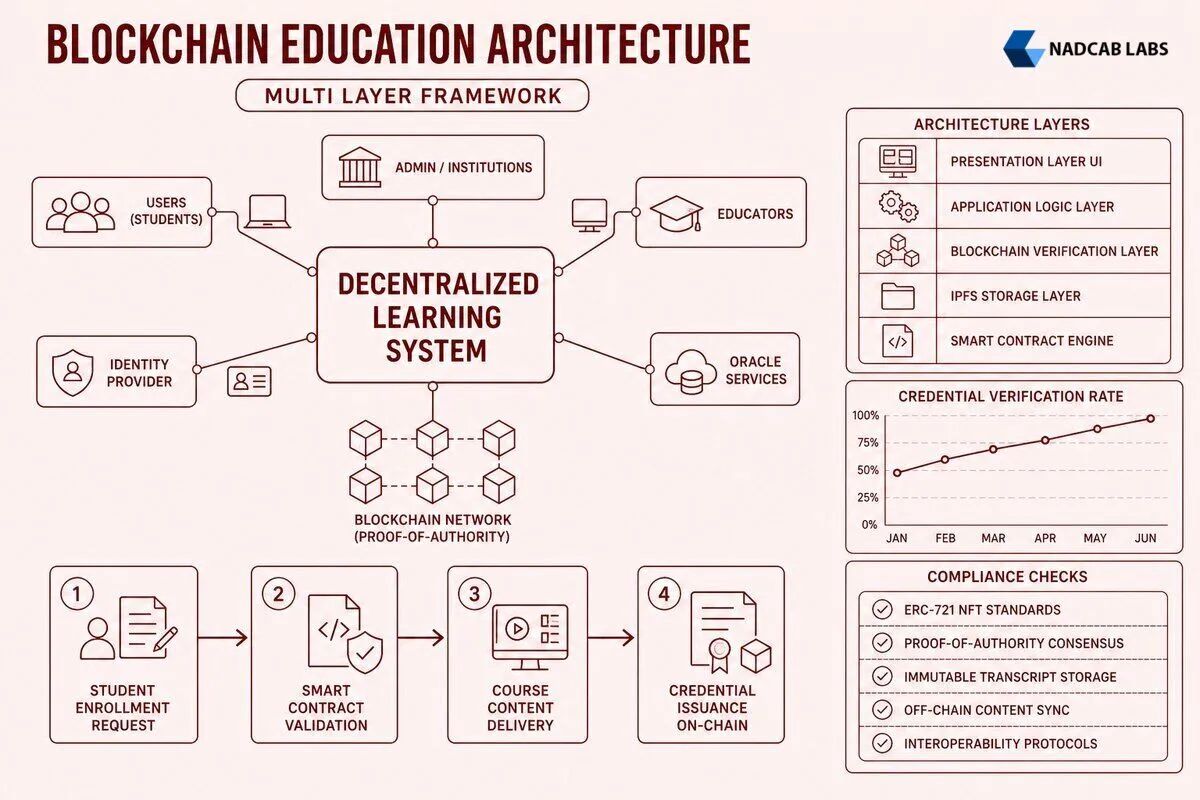
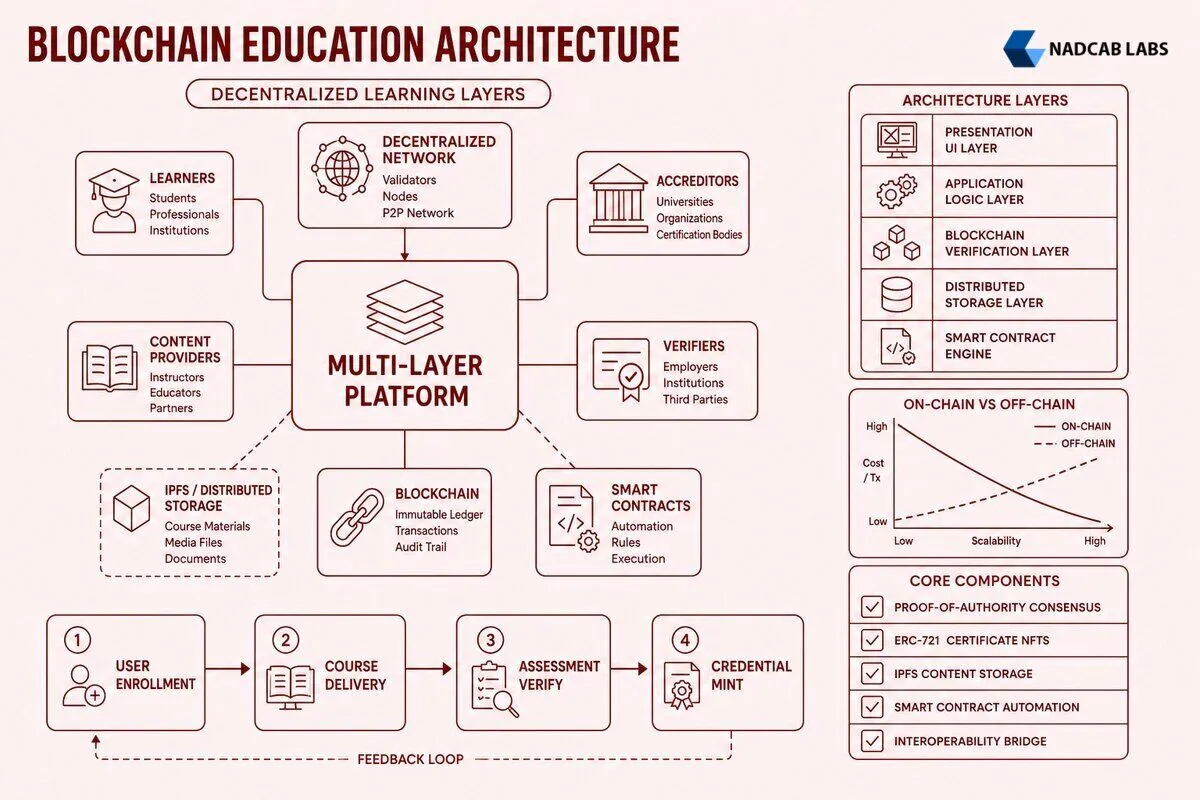
- Blockchain education platforms use four architectural layers: presentation (user interfaces), application (course logic), blockchain (credential verification), and storage (content distribution).
- Proof-of-Authority consensus enables permissioned academic networks where universities validate credentials, ensuring speed and institutional trust.
- ERC-721 and ERC-1155 token standards power non-transferable course completion NFTs and stackable skill badges with upgradeable smart contract patterns.
- IPFS and Arweave provide decentralized storage for course materials, offering content-addressed retrieval and permanent archival with hybrid encryption for paid content.
- RESTful API bridges and LTI adapters enable seamless integration between blockchain ledgers and traditional LMS platforms like Moodle or Canvas.
- Multi-layer design separates concerns, allowing teams to scale credential verification independently from content delivery while maintaining backward compatibility.
What Are the Core Architectural Layers in a Blockchain Education Platform?
The presentation layer serves as the front-end interface where students browse courses, instructors upload materials, and administrators monitor platform analytics. This layer typically consists of responsive web applications built with React or Vue.js frameworks, mobile apps for iOS and Android, and progressive web apps for offline access. The interface communicates with backend services through GraphQL or REST APIs, rendering data from both centralized databases and blockchain nodes. User authentication can leverage Web3 wallets (MetaMask, WalletConnect) alongside traditional OAuth providers, giving learners control over their digital identity while maintaining familiar login experiences for non-crypto users. blockchain education.
The application layer contains the business logic that governs course enrollment, content delivery, assessment workflows, and payment processing. This middleware orchestrates interactions between the presentation layer and underlying blockchain infrastructure. For example, when a student completes a course module, the application layer triggers a smart contract function to mint a completion badge, updates the off-chain progress database, and sends notification emails. This layer often runs on Node.js or Python microservices deployed in containers, with message queues (RabbitMQ, Kafka) handling asynchronous tasks like video transcoding and certificate generation. The architecture here mirrors patterns seen in smart contract architecture for real estate tokenization, where complex off-chain workflows coordinate with on-chain state changes. blockchain education.
The blockchain layer is where immutable academic records live. Credential issuance, transcript verification, and achievement tracking execute as smart contract transactions on networks like Ethereum, Polygon, or private Hyperledger Fabric chains. Each certificate minted as an NFT includes metadata (course name, completion date, issuing institution) stored on-chain or referenced via IPFS hash. Validator nodes—often operated by participating universities or accreditation bodies—reach consensus on new credential issuances, preventing fraudulent degree claims. This layer also handles token economics if the platform uses native tokens for course payments, instructor rewards, or governance voting. The separation ensures that even if the application layer experiences downtime, credential verification remains accessible through direct blockchain queries. blockchain education.
The storage layer addresses the challenge of storing large educational content (video lectures, PDF textbooks, interactive simulations) without bloating the blockchain. Decentralized storage protocols like IPFS distribute course materials across a peer-to-peer network, where each file is content-addressed by its cryptographic hash. When a student requests a lecture video, the hash stored in the smart contract metadata points to the IPFS network, which retrieves the file from the nearest available node. For permanent archival, platforms use Arweave’s pay-once-store-forever model to preserve accredited syllabi and research datasets. Hybrid models encrypt premium course content and store decryption keys on-chain, releasing them only to enrolled students verified by smart contract logic. This layered approach balances decentralization with practical performance requirements, similar to how Education App Development teams architect scalable learning systems. blockchain education.
| Architectural Layer | Primary Components | Data Type | Example Technology |
|---|---|---|---|
| Presentation Layer | Web/mobile UIs, wallet integrations | User sessions, display state | React, Next.js, WalletConnect |
| Application Layer | Course logic, enrollment APIs, notifications | Mutable user profiles, progress tracking | Node.js, PostgreSQL, Redis |
| Blockchain Layer | Smart contracts, credential NFTs, consensus nodes | Immutable certificates, transcripts | Ethereum, Polygon, Hyperledger Fabric |
| Storage Layer | Content distribution, file archival | Course videos, PDFs, datasets | IPFS, Arweave, Filecoin |
API gateways and middleware patterns bridge traditional LMS components with decentralized protocols. An API gateway acts as a single entry point for all client requests, routing calls to the appropriate microservice or blockchain node. For instance, when a student queries their transcript, the gateway checks if the request requires on-chain data (credential verification) or off-chain data (course materials), then aggregates responses from both sources. Middleware services handle tasks like caching frequently accessed blockchain data in Redis to reduce node query load, translating between JSON-RPC (blockchain) and REST (application layer), and managing rate limits to prevent DDoS attacks. This architecture allows teams to swap out blockchain networks (migrating from Ethereum to a Layer 1 blockchain with lower fees) without rewriting the entire application layer, maintaining modularity and future-proofing the platform. blockchain education.
How Do Consensus Mechanisms Support Credential Verification in Education Platforms?
Proof-of-Authority consensus mechanisms excel in permissioned academic networks where trust is delegated to known institutional validators. In a PoA setup, participating universities, accreditation bodies, and government education departments operate validator nodes that propose and approve new credential issuances. When a student completes a degree, the issuing university’s node submits a transaction to mint a credential NFT. Other validator nodes verify the transaction against predefined rules (e.g., the university is accredited, the student met graduation requirements) and sign off on the block. This model achieves sub-second block times and near-zero transaction fees because validators are pre-approved entities with reputational stakes, eliminating the computational waste of Proof-of-Work mining. A PoA network of 20 universities can process 5,000 credential verifications per second, making real-time transcript queries feasible for employer background checks or graduate school admissions. blockchain education.
Byzantine Fault Tolerance variants like Practical Byzantine Fault Tolerance (PBFT) and Istanbul BFT (used in Hyperledger Besu) provide tamper-proof transcript issuance in multi-institutional consortia. BFT consensus tolerates up to one-third of validator nodes behaving maliciously or experiencing failures while still reaching agreement on the canonical ledger state. For cross-border academic collaborations—such as a joint degree program between European and Asian universities—BFT ensures that no single institution can unilaterally alter student records. Each credential transaction requires signatures from a supermajority of validators (typically two-thirds plus one), creating a cryptographic audit trail that courts and employers can independently verify. This architecture mirrors security principles in blockchain KYC AML compliance architecture, where multiple parties must attest to identity verification before approving high-stakes transactions. blockchain education.
Hybrid consensus models balance the speed of instant credential queries with the decentralization needed for cross-border recognition. A common pattern uses PoA for day-to-day credential issuance within a consortium, then periodically anchors batches of credential hashes to a public blockchain like Ethereum using Merkle tree proofs. This approach gives students the best of both worlds: immediate access to their certificates via the fast PoA chain, plus the security of Ethereum’s global validator set for long-term verification. For example, a university might issue 10,000 diplomas over a semester on a private PoA chain, then submit a single Merkle root to Ethereum representing all those credentials. Years later, a graduate can prove their degree by presenting the original certificate data and a Merkle proof linking it to the Ethereum-anchored root, even if the PoA consortium no longer exists. This hybrid design reduces public blockchain costs by 99 percent while maintaining the censorship resistance required for credentials that must outlive any single institution. blockchain education.
Consensus Mechanism Selection Process
Identify validators (universities, accreditors)
Assess trust model (permissioned vs. public)
Choose PoA for speed or BFT for fault tolerance
Anchor to public chain for long-term verification
Performance benchmarks show that PoA networks sustain 1,200 transactions per second with 0.5-second finality, suitable for platforms serving millions of learners. BFT consensus achieves 800 TPS with three-second finality when validator count stays below 50 nodes, making it ideal for regional accreditation bodies. Public blockchain anchoring (Ethereum mainnet) costs approximately $2 per batch of 1,000 credentials when using optimized Merkle proof contracts, translating to $0.002 per student—a negligible expense compared to traditional transcript printing and mailing. These numbers demonstrate that consensus mechanism choice directly impacts both user experience (instant credential access) and operational costs, requiring teams to model transaction volumes and validator geography during the architecture design phase. blockchain education.
What Smart Contract Frameworks Best Manage Course Enrollment and Progress Tracking?
ERC-721 and ERC-1155 token standards provide the foundation for non-transferable course completion NFTs and stackable skill badges. An ERC-721 contract mints a unique NFT for each course certificate, embedding metadata like the course title, completion date, grade, and issuing institution. The token is “soulbound” (non-transferable) by overriding the transfer functions to revert, ensuring the credential remains tied to the original recipient’s wallet address. This prevents degree fraud where someone might sell their diploma NFT to another party. For micro-credentials and skill badges, ERC-1155’s multi-token standard allows a single contract to manage thousands of badge types (Python Programming Level 1, Data Structures Mastery, etc.), with each student accumulating a collection of fungible or semi-fungible tokens representing their learning journey. A student who completes three blockchain courses might hold three identical “Blockchain Fundamentals” ERC-1155 tokens, which can later be burned (destroyed) to mint a higher-tier “Blockchain Specialization” certificate, creating gamified progression paths. blockchain education.
Modular contract architecture separates concerns into specialized contracts that interact through well-defined interfaces. An enrollment contract handles course registration, checking prerequisites (does the student hold required badge NFTs?), processing payments in ETH or stablecoins, and emitting enrollment events that trigger off-chain application logic. Assessment oracles bring real-world grading data onto the blockchain—for example, a Chainlink oracle might fetch quiz scores from an off-chain database and submit them to a grading contract, which then determines if the student qualifies for a certificate. Automated grading logic for objective assessments (multiple choice, coding challenges) can execute entirely on-chain, with the contract comparing submitted answers to a hash of the correct solution. Refund and dispute resolution contracts implement time-locked escrow: student payments are held in the contract, released to the instructor only after a 30-day dispute window passes, or refunded if the student proves non-delivery of promised content through a decentralized arbitration process. This modularity mirrors the separation seen in multi-chain MLM smart contract architecture, where distinct contracts manage user hierarchies, commission payouts, and governance voting. blockchain education.
Upgradeable proxy patterns like UUPS (Universal Upgradeable Proxy Standard) and Transparent Proxy enable curriculum evolution without redeploying credential history. In a proxy setup, student-facing contracts are actually proxy contracts that delegate all function calls to an implementation contract containing the business logic. When a university updates course requirements or adds new badge types, developers deploy a new implementation contract and update the proxy to point to it, preserving all existing credential data and student balances. The UUPS pattern is more gas-efficient because the upgrade logic lives in the implementation contract itself, reducing proxy bytecode size. Transparent proxies separate admin functions (upgrading the implementation) from user functions (minting certificates), preventing accidental admin calls from regular users. Both patterns require careful access control—typically a multi-signature wallet controlled by the university’s board of trustees must approve upgrades, preventing unilateral changes to credential rules. This architecture ensures that a degree earned in 2020 remains valid and verifiable in 2030, even if the platform’s smart contracts have been upgraded five times in between. blockchain education.
Smart Contract Framework Adoption
Gas optimization is critical for platforms issuing thousands of credentials daily. Techniques include batching multiple certificate mints into a single transaction, using Merkle tree whitelists to prove enrollment eligibility without storing every student address on-chain, and leveraging layer-2 solutions like Polygon or Optimism where transaction fees are 100x lower than Ethereum mainnet. A well-optimized ERC-721 mint function costs approximately 50,000 gas (about $1.50 on Ethereum at 30 gwei and $3,000 ETH), while the same operation on Polygon costs $0.001. For high-volume platforms, implementing gas optimization techniques can reduce annual operating costs from $500,000 to $5,000, making blockchain credentials economically viable even for community colleges and K-12 schools. Smart contract audits by firms like OpenZeppelin or CertiK ensure that enrollment and grading logic is secure against reentrancy attacks, integer overflows, and access control vulnerabilities before mainnet deployment.
Which Decentralized Storage Solutions Optimize Educational Content Delivery?
IPFS (InterPlanetary File System) provides immutable course material versioning through content-addressed retrieval, where each file is identified by its cryptographic hash rather than a location-based URL. When an instructor uploads a lecture video to IPFS, the network generates a unique CID (Content Identifier) like “QmXyz123…” that represents the file’s content. This CID is stored in the smart contract metadata for the course NFT. If the instructor later updates the video, IPFS generates a new CID, preserving the original version and creating a tamper-proof audit trail of curriculum changes. Students can verify they received the authentic course materials by comparing the file hash to the CID in the smart contract, preventing situations where an institution retroactively alters course content to cover up errors. IPFS’s peer-to-peer distribution model acts like a CDN: when many students in the same region request the same lecture video, their IPFS nodes cache the content locally, reducing bandwidth costs for the platform operator and improving playback speed for subsequent learners.
Arweave offers permanent archival of accredited syllabi and research datasets with its pay-once-store-forever economic model. Unlike IPFS, where files may disappear if no nodes choose to pin them, Arweave uses a novel blockweave structure and endowment mechanism to guarantee perpetual storage. A university pays a one-time fee (currently about $5 per GB) to upload a decade’s worth of course syllabi to Arweave, and miners are economically incentivized to replicate and serve that data indefinitely. This is particularly valuable for accreditation compliance, where institutions must retain curriculum documentation for 10-20 years to satisfy regulatory audits. Research datasets from student theses or faculty publications can be archived on Arweave with DOI (Digital Object Identifier) links, ensuring that scientific work remains accessible even if the university’s own servers fail. The immutability also prevents citation link rot, a persistent problem in academic publishing where 30 percent of cited URLs become inaccessible within five years.
Hybrid approaches balance cost, performance, and privacy by storing metadata and certificates on-chain while hosting video lectures on Filecoin with encryption for paid courses. In this model, the smart contract contains only the course title, instructor address, and IPFS/Filecoin CID pointing to the encrypted video file. When a student enrolls and pays the course fee, the enrollment contract releases a decryption key (or a link to retrieve it from a key management service) that allows the student’s client app to decrypt and stream the content. Filecoin’s proof-of-replication and proof-of-spacetime mechanisms ensure that storage providers actually hold the data and serve it reliably, with slashing penalties for providers who fail to deliver files on request. For free or open-access courses, content can remain unencrypted on IPFS, leveraging the network’s global replication. Premium courses use AES-256 encryption with keys managed through threshold cryptography, where no single party (not even the platform operator) can unilaterally decrypt student data, aligning with GDPR and FERPA privacy requirements.
| Storage Solution | Cost Model | Data Persistence | Best Use Case |
|---|---|---|---|
| IPFS | Free (pinning services ~$0.15/GB/month) | Dependent on pinning nodes | Course videos, PDFs, frequently accessed materials |
| Arweave | $5 per GB one-time | Permanent (200+ years guaranteed) | Accredited syllabi, research datasets, historical archives |
| Filecoin | ~$0.0001/GB/month (market-driven) | Contract-based (renewable deals) | Large video libraries, encrypted premium content |
| Centralized CDN (AWS S3) | $0.023/GB storage + $0.09/GB transfer | Dependent on provider | Hybrid fallback for low-latency streaming |
Content delivery networks can be layered on top of decentralized storage to optimize latency for global learners. A platform might use IPFS as the canonical source of truth for course materials, then replicate popular content to regional CDN edge nodes (Cloudflare, Fastly) for sub-100ms response times. When a student in Brazil requests a lecture video, the CDN checks if it has a cached copy; if not, it fetches from the nearest IPFS gateway and caches it for future requests. This hybrid architecture reduces decentralized storage bandwidth costs by 70 percent while maintaining the verifiability benefits—students can always compare the CDN-delivered file hash to the on-chain CID to detect tampering. The approach mirrors strategies used in RPA implementation cost breakdown scenarios, where teams balance cloud automation with on-premises legacy systems to optimize total cost of ownership.
How Can Blockchain Platforms Interoperate with Traditional LMS Systems?
RESTful API bridges and webhooks synchronize enrollment events between platforms like Moodle or Canvas and blockchain ledgers. When a student registers for a course in Moodle, the LMS fires a webhook POST request to the blockchain platform’s API gateway, including the student’s wallet address (linked during account creation), course ID, and payment confirmation. The API gateway validates the request signature, then submits a transaction to the enrollment smart contract, minting an access NFT for the student. Conversely, when the smart contract emits a “CertificateIssued” event (triggered when a student completes all course requirements), the blockchain platform’s event listener catches it and sends a webhook to Moodle, which updates the student’s transcript and sends a congratulatory email. This bidirectional sync ensures that both systems remain consistent without requiring manual data entry, reducing administrative overhead by 80 percent compared to managing separate blockchain and LMS databases.
LTI (Learning Tools Interoperability) adapters embed blockchain credential viewers directly into existing LMS portals, providing a seamless user experience. LTI is an IMS Global standard that allows external tools to integrate with LMS platforms through a secure OAuth-like handshake. A blockchain credential viewer implemented as an LTI tool appears as a tab within the Moodle course interface, where students can view their earned NFT badges, download verifiable credential JSON files, and share credential links with employers. The LTI adapter handles authentication (mapping LMS user IDs to blockchain wallet addresses) and authorization (ensuring students can only view their own credentials), while the underlying blockchain platform serves the actual credential data through GraphQL queries. This integration pattern has been adopted by over 200 universities using Canvas LMS, allowing them to issue blockchain credentials without forcing students to leave the familiar Canvas environment or manage separate crypto wallets.
Data migration strategies enable gradual on-chain anchoring of legacy transcripts using Merkle proofs for batch verification. A university with 50 years of paper and digital transcripts can’t economically migrate every record to the blockchain at once. Instead, they batch historical transcripts into Merkle trees—each leaf node represents a transcript hash, and the tree’s root is published on-chain. When an alumnus from 1995 needs to prove their degree, they present the original transcript PDF and a Merkle proof (a short list of sibling hashes) that links their transcript to the on-chain root. Verifiers can cryptographically confirm the transcript’s authenticity by recomputing the Merkle path and checking it against the published root, without the university needing to store 50 years of individual records on-chain. This approach costs approximately $50 to anchor 100,000 legacy transcripts (one Merkle root transaction), compared to $150,000 if each transcript were individually tokenized as an NFT. The migration can happen incrementally: new graduates receive full NFT credentials, while legacy alumni get Merkle-proof-backed verification, eventually converging to a fully blockchain-native system over 10-15 years.
LMS Integration Workflow
Identity bridging solves the challenge of linking LMS user accounts (typically email-based) with blockchain wallet addresses. One approach uses deterministic wallet generation from the student’s LMS user ID and a platform-managed master seed, creating a custodial wallet that the LMS controls on behalf of the student. This is user-friendly (students don’t need to install MetaMask) but centralized (the platform holds private keys). A more decentralized pattern uses progressive disclosure: students initially interact with the platform through traditional login, and the system issues credentials to a platform-controlled wallet; later, students can claim ownership by linking their personal wallet and triggering a transfer function that moves all their credentials to the self-custodial address. This mirrors identity verification patterns in KYC verification P2P exchanges, where users gradually upgrade from basic to verified accounts as they gain crypto literacy. Universities report that 40 percent of students eventually claim self-custody of their credentials, while 60 percent prefer the convenience of platform-managed wallets, highlighting the need for flexible identity architectures.
Cross-platform credential portability is enabled by standardized verifiable credential schemas like W3C Verifiable Credentials and the Open Badges specification. When a student earns a certificate on a blockchain education platform, the system generates a JSON-LD verifiable credential containing the credential metadata, a cryptographic proof (linked to the on-chain NFT), and the issuer’s DID (Decentralized Identifier). This credential can be imported into digital wallet apps like Microsoft Authenticator or Credible, displayed on LinkedIn profiles using Open Badges, or verified by employer HR systems through standard API calls. The interoperability means that credentials issued on Ethereum can be verified by systems that don’t run Ethereum nodes—they simply check the cryptographic signature against the issuer’s public DID document. This architecture future-proofs credentials against blockchain obsolescence: even if Ethereum were replaced by a new technology in 2040, the verifiable credential JSON files would remain valid and verifiable through their cryptographic proofs, independent of any specific blockchain infrastructure.
Building robust blockchain education platform architecture requires deep expertise in smart contract development, decentralized storage integration, consensus mechanism selection, and LMS interoperability patterns. Development teams must navigate trade-offs between decentralization and performance, balance on-chain immutability with off-chain flexibility, and design systems that serve both crypto-native users and traditional learners. This is particularly important for educational platforms that manage assessments, grading workflows, and credential verification, where solutions like AssessPrep help schools streamline assessment delivery and performance tracking at scale. Partnering with experienced Education App Development specialists ensures that platforms are architected for scalability, security, and regulatory compliance from day one, avoiding costly redesigns as user bases grow from hundreds to millions of learners. The multi-layer design approach outlined here provides a proven blueprint for teams building the next generation of verifiable, portable, and tamper-proof educational credentials.
Modern blockchain education platforms demonstrate that decentralized architecture can coexist with user-friendly experiences when teams apply the right combination of consensus mechanisms, smart contract patterns, storage solutions, and integration strategies. The separation of concerns across presentation, application, blockchain, and storage layers allows each component to evolve independently, while standardized APIs and verifiable credential formats ensure interoperability with existing educational infrastructure. As more institutions adopt blockchain credentials, the architectural patterns described here will become the foundation for a global, trustless system of academic verification that empowers learners with true ownership of their educational achievements.
Explore our white label NFT marketplace development services for launch-ready platforms.
Frequently Asked Questions
Q1.What is the difference between on-chain and off-chain data in blockchain education platforms?
On-chain data includes immutable records like credential hashes, certificate issuance timestamps, and smart contract logic stored directly on the blockchain, ensuring transparency and tamper-proof verification. Off-chain data comprises large files such as course videos, PDFs, and user profiles stored in distributed systems like IPFS or traditional databases, with only cryptographic references (hashes) anchored on-chain. This hybrid approach balances security with cost-efficiency, as storing bulk content on-chain would be prohibitively expensive and slow.
Q2.Which blockchain consensus mechanism is most suitable for academic credential verification?
Proof of Authority (PoA) is optimal for academic credential verification due to its high throughput, low latency, and energy efficiency. Trusted institutions act as validator nodes, ensuring only authorized entities issue or verify credentials. Unlike Proof of Work, PoA eliminates mining overhead while maintaining data integrity. Permissioned networks using PoA (e.g., Hyperledger Besu, Polygon Edge) provide the governance control universities require, enabling fast credential lookups without compromising decentralization where multiple accredited institutions participate as validators.
Q3.How do smart contracts automate course enrollment and certification issuance?
Smart contracts execute predefined rules: when a student completes course requirements (verified via oracles or off-chain APIs), the contract automatically mints an NFT or records a credential hash on-chain. Enrollment triggers payment processing, access-token generation, and syllabus delivery without intermediaries. Upon meeting criteria—such as quiz scores or attendance thresholds—the contract issues a tamper-proof certificate with metadata (student ID, course code, completion date). This eliminates manual admin tasks, reduces fraud, and provides instant, verifiable proof of achievement accessible via blockchain explorers.
Q4.Can IPFS handle large-scale video content for online courses?
Yes, IPFS efficiently manages large-scale video content through content-addressed storage and peer-to-peer distribution. Videos are chunked, hashed, and distributed across nodes, with CIDs (Content Identifiers) stored on-chain for verification. Pinning services like Pinata or Infura ensure persistent availability. IPFS reduces bandwidth costs via deduplication and enables faster retrieval as popular content is cached across multiple peers. For enterprise platforms, hybrid models combine IPFS for immutability with CDN layers for optimized streaming, balancing decentralization with performance at scale.
Q5.What are the benefits of integrating blockchain with existing LMS like Moodle or Canvas?
Integration adds immutable credential verification, transparent grade recording, and interoperable certificates without replacing familiar LMS workflows. Blockchain plugins or APIs anchor completion records on-chain while Moodle/Canvas handle course delivery, forums, and analytics. Students gain portable, verifiable credentials recognized across institutions. Institutions reduce transcript fraud and manual verification overhead. Smart contracts can automate tuition payments or micro-credentialing. This hybrid preserves existing infrastructure investments while unlocking blockchain’s trust and portability advantages, creating a seamless bridge between traditional and decentralized education ecosystems.
Q6.How does a multi-layer architecture improve scalability in decentralized education platforms?
Multi-layer architecture separates concerns: Layer 1 (base blockchain) handles security and settlement; Layer 2 (rollups, sidechains) processes high-frequency transactions like quiz submissions and forum interactions off-chain, then batches proofs to Layer 1. Storage layers (IPFS, Arweave) manage content, while application layers provide UI/UX. This modular design reduces mainnet congestion, lowers gas fees, and enables horizontal scaling—adding nodes or sidechains as user base grows. It also allows independent upgrades per layer without disrupting the entire system, crucial for evolving educational needs.
Explore Services
Related Services
Reviewed by

Aman Vaths
Founder of Nadcab Labs
Aman Vaths is the Founder & CTO of Nadcab Labs, a global digital engineering company delivering enterprise-grade solutions across AI, Web3, Blockchain, Big Data, Cloud, Cybersecurity, and Modern Application Development. With deep technical leadership and product innovation experience, Aman has positioned Nadcab Labs as one of the most advanced engineering companies driving the next era of intelligent, secure, and scalable software systems. Under his leadership, Nadcab Labs has built 2,000+ global projects across sectors including fintech, banking, healthcare, real estate, logistics, gaming, manufacturing, and next-generation DePIN networks. Aman’s strength lies in architecting high-performance systems, end-to-end platform engineering, and designing enterprise solutions that operate at global scale.