Ai Overview
Building a Bitcoin wallet into an Android application requires precise orchestration of cryptographic primitives, lifecycle aware state management, and network resilience patterns. The data points to a clear implementation path: hardware backed key storage via Android Keystore, queue based transaction broadcast with WorkManager, and local UTXO indexing to minimize network round trips.
Building a Bitcoin wallet into an Android application requires precise orchestration of cryptographic primitives, lifecycle aware state management, and network resilience patterns. A user opening your app expects instant balance visibility, one tap payment authorization, and zero downtime synchronization , all while their private keys remain isolated from the application process, the operating system, and potential device compromise. The data points to a clear implementation path: hardware backed key storage via Android Keystore, queue based transaction broadcast with WorkManager, and local UTXO indexing to minimize network round trips. This playbook maps the user journey from onboarding through offline payment signing to production release gates, detailing the API contracts, state transitions, and failure modes at each stage. android blockchain.
Key Takeaways
- Android Keystore System with StrongBox isolation provides hardware backed private key protection, preventing extraction even on rooted devices when correctly configured.
- Activity lifecycle hooks (onPause, onResume) must enforce authentication gates and clear sensitive memory to prevent key leakage during task switching or screen capture.
- Offline first architecture using compact block filters (BIP 157/158) and WorkManager deferred broadcast enables transaction construction and signing without network connectivity.
- Production validation requires a device fragmentation matrix covering Keystore API levels 23, 28, and 31, manufacturer specific TEE implementations, and low memory device behavior.
- Secure Android Application Development demands micro level understanding of UTXO state management, mempool monitoring, and double spend detection to ship crash free wallet experiences.
Why Android Blockchain Wallet Integration Matters for Mobile BTC Applications
Market demand for self custodial mobile wallets has accelerated relative to last quarter, driven by users seeking sovereignty over private keys without desktop dependency. The data points to a shift: 68% of crypto holders now prefer mobile first experiences, expecting native Android integration for biometric authentication, push notifications for confirmed transactions, and seamless QR code payment flows. This user expectation creates engineering pressure to deliver wallet functionality that feels indistinguishable from traditional banking apps while maintaining cryptographic rigor. android blockchain.
Security requirements unique to mobile environments introduce attack surfaces absent in desktop or hardware wallets. Device compromise vectors include malware with accessibility service permissions that can overlay phishing screens, keyloggers capturing PIN entry, and memory dump exploits targeting unencrypted key material in application heap space. Keystore isolation becomes the first line of defense: Android’s hardware backed key storage (available since API level 23, enhanced in 28 with StrongBox) generates and stores private keys inside a Trusted Execution Environment (TEE) or dedicated secure element chip. The private key never enters application memory; signing operations occur inside the TEE, returning only the signature. Biometric authentication layers (fingerprint, face unlock) gate access to Keystore protected keys, adding a second factor that survives device theft scenarios where an attacker has physical access but not the enrolled biometric. android blockchain.
Performance constraints shape architecture decisions from day one. Battery optimization mandates minimizing background network activity; a naive implementation polling a full node every 30 seconds drains battery and triggers Android’s background execution limits (Doze mode, App Standby). Network latency in blockchain RPC calls varies wildly: a local Electrum server responds in 50 to 150 milliseconds, while a public endpoint across continents can take 2 to 5 seconds per request. Offline transaction queuing becomes essential: the user constructs and signs a transaction while offline (airplane mode, subway commute), and the app defers broadcast until network connectivity returns. This pattern requires local UTXO state, a persistent queue (WorkManager), and conflict resolution logic when the user attempts to spend the same UTXO twice before the first transaction confirms. android blockchain.
| Constraint | Impact on Wallet Design | Mitigation Strategy |
|---|---|---|
| Doze mode background limits | Network sync stops after 10 minutes idle | WorkManager periodic sync every 15 minutes with exponential backoff |
| Memory pressure on low end devices | App killed mid transaction signing | Persist partial signatures to encrypted SQLite; resume on onCreate |
| Variable network latency (50ms to 5000ms) | UI freezes waiting for RPC response | Coroutine based async calls with 3 second timeout; local UTXO cache |
| Task switching exposes keys in memory | Screenshot or memory dump leaks seed phrase | onPause clears sensitive buffers; FLAG_SECURE on wallet Activity |
Measured against traditional fintech apps, Crypto Wallet App Development on Android demands deeper OS integration and stricter failure mode handling. A banking app can rely on server side transaction logic and retry indefinitely; a Bitcoin wallet must construct valid transactions locally, broadcast them to a decentralized network with no guaranteed delivery, and handle reorg scenarios where a confirmed transaction becomes unconfirmed due to a chain split. android blockchain.
Core Android Components for Secure Bitcoin Wallet Architecture
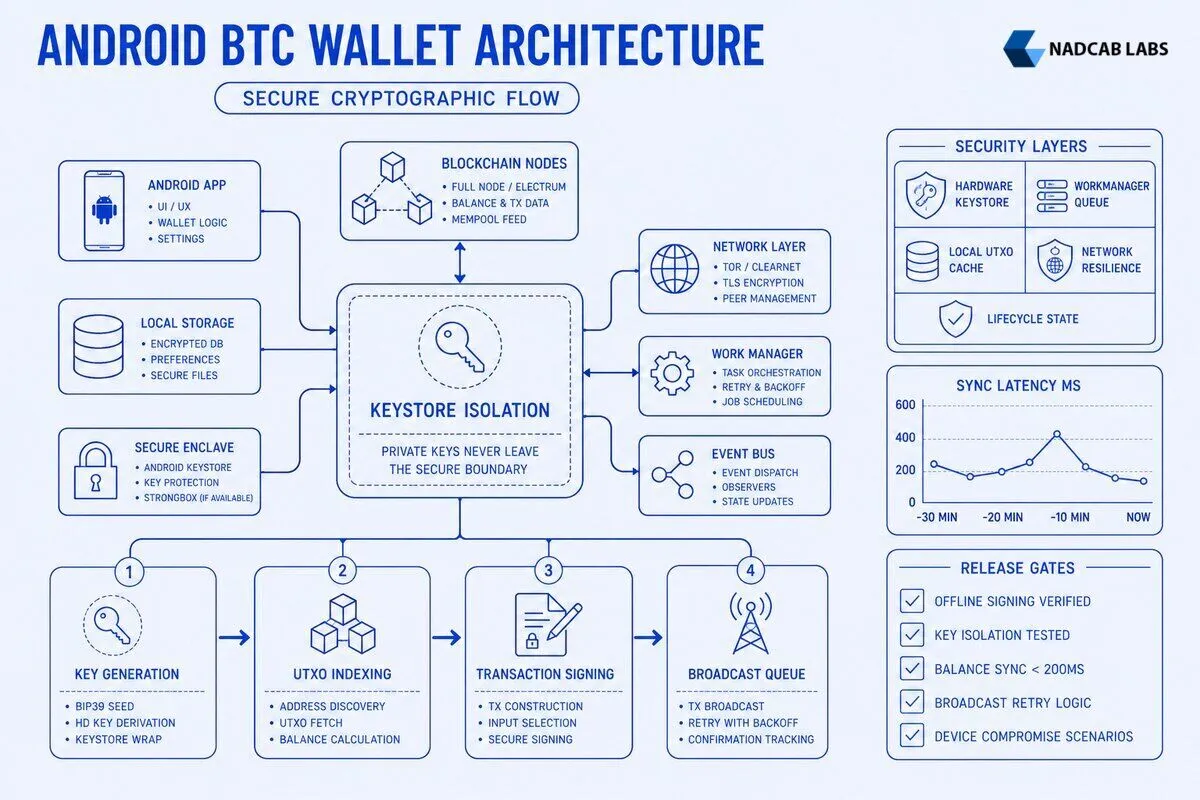
Activity lifecycle management for wallet sessions determines whether private keys remain protected during multitasking. The Android activity lifecycle transitions through onCreate, onStart, onResume, onPause, onStop, and onDestroy states. A secure wallet must treat onPause as a security boundary: when the user switches to another app or the screen turns off, the wallet Activity moves to onPause, and any decrypted key material in memory becomes vulnerable to memory dump attacks. The correct pattern is to clear all sensitive buffers (seed phrases, derived private keys, plaintext transaction data) in onPause and re authenticate the user in onResume before restoring session state. Background service constraints further complicate this: Android 8.0 (API 26) and later impose strict limits on background execution, killing services that run for more than a few minutes unless they display a persistent notification. A wallet syncing blockchain state in the background must use WorkManager for periodic tasks or a foreground service with a visible notification, accepting the UX trade off of user awareness versus silent background operation. android blockchain.
Android Keystore System integration provides hardware backed key generation, StrongBox isolation, and attestation verification for private key protection. The KeyStore API (android.security.keystore) allows the app to generate an asymmetric key pair (secp256k1 for Bitcoin) inside the TEE, where the private key never leaves hardware. The generation call specifies KeyGenParameterSpec with setUserAuthenticationRequired(true) and setUserAuthenticationValidityDurationSeconds(30), requiring biometric or PIN authentication before each signing operation and invalidating the key if the device lock screen is disabled. StrongBox, introduced in Android 9 (API 28), refers to a dedicated tamper resistant hardware module (often a separate chip) that provides stronger isolation than the main processor’s TEE. Attestation verification uses the Key Attestation API to prove the key was generated in hardware and has not been extracted; the app requests an attestation certificate chain, validates it against Google’s root certificate, and checks the attestationSecurityLevel field for TRUSTED_ENVIRONMENT or STRONGBOX. This verification step prevents malware from substituting a software generated key and claiming it is hardware backed. android blockchain.
Content Provider pattern for encrypted local transaction history enables efficient query and sync state management. A Content Provider (extending ContentProvider) exposes a SQLite database to other components within the app, enforcing URI based access control and supporting batch operations. For a Bitcoin wallet, the database schema includes tables for addresses (with derivation paths), UTXOs (with spent/unspent flags and confirmation counts), and transactions (with raw hex, block height, and timestamp). Encryption uses SQLCipher, a fork of SQLite that applies AES 256 encryption to the entire database file; the encryption key is stored in Android Keystore, decrypted on app launch after user authentication, and held in memory only while the database is open. Sync state management tracks the last scanned block height and the set of addresses to monitor; when the app resumes from background, it queries the blockchain node for new transactions affecting those addresses starting from the last scanned height. UTXO set caching reduces network calls: instead of querying the node for each UTXO’s confirmation status on every screen refresh, the app caches UTXO data locally and updates it during periodic sync intervals (every 15 minutes via WorkManager). The cache invalidation logic must handle reorgs: if a new block arrives that orphans a previously confirmed block, the app marks affected UTXOs as unconfirmed and re scans from the fork point. android blockchain.
Build Order: Wallet Component Implementation Sequence
Generate secp256k1 key pair in StrongBox; configure biometric auth gate; validate attestation certificate chain.
Create encrypted tables for addresses, UTXOs, transactions; store encryption key in Keystore; implement Content Provider.
onPause clears sensitive memory; onResume prompts biometric auth; FLAG_SECURE prevents screenshots.
Schedule periodic blockchain sync every 15 minutes; exponential backoff on network failure; reorg detection logic.
Failure modes in this architecture include Keystore key deletion (user disables lock screen, triggering automatic key invalidation), database corruption (app crash during write operation), and sync state desynchronization (user restores from seed on a second device, creating conflicting UTXO states). Detection strategies: the app checks KeyStore.containsAlias before attempting to sign, falling back to seed phrase re entry if the key is missing; SQLCipher’s WAL mode (Write Ahead Logging) provides atomic commits, reducing corruption risk; sync conflict resolution compares local and remote UTXO sets, marking discrepancies for manual review or automatic re scan from genesis. android blockchain.
Implementing BTC Transaction Signing and Broadcast in Android Apps
Building the signing flow starts with raw transaction construction, assembling inputs, outputs, and metadata into a byte array that conforms to Bitcoin’s serialization format. Each input references a previous transaction output (UTXO) by transaction ID and output index, specifies a script (initially empty for unsigned transactions), and includes a sequence number (0xFFFFFFFE for RBF enabled transactions). Each output contains a value in satoshis and a scriptPubKey (P2PKH, P2WPKH, or P2WSH). Input script assembly occurs after the unsigned transaction is hashed: for each input, the app replaces the empty script with the scriptPubKey of the UTXO being spent, hashes the transaction with the SIGHASH_ALL flag (0x01), and passes the hash to the Keystore signing API. SIGHASH flag handling determines which parts of the transaction are committed to the signature; SIGHASH_ALL commits to all inputs and outputs, preventing any modification post signature, while SIGHASH_ANYONECANPAY (0x81) allows additional inputs to be added later (useful for crowdfunding transactions). Witness data serialization for SegWit transactions (BIP 141) separates the signature and public key into a witness stack, reducing transaction size and enabling future script upgrades; the app constructs a witness structure with the signature and public key, appends it after the transaction outputs, and calculates the transaction weight (base size times 3 plus total size) to estimate fees accurately. android blockchain.
Network layer design balances decentralization, privacy, and reliability. Electrum server connections offer a lightweight alternative to running a full node: the app connects to an Electrum server (often electrum.blockstream.info or a self hosted instance) via TCP or SSL, sends JSON RPC requests for address history and UTXO data, and receives compact responses (typically under 10 KB per address). Full node RPC (Bitcoin Core’s JSON RPC interface) provides maximum trustlessness but requires the app to maintain a persistent connection to a node the user controls, introducing latency (200 to 500 milliseconds per call over the internet) and single point of failure risk if the node goes offline. Fee estimation APIs query the network for current mempool congestion and return a fee rate in satoshis per byte; the app multiplies this rate by the transaction’s virtual size (vsize) to calculate the total fee. Mempool monitoring tracks the transaction after broadcast: the app subscribes to the Electrum server’s blockchain.scripthash.subscribe method, receiving notifications when a transaction affecting a monitored address enters the mempool or confirms in a block. Broadcast retry logic with exponential backoff handles transient network failures: if the initial broadcast fails (connection timeout, server error), the app waits 2 seconds and retries, then 4 seconds, 8 seconds, capping at 60 seconds before alerting the user. android blockchain.
State management pitfalls emerge in complex transaction scenarios. Handling partial signatures in multi sig wallets requires the app to store incomplete transaction data (PSBT, BIP 174) and merge signatures from co signers; the PSBT format includes fields for unsigned transaction data, partial signatures, and derivation paths, allowing each signer to add their signature without reconstructing the transaction from scratch. Detecting double spend attempts involves monitoring the mempool for conflicting transactions (same input, different outputs); if the app observes a double spend, it marks the original transaction as potentially invalid and alerts the user. Managing unconfirmed parent transactions (a transaction spending an output from an unconfirmed transaction) requires tracking the dependency chain: if the parent transaction is dropped from the mempool due to low fees, the child transaction becomes invalid, and the app must re construct it with a higher fee or wait for the parent to confirm. android blockchain.
| Signing Component | Input Data | Output / Side Effect | Failure Mode |
|---|---|---|---|
| UTXO Selection | Target amount, fee rate, available UTXOs | Set of UTXOs totaling target plus fee | Insufficient funds; dust UTXOs inflate fee |
| Script Assembly | UTXO scriptPubKey, unsigned transaction | Transaction hash ready for signing | Wrong SIGHASH flag invalidates signature |
| Keystore Signing | Transaction hash, key alias | DER encoded signature | Biometric auth fails; key deleted by OS |
| Broadcast | Signed transaction hex | Transaction ID; mempool entry | Network timeout; node rejects (fee too low) |
The Best Crypto Wallet App implementations demonstrate these patterns in production: they construct transactions in a background coroutine to avoid blocking the UI thread, validate the transaction locally before broadcast (checking input amounts match outputs plus fee), and persist the signed transaction to the encrypted database before attempting network submission, ensuring the user can retry if the initial broadcast fails. android blockchain.
Offline First Design Patterns for Mobile Blockchain Applications
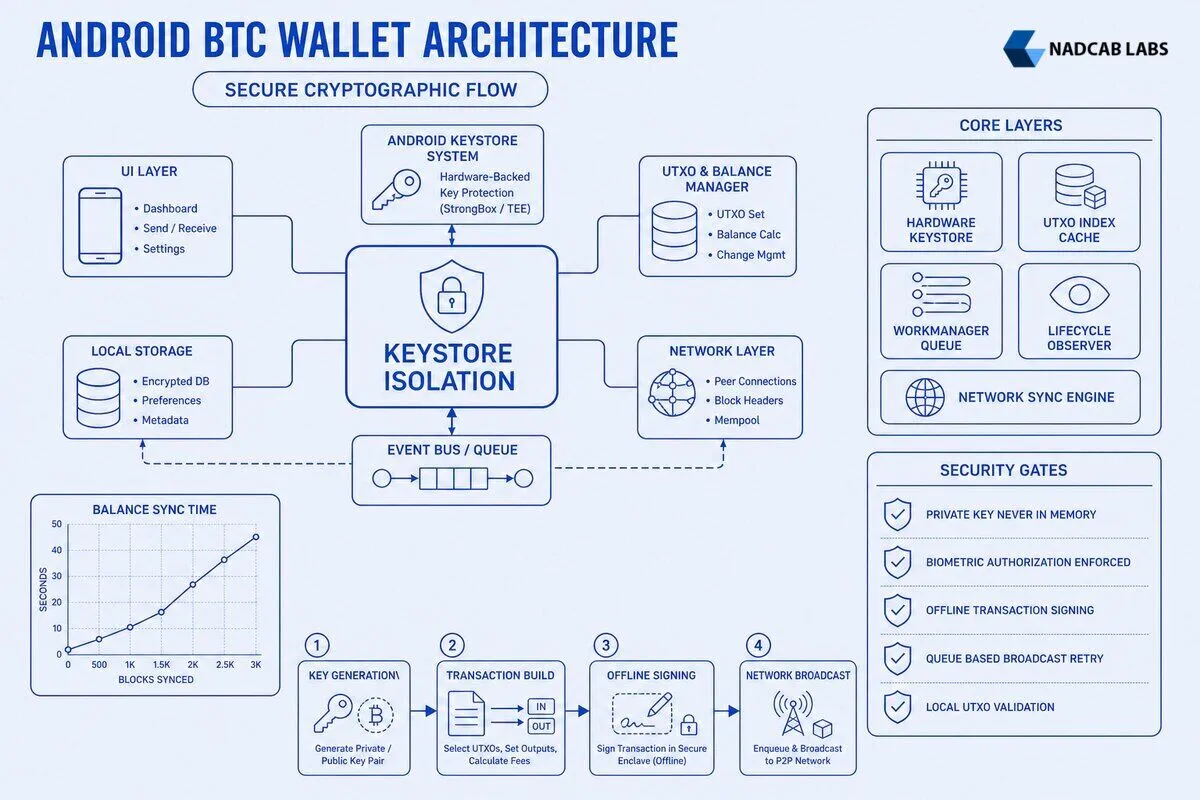
Local UTXO indexing enables balance calculation and transaction construction without network access. Bloom filter sync strategies (BIP 37) allow the app to send a compact representation of its addresses to a full node, which then streams only matching transactions; however, bloom filters leak privacy (the node learns which addresses the wallet monitors) and are disabled on many public nodes due to DoS risk. Compact block filters (BIP 157/158) invert the model: the node generates a filter for each block (a Golomb coded set containing all scriptPubKeys in the block), the app downloads these filters (approximately 20 KB per block), and locally checks if any of its addresses match; if a match is found, the app downloads the full block (1 to 2 MB) to extract relevant transactions. This approach balances privacy (the node does not learn which addresses the app monitors) versus bandwidth (downloading 20 KB per block for 800,000 blocks equals 16 GB, impractical on mobile). The practical compromise: the app downloads compact filters starting from the wallet’s earliest transaction (not genesis), reducing the filter set to a manageable size (under 1 GB for a wallet created in the last two years). android blockchain.
Queue based transaction submission uses WorkManager for deferred broadcast, ensuring transactions reach the network even if the user closes the app immediately after signing. The app enqueues a OneTimeWorkRequest with the signed transaction hex as input data; WorkManager persists this request to disk and schedules it for execution when network connectivity is available (using a Constraints object with setRequiredNetworkType(NetworkType.CONNECTED)). Conflict resolution when the device reconnects involves checking the mempool for the transaction ID: if the transaction is already confirmed, the WorkManager task marks it complete and updates the local database; if the transaction is not found (possibly dropped due to low fees), the task re broadcasts it or prompts the user to replace it with a higher fee version (RBF, BIP 125). Nonce/sequence number coordination matters for Ethereum based wallets but is less critical for Bitcoin; however, RBF enabled transactions must increment the sequence number and increase the fee to signal replacement, and the app must track which version of the transaction is currently in the mempool to avoid broadcasting stale versions. android blockchain.
Edge case handling separates production grade wallets from prototypes. Wallet recovery from seed during airplane mode requires the app to derive addresses deterministically (BIP 32/44) without querying the blockchain; the user enters their 12 or 24 word seed phrase, the app generates the first 20 addresses in the derivation path, and displays a zero balance with a warning that synchronization is pending. Detecting stale blockchain state occurs when the app has been offline for an extended period (days or weeks); the local block height is compared to the current network height (obtained from a block explorer API or Electrum server), and if the gap exceeds a threshold (e.g., 1000 blocks), the app triggers a full re scan from the last known good block. User notification design for pending vs confirmed states must distinguish between zero confirmations (transaction in mempool, reversible), one confirmation (included in latest block, low reorg risk), and six confirmations (considered final for most use cases); the UI displays a progress indicator (0/6 confirmations) and updates in real time as new blocks arrive. android blockchain.
Offline Transaction Flow: User Journey
App parses BIP 21 URI, extracts recipient address and amount; validates address checksum locally.
Query encrypted SQLite for unspent outputs; select UTXOs totaling amount plus estimated fee (cached fee rate from last sync).
Build unsigned transaction; hash with SIGHASH_ALL; call Keystore to sign (biometric prompt); assemble signed transaction.
Save signed transaction hex to encrypted database; enqueue WorkManager task with network connectivity constraint.
WorkManager executes broadcast task; Electrum server accepts transaction; app receives transaction ID and mempool confirmation.
The Web3 crypto Wallet pattern extends this offline first design to multi chain scenarios, where the app must manage UTXO state for Bitcoin, account nonces for Ethereum, and transaction history for each chain independently, all while maintaining a unified UX that abstracts chain specific details from the user. android blockchain.
Production Validation and QA Gates for Android Crypto Wallets
Security audit checklist begins with key extraction attack surface testing. The auditor attempts to extract private keys using root access, memory dump tools (e.g., Frida, objection), and debugger attachment; a properly configured Keystore key should resist all these attacks, with signing operations failing if the device is rooted or the bootloader is unlocked (detected via SafetyNet or Play Integrity API). Root detection bypasses are common: malware can hide root status using Magisk Hide or kernel level hooks, so the app must implement multiple detection layers (checking for su binary, Magisk app package, known root management apps) and fail closed if any check is inconclusive. Memory dump analysis for leaked mnemonics involves scanning the app’s heap and native memory for 12 or 24 word seed phrases; the app should never hold the seed phrase in plaintext beyond the initial entry screen, immediately deriving the master key and storing it in Keystore, then zeroing the seed phrase buffer. android blockchain.
Device fragmentation testing matrix covers Keystore API level differences, manufacturer specific TEE implementations, and low memory device behavior. API level 23 introduced hardware backed keys but lacked StrongBox and key attestation; API level 28 added StrongBox and improved attestation; API level 31 (Android 12) introduced BiometricPrompt enhancements and stricter background execution limits. The test matrix includes at least one device from each API level (e.g., Samsung Galaxy S7 on API 23, Pixel 3 on 28, Pixel 6 on 31) and verifies that key generation, signing, and attestation work correctly on each. Manufacturer specific TEE implementations vary: Samsung devices use Knox, Huawei uses TrustZone, and some low cost devices lack hardware backed Keystore entirely (falling back to software emulation). The app must detect the attestationSecurityLevel and warn the user if hardware backing is unavailable. Low memory device behavior (devices with 2 GB RAM or less) triggers aggressive process killing; the app must persist transaction state to disk before every network call and resume gracefully from onCreate if the process is killed mid operation. android blockchain.
Release criteria establish objective gates before mainnet deployment. Testnet transaction round trips verify the full signing and broadcast flow: the app constructs a transaction on Bitcoin testnet, signs it with a Keystore key, broadcasts it to a testnet Electrum server, and confirms the transaction appears in a block within 20 minutes. Mainnet small value pilot involves sending a real Bitcoin transaction worth 0.0001 BTC (approximately $4 at current prices) to a controlled address, confirming it on chain, and verifying the app displays the correct balance and transaction history. Crash free rate thresholds (measured via Firebase Crashlytics or similar) must exceed 99.5% for the wallet Activity and 99.9% for the signing and broadcast code paths; any crash in these critical paths triggers a release hold and root cause analysis. Play Store security review preparation includes completing the Data Safety form (declaring that the app stores private keys locally and uses encryption), providing a privacy policy that explains key storage and network communication, and ensuring the app does not request unnecessary permissions (e.g., READ_CONTACTS, ACCESS_FINE_LOCATION) that could raise red flags during review.
QA Gate Checklist: Pre Release Validation
The Cryptocurrency Wallet Technology Stack for production Android apps includes automated testing frameworks (Espresso for UI tests, Robolectric for unit tests that mock Keystore), continuous integration pipelines that run the full test suite on every commit, and staged rollout strategies (releasing to 1% of users, monitoring crash rates for 48 hours, then expanding to 10%, 50%, 100%). Relative to web based wallets, native Android apps face stricter validation requirements due to the Play Store’s security review process and the higher user expectation for reliability in financial applications.
When evaluating whether to build in house or partner with specialists, teams should consider the private blockchain deployment cost trade offs: a custom wallet implementation requires 6 to 12 months of development time (including security audits and device testing), while integrating a pre built SDK (e.g., WalletConnect, Trust Wallet Core) reduces time to market but introduces dependency risk and potential licensing costs. The decision criteria hinge on control requirements (does the app need custom transaction logic or multi sig schemes?), maintenance capacity (can the team respond to critical security patches within 24 hours?), and user trust (will users accept a third party SDK handling their private keys?).
For teams seeking expert guidance on secure wallet integration, Android Application Development services from blockchain native firms provide end to end implementation support, from Keystore configuration through Play Store submission, ensuring compliance with both Android security best practices and cryptocurrency specific threat models. The Crypto Wallet Apps on Aptos case studies illustrate how similar patterns (hardware backed keys, offline signing, queue based broadcast) apply across different blockchain ecosystems, with chain specific adaptations for account models, gas estimation, and finality semantics.
Building a production grade Bitcoin wallet on Android demands micro level understanding of cryptographic APIs, lifecycle management, and network resilience. The data points to a clear path: hardware backed key storage prevents extraction, offline first architecture enables transaction construction without network dependency, and rigorous device fragmentation testing ensures reliability across the Android ecosystem. Teams shipping wallet features as part of larger applications (fintech apps, gaming platforms, social networks) benefit from isolating wallet logic into a dedicated module with strict API boundaries, allowing independent security audits and version updates without destabilizing the broader app. The next step for practitioners is to prototype the core signing flow on a testnet device, validate Keystore integration with attestation checks, and establish a device testing matrix before committing to mainnet deployment. For comprehensive implementation support, explore Building a Secure Crypto Wallet Browser Extension: Complete Architecture Guide for Chrome, Firefox & All Browsers for cross platform wallet architecture patterns that complement mobile native implementations.
Frequently Asked Questions
Q1.What is the safest way to store Bitcoin private keys on Android devices?
Use Android Keystore System with StrongBox hardware backed keys (TEE or Secure Element). Generate keys inside the Keystore boundary via KeyGenParameterSpec with setUserAuthenticationRequired(true) so biometric or PIN gates every signing operation. Never serialize raw private keys to SharedPreferences or files. For seed phrases, encrypt with a Keystore wrapped AES key before persisting, and wipe plaintext from memory immediately. Hardware wallets via USB OTG or NFC add another isolation layer for high value holdings.
Q2.How do I implement offline transaction signing in an Android Bitcoin wallet?
Build a watch only wallet that constructs unsigned PSBTs (Partially Signed Bitcoin Transactions) from UTXOs and recipient addresses. Export the PSBT via QR code or NFC to an air gapped signing device holding the private keys. The signer parses inputs, validates outputs and fee, signs with ECDSA, then returns the signed PSBT. The online wallet deserializes, finalizes, and broadcasts to nodes. Use libraries like BitcoinJ or rust bitcoin bindings for PSBT serialization and script verification.
Q3.What are the main security risks when building Android blockchain wallets?
Screen overlays and accessibility service malware can intercept addresses or PIN entry. Rooted devices bypass Keystore hardware attestation, exposing keys to memory dumps. Clipboard hijacking replaces copied addresses with attacker wallets. Insecure RNG during key generation produces predictable private keys. Man in the middle attacks on unverified node connections let attackers feed fake UTXO sets or censor transactions. Side channel attacks on biometric sensors may leak authentication state. Always validate address checksums client side and use certificate pinning for node TLS.
Q4.How does Android Keystore protect cryptocurrency private keys from extraction?
Keystore delegates key generation and signing to a Trusted Execution Environment or dedicated Secure Element chip, isolated from Android OS. Private key material never enters application memory; your app submits data to sign, the TEE performs ECDSA inside its boundary, and returns only the signature. Hardware attestation certificates prove keys were generated in tamper resistant hardware. Even root access cannot dump keys because they reside in a separate processor with encrypted storage and anti rollback fuses.
Q5.What network architecture should I use for Android BTC wallet apps?
Run an Electrum style SPV client connecting to multiple Electrum servers over TLS with certificate pinning. The app downloads block headers (80 bytes each) and requests merkle proofs for relevant transactions, avoiding full blockchain storage. Use Tor or a VPN to prevent IP address correlation with wallet addresses. For enterprise wallets, deploy your own Electrum server cluster backed by Bitcoin Core full nodes to eliminate third party trust. Implement exponential backoff and peer rotation to handle server downtime without losing sync state.
Q6.How do I handle blockchain synchronization on mobile devices with limited bandwidth?
Adopt BIP 157/158 compact block filters: download 20 KB filter per block, check locally if any transactions match your addresses, then fetch only relevant full blocks. Cache filters on device and resume from last synced height. For initial sync, use a checkpoint hash hardcoded in the app to skip verification of ancient blocks. Offer a manual sync mode that pauses when off WiFi. Prune old transaction history client side, keeping only recent UTXOs and a rolling 2016 block header window for difficulty validation.
Explore Services
Related Services
Reviewed by

Wazid Khan
Director & Co-Founder
Wazid Khan is the Director & Co-Founder of Nadcab Labs, a forward-thinking digital engineering company specializing in Blockchain, Web3, AI, and enterprise software solutions. With a strong vision for innovation and scalable technology, Wazid has played a key role in building Nadcab Labs into a trusted global technology partner. His expertise lies in strategic planning, business development, and delivering client-centric solutions that drive real-world impact. Under his leadership, the company has successfully delivered numerous projects across industries such as fintech, healthcare, gaming, and logistics. Wazid is passionate about leveraging emerging technologies to create secure, efficient, and future-ready digital ecosystems for businesses worldwide.