Ai Overview
Cross-layer messaging in modular blockchains solves the fundamental challenge of enabling trustless communication between separated execution, consensus, data availability, and settlement layers. Unlike monolithic chains where all functions share a single state machine, modular architectures require specialized protocols—such as the Inter-Blockchain Communication (IBC) standard and various bridge patterns—to relay messages, verify state proofs, and coordinate transactions across independently operating layers.
Cross-layer messaging in modular blockchains solves the fundamental challenge of enabling trustless communication between separated execution, consensus, data availability, and settlement layers. Unlike monolithic chains where all functions share a single state machine, modular architectures require specialized protocols—such as the Inter-Blockchain Communication (IBC) standard and various bridge patterns—to relay messages, verify state proofs, and coordinate transactions across independently operating layers. This technical architecture guide explains how these interoperability mechanisms work, which security models protect cross-layer transfers, and what infrastructure teams need to deploy robust messaging systems in production modular environments.
Key Takeaways
- Modular blockchain interoperability requires specialized cross-layer messaging protocols because execution, consensus, data availability, and settlement layers operate as independent state machines.
- IBC protocol enables trustless communication through light client verification, state proof validation, and packet relay mechanisms across heterogeneous modular chains.
- Bridge security models—optimistic, zero-knowledge proof, and validator-based—offer different trust assumptions and latency tradeoffs for connecting modular layers.
- Synchronous and asynchronous messaging patterns serve distinct use cases: atomic transactions for execution-settlement coordination versus event-driven queues for data availability integration.
- Relayer node infrastructure, validator set coordination, and continuous monitoring form the operational backbone of production cross-layer messaging systems.
- State proof verification techniques—Merkle proofs, fraud proofs, validity proofs—provide cryptographic guarantees that messages originated from legitimate source chains without requiring full node validation.
What is cross-layer messaging in modular blockchain architectures?
Cross-layer messaging refers to the protocols and mechanisms that enable communication between the distinct functional layers of a modular blockchain system. In a modular design, execution (where smart contracts run), consensus (where validators agree on state), data availability (where transaction data is published and stored), and settlement (where final state commitments are anchored) operate as separate, specialized layers. Each layer maintains its own state machine, validator set, and security model. This separation creates a fundamental challenge: how can a transaction initiated on an execution layer trustlessly interact with a settlement layer, or how can data availability proofs be verified by consensus validators without introducing centralized intermediaries?
The core difference from monolithic chain interoperability is architectural. Monolithic blockchains like Ethereum pre-merge bundled all four functions into a single chain, so “cross-chain” communication meant connecting entirely separate networks with no shared security. Modular stacks, by contrast, often share security assumptions across layers—a rollup execution layer may derive its security from an Ethereum settlement layer—but still require explicit messaging protocols to move state and assets between layers. This creates a hybrid trust model: layers may share validators or finality guarantees, yet each maintains independent state roots that must be cryptographically verified during message passing.
Trust assumptions in cross-layer messaging determine security guarantees. A fully trustless system relies on cryptographic proofs—Merkle inclusion proofs, fraud proofs, or zero-knowledge validity proofs—to verify that a message originated from the claimed source layer and reflects accurate state. Semi-trusted systems may use validator committees or multi-signature schemes where a subset of participants attest to cross-layer messages, introducing liveness and censorship risks if validators collude. The choice of trust model directly impacts latency, cost, and attack surface: trustless proof verification requires on-chain computation and storage for state roots, while validator attestations reduce overhead but concentrate risk in the signer set.
Security models also differ based on finality characteristics. Consensus layers with instant finality (like Tendermint-based chains) can provide immediate cross-layer message confirmation, whereas probabilistic finality chains (like Ethereum’s Gasper) require waiting for sufficient block confirmations before considering a message irreversible. This finality gap creates challenges for atomic cross-layer transactions: if an execution layer commits to a state change based on a settlement layer message that later reorganizes, the execution layer must handle rollback logic or accept the risk of inconsistent state. Effective cross-layer messaging protocols must account for these finality differences through timeout mechanisms, challenge periods, or conditional execution patterns.
Practical modular architectures employ multiple messaging patterns simultaneously. A rollup might use optimistic fraud proofs for execution-to-settlement state commitments (posting compressed transaction batches to Ethereum), IBC for peer-to-peer communication with other Cosmos SDK chains, and a dedicated data availability sampling protocol to verify that transaction data was published to Celestia. Each pattern serves a specific layer interaction: state commitments anchor execution layer state on settlement layers, peer messaging enables cross-chain asset transfers, and data availability proofs ensure execution layers can reconstruct state from published data. Understanding which pattern fits which layer interaction is essential for designing robust layer separation in blockchain systems.
How does the Inter-Blockchain Communication (IBC) protocol enable modular interoperability?
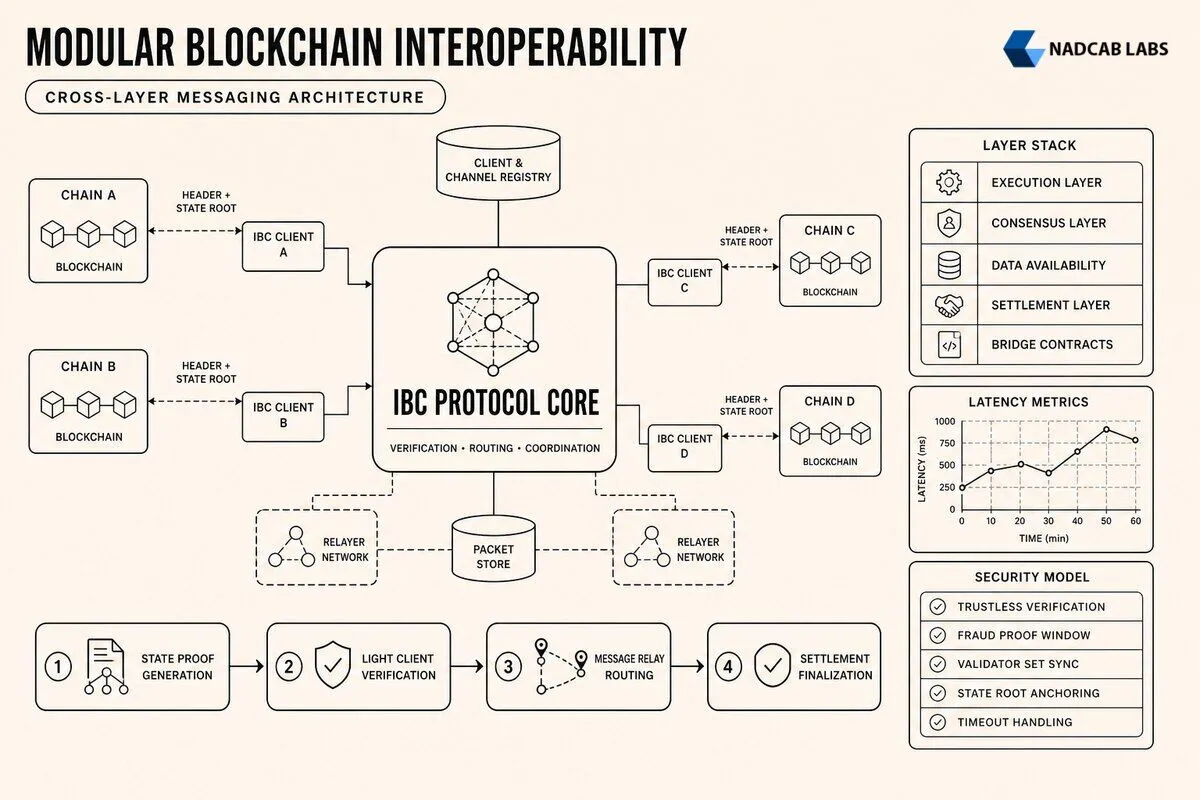
The IBC protocol provides a standardized framework for trustless communication between independent blockchains, including modular layers that operate as sovereign chains. IBC’s architecture consists of four core components: clients, connections, channels, and packet relays. A client is an on-chain light client that tracks the consensus state of a counterparty chain—storing validator set hashes, block headers, and state roots—without running a full node. Connections establish authenticated links between two chains by verifying each chain’s client state through a handshake process. Channels sit atop connections and define application-level communication pathways, such as token transfers or cross-chain contract calls. Packet relays are off-chain processes run by relayer nodes that physically move messages between chains by submitting transactions to both source and destination chains.
Light client verification is the cryptographic foundation of IBC’s trustlessness. When Chain A sends a message to Chain B, Chain B’s on-chain light client of Chain A verifies that the message was included in a finalized block by checking a Merkle proof against the stored state root. This verification requires Chain B to maintain up-to-date knowledge of Chain A’s consensus state, which relayers update by submitting new block headers and validator set changes. The light client validates these headers using the last known validator set’s signatures, ensuring that only legitimate consensus-approved state transitions are accepted. This approach eliminates the need for trusted intermediaries: the on-chain light client itself performs cryptographic verification, and relayers are untrusted message couriers that cannot forge proofs.
State proof validation across heterogeneous modular chains introduces complexity because different consensus mechanisms produce different proof formats. A Tendermint-based consensus layer generates compact block headers with validator signatures, while an Ethereum settlement layer produces Merkle Patricia Trie proofs for account and storage state. IBC accommodates this heterogeneity through modular client implementations: each chain type (Tendermint, Ethereum, Polkadot) has a dedicated light client specification that knows how to verify that chain’s specific proof format. For example, an IBC connection between a Cosmos SDK execution layer and an Ethereum settlement layer would deploy a Tendermint light client on Ethereum (to verify Cosmos headers) and an Ethereum light client on Cosmos (to verify Ethereum state roots). This bidirectional verification ensures both chains can trustlessly validate messages from the counterparty.
Practical implementation patterns for IBC in Cosmos SDK-based modular ecosystems leverage the SDK’s native IBC module, which provides pre-built client, connection, and channel handlers. Developers building a modular stack with Cosmos SDK for execution and Celestia for data availability can establish an IBC channel between the execution chain and other Cosmos chains by configuring the IBC module with the appropriate client parameters (chain ID, trust level, unbonding period). The execution chain’s IBC module maintains light clients for each connected chain, and relayers monitor both chains for new packets to relay. For cross-layer messaging within the same modular stack—such as an execution layer communicating with its settlement layer—teams often implement custom IBC applications that define specific packet structures for state commitments, data availability proofs, or validator set updates, ensuring that cross-layer messages conform to the IBC packet lifecycle (send, receive, acknowledge, timeout).
IBC’s packet relay mechanism handles message delivery guarantees through a combination of acknowledgments and timeouts. When a source chain sends a packet, it stores a commitment hash of the packet data. The destination chain, upon receiving and processing the packet, sends an acknowledgment back to the source. The source chain verifies the acknowledgment proof and clears the commitment. If the destination chain does not process the packet within a specified timeout period, the source chain can prove the timeout and execute rollback logic (such as refunding tokens). This design ensures that packets are either successfully delivered and acknowledged or provably timed out, preventing funds from being locked indefinitely. For modular blockchains, this guarantee is critical when coordinating state changes across execution and settlement layers: if a settlement layer fails to finalize an execution layer’s state commitment within the timeout window, the execution layer can revert the pending state and retry or escalate to a fallback mechanism.
| IBC Component | Function | Trust Model | Typical Latency |
|---|---|---|---|
| Light Client | Tracks counterparty chain consensus state and validates block headers | Trustless (cryptographic proof verification) | Header update every 6-12 seconds |
| Connection | Establishes authenticated bidirectional link between two chains | Trustless (verified via light client handshake) | One-time setup: 30-60 seconds |
| Channel | Application-level pathway for specific message types (tokens, contract calls) | Trustless (inherits connection security) | One-time setup: 20-40 seconds |
| Packet Relay | Off-chain process that submits messages and proofs to both chains | Untrusted (relayer cannot forge proofs, only courier role) | Message delivery: 10-30 seconds per hop |
| Acknowledgment | Destination chain confirms receipt and processing of packet | Trustless (cryptographic proof of acknowledgment) | Round-trip confirmation: 20-60 seconds |
What are the core bridge security models for connecting modular blockchain layers?
Bridge security models define the trust assumptions and verification mechanisms that protect asset transfers and message passing between modular blockchain layers. Optimistic bridges assume messages are valid by default and rely on fraud proofs to challenge invalid state transitions during a dispute period. A rollup execution layer posting state commitments to an Ethereum settlement layer typically uses an optimistic bridge: the execution layer submits a state root, and any observer can submit a fraud proof within a seven-day challenge window if the state root is incorrect. This model minimizes on-chain computation (the settlement layer does not re-execute transactions) but introduces latency due to the challenge period. Optimistic bridges work well for execution-to-settlement communication where finality can tolerate delays, but they are vulnerable to data withholding attacks if the execution layer does not publish sufficient transaction data for fraud proof generation.
Zero-knowledge proof bridges replace optimistic assumptions with cryptographic validity proofs that prove correct execution before state transitions are accepted. A ZK-rollup execution layer generates a succinct proof (SNARK or STARK) that its state transition from root R1 to R2 followed the protocol rules, and the settlement layer verifies this proof on-chain. Verification cost is constant regardless of transaction count (a single proof covers thousands of transactions), and finality is immediate—no challenge period is needed because the proof itself guarantees correctness. ZK bridges offer superior security and latency compared to optimistic bridges but require significant prover infrastructure: generating proofs for complex smart contract execution demands specialized hardware and can take minutes per batch. For modular stacks prioritizing fast finality and maximum security, ZK bridges are the preferred choice despite higher operational costs.
Validator-based bridges rely on a trusted or semi-trusted set of validators to attest to cross-layer messages. A common pattern is a multi-signature bridge where M-of-N validators must sign a message before it is accepted on the destination layer. This model is simpler to implement than proof-based bridges and offers low latency (validators can sign messages in seconds), but it introduces centralization risk: if M validators collude or are compromised, they can authorize fraudulent messages. Validator-based bridges are often used for connecting modular layers with shared security (where the same validator set secures both layers) or for low-value message passing where the cost of proof generation outweighs the risk. For high-value asset transfers or critical state commitments, proof-based bridges (optimistic or ZK) are generally preferred to minimize trust assumptions.
State proof verification techniques underpin all bridge security models. Merkle proofs allow a destination layer to verify that a specific transaction or state value was included in a source layer’s state tree without downloading the entire state. The source layer publishes a Merkle root, and the prover submits the value plus a Merkle path (sibling hashes from the value to the root). The destination layer recomputes the root from the path and compares it to the published root—if they match, the value is proven to exist in the source state. Fraud proofs extend this concept: if a rollup execution layer publishes an incorrect state root, a challenger submits a fraud proof consisting of the pre-state, transaction, and post-state, and the settlement layer re-executes the transaction to verify the challenger’s claim. Validity proofs (ZK proofs) take a different approach: instead of proving a specific value’s inclusion, they prove that the entire state transition was computed correctly according to the protocol’s rules, providing a stronger guarantee than fraud proofs.
Attack vectors specific to modular blockchain bridge architectures include data availability attacks, eclipse attacks on light clients, and validator set takeover. A data availability attack occurs when an execution layer publishes a state root to a settlement layer but withholds the underlying transaction data, preventing fraud proof generation. Modular designs mitigate this by separating data availability into a dedicated layer (like Celestia) and requiring execution layers to prove data was published before the settlement layer accepts state roots. Eclipse attacks target light clients by feeding them false block headers; an attacker controlling a victim’s network peers can present a fake chain with valid-looking headers. IBC mitigates this through social consensus and client diversity: light clients require a threshold of validator signatures, and operators monitor multiple independent sources for header consistency. Validator set takeover attacks exploit bridges where a small validator set controls message attestation; if attackers acquire enough stake or compromise enough keys, they can authorize arbitrary messages. Proof-based bridges eliminate this vector by replacing validator attestation with cryptographic proofs that do not depend on any trusted party.
Bridge Security Model Process Flow
Source layer creates message and publishes state commitment
Merkle proof, fraud proof, or ZK validity proof created
Relayer submits proof to destination layer for on-chain verification
Destination layer accepts message and updates state or waits for challenge period
Mitigation strategies for modular bridge architectures combine cryptographic guarantees, economic incentives, and operational best practices. For data availability, execution layers must prove data publication to a dedicated DA layer before settlement layers accept state roots—this pattern is standard in cross-chain bridge designs for rollups. For light client security, operators run multiple independent light client implementations and compare state roots across clients to detect eclipse attempts. For validator-based bridges, teams implement slashing conditions where validators lose staked collateral if they sign fraudulent messages, and they rotate validator sets regularly to limit the window for collusion. Additionally, bug bounties, formal verification of bridge contracts, and continuous security audits reduce the risk of implementation flaws that attackers could exploit to bypass proof verification logic.
Which cross-chain messaging patterns best suit different modular blockchain configurations?
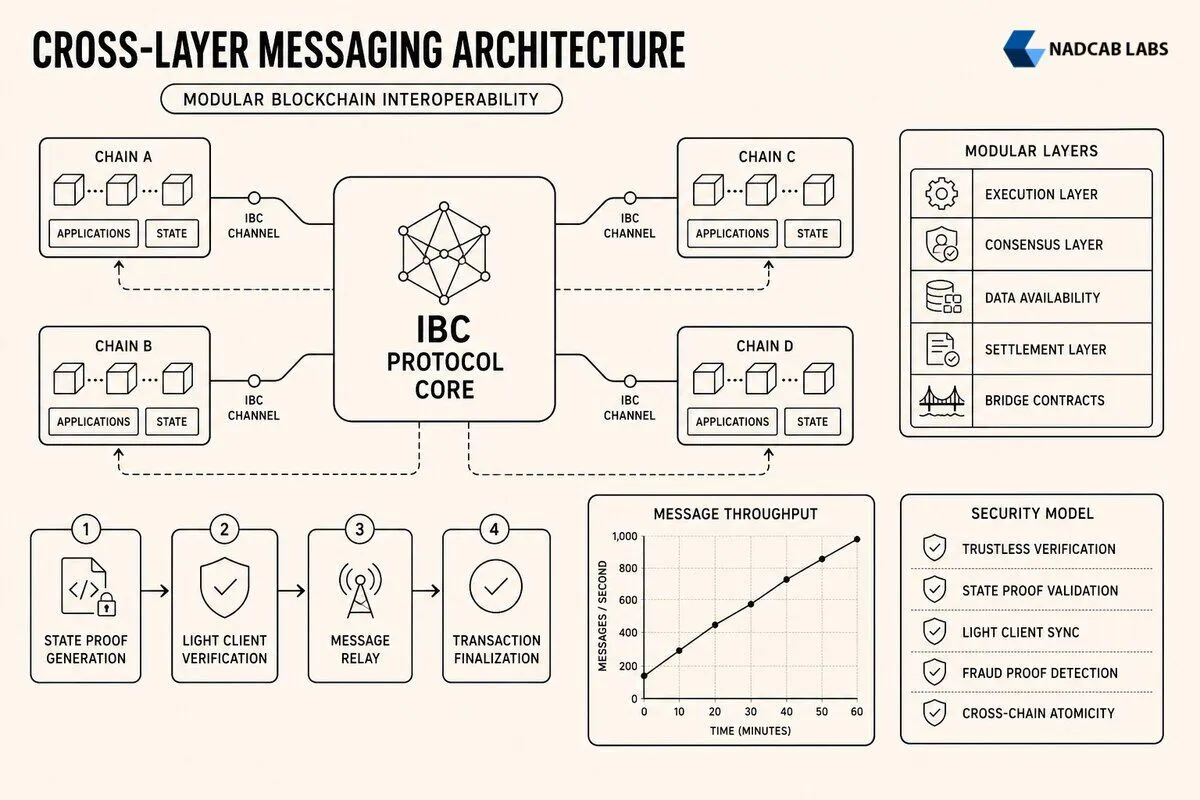
Synchronous messaging patterns enable atomic cross-layer transactions where state changes on multiple layers either all succeed or all fail together. In a modular stack with an execution layer and a settlement layer, a synchronous pattern might involve the execution layer locking user funds, sending a message to the settlement layer, waiting for confirmation, and then finalizing the state change only if the settlement layer acknowledges success. This pattern requires both layers to remain online and responsive during the transaction lifecycle, and it introduces latency proportional to the slowest layer’s block time. Synchronous messaging is ideal for use cases requiring strong consistency guarantees, such as cross-layer asset transfers where partial execution would leave funds locked or create double-spend opportunities. However, it is less suitable for high-throughput scenarios because each message creates a blocking dependency that limits parallelism.
Asynchronous messaging patterns decouple message sending from message processing, allowing the source layer to continue operating without waiting for the destination layer’s response. An execution layer can emit events or enqueue messages for a data availability layer, and relayers process these messages at their own pace. If a message fails, the source layer is not blocked—it can retry, log the failure, or trigger compensating logic. Asynchronous patterns are essential for integrating data availability layers because DA layers operate on different finality timelines than execution layers: an execution layer may produce blocks every two seconds, while the DA layer batches and publishes data every thirty seconds. Event-driven architectures built on asynchronous messaging enable modular layers to operate independently while still coordinating state through eventual consistency models.
Event-driven architectures and message queuing patterns are particularly effective for data availability layer integration. An execution layer emits transaction batches as events, and a dedicated publisher service subscribes to these events, aggregates them into blobs, and submits them to the DA layer. The DA layer returns a data availability proof (a Merkle root or commitment), which the publisher relays back to the execution layer. This pattern decouples execution throughput from DA latency: the execution layer can continue producing blocks while the publisher handles DA submission in the background. Message queues (such as Kafka or RabbitMQ in off-chain infrastructure) buffer events during periods of high load or DA layer congestion, ensuring that no transaction data is lost even if the DA layer experiences temporary downtime. For production private blockchain architecture design patterns, event-driven integration with DA layers is a standard approach.
Atomic cross-layer transactions in modular environments require careful coordination of commit and rollback logic across layers. A two-phase commit protocol is one approach: the execution layer prepares a state change and sends a prepare message to the settlement layer. The settlement layer validates the message and responds with a prepared acknowledgment. Only after receiving this acknowledgment does the execution layer commit the state change. If the settlement layer rejects the message or times out, the execution layer rolls back the prepared state. This pattern ensures atomicity but introduces significant latency (two round-trips between layers) and complexity (both layers must maintain transaction logs for rollback). An alternative approach uses compensating transactions: the execution layer commits optimistically, and if the settlement layer later rejects the state, the execution layer executes a compensating transaction to reverse the original change. This reduces latency but requires application-level logic to handle compensation correctly.
Rollback handling in modular environments must account for finality differences between layers. If an execution layer commits a state change based on a settlement layer message that later reorganizes due to a chain reorg, the execution layer must detect the reorg and revert the state change. Modular designs mitigate this risk by waiting for sufficient finality on the settlement layer before processing messages: for example, an execution layer might wait for 64 Ethereum blocks (approximately 13 minutes) before considering a settlement layer message irreversible. For faster finality, teams can use instant-finality consensus mechanisms (like Tendermint) on the settlement layer, eliminating the reorg risk entirely. Rollback handling also requires maintaining state checkpoints: if a cross-layer transaction fails midway, the execution layer must restore state to the last consistent checkpoint rather than attempting to reverse individual operations, which may have cascading dependencies.
Messaging Pattern Suitability by Configuration
Choosing the right messaging pattern depends on the specific modular configuration and use case requirements. For a rollup execution layer posting state commitments to an Ethereum settlement layer, an asynchronous pattern with optimistic commits and fraud proof challenges is standard—latency is acceptable (7-day challenge period), and throughput is maximized by not blocking execution on settlement confirmation. For a cross chain swap between two execution layers sharing a settlement layer, a synchronous atomic swap pattern ensures that both sides of the trade complete or neither does, preventing partial execution. For integrating a Celestia data availability layer with a Cosmos SDK execution layer, an event-driven asynchronous pattern with message queuing handles the throughput mismatch between fast execution blocks and slower DA batching. Understanding these tradeoffs allows architects to design modular stacks that balance consistency, latency, and throughput for their specific application requirements.
What infrastructure and validator requirements support robust cross-layer messaging?
Relayer node architecture forms the operational backbone of cross-layer messaging systems. A relayer is an off-chain process that monitors multiple blockchain layers, detects pending messages or state changes, constructs proofs, and submits transactions to destination layers to relay those messages. For IBC-based systems, relayers run light clients for each connected chain, subscribe to block events, and maintain a queue of packets to relay. A production relayer setup typically includes redundant relayer instances running in different geographic regions to ensure high availability—if one relayer goes offline, others continue processing messages. Relayers also require access to RPC endpoints for all connected chains, sufficient gas funds to pay transaction fees on destination chains, and monitoring infrastructure to track message delivery success rates and latency.
Incentive mechanisms for relayers vary across modular architectures. In IBC, relayers are not directly compensated by the protocol—they operate altruistically or are funded by the chains they serve (chain foundations often run relayers to ensure connectivity). Some modular stacks implement fee markets where users include relayer fees in cross-layer messages, and relayers compete to relay high-fee messages first. This market-based approach ensures relayer sustainability but introduces complexity: users must estimate appropriate fees, and relayers must implement fee prioritization logic. An alternative model is validator-operated relayers, where the same entities securing the consensus layer also run relayers as part of their validator responsibilities. This aligns incentives (validators are already economically invested in the chain’s success) but concentrates relayer operation among a smaller set of participants, potentially reducing decentralization.
Operational costs for maintaining cross-layer bridges include infrastructure expenses, gas fees, and labor. A relayer monitoring ten chains requires ten RPC endpoints (either self-hosted full nodes or third-party RPC services), each costing $100-500 per month for reliable infrastructure. Gas fees can be substantial: relaying a single IBC packet involves submitting transactions to both source and destination chains, and during periods of high congestion on Ethereum or other high-fee chains, a single message relay can cost $50-200 in gas. For a bridge relaying hundreds of messages per day, monthly gas costs can reach thousands of dollars. Labor costs include DevOps engineers to maintain relayer infrastructure, monitor for failures, and upgrade relayer software when protocol changes occur. For teams building modular stacks, budgeting for relayer operation is essential—underfunded relayer infrastructure leads to message delivery delays, user complaints, and potential security incidents if messages time out.
Validator set coordination across modular blockchain layers ensures that state transitions on one layer are recognized and validated by other layers. In a shared security model (like Cosmos Hub’s Interchain Security or Ethereum’s restaking), the same validator set secures multiple layers, and cross-layer messages can rely on the assumption that validators will not collude to attack their own chains. Coordination involves synchronizing validator set updates: when validators join or leave the consensus layer, the execution and settlement layers must update their light clients to reflect the new validator set. This synchronization typically happens through governance-approved transactions or automated relayers that detect validator set changes and submit update transactions. Failure to synchronize validator sets can break cross-layer messaging: if a settlement layer’s light client still expects signatures from old validators who have unbonded, it will reject messages signed by the new validator set.
Finality guarantees across modular layers determine how quickly cross-layer messages can be considered irreversible. Instant-finality consensus mechanisms (Tendermint, HotStuff) provide deterministic finality within seconds: once a block is finalized, it cannot be reverted. This allows cross-layer messages to be processed with minimal delay—an execution layer can trust a settlement layer message as soon as the settlement layer finalizes the block containing that message. Probabilistic finality mechanisms (Nakamoto consensus, Ethereum’s Gasper) require waiting for sufficient block confirmations to achieve economic finality: the cost of reverting the chain exceeds the potential profit from an attack. For Ethereum, 64 blocks (two epochs) provide strong economic finality, but this introduces a 13-minute delay before cross-layer messages can be safely processed. Modular architectures must design timeout and retry logic around these finality characteristics: messages should not be considered final until the source layer has reached its finality threshold, and destination layers should reject messages from blocks that have not yet finalized.
| Infrastructure Component | Monthly Cost (USD) | Scaling Factor | Criticality |
|---|---|---|---|
| RPC Endpoints (per chain) | $200 | Linear with chain count | High |
| Relayer Compute (redundant instances) | $300 | Fixed (3-5 instances sufficient) | High |
| Gas Fees (Ethereum settlement) | $2,500 | Linear with message volume | Critical |
| Gas Fees (Low-cost chains) | $150 | Linear with message volume | Medium |
| Monitoring & Alerting | $100 | Fixed (covers all chains) | High |
| DevOps Labor (part-time) | $4,000 | Grows with complexity | Critical |
Monitoring, observability, and incident response strategies are essential for production cross-layer messaging systems. Monitoring infrastructure should track relayer uptime, message delivery latency, gas balance on all chains, light client synchronization status, and error rates for proof verification. Observability tools like Prometheus and Grafana provide real-time dashboards showing message queue depth, average relay time, and failed transaction counts. Alerting rules trigger notifications when critical thresholds are breached: if relayer gas balance drops below a threshold, if message delivery latency exceeds 60 seconds, or if proof verification failures spike above 5%. Incident response playbooks define procedures for common failure scenarios—such as relayer crashes, RPC endpoint outages, or validator set desynchronization—ensuring that on-call engineers can quickly diagnose and resolve issues before users experience service degradation.
For teams deploying cross-chain bridge development solutions in modular architectures, operational excellence requires treating relayer infrastructure as a first-class production service. This includes automated deployment pipelines for relayer software updates, canary deployments to test changes on low-traffic routes before rolling out to high-value bridges, and disaster recovery procedures for restoring relayer state from backups if infrastructure fails. Additionally, teams should establish service-level objectives (SLOs) for message delivery latency and reliability—for example, “99% of messages delivered within 30 seconds” and “99.9% uptime for relayer infrastructure”—and measure actual performance against these targets. Achieving these SLOs requires investment in redundant infrastructure, proactive monitoring, and continuous optimization of relayer logic to handle edge cases like chain reorganizations, validator set changes, and network partitions.
Final Thoughts
Cross-layer messaging in modular blockchains represents a fundamental shift from the integrated communication models of monolithic chains to specialized, proof-based interoperability protocols. The IBC protocol and various bridge security models—optimistic, zero-knowledge, and validator-based—provide the cryptographic and economic foundations for trustless communication between separated execution, consensus, data availability, and settlement layers. Choosing the right messaging pattern (synchronous for atomic transactions, asynchronous for high throughput) and bridge architecture (proof-based for security, validator-based for speed) depends on the specific requirements of each modular configuration. Robust cross-layer messaging requires significant infrastructure investment: relayer nodes, validator coordination, continuous monitoring, and operational expertise to maintain high availability and low latency. As modular blockchain adoption accelerates, teams that master these interoperability mechanisms will build the scalable, secure, and composable systems that define the next generation of decentralized applications. For organizations exploring modular blockchain architectures, understanding cross-layer messaging is essential to designing systems that balance performance, security, and operational sustainability.
Frequently Asked Questions
Q1.What is the difference between IBC and traditional blockchain bridges?
IBC (Inter-Blockchain Communication) uses light clients and cryptographic proofs for trustless verification, eliminating third-party custodians. Traditional bridges rely on validators or multisig committees to lock and mint tokens, introducing trust assumptions. IBC validates state transitions directly on-chain through consensus proofs, while bridges depend on external validator honesty. IBC supports native cross-chain messaging beyond token transfers, whereas most bridges focus solely on asset bridging with higher centralization risks.
Q2.How do state proofs work in modular blockchain interoperability?
State proofs cryptographically verify blockchain state changes without replaying full transaction history. A light client receives block headers and Merkle proofs demonstrating specific state transitions occurred. The proof includes the state root, transaction inclusion proof, and validator signatures confirming consensus. Modular chains use these proofs to validate execution layer outputs on settlement layers, enabling trustless verification. ZK-rollups generate succinct validity proofs, while optimistic rollups submit state commitments with fraud-proof challenges for disputed transitions.
Q3.Which messaging pattern is most secure for cross-layer communication?
Validity proof systems (ZK-based) offer the highest security for cross-layer messaging in modular architectures. They provide mathematical certainty of state correctness through cryptographic proofs verified on-chain, eliminating trust assumptions. IBC with light clients ranks second, requiring only trust in source chain consensus. Optimistic bridges introduce economic security with fraud-proof windows but carry latency and liveness risks. Multisig bridges remain least secure, depending entirely on committee honesty and resistance to collusion or key compromise.
Q4.What are the main risks of using optimistic bridges in modular architectures?
Optimistic bridges face fraud-proof window vulnerabilities where malicious state roots can finalize if no challenger submits valid proofs within the dispute period. Liveness failures occur when honest validators cannot access networks to challenge fraudulent claims. Economic attacks become viable when bridge value exceeds validator bond collateral. Censorship risks emerge if sequencers block fraud-proof transactions. Additionally, 7-14 day withdrawal delays impact capital efficiency and user experience compared to instant validity-proof alternatives.
Q5.How do relayer nodes ensure message delivery between modular blockchain layers?
Relayer nodes monitor source chain events, package proofs, and submit them to destination chains. They fetch block headers, construct Merkle proofs of message inclusion, and relay packets with validator signatures. Economic incentives through transaction fees motivate relayers to deliver messages promptly. Multiple independent relayers provide redundancy and censorship resistance. IBC relayers verify light client state synchronization before packet submission. Some protocols implement timeout mechanisms and acknowledgment flows to guarantee delivery or revert state changes if messages fail to reach destinations.
Q6.Can modular blockchains achieve atomic transactions across execution and settlement layers?
True atomicity across modular layers remains challenging due to asynchronous finality and separate consensus domains. Two-phase commit protocols can simulate atomicity but introduce liveness dependencies and complexity. Optimistic rollups achieve eventual atomicity through fraud proofs, though with delayed finality. ZK-rollups provide faster pseudo-atomicity by proving execution validity on settlement layers within minutes. Cross-layer atomic swaps use hash time-locked contracts for conditional execution. Most modular designs prioritize composability over strict atomicity, accepting eventual consistency models for practical scalability.
Explore Services
Related Services
Reviewed by

Aman Vaths
Founder of Nadcab Labs
Aman Vaths is the Founder & CTO of Nadcab Labs, a global digital engineering company delivering enterprise-grade solutions across AI, Web3, Blockchain, Big Data, Cloud, Cybersecurity, and Modern Application Development. With deep technical leadership and product innovation experience, Aman has positioned Nadcab Labs as one of the most advanced engineering companies driving the next era of intelligent, secure, and scalable software systems. Under his leadership, Nadcab Labs has built 2,000+ global projects across sectors including fintech, banking, healthcare, real estate, logistics, gaming, manufacturing, and next-generation DePIN networks. Aman’s strength lies in architecting high-performance systems, end-to-end platform engineering, and designing enterprise solutions that operate at global scale.