Ai Overview
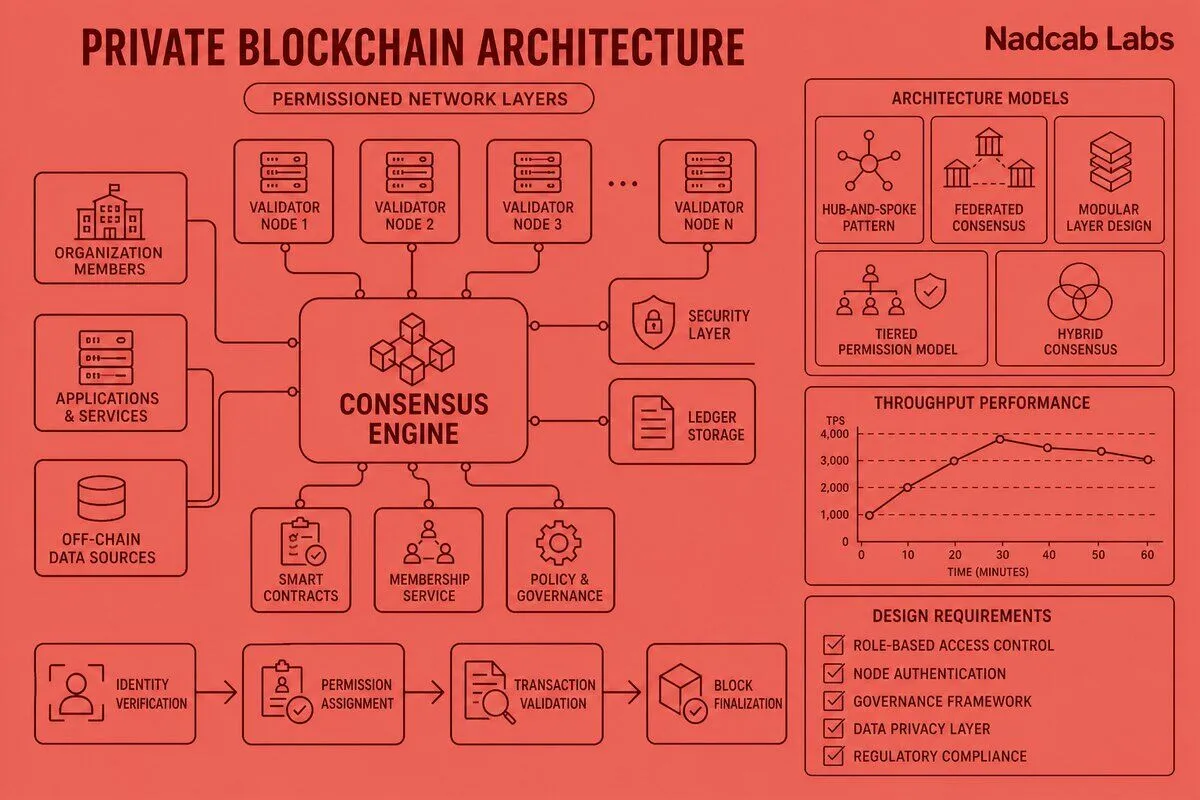
Private blockchain architecture design patterns define how permissioned networks structure their nodes, consensus mechanisms, access controls, and data layers to meet enterprise requirements for security, performance, and governance. Unlike public blockchains where anyone can participate, private blockchain architectures enforce identity verification and role-based permissions at every layer.
Private blockchain architecture design patterns define how permissioned networks structure their nodes, consensus mechanisms, access controls, and data layers to meet enterprise requirements for security, performance, and governance. Unlike public blockchains where anyone can participate, private blockchain architectures enforce identity verification and role-based permissions at every layer. In 2026, organizations deploy five core patterns — hub-and-spoke, federated, modular, tiered permission, and hybrid consensus models — each optimized for specific use cases ranging from supply chain consortia to financial settlement networks. Choosing the right pattern depends on trust assumptions, regulatory needs, throughput requirements, and whether a single organization or multiple entities will govern the network.
Key Takeaways
- Hub-and-spoke architectures centralize validation with a single authority operating core nodes while peripheral participants submit transactions
- Federated patterns distribute trust across pre-approved organizational nodes without a single controller, ideal for industry consortia
- Modular designs separate consensus, execution, and data layers for independent upgrades and regulatory compliance flexibility
- Tiered permission models enforce multi-level access control distinguishing read, write, and governance privileges across network roles
- Consensus mechanism choice directly shapes architecture: PBFT and RAFT enable low-latency finality in closed validator sets
- Node hierarchy patterns optimize performance by separating validator, observer, and client tiers with distinct resource allocations
What Are the Core Private Blockchain Architecture Patterns Used in 2026?
The hub-and-spoke pattern establishes a hierarchical structure where a central authority operates validator nodes responsible for consensus and block production, while peripheral participant nodes submit transactions and query state. Banks often deploy this pattern for internal settlement systems where the institution controls all validator infrastructure but allows branch offices or subsidiaries to run lightweight client nodes. The central hub enforces compliance rules and maintains the canonical ledger while spokes benefit from shared infrastructure without operational overhead.
Federated node architecture distributes trust among multiple pre-approved organizations, each operating validator nodes with equal governance rights. No single entity controls the network; consensus requires agreement from a threshold of federated members. Industry consortia like trade finance networks or interbank clearing systems adopt federated patterns when competitors must collaborate without ceding control to a central operator. Each member validates transactions relevant to their domain while collectively maintaining network integrity through voting mechanisms.
Tiered permission models implement multi-level access control separating read, write, and governance privileges across network layers. A typical three-tier structure grants validator nodes full governance rights to approve protocol changes, transaction nodes permission to submit and endorse transactions, and observer nodes read-only access to query ledger state. This pattern appears in supply chain networks where manufacturers hold validator status, logistics providers operate transaction nodes, and customs authorities run observer nodes for audit purposes. The architecture enforces principle of least privilege while maintaining transparency for authorized parties.
These patterns often combine in practice. A private blockchain deployment might use federated validators for decentralization while implementing tiered permissions for external auditors. The key architectural decision involves balancing control centralization against operational complexity and trust distribution requirements.
How Do Consensus Mechanisms Shape Private Blockchain Design Patterns in 2026?
PBFT (Practical Byzantine Fault Tolerance) and RAFT dominate private blockchain consensus in 2026 because they deliver low-latency finality in permissioned environments with known validator sets. PBFT tolerates up to one-third malicious nodes through multi-round voting where validators exchange prepare and commit messages before finalizing blocks. This mechanism suits federated architectures where trust distributes across organizational boundaries and Byzantine fault tolerance protects against compromised validators. RAFT simplifies consensus for hub-and-spoke patterns where validators belong to a single trusted entity; it elects a leader node that proposes blocks while followers replicate state, achieving faster finality than PBFT with lower message complexity.
Hybrid consensus patterns combine Proof of Authority for block production with voting mechanisms for governance decisions. Validator nodes stake their organizational reputation rather than cryptocurrency, producing blocks in round-robin or weighted rotation. Protocol upgrades, member additions, or policy changes trigger separate voting rounds where validators cast ballots weighted by their governance tokens or contractual stake. This separation allows high-throughput transaction processing through simple PoA while preserving democratic governance for critical network decisions.
Consensus-driven architecture choices create fundamental tradeoffs between synchronous and asynchronous models affecting throughput and fault tolerance. Synchronous consensus like PBFT assumes bounded network delays and requires all validators to participate in each round, limiting throughput to the slowest validator’s capacity but guaranteeing immediate finality. Asynchronous models like HotStuff tolerate arbitrary network delays and allow progress with partial validator participation, increasing throughput at the cost of probabilistic finality. Enterprise architects select synchronous patterns for financial settlement requiring instant finality and asynchronous models for supply chain tracking where eventual consistency suffices.
| Consensus Mechanism | Finality Latency | Fault Tolerance | Best Architecture Pattern |
|---|---|---|---|
| PBFT | 2-5 seconds | 33% Byzantine nodes | Federated multi-org |
| RAFT | 0.5-2 seconds | 50% crash failures | Hub-and-spoke single-org |
| PoA + Voting | 1-3 seconds | Governance-dependent | Hybrid consortium |
| HotStuff | 3-8 seconds | 33% Byzantine async | High-throughput federated |
When Should You Choose Modular vs. Monolithic Private Blockchain Architectures in 2026?
Modular layer separation divides the blockchain stack into independent consensus, execution, and data availability layers that can evolve separately. The consensus layer runs validator nodes using PBFT or RAFT to order transactions. The execution layer processes smart contract logic through isolated runtime environments like WebAssembly sandboxes. The data availability layer manages state storage and historical archives with configurable retention policies. This separation enables upgrading consensus algorithms without rewriting smart contracts or swapping execution engines to comply with new regulations while preserving existing transaction history. Financial institutions favor modular architectures when regulatory requirements demand provable separation between transaction ordering and business logic execution.
Monolithic integrated stacks tightly couple consensus, execution, and storage into a single unified codebase where components share memory and communicate through internal APIs rather than network protocols. Hyperledger Fabric’s peer nodes exemplify this pattern by combining endorsement, ordering, and state management in coordinated processes. Deployment simplicity makes monolithic stacks attractive for single-organization use cases like internal audit trails or document verification systems where a bank operates all infrastructure and regulatory requirements remain stable. The unified architecture reduces operational overhead and eliminates cross-layer network latency.
The decision matrix weighs regulatory complexity, multi-party requirements, and future scalability needs. Choose modular when multiple organizations with conflicting compliance regimes must share infrastructure — a healthcare consortium where European members need GDPR-compliant data residency while US participants require HIPAA audit trails benefits from separable data layers. Select modular for anticipated protocol upgrades like migrating from PBFT to a quantum-resistant consensus mechanism without disrupting live applications. Opt for monolithic when a single entity controls all nodes, regulatory requirements stay constant, and operational simplicity outweighs future flexibility. A modular blockchain architecture adds 20-30% infrastructure complexity but reduces upgrade downtime from weeks to hours.
Modular Architecture Layer Flow
Smart contracts & dApps
Transaction processing
Block ordering & finality
State storage & archives
What Node Hierarchy Patterns Optimize Private Blockchain Performance in 2026?
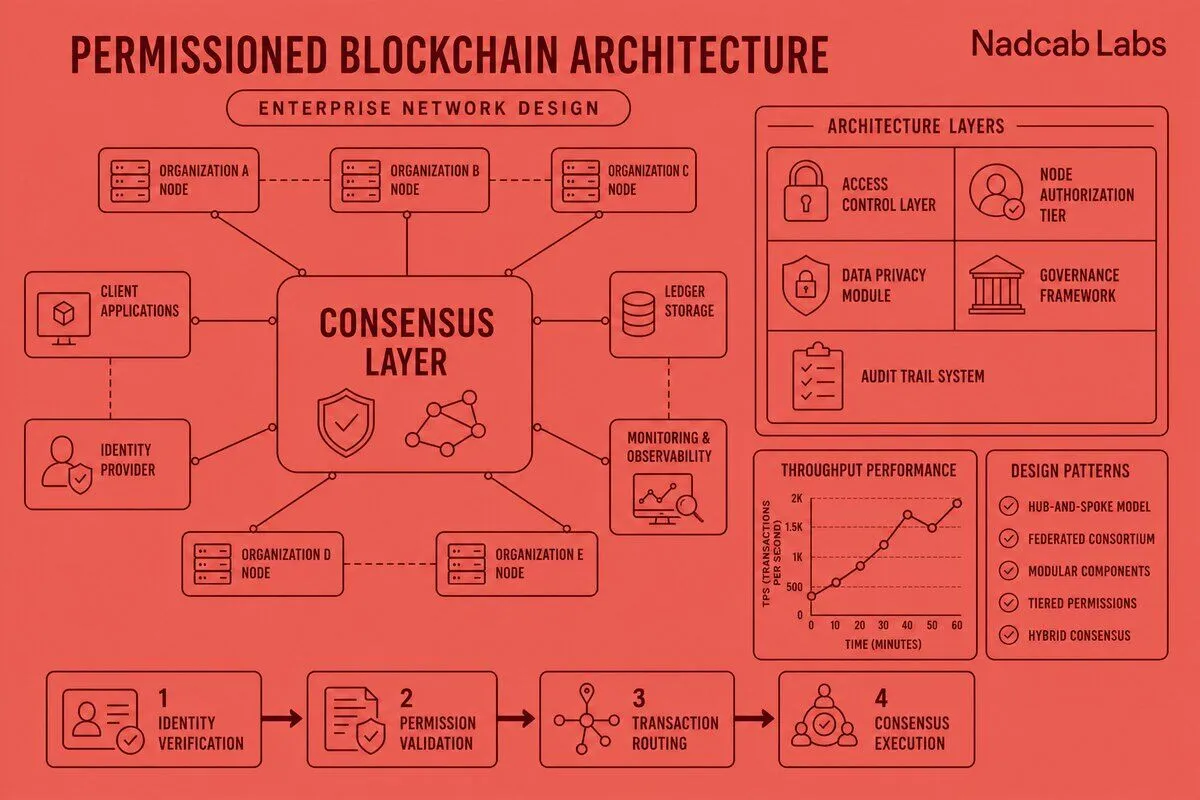
The validator-observer-client three-tier model separates consensus participants from read-only nodes and lightweight clients to optimize resource allocation and network efficiency. Validator nodes run full consensus protocols, maintain complete state, and require high-performance infrastructure with 16+ CPU cores and 64GB+ RAM to process transaction endorsements and produce blocks. Observer nodes replicate finalized blocks and serve read queries for applications needing real-time state access without participating in consensus, typically deployed with 8 CPU cores and 32GB RAM. Lightweight clients connect via JSON-RPC or gRPC to query specific state without storing the full ledger, running on commodity hardware or mobile devices.
Geographic distribution patterns deploy regional validator clusters with cross-region replication for latency optimization while maintaining fault tolerance. A global trade finance network might operate validator clusters in New York, London, Singapore, and Frankfurt, with each region running 3-5 validator nodes using PBFT. Transactions submitted in Asia route to Singapore validators for sub-50ms endorsement latency, while cross-region replication ensures New York validators maintain synchronized state for disaster recovery. This pattern reduces user-perceived latency by 60-80% compared to centralized validator deployments while preserving Byzantine fault tolerance across geographic boundaries.
Resource allocation strategies distinguish compute-heavy validator nodes from storage-optimized archival nodes in hybrid topologies. Validator nodes prioritize CPU and memory for cryptographic operations and smart contract execution, using NVMe SSDs for hot state data but pruning historical blocks older than 90 days. Archival nodes dedicate resources to long-term storage with HDD arrays retaining complete transaction history for compliance audits and forensic analysis. A pharmaceutical supply chain network runs 7 validator nodes for real-time tracking and 3 archival nodes storing 10-year drug provenance records required by FDA regulations. This separation reduces validator infrastructure costs by 40% while meeting regulatory retention requirements.
Node Resource Allocation Comparison
How Do You Map Enterprise Use Cases to Private Blockchain Architecture Patterns in 2026?
Supply chain traceability networks adopt federated architecture with industry consortium nodes and tiered read permissions for external auditors. A food safety consortium includes validators operated by major retailers, processors, and logistics providers using PBFT consensus. Each validator endorses transactions for products moving through their facilities. Tier-2 transaction nodes run by smaller suppliers submit provenance data without validator privileges. Tier-3 observer nodes grant government food safety inspectors read-only access to trace contamination sources during recalls. The federated pattern prevents any single company from manipulating records while tiered permissions satisfy regulatory transparency without exposing competitive intelligence. Integration with blockchain disaster recovery architecture ensures supply chain data survives regional infrastructure failures.
Financial settlement networks implement hub-and-spoke architectures with bank-operated validators and regulatory observer nodes for compliance. A central bank operates core validator infrastructure using RAFT consensus for sub-second finality on interbank transfers. Commercial banks run lightweight client nodes that submit payment instructions and query settlement status. Regulatory authorities operate dedicated observer nodes with real-time access to all transactions for anti-money laundering surveillance and systemic risk monitoring. The hub-and-spoke pattern centralizes operational control with the central bank while distributing access to commercial participants. Compliance modules enforce blockchain KYC AML compliance architecture rules at the validator level before transactions reach consensus.
Healthcare data sharing platforms require modular designs separating patient consent layers from clinical data layers with zero-knowledge proofs. The consent layer runs on a lightweight DAG-based structure where patients grant and revoke data access permissions through mobile apps. The clinical data layer uses PBFT validators operated by hospital systems to store encrypted medical records. Zero-knowledge proofs enable researchers to query aggregate statistics without accessing individual patient data. Modular separation allows upgrading consent mechanisms to support emerging privacy regulations while maintaining HIPAA-compliant clinical data storage. This architecture pattern extends to Real Estate Tokenization Explained scenarios where property ownership records require similar consent and privacy controls.
Cross-industry patterns emerge around identity management and asset tokenization. Blockchain Identity Management systems use tiered permissions where credential issuers operate validators, relying parties run observer nodes, and users control lightweight clients. Asset tokenization platforms for securities or commodities adopt federated architectures where custodians, exchanges, and regulators share validator responsibilities. The ERC721 in Smart Contract standard adapts to private blockchains through permission wrappers that restrict token transfers to KYC-verified addresses. Architecture selection hinges on trust distribution requirements and regulatory jurisdiction boundaries rather than technical performance alone.
Use Case Architecture Decision Framework
| Use Case | Pattern | Consensus | Key Requirement |
|---|---|---|---|
| Supply Chain | Federated + Tiered | PBFT | Multi-party trust |
| Financial Settlement | Hub-and-Spoke | RAFT | Instant finality |
| Healthcare Data | Modular | PBFT | Privacy separation |
| Asset Tokenization | Federated | PoA + Voting | Regulatory compliance |
Private blockchain architecture design patterns in 2026 reflect maturity in understanding how network topology, consensus mechanisms, and permission models combine to meet enterprise requirements. Hub-and-spoke patterns suit single-organization deployments prioritizing operational simplicity and centralized control. Federated architectures enable multi-party collaboration without trusted intermediaries through distributed validator sets. Modular designs provide flexibility for evolving regulatory landscapes by separating consensus from execution and storage. Tiered permission models enforce principle of least privilege while maintaining transparency for authorized stakeholders. Node hierarchy patterns optimize performance by allocating resources according to role-specific requirements across validator, observer, and client tiers. Successful implementations map these patterns to specific use case characteristics — trust distribution needs, regulatory jurisdiction boundaries, throughput requirements, and governance models — rather than applying generic templates. Organizations seeking to implement these patterns benefit from expert guidance in architecture selection and deployment. Nadcab Labs specializes in designing and deploying custom private blockchain architectures tailored to enterprise requirements, from initial pattern selection through production deployment and ongoing optimization.
Frequently Asked Questions
Q1.What is the architecture of a private blockchain in 2026?
Private blockchain architecture in 2026 typically features permissioned nodes, role-based access controls, and modular consensus layers. It includes identity management systems, smart contract engines, and configurable data privacy zones. Modern designs separate consensus, execution, and storage layers for flexibility. Organizations deploy hybrid patterns combining centralized governance with distributed verification, optimized for enterprise compliance and performance requirements.
Q2.How do federated node patterns differ from hub-and-spoke architectures in private blockchains for 2026?
Federated node patterns in 2026 distribute authority equally among trusted participants who jointly validate transactions, eliminating single points of failure. Hub-and-spoke architectures centralize coordination through one master node that manages peripheral nodes. Federated models offer better resilience and decentralization, while hub-and-spoke provides simpler governance and faster decision-making. Choice depends on trust distribution requirements and operational complexity tolerance.
Q3.What consensus mechanisms work best with tiered permission models in private blockchain design for 2026?
PBFT (Practical Byzantine Fault Tolerance) and Raft work excellently with tiered permissions in 2026, allowing different validation rights per node tier. IBFT 2.0 supports weighted voting based on permission levels. Proof of Authority assigns validation rights to verified identities in specific tiers. These mechanisms enable granular control where admin nodes validate critical transactions while lower tiers handle routine operations efficiently.
Q4.When should enterprises choose modular over monolithic private blockchain architectures in 2026?
Enterprises should choose modular architectures in 2026 when requiring frequent protocol updates, multiple use cases on one network, or integration with diverse legacy systems. Modular designs suit organizations needing independent scaling of consensus, storage, and execution layers. Monolithic architectures work better for single-purpose networks with stable requirements, simpler governance, and lower operational complexity where tight integration provides performance advantages.
Q5.How do node hierarchy patterns affect transaction throughput in private blockchains for 2026?
Node hierarchy patterns in 2026 significantly boost throughput by assigning validation duties based on capability. Validator nodes handle consensus while observer nodes only replicate data, reducing network overhead. Tiered architectures enable parallel processing where regional clusters validate locally before global settlement. Properly designed hierarchies achieve 10-50x throughput improvements versus flat structures by optimizing communication paths and computational distribution across node types.
Q6.What are the key decision factors for selecting private blockchain architecture patterns in 2026?
Key factors in 2026 include transaction volume requirements, participant trust levels, regulatory compliance needs, and integration complexity. Consider governance structure preferences, data privacy requirements, and disaster recovery capabilities. Evaluate scalability horizons, development team expertise, and maintenance resources. Budget constraints, time-to-market pressure, and future flexibility needs also drive pattern selection. Nadcab Labs recommends aligning architecture with specific business workflows and organizational maturity.
Explore Services
Related Services
Reviewed by

Aman Vaths
Founder of Nadcab Labs
Aman Vaths is the Founder & CTO of Nadcab Labs, a global digital engineering company delivering enterprise-grade solutions across AI, Web3, Blockchain, Big Data, Cloud, Cybersecurity, and Modern Application Development. With deep technical leadership and product innovation experience, Aman has positioned Nadcab Labs as one of the most advanced engineering companies driving the next era of intelligent, secure, and scalable software systems. Under his leadership, Nadcab Labs has built 2,000+ global projects across sectors including fintech, banking, healthcare, real estate, logistics, gaming, manufacturing, and next-generation DePIN networks. Aman’s strength lies in architecting high-performance systems, end-to-end platform engineering, and designing enterprise solutions that operate at global scale.