Ai Overview
GroveX BTC security architecture defines how production Bitcoin exchanges isolate private keys, gate API access, validate orders, and respond to threats. Gox lost 850,000 BTC when hot wallet keys leaked; Bitfinex suffered a $72 million drain after a multi signature implementation flaw; Binance halted withdrawals when API credentials enabled unauthorized transfers. Withdrawal workflows above threshold limits (commonly $10,000 USD equivalent) require multi party authorization.
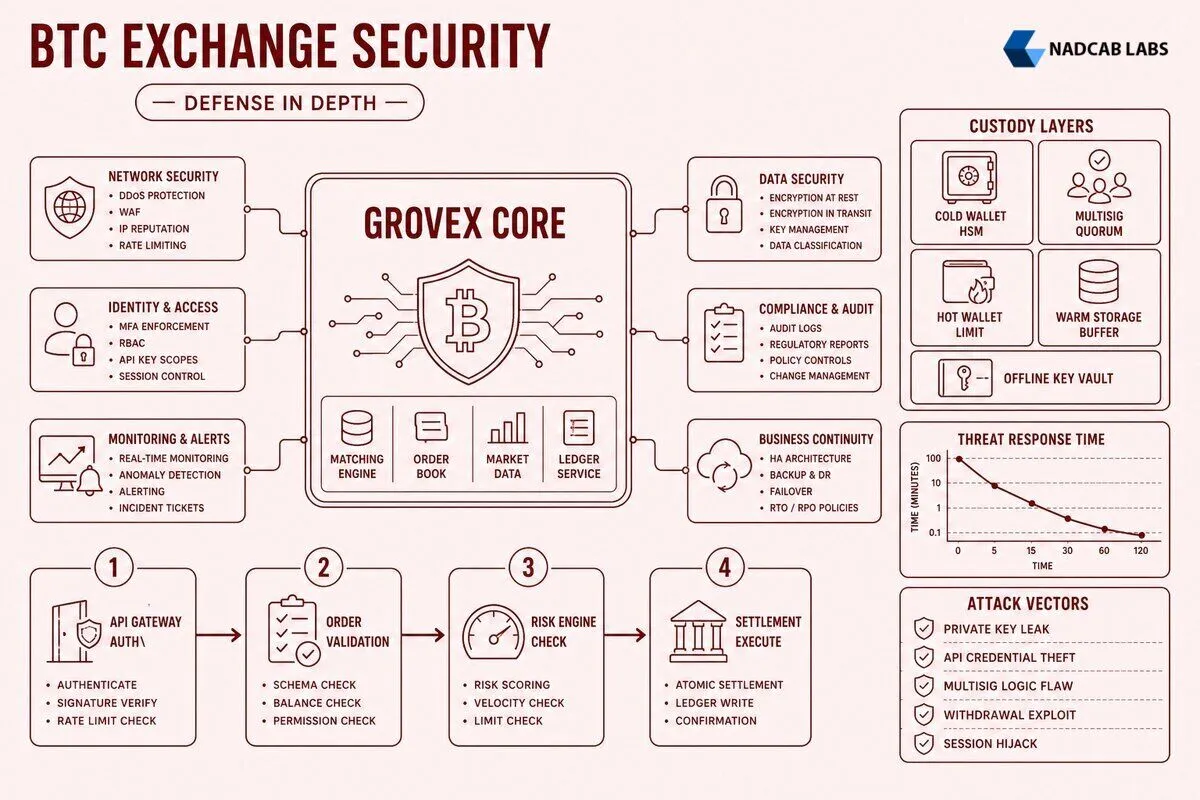
GroveX BTC security architecture defines how production Bitcoin exchanges isolate private keys, gate API access, validate orders, and respond to threats. Each component exists because a real attack exposed a gap: Mt. Gox lost 850,000 BTC when hot wallet keys leaked; Bitfinex suffered a $72 million drain after a multi signature implementation flaw; Binance halted withdrawals when API credentials enabled unauthorized transfers. Operators who understand *why* each layer exists can debug failures faster and justify architecture choices during audits. Below, we trace custody mechanisms, authentication flows, order validation pipelines, and incident response procedures, explaining inputs, state changes, failure modes, and verification steps at each stage.
Key Takeaways
- Multi signature cold storage keeps most BTC offline using HSM backed quorum signing. Keyholders physically verify transaction payloads on hardware wallet screens before signing, preventing remote exfiltration.
- OAuth 2.0 token rotation invalidates refresh tokens after one use. IP whitelisting and Redis backed rate limiters block credential replay and DDoS amplification at the gateway layer.
- Pre trade balance checks with optimistic locking prevent race conditions when concurrent orders hit the same account. Self trade filters and circular graph analysis catch wash trading before regulators flag it.
- SIEM platforms index logs from every service. Blockchain tracing monitors mempool events and flags withdrawals to sanctioned addresses before broadcast, reducing compliance risk.
- Penetration tests run quarterly; bug bounty programs extend coverage. Incident runbooks specify freeze criteria, rollback procedures, and stakeholder notification SLAs that reduce MTTR.
- Partnering with security specialists provides SIEM connectors, compliance schema mapping, and audit coordination that cut time to regulatory approval, but exchanges must own alert tuning and response logic.
Why custody, authentication, and validation layers exist
Bitcoin exchanges face a narrow set of high impact failure modes. Hot wallets hold liquid inventory for instant withdrawals. An attacker who exfiltrates the private key can drain funds before operators notice; the Bitcoin network offers no “undo” button. Cold storage introduces air gap verification, but that delay blocks emergency fund movements when market volatility spikes and users demand immediate liquidity. API endpoints become attack surfaces when distributed credential sets bypass rate limits or when session tokens leak through XSS vulnerabilities. Order books turn into manipulation vectors: place large orders to spoof liquidity, cancel before execution, trigger stop loss cascades in retail accounts, then profit on the opposite side. grovex btc security.
Regulatory compliance imposes logging and approval requirements that touch every state transition. AML and KYC integration points must record every identity verification event with immutable audit trails. Withdrawal workflows above threshold limits (commonly $10,000 USD equivalent) require multi party authorization. Compliance officers need dashboards showing flagged transactions, pending reviews, and automated hold reasons. Security teams provide the SIEM connectors and compliance reporting templates that map blockchain events to regulatory schema (FinCEN SAR filings, FATF Travel Rule data), but the exchange must define what gets logged, when approvals trigger, and how long records persist (typically seven years for financial institutions). grovex btc security.
Incident response playbooks define detection criteria and escalation paths. Sudden withdrawal spikes from dormant accounts (no activity for 90+ days, then three large withdrawals in 10 minutes) trigger account freeze logic. Geolocation mismatches between login IP and historical session data escalate to manual review queues. Rollback decision criteria specify when to halt trading, snapshot the order book state, and coordinate with blockchain validators to reverse finalized transactions. (This is rare and documented mainly in smart contract exploit scenarios where consensus allows chain reorganization.) Operators who skip this phase discover gaps after a breach, when legal teams demand forensic timelines and user notification templates that do not exist. grovex btc security.
Production teams evaluating grovex btc security ask: can we prove custody of private keys without exposing them? Can we rate limit API abuse without blocking legitimate high frequency traders? Can we detect wash trading before regulators flag it? The answers determine whether the platform passes external audits and maintains insurance coverage for custodied assets.
| Threat Vector | Detection Mechanism | Mitigation SLA | Stakeholder Sign Off |
|---|---|---|---|
| Hot wallet private key exfiltration | HSM access logs, unauthorized signing attempt alerts | 15 min key rotation, 60 min fund sweep to cold storage | CTO, Compliance Officer |
| API credential stuffing | Failed login rate exceeds 10 per minute per IP, CAPTCHA challenge | Immediate IP block, 24 hr account unlock review | Security Lead, DevOps |
| Order book spoofing | Cancel to fill ratio exceeds 80%, order size exceeds 5x average volume | Real time trading suspension, 2 hr investigation window | Trading Ops, Legal |
| Smart contract reentrancy on withdrawal | Gas usage anomaly, duplicate nonce detection | Contract pause within 5 min, emergency upgrade deploy | Blockchain Architect, Auditor |
Multi signature wallet custody: how offline signing works
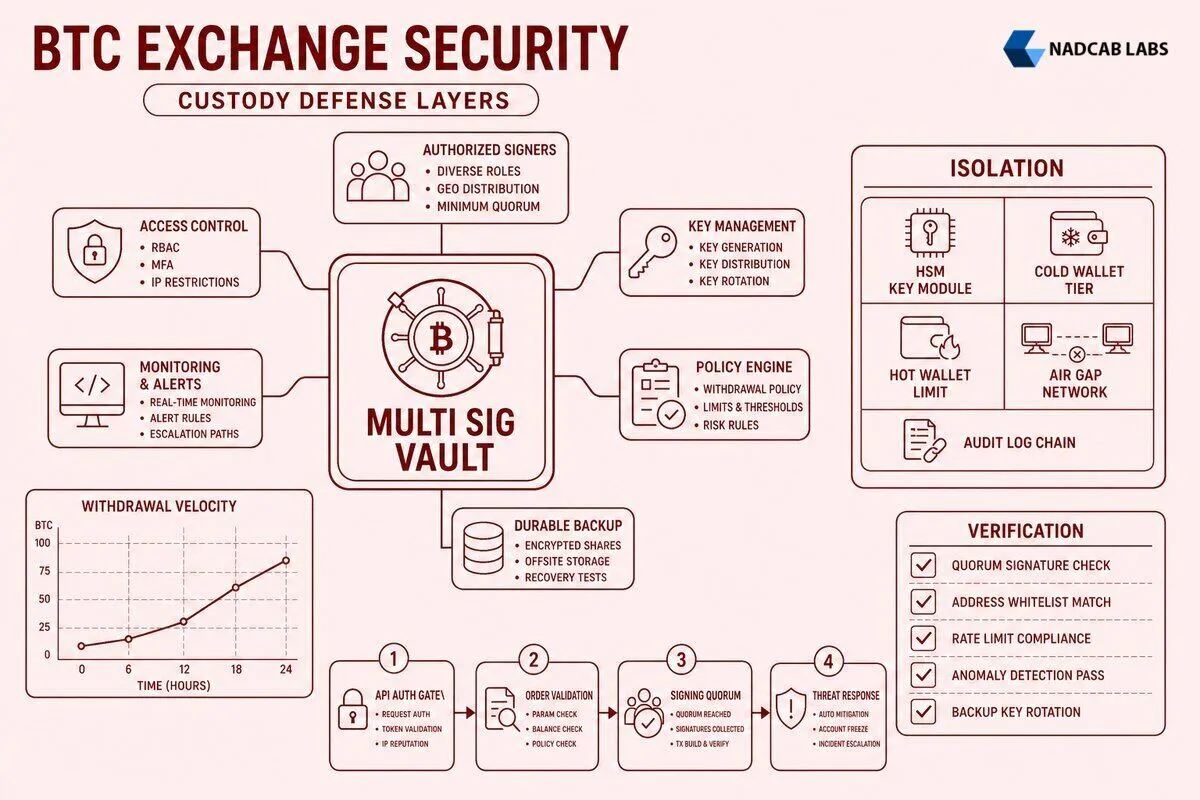
Cold wallet architecture isolates private keys on offline signing devices. Keys never touch internet connected machines. Air gapped laptops generate seeds using hardware random number generators (pulling entropy from /dev/urandom on Linux or equivalent), then store them on Trezor or Ledger devices kept in bank vaults. The signing ceremony requires physical presence: three keyholders insert their devices, the transaction payload displays on each screen (destination address, amount in BTC, fee rate), and all three must confirm before the partially signed Bitcoin transaction (PSBT) assembles into a valid signature. This quorum threshold (3 of 5 or 5 of 7) prevents a single compromised keyholder from draining funds. If an attacker coerces one keyholder, they still cannot move assets. grovex btc security.
Hardware security modules integrate into this flow for enterprises needing faster turnaround. HSMs like Thales Luna or AWS CloudHSM store keys in tamper resistant chips that log every access attempt and physically destroy keys if the enclosure is breached. The exchange backend submits a withdrawal request to the HSM API, which checks policy rules: daily limit, whitelisted destination addresses, approval count. If policy fails, the HSM returns an error code (e.g., CKR_FUNCTION_FAILED in PKCS#11 parlance) and logs the rejection. Operators review HSM audit trails weekly to catch unauthorized access patterns or configuration drift (someone changed the daily limit without a change ticket). The HSM never exposes the raw private key; it accepts a transaction hash, signs internally using ECDSA secp256k1, and returns the signature. grovex btc security.
Hot wallet replenishment triggers when the hot wallet BTC balance drops below a threshold. Many exchanges set this at 5% of total daily withdrawal volume; if users withdraw 100 BTC per day on average, the hot wallet holds 5 BTC and cold storage holds the rest. An automated script generates a top up transaction from cold storage. This transaction enters a manual approval queue visible to the finance team. Two approvers verify the destination address matches the hot wallet public key hash (comparing against a known good value stored in a separate config repository), check recent transaction history for anomalies (unexpected outflows, address reuse), then sign the PSBT. The signed transaction broadcasts to the Bitcoin network. Balance monitoring alerts confirm arrival within 60 minutes (six confirmations at 10 minute block intervals). Transaction batching reduces on chain fees: instead of individual user withdrawals, the exchange aggregates 50 payouts into one multi output transaction, cutting miner fees significantly during high fee periods (200+ sat/vB). grovex btc security.
Key rotation schedules enforce periodic re keying. Every 90 days, the team generates new cold wallet addresses, transfers funds from old addresses, and updates the withdrawal processing logic to point to new public keys. Backup verification tests run monthly: restore a seed phrase on a fresh device, derive the first 20 addresses using BIP32/BIP44 derivation paths, confirm they match the recorded list, then wipe the device. Disaster recovery drills simulate total key loss (fire, theft, hardware failure). The team retrieves backup seeds from geographically distributed vaults (one in New York, one in Zurich, one in Singapore), reconstructs the wallet, and measures time to restore. Target: under 4 hours. This SLA feeds into insurance policy terms and regulatory filings; insurers want proof that fund recovery does not depend on a single point of failure. grovex btc security.
Cold Wallet Signing Flow
Failure modes surface in predictable ways. Lost devices: redundant keyholders cover this; the quorum threshold allows N minus M failures. Firmware bugs in hardware wallets: run parallel signing on different device models (Trezor Model T and Ledger Nano X, for example). If one device displays a different address due to a display driver bug, the discrepancy halts the ceremony. Social engineering attacks on keyholders: mandatory video call verification during signing ceremonies. If a keyholder receives an urgent Slack message asking them to sign “an emergency withdrawal,” the video call forces them to see the other participants and confirm the request is legitimate. Teams running grovex btc infrastructure document every exception. If a keyholder is unavailable (illness, travel), the backup rotation matrix specifies which alternate signs, and that event logs to the compliance database with justification notes. grovex btc security.
API authentication: OAuth token lifecycle and rate limiting
OAuth 2.0 token lifecycle begins when a user logs in. The authentication server validates credentials against bcrypt hashed passwords (cost factor 12, salted) stored in a hardened database, then issues a short lived JWT access token (15 min expiry) and a refresh token (7 day expiry). The JWT claims structure includes user ID, account tier (retail, VIP, institutional), granted scopes (read:balance, trade:spot, withdraw:crypto), issuer signature (RS256 algorithm, 2048 bit RSA key), and issued at timestamp. Every API request carries this token in the Authorization header (Bearer scheme). The API gateway verifies the signature using the public key (fetched from a JWKS endpoint or cached locally), checks expiry timestamp against server time (allowing 30 second clock skew), and extracts scopes to enforce permission boundaries. A request to POST /api/v1/withdraw without the withdraw:crypto scope returns HTTP 403. grovex btc security.
Refresh token rotation happens automatically. When the access token expires, the client sends the refresh token to the auth server at POST /oauth/token with grant_type=refresh_token. The server invalidates the old refresh token in Redis (DEL command on the token hash), issues a new access token and a new refresh token, and logs the rotation event with client IP and user agent. This prevents replay attacks: stolen refresh tokens become useless after one use. If an attacker intercepts a refresh token and uses it before the legitimate client, the legitimate client’s next refresh attempt fails, alerting the user that their session was hijacked. IP whitelisting rules add another gate. Institutional clients register their office IP ranges (e.g., 203.0.113.0/24); any token request from an unlisted IP triggers a security review email and temporary account lock. Session timeout enforcement logs users out after 30 minutes of inactivity, forcing re authentication. grovex btc security.
Rate limit tiers vary by endpoint and user type. Public market data endpoints (GET /api/v1/ticker, GET /api/v1/orderbook) allow 100 requests per minute per IP without authentication. Authenticated retail users get 300 requests per minute across all private endpoints (balance, order history, active positions). VIP trading accounts with verified institutional status receive 1,000 requests per minute, enabling high frequency strategies. The API gateway tracks request counts in Redis with sliding window counters (ZREMRANGEBYSCORE to evict old timestamps, ZCARD to count current window). When a client exceeds the limit, the gateway returns HTTP 429 with a Retry After header indicating seconds until the quota resets. DDoS mitigation layers (Cloudflare, AWS Shield) cache responses at edge nodes, absorbing traffic spikes before they reach origin servers. grovex btc security.
Anomaly detection monitors authentication patterns. A sudden spike in failed login attempts (more than 10 in 60 seconds from a single IP) triggers CAPTCHA challenges on subsequent requests. Geolocation mismatch alerts fire when a user who normally logs in from New York (based on 90 day history) suddenly authenticates from Moscow without prior travel notification. The system queries MaxMind GeoIP2 database, compares city level location, and flags discrepancies exceeding 500 km. Device fingerprinting changes (browser user agent, screen resolution, installed fonts, canvas rendering hash) flag potential account takeover. Automated account lockout triggers after three consecutive failed 2FA attempts (TOTP code mismatch), requiring email verification to unlock. Security teams review these alerts in a daily triage queue, escalating suspicious patterns to fraud investigation.
API Rate Limit Distribution by User Tier
Production debugging traces requests through access logs. Each API request logs timestamp, user ID, endpoint path, response status, latency (measured at gateway egress), and request ID (UUID v4). When a user reports “my withdrawal is stuck,” engineers grep logs for that user ID, trace the withdrawal request through the matching engine, settlement queue, and blockchain broadcast service, then identify where state transition failed. Common culprits: insufficient gas (Ethereum transactions), nonce collision (two transactions from the same address with the same nonce), blacklist check false positive (address flagged by Chainalysis but user has proof of legitimate source). Centralized log aggregation across microservices reduces mean time to resolution from hours to minutes; instead of SSH ing into five different servers, engineers query a single Elasticsearch index.
Order validation: preventing market manipulation
Pre trade checks execute before an order enters the matching engine. Account balance verification queries the user’s available BTC and fiat balances from Postgres (SELECT available_btc, available_usd FROM balances WHERE user_id = ? FOR UPDATE), subtracts pending order reserves (SUM of open order quantities), and confirms the new order does not exceed spendable funds. Margin requirement calculation applies leverage rules: a 10x leveraged long position requires 10% collateral; the system computes position value (quantity * mark price), multiplies by margin ratio (0.1 for 10x), and rejects orders that would breach maintenance margin thresholds (typically 3% to avoid liquidation cascades). Order size limits cap individual orders at a percentage of the 24 hour trading volume for that pair (e.g., no single order exceeding 2% of daily volume), preventing single trades from moving the market excessively. Self trade prevention logic checks if the incoming order would match against another order from the same user ID; if true, the system cancels the older order to avoid artificial volume inflation.
Post trade reconciliation verifies settlement. The settlement service reads fill messages from Kafka (topic: trade.fills, partition key: user_id), updates user balances in Postgres with row level locks (UPDATE balances SET available_btc = available_btc + ?, reserved_btc = reserved_btc ? WHERE user_id = ? AND version = ?), and writes a settlement confirmation record. The version field implements optimistic locking: if two concurrent updates target the same row, the second one fails with a version mismatch error and retries. A separate reconciliation job runs every 10 minutes, summing all balance changes since the last checkpoint and comparing against blockchain finality data (for on chain settlements). Discrepancies trigger alerts to the operations team. If the database shows 1.5 BTC withdrawn but the blockchain explorer shows 1.48 BTC (due to rounding or fee miscalculation), engineers investigate transaction logs and adjust balances with compensating entries, logging the correction reason for audit trails.
Wash trading detection uses pattern recognition algorithms. The system builds a directed graph of trades: nodes represent accounts, edges represent filled orders (weighted by trade volume). Circular trade patterns (A sells to B, B sells to C, C sells to A within a 60 second window) flag as suspicious. The algorithm runs a depth first search from each node, looking for cycles shorter than four hops. Timing correlations analyze order placement intervals: if two accounts consistently place opposite orders within 100 milliseconds across multiple pairs, the fraud detection model scores them as likely coordinated. Flagged accounts enter a manual review queue. Compliance analysts examine trade history, IP logs, KYC documents, and withdrawal destinations. Confirmed wash traders face account suspension and regulatory reporting to financial authorities (FinCEN SAR filing in the US, FIU reporting in EU jurisdictions). This workflow ties directly to crm data security practices, ensuring investigative data remains encrypted (AES 256 at rest) and access controlled (role based permissions, audit logs for every query).
| Validation Gate | Input Data | Failure Mode | Remediation Step |
|---|---|---|---|
| Balance check | Available BTC, pending reserves, new order quantity | Race condition: concurrent orders deplete balance | Optimistic locking with version field, retry on conflict |
| Margin calculation | Position size, leverage ratio, collateral value | Price oracle lag during volatility spikes | Use 10 second TWAP, halt trading if oracle stale exceeds 30s |
| Self trade filter | User ID, order book snapshot | False positive when user has multiple sub accounts | Whitelist approved sub account pairs in config |
| Wash trade graph | Trade counterparties, timestamps, order IDs | High frequency market makers flagged incorrectly | Exempt verified MM accounts, tune timing threshold to 50ms |
Choosing validation depth depends on user mix. Exchanges with retail only users apply stricter self trade prevention (zero tolerance). Platforms serving institutional market makers relax timing thresholds to avoid blocking legitimate arbitrage (a market maker might place offsetting orders on two venues within milliseconds to capture spread). The trade off is false positive rate versus regulatory risk. Security specialists conduct quarterly reviews of validation rule effectiveness, analyzing flagged versus confirmed fraud cases to tune thresholds and reduce operational overhead (fewer false positives means less analyst time wasted).
Threat intelligence and incident response
Real time monitoring stacks integrate SIEM platforms like Splunk or the ELK stack (Elasticsearch, Logstash, Kibana). Log shippers on every service (API gateway, matching engine, wallet service, blockchain node) forward structured JSON logs to a central Kafka topic (e.g., logs.all, with 30 day retention). Logstash parses these events, enriches them with geolocation data (MaxMind GeoIP2) and user metadata (account tier, KYC status), then indexes to Elasticsearch. Kibana dashboards display real time metrics: API error rates (5xx responses per minute), failed authentication attempts per minute, average withdrawal processing time (from request to blockchain broadcast), and blockchain confirmation delays (time between broadcast and six confirmations). Alerts trigger when metrics exceed thresholds (error rate exceeds 2%, withdrawal queue depth exceeds 500 pending transactions). Alert rules use Elasticsearch Watcher or Kibana Alerting, sending notifications to PagerDuty or Slack.
Blockchain transaction tracing monitors on chain activity. The exchange runs full Bitcoin nodes (Bitcoin Core with txindex enabled) that subscribe to mempool events via ZMQ (zmqpubrawtx socket). When a user initiates a withdrawal, the system logs the transaction hash, monitors confirmation count via RPC calls (getblockcount, getrawtransaction with verbose flag), and flags if the transaction remains unconfirmed for more than 60 minutes (indicating low fee or network congestion). Wallet address blacklist feeds integrate from services like Chainalysis or Elliptic. Before processing a withdrawal, the system checks if the destination address appears on sanctions lists (OFAC SDN list, EU consolidated list) or is linked to known ransomware campaigns. The check happens via API call (POST /v1/addresses/screen with address payload). Matches trigger automatic holds and compliance review. Smart contract interaction logs (for exchanges supporting Ethereum based tokens) record every contract call (function selector, input parameters, gas used, revert reason from eth_call simulation), enabling post mortem analysis of failed transactions.
Incident escalation matrices classify severity. P0 incidents involve confirmed fund loss, unauthorized withdrawals exceeding $100k, or total platform downtime (all services unreachable). The on call engineer pages the CTO, security lead, and legal counsel immediately (PagerDuty high urgency alert, SMS and phone call). P1 incidents (API degradation affecting >10% of requests, partial service outage, suspicious but unconfirmed activity) escalate to the DevOps lead within 15 minutes. P2 and P3 (UI bugs, minor performance issues, single user reports) route to the standard support queue. Communication templates pre draft user notifications: “We detected unusual activity on your account and temporarily restricted withdrawals. Please verify recent transactions and update your password. Contact [email protected] with questions.” Post mortem documentation requirements mandate root cause analysis (five whys technique), timeline reconstruction (minute by minute event log), corrective actions (code patches, config changes), and preventive measures (new monitoring rules, process improvements) within 48 hours of incident resolution. These documents feed into quarterly board reviews and insurance renewals.
Incident Response Escalation Path
Penetration testing runs quarterly. External auditors from firms like Trail of Bits or Kudelski Security receive scoped access to staging environments mirroring production (same code, sanitized data). In scope assets include API endpoints, web frontend, mobile apps, and smart contracts. Out of scope: social engineering attacks on employees, physical security tests, attacks that cause data loss. Auditors attempt to exploit known vulnerabilities (SQL injection via order comment fields, XSS in username display, CSRF on withdrawal endpoints, API rate limit bypass via header manipulation, smart contract reentrancy in withdrawal logic). Findings receive severity scores (critical: remote code execution or fund theft; high: privilege escalation or data leak; medium: DoS or info disclosure; low: missing headers or verbose errors). Remediation SLAs mandate critical fixes within 7 days, high within 30 days. Re test verification happens before production deployment: auditors confirm the patched code no longer exhibits the vulnerability (they re run the exploit and verify it fails). Bug bounty programs extend this coverage. Platforms like HackerOne or Immunefi host the exchange’s bounty page, listing payout tiers ($500 for low severity bugs up to $100k for critical fund at risk exploits). Researchers submit findings via encrypted channels (PGP encrypted email or HackerOne’s platform); the security team triages, validates (reproduce the bug in staging), and pays out within 14 days for confirmed issues.
Multi cloud deployments introduce correlation challenges. If the exchange runs hot wallets on AWS and cold storage HSMs on premises, a unified monitoring layer correlates events from both environments. When an AWS IAM role attempts to access the S3 bucket storing encrypted wallet backups outside business hours (query: CloudTrail event where eventName = GetObject AND eventTime NOT BETWEEN 09:00 AND 17:00 UTC), the system cross references the access pattern against employee shift schedules (stored in the HR database) and flags anomalies. This level of integration reduces blind spots that attackers exploit by moving laterally between cloud and on prem infrastructure. Cloud security monitoring services automate this correlation, but exchanges must define what constitutes “normal” (baseline traffic patterns, approved access times, expected API call sequences).
Production teams evaluating grovex btc platforms compare incident response maturity. Mature operations maintain runbooks for every alert type. Example: “Hot wallet balance below threshold” runbook includes steps to verify cold storage availability (check HSM status, confirm keyholders are reachable), initiate replenishment transaction (generate PSBT, collect signatures), notify finance team (Slack message to #finance channel), update status page (post to status.example.com with ETA for resolution). Immature setups rely on tribal knowledge (only the senior engineer knows how to fix it), leading to inconsistent responses and longer downtime. The difference shows in insurance premiums: platforms with documented, tested incident workflows qualify for lower coverage costs because insurers see reduced risk of catastrophic loss (they review runbooks during underwriting).
Connecting security architecture to business outcomes means tracking metrics that matter to stakeholders. CFOs care about cost per incident (engineering hours at $200/hr, legal fees, customer compensation for delayed withdrawals). Compliance officers track audit findings closed on time (percentage of findings remediated within SLA). Product managers measure user trust via withdrawal completion rates (a drop from 98% to 92% indicates users fear fund safety and cancel withdrawals). Engineering leads monitor mean time to detect (MTTD, time from incident start to alert firing) and mean time to resolve (MTTR, time from alert to full service restoration). A well architected sap blockchain integration or similar enterprise system feeds these metrics into executive dashboards (Grafana, Tableau), making security posture visible and measurable rather than abstract.
Putting it all together
GroveX BTC security architecture layers custody controls, authentication gates, validation logic, and threat response workflows into a defense in depth model. Multi signature cold storage isolates reserves offline while HSM backed hot wallets enable instant liquidity. OAuth token rotation and rate limiting tiers prevent credential theft and API abuse. Pre trade validation and wash trading detection maintain market integrity and regulatory compliance. SIEM integration, blockchain tracing, and quarterly penetration tests form the continuous monitoring backbone. Production teams that implement these phases with clear stakeholder sign off gates and SLA commitments achieve audit readiness faster and reduce incident response times. Partnering with security specialists accelerates deployment of monitoring tools, compliance reporting workflows, and external audit coordination, turning security architecture from a cost center into a competitive advantage that attracts institutional capital and passes regulatory scrutiny. The key is understanding not just *what* each layer does, but *how* it fails and *where* to look when something breaks.
Frequently Asked Questions
Q1.What is the difference between hot wallet and cold wallet custody in GroveX BTC architecture?
Hot wallets stay online for instant withdrawals, holding minimal BTC (typically 2 to 5% of total reserves) with private keys in memory or encrypted databases. Cold wallets remain offline, storing the majority of funds on air-gapped hardware or paper wallets; transactions require manual signing via USB or QR codes. GroveX uses threshold signatures (2 of 3 or 3 of 5) on cold storage to prevent single-point compromise, while hot wallets enforce rate limits and real-time anomaly detection to cap exposure during breaches.
Q2.How does GroveX BTC prevent API key theft and unauthorized withdrawals?
GroveX enforces IP whitelisting, short-lived JWT tokens (15 minute expiry), and scopes each API key to read-only or withdrawal permissions with daily limits. Withdrawal requests trigger email plus TOTP confirmation; backend verifies HMAC signatures on every payload to detect replay attacks. Suspicious patterns (new device, geo-velocity anomalies, sudden large amounts) pause the transaction and alert the user. Rate limiters cap API calls to 100 per minute per key, blocking brute-force attempts at the edge.
Q3.What role do hardware security modules (HSMs) play in Bitcoin exchange security?
HSMs generate and store private keys inside tamper-resistant chips that never expose raw key material; signing happens internally and outputs only the ECDSA signature. GroveX deploys FIPS 140-2 Level 3 HSMs in a quorum (3 of 5) so no single device can authorize withdrawals. HSMs log every signature request with timestamp and operator ID, enabling audit trails. If physical tampering is detected, the module zeroes keys instantly, preventing extraction even under hardware attack.
Q4.How can exchanges detect and block wash trading or market manipulation attempts?
Real-time surveillance engines track order-book patterns: matching buy and sell orders from the same user or linked accounts, abnormal cancel-to-fill ratios above 95%, and synchronized trades across multiple pairs. GroveX fingerprints device IDs, wallet clusters, and timing correlations; machine-learning models flag accounts with volume spikes that lack corresponding on-chain deposits. Detected manipulators face automatic trade reversals, account suspension, and reporting to compliance teams for potential regulatory filing.
Q5.What are the key components of a crypto exchange incident response plan?
Detection layer aggregates logs from WAF, intrusion-detection systems, and blockchain monitors into a SIEM; alerts trigger within 60 seconds of anomaly. Containment playbook isolates affected hot wallets, revokes API sessions, and pauses withdrawals via kill-switch. Forensics team captures memory dumps, database snapshots, and transaction hashes before remediation. Communication protocol notifies users within four hours, regulators within 24, and publishes post-mortem with root cause, timeline, and mitigation steps to rebuild trust.
Q6.How often should Bitcoin exchange platforms rotate cryptographic keys and test disaster recovery?
Hot wallet keys rotate every 30 days; cold wallet keys every 90 days or after any staff departure with access. Disaster recovery drills run quarterly, simulating total database loss, HSM failure, and DDoS attacks; teams must restore order matching and wallet services from encrypted backups within four hours. GroveX maintains geographically distributed replicas (three regions) and tests failover under load, measuring RTO (recovery time objective) and RPO (recovery point objective) to ensure sub-hour downtime and zero transaction loss.
Explore Services
Related Services
Reviewed by

Wazid Khan
Director & Co-Founder
Wazid Khan is the Director & Co-Founder of Nadcab Labs, a forward-thinking digital engineering company specializing in Blockchain, Web3, AI, and enterprise software solutions. With a strong vision for innovation and scalable technology, Wazid has played a key role in building Nadcab Labs into a trusted global technology partner. His expertise lies in strategic planning, business development, and delivering client-centric solutions that drive real-world impact. Under his leadership, the company has successfully delivered numerous projects across industries such as fintech, healthcare, gaming, and logistics. Wazid is passionate about leveraging emerging technologies to create secure, efficient, and future-ready digital ecosystems for businesses worldwide.