Ai Overview
Smart contract architecture for supply chain systems in 2026 requires a multi-layer approach that balances on-chain transparency with off-chain scalability, integrates real-world data through oracle networks, and supports complex multi-stakeholder workflows from procurement to delivery. This architecture reduces Ethereum mainnet gas costs from $50-200 per complex transaction to $2-5 for hash verification while maintaining audit integrity.
Smart contract architecture for supply chain systems in 2026 requires a multi-layer approach that balances on-chain transparency with off-chain scalability, integrates real-world data through oracle networks, and supports complex multi-stakeholder workflows from procurement to delivery. Unlike generic blockchain implementations, production-ready supply chain architectures must address consensus requirements across competing organizations, privacy constraints for sensitive commercial data, and gas optimization for high-volume transaction processing.
Key Takeaways
- Supply chain smart contract design requires three core layers: consensus for multi-party validation, execution for business logic, and data availability for hybrid on-chain/off-chain storage.
- Factory and state machine patterns enable dynamic contract creation and lifecycle management across procurement, shipment, and payment workflows.
- Oracle integration architecture connects IoT sensors, carrier APIs, and customs systems to trigger automated contract execution based on real-world events.
- Role-based access control and zero-knowledge proofs protect sensitive pricing and trade secrets while maintaining audit transparency on public blockchains.
- Layer-2 solutions and transaction batching reduce gas costs by 70-90% for enterprise supply chain operations processing thousands of daily updates.
What Are the Core Layers in Smart Contract Architecture for Supply Chain in 2026?
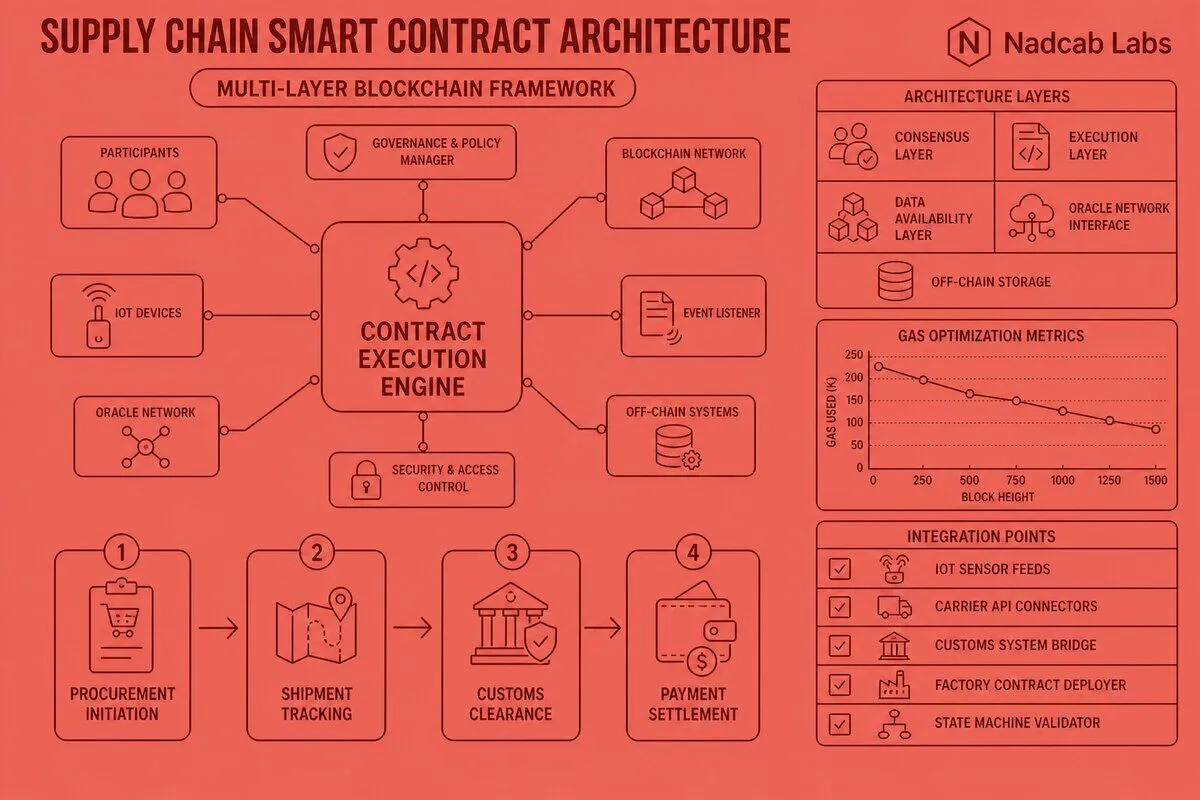
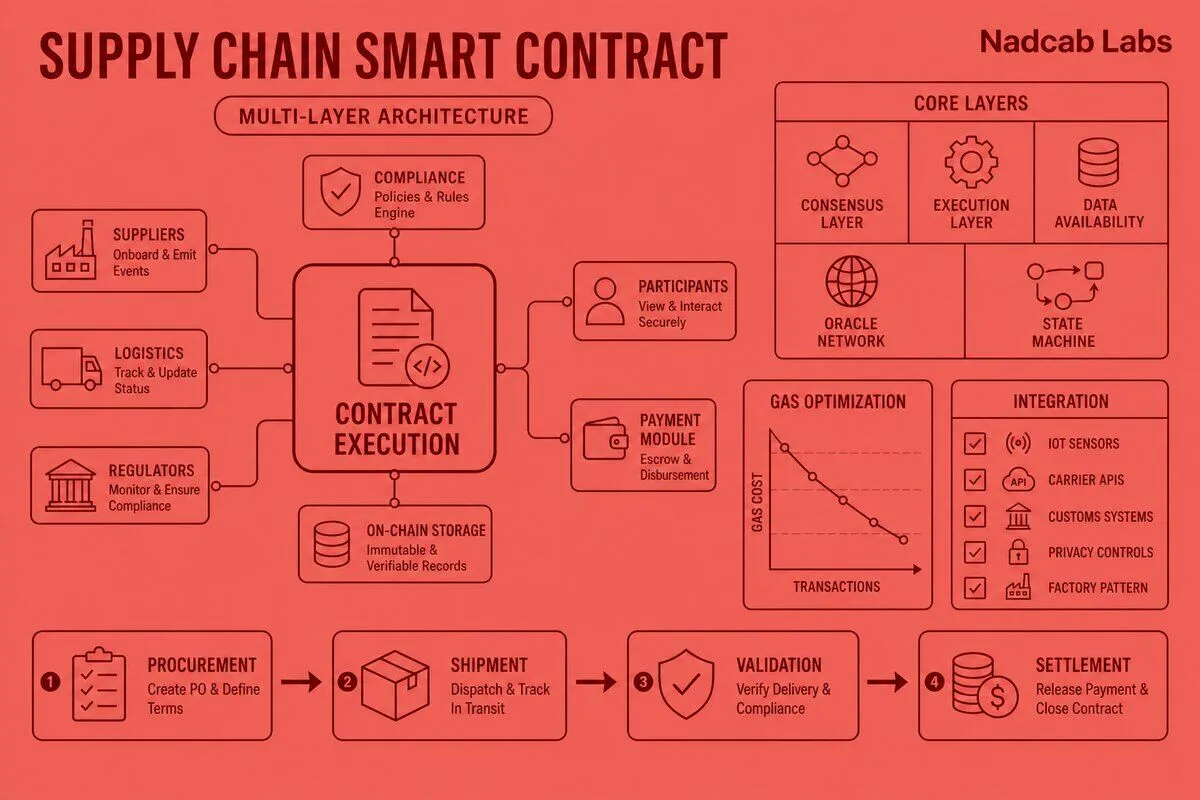
The consensus layer forms the foundation of supply chain smart contract architecture, determining how multiple stakeholders validate transactions without a central authority. Byzantine fault-tolerant consensus mechanisms like Practical Byzantine Fault Tolerance (PBFT) or Istanbul BFT work well for permissioned supply chain networks where participants are known entities—manufacturers, suppliers, logistics providers, and buyers. These protocols tolerate up to one-third malicious nodes while maintaining transaction finality in seconds, crucial for time-sensitive supply chain operations. For hybrid architectures connecting private consortiums to public chains, bridges validate cross-chain state transitions and enable interoperability between internal procurement systems and external marketplaces.
The execution layer implements business logic through Smart Contract state machines that model real-world supply chain workflows. This layer processes transactions, updates contract state, and enforces conditional logic like “release payment only if GPS coordinates confirm delivery AND temperature logs show cold-chain compliance.” Modern execution environments support multiple virtual machines—Ethereum Virtual Machine (EVM) for broad compatibility, WebAssembly (WASM) for performance-critical operations, and custom VMs optimized for supply chain-specific computations. The execution layer must handle concurrent transactions from different supply chain stages without race conditions, using locking mechanisms or optimistic concurrency control depending on throughput requirements.
The data availability and storage layer balances transparency requirements with cost constraints by splitting data across on-chain and off-chain repositories. Critical state data—contract ownership, shipment status, payment milestones—lives on-chain for immutability and audit trails. Large documents like bills of lading, quality certificates, and product specifications store off-chain in IPFS or Arweave, with content-addressed hashes recorded on-chain for verification. This hybrid approach reduces gas costs by 95% compared to full on-chain storage while maintaining cryptographic proof of document integrity. Event logs emitted by smart contracts create indexed audit trails that supply chain visibility platforms query for real-time tracking dashboards.
Which Smart Contract Design Patterns Work Best for Multi-Party Supply Chain Agreements in 2026?
Factory patterns enable dynamic creation of supply chain contracts without deploying new code for each transaction. A master factory contract holds templates for purchase orders, shipment agreements, and quality verification contracts, then instantiates copies with specific parameters—buyer address, SKU list, delivery deadline, payment amount. This pattern reduces deployment costs and standardizes contract interfaces across thousands of supply chain transactions. Role-based initialization ensures only authorized parties can create certain contract types: manufacturers deploy production contracts, logistics providers create shipment trackers, and buyers initiate payment escrows. The factory maintains a registry of all deployed contracts for audit and analytics purposes.
State machine patterns model shipment lifecycle transitions through discrete stages with conditional progression rules. A typical supply chain state machine includes: Ordered (initial state after purchase order creation), Manufactured (production complete with quality verification), Shipped (goods in transit with carrier custody transfer), InTransit (active GPS tracking and sensor monitoring), Delivered (arrival at destination confirmed by geofence), and Verified (buyer inspection complete, payment released). Each state transition requires specific conditions—moving from Shipped to InTransit needs carrier signature and IoT device activation, while Delivered to Verified requires buyer multi-signature approval. Invalid transitions revert, preventing premature payment release or fraudulent status updates.
Escrow and conditional payment patterns automate fund release based on milestone completion and quality verification. A multi-signature escrow contract holds payment in a locked state until predefined conditions are met: shipment delivery confirmed by GPS coordinates, temperature logs show compliance with cold-chain requirements, and quality inspection passes threshold criteria. The escrow supports partial releases for multi-stage deliveries—30% on manufacturing completion, 40% on shipment departure, 30% on final delivery. Dispute resolution mechanisms allow arbitrators (third-party inspectors or DAO governance) to adjudicate conflicts when automated verification fails. These patterns reduce payment delays from weeks to minutes while protecting both buyer and supplier interests through cryptographic enforcement rather than legal contracts.
How Should Oracle Integration and Off-Chain Data Architecture Be Designed for Supply Chain in 2026?
Hybrid on-chain/off-chain data architecture separates public verification data from private commercial information to balance transparency with confidentiality. On-chain storage holds shipment status updates, custody transfer events, and payment milestones—information that multiple parties need to verify independently. Off-chain databases managed by supply chain software development platforms store sensitive pricing, supplier identities, and proprietary formulas, with access controlled through cryptographic keys and zero-knowledge proofs. Smart contracts reference off-chain data through content hashes, enabling verification without exposure. This architecture reduces Ethereum mainnet gas costs from $50-200 per complex transaction to $2-5 for hash verification while maintaining audit integrity.
Oracle network architecture connects smart contracts to real-world data sources through decentralized validation. IoT sensor oracles aggregate temperature, humidity, shock, and GPS data from shipment containers, with multiple nodes validating readings before submitting to smart contracts. This prevents single points of failure or manipulation—if three of five oracle nodes report temperatures above threshold, the smart contract automatically flags a cold-chain violation and withholds payment. API oracles fetch customs clearance status, carrier tracking updates, and weather conditions that impact delivery schedules. Chainlink, Band Protocol, and custom oracle networks provide redundant data feeds with cryptographic proof of data source and timestamp, essential for dispute resolution and compliance audits.
Supply Chain Data Flow Architecture
Event emission patterns and indexing strategies enable real-time supply chain visibility without constant blockchain polling. Smart contracts emit structured events for every state change—ShipmentCreated, CustodyTransferred, QualityVerified, PaymentReleased—with indexed parameters like shipment ID, timestamp, and involved parties. Off-chain indexers (The Graph, custom event listeners) subscribe to these events and populate relational databases that power smart contract warehouse management systems and tracking dashboards. This architecture provides millisecond query response times for supply chain visibility platforms while maintaining blockchain as the authoritative source of truth. Event replay capabilities enable audit trail reconstruction and dispute investigation by replaying historical events through contract logic.
What Access Control and Privacy Mechanisms Should Supply Chain Smart Contracts Implement in 2026?
Role-based access control (RBAC) on-chain enforces permission hierarchies across manufacturer, supplier, logistics, and buyer roles through modifier functions and access control lists. A typical implementation uses OpenZeppelin’s AccessControl library with custom roles: MANUFACTURER_ROLE can update production status and quality metrics, LOGISTICS_ROLE can transfer custody and update shipment location, BUYER_ROLE can verify delivery and release payment. Multi-signature requirements for critical operations—contract deployment needs three of five consortium members, payment release requires both buyer and quality inspector signatures—prevent unilateral actions. Dynamic role assignment through governance contracts allows adding new suppliers or removing compromised parties without redeploying the entire system.
Zero-knowledge proof integration protects sensitive pricing, formulas, and trade secrets on public blockchains while maintaining verification capability. A manufacturer can prove production cost falls within an agreed range without revealing exact figures using zk-SNARKs. Buyers verify product authenticity through Smart Contract Provenance without exposing supplier identities to competitors. zkEVM implementations like Polygon zkEVM and zkSync enable private computation of complex supply chain logic—margin calculations, dynamic pricing, volume discounts—with public verification of results. This architecture allows supply chains to leverage public blockchain security and interoperability while protecting commercial confidentiality that prevents adoption of fully transparent systems.
| Privacy Approach | Data Visibility | Verification Method | Best Use Case |
|---|---|---|---|
| Public Ledger | All parties see all data | Direct on-chain validation | Commodity tracking, public certifications |
| Private Channels | Only transaction parties access | Selective disclosure with proofs | Pharmaceutical supply chains, defense contracts |
| Zero-Knowledge Proofs | Encrypted data with proof of validity | Cryptographic verification without exposure | Competitive pricing, proprietary formulas |
| Hybrid (Hash Anchoring) | Metadata public, details off-chain | Content hash verification | Enterprise supply chains with compliance needs |
Private channel versus public ledger trade-offs depend on supply chain confidentiality requirements and regulatory constraints. Hyperledger Fabric channels allow subsets of consortium members to transact privately while maintaining shared ledger integrity. A manufacturer and tier-1 supplier can negotiate pricing in a private channel, then publish only the final purchase order hash to the public consortium chain for downstream visibility. This architecture supports GDPR compliance by keeping personal data off immutable public ledgers while maintaining audit trails. However, private channels sacrifice the security guarantees and interoperability of public blockchains, requiring careful analysis of threat models and trust assumptions when designing Smart Contract Audit Architecture.
How Can Smart Contract Architecture Address Scalability and Gas Optimization for Supply Chain in 2026?
Layer-2 solutions and sidechain architecture dramatically reduce transaction costs and increase throughput for high-volume supply chain operations. Polygon PoS processes supply chain transactions at $0.01-0.05 per operation versus $5-50 on Ethereum mainnet, with 2-second block times enabling near-real-time shipment updates. Arbitrum and Optimism rollups batch hundreds of supply chain transactions into single Ethereum commitments, reducing per-transaction costs by 90% while inheriting mainnet security. Application-specific sidechains like Polygon Supernets allow supply chain consortiums to customize consensus parameters, gas token economics, and validator sets for their specific throughput and latency requirements. Bridges between Layer-2 networks and mainnet enable settlement of high-value transactions on Ethereum while processing routine updates on cheaper networks.
Transaction batching strategies aggregate multiple supply chain updates into single on-chain transactions to amortize gas costs across operations. Instead of writing each pallet scan to blockchain individually, a warehouse batches 100 scans into a Merkle tree, submits only the root hash on-chain, and provides Merkle proofs for individual item verification. Multi-party approval workflows collect signatures off-chain through ECDSA or BLS signature schemes, then submit a single aggregated signature transaction. State channels allow frequent updates between two parties—manufacturer and logistics provider exchanging custody dozens of times during multi-modal transport—with only opening and closing transactions hitting the blockchain. These patterns reduce gas consumption from thousands of dollars per day to hundreds for enterprise supply chains processing 10,000+ daily transactions.
Gas Cost Comparison: Supply Chain Operations (USD)
Upgrade mechanisms enable evolving supply chain requirements without data migration or service interruption through proxy patterns and modular architecture. The transparent proxy pattern separates contract logic from data storage—upgrades deploy new logic contracts while preserving state in the proxy. This allows adding new shipment stages, integrating additional oracle feeds, or patching Smart Contract Vulnerabilities without losing historical transaction data. The diamond standard (EIP-2535) supports unlimited contract size through faceted architecture, where each supply chain function—procurement, logistics, quality, payment—lives in separate facets that share state. Governance mechanisms through DAO voting or multi-signature admin control determine when and how upgrades deploy, balancing agility with stability for production systems processing millions in daily transaction value.
Working with experienced teams like those available when you Hire Smart contract developer specialists ensures these architectural patterns are implemented correctly from the start. Professional Smart Contract Audit services verify that upgrade mechanisms, access controls, and gas optimizations function as designed before production deployment. Integration with emerging technologies like Ai proof of Inference systems can further enhance supply chain automation through verified machine learning predictions for demand forecasting and route optimization.
Final Thoughts
Smart contract architecture for supply chain systems in 2026 demands careful orchestration of consensus mechanisms, execution environments, data storage strategies, oracle networks, and access controls to deliver the transparency and automation that supply chains require while managing costs and protecting commercial confidentiality. The architectural patterns outlined—layered design, factory and state machine contracts, hybrid on-chain/off-chain data, zero-knowledge privacy, and Layer-2 scalability—provide a production-ready blueprint for development teams building real supply chain systems. Organizations implementing these architectures gain automated compliance, reduced settlement times from weeks to minutes, and cryptographic audit trails that satisfy regulatory requirements across global trade networks. As supply chain complexity increases and stakeholder demands for visibility grow, robust smart contract architecture becomes the foundation for competitive advantage in logistics, manufacturing, and distribution operations.
Frequently Asked Questions
Q1.What are the main layers in a smart contract architecture for supply chain in 2026?
In 2026, supply chain smart contract architecture typically has four layers: the data layer (on-chain storage and IPFS references), the logic layer (core business rules and verification contracts), the integration layer (oracles and API connectors), and the presentation layer (user interfaces and dashboards). This separation ensures modularity, easier upgrades, and clear responsibility boundaries across stakeholders.
Q2.How do oracles integrate with supply chain smart contracts in 2026?
In 2026, oracles feed real-world data—like IoT sensor readings, GPS coordinates, and customs clearances—into supply chain smart contracts via signed data feeds or decentralized oracle networks. Smart contracts verify oracle signatures, timestamp data, and trigger automated actions (payments, ownership transfers) when conditions are met. This bridges physical logistics with on-chain execution reliably.
Q3.What smart contract patterns are best for multi-party supply chain agreements in 2026?
In 2026, the factory pattern deploys separate contract instances per shipment, while the escrow pattern holds funds until delivery milestones. Role-based access control (RBAC) manages permissions for manufacturers, carriers, and buyers. Multi-signature wallets approve high-value transactions, and event-driven workflows coordinate handoffs between parties, ensuring transparency and trust.
Q4.How can smart contracts handle private supply chain data on public blockchains in 2026?
In 2026, supply chain smart contracts use zero-knowledge proofs to verify conditions without revealing sensitive data, store encrypted hashes on-chain while keeping full data off-chain (IPFS or private databases), and employ private transaction layers like zk-rollups. Permissioned sidechains or enterprise blockchains offer another route, balancing transparency with confidentiality for competitive supply chain information.
Q5.What are the gas costs and scalability limits of supply chain smart contracts in 2026?
In 2026, gas costs vary by blockchain: Ethereum Layer 2 solutions reduce fees to cents per transaction, while purpose-built supply chain chains offer even lower costs. Scalability limits depend on throughput—modern chains handle thousands of transactions per second. Batching updates, using off-chain computation with on-chain verification, and choosing the right network minimize costs and scale effectively.
Q6.How do you upgrade smart contracts in a live supply chain system in 2026?
In 2026, upgradeable proxy patterns separate logic from storage, allowing new logic contracts to be deployed while preserving state. Governance mechanisms (multi-sig or DAO votes) approve upgrades. Thorough testing on testnets, phased rollouts, and emergency pause functions protect live supply chains. Clear migration paths and versioning ensure continuity without disrupting ongoing shipments or transactions.
Explore Services
Related Services
Reviewed by

Aman Vaths
Founder of Nadcab Labs
Aman Vaths is the Founder & CTO of Nadcab Labs, a global digital engineering company delivering enterprise-grade solutions across AI, Web3, Blockchain, Big Data, Cloud, Cybersecurity, and Modern Application Development. With deep technical leadership and product innovation experience, Aman has positioned Nadcab Labs as one of the most advanced engineering companies driving the next era of intelligent, secure, and scalable software systems. Under his leadership, Nadcab Labs has built 2,000+ global projects across sectors including fintech, banking, healthcare, real estate, logistics, gaming, manufacturing, and next-generation DePIN networks. Aman’s strength lies in architecting high-performance systems, end-to-end platform engineering, and designing enterprise solutions that operate at global scale.