Ai Overview
Building a blockchain project requires careful financial planning across multiple cost categories that many teams underestimate. Developer compensation forms the largest single cost center, typically representing 50–65% of total project budgets. Eastern European markets in Ukraine, Poland, and Romania offer 50–65% cost savings while maintaining strong technical capabilities and English proficiency.
Building a blockchain project requires careful financial planning across multiple cost categories that many teams underestimate. A blockchain development budget encompasses developer salaries, infrastructure expenses, security audits, third-party integrations, and ongoing maintenance — each with its own pricing variables tied to technical complexity, geographic location, and platform choice. Understanding these components helps organizations allocate resources effectively and avoid mid-project funding gaps that derail promising blockchain initiatives.
Key Takeaways
- Developer costs vary dramatically by region: North American blockchain developers charge $120–$250/hour while Eastern European talent ranges $50–$100/hour for similar expertise levels
- Infrastructure expenses include gas fees (which can fluctuate 10x during network congestion), node hosting ($200–$2,000/month), and decentralized storage solutions with distinct cost models
- Smart contract audits from reputable firms typically cost $10,000–$50,000 per contract, scaling with complexity and critical security requirements
- Ongoing maintenance consumes 15–25% of initial development costs annually, covering protocol upgrades, bug fixes, and infrastructure scaling
- Platform choice fundamentally impacts budget: Ethereum mainnet deployment costs significantly more in gas fees than Layer 2 solutions or alternative chains like Solana or Polygon
- Hidden costs frequently emerge in compliance (KYC/AML integration), oracle services, and cross-chain bridge implementations that weren’t scoped initially
What Are the Core Components of a Blockchain Development Budget?
Every blockchain development budget breaks down into three primary expense categories that interact in complex ways. Developer compensation forms the largest single cost center, typically representing 50–65% of total project budgets. Infrastructure expenses account for another 20–30%, while third-party services and integrations consume the remaining 10–20%. These percentages shift based on project complexity, team composition, and architectural decisions made during the design phase.
Developer salaries and contractor fees vary by experience level and specialization. Junior blockchain developers with 1–2 years of experience command $60,000–$90,000 annually in salary or $40–$75 per hour as contractors. Mid-level developers with 3–5 years of blockchain-specific experience earn $100,000–$150,000 annually or $80–$130 hourly. Senior blockchain architects and protocol engineers with 6+ years of experience demand $160,000–$250,000 in salary or $140–$250 per hour. These figures represent North American markets; other regions show different pricing structures covered in the next section. blockchain development budget.
Infrastructure costs include node hosting, cloud services, and network transaction fees that directly impact operational budgets. Self-hosted node infrastructure requires dedicated servers costing $500–$3,000 monthly depending on blockchain network and redundancy requirements. Managed node services like Infura or Alchemy charge $0–$500 monthly for basic tiers, scaling to $2,000+ for enterprise plans with higher request volumes and guaranteed uptime. Gas fees on Ethereum mainnet can range from $2–$50 per transaction during normal periods, spiking to $100–$500 during network congestion events. Layer 2 solutions reduce these costs by 90–95%, making them attractive for high-transaction-volume applications. blockchain development budget.
Third-party service expenses cover oracle integrations, API subscriptions, and middleware platforms that connect blockchain applications to external data sources and systems. Chainlink oracle networks charge per data feed request, with costs ranging from $0.10–$2.00 per call depending on data type and update frequency. API services for wallet connectivity, market data, or identity verification typically cost $100–$1,000 monthly based on usage tiers. Middleware platforms that simplify cross-chain interactions or provide abstraction layers charge $500–$5,000 monthly for production environments. When engaging a blockchain development company, these third-party costs are often bundled into comprehensive service packages with negotiated volume discounts. blockchain development budget.
Storage solutions represent another infrastructure consideration with distinct cost models. On-chain storage on Ethereum costs approximately $20,000 per megabyte at current gas prices, making it prohibitively expensive for anything beyond small metadata. IPFS provides free decentralized storage with pinning services costing $5–$50 monthly per gigabyte depending on redundancy and retrieval speed requirements. Arweave offers permanent storage for a one-time fee of approximately $5–$10 per gigabyte, attractive for immutable document storage or NFT metadata. The private blockchain deployment cost differs significantly, as organizations control infrastructure directly and avoid public network gas fees entirely. blockchain development budget.
| Cost Category | Monthly Range | Annual Range | Primary Variables |
|---|---|---|---|
| Senior Developer (North America) | $13,300–$20,800 | $160,000–$250,000 | Experience, specialization, location |
| Managed Node Service (Enterprise) | $500–$2,000 | $6,000–$24,000 | Request volume, uptime SLA, support level |
| Gas Fees (Ethereum Mainnet) | $1,000–$10,000 | $12,000–$120,000 | Transaction volume, network congestion, contract complexity |
| Oracle Services (Production) | $200–$2,000 | $2,400–$24,000 | Data feed frequency, number of feeds, data source quality |
| Decentralized Storage (IPFS Pinning) | $50–$500 | $600–$6,000 | Data volume, redundancy level, retrieval speed |
How Do Developer Rates Vary by Region and Expertise Level?
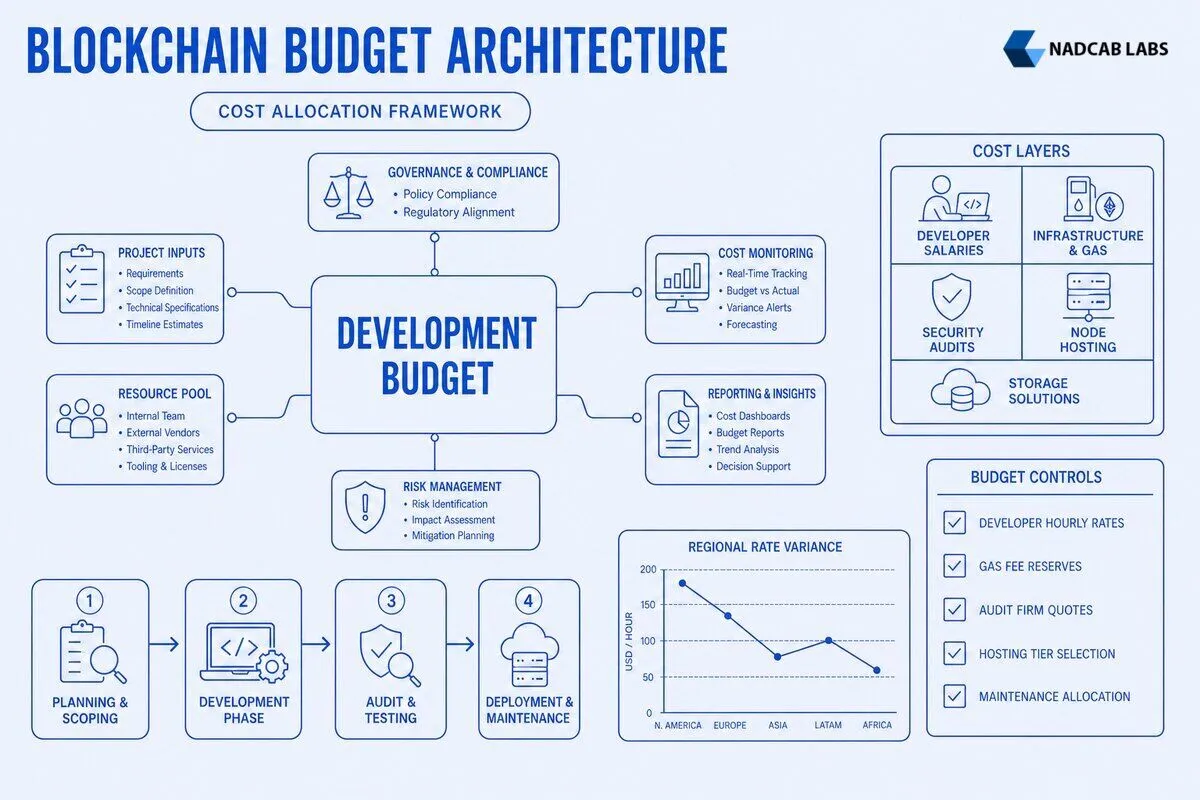
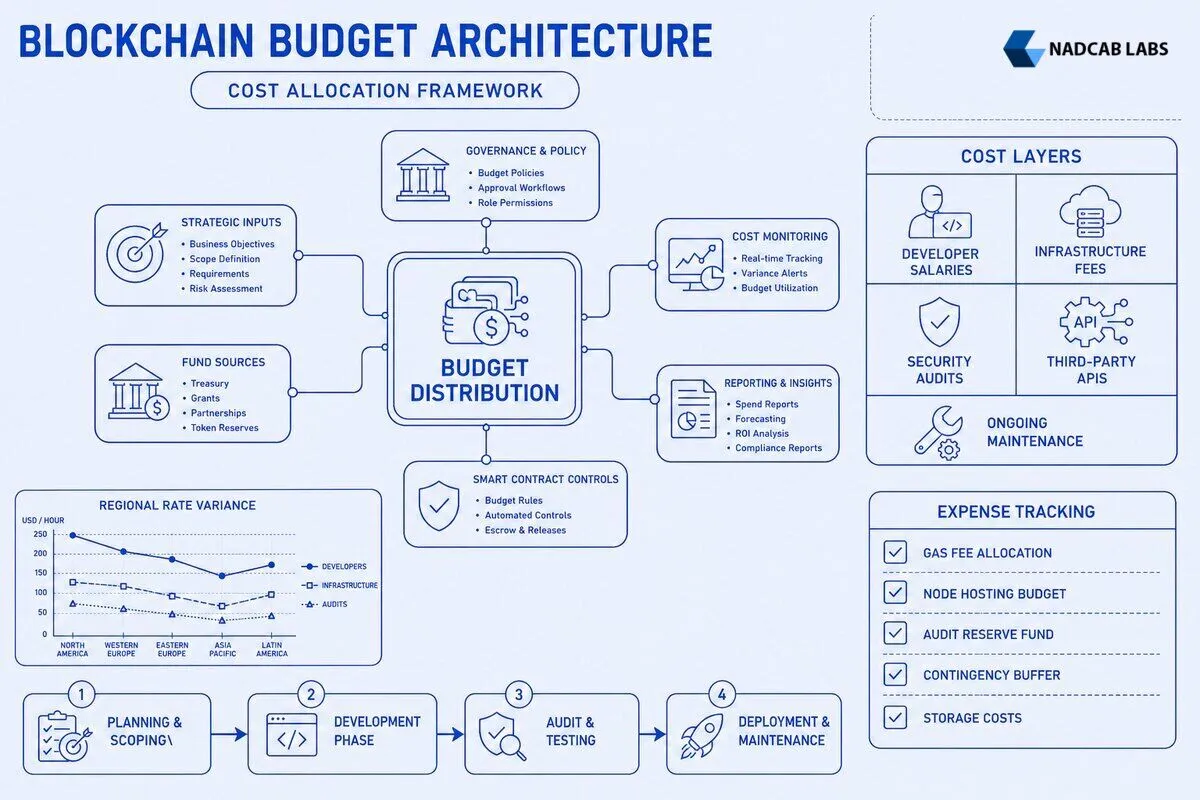
Geographic location creates dramatic cost differences for blockchain development talent while maintaining relatively consistent quality standards across major tech hubs. North American blockchain developers command the highest rates globally, with Silicon Valley and New York City representing premium markets. Western European developers in London, Berlin, and Amsterdam charge 15–25% less than North American counterparts for equivalent experience levels. Eastern European markets in Ukraine, Poland, and Romania offer 50–65% cost savings while maintaining strong technical capabilities and English proficiency. Asian markets show the widest variance, with Singapore and Tokyo approaching Western rates while India, Vietnam, and the Philippines offer 60–75% discounts. blockchain development budget.
Regional rate comparison reveals specific pricing structures across major blockchain development markets. North American senior blockchain developers charge $140–$250 per hour, mid-level developers $80–$130 per hour, and junior developers $40–$75 per hour. Western European rates run $100–$180 for senior talent, $60–$100 for mid-level, and $35–$60 for junior developers. Eastern European markets price senior developers at $70–$120 per hour, mid-level at $45–$75, and junior at $25–$45. Asian markets outside Singapore and Japan show senior rates of $50–$90 per hour, mid-level $30–$55, and junior $20–$35. These figures represent contractor rates; full-time salaries typically convert to 40–50% lower effective hourly costs when accounting for benefits and overhead. blockchain development budget.
Skill tier pricing extends beyond simple experience years to encompass specialized technical competencies. Protocol engineers who design consensus mechanisms or core blockchain infrastructure command 30–50% premiums over application developers building on existing platforms. Smart contract developers specializing in Solidity for Ethereum charge baseline rates, while Rust developers for Solana or Substrate command 15–25% premiums due to smaller talent pools. Move language developers for Aptos and Sui represent the highest premium tier at 40–60% above Solidity rates, reflecting extreme scarcity of production experience. Zero-knowledge proof specialists and cryptographers command similar premiums for privacy-focused projects requiring advanced mathematical expertise.
Specialist premiums for blockchain-specific languages reflect supply-demand imbalances in rapidly evolving ecosystems. Solidity developers represent the largest talent pool with relatively competitive pricing at baseline rates. Rust developers for blockchain applications charge 15–25% more due to the language’s steeper learning curve and smaller developer community. Move language expertise commands 40–60% premiums as Aptos and Sui ecosystems mature without proportional developer training programs. Vyper developers for security-critical Ethereum contracts charge 20–30% premiums despite smaller market share, valued for the language’s audit-friendly design. Cairo developers for StarkNet and other zk-rollup platforms command 35–50% premiums as zero-knowledge technology gains adoption faster than developer education scales.
Regional Developer Rate Comparison
Team composition strategy significantly impacts total blockchain project cost estimation. A typical enterprise blockchain project requires 1 protocol architect, 2–3 smart contract developers, 1–2 backend developers, 1 frontend developer, 1 DevOps engineer, and 1 QA specialist over a 6–9 month development cycle. Using North American rates, this team costs $180,000–$300,000 monthly or $1.08M–$2.7M total. The same team composition in Eastern Europe costs $70,000–$120,000 monthly or $420K–$1.08M total, representing 60–65% savings. Hybrid teams mixing senior North American architects with Eastern European implementation developers achieve 35–45% cost reductions while maintaining architectural quality and strategic oversight.
Contractor versus full-time employee economics shift based on project duration and organizational needs. Short-term projects under 6 months favor contractors despite higher hourly rates, avoiding recruitment costs, benefits, and post-project retention challenges. Projects exceeding 12 months show 25–35% cost advantages for full-time employees when factoring total compensation against contractor rates. The Blockchain MLM Platform development typically requires 8–12 month timelines, making full-time hiring more economical for core team members while using contractors for specialized audit and security roles.
What Infrastructure and Platform Costs Should You Account For?
Platform selection fundamentally determines infrastructure cost structures through gas fee models, node requirements, and ecosystem tooling maturity. Ethereum mainnet represents the highest infrastructure cost option with gas fees ranging from $2–$50 per transaction during normal network conditions, escalating to $100–$500 during DeFi activity spikes or NFT mints. Layer 2 solutions like Arbitrum, Optimism, and zkSync reduce transaction costs by 90–95%, bringing per-transaction fees to $0.10–$2.00 while maintaining Ethereum security guarantees. Alternative Layer 1 chains like Solana charge $0.00025 per transaction with consistent pricing regardless of network activity, while Polygon offers $0.01–$0.10 transaction costs with Ethereum compatibility.
Gas fees and transaction costs across major platforms reveal stark differences in operational budgets for high-throughput applications. An application processing 10,000 transactions daily on Ethereum mainnet incurs $20,000–$500,000 monthly in gas fees depending on network congestion, making it prohibitive for consumer applications with thin margins. The same transaction volume on Arbitrum costs $1,000–$20,000 monthly, on Polygon $100–$1,000 monthly, and on Solana approximately $75 monthly. These differences compound over time, making platform choice a critical budget driver for applications expecting significant user adoption. Projects requiring EHR interoperability blockchain cost analysis must factor in sustained high transaction volumes as healthcare data exchanges scale across provider networks.
Node infrastructure decisions balance control, reliability, and cost across self-hosted and managed service options. Self-hosted Ethereum archive nodes require 12TB+ storage, 32GB+ RAM, and high-bandwidth connections, costing $800–$3,000 monthly for dedicated servers with redundancy. Managed node services like Infura provide free tiers supporting 100,000 daily requests, adequate for development and small production deployments. Enterprise tiers supporting millions of daily requests with 99.9% uptime SLAs cost $500–$2,000 monthly. Alchemy offers similar pricing with enhanced debugging tools and webhook infrastructure. QuickNode provides multi-chain node access at $50–$1,000 monthly depending on request volume and supported networks, attractive for cross-chain applications requiring unified infrastructure management.
Storage solutions present distinct cost-benefit tradeoffs between decentralization, permanence, and expense. On-chain storage costs approximately $20,000 per megabyte on Ethereum at current gas prices, practical only for critical state data and small metadata. IPFS provides content-addressed decentralized storage with free base functionality, but production applications require pinning services ensuring content availability. Pinata charges $20 monthly for 100GB storage with 10GB bandwidth, scaling to custom enterprise plans. Filecoin offers decentralized paid storage at $0.0000015 per GB per epoch (30 seconds), translating to approximately $1.50 per GB annually with retrieval costs adding $0.01–$0.10 per GB. Arweave’s permanent storage model charges one-time fees of $5–$10 per gigabyte with no ongoing costs, optimal for immutable records and NFT metadata requiring guaranteed long-term availability.
| Platform | Transaction Cost | Monthly Cost (10K tx/day) | Best Use Case |
|---|---|---|---|
| Ethereum Mainnet | $2–$50 (normal), $100–$500 (peak) | $20,000–$500,000 | High-value DeFi, institutional settlement |
| Arbitrum (L2) | $0.10–$2.00 | $1,000–$20,000 | DeFi applications requiring Ethereum security |
| Polygon | $0.01–$0.10 | $100–$1,000 | Gaming, NFTs, consumer applications |
| Solana | $0.00025 | $75 | High-frequency trading, social applications |
| Avalanche | $0.50–$2.00 | $5,000–$20,000 | Enterprise subnets, custom blockchain applications |
Cross-chain infrastructure adds complexity and cost when applications span multiple blockchain networks. Bridge protocols enabling asset transfers between chains charge fees ranging from 0.1%–0.5% of transferred value plus gas costs on both source and destination chains. Multichain indexing services providing unified data access across networks cost $500–$3,000 monthly for production deployments. The exchange listing cost breakdown demonstrates how infrastructure costs multiply when supporting multiple blockchain networks simultaneously, as each chain requires dedicated node infrastructure, monitoring, and maintenance resources.
Development environment costs include testnet faucets, staging infrastructure, and continuous integration pipelines specific to blockchain applications. Testnet operations consume minimal direct costs but require dedicated DevOps time for network monitoring and periodic resets. Staging environments mirroring production infrastructure cost 30–50% of production monthly expenses, necessary for proper testing before mainnet deployment. CI/CD pipelines incorporating smart contract testing frameworks, security scanners, and deployment automation require $200–$1,000 monthly in cloud computing resources for active development teams. The entertainment app development cost breakdown includes similar infrastructure considerations when blockchain features integrate into broader application architectures.
How Much Should You Allocate for Security Audits and Compliance?
Security audit costs vary dramatically based on firm reputation, contract complexity, and project criticality. Top-tier audit firms like Trail of Bits, OpenZeppelin, and Consensys Diligence charge $15,000–$50,000 per smart contract for comprehensive audits including manual review, automated analysis, and formal verification where applicable. Mid-tier firms offer $8,000–$20,000 audits with solid reputations but less brand recognition. Budget audit services start at $3,000–$7,000 per contract, suitable for low-risk applications but insufficient for protocols handling significant value. Complex DeFi protocols with multiple interacting contracts require $75,000–$200,000 in total audit costs, while simple NFT contracts might only need $5,000–$10,000 audits.
Smart contract audit pricing by firm reputation reflects the security stakes and insurance considerations. Trail of Bits charges $300–$400 per hour with typical audits consuming 40–120 hours depending on contract complexity, totaling $12,000–$48,000. OpenZeppelin’s audit services range from $20,000 for basic contracts to $100,000+ for complex protocol suites. Quantstamp offers tiered pricing starting at $10,000 for standard audits, scaling to $50,000+ for protocols requiring economic modeling and game theory analysis. CertiK provides automated scanning starting at $5,000 with manual audits adding $15,000–$40,000. The dApp development cost breakdown must include these security expenses as non-negotiable budget items, since unaudited contracts face extreme risk of exploits and loss of user funds.
Penetration testing and vulnerability assessment budgets extend beyond smart contract audits to cover full-stack application security. Infrastructure penetration testing examining node security, API endpoints, and wallet integration points costs $10,000–$30,000 for comprehensive assessments. Frontend security reviews checking for transaction manipulation, signature verification bypasses, and wallet connection vulnerabilities run $5,000–$15,000. Backend API security testing ensuring proper authentication, rate limiting, and data validation costs $8,000–$20,000. Bug bounty programs provide ongoing security coverage, with platforms like Immunefi and HackerOne facilitating researcher engagement. Typical bug bounty budgets allocate $50,000–$500,000 in total rewards based on protocol value, with critical vulnerabilities paying $10,000–$100,000 per finding.
Legal compliance costs for KYC/AML integration vary by jurisdiction and user base size. Basic KYC provider integration using services like Jumio, Onfido, or Sumsub costs $2–$5 per verification with monthly minimums of $500–$2,000. Enterprise KYC solutions with advanced fraud detection and ongoing monitoring run $10,000–$50,000 in setup fees plus $3–$8 per verification. AML screening against sanctions lists and PEP databases adds $0.50–$2.00 per check. Continuous transaction monitoring for suspicious activity patterns requires specialized compliance software costing $5,000–$25,000 monthly for platforms processing significant transaction volumes. The SSI implementation cost includes similar identity verification expenses when building self-sovereign identity systems requiring regulatory compliance.
Smart Contract Audit Process Flow
Regulatory filing and jurisdiction-specific compliance requirements impose additional legal costs beyond technical implementation. Securities law analysis determining whether tokens constitute securities costs $15,000–$50,000 for comprehensive legal opinions. Money transmitter license applications in the United States range from $5,000–$50,000 per state with ongoing compliance costs of $10,000–$100,000 annually per jurisdiction. European MiCA regulation compliance requires $50,000–$200,000 in legal preparation and documentation. Privacy law compliance for GDPR, CCPA, and similar regulations adds $20,000–$75,000 in initial legal review and technical implementation costs. Organizations pursuing modular blockchain architectures must consider how compliance costs distribute across different protocol layers and jurisdictions.
Insurance and risk mitigation strategies provide financial protection against security failures and operational incidents. Smart contract insurance through Nexus Mutual or InsurAce costs 2%–5% of covered value annually, protecting against specific exploit scenarios. Directors and officers insurance for blockchain companies costs $10,000–$50,000 annually depending on company size and risk profile. Cyber liability insurance covering data breaches and operational disruptions runs $5,000–$30,000 annually for small to mid-sized projects. These insurance costs represent essential risk management expenses that prevent catastrophic financial losses from security incidents or regulatory actions.
What Ongoing Maintenance and Operational Costs Should You Plan For?
Monthly infrastructure and hosting fees for production environments create predictable baseline operational costs. Managed node services for multi-chain applications cost $1,000–$5,000 monthly depending on supported networks and request volumes. Cloud infrastructure hosting backend APIs, databases, and monitoring systems runs $500–$3,000 monthly for applications serving thousands of daily active users, scaling to $10,000–$50,000 monthly for platforms with millions of users. CDN costs for frontend delivery and IPFS gateway services add $200–$2,000 monthly based on bandwidth consumption. Database hosting for off-chain data indexing costs $300–$2,000 monthly depending on data volume and query complexity. Total infrastructure costs typically range from $2,000–$10,000 monthly for small to medium applications, reaching $20,000–$100,000 monthly for large-scale platforms.
Protocol upgrade costs, bug fixes, and feature enhancement budgets require ongoing development resources. Maintenance development typically consumes 15–25% of initial development costs annually, translating to $150,000–$500,000 yearly for projects with $1M–$2M initial builds. Critical bug fixes demand immediate attention with costs ranging from $5,000–$25,000 per incident depending on complexity and urgency. Protocol upgrades implementing new features or optimizing gas costs require 2–4 weeks of development time, costing $20,000–$80,000 per major upgrade cycle. Security patch implementation following audit findings or disclosed vulnerabilities costs $10,000–$40,000 per incident including testing and deployment. The Blockchain Identity Management systems require particularly careful maintenance as identity protocols demand high reliability and security standards.
Community management, support systems, and documentation maintenance expenses support user adoption and retention. Community managers handling Discord, Telegram, and social media engagement cost $50,000–$90,000 annually for full-time roles or $3,000–$8,000 monthly for contractors. Technical support specialists responding to user issues and providing integration assistance run $60,000–$100,000 annually per full-time employee. Documentation writers maintaining developer guides, API references, and user tutorials cost $70,000–$110,000 annually for experienced technical writers or $5,000–$10,000 per major documentation update using contractors. Video tutorial production and educational content creation adds $2,000–$8,000 per video depending on production quality and technical complexity.
Monitoring and incident response infrastructure prevents downtime and ensures rapid problem resolution. Application performance monitoring tools like Datadog or New Relic cost $100–$500 monthly for basic plans, scaling to $2,000–$10,000 monthly for comprehensive enterprise monitoring. Blockchain-specific monitoring services tracking transaction success rates, gas prices, and contract events run $200–$2,000 monthly. On-call engineering rotation for 24/7 incident response requires 2–3 engineers with 20–30% salary premiums for on-call duties, adding $30,000–$60,000 to annual personnel costs. Incident response retainer agreements with specialized blockchain security firms cost $5,000–$20,000 monthly, providing rapid expert assistance during security incidents or complex technical failures.
| Operational Category | Monthly Cost | Annual Cost | Scaling Factor |
|---|---|---|---|
| Infrastructure Hosting (Medium Scale) | $2,000–$10,000 | $24,000–$120,000 | Scales with user count and transaction volume |
| Maintenance Development (15-25% of initial) | $12,500–$42,000 | $150,000–$500,000 | Based on initial development investment |
| Community Management | $4,200–$7,500 | $50,000–$90,000 | Grows with community size and engagement needs |
| Monitoring & Incident Response | $5,300–$20,500 | $64,000–$246,000 | Higher for mission-critical financial applications |
| Security Updates & Patches | $1,700–$6,700 | $20,000–$80,000 | Varies with protocol complexity and audit frequency |
Marketing and user acquisition costs drive adoption but vary dramatically by project type and target audience. Developer-focused infrastructure projects allocate $10,000–$50,000 monthly for technical content marketing, conference sponsorships, and developer relations. Consumer-facing applications require $50,000–$200,000 monthly for user acquisition through social media advertising, influencer partnerships, and community incentives. Token launch marketing campaigns consume $100,000–$500,000 in concentrated spending over 2–3 months. Ongoing brand awareness and community engagement typically costs 10–20% of total operational budgets for projects seeking sustained growth.
Third-party service renewals and subscription costs accumulate as projects mature and integrate additional tools. Analytics platforms like Dune Analytics or Nansen cost $400–$3,000 monthly for team plans providing on-chain data insights. Security monitoring services detecting suspicious transactions or contract interactions run $500–$5,000 monthly. API rate limit increases for growing applications add $200–$2,000 monthly per service. Development tool subscriptions for IDEs, testing frameworks, and deployment platforms cost $100–$1,000 monthly per developer. These recurring costs compound over time, making subscription management an important budget discipline for long-running projects.
Legal and accounting services provide ongoing compliance and financial management. Monthly accounting and bookkeeping for blockchain projects costs $2,000–$8,000 depending on transaction volume and regulatory complexity. Quarterly tax preparation and filing adds $5,000–$20,000 per quarter for projects with token operations or complex revenue models. Annual audit requirements for regulated entities or venture-backed companies cost $25,000–$100,000 depending on company size and audit scope. Legal counsel retainer agreements providing ongoing regulatory guidance and contract review run $5,000–$25,000 monthly for active projects navigating evolving regulatory landscapes.
Final Thoughts
Effective blockchain development budgeting requires understanding how developer costs, infrastructure expenses, security investments, and maintenance obligations interact across project lifecycles. Regional rate variations create 50–65% cost differences between North American and Eastern European development teams, while platform choice determines whether gas fees consume $75 or $500,000 monthly for equivalent transaction volumes. Security audits represent non-negotiable expenses ranging from $10,000 for simple contracts to $200,000 for complex protocols, with ongoing maintenance consuming 15–25% of initial development costs annually. Organizations that account for these cost drivers during planning avoid mid-project funding crises and build sustainable blockchain applications aligned with business objectives. Comprehensive budget frameworks covering all expense categories enable realistic project scoping and resource allocation that supports long-term blockchain initiative success.
Frequently Asked Questions
Q1.What is the average cost to develop a blockchain application?
Blockchain application development typically ranges from $50,000 to $500,000+ depending on complexity. Simple DApps with basic smart contracts cost $50,000-$150,000, while enterprise solutions with custom consensus mechanisms, advanced tokenomics, and multi-chain integration exceed $300,000. MVP development starts around $30,000-$80,000. Factors include blockchain platform choice (Ethereum, Polygon, Solana), feature scope, security requirements, and integration complexity. At Nadcab Labs, we provide detailed cost breakdowns during initial consultation to align technical requirements with realistic budget expectations.
Q2.How much do blockchain developers charge per hour in different regions?
Blockchain developer rates vary significantly by region: North America charges $150-$250/hour, Western Europe $120-$200/hour, Eastern Europe $80-$150/hour, and Asia $50-$120/hour. Senior architects and security specialists command premium rates of $200-$350/hour globally. Specialized skills like zero-knowledge proofs, Layer-2 solutions, or DeFi protocol development add 20-40% to base rates. Nadcab Labs offers competitive rates with senior-level expertise across multiple blockchain platforms, ensuring cost-effective development without compromising quality or security standards.
Q3.What are the hidden costs in blockchain development projects?
Hidden costs often add 30-50% to initial estimates: third-party API integrations ($5,000-$20,000), oracle services (Chainlink nodes $500-$2,000/month), infrastructure monitoring tools ($200-$1,000/month), legal compliance reviews ($10,000-$50,000), unexpected smart contract redeployments ($3,000-$15,000), and post-launch optimization ($10,000-$30,000). Testing on multiple testnets, additional security audits after code changes, and emergency incident response capabilities also accumulate costs. Nadcab Labs includes comprehensive cost modeling covering these often-overlooked expenses during project planning phases.
Q4.How do gas fees impact the total cost of blockchain development?
Gas fees significantly affect deployment and operational costs. Ethereum mainnet contract deployment ranges $500-$5,000 depending on complexity and network congestion. Initial testing across testnets costs $0 but mainnet deployment, contract verification, and initial transactions add up. High-frequency applications may incur $10,000-$100,000+ annually in gas fees. Layer-2 solutions reduce costs by 90-95%. Budget 15-25% of development costs for deployment and initial operational gas fees. Nadcab Labs optimizes smart contract code to minimize gas consumption and recommends cost-effective blockchain platforms.
Q5.What percentage of budget should be allocated to smart contract audits?
Allocate 10-20% of total development budget for comprehensive smart contract audits. Professional audits cost $5,000-$15,000 for simple contracts, $15,000-$50,000 for moderate complexity, and $50,000-$200,000+ for complex DeFi protocols or multi-contract systems. Critical financial applications require multiple independent audits. Include penetration testing ($3,000-$10,000) and formal verification ($10,000-$30,000) for high-value systems. Nadcab Labs conducts internal security reviews throughout development and coordinates with leading audit firms, ensuring thorough vulnerability assessment before mainnet deployment.
Q6.How much does it cost to maintain a blockchain application annually?
Annual blockchain maintenance typically costs 15-25% of initial development investment. Expect $15,000-$100,000+ yearly for infrastructure hosting ($2,000-$10,000), node maintenance ($3,000-$15,000), security monitoring ($5,000-$20,000), protocol upgrades ($5,000-$30,000), and ongoing gas fees. Enterprise applications with high transaction volumes may exceed $200,000 annually. Include bug fixes, performance optimization, and compliance updates. Nadcab Labs offers flexible maintenance packages covering infrastructure management, security monitoring, and protocol updates to ensure optimal performance and security.
Explore Services
Related Services
Reviewed by

Aman Vaths
Founder of Nadcab Labs
Aman Vaths is the Founder & CTO of Nadcab Labs, a global digital engineering company delivering enterprise-grade solutions across AI, Web3, Blockchain, Big Data, Cloud, Cybersecurity, and Modern Application Development. With deep technical leadership and product innovation experience, Aman has positioned Nadcab Labs as one of the most advanced engineering companies driving the next era of intelligent, secure, and scalable software systems. Under his leadership, Nadcab Labs has built 2,000+ global projects across sectors including fintech, banking, healthcare, real estate, logistics, gaming, manufacturing, and next-generation DePIN networks. Aman’s strength lies in architecting high-performance systems, end-to-end platform engineering, and designing enterprise solutions that operate at global scale.