Ai Overview
Patient consent management on blockchain transforms how healthcare organizations record, enforce, and audit permission to access sensitive medical data. This architecture eliminates fragmented audit trails, puts patients in direct control of who sees their information, and automates compliance checks through smart contracts.
Patient consent management on blockchain transforms how healthcare organizations record, enforce, and audit permission to access sensitive medical data. Instead of relying on paper forms or siloed digital databases, blockchain systems create tamper-proof, patient-controlled consent records that follow data across every exchange—from primary care visits to specialist referrals and research studies. This architecture eliminates fragmented audit trails, puts patients in direct control of who sees their information, and automates compliance checks through smart contracts.
Key Takeaways
- Blockchain consent systems replace fragmented paper and database records with immutable, patient-sovereign permission logs that follow data across providers.
- Consent tokenization represents permissions as on-chain digital assets, enabling granular control—patients can grant read-only access to lab results while restricting prescription history.
- Smart contracts automatically enforce consent rules: if a patient revokes access at 3 PM, the contract blocks provider queries at 3:01 PM without manual intervention.
- Immutable audit trails timestamp every consent event—grant, modification, revocation—with cryptographic proof of who accessed data under which terms, satisfying HIPAA and GDPR requirements.
- Decentralized identity frameworks (DIDs and verifiable credentials) anchor consent to portable patient identities, not institution-specific IDs, ensuring permissions persist across health systems.
- Integration with EHR platforms via FHIR APIs bridges on-chain consent logic with off-chain clinical data, maintaining performance while preserving blockchain’s auditability benefits.
What is patient consent management on blockchain and why does it matter?
Patient consent management on blockchain is a decentralized system that records, enforces, and audits permissions for accessing healthcare data using distributed ledger technology. Every consent decision—whether a patient allows a cardiologist to view their imaging studies or grants a research team access to anonymized lab results—becomes a cryptographically signed transaction stored across multiple nodes. This approach replaces traditional consent workflows where paper forms sit in filing cabinets, scanned PDFs live in isolated document management systems, and no single party can prove the complete history of who accessed what data under which authorization.
The core problem in legacy systems is fragmentation. A patient might sign a HIPAA authorization form at a clinic, email consent to a specialist, and verbally approve data sharing during a telehealth call. These records rarely synchronize: the clinic’s EHR has one version, the specialist’s portal another, and the telehealth platform a third. When a patient wants to revoke consent or audit who viewed their records, reconstructing the truth requires manual phone calls, faxed requests, and weeks of administrative overhead. Worse, malicious actors can alter paper records or database entries with minimal forensic trace, undermining trust and regulatory compliance. patient consent.
Blockchain solves these issues through three fundamental properties. First, immutability ensures that once a consent transaction is recorded, no party—not the hospital, not the patient, not even a system administrator—can delete or modify it without creating a visible, timestamped audit trail. Second, transparency means every authorized participant (patient, provider, auditor) can view the same ledger, eliminating disputes over “he said, she said” consent histories. Third, patient sovereignty shifts control from institutions to individuals: patients hold cryptographic keys that grant or revoke access in real time, and smart contracts enforce those decisions automatically across all integrated systems. patient consent.
This architecture matters because healthcare data governance is under intense regulatory scrutiny. HIPAA’s Privacy Rule mandates that covered entities obtain valid authorization before disclosing protected health information, and the Security Rule requires audit controls to track access. GDPR Article 7 demands clear, affirmative consent that users can withdraw at any time, with controllers able to demonstrate compliance. Traditional systems struggle to meet these standards at scale—audit logs are often incomplete, consent forms lack granular detail, and revocation processes are slow. Blockchain-based consent management provides a cryptographic proof layer that satisfies regulators, reduces legal risk, and rebuilds patient trust by making data governance transparent and verifiable. patient consent.
For organizations pursuing healthcare software development, blockchain consent frameworks offer a competitive differentiator. Patients increasingly demand control over their medical records, especially as telemedicine, wearable devices, and genomic testing generate data across dozens of platforms. A decentralized consent layer allows patients to carry permissions with them—granting a new specialist access without re-signing forms, or instantly revoking a third-party app’s API access when they switch providers. This portability and real-time control are impossible in siloed legacy systems, making blockchain a strategic enabler for patient-centric care models. patient consent.
How does consent tokenization work in blockchain healthcare systems?
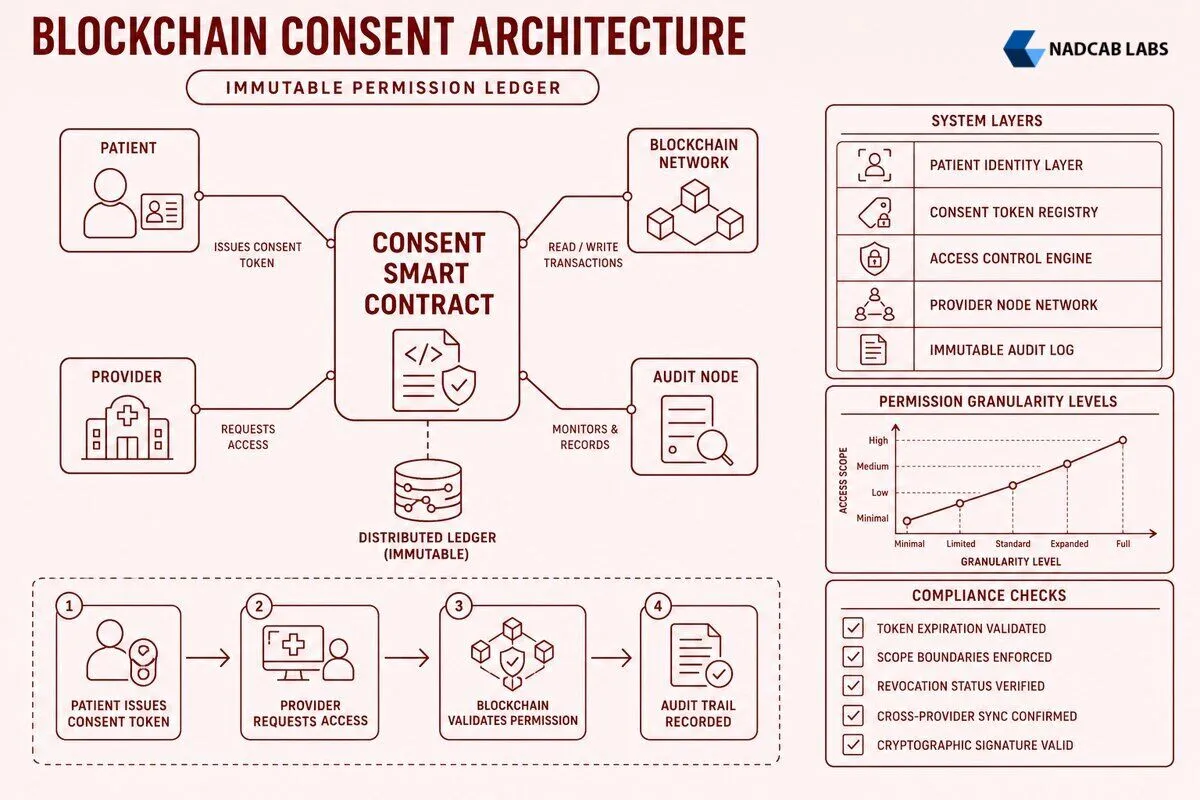
Consent tokenization represents patient permissions as on-chain digital assets—tokens that encode who can access which data elements, for what purpose, and until when. Each token is tied to a patient’s decentralized identifier (DID) and contains metadata specifying the scope of consent: read-only access to lab results, write permissions for a specialist to add notes, or share rights allowing a research institution to analyze anonymized records. When a provider queries a patient’s data, the system checks whether the provider holds a valid consent token; if not, the query is automatically rejected by smart contract logic. patient consent.
The mechanism works through a layered permission model. At the coarsest level, a patient might issue a “full medical record” token to their primary care physician, granting access to everything. More commonly, patients use granular tokens: a “cardiology consult” token allows a cardiologist to read imaging studies and stress test results but blocks mental health notes and genetic data. A “clinical trial” token permits a research team to access de-identified lab values for a specific study period, with automatic expiration after six months. Each token is a non-fungible, transferable asset on the blockchain—patients can delegate tokens (e.g., a parent managing a child’s consent), revoke them instantly, or set time-based conditions that expire without manual intervention. patient consent.
Smart contracts enforce these rules through programmable logic. Consider a scenario where a patient grants a specialist read access to their imaging archive but explicitly excludes psychiatric records. The consent smart contract stores this rule as code: when the specialist’s EHR system sends a FHIR query for “all patient documents,” the contract intercepts the request, filters out psychiatric records, and returns only the authorized imaging files. If the patient later revokes the token via a mobile app, the contract updates its state, and subsequent queries return an access-denied error—no manual IT ticket, no phone call to the records department. This automation reduces administrative burden and eliminates the lag between consent changes and system enforcement. patient consent.
Granular permission models extend beyond binary “allow/deny” flags. Attribute-based access control (ABAC) on blockchain can encode complex conditions: “Allow Dr. Smith to view lab results if the visit reason is ‘diabetes management’ and the data is less than one year old.” Role-based access control (RBAC) assigns tokens to provider roles rather than individuals, so any endocrinologist in a hospital network can access diabetes-related records without the patient issuing separate tokens to each doctor. Hybrid models combine both: a patient grants RBAC tokens to their care team for routine access, plus temporary ABAC tokens to external specialists for second opinions, with automatic expiration after the consult. patient consent.
The table below compares consent token types and their typical use cases in healthcare blockchain systems: patient consent.
| Token Type | Permission Scope | Typical Use Case | Expiration Model |
|---|---|---|---|
| Full Record Token | Read/write access to all data elements | Primary care physician managing ongoing treatment | Indefinite until patient revokes |
| Specialty Consult Token | Read-only for specific clinical domain (cardiology, oncology) | Referral to specialist for second opinion | 90 days or end of treatment episode |
| Research Study Token | Read-only, anonymized data for approved study protocol | Clinical trial enrollment or registry participation | Fixed term (e.g., 12 months) with opt-out clause |
| Emergency Access Token | Read-only for life-critical data (allergies, medications) | Paramedic or ER physician treating unconscious patient | Single-use or 24-hour window |
| Third-Party App Token | API access to patient-generated health data (wearables, apps) | Fitness app analyzing activity logs or medication adherence tool | Renewable every 30 days with patient confirmation |
Consent tokenization also supports delegation and multi-party scenarios. A parent managing a child’s consent can issue sub-tokens to pediatricians, school nurses, and sports coaches, each with different permission levels. In research, a patient might grant a university hospital access to raw genomic data while simultaneously issuing a token to a pharmaceutical company for aggregated, de-identified analysis—both tokens reference the same underlying data but enforce different privacy constraints. This flexibility is impossible in traditional role-based systems where permissions are hard-coded in EHR software and require IT changes to modify. patient consent.
From a technical perspective, consent tokens are often implemented as ERC-721 or ERC-1155 non-fungible tokens on Ethereum-compatible chains, or as custom chaincode in Hyperledger Fabric. Each token’s metadata includes the patient’s DID, the provider’s DID, the data category (using standardized codes like SNOMED CT or LOINC), the permission type (read, write, share), and validity conditions (time range, purpose of use). When a provider queries data, an off-chain oracle or middleware service reads the token state from the blockchain and applies the corresponding access policy before returning results from the EHR database. This hybrid architecture keeps sensitive clinical data off-chain (for performance and privacy) while leveraging blockchain for tamper-proof consent enforcement. patient consent.
What are immutable audit trails and how do they improve consent tracking?
An immutable audit trail is a chronological, tamper-proof log of every event related to patient consent—who granted access, when permissions were modified, which providers queried data under which consent terms, and when revocations took effect. Unlike traditional database logs that administrators can edit or delete, blockchain audit trails are cryptographically sealed: each event is hashed and linked to the previous block, so altering a single entry would invalidate the entire chain and be immediately detectable by all network participants.
The process begins when a patient grants consent. The system creates a transaction containing the patient’s DID, the provider’s DID, the data scope, and a timestamp. This transaction is signed with the patient’s private key, broadcast to the network, and included in the next block. Miners or validators verify the signature, confirm the transaction follows consensus rules, and add it to the ledger. From that moment, the consent record exists on every node—no single party can claim it was never granted or backdated. If the patient later modifies consent (e.g., expanding access from “lab results only” to “full record”), a new transaction references the original consent’s transaction hash, creating an unbroken chain of custody. patient consent.
Revocation events are equally transparent. When a patient clicks “Revoke Access” in their mobile app, the system generates a revocation transaction that nullifies the original consent token. This transaction is timestamped and permanently recorded, so if a provider attempts to access data after revocation, the smart contract rejects the query and logs the denial attempt. Auditors can trace the complete lifecycle: consent granted on January 15 at 10:23 AM, modified on February 3 at 2:45 PM to add imaging studies, and revoked on March 10 at 9:17 AM. Every step includes cryptographic proof of who initiated the action, eliminating disputes over consent validity. patient consent.
The compliance benefits are substantial. HIPAA’s Security Rule (45 CFR § 164.312(b)) requires covered entities to “implement hardware, software, and/or procedural mechanisms that record and examine activity in information systems that contain or use electronic protected health information.” Traditional audit logs stored in SQL databases or SIEM tools can be manipulated by privileged users—a rogue administrator could delete entries showing unauthorized access. Blockchain audit trails are append-only: even system administrators cannot alter past records without detection. This property satisfies HIPAA’s integrity controls and provides defensible evidence in breach investigations or malpractice litigation. patient consent.
GDPR Article 30 mandates that data controllers maintain records of processing activities, including the legal basis for processing (consent being one such basis). Blockchain consent logs automatically generate this documentation: every data access is tied to a specific consent transaction, proving that processing occurred under valid authorization. If a patient exercises their Article 17 “right to erasure,” the system can trace which providers accessed data under now-revoked consent, enabling targeted deletion requests. The immutable trail also supports Article 15’s “right of access”—patients can export their complete consent history as a verifiable credential, showing exactly who had permission to view their data and when. patient consent.
The workflow below illustrates how immutable audit trails capture consent lifecycle events in a blockchain system: patient consent.
Cryptographic proof mechanisms enhance audit trail reliability. Each transaction includes a digital signature generated with the patient’s private key, which validators verify against the patient’s public key (stored in their DID document). This proves that the consent action originated from the legitimate patient, not an impersonator. Hash pointers link each block to its predecessor, so tampering with an old consent record would require recalculating hashes for all subsequent blocks—a computationally infeasible task in proof-of-work or proof-of-stake networks. Some systems add zero-knowledge proofs to audit trails, allowing regulators to verify that consent was obtained without revealing the patient’s identity or the specific data accessed. patient consent.
For organizations implementing HIPAA compliant blockchain architecture, immutable audit trails reduce the cost and complexity of compliance audits. Instead of manually reviewing server logs, database queries, and paper authorization forms, auditors can query the blockchain for a complete, verifiable consent history. Automated compliance checks become feasible: a smart contract can flag any data access that occurred without a valid consent token, triggering alerts for security teams to investigate potential breaches. This proactive monitoring is far more effective than reactive log analysis, where violations are often discovered months after the fact.
21 CFR Part 11, which governs electronic records in FDA-regulated clinical trials, requires that systems generate audit trails showing “the date and time of operator entries and actions that create, modify, or delete electronic records.” Blockchain consent systems meet this standard by default—every consent modification is timestamped with block height and UTC time, and the identity of the actor (patient, provider, or delegated guardian) is cryptographically verified. This built-in compliance reduces the validation burden for clinical trial sponsors and contract research organizations, accelerating study timelines and lowering regulatory risk.
How do patients control data access permissions in decentralized consent frameworks?
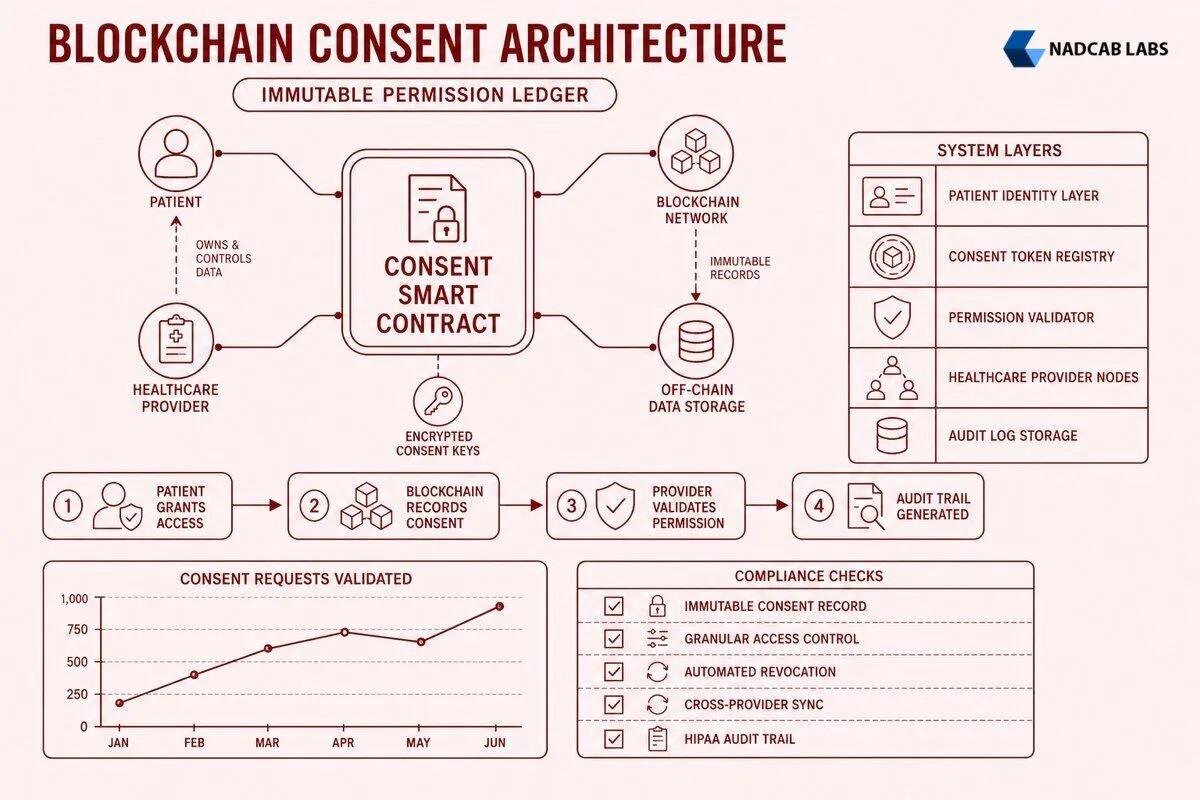
Patient control in decentralized consent frameworks centers on self-sovereign identity and cryptographic key management. Each patient holds a private key that signs consent transactions, and only the patient (or an authorized delegate) can grant, modify, or revoke permissions. This shifts the locus of control from institutions—who traditionally “own” consent records in their EHR systems—to individuals, who carry portable consent credentials across providers, payers, and research organizations.
The user interface typically consists of a mobile app or web portal where patients see a dashboard of active consent tokens. Each token displays the provider’s name, the data scope (e.g., “Lab Results,” “Imaging Studies,” “Prescription History”), the permission type (read, write, share), and the expiration date. Patients can tap a token to view its full details—when it was granted, which specific data elements are included, and a log of every time the provider accessed data under that consent. To revoke access, the patient taps “Revoke,” enters a PIN or biometric confirmation, and the app broadcasts a revocation transaction to the blockchain. Within seconds, the smart contract updates, and the provider’s next query is denied.
Real-time control is a key differentiator. In legacy systems, revoking consent requires filling out a form, faxing it to the provider’s records department, and waiting days or weeks for IT staff to update access control lists. During that lag, the provider can continue accessing data. Blockchain consent systems eliminate this delay: the revocation transaction is final as soon as it’s included in a block (typically 5–15 seconds on permissioned chains, 1–2 minutes on public chains). This immediacy is critical in scenarios like ending a doctor-patient relationship, withdrawing from a clinical trial, or revoking a third-party app’s API access after a data breach.
Role-based access control (RBAC) in decentralized frameworks assigns permissions to provider roles rather than individuals. For example, a patient might grant a “Primary Care Physician” role full access to their medical record. When the patient switches from Dr. Jones to Dr. Smith, the hospital’s identity system updates the role assignment, and Dr. Smith automatically inherits the consent token—no need for the patient to re-sign forms. This approach balances patient control with operational efficiency, especially in large health systems where patients see multiple providers within the same care team.
Attribute-based access control (ABAC) offers finer granularity by encoding conditions into consent logic. A patient might grant access only if the provider’s purpose of use is “treatment” (blocking marketing or research uses), or restrict access to data collected after a certain date (excluding old records from a previous diagnosis). ABAC policies are stored in smart contract code, so the system evaluates attributes at query time—provider role, data category, purpose of use, time of access—and applies the most restrictive applicable rule. This model supports complex scenarios like “allow any endocrinologist in my insurance network to view diabetes-related data, but only during business hours and only if I’m enrolled in their practice.”
Multi-party consent scenarios introduce additional complexity. In clinical research, a patient might grant a university hospital access to raw genomic data, a pharmaceutical sponsor access to de-identified trial outcomes, and a regulatory agency access to adverse event reports—all under different consent terms. The blockchain system manages these overlapping permissions through a consent graph: each token points to the same patient DID but specifies different data scopes and access policies. When a party queries data, the smart contract evaluates all relevant tokens and returns the intersection of permitted data elements. If the patient revokes one token (e.g., withdrawing from the trial), the other tokens remain active, ensuring that ongoing treatment or regulatory reporting continues uninterrupted.
Delegation mechanisms allow patients to authorize proxies—parents managing children’s consent, adult children managing elderly parents’ records, or legal guardians acting on behalf of incapacitated individuals. The patient issues a delegation token to the proxy’s DID, specifying which consent actions the proxy can perform (grant, revoke, view audit logs) and for which data categories. Delegation tokens are themselves recorded on the blockchain, creating a transparent chain of authority. If a patient later revokes delegation (e.g., a child reaches adulthood and assumes control), the proxy’s tokens are automatically invalidated, and future consent decisions require the patient’s direct signature.
The bar chart below shows the distribution of consent control actions in a sample blockchain healthcare network over a three-month period:
Patient-facing interfaces also support consent templates for common scenarios. Instead of manually configuring permissions for every provider, a patient can select a “Primary Care Bundle” template that grants their PCP read/write access to all data, or a “Specialist Referral” template that gives a consultant read-only access to relevant clinical domains for 90 days. Templates reduce friction while maintaining patient sovereignty—the patient reviews and approves the template before it’s applied, and can customize individual permissions if needed. This approach balances usability with control, addressing concerns that blockchain systems are too complex for non-technical users.
Integration with Blockchain Identity Management systems ensures that consent credentials are portable across health systems. A patient’s DID and associated consent tokens are not tied to a single hospital’s EHR—they follow the patient wherever they receive care. When a patient visits a new provider, they present their DID (via QR code, NFC tap, or API), the provider queries the blockchain for active consent tokens, and the system automatically provisions access according to the patient’s pre-configured permissions. This eliminates redundant consent forms and reduces onboarding friction, especially for patients with chronic conditions who see multiple specialists across different institutions.
What are the key technical components of a blockchain consent management architecture?
A production-grade blockchain consent management system comprises five layers: the identity layer, the blockchain ledger, smart contract logic, integration middleware, and the application layer. Each component addresses specific technical challenges—identity verification, transaction throughput, data privacy, EHR interoperability, and user experience—while maintaining the security and auditability guarantees that make blockchain valuable for healthcare consent.
The identity layer anchors consent to verifiable, portable patient and provider identities using decentralized identifiers (DIDs) and verifiable credentials (VCs). A DID is a globally unique identifier (e.g., did:example:123abc) that resolves to a DID document containing the entity’s public keys, service endpoints, and authentication methods. Patients generate DIDs using mobile wallets or browser extensions, and providers receive DIDs from credentialing authorities (hospitals, medical boards, licensing agencies). When a patient grants consent, the transaction references the patient’s DID and the provider’s DID, creating a cryptographically verifiable link between identities and permissions.
Verifiable credentials extend DIDs by packaging identity claims (e.g., “Dr. Smith is a licensed cardiologist in California”) into digitally signed documents that third parties can verify without contacting the issuer. A hospital might issue a VC to Dr. Smith certifying her medical license number, specialty, and DEA registration. When Dr. Smith requests access to a patient’s cardiac imaging, the consent smart contract verifies her VC against trusted issuer registries, confirms she holds a valid “cardiologist” credential, and grants access if the patient’s consent token permits cardiology consults. This eliminates manual credentialing checks and reduces the risk of impersonation or privilege escalation.
The blockchain ledger stores consent transactions and enforces consensus rules. Permissioned blockchains like Hyperledger Fabric or Corda are common in healthcare because they offer fine-grained access control, higher throughput (1,000–10,000 transactions per second), and privacy features like private data collections. In Fabric, consent transactions are recorded in channels restricted to authorized participants (patients, providers, payers), and chaincode (smart contracts) enforces access policies. Public blockchains like Ethereum or Polygon can also be used, especially for patient-controlled consent where transparency and censorship resistance are priorities. However, public chains require careful design to avoid exposing sensitive metadata—consent transactions typically include only DIDs and hashed data pointers, not plaintext clinical information.
Smart contracts implement the business logic for consent management. In Solidity (Ethereum) or chaincode (Fabric), contracts define functions like grantConsent(patientDID, providerDID, dataScope, expirationDate), revokeConsent(consentID), and checkAccess(providerDID, dataCategory). When a provider queries data, the EHR system calls checkAccess, passing the provider’s DID and the requested data category. The contract searches its state for a valid consent token matching those parameters, verifies the token hasn’t expired, and returns a boolean result. If the result is true, the EHR proceeds with the query; if false, it denies access and logs the attempt. This deterministic enforcement eliminates human error and ensures that consent rules are applied consistently across all data exchanges.
Advanced smart contracts support conditional logic and event-driven workflows. For example, a contract might automatically revoke consent if a patient’s insurance coverage lapses (triggering a webhook from the payer’s system), or escalate access requests to the patient for manual approval if a provider attempts to access data outside their specialty. Event logs emitted by smart contracts (e.g., ConsentGranted, ConsentRevoked, AccessDenied) feed into analytics dashboards, enabling compliance officers to monitor consent patterns, detect anomalies, and generate regulatory reports.
Integration middleware bridges on-chain consent logic with off-chain EHR systems and data repositories. Healthcare data is too large and sensitive to store directly on a blockchain—a single MRI scan can be 500 MB, and HIPAA requires that ePHI be encrypted at rest and in transit. The hybrid architecture stores clinical data in traditional databases (SQL, NoSQL, or FHIR servers) and records only consent metadata and cryptographic hashes on-chain. When a provider queries data, the middleware performs these steps: (1) call the blockchain smart contract to verify consent, (2) if approved, query the EHR database for the requested data, (3) log the access event on-chain, (4) return the data to the provider. This approach preserves blockchain’s auditability while maintaining the performance and scalability of conventional databases.
FHIR (Fast Healthcare Interoperability Resources) APIs are the standard integration point. A consent smart contract can map to FHIR Consent resources, which define who (actor), what (data category), when (validity period), and why (purpose of use) for each permission. Middleware translates blockchain consent tokens into FHIR Consent resources that EHR systems understand, enabling seamless interoperability. For example, Epic or Cerner EHRs can consume FHIR Consent resources to enforce access control without needing custom blockchain integrations. This standards-based approach accelerates adoption and reduces implementation costs for healthcare organizations already using FHIR for data exchange.
The table below outlines the technical stack for a typical blockchain consent management deployment:
| Layer | Technology | Function | Example Implementation |
|---|---|---|---|
| Identity Layer | DIDs + Verifiable Credentials | Anchor consent to portable, verifiable identities | W3C DID spec, Sovrin, uPort, or ION (Sidetree on Bitcoin) |
| Blockchain Ledger | Hyperledger Fabric or Ethereum | Store immutable consent transactions and audit logs | Fabric v2.5 with Raft consensus, or Polygon PoS with EIP-1559 |
| Smart Contracts | Solidity or Chaincode (Go) | Enforce consent rules and access policies | OpenZeppelin AccessControl library, or custom Fabric chaincode |
| Integration Middleware | FHIR API Gateway + Oracles | Bridge on-chain consent with off-chain EHR data | HAPI FHIR server, Chainlink oracles, or custom Node.js gateway |
| Application Layer | Mobile/Web Apps | Patient-facing consent management UI | React Native app with WalletConnect, or web portal with MetaMask |
| Data Storage | Encrypted Databases | Store clinical data off-chain with on-chain pointers | PostgreSQL with pgcrypto, or IPFS with AES-256 encryption |
The application layer provides user interfaces for patients, providers, and administrators. Patient apps (mobile or web) display active consent tokens, audit logs, and delegation settings, with intuitive controls for granting and revoking permissions. Provider portals integrate with EHR workflows, surfacing consent status during patient chart reviews and alerting clinicians when consent is missing or expired. Administrative dashboards aggregate consent metrics—percentage of patients with active consent, average time to grant consent, frequency of revocations—enabling compliance teams to identify process bottlenecks and train staff on consent best practices.
Security considerations include key management, access control, and disaster recovery. Patients must securely store their private keys—loss of the key means loss of control over consent. Solutions include hardware wallets (Ledger, Trezor), multi-signature schemes (requiring 2-of-3 keys to sign transactions), or social recovery mechanisms (trusted contacts can help restore access). For organizations implementing private blockchain architecture design patterns, permissioned networks reduce the attack surface by restricting validator nodes to trusted entities (hospitals, payers, regulators) and encrypting data in transit with TLS. Regular key rotation, penetration testing, and incident response plans are essential to maintain security posture.
Scalability and performance require careful design. Blockchain transactions have higher latency than database writes—Ethereum mainnet averages 12-second block times, Fabric can achieve sub-second finality with Raft consensus. To avoid bottlenecks, consent systems batch transactions (e.g., committing 100 consent grants in a single block) and use layer-2 solutions like state channels or rollups for high-frequency operations. Off-chain computation via oracles or trusted execution environments (TEEs) can evaluate complex consent policies without burdening the blockchain, posting only the final access decision on-chain for audit purposes.
Disaster recovery and business continuity planning must account for blockchain’s distributed nature. Unlike centralized databases where backups are straightforward, blockchain data is replicated across nodes, so recovery involves re-syncing from peers or restoring from snapshots. Organizations should maintain geographically distributed validator nodes, implement blockchain disaster recovery architecture patterns like cross-region replication, and test failover procedures regularly. For permissioned chains, governance policies should define procedures for adding/removing nodes, upgrading chaincode, and handling consensus failures.
Interoperability with existing health IT infrastructure is critical for adoption. Most hospitals run Epic, Cerner, or Allscripts EHRs that were not designed for blockchain integration. Middleware solutions like HL7 FHIR adapters translate blockchain consent tokens into standard authorization formats (OAuth 2.0 scopes, SAML assertions, or XACML policies) that legacy systems recognize. This allows incremental deployment—organizations can pilot blockchain consent for a single use case (e.g., research consent) while maintaining existing workflows for routine clinical care. Over time, as blockchain proves value, integration deepens to cover more consent scenarios and data types.
For teams exploring crypto exchange KYC implementation or other identity-heavy applications, the lessons from healthcare consent management are transferable: decentralized identity reduces reliance on centralized identity providers, immutable audit trails satisfy regulatory requirements, and smart contracts automate compliance checks. The technical patterns—DIDs, verifiable credentials, hybrid on-chain/off-chain architecture—apply across industries where trust, privacy, and auditability are paramount.
Final Thoughts
Patient consent management on blockchain fundamentally redefines healthcare data governance by replacing fragmented, institution-controlled records with immutable, patient-sovereign permission systems. Through consent tokenization, granular smart contract enforcement, and cryptographic audit trails, patients gain real-time control over who accesses their data, for what purpose, and for how long—while providers and regulators benefit from transparent, tamper-proof compliance documentation. The architecture combines decentralized identity (DIDs and verifiable credentials), permissioned or public blockchains for transaction immutability, and FHIR-based integration middleware to bridge on-chain consent logic with off-chain clinical databases. This hybrid approach preserves the performance and scalability of traditional EHR systems while adding blockchain’s trust and auditability guarantees. As healthcare organizations adopt blockchain consent frameworks, they unlock new patient-centric care models—portable consent credentials that follow patients across providers, automated revocation workflows that eliminate administrative lag, and cryptographic proof of compliance that reduces legal risk and builds trust. The technical components and design patterns outlined here provide a blueprint for teams building production-grade consent systems, whether supporting clinical care, research, or third-party data sharing. By grounding consent in immutable, patient-controlled records, blockchain transforms a historically opaque, institution-centric process into a transparent, verifiable foundation for modern healthcare data exchange. patient consent.
Explore our white label NFT marketplace development services for launch-ready platforms.
Frequently Asked Questions
Q1.What is the difference between blockchain consent management and traditional consent forms?
Blockchain consent management creates immutable, timestamped records with cryptographic verification, while traditional forms rely on paper or centralized databases vulnerable to tampering. Blockchain enables patient-controlled access through private keys, real-time consent updates, and transparent audit trails. Traditional systems require manual tracking, lack interoperability, and provide no cryptographic proof of consent authenticity or modification history across healthcare networks.
Q2.Can patients revoke consent retroactively on a blockchain system?
Patients cannot retroactively erase blockchain consent records due to immutability, but they can add new transactions that revoke future access. The blockchain maintains a complete audit trail showing original consent and subsequent revocation with timestamps. Data accessed before revocation remains legally obtained. Smart contracts automatically enforce new consent states, preventing further access while preserving the historical record for compliance and dispute resolution.
Q3.How does blockchain consent management integrate with existing EHR platforms?
Integration occurs through API middleware that translates blockchain consent states into EHR-compatible access control lists. Smart contracts emit events when consent changes, triggering webhooks to update EHR permissions. Off-chain storage solutions like IPFS store detailed consent documents while blockchain anchors hashes for verification. HL7 FHIR standards enable interoperability, allowing EHR systems to query blockchain nodes for real-time consent validation before data access.
Q4.What happens to consent records if a patient loses access to their private key?
Lost private keys create permanent access issues since blockchain transactions require cryptographic signatures. Recovery mechanisms include multi-signature wallets requiring trusted guardians, social recovery contracts with designated contacts, or time-locked recovery addresses. Healthcare organizations implement key escrow services or hierarchical deterministic wallets with secure backup phrases. Without recovery systems, patients cannot modify consent, requiring legal intervention and new identity establishment on-chain.
Q5.Are blockchain consent systems compliant with HIPAA and GDPR regulations?
Blockchain consent systems can achieve compliance through careful architecture. HIPAA requires access controls, audit logs, and data integrity—blockchain provides these inherently. GDPR’s right to erasure conflicts with immutability; solutions include storing only consent metadata on-chain with encrypted off-chain data, zero-knowledge proofs, or permissioned blockchains with governance-approved deletion mechanisms. Proper implementation with legal frameworks ensures regulatory alignment while maintaining blockchain benefits.
Q6.How do smart contracts enforce consent rules across multiple healthcare providers?
Smart contracts define granular consent policies—data types, access duration, specific providers—and automatically validate requests against these rules. When providers query patient data, contracts check on-chain consent state before granting access. Event-driven architecture notifies all authorized parties of consent changes instantly. Multi-party computation enables consent verification without exposing sensitive data. Standardized contract interfaces ensure consistent enforcement across diverse healthcare networks and jurisdictions.
Explore Services
Related Services
Reviewed by

Aman Vaths
Founder of Nadcab Labs
Aman Vaths is the Founder & CTO of Nadcab Labs, a global digital engineering company delivering enterprise-grade solutions across AI, Web3, Blockchain, Big Data, Cloud, Cybersecurity, and Modern Application Development. With deep technical leadership and product innovation experience, Aman has positioned Nadcab Labs as one of the most advanced engineering companies driving the next era of intelligent, secure, and scalable software systems. Under his leadership, Nadcab Labs has built 2,000+ global projects across sectors including fintech, banking, healthcare, real estate, logistics, gaming, manufacturing, and next-generation DePIN networks. Aman’s strength lies in architecting high-performance systems, end-to-end platform engineering, and designing enterprise solutions that operate at global scale.