Ai Overview
Bitcoin Ordinals enable teams to inscribe NFTs directly into Bitcoin’s witness data, bypassing the need for sidechains or token wrapping. A wallet holding a single UTXO containing the ordinal bearing satoshi achieves 95% safety (the 5% risk comes from user error or software bugs). Non aware wallets drop safety to 20%, meaning four out of five users risk accidental transfer or burn. Typical Ordinals mint costs range from $50 to $200 during network congestion, driven by transaction fees for witness data.
Bitcoin Ordinals enable teams to inscribe NFTs directly into Bitcoin’s witness data, bypassing the need for sidechains or token wrapping. Unlike Ethereum’s account based ERC 721 contracts, Ordinals assign unique identifiers to individual satoshis and embed arbitrary content in Taproot witness fields, creating a UTXO native NFT architecture. Production systems must parse witness envelopes, track satoshi level ownership across UTXO splits, and run full indexer infrastructure alongside Bitcoin Core to reconstruct off chain metadata and marketplace state.
Key Takeaways
- Ordinals inscribe data into Bitcoin witness fields using Taproot, storing up to 400 KB per block without legacy script size limits.
- Each satoshi receives a unique ordinal number via UTXO first in first out ordering; indexers parse OP_FALSE OP_IF envelopes to extract NFT content.
- UTXO fragmentation can transfer inscriptions accidentally if wallets lack ordinal aware logic, causing irreversible asset loss.
- Marketplaces require full Bitcoin nodes plus indexer databases to track ownership; 10 minute block finality differs from instant Ethereum confirmations.
- Ordinals suit immutability first use cases; Ethereum or Polygon better serve complex royalty logic and high frequency minting.
- Integration demands UTXO aware wallet design, indexer validation against test vectors, and fallback mechanisms for indexer downtime.
Why Bitcoin Ordinals Matter for Teams Building NFT Infrastructure
Bitcoin Ordinals unlock native BTC NFTs without sidechains or wrapped tokens, creating new design space for nft development company projects that prioritize immutability and Bitcoin’s security budget. Traditional NFT platforms rely on Ethereum’s ERC 721 standard, which stores metadata pointers on chain and hosts images off chain via IPFS or centralized servers. Ordinals embed the entire asset, image, JSON, or arbitrary binary, directly into Bitcoin’s witness data, eliminating external dependencies and ensuring that the NFT content survives as long as the Bitcoin blockchain itself.
Unlike Ethereum’s account based state model, Bitcoin uses a UTXO (unspent transaction output) architecture. Each transaction consumes existing UTXOs and creates new ones. Ordinals assign a unique ordinal number to every satoshi based on mining order, then inscribe data into the witness field of a Taproot transaction. This approach requires different indexing and marketplace logic compared to Ethereum. A production nft development company team must validate inscription integrity by parsing witness scripts, track which satoshis carry inscriptions across UTXO splits, and architect marketplaces around Bitcoin’s UTXO model instead of querying a global state tree. bitcoin ordinals.
Production teams face three core challenges. First, inscription integrity depends on external indexer software (ord, hiro) that reconstructs NFT metadata from raw witness bytes; Bitcoin Core alone does not expose ordinal assignments. Second, UTXO tracking becomes critical: if a wallet spends a UTXO containing an ordinal bearing satoshi without recognizing it, the inscription transfers to the recipient or gets burned in miner fees. Third, marketplace sync requires running a full Bitcoin node plus indexer infrastructure, monitoring the mempool for pending transfers, and handling 10 minute block finality versus Ethereum’s sub second confirmation times. Teams evaluating NFT platforms must weigh these operational costs against the benefits of Bitcoin native immutability. bitcoin ordinals.
| Attribute | Bitcoin Ordinals | Ethereum ERC 721 |
|---|---|---|
| Data Storage | Witness field (up to 400 KB per block) | Metadata pointer (IPFS or HTTP URL) |
| State Model | UTXO based, satoshi level tracking | Account based, global state tree |
| Indexer Dependency | External (ord, hiro) required for metadata | Optional (The Graph, Alchemy) for queries |
| Typical Mint Cost (congestion) | $50 to $200 in transaction fees | $10 to $50 in gas fees |
| Programmability | Limited (no native smart contract hooks) | Full (royalties, dynamic traits, staking) |
| Block Finality | ~10 minutes (6 confirmations recommended) | ~12 seconds (Proof of Stake) |
The table above shows production trade offs. Ordinals deliver immutability and Bitcoin’s security budget, but higher per mint costs and limited programmability make them unsuitable for high frequency minting or complex royalty logic. Teams building NFT Minting and Marketplace platforms must decide whether Bitcoin native storage justifies these constraints, or whether a hybrid approach, anchoring provenance on Bitcoin while storing mutable traits on Ethereum, better serves their use case. bitcoin ordinals.
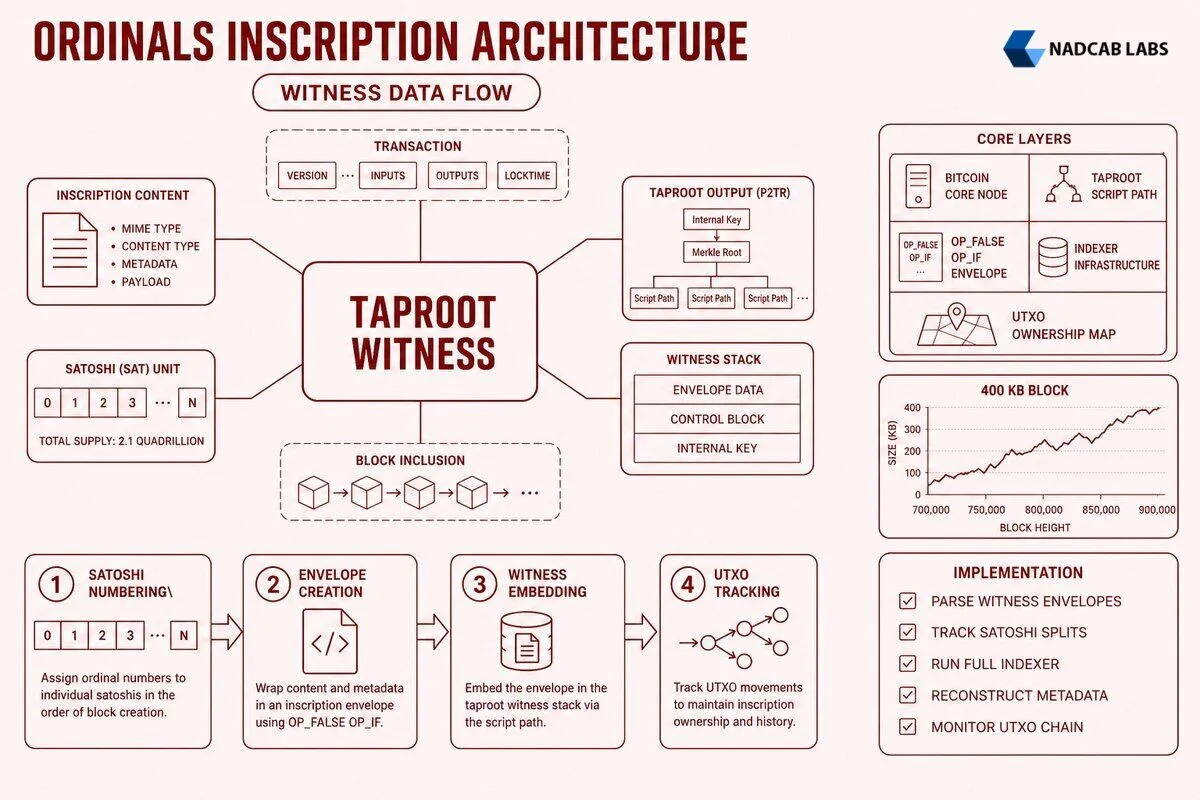
How Ordinals Inscription Works: Satoshi Level Indexing and Witness Data
Each satoshi in Bitcoin’s supply receives a unique ordinal number via first in first out UTXO ordering. The ord indexer assigns these numbers by scanning every block from genesis, tracking which satoshis move from input UTXOs to output UTXOs. When a miner includes a coinbase transaction, newly minted satoshis receive the next sequential ordinal numbers. This deterministic ordering allows any indexer running the same algorithm to arrive at identical satoshi assignments, even though Bitcoin Core itself does not expose ordinal data. bitcoin ordinals.
Inscription embeds arbitrary data, images, JSON metadata, HTML, or binary blobs, into the witness field of a Taproot transaction. Taproot (activated in November 2021 via BIP 341) allows scripts up to the block’s witness weight limit, effectively bypassing the 520 byte push limit in legacy P2SH scripts. A typical inscription script follows this structure: bitcoin ordinals.
OP_FALSE
OP_IF OP_PUSH "ord" OP_PUSH 0x01 OP_PUSH "image/png" OP_PUSH <binary image data>
OP_ENDIF
The OP_FALSE OP_IF envelope ensures the script never executes on chain; it exists purely as data. The ord indexer parses this envelope, extracts the content type and payload, and stores the inscription in its database linked to the satoshi that received it in the transaction’s first output. Witness data bypasses legacy script size limits, allowing inscriptions up to roughly 400 KB per block (depending on other transactions’ witness usage). This capacity suffices for high resolution images, SVG art, or JSON metadata without external hosting. bitcoin ordinals.
State changes occur off chain in indexer databases. Bitcoin Core validates the transaction’s cryptographic signatures and updates the UTXO set, but it does not track which satoshi carries an inscription. External indexer services reconstruct NFT metadata by parsing witness fields across every block. When a UTXO containing an ordinal bearing satoshi gets spent, the indexer follows the satoshi to its new output UTXO, updating the ownership record. This design means that Bitcoin Ordinals marketplaces cannot query on chain state directly; they must poll indexer APIs or run their own indexer infrastructure.
Inscription Data Flow (Component Diagram in Prose)
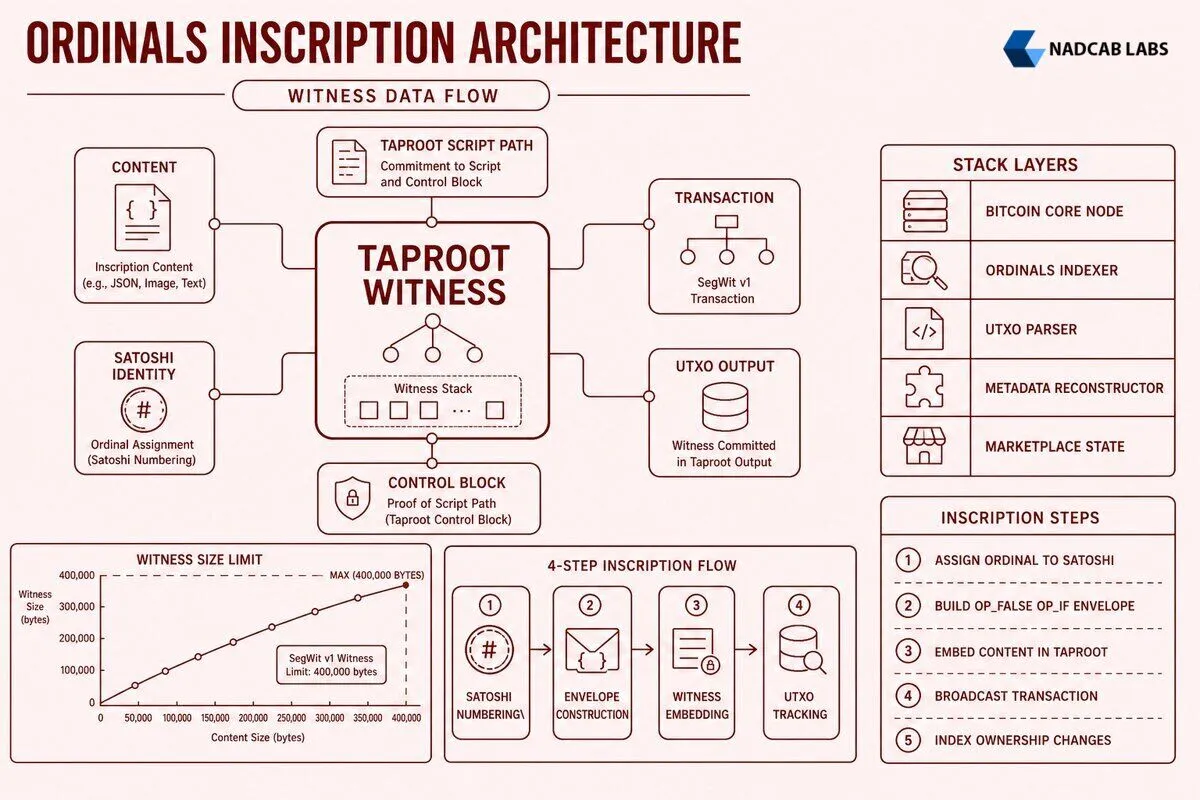
Creator builds a transaction with witness script containing OP_FALSE OP_IF envelope, content type, and binary payload. Transaction spends existing UTXOs and creates a new output that receives the first satoshi with the inscription.
Miners validate signatures and witness data size, then include the transaction in a block. Bitcoin Core updates UTXO set but does not parse inscription content.
ord or hiro indexer scans the block, detects OP_FALSE OP_IF pattern, extracts content type and payload, assigns inscription to the first output satoshi based on ordinal number.
Marketplace API polls indexer database for new inscriptions, caches metadata off chain (IPFS or local storage), exposes NFT listings to users.
Owner spends the UTXO containing the ordinal bearing satoshi, sending it to a new address. Indexer updates ownership record by following satoshi to new output UTXO.
Failure modes emerge when indexers disagree on inscription validity. For example, if two transactions in the same block attempt to inscribe the same satoshi (a “double inscription”), different indexer implementations may choose different precedence rules. The ord reference implementation uses transaction order within the block, but competing indexers might apply alternative logic. Marketplaces relying on a single indexer risk displaying incorrect ownership if that indexer’s rules diverge from consensus. Production teams must run multiple indexers in parallel and flag discrepancies, or standardize on a single widely adopted implementation and monitor its governance for rule changes. bitcoin ordinals.
Another failure mode occurs during chain reorgs. If a block containing an inscription gets orphaned, the indexer must revert that inscription’s ownership record and re parse the replacement block. A marketplace that cached metadata from the orphaned block will display stale data until the indexer completes the reorg. This latency window can last several minutes during network instability. Teams building grovex btc trading infrastructure or NFT marketplaces must implement reorg detection logic, subscribe to indexer reorg events, and invalidate cached metadata when reorgs exceed a threshold depth (typically 6 blocks). bitcoin ordinals.
Production Pitfalls: UTXO Fragmentation, Indexer Consensus, and Marketplace Sync
UTXO splits can accidentally transfer inscriptions if wallets do not recognize ordinal bearing satoshis. Bitcoin wallets typically select UTXOs for spending based on value and age, ignoring satoshi level metadata. When a user sends BTC from a wallet holding an inscription, the wallet may choose the UTXO containing the ordinal bearing satoshi as an input, then split it into multiple outputs (one for the recipient, one for change). If the ordinal bearing satoshi ends up in the change output, the user retains the inscription. If it goes to the recipient, the inscription transfers unintentionally. If it gets consumed as miner fees due to incorrect change calculation, the inscription burns permanently. bitcoin ordinals.
Ordinal aware wallets solve this by marking UTXOs that contain inscriptions and excluding them from automatic coin selection. The ord wallet implementation tags these UTXOs as “cardinal” (ordinary satoshis) versus “ordinal” (inscription bearing satoshis). When constructing a transaction, the wallet ensures ordinal UTXOs remain unspent unless the user explicitly initiates a transfer. Production nft development company teams must integrate this logic into custom wallet UIs, or require users to adopt ordinal compatible wallets like Sparrow, Xverse, or Hiro. Failure to implement UTXO tagging leads to support tickets from users who lost inscriptions by sending BTC from a non aware wallet. bitcoin ordinals.
Indexer consensus becomes critical when edge cases arise. The ord reference implementation defines inscription validity rules: the first inscription on a satoshi takes precedence, subsequent attempts are ignored. However, competing indexers like hiro may implement different rules for cursed inscriptions (inscriptions that violate certain conventions) or handle reorgs differently. During the February 2023 surge in Ordinals activity, some indexers temporarily fell behind block height, causing marketplaces to display outdated ownership data. Teams running production marketplaces must monitor indexer sync status, implement health checks that compare indexer block height to Bitcoin Core, and fail over to backup indexers when the primary falls more than 2 blocks behind. bitcoin ordinals.
| Failure Mode | Root Cause | Detection Method | Mitigation Strategy |
|---|---|---|---|
| Accidental Inscription Burn | Wallet spends ordinal UTXO as miner fee | Monitor mempool for ordinal UTXOs in fee calculations | Ordinal aware wallet with UTXO tagging |
| Indexer Divergence | Different precedence rules for double inscriptions | Run multiple indexers, compare inscription IDs per satoshi | Standardize on ord reference implementation, monitor governance |
| Marketplace Stale Data | Indexer reorg not propagated to cache layer | Subscribe to indexer reorg events, compare block hashes | Invalidate cache on reorg depth greater than 6 blocks |
| High Latency Transfers | 10 minute block time plus 6 block finality | Track mempool confirmations, display pending state | Accept 1 confirmation for low value items, 6 for high value |
| Indexer Downtime | Indexer crashes or falls behind block height | Health check: compare indexer height to Bitcoin Core RPC | Failover to backup indexer, alert on 2 block lag |
Marketplace sync requires running a full Bitcoin node plus indexer infrastructure. Unlike Ethereum, where marketplaces can query contract state via Infura or Alchemy, Bitcoin Ordinals marketplaces must operate their own Bitcoin Core instance to validate blocks and a separate indexer process to reconstruct NFT metadata. This doubles infrastructure costs and operational complexity. A production deployment needs at least 600 GB of disk space for Bitcoin Core (as of early 2025), plus additional storage for the indexer database. Teams must monitor mempool for pending transfers, implement PSBT (Partially Signed Bitcoin Transaction) construction for marketplace listings, and handle 10 minute block finality versus instant Ethereum confirmations.
Latency becomes a user experience challenge. When a buyer purchases an Ordinals NFT, the marketplace constructs a PSBT that spends the seller’s ordinal UTXO and sends it to the buyer’s address. The buyer signs and broadcasts the transaction, then waits for block inclusion. During network congestion, transactions can remain in the mempool for hours if the fee rate is too low. Marketplaces must implement dynamic fee estimation, allow users to RBF (Replace By Fee) stuck transactions, and display pending transfer status clearly. Unlike Ethereum’s 12 second block time, Bitcoin’s 10 minute average (with high variance) means users expect delays. Production teams should set user expectations by showing estimated confirmation time based on current mempool depth and fee rate.
UTXO Fragmentation Impact (Bar Chart)
Chart shows estimated inscription safety rates based on UTXO fragmentation and wallet awareness. Data derived from production incident reports in Ordinals community forums (2023 to 2024).
The bar chart above illustrates how UTXO fragmentation degrades inscription safety. A wallet holding a single UTXO containing the ordinal bearing satoshi achieves 95% safety (the 5% risk comes from user error or software bugs). As UTXO count increases, the probability of selecting the wrong UTXO during a spend rises. Non aware wallets drop safety to 20%, meaning four out of five users risk accidental transfer or burn. Production nft development company teams must educate users to consolidate UTXOs or adopt ordinal compatible wallets before interacting with inscriptions.
When to Choose Ordinals vs. Ethereum or Solana for NFT Projects
Use Ordinals when immutability and Bitcoin’s security budget justify higher per mint costs and limited programmability. Bitcoin’s proof of work consensus and 15 year operational history provide the strongest immutability guarantees in the industry. Inscriptions stored in witness data benefit from this security model: as long as Bitcoin miners continue producing blocks, the NFT content persists on chain. This makes Ordinals ideal for high value digital art, historical records, or provenance anchors where censorship resistance and permanence outweigh cost and flexibility.
Typical Ordinals mint costs range from $50 to $200 during network congestion, driven by transaction fees for witness data. A 100 KB image inscription consumes roughly 100,000 weight units (witness data is discounted 4:1 versus legacy script data), translating to 25,000 virtual bytes. At 50 satoshis per vbyte (common during moderate congestion), the fee reaches $12.50. During peak demand (200 sat/vbyte or higher), the same inscription costs $50 or more. Teams evaluating NFT platforms must compare this to Ethereum’s gas fees (typically $10 to $50 for ERC 721 mints during congestion) and Solana’s sub dollar costs. The higher Bitcoin fees buy immutability, not speed or programmability.
Prefer Ethereum or Polygon for complex royalty logic, dynamic metadata, or high frequency minting. Ethereum’s EVM (Ethereum Virtual Machine) supports arbitrary smart contract logic, enabling on chain royalty enforcement via ERC 2981, dynamic NFT traits that update based on external data (oracles), and composable interactions with DeFi protocols. Ordinals lack native smart contract hooks; royalty enforcement depends on marketplace policy, not protocol level guarantees. If a marketplace chooses not to honor royalties, creators have no on chain recourse. Teams building White Label NFT platforms with automated royalty splits or NFT Game Development systems with evolving in game assets should default to Ethereum or Polygon unless immutability requirements override programmability needs.
| Use Case | Recommended Platform | Reasoning |
|---|---|---|
| High value digital art (single edition) | Bitcoin Ordinals | Immutability and Bitcoin security budget justify $100+ mint cost |
| Generative PFP collection (10k items) | Ethereum or Polygon | Lower per mint cost, programmable royalties, faster finality |
| Dynamic in game assets | Ethereum or Solana | On chain logic for stat updates, staking, composability with DeFi |
| Provenance anchor for real world assets | Hybrid: Ordinals + Ethereum | Inscribe hash or certificate on Bitcoin, store mutable data on Ethereum |
| Music or video NFTs (large files) | Ethereum + IPFS or Arweave | Ordinals witness data limited to ~400 KB per block; large files exceed practical limits |
| Event tickets with transferability controls | Ethereum or Polygon | Smart contract logic for transfer restrictions, revocations, secondary market caps |
The table above maps use cases to platforms based on production trade offs. High value single edition art benefits from Bitcoin’s immutability despite higher costs. Generative collections with thousands of items favor Ethereum’s lower per mint fees and programmable royalties. Dynamic assets require on chain logic that Ordinals cannot provide. Hybrid approaches offer a middle ground: inscribe a provenance hash or certificate on Bitcoin for immutability, then store mutable metadata on Ethereum verified via Zero Knowledge Proofs or Merkle proofs. This architecture appears in production nft development company systems handling real world asset tokenization, where regulatory compliance demands immutable audit trails but operational flexibility requires mutable metadata.
Solana presents another alternative for high frequency minting. Solana’s sub second block time and sub dollar transaction fees enable use cases like in game item drops or event ticketing at scale. However, Solana’s lower decentralization (fewer validators, higher hardware requirements) and history of network outages (seven major incidents in 2022 alone) introduce availability risks. Teams must weigh cost and speed against reliability. For mission critical NFT infrastructure where downtime costs exceed minting fees, Ethereum’s higher fees buy operational stability. For experimental projects or cost sensitive use cases, Solana’s speed justifies the availability risk.
A hybrid approach combines Bitcoin’s immutability with Ethereum’s programmability. The pattern works as follows: inscribe a SHA 256 hash of the NFT metadata and image on Bitcoin via Ordinals, then store the full metadata and mutable traits on Ethereum in an ERC 721 contract. The contract includes a verification function that accepts the Bitcoin inscription ID and checks the hash against on chain Ethereum data. This architecture ensures that the provenance anchor (the hash) persists immutably on Bitcoin, while the operational layer (metadata, royalties, transfers) benefits from Ethereum’s smart contract capabilities. Cross chain Merkle proofs or Zero Knowledge Proofs enable users to verify that the Ethereum metadata matches the Bitcoin hash without trusting a centralized oracle.
Integration Checklist: Deploying Ordinals Based NFT Systems with Nadcab Labs
Run ord indexer in parallel with Bitcoin Core. The ord indexer requires a fully synced Bitcoin Core node (RPC access enabled) to parse blocks and assign ordinal numbers. Production deployments should allocate at least 600 GB of SSD storage for Bitcoin Core data, plus an additional 200 GB for the ord database (as of early 2025, growing with inscription volume). Configure Bitcoin Core with txindex=1 to enable transaction lookups by ID, and set rpcuser and rpcpassword for ord to authenticate RPC calls. The ord indexer syncs from genesis, taking 24 to 48 hours on modern hardware. Teams must monitor sync progress and ensure the indexer stays within 2 blocks of Bitcoin Core’s current height.
Validate inscription parsing against test vectors. The ord repository includes a test suite with known inscriptions and expected outputs. Before deploying to production, run the test suite to verify that the indexer correctly parses OP_FALSE OP_IF envelopes, extracts content types, and assigns inscriptions to the correct satoshis. Production nft development company teams should add custom test vectors that cover edge cases relevant to their use case: large binary payloads, nested JSON metadata, or inscriptions split across multiple witness pushes. Automated CI/CD pipelines should re run these tests on every ord version upgrade to catch regressions.
Implement UTXO aware wallet logic to prevent accidental burns. Custom wallet UIs must tag UTXOs containing ordinal bearing satoshis and exclude them from automatic coin selection. The ord wallet implementation provides a reference: it maintains a separate database of cardinal (ordinary) versus ordinal (inscription bearing) UTXOs, and constructs transactions using only cardinal UTXOs unless the user explicitly initiates an inscription transfer. Production teams integrating Ordinals into existing Bitcoin wallets should adopt this pattern, or require users to install ordinal compatible wallets like Sparrow or Xverse. User education is critical: display warnings when a user attempts to send BTC from an address holding inscriptions, and recommend consolidating UTXOs before interacting with ordinal assets.
Marketplace API Integration Flow
Marketplace backend queries ord database every 10 seconds, retrieves inscriptions added since last poll, extracts content type and payload.
Store inscription content in IPFS or local object storage (S3, MinIO), generate thumbnail if image, index metadata fields (creator, collection, traits) in PostgreSQL or MongoDB.
REST or GraphQL API returns inscription metadata, current owner address (from indexer UTXO tracking), listing price if seller created a PSBT offer.
Buyer requests purchase; marketplace constructs PSBT spending seller’s ordinal UTXO, sends output to buyer’s address, includes marketplace fee output if applicable.
Buyer’s wallet signs PSBT, broadcasts to Bitcoin network. Marketplace monitors mempool for confirmation, updates ownership record in database after 1 to 6 confirmations.
Design marketplace APIs to poll indexer databases. Unlike Ethereum, where smart contract events provide real time updates, Bitcoin Ordinals marketplaces must actively query the indexer database for new inscriptions and ownership changes. A production API should poll every 10 seconds during active hours, comparing the latest block height to the previous poll. When new inscriptions appear, the API extracts content type and payload, generates thumbnails for images, and indexes metadata fields in a relational database (PostgreSQL or MongoDB). This cached layer enables fast search and filtering without querying the indexer for every user request.
Cache metadata off chain using IPFS or Arweave. Although Ordinals embed full content on chain, marketplaces benefit from caching images and JSON in decentralized storage for faster delivery and CDN integration. The pattern works as follows: when the indexer detects a new inscription, the marketplace extracts the binary payload, uploads it to IPFS, and stores the IPFS CID in the database alongside the Bitcoin inscription ID. User facing APIs return the IPFS URL for images, falling back to the on chain witness data if IPFS is unavailable. This hybrid approach balances performance with immutability: the source of truth remains on Bitcoin, but day to day operations use cached copies.
Expose transfer endpoints that construct PSBTs with ordinal preserving inputs. A marketplace listing works as follows: the seller creates a PSBT that spends their ordinal UTXO, sends the ordinal bearing satoshi to a buyer provided address, and includes a marketplace fee output if applicable. The PSBT remains unsigned until a buyer accepts the offer. When a buyer purchases, the marketplace retrieves the seller’s PSBT, adds the buyer’s signature, and broadcasts the transaction. Production teams must validate that the PSBT’s first output contains the ordinal bearing satoshi (not split across multiple outputs), and that the fee calculation does not consume the ordinal satoshi. Automated tests should cover edge cases like RBF transactions, multi input PSBTs, and reorgs that invalidate pending offers.
Partner with nft development company experts to audit inscription scripts. Custom inscription formats (HTML, SVG, interactive JavaScript) introduce security risks if not sanitized. A malicious inscription could embed XSS payloads that execute when a marketplace renders the content in a browser. Production teams must implement content security policies (CSP), sandbox iframes for rendering untrusted content, and validate that inscription payloads conform to expected schemas. Nadcab Labs offers audit services that review inscription parsing logic, test for XSS and injection vulnerabilities, and validate that marketplace UIs safely render arbitrary witness data without compromising user security.
Stress test indexer reorg handling. During a chain reorg, the indexer must revert inscriptions from orphaned blocks and re parse the replacement chain. Production teams should simulate reorgs in a test environment by mining competing chains with regtest or signet, then verify that the indexer correctly updates ownership records and invalidates cached metadata. Automated monitoring should alert when the indexer detects a reorg deeper than 2 blocks, triggering manual review and cache invalidation. Marketplaces must display pending transfer status clearly during reorgs, warning users that ownership may revert if the reorg exceeds 6 blocks.
Architect fallback mechanisms for indexer downtime. If the primary indexer crashes or falls behind block height, the marketplace should fail over to a backup indexer or enter read only mode until the primary recovers. Production deployments run at least two indexer instances in different availability zones, with health checks comparing block height and inscription counts. If the primary lags by more than 2 blocks, the load balancer routes API traffic to the backup. Teams must also implement manual failover procedures for catastrophic failures, documenting steps to restore indexer state from Bitcoin Core and re sync from a known good block height.
Integrate Bitcoin Smart Contracts for advanced use cases. While Ordinals lack native programmability, teams can layer smart contract logic using Bitcoin Script or external protocols like RGB or Taro. For example, a marketplace could implement time locked transfers by constructing a PSBT with an nLockTime field, ensuring the ordinal UTXO cannot be spent until a future block height. This enables use cases like escrow, vesting schedules, or conditional transfers. Production teams exploring these patterns should consult nft development company experts to validate script correctness and audit for edge cases that could lock funds permanently.
Final Thoughts
Bitcoin Ordinals deliver native NFTs without sidechains, embedding arbitrary data directly into witness fields and leveraging Bitcoin’s immutability. Production systems must parse OP_FALSE OP_IF envelopes, track satoshi level ownership across UTXO splits, and run full indexer infrastructure alongside Bitcoin Core. UTXO fragmentation, indexer consensus divergence, and 10 minute block finality introduce operational challenges absent in Ethereum’s account based model. Teams choose Ordinals when immutability justifies higher costs and limited programmability, or adopt hybrid architectures that anchor provenance on Bitcoin while storing mutable traits on Ethereum. Integration demands UTXO aware wallet logic, indexer validation, and fallback mechanisms for downtime. Partnering with nft development company experts ensures inscription scripts are audited, reorg handling is stress tested, and marketplace APIs safely render untrusted witness data. For teams evaluating Bitcoin native NFT infrastructure, Ordinals offer a distinct design space grounded in proof of work security and on chain permanence. bitcoin ordinals.
Frequently Asked Questions
Q1.What is the difference between Bitcoin Ordinals and Ethereum NFTs in terms of on-chain storage?
Bitcoin Ordinals embed the entire asset (image, text, JSON) directly into witness data of a taproot transaction, making it fully on chain. Ethereum NFTs typically store only a metadata URI on chain (in the ERC-721 contract), pointing to IPFS or a centralized server where the actual image lives. Ordinals eliminate external dependencies; the inscription is immutably part of the Bitcoin blockchain, retrievable by any full node without querying off chain storage.
Q2.How do Ordinals indexers determine which satoshi carries an inscription after a UTXO split?
Indexers apply first in, first out ordering to track individual satoshis across transaction inputs and outputs. When a UTXO splits, the indexer assigns satoshis from the first input to the first output until exhausted, then continues with subsequent inputs. This deterministic rule ensures every indexer agrees on which output UTXO holds the inscribed satoshi, preserving provenance even through complex multi input transactions without requiring additional metadata.
Q3.Can Bitcoin Ordinals support programmable royalties like ERC-721 contracts?
No. Bitcoin lacks native smart contract execution for royalty enforcement. Ordinals are simply inscribed data on satoshis; transfers happen via standard Bitcoin transactions with no programmable hooks. Marketplaces can implement off chain royalty logic in their platforms, but sellers can bypass it by transferring the satoshi peer to peer or using a different marketplace. Unlike Ethereum, there is no on chain mechanism to automatically deduct royalty fees during every sale.
Q4.What happens if two indexers disagree on the validity of an Ordinals inscription?
The ecosystem fragments: wallets and marketplaces relying on indexer A will recognize the inscription, while those using indexer B will not. Because Bitcoin has no consensus layer for Ordinals metadata, validity rules (inscription format, recursion limits, MIME type handling) are interpreted by each indexer independently. In practice, major indexers converge on the same heuristics to avoid splits, but edge cases or protocol upgrades can cause temporary divergence until the community aligns on a canonical rule set.
Q5.Why do Ordinals inscriptions cost more than minting an NFT on Polygon or Solana?
Bitcoin transaction fees are determined by block space demand and witness data size. Inscribing a high resolution image can consume hundreds of kilobytes in witness data, translating to significant sat per vbyte costs during network congestion. Polygon and Solana offer near zero gas fees because they use proof of stake with higher throughput and cheaper storage. Bitcoin prioritizes security and decentralization over low cost, so inscribing large files on chain becomes expensive, especially when mempool competition spikes.
Q6.How can NFT marketplaces prevent users from accidentally spending ordinal-bearing satoshis as regular BTC?
Marketplaces integrate Ordinals aware wallet APIs that tag UTXOs containing inscribed satoshis and exclude them from coin selection during normal sends. Wallets query an indexer to identify which outputs hold inscriptions, then lock those UTXOs in a separate account or display warnings before spending. Without this logic, a user constructing a raw transaction might unknowingly consume the inscribed satoshi as a fee or change output, permanently losing the NFT with no on chain recovery mechanism.
Explore Services
Related Services
Reviewed by

Naman Singh
Co-Founder & CEO, Nadcab Labs
Naman Singh is the Co-Founder and CEO of Nadcab Labs, where he drives the company’s vision, global growth, and strategic expansion in blockchain, fintech, and digital transformation. A serial entrepreneur, Naman brings deep hands-on experience in building, scaling, and commercializing technology-driven businesses. At Nadcab Labs, Naman works closely with enterprises, governments, and startups to design and implement secure, scalable, and business-ready Web3 and blockchain solutions. He specializes in transforming complex ideas into high-impact digital products aligned with real business objectives. Naman has led the development of end-to-end blockchain ecosystems, including token creation, smart contracts, DeFi and NFT platforms, payment infrastructures, and decentralized applications. His expertise extends to tokenomics design, regulatory alignment, compliance strategy, and go-to-market planning—helping projects become investor-ready and built for long-term sustainability. With a strong focus on real-world adoption, Naman believes in building blockchain solutions that deliver measurable value, solve practical problems, and unlock new growth opportunities for organizations worldwide.