Ai Overview
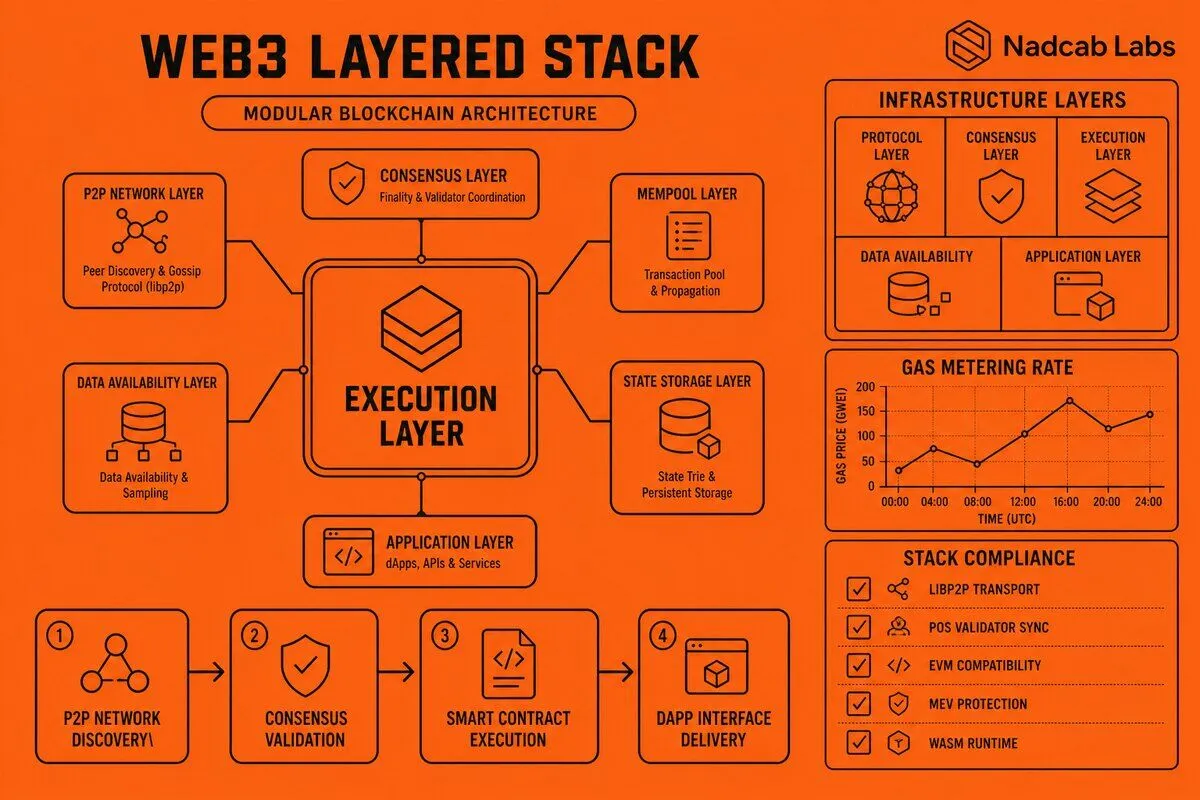
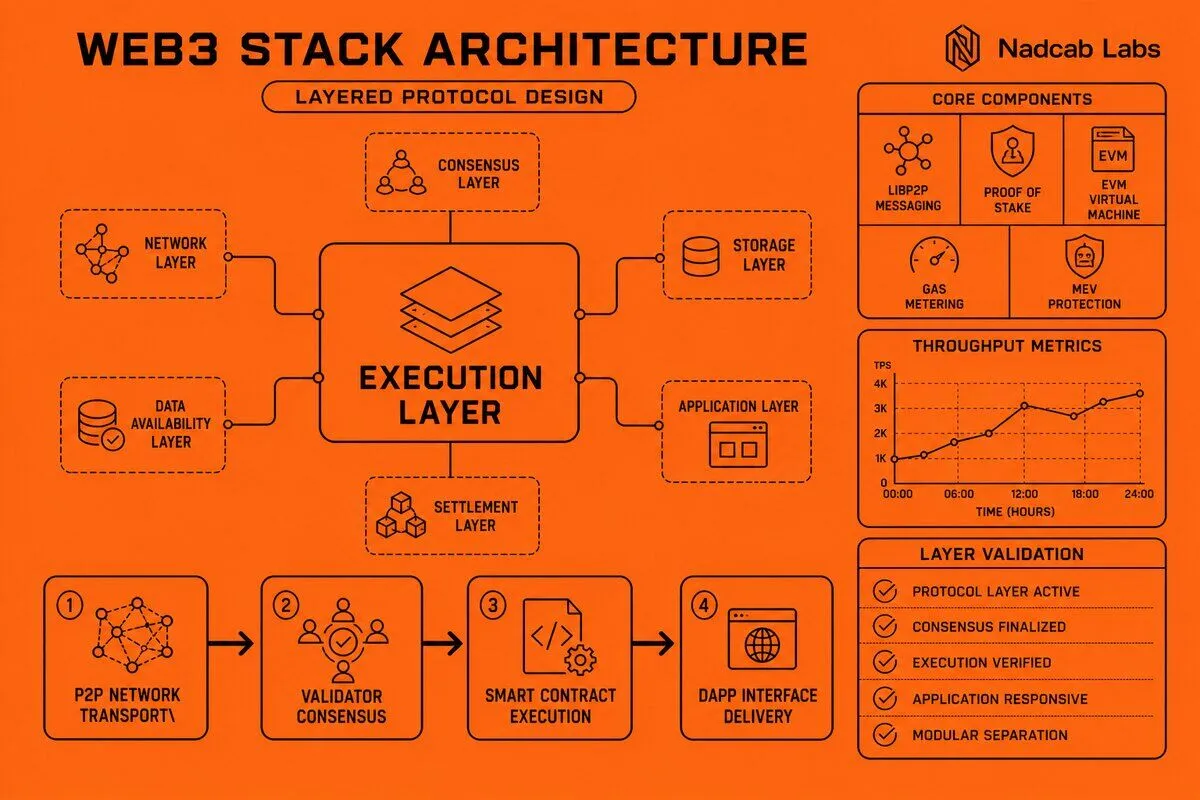
Web3 infrastructure layers form a modular stack that separates network communication, consensus, execution, and user-facing services into distinct architectural components. Each layer performs specialized functions—protocol layers handle peer-to-peer messaging, consensus layers achieve distributed agreement, execution layers process smart contracts, and application layers deliver dApp interfaces—enabling scalable, maintainable systems that can evolve independently.
Web3 infrastructure layers form a modular stack that separates network communication, consensus, execution, and user-facing services into distinct architectural components. Each layer performs specialized functions—protocol layers handle peer-to-peer messaging, consensus layers achieve distributed agreement, execution layers process smart contracts, and application layers deliver dApp interfaces—enabling scalable, maintainable systems that can evolve independently.
Key Takeaways
- Web3 infrastructure layers separate protocol, consensus, execution, and application concerns into distinct modules for improved scalability and maintainability.
- Protocol layers manage P2P networking and data transport using standards like libp2p, while consensus layers coordinate validator agreement through PoS, BFT, or hybrid mechanisms.
- Execution layers run virtual machines (EVM, WASM) to process transactions and smart contracts, with gas metering and MEV protection as critical design considerations.
- Application layers integrate wallets, indexers, and middleware to deliver user-facing services, requiring robust API design and cross-layer security validation.
- Modular Web3 layer stacks allow independent optimization of each component, reducing coupling and enabling parallel upgrades across the infrastructure.
- Understanding layer interactions is essential for building high-performance decentralized systems that balance throughput, latency, and security guarantees.
What Are the Four Core Layers of Web3 Infrastructure?
Web3 infrastructure layers divide system responsibilities into four primary tiers: the protocol layer, consensus layer, execution layer, and application layer. This modular Web3 infrastructure approach mirrors traditional software architecture patterns but adapts them for decentralized, trustless environments where no single authority controls the stack.
The protocol layer sits at the foundation, managing network-level communication between nodes. It handles peer discovery, message routing, and data propagation across the distributed network. Without a reliable protocol layer, nodes cannot exchange blocks, transactions, or state updates, making it the bedrock of any Web3 system design.
Above the protocol layer, the consensus layer coordinates agreement among validators or miners. This layer implements the rules that determine which transactions are valid, how blocks are proposed and finalized, and how the network resolves forks. Consensus mechanisms like Proof of Stake (PoS) or Byzantine Fault Tolerance (BFT) variants operate here, directly impacting network security and performance.
The execution layer processes the actual business logic of the blockchain. It runs virtual machines that execute smart contracts, update account balances, and manage state transitions. This layer must be deterministic—every node running the same transaction sequence must arrive at identical state—so gas metering and sandboxing are critical to prevent abuse and ensure predictability.
At the top, the application layer provides user-facing interfaces and developer tools. Wallets, block explorers, indexing services, and dApp frontends all live here. This layer translates raw blockchain data into usable formats, handles authentication, and bridges the gap between decentralized backends and traditional web experiences. For teams building Web3 Development solutions, understanding how these layers interact is fundamental to delivering robust, scalable products.
Modular layering improves scalability because each tier can be optimized independently. A team can upgrade consensus algorithms without rewriting the execution engine, or swap protocol standards without touching application code. This separation of concerns reduces coupling, speeds iteration, and allows specialized teams to focus on their domain—network engineers on protocol efficiency, cryptographers on consensus safety, and frontend developers on user experience.
Why does this matter in practice? Consider a high-throughput DeFi protocol. If consensus and execution are tightly coupled, improving transaction speed might require overhauling both layers simultaneously, increasing risk and complexity. With clear boundaries, developers can parallelize work: one team optimizes validator selection logic while another tunes the virtual machine’s gas scheduler. The result is faster innovation cycles and more resilient systems.
| Layer | Primary Function | Key Technologies | Typical Latency Impact |
|---|---|---|---|
| Protocol | P2P networking, message propagation | libp2p, devp2p, gossipsub | 50–200 ms per hop |
| Consensus | Block proposal, validator agreement | PoS, BFT, PBFT, Tendermint | 1–12 seconds per block |
| Execution | Smart contract execution, state updates | EVM, WASM, Move VM | 10–500 ms per transaction |
| Application | User interfaces, indexing, APIs | GraphQL, REST, WebSockets | 5–50 ms query response |
Each layer’s performance characteristics compound. A slow protocol layer delays block propagation, which increases consensus latency, which in turn delays execution finality. Application developers must account for this cascading effect when designing user experiences—real-time trading interfaces need faster consensus finality than batch settlement systems.
How Does the Protocol Layer Enable Network Communication and Data Transport?
The protocol layer orchestrates peer-to-peer (P2P) networking, ensuring nodes can discover each other, exchange messages, and propagate data across the decentralized network. Unlike centralized systems with known server addresses, Web3 architecture layers rely on distributed discovery mechanisms where nodes advertise their presence and capabilities without a central directory.
Node discovery typically uses distributed hash tables (DHTs) or bootstrap nodes. When a new node joins the network, it contacts a few known bootstrap peers, retrieves a list of active nodes, and begins forming connections. Protocols like Kademlia—used in Ethereum’s devp2p—organize nodes into a structured overlay network, enabling efficient lookups even in networks with millions of participants.
Message propagation relies on gossip protocols or structured routing. In gossip-based systems like Ethereum’s gossipsub, each node forwards messages to a random subset of peers, ensuring rapid dissemination without flooding the entire network. This approach trades some redundancy for resilience: even if some nodes fail or act maliciously, messages still reach the majority of the network within seconds.
Structured routing, by contrast, uses deterministic paths based on node identifiers. BitTorrent’s DHT and IPFS’s routing layer exemplify this model. While more efficient in terms of bandwidth, structured routing can be less robust under churn—when many nodes join or leave simultaneously—because routing tables take time to stabilize.
Protocol standards like libp2p and devp2p provide modular frameworks for building these networking layers. Libp2p, developed by Protocol Labs, offers pluggable transports (TCP, QUIC, WebRTC), multiplexing, and secure channels. Developers can swap transport layers without rewriting application logic, making it easier to adapt to new network conditions or regulatory requirements. For example, a blockchain operating in a region with restricted TCP ports can switch to WebRTC without touching consensus or execution code.
Interoperability hinges on shared protocol standards. If two chains use incompatible message formats or discovery mechanisms, cross-chain communication requires bridges or relays, adding latency and complexity. Standardized protocols reduce these friction points, enabling smoother integration between different Web3 Infrastructure components.
Trade-offs between gossip and structured routing become apparent under load. Gossip protocols excel in dynamic environments with frequent node churn, but they consume more bandwidth because messages are duplicated across multiple paths. Structured routing minimizes redundancy, but routing table maintenance overhead grows with network size. High-frequency trading platforms might prefer structured routing to reduce latency variance, while public blockchains with unpredictable participation favor gossip for its fault tolerance.
Security at the protocol layer involves defending against eclipse attacks, where an adversary isolates a node by controlling all its peers, and Sybil attacks, where a single entity creates many fake identities. Mitigation strategies include peer diversity requirements (connecting to nodes from different IP ranges), proof-of-work challenges during handshake, and reputation systems that track peer behavior over time.
Typical Message Propagation Flow
Real-world performance depends on network topology and peer selection algorithms. A well-connected node with low-latency links to geographically diverse peers can propagate blocks faster than an isolated node with high-latency connections. Monitoring tools track propagation time distributions, helping operators identify bottlenecks and optimize peer configurations.
What Functions Does the Consensus Layer Perform in Web3 Systems?
The consensus layer blockchain coordinates distributed agreement on transaction ordering and block validity. Without consensus, each node would maintain its own version of the ledger, making the system useless for coordinating value transfers or executing contracts. Consensus mechanisms ensure all honest nodes converge on a single canonical history, even when some participants are offline or malicious.
Achieving agreement requires solving two core problems: proposing new blocks and finalizing them. Block proposal determines which validator or miner gets to extend the chain at a given moment. In Proof of Work (PoW), miners compete to solve cryptographic puzzles, with the first solution winning the right to propose. In Proof of Stake (PoS), validators are selected pseudo-randomly based on their stake, reducing energy consumption but introducing new attack vectors like stake grinding.
Finality guarantees tell users when a transaction is irreversible. Probabilistic finality, used in PoW chains like Bitcoin, means the chance of reversal decreases exponentially with each additional block. After six confirmations, reversing a Bitcoin transaction requires controlling more than 50% of network hashpower for an extended period—economically infeasible for most attackers. Deterministic finality, found in BFT-based systems like Tendermint, provides immediate certainty: once a block is finalized, no reorganization is possible under any circumstance short of violating the protocol’s safety assumptions.
Fork-choice rules resolve temporary disagreements when multiple valid blocks appear simultaneously. Ethereum’s LMD-GHOST (Latest Message Driven Greediest Heaviest Observed SubTree) selects the chain with the most validator attestations, not just the longest chain. This approach improves security under network partitions and makes the system more responsive to validator votes.
Validator selection impacts decentralization and performance. Random selection reduces predictability, making it harder for attackers to target specific validators, but introduces variance in block times. Deterministic rotation ensures consistent block intervals but allows adversaries to prepare attacks in advance. Hybrid approaches, like Ethereum’s committee-based selection, balance these trade-offs by rotating large validator sets while maintaining predictable timing.
Performance implications of consensus design are stark. PoW systems like Bitcoin finalize blocks every ten minutes on average, limiting throughput to around seven transactions per second. PoS systems like Algorand achieve sub-second finality and thousands of transactions per second by reducing the number of validators involved in each consensus round and using cryptographic sortition to select participants unpredictably.
Byzantine Fault Tolerance (BFT) variants offer strong safety guarantees but require more communication overhead. Practical BFT (PBFT) needs three rounds of voting among all validators, scaling quadratically with validator count. Optimizations like HotStuff reduce communication to linear complexity by using threshold signatures, enabling larger validator sets without sacrificing speed. For developers building Web3 Application Architecture, choosing the right consensus model depends on whether the use case prioritizes decentralization, speed, or finality guarantees.
| Consensus Mechanism | Finality Type | Typical Throughput (TPS) | Energy Efficiency |
|---|---|---|---|
| Proof of Work (PoW) | Probabilistic | 7–15 | Low (high energy use) |
| Proof of Stake (PoS) | Probabilistic or deterministic | 1,000–4,000 | High (minimal energy) |
| Practical BFT (PBFT) | Deterministic | 500–2,000 | High |
| Tendermint BFT | Deterministic | 1,000–10,000 | High |
| HotStuff (optimized BFT) | Deterministic | 5,000–20,000 | High |
Latency and throughput are inversely related in most consensus designs. Faster block times reduce user-perceived latency but increase the risk of forks and wasted work. Slower block times allow more transactions per block, improving throughput, but frustrate users waiting for confirmations. Optimizing this balance requires understanding application requirements: payment systems need fast finality, while batch settlement can tolerate longer confirmation times.
Security assumptions vary across mechanisms. PoW assumes attackers control less than 50% of hashpower; PoS assumes less than one-third of staked value is malicious; BFT variants assume fewer than one-third of validators are Byzantine. Violating these assumptions can lead to double-spends, chain halts, or permanent forks. Monitoring validator distribution and stake concentration is critical for maintaining security margins.
How Does the Execution Layer Process Transactions and Smart Contracts?
The execution layer architecture runs the virtual machines that process transactions, update account balances, and execute smart contract code. This layer must be deterministic: given identical inputs and state, every node must produce identical outputs. Non-determinism—caused by floating-point arithmetic, random number generation, or system clock dependencies—would cause nodes to diverge, breaking consensus.
Virtual machine architectures define how smart contracts are compiled, stored, and executed. The Ethereum Virtual Machine (EVM) uses a stack-based bytecode format, where operations manipulate a stack of 256-bit words. Developers write contracts in high-level languages like Solidity, which compile to EVM bytecode. This abstraction allows the same contract to run on any EVM-compatible chain, from Ethereum mainnet to layer-2 rollups.
WebAssembly (WASM) offers an alternative execution model with better performance and broader language support. Chains like Polkadot and Near use WASM runtimes, allowing developers to write contracts in Rust, C++, or AssemblyScript. WASM’s just-in-time compilation can execute code faster than EVM’s interpreter, but it requires more sophisticated sandboxing to prevent unsafe operations.
State management is the execution layer’s most complex challenge. Blockchains maintain a global state—a mapping of addresses to account balances, contract storage, and code. Every transaction modifies this state, and nodes must apply changes in identical order to stay synchronized. State trees like Merkle Patricia Tries enable efficient verification: nodes can prove a specific account’s balance without downloading the entire state, critical for light clients and fraud proofs.
Gas metering prevents infinite loops and resource exhaustion. Each operation—addition, storage write, contract call—consumes a fixed amount of gas. Transactions specify a gas limit and gas price; if execution exceeds the limit, the transaction reverts, but the sender still pays for consumed gas. This mechanism aligns incentives: users pay for computation they consume, and validators are compensated for processing transactions.
Transaction ordering and MEV (Maximal Extractable Value) considerations introduce economic and security complexities. Validators can reorder, insert, or censor transactions within a block to extract profit—frontrunning a large DEX trade, for example. MEV can destabilize consensus if validators compete aggressively for extraction opportunities, or collude to exclude competitors. Solutions like encrypted mempools, commit-reveal schemes, and fair ordering protocols aim to reduce MEV’s negative externalities.
Optimization strategies for high-frequency execution environments focus on reducing state access latency and parallelizing execution. State caching keeps frequently accessed data in memory, avoiding expensive disk reads. Parallel execution runs independent transactions simultaneously, but requires sophisticated conflict detection to prevent race conditions. Solana’s Sealevel runtime, for instance, requires transactions to declare which accounts they’ll access, enabling parallel execution of non-conflicting transactions.
For teams working on Web3 DeFi Protocol implementations, execution layer performance directly impacts user experience. A slow execution engine increases transaction confirmation times, frustrating users and limiting protocol throughput. Profiling gas usage, optimizing storage patterns, and batching operations can reduce costs and improve responsiveness.
Transaction Execution Workflow
Execution layer upgrades require careful coordination. Changing gas costs, adding opcodes, or modifying state transition rules can break existing contracts. Hard forks—network-wide upgrades that change consensus rules—must be scheduled and tested extensively. Ethereum’s London fork, which introduced EIP-1559’s fee market redesign, required months of testnet validation and client coordination to ensure smooth deployment.
Security at the execution layer involves sandboxing untrusted code, validating inputs, and preventing reentrancy attacks. The DAO hack in 2016 exploited a reentrancy vulnerability where a malicious contract recursively called a withdrawal function before the state updated, draining funds. Modern development frameworks like OpenZeppelin provide audited libraries and reentrancy guards to prevent such exploits.
What Role Does the Application Layer Play in User-Facing Web3 Services?
The application layer Web3 translates raw blockchain data into user-friendly interfaces and developer-friendly APIs. While lower layers handle consensus and execution, the application layer delivers the experiences users interact with: wallet interfaces, block explorers, DeFi dashboards, and NFT marketplaces. This layer bridges the gap between decentralized backends and traditional web expectations for responsiveness, usability, and reliability.
dApp frontends typically run in web browsers or mobile apps, using JavaScript libraries like ethers.js or web3.js to communicate with blockchain nodes. These libraries abstract RPC (Remote Procedure Call) complexity, providing simple functions to query balances, send transactions, and listen for events. Developers can build rich interfaces without understanding low-level protocol details, accelerating development cycles.
Wallet integrations are central to application layer design. Wallets like MetaMask, WalletConnect, and Coinbase Wallet manage private keys and sign transactions on behalf of users. dApps request wallet approval for each transaction, ensuring users maintain control over their assets. This pattern shifts security responsibility to the wallet provider, but introduces friction: users must approve every action, slowing workflows compared to traditional web apps.
Middleware components handle indexing, caching, and data aggregation. Blockchain nodes store raw blocks and transactions, but querying historical data or aggregating statistics is inefficient. Indexers like The Graph scan blocks, extract relevant events, and store them in relational databases optimized for complex queries. A DeFi dashboard querying “total value locked across all protocols” would timeout if it queried every block directly; indexers pre-compute these metrics and serve them via GraphQL APIs in milliseconds.
API design patterns for blockchain applications differ from traditional REST APIs. Blockchain state is append-only and eventually consistent, so APIs must handle reorgs (chain reorganizations) gracefully. A transaction confirmed in block N might disappear if block N is replaced during a reorg. Robust APIs expose block numbers or timestamps with every response, allowing clients to detect stale data and refetch as needed.
Querying blockchain state efficiently requires understanding the trade-offs between full nodes, light clients, and third-party RPC providers. Full nodes store the entire blockchain and can answer any query, but require significant disk space and bandwidth. Light clients verify block headers and request Merkle proofs for specific data, reducing resource requirements but relying on full nodes for data availability. Third-party RPC providers like Infura or Alchemy offer hosted nodes with high availability and caching, but introduce centralization risks—if the provider goes down or censors requests, dApps relying on it become unavailable.
Security best practices for cross-layer communication start with input validation. User-supplied addresses, token amounts, and contract parameters must be sanitized to prevent injection attacks. Frontend code should verify transaction parameters before prompting wallet signatures, preventing phishing attacks where malicious sites trick users into signing harmful transactions. For insights into secure design patterns, teams can reference RPA architecture design patterns that emphasize validation at every boundary.
Data validation extends to smart contract interactions. Frontends should decode transaction calldata and display human-readable descriptions—”Approve 100 USDC to contract 0x123…”—so users understand what they’re signing. Libraries like ethers.js provide ABI decoding utilities, but developers must implement clear UI flows to surface this information.
Application Layer Component Performance
Real-time updates require WebSocket connections or polling strategies. Traditional web apps use HTTP requests, which are stateless and require clients to repeatedly ask for updates. WebSockets maintain persistent connections, allowing servers to push new blocks, pending transactions, or event logs as they occur. This reduces latency and server load, but requires careful connection management to handle network interruptions gracefully.
Cross-chain applications add another layer of complexity. A multi-chain wallet must track balances and transactions across Ethereum, Polygon, Arbitrum, and other networks. Each chain has different RPC endpoints, block times, and finality guarantees. Middleware like Decentralized Public Key infrastructure can help manage identity across chains, but developers must still handle chain-specific quirks in their application logic.
Cost considerations at the application layer often surprise new developers. Querying full nodes is free but slow; using third-party RPC providers is fast but introduces rate limits and potential costs. The Graph’s hosted service charges for queries beyond free tiers, and running a private indexer requires server infrastructure. Teams building production dApps must budget for these operational expenses, which can rival traditional cloud hosting costs. For detailed cost breakdowns, refer to SSI implementation cost analyses that cover infrastructure expenses across layers.
User experience hinges on managing asynchronous workflows. Blockchain transactions aren’t instant—they must propagate, get included in a block, and achieve finality. Good application design shows pending states, estimates confirmation times, and handles failures gracefully. A swap interface might display “Transaction pending (block 12345)” with a link to a block explorer, then update to “Confirmed (2/12 blocks)” as finality progresses.
Integration with traditional backends is common in hybrid applications. A gaming dApp might store high-frequency game state in a centralized database for responsiveness, committing only critical state transitions (item ownership, tournament results) to the blockchain. This reduces costs and latency while preserving decentralization for the most valuable data. For teams exploring hybrid architectures, Serverless Application patterns can provide scalable, cost-effective backends that complement blockchain components.
Monitoring and observability are essential for production applications. Tracking RPC response times, indexer lag, wallet connection success rates, and transaction failure reasons helps teams identify bottlenecks and optimize user flows. Tools like Tenderly and Blocknative provide real-time transaction monitoring and simulation, allowing developers to debug issues before they reach production.
For developers building comprehensive solutions, understanding how the application layer interacts with lower layers is critical. A slow consensus layer increases transaction confirmation times, frustrating users even if the frontend is fast. A poorly optimized execution layer drives up gas costs, making the dApp expensive to use. Holistic Validator Costs for DeFi analysis helps teams balance performance, cost, and decentralization across the entire Web3 layer stack.
Mobile application development introduces additional constraints. Native apps on iOS and Android require specialized SDKs and must handle platform-specific security models. Android Application Development teams must navigate Google Play policies around cryptocurrency, which restrict certain wallet features. Mobile apps also face stricter resource limits—battery life, network bandwidth, and storage—requiring more aggressive caching and optimization strategies than desktop dApps.
Final Thoughts
Web3 infrastructure layers provide a modular framework for building decentralized systems, separating protocol networking, consensus coordination, execution processing, and application delivery into distinct, independently optimizable components. Understanding how each layer functions—and how they interact—is essential for designing scalable, secure, and maintainable Web3 systems. The protocol layer ensures reliable peer-to-peer communication, the consensus layer coordinates distributed agreement, the execution layer processes smart contracts deterministically, and the application layer delivers user-facing services through robust APIs and interfaces.
Successful Web3 system design requires balancing trade-offs across layers: faster consensus improves user experience but may sacrifice decentralization; more powerful execution engines increase throughput but raise validator hardware requirements; richer application features enhance usability but introduce centralization risks if they rely on third-party infrastructure. By treating each layer as a modular component with clear interfaces and responsibilities, teams can iterate faster, reduce coupling, and build systems that evolve gracefully as requirements change and technology advances.
For organizations ready to implement production-grade Web3 infrastructure, partnering with experienced development teams ensures architectural decisions align with long-term goals. Whether building a high-throughput DeFi protocol, a cross-chain identity system, or a consumer-facing dApp, understanding Web3 infrastructure layers from protocol to application is the foundation for delivering robust, scalable decentralized solutions.
Frequently Asked Questions
Q1.What are the layers of Web3?
Web3 infrastructure comprises five core layers: the network layer (peer-to-peer communication), consensus layer (agreement protocols), execution layer (smart contract runtime), data availability layer (storage and retrieval), and application layer (user-facing dApps). Each layer handles specific functions, from low-level networking to high-level user interfaces. This separation enables modularity, allowing developers to optimize individual components without disrupting the entire stack. Nadcab Labs designs systems leveraging this layered approach for enhanced performance and maintainability.
Q2.How do Web3 infrastructure layers interact with each other?
Layers communicate through standardized interfaces and APIs. The network layer transmits data to the consensus layer, which validates transactions before passing them to the execution layer for processing. Results are stored in the data availability layer and surfaced through the application layer. This vertical integration ensures each layer performs its specialized function while maintaining interoperability. Nadcab Labs implements robust inter-layer protocols to minimize latency and maximize throughput across the entire stack.
Q3.What is the difference between the consensus layer and execution layer in Web3?
The consensus layer determines which transactions are valid and their ordering through mechanisms like Proof-of-Stake or Proof-of-Work, ensuring network agreement. The execution layer processes these validated transactions, running smart contract code and updating state. Ethereum’s post-merge architecture separates these explicitly: consensus clients handle block proposals while execution clients compute state transitions. This separation enables independent optimization of security and computational efficiency. Nadcab Labs leverages this distinction when architecting high-performance blockchain solutions.
Q4.Why is modular architecture important for Web3 scalability?
Modular architecture allows each layer to scale independently based on specific bottlenecks. Data availability can use specialized solutions like rollups, while execution leverages parallel processing without redesigning consensus. This separation enables horizontal scaling, where components are upgraded or replaced without system-wide disruption. Modular designs also facilitate experimentation with new technologies at individual layers. Nadcab Labs implements modular frameworks that achieve 10-100x throughput improvements compared to monolithic architectures through targeted layer optimization.
Q5.How does the protocol layer affect Web3 network performance?
The protocol layer defines fundamental rules for data formatting, transaction validation, and state transitions, directly impacting throughput and latency. Efficient protocol design minimizes computational overhead per transaction, enabling higher TPS. Protocol choices around block size, gas limits, and signature schemes determine network capacity. Poorly optimized protocols create bottlenecks regardless of hardware improvements. Nadcab Labs conducts protocol-level analysis to identify performance constraints, implementing optimizations like batching, compression, and parallel validation to maximize network efficiency.
Q6.What are common challenges when designing multi-layer Web3 systems?
Key challenges include maintaining security across layer boundaries, ensuring atomic operations span multiple layers, managing state synchronization between components, and optimizing cross-layer communication latency. Complexity increases exponentially with each added layer, requiring sophisticated orchestration. Debugging becomes difficult when issues arise from layer interactions rather than individual components. Nadcab Labs addresses these through comprehensive integration testing, formal verification of inter-layer contracts, and monitoring systems that track cross-layer transaction flows to identify bottlenecks.
Explore Services
Related Services
Reviewed by

Aman Vaths
Founder of Nadcab Labs
Aman Vaths is the Founder & CTO of Nadcab Labs, a global digital engineering company delivering enterprise-grade solutions across AI, Web3, Blockchain, Big Data, Cloud, Cybersecurity, and Modern Application Development. With deep technical leadership and product innovation experience, Aman has positioned Nadcab Labs as one of the most advanced engineering companies driving the next era of intelligent, secure, and scalable software systems. Under his leadership, Nadcab Labs has built 2,000+ global projects across sectors including fintech, banking, healthcare, real estate, logistics, gaming, manufacturing, and next-generation DePIN networks. Aman’s strength lies in architecting high-performance systems, end-to-end platform engineering, and designing enterprise solutions that operate at global scale.