Ai Overview
Token vesting smart contract architecture defines how tokens are locked and released over time to align long-term incentives for teams, investors, and communities. This pattern adds approximately 2,400 gas per function call due to the delegation overhead and requires careful storage layout management to prevent collisions between proxy and implementation storage slots. On Ethereum mainnet where gas costs are highest, these optimizations can reduce deployment costs by 30-40% and per-claim costs by 15-25%.
Token vesting smart contract architecture defines how tokens are locked and released over time to align long-term incentives for teams, investors, and communities. In 2026, robust vesting architectures combine security patterns, gas optimization, and multi-chain compatibility to prevent manipulation while minimizing operational costs. This guide breaks down the core architectural patterns, security trade-offs, and implementation decisions you need to build production-ready vesting systems.
Key Takeaways
- Linear, cliff, graded, and milestone-based vesting patterns serve different use cases with measurable gas cost differences per claim operation
- Security requires reentrancy guards, timestamp manipulation mitigation, and role-based access control with multi-signature integration
- Upgradeable proxy patterns (UUPS, Transparent, Beacon) trade flexibility for complexity; immutable contracts maximize trust for high-value distributions
- Multi-chain vesting demands chain-specific optimizations: Solidity storage packing for EVM, Program Derived Addresses for Solana, and cross-chain state synchronization
- Gas optimization through batch operations, merkle proofs, and lazy evaluation reduces costs by 40-60% for large beneficiary sets
- Production deployment requires comprehensive audit checklists covering access control, arithmetic safety, and event emission for monitoring
What Are the Core Vesting Contract Architecture Patterns in 2026?
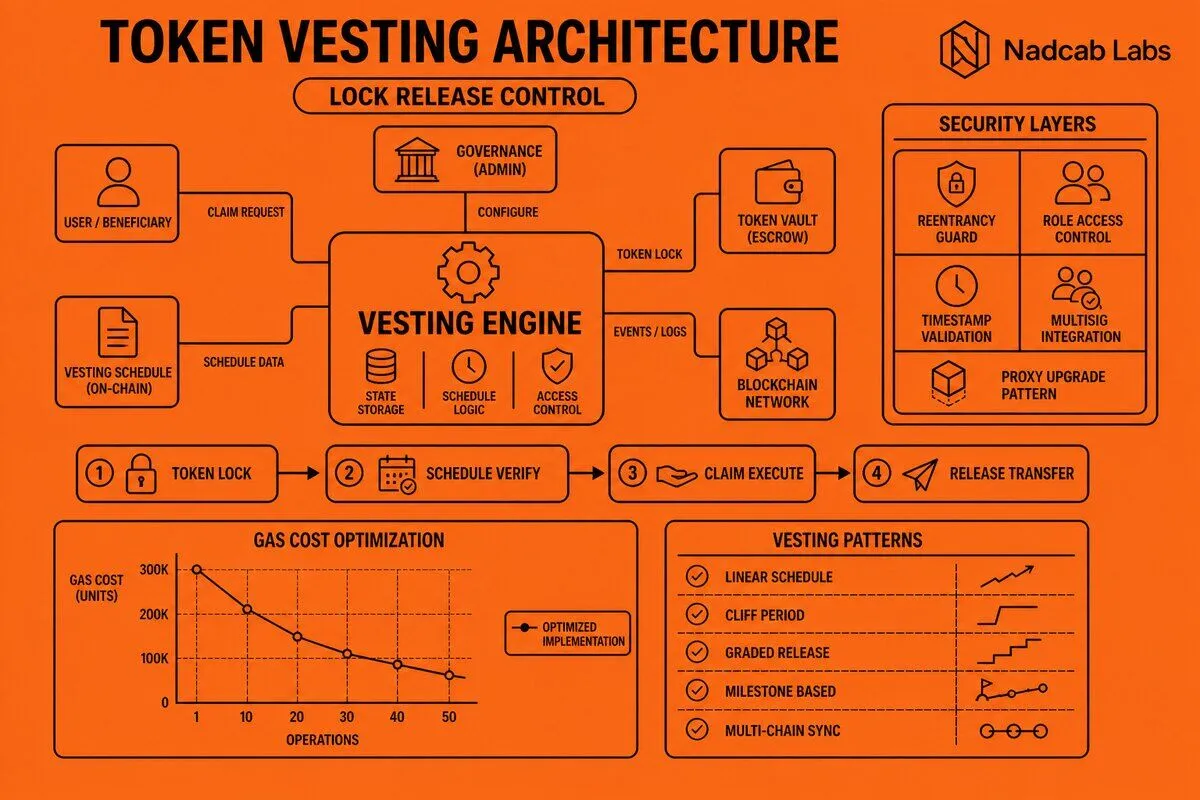
Vesting contract design patterns fall into four primary architectures, each optimized for specific token distribution scenarios. Linear vesting releases tokens at a constant rate from start to end date, making it ideal for team allocations where gradual alignment matters. Cliff vesting locks all tokens until a specific date, then releases everything at once—commonly used for advisor grants where early commitment verification is critical. Graded vesting combines multiple cliff periods with incremental releases, typical in investor agreements with quarterly unlocks. Milestone-based vesting ties releases to external conditions like revenue targets or development deliverables, prevalent in DAO contributor rewards.
The architectural choice directly impacts gas costs and user experience. Linear vesting incurs the lowest per-claim cost because each beneficiary can call a simple time-based calculation function whenever they want their accumulated tokens. Cliff vesting creates a single unlock spike where many beneficiaries claim simultaneously, potentially causing network congestion on the unlock date. Graded vesting sits in the middle with periodic claim windows. Milestone-based vesting has variable costs depending on oracle integration complexity and condition verification logic.
| Architecture Pattern | Gas Cost Per Claim | Best Use Case | Complexity Level |
|---|---|---|---|
| Linear Vesting | ~45,000 gas | Team allocations, employee stock options | Low |
| Cliff Vesting | ~38,000 gas (single unlock) | Advisor grants, short-term commitments | Low |
| Graded Vesting | ~52,000 gas | Investor agreements, quarterly unlocks | Medium |
| Milestone-Based | ~68,000–95,000 gas | DAO contributor rewards, performance grants | High |
When working with a Token Development Company, the architecture selection process begins with mapping stakeholder categories to vesting requirements. Team vesting typically combines a 6-12 month cliff with 24-48 month linear release to ensure long-term commitment. Investor vesting often uses graded patterns with 10-25% initial unlock at token generation event, then quarterly releases over 12-24 months. DAO contributor rewards increasingly adopt milestone-based architecture where tokens unlock as governance proposals pass or development milestones complete, verified through oracle feeds or multi-signature attestation.
The process flow for implementing a hybrid cliff-plus-linear vesting schedule follows this sequence:
(e.g., 6 months)
(e.g., 24 months)
(total / duration)
(beneficiary mapping)
(post-cliff only)
Modern vesting architectures also incorporate revocability patterns where project owners can cancel unvested tokens if a team member leaves or an investor breaches terms. This requires careful access control design to prevent abuse while maintaining flexibility. The Token Smart Contract structure must separate revocation authority from beneficiary claim functions and emit detailed events for transparency.
How Do You Build Security Into Vesting Contract Architecture in 2026?
Security architecture for vesting contracts centers on three critical vulnerability classes: reentrancy attacks during claim functions, timestamp manipulation by miners or validators, and unauthorized access to administrative functions. Reentrancy protection is mandatory because claim functions transfer tokens to beneficiaries, creating an external call that malicious contracts can exploit to drain the vesting pool. The industry-standard mitigation uses OpenZeppelin’s ReentrancyGuard modifier combined with the checks-effects-interactions pattern.
The checks-effects-interactions pattern requires that claim functions first verify conditions (has cliff passed, are tokens available), then update internal state (mark tokens as claimed, update beneficiary balance), and only finally make the external token transfer. This ordering ensures that even if a reentrancy attack occurs during the transfer, the contract state already reflects the claim and subsequent calls will fail the initial checks. A production-ready claim function structure looks like this: verify beneficiary identity and claim eligibility, calculate vested amount based on current timestamp, update claimed amount in storage, emit ClaimExecuted event with details, then transfer tokens to beneficiary address.
Timestamp manipulation poses a subtler threat because vesting schedules rely on block.timestamp to calculate how many tokens have vested. Miners on proof-of-work chains and validators on proof-of-stake chains can manipulate timestamps within a small window (typically 15 seconds to a few minutes) to potentially claim tokens slightly earlier than intended. For most vesting schedules spanning months or years, this manipulation window is negligible. However, high-value vesting contracts can mitigate this risk by using block.number instead of block.timestamp for time calculations, accepting that block times vary slightly but eliminating direct timestamp control. Another approach integrates Chainlink or other oracle services to provide tamper-resistant timestamps for critical unlock events.
Access control architecture must separate three distinct roles with different permission levels. The owner role (typically a multi-signature wallet) can create new vesting schedules, set global parameters like minimum cliff periods, and pause the contract in emergencies. Beneficiary roles can only claim their own vested tokens and view their schedule details. The revocation authority role (often the same as owner but architecturally separate) can cancel unvested tokens for specific beneficiaries, with this action emitting a RevocationExecuted event for audit trails. Similar patterns appear in P2P exchange escrow smart contract architecture where role separation prevents single points of failure.
Multi-signature integration adds another security layer by requiring multiple parties to approve sensitive operations like creating large vesting schedules or revoking allocations. The vesting contract should accept calls only from a pre-configured multi-sig address for administrative functions, with the multi-sig threshold (e.g., 3-of-5 signatures) set based on organizational security requirements. This pattern appears throughout production systems, as seen in smart contract modules for MLM compensation where payment authorization requires multiple approvers.
Should Vesting Contracts Be Upgradeable or Immutable in 2026?
The upgradeable versus immutable decision represents the fundamental architectural trade-off between flexibility and trust. Upgradeable vesting contracts use proxy patterns (Transparent, UUPS, or Beacon) that separate logic from storage, allowing the contract owner to fix bugs or add features after deployment. Immutable contracts cannot be changed once deployed, providing maximum trust guarantees but zero flexibility if issues arise. The choice depends on project stage, token value, and stakeholder trust dynamics.
Transparent proxy patterns route all calls through a proxy contract that delegates to an implementation contract, with the proxy owner able to upgrade the implementation address. This pattern adds approximately 2,400 gas per function call due to the delegation overhead and requires careful storage layout management to prevent collisions between proxy and implementation storage slots. UUPS (Universal Upgradeable Proxy Standard) moves upgrade logic into the implementation contract itself, reducing gas costs by about 800 gas per call and simplifying the proxy. Beacon proxies work well for multiple vesting contracts sharing the same logic, where a single beacon contract points to the current implementation and all proxies read from that beacon.
| Approach | Trust Model | Gas Overhead | Complexity | Best For |
|---|---|---|---|---|
| Immutable | Zero trust required | None | Low | Investor vesting, audited systems |
| Transparent Proxy | Trust proxy owner | ~2,400 gas/call | High | Early-stage projects, frequent updates |
| UUPS Proxy | Trust implementation | ~1,600 gas/call | Medium | Established projects, moderate updates |
| Beacon Proxy | Trust beacon owner | ~2,000 gas/call | High | Multiple vesting contracts, coordinated upgrades |
Storage layout considerations become critical for upgradeable contracts because adding new state variables in an upgrade can overwrite existing data if not done carefully. Vesting contracts store beneficiary addresses mapped to schedule structs containing start time, cliff duration, total amount, and claimed amount. When upgrading, new variables must be appended to the storage layout, never inserted in the middle. OpenZeppelin’s storage gap pattern reserves empty storage slots in the base contract to accommodate future variables without breaking existing data. The same principles apply in smart contract architecture for supply chain systems where data integrity across upgrades is paramount.
Immutability makes sense when investor confidence is paramount, audit simplicity matters, or the vesting logic is straightforward and unlikely to need changes. A well-audited immutable vesting contract provides the strongest guarantee to token holders that their vesting schedules cannot be altered by project owners. This approach reduces attack surface because there are no upgrade mechanisms to exploit and simplifies security reviews since auditors only examine one contract version. Many institutional investors require immutable vesting contracts as a condition of participation, viewing upgradeability as an unacceptable risk vector. For more on upgrade patterns, see our guide on Upgradeable Token Contract Patterns.
How Does Vesting Contract Architecture Differ Across Blockchains in 2026?
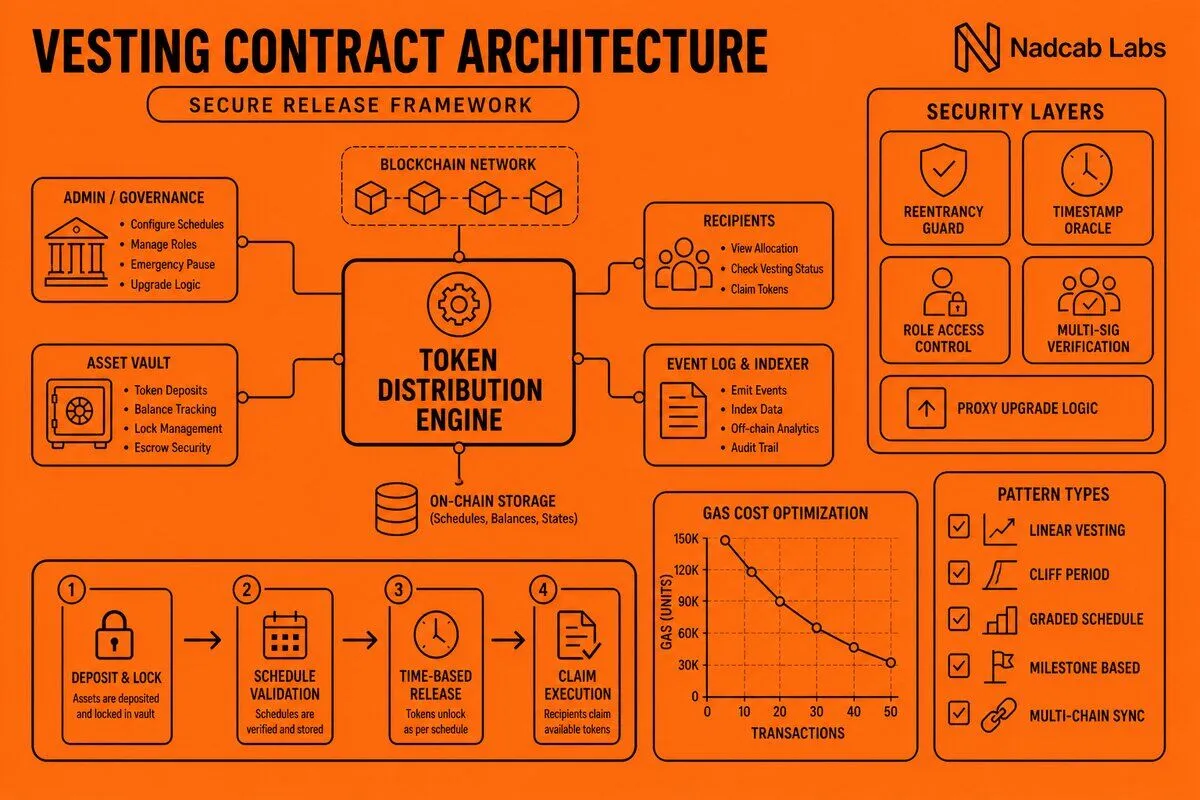
Multi-chain vesting architecture requires blockchain-specific optimizations because different chains have fundamentally different execution models, cost structures, and security assumptions. EVM-compatible chains (Ethereum, BSC, Polygon, Arbitrum, Optimism) all run Solidity contracts with similar patterns but dramatically different gas costs. Solana uses a completely different account model with Program Derived Addresses and rent considerations. Non-EVM chains like Cosmos or Polkadot require native language implementations (Rust, Go) with their own architectural patterns.
On EVM chains, gas optimization focuses on storage packing and batch operations. Solidity stores variables in 32-byte slots, so packing multiple smaller variables into single slots reduces storage costs. A vesting schedule struct can pack beneficiary address (20 bytes), start timestamp (4 bytes), and cliff duration (4 bytes) into one slot, then total amount and claimed amount in separate slots. Batch claim functions allow multiple beneficiaries to claim in a single transaction, amortizing base transaction costs across participants. On Ethereum mainnet where gas costs are highest, these optimizations can reduce deployment costs by 30-40% and per-claim costs by 15-25%.
Solana vesting architecture differs fundamentally because Solana uses an account model where each piece of state lives in a separate account with rent requirements. A typical Solana vesting program creates Program Derived Addresses for each beneficiary, isolating their vesting schedule in a dedicated account. This isolation improves security by preventing one beneficiary from accidentally affecting another’s data, but requires paying rent for each account (typically 0.00089 SOL per account, refundable when closed). The program uses seeds derived from the beneficiary’s public key and a program-specific identifier to generate deterministic PDA addresses, ensuring each beneficiary has exactly one vesting account.
Cross-chain vesting coordination becomes necessary when projects distribute tokens on multiple chains or need to synchronize vesting schedules across ecosystems. Bridge integration patterns allow a master vesting contract on one chain to control unlock schedules on other chains through message-passing protocols like LayerZero, Wormhole, or Axelar. State synchronization strategies range from simple periodic updates (master chain broadcasts current vested amounts to slave chains) to real-time synchronization where each claim on any chain triggers updates across all chains. The architectural complexity increases significantly with cross-chain requirements, similar to challenges in private blockchain architecture design patterns where multiple networks must coordinate state.
Unified claim interfaces abstract chain-specific differences behind a common API, allowing beneficiaries to check vesting status and claim tokens through a single frontend regardless of which blockchain holds their tokens. This typically involves a backend service that queries vesting contracts across chains, aggregates data, and routes claim transactions to the appropriate chain based on user selection. The architecture must handle chain-specific wallet connections, transaction signing, and confirmation patterns while presenting a seamless user experience.
What Gas Optimization Techniques Work Best for Vesting Contracts in 2026?
Gas optimization for vesting contracts targets three main areas: batch schedule creation during deployment, claim function efficiency, and multi-beneficiary architecture patterns. Batch vesting schedule creation becomes critical when setting up vesting for hundreds or thousands of beneficiaries, as seen in large token launches or DAO airdrops. Instead of calling a createSchedule function once per beneficiary (each costing 60,000-80,000 gas), a batch function processes arrays of beneficiaries and schedules in a single transaction.
Array packing optimizes batch creation by storing schedule parameters as tightly packed bytes rather than separate variables. For example, packing start time (uint32), cliff duration (uint32), and total amount (uint128) into a single bytes32 value reduces storage writes from three slots to one. This optimization saves approximately 15,000 gas per schedule. For 100 beneficiaries, the savings approach 1.5 million gas, or roughly $18 at typical Ethereum prices. The trade-off is increased code complexity for packing and unpacking values, which requires careful testing to prevent overflow or truncation bugs.
Merkle tree proofs offer an alternative approach for very large beneficiary sets where storing all schedules on-chain becomes prohibitively expensive. The contract stores only the merkle root of all schedules, and beneficiaries provide merkle proofs when claiming to verify their schedule exists in the tree. This reduces deployment costs from linear in the number of beneficiaries to constant (just the root hash), but increases claim costs slightly (merkle proof verification adds 5,000-8,000 gas per claim). The crossover point where merkle trees become more efficient than direct storage occurs around 500-1,000 beneficiaries, depending on claim frequency assumptions.
Claim function optimization focuses on minimizing computation and storage operations during the most frequent user interaction. Lazy evaluation calculates vested amounts on-demand based on current timestamp rather than pre-computing and storing intermediate values. This approach saves storage costs but requires efficient calculation logic. A well-optimized linear vesting calculation uses simple arithmetic: vestedAmount equals totalAmount multiplied by (currentTime minus startTime) divided by (endTime minus startTime), with bounds checking to prevent overflow. This calculation costs approximately 1,500 gas compared to reading pre-computed values from storage at 2,100 gas, making lazy evaluation more efficient.
| Optimization Technique | Gas Saved Per Operation | Implementation Complexity | Best Scenario |
|---|---|---|---|
| Storage Packing | ~15,000 per schedule | Medium | Batch schedule creation |
| Merkle Proofs | ~50,000 per 100 beneficiaries | High | Large airdrops, 1000+ beneficiaries |
| Lazy Evaluation | ~600 per claim | Low | Linear/cliff vesting patterns |
| Batch Claims | ~8,000 per additional claim | Medium | Multi-beneficiary claims, automated systems |
Event emission strategies balance monitoring needs with gas costs. Each event costs approximately 375 gas plus 375 gas per indexed parameter. A minimal claim event with indexed beneficiary address and amount costs about 1,500 gas. Production systems often emit detailed events including vesting schedule ID, claimed amount, remaining amount, and timestamp for comprehensive audit trails, accepting the higher gas cost (2,500-3,000 gas) for operational visibility. The architecture should emit events before external calls to ensure they execute even if the call fails, following the same checks-effects-interactions pattern used for security.
Multi-beneficiary architecture patterns present a fundamental design choice: deploy individual contracts per beneficiary or use a shared pool design. Individual contracts provide maximum isolation and simplify permission logic since each beneficiary owns their contract, but deployment costs scale linearly (approximately 200,000 gas per contract). Shared pool designs store all schedules in a single contract with mapping-based access control, reducing deployment to a constant cost but increasing complexity around beneficiary management. The crossover point favors shared pools for more than 10-15 beneficiaries, with the gap widening as beneficiary count increases. At 100 beneficiaries, a shared pool saves approximately 18 million gas compared to individual contracts. These patterns extend to other domains like Smart Contract Wallet Architecture where similar isolation versus efficiency trade-offs exist.
Before/after gas cost analysis demonstrates optimization impact. An unoptimized vesting contract for 50 beneficiaries might cost 4.2 million gas to deploy and 55,000 gas per claim. After applying storage packing, lazy evaluation, and batch creation, deployment drops to 2.1 million gas (50% reduction) and claims to 42,000 gas (24% reduction). For projects with frequent claims or high gas price environments, these optimizations pay for themselves quickly. Professional Smart Contract developers routinely apply these patterns during implementation to minimize long-term operational costs.
Production deployment requires comprehensive testing across gas optimization techniques to verify that savings materialize without introducing bugs. The testing framework should include gas benchmarking for each function, comparison tests between optimized and unoptimized versions, and stress tests with maximum beneficiary counts. Automated testing tools like Hardhat gas reporter provide detailed breakdowns of gas usage per function, helping identify remaining optimization opportunities. Before mainnet deployment, projects should conduct a thorough Smart Contract Audit that specifically reviews gas optimization implementations for correctness and security trade-offs.
Final Thoughts
Token vesting smart contract architecture in 2026 demands careful balance between security, gas efficiency, and operational flexibility. The core patterns—linear, cliff, graded, and milestone-based—each serve specific distribution scenarios with measurable cost and complexity trade-offs. Security architecture must address reentrancy, timestamp manipulation, and access control through proven patterns like ReentrancyGuard and multi-signature integration. The upgradeable versus immutable decision hinges on project stage and stakeholder trust requirements, with proxy patterns offering flexibility at the cost of complexity. Multi-chain deployments require chain-specific optimizations, from Solidity storage packing on EVM chains to Program Derived Addresses on Solana. Gas optimization through batch operations, merkle proofs, and lazy evaluation can reduce costs by 40-60% for large beneficiary sets. As token distribution becomes increasingly sophisticated, robust vesting architecture remains foundational to aligning long-term incentives while protecting all stakeholders. For comprehensive guidance on broader token ecosystem infrastructure, review our Smart Contract Architecture resource hub covering patterns across use cases and chains.
Frequently Asked Questions
Q1.What is the most gas-efficient vesting contract architecture in 2026?
The most gas-efficient token vesting smart contract architecture in 2026 uses batch processing for multiple beneficiaries, lazy claim mechanisms where tokens are calculated on-demand rather than stored, and minimal storage patterns with packed structs. Implementing merkle trees for large-scale vesting schedules and avoiding loops in favor of mathematical formulas for linear vesting significantly reduces gas costs while maintaining security and functionality.
Q2.Should vesting contracts be upgradeable or immutable in 2026?
In 2026, token vesting smart contract architecture should prioritize immutability for core vesting logic to ensure trust and prevent manipulation. However, using proxy patterns for administrative functions like emergency pause or beneficiary updates provides necessary flexibility. The best approach combines immutable vesting calculations with minimal upgradeable governance features, clearly documented and time-locked to balance security with operational needs.
Q3.How do you prevent timestamp manipulation in vesting contracts in 2026?
In 2026, prevent timestamp manipulation in token vesting smart contract architecture by using block.timestamp with awareness of miner flexibility (±15 seconds). Design vesting periods in days or weeks rather than seconds, making minor timestamp shifts irrelevant. Implement checks ensuring timestamps only move forward, and consider using block numbers for critical milestones. Avoid reliance on precise second-level timing for financial calculations.
Q4.What are the security risks in token vesting smart contracts in 2026?
Key security risks in token vesting smart contract architecture in 2026 include reentrancy attacks during token claims, integer overflow in vesting calculations, unauthorized access to admin functions, and front-running of vesting releases. Additional risks involve timestamp manipulation, improper access controls, insufficient validation of beneficiary addresses, and vulnerabilities in upgradeable proxy patterns. Comprehensive audits and formal verification are essential mitigation strategies.
Q5.How does vesting contract architecture differ between Ethereum and Solana in 2026?
In 2026, Ethereum token vesting smart contract architecture uses Solidity with ERC-20 standards, emphasizing gas optimization and storage efficiency. Solana vesting contracts use Rust with program-derived addresses (PDAs), leveraging parallel processing and lower transaction costs. Solana’s architecture requires different account management patterns and rent considerations, while Ethereum focuses on minimizing storage and computational complexity due to higher gas costs.
Q6.What OpenZeppelin contracts should be used for vesting implementation in 2026?
For token vesting smart contract architecture in 2026, use OpenZeppelin’s VestingWallet as a foundation, along with Ownable or AccessControl for permissions, ReentrancyGuard for security, and SafeERC20 for token transfers. Pausable adds emergency controls, while TimelockController provides governance delays. These battle-tested contracts reduce development risk, ensure security best practices, and provide standardized interfaces that integrate seamlessly with existing DeFi ecosystems.
Explore Services
Related Services
Reviewed by

Aman Vaths
Founder of Nadcab Labs
Aman Vaths is the Founder & CTO of Nadcab Labs, a global digital engineering company delivering enterprise-grade solutions across AI, Web3, Blockchain, Big Data, Cloud, Cybersecurity, and Modern Application Development. With deep technical leadership and product innovation experience, Aman has positioned Nadcab Labs as one of the most advanced engineering companies driving the next era of intelligent, secure, and scalable software systems. Under his leadership, Nadcab Labs has built 2,000+ global projects across sectors including fintech, banking, healthcare, real estate, logistics, gaming, manufacturing, and next-generation DePIN networks. Aman’s strength lies in architecting high-performance systems, end-to-end platform engineering, and designing enterprise solutions that operate at global scale.