Ai Overview
Upgradeable token contract patterns represent critical architectural approaches enabling smart contract functionality improvements after deployment without disrupting token operations or requiring user migrations. Traditional smart contracts deploy as immutable code on blockchain networks, creating challenges when bugs are discovered, features need enhancement, or business logic requires modification.
Upgradeable token contract patterns represent critical architectural approaches enabling smart contract functionality improvements after deployment without disrupting token operations or requiring user migrations. Traditional smart contracts deploy as immutable code on blockchain networks, creating challenges when bugs are discovered, features need enhancement, or business logic requires modification. Understanding upgradeable contract patterns proves essential for projects anticipating long-term evolution while maintaining security, preserving user balances, and ensuring seamless transitions between contract versions.
The immutability of blockchain smart contracts provides security guarantees preventing unauthorized code changes, but this same characteristic creates inflexibility problematic for complex token ecosystems requiring adaptability. Upgradeable patterns solve this dilemma through proxy architectures separating contract storage from logic, enabling logic updates while preserving state. Professional crypto token solutions providers implement these patterns carefully, as improper upgradeable implementations introduce severe vulnerabilities potentially enabling malicious upgrades or state corruption.
Key Takeaways
- Proxy Pattern Foundation: Upgradeable contracts utilize proxy architectures delegating execution to separate implementation contracts, enabling logic updates while preserving storage and token balances across upgrades.
- Storage Collision Risks: Improper variable declaration ordering between contract versions causes storage collisions corrupting state data, requiring strict storage layout management and initialization patterns preventing conflicts.
- Three Primary Patterns: Transparent proxy, UUPS (Universal Upgradeable Proxy Standard), and beacon proxy patterns offer different trade-offs regarding gas costs, security models, and upgrade authority control mechanisms.
- Initialization Over Constructors: Upgradeable contracts replace constructors with initializer functions preventing re-initialization and properly setting up state during initial deployment through proxy delegation.
- Access Control Critical: Secure upgrade mechanisms require robust authorization ensuring only designated administrators can execute upgrades, preventing malicious actors from deploying compromised implementation contracts.
- Testing Complexity Increases: Upgradeable contracts demand comprehensive testing including storage layout verification, initialization testing, upgrade simulation, and cross-version compatibility validation before production deployment.
- Gas Cost Implications: Proxy delegation adds overhead to every function call, increasing transaction costs by 2000-5000 gas per call compared to direct contract interactions without proxy layers.
- Governance Integration Common: Decentralized projects implement time-locks and multi-signature governance controlling upgrade execution, balancing flexibility with community oversight preventing unilateral malicious changes.
Understanding Upgradeable Smart Contract Architecture
Smart contract upgradeability fundamentally challenges blockchain’s immutability premise, requiring careful architectural approaches preserving security while enabling controlled evolution. Traditional contracts deploy as permanent code executing deterministically, but complex token ecosystems require adaptability addressing discovered vulnerabilities, implementing new features, or optimizing performance without abandoning existing deployments and migrating users.
The Immutability Challenge
Blockchain immutability provides critical security guarantees, ensuring code executing today will function identically tomorrow without the risk of unauthorized modifications. This permanence prevents contract owners from changing rules retroactively, stealing user funds through code alterations, or introducing backdoors after deployment. For any token development company, this reliability is a major advantage when building trust with users. However, immutability also creates challenges when contracts contain bugs, require feature enhancements, or need optimization to address unforeseen circumstances.
Non-upgradeable contracts force projects choosing between deploying with known limitations or risking undiscovered vulnerabilities. Bug discoveries post-deployment necessitate deploying entirely new contracts and convincing users to migrate, fragmenting liquidity and creating confusion. Major protocol hacks have demonstrated how immutable contract vulnerabilities can result in irreversible fund losses when no upgrade path exists for deploying fixes.
Proxy Pattern Fundamentals
Upgradeable token contract patterns leverage proxy contracts separating persistent storage from executable logic. The proxy contract maintains all state including token balances, allowances, and configuration while delegating function execution to separate implementation contracts containing business logic. Upgrades replace the implementation contract address the proxy delegates to, enabling logic changes without migrating storage or requiring user action.
This separation relies on Ethereum’s `delegatecall` opcode executing code from one contract within another contract’s context. When users interact with proxy contracts, calls are forwarded to implementation contracts which execute using the proxy’s storage. The proxy address remains constant preserving token addresses users know, while implementation contracts can be replaced transparently updating functionality.[1]
Storage and Logic Separation
Successful upgradeable architecture requires strict separation between storage variables living in proxy contracts and logic functions residing in implementation contracts. Storage layout must remain consistent across implementations, with new versions only appending additional variables rather than modifying existing storage slots. This discipline prevents storage collisions where new implementations incorrectly interpret storage slot contents.
Implementation contracts must be stateless, storing no state in their own storage but only manipulating proxy storage through delegatecall context. Violating this principle by storing data in implementation contracts creates state that disappears when implementations are upgraded, causing logic errors or security vulnerabilities in upgraded versions.
| Aspect | Non-Upgradeable Contracts | Upgradeable Contracts |
|---|---|---|
| Code Modification | Impossible after deployment | Logic replaceable through proxy upgrade |
| Bug Fixes | Require new deployment and migration | Deployable through implementation update |
| Gas Costs | Lower, direct function calls | Higher, additional delegatecall overhead |
| Complexity | Simple, straightforward architecture | Complex, requires careful storage management |
| Security Risks | Vulnerabilities permanent but predictable | Upgrade mechanism introduces additional attack vectors |
| User Trust | High, guaranteed code permanence | Requires trust in upgrade governance |
Transparent Proxy Pattern
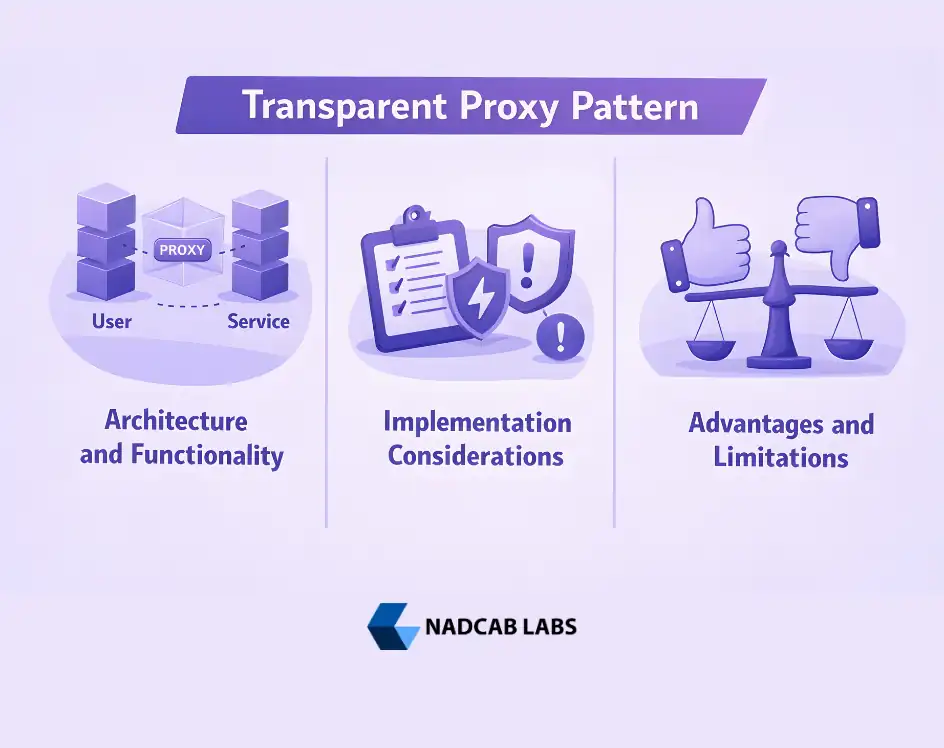
The transparent proxy pattern represents one of the most widely adopted upgradeable architectures, distinguishing between admin and user interactions to prevent function selector conflicts between proxy and implementation contracts. This pattern ensures administrative functions like upgrades only execute for designated admin addresses, while all other callers have their calls forwarded to implementation contracts.
Architecture and Functionality
Transparent proxies contain fallback functions delegating all calls to implementation contracts except when admin addresses invoke admin-specific functions like `upgradeTo()` or `changeAdmin()`. This separation prevents situations where implementation contracts declare functions with identical signatures to proxy admin functions, creating ambiguity about which function executes.
The pattern requires checking caller identity on every function invocation, adding gas overhead but providing clear separation between administrative and user operations. Admin addresses can never call implementation functions directly through the proxy, ensuring consistent behavior regardless of which functions implementations expose.
Implementation Considerations
Transparent proxy implementations store admin address and implementation address in specific storage slots using unstructured storage patterns preventing collisions with implementation contract storage. The `EIP-1967` standard defines specific slots for these values, ensuring consistency across different transparent proxy implementations.
During the timeline for token and coin launch, developers must carefully initialize transparent proxies ensuring admin controls are properly configured before making contracts publicly accessible. Admin private keys require secure management, as compromise enables malicious upgrades stealing funds or disrupting token functionality.
Advantages and Limitations
Transparent proxies offer clear mental models separating admin and user functions, reducing complexity around function selector conflicts. This clarity makes them popular for token contracts where upgrade paths need definition but governance complexity should be minimized during early development stages.
However, the admin check on every call increases gas costs for all users, even those simply transferring tokens or checking balances. For high-frequency token operations, this overhead can meaningfully increase transaction costs compared to alternative patterns. Additionally, the admin having unilateral upgrade authority concentrates power requiring trust or additional governance mechanisms.
UUPS (Universal Upgradeable Proxy Standard) Pattern
UUPS represents a gas-efficient alternative to transparent proxies by moving upgrade logic from proxy contracts into implementation contracts. This architecture reduces proxy contract complexity and eliminates per-call admin checks, decreasing gas costs while maintaining upgradeability through different mechanisms.
Design Philosophy
UUPS proxies contain minimal logic, simply delegating all calls to implementation contracts without admin checks or upgrade functions. Instead, implementation contracts themselves contain `upgradeTo()` functions controlling how upgrades execute. This inversion means proxy contracts remain extremely simple while implementations bear responsibility for upgrade authorization and execution.
Because upgrade logic resides in implementations, all UUPS implementations must include proper upgrade functions and authorization checks. Deploying implementation without upgrade capability creates irreversibly non-upgradeable contracts despite using UUPS proxies, as the proxy itself contains no upgrade mechanism.
Gas Optimization Benefits
Eliminating admin checks from proxy contracts reduces gas consumption for all user interactions. According to OpenZeppelin’s analysis, UUPS proxies save approximately 2,100 gas per transaction compared to transparent proxies, meaningful savings for high-volume token contracts processing thousands of daily transfers[2].
This efficiency particularly benefits DeFi protocols and payment tokens where transaction costs directly impact user experience and adoption. Lower per-transaction costs improve competitiveness against non-upgradeable alternatives while maintaining upgrade flexibility addressing future needs.
Security Considerations
UUPS requires implementations correctly implement upgrade functions with proper authorization. Forgetting upgrade logic in implementations or implementing inadequate access controls creates severe vulnerabilities. Unlike transparent proxies where upgrade logic is centralized in proxy contracts, UUPS distributes this responsibility across all implementations.
Testing must verify every implementation includes proper upgrade capabilities before deployment. Implementation contracts without upgrade functions or with compromised authorization enable attacks or create upgrade deadlocks requiring new proxy deployments. Professional coin and token service providers implement rigorous testing protocols validating upgrade function presence and correct authorization in all UUPS implementations.
Beacon Proxy Pattern
Beacon proxies enable upgrading multiple proxy instances simultaneously through shared beacon contracts tracking current implementation addresses. This pattern suits scenarios deploying many instances of similar contracts, allowing coordinated upgrades across entire proxy fleets without individual proxy updates.
Multi-Proxy Architecture
Beacon architecture introduces beacon contracts storing implementation addresses that multiple proxies reference for delegation targets. All proxies pointing to a specific beacon automatically upgrade when that beacon’s implementation address changes, providing centralized upgrade control across distributed proxy instances.
This pattern fits use cases like token factories creating multiple similar token contracts, NFT collections with consistent upgrade requirements, or multi-chain deployments maintaining synchronized functionality. Single beacon upgrades apply to hundreds or thousands of proxies simultaneously, dramatically reducing upgrade operational complexity.
Implementation Structure
Beacon proxy systems require three contract types: beacon contracts storing implementation addresses and providing upgrade functions, proxy contracts delegating to implementations referenced by beacons, and implementation contracts containing executable logic. Proxies query beacons for current implementation addresses before delegating calls.
This additional indirection adds slight gas overhead compared to direct proxy patterns, but enables powerful fleet management capabilities. Projects creating numerous similar contracts benefit from coordinated upgrades outweighing marginal per-call costs.
Use Cases and Benefits
Beacon patterns excel for platform tokens issuing multiple related contracts sharing upgrade requirements. For example, platforms creating separate token contracts for different asset classes can upgrade all simultaneously by updating the shared beacon. This synchronization prevents version fragmentation where some tokens operate with updated logic while others remain on outdated implementations.
Managing crypto token supply across multiple contract instances becomes simpler with beacon proxies, as supply management logic updates deploy universally rather than requiring individual contract upgrades. This consistency reduces operational overhead and bug risks from version mismatches.
| Pattern | Gas Cost | Best Use Case | Key Risk |
|---|---|---|---|
| Transparent Proxy | Highest (admin checks) | Simple tokens with clear admin separation | Centralized admin control |
| UUPS | Lowest (no admin checks) | High-volume tokens prioritizing gas efficiency | Forgetting upgrade logic in implementation |
| Beacon Proxy | Medium (beacon query) | Multiple similar contracts requiring coordinated upgrades | Beacon compromise affects all proxies |
Storage Layout Management
Proper storage management represents the most critical aspect of upgradeable contract development, as storage collisions between contract versions cause catastrophic state corruption impossible to recover without complex migration procedures. Understanding Solidity’s storage layout rules and implementing defensive programming practices prevents these devastating errors.
Storage Slot Allocation
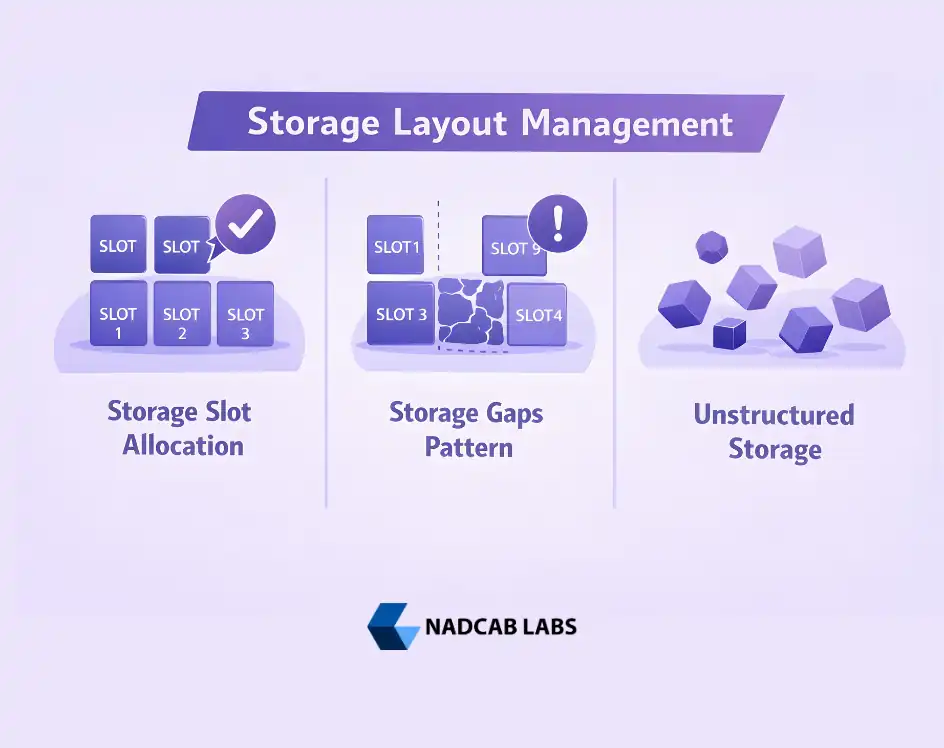
Solidity allocates storage sequentially starting from slot 0, packing multiple variables into single slots when possible based on type sizes. State variables declared in contracts occupy specific slots determined by declaration order, with inheritance adding parent contract variables before child contract variables.
Upgradeable contracts must maintain identical storage layouts across versions for all existing variables. New implementations can only append additional variables after all previous variables, never inserting, removing, or reordering existing variables. Violating these rules causes new implementations to interpret storage slots incorrectly, reading balances as allowances or vice versa.
Storage Gaps Pattern
Professional implementations use storage gaps reserving empty slots for future variables. By declaring `uint256[50] private __gap;` at the end of upgradeable contracts, developers reserve 50 storage slots for future use. Adding new variables consumes gap slots rather than appending beyond existing variables, maintaining storage layout compatibility.
This technique proves especially important for base contracts inherited by implementations. Upgrading base contracts by adding variables would shift all child contract storage, but using gaps allows base contract extension without affecting child layouts. Gap sizes should balance flexibility against storage costs and contract size limitations.
Unstructured Storage
Unstructured storage uses hash-based slot calculation for critical proxy storage like admin addresses and implementation addresses, preventing collisions with regular storage. By storing these values at slots derived from hashing specific strings, proxies guarantee no overlap with implementation storage regardless of implementation layouts.
EIP-1967 standardizes storage slots for proxy metadata using keccak256 hashes of descriptive strings. This approach eliminates dependency on storage layout declaration order, providing collision-resistant locations for proxy-specific data. Implementations should never access these special slots directly, maintaining strict separation between proxy and implementation storage.
Initialization Patterns
Upgradeable contracts cannot use constructors for initialization since constructor code executes during deployment, affecting only implementation contracts rather than proxy state. Instead, upgradeable patterns employ initializer functions establishing initial state after proxy deployment through delegatecall execution.
Initializer Functions
Initializer functions replace constructors, executing once to set up initial state like token names, symbols, total supply, and admin addresses. These functions must include guards preventing multiple executions, as calling initializers multiple times could reset balances, change ownership, or corrupt state in unpredictable ways.
OpenZeppelin’s `Initializable` contract provides `initializer` modifier enforcing single execution. This modifier sets a flag after first execution, reverting subsequent attempts ensuring initialization logic only runs once per proxy instance. All upgradeable contracts should inherit this protection preventing re-initialization attacks.
Multi-Step Initialization
Complex contracts may require multi-step initialization where parent contracts initialize before children. Solidity’s `initializer` modifier can be combined with `onlyInitializing` for functions called during initialization by other initializers but not directly by users.
This pattern enables proper initialization chains in complex inheritance hierarchies. Base contracts use `onlyInitializing` for setup functions called by child initializers, while child initializers use standard `initializer` modifier preventing multiple executions of the initialization process.
Initializer Reentrancy Protection
Initializers should include reentrancy guards preventing malicious initialization callbacks attempting to re-enter initialization logic mid-execution. While re-initialization after completion is prevented by initializer flags, reentrancy during initialization could exploit partially initialized state.
Combining `initializer` with `nonReentrant` modifiers provides comprehensive protection. This defense-in-depth approach ensures initialization executes atomically without interruption, establishing consistent state before any external interactions.
Upgrade Authorization and Governance
Controlling who can execute upgrades and under what conditions determines whether upgradeability enhances security through bug fixes or creates centralization risks enabling malicious behavior. Proper authorization mechanisms balance flexibility against community protection.
Access Control Mechanisms
Simple upgradeable contracts use single admin addresses controlling upgrade execution. While straightforward, this approach concentrates power in individual keys vulnerable to compromise, loss, or insider threats. If admin keys are compromised, attackers can deploy malicious implementations stealing all funds.
Multi-signature wallets requiring multiple approvals for upgrades distribute trust across several parties. Requiring 3-of-5 or 5-of-9 signatures for upgrades prevents single points of failure while enabling legitimate upgrades when multiple authorized parties agree. This balance suits projects with identified trusted parties but requiring protection against individual key compromise.
Timelock Implementation
Timelocks enforce minimum delays between upgrade proposals and execution, providing community time to review changes and exit if disagreeable. A 48-hour timelock gives users time to examine new implementation code, assess whether changes are acceptable, and withdraw funds if upgrades appear malicious before they activate.
Timelock governance typically combines with multi-signature or DAO voting. Approved upgrades enter a queue but cannot execute until the timelock period elapses. This delay trades upgrade speed for security, preventing rushed or surprise malicious upgrades while allowing urgent bug fixes after waiting periods.
DAO Governance Integration
Decentralized autonomous organizations enable token holder voting on upgrades, distributing control across communities rather than concentrating in admin addresses. Governance token holders propose upgrades, vote on proposals, and execute approved changes through on-chain governance contracts enforcing voting results.
This approach maximizes decentralization but introduces governance complexity and slows upgrade execution. Simple bug fixes may require days or weeks for proposal, voting, and execution compared to instant admin upgrades. Projects must balance decentralization benefits against reduced agility responding to emergencies.
Testing and Verification
Upgradeable contracts demand more comprehensive testing than standard contracts due to storage layout requirements, initialization patterns, and upgrade simulation complexity. Rigorous testing prevents deployment errors causing irreversible damage.
Storage Layout Verification
Automated tools like OpenZeppelin’s Upgrades plugins validate storage layout compatibility between contract versions, preventing dangerous storage changes. These tools compare storage layouts flagging variables added in wrong positions, type changes, or removed variables before deployment.
Manual verification involves examining storage layouts generated by Solidity compiler, confirming new variables only append to existing layouts. Any layout modification beyond appending indicates potential storage collision requiring refactoring before upgrade deployment.
Upgrade Simulation
Simulating upgrades on test networks or mainnet forks validates that new implementations integrate correctly with existing state. Tests should initialize proxies with realistic data, perform upgrades, then verify all storage remains intact and new functionality works as expected.
Simulations catch issues invisible in isolated testing, like storage interpretation errors or initialization conflicts only apparent when upgrading from actual deployed contracts. According to a 2024 audit report, 23% of upgradeable contract vulnerabilities discovered during audits involved storage layout errors preventable through comprehensive upgrade simulation.
Integration Testing
Testing interactions between upgraded contracts and dependent systems ensures compatibility with exchanges, wallets, and protocols integrating the token. Upgrade changes should maintain interface compatibility or coordinate with integration partners about breaking changes requiring updates.
Comprehensive test suites verify token transfers, approvals, and all standard functions work identically post-upgrade. Tests should also confirm new features function properly and gas costs remain reasonable after upgrade implementation.
Implement Secure Upgradeable Patterns
Partner with experienced blockchain developers to implement robust upgradeable token contracts with proper storage management, secure governance, and comprehensive testing protocols.
Security Considerations and Best Practices
Upgradeable contracts introduce additional attack surfaces requiring defensive programming practices beyond standard smart contract development. Understanding common vulnerabilities and implementing protective measures prevents exploits specific to proxy architectures.
Initialization Security
Uninitialized proxies represent critical vulnerabilities enabling attackers to call initialization functions claiming admin roles or setting malicious parameters. Implementations should ensure initialization executes atomically during deployment, ideally within the same transaction deploying proxies.
Front-running risks exist where attackers monitor pending proxy deployments and submit initialization transactions with higher gas prices, executing before legitimate initialization. Using initializer factories that deploy and initialize in single transactions eliminates this window.
Selfdestruct Prohibition
Implementation contracts must never contain `selfdestruct` operations, as destroying implementation contracts while proxies reference them creates unusable proxies unable to delegate to non-existent code. This renders all proxies using that implementation permanently frozen with inaccessible funds.
Code reviews should explicitly verify no `selfdestruct` calls exist in implementations or any libraries they utilize. This protection extends to delegatecall targets which could contain destructive operations executed within proxy context.
Delegatecall Safety
Arbitrary delegatecall from implementation contracts creates severe vulnerabilities enabling attackers to execute malicious code within proxy context accessing and manipulating storage. Implementations should carefully control any delegatecall usage, validating targets are trusted contracts with known behavior.
Liberal delegatecall usage essentially grants implementation contracts ability to become proxy upgrades themselves, bypassing governance controls and authorization mechanisms. Strict controls preventing unauthorized delegatecall protect upgrade integrity.
Final Thoughts
Upgradeable token contract patterns provide essential flexibility enabling long-term token evolution while preserving deployment addresses and user balances. The transparent proxy, UUPS, and beacon proxy patterns offer different trade-offs regarding gas efficiency, security models, and multi-contract management capabilities. Choosing appropriate patterns depends on project requirements balancing gas costs, governance complexity, and upgrade coordination needs.
Implementing upgradeable contracts securely requires deep understanding of storage layout management, initialization patterns, and proxy delegation mechanics. Storage collisions represent the most dangerous pitfall, demanding strict variable ordering discipline and comprehensive testing validating layout compatibility across versions. Professional development teams leverage established frameworks like OpenZeppelin’s upgradeable contracts library reducing implementation risks.
Governance mechanisms controlling upgrade authorization prove as critical as technical implementation quality. Centralized admin control provides flexibility but requires trust, while timelock delays and DAO voting enhance decentralization at the cost of reduced agility. Projects should carefully consider their specific security requirements, community expectations, and operational needs when designing upgrade authorization systems.
The additional complexity of upgradeable patterns must be justified by genuine need for future flexibility. Simple tokens with well-defined requirements may benefit from non-upgradeable architecture’s simplicity and lower gas costs. However, complex protocols anticipating evolution, facing regulatory uncertainty, or requiring iterative improvement find upgradeable patterns essential for sustainable long-term operation without forcing disruptive user migrations.
Frequently Asked Questions
Q1.What are upgradeable token contracts?
Upgradeable token contracts use proxy architectures separating storage from logic, enabling business logic updates without changing contract addresses or requiring user migrations. proxies delegate execution to replaceable implementation contracts preserving state across upgrades.
Q2.Why use upgradeable contract patterns?
Upgradeability enables bug fixes, feature additions, and optimization after deployment without abandoning existing contracts. this flexibility proves essential for complex long-term projects requiring adaptation while maintaining token addresses and user balances.
Q3.What risks do upgradeable contracts have?
Storage collisions from improper variable management corrupt state, unauthorized upgrades enable fund theft, and initialization vulnerabilities allow attacker takeover. additional complexity increases testing requirements and introduces new attack vectors requiring careful implementation
Q4.How do transparent proxies work?
Transparent proxies distinguish admin from user calls, delegating user transactions to implementations while restricting admin functions. this separation prevents function selector conflicts but adds gas overhead checking caller identity on every transaction.
Q5.When use beacon proxy pattern?
Beacon proxies suit scenarios deploying multiple similar contracts requiring coordinated upgrades. single beacon updates apply to all proxies simultaneously, simplifying fleet management for token factories or multi-instance deployments.
Q6.What governance protects upgrade security?
Multi-signature requirements, timelock delays, and dao voting distribute control preventing unilateral malicious upgrades. these mechanisms balance upgrade flexibility with community protection through distributed authorization and review periods enabling informed decisi
Explore Services
Related Services
Reviewed by

Aman Vaths
Founder of Nadcab Labs
Aman Vaths is the Founder & CTO of Nadcab Labs, a global digital engineering company delivering enterprise-grade solutions across AI, Web3, Blockchain, Big Data, Cloud, Cybersecurity, and Modern Application Development. With deep technical leadership and product innovation experience, Aman has positioned Nadcab Labs as one of the most advanced engineering companies driving the next era of intelligent, secure, and scalable software systems. Under his leadership, Nadcab Labs has built 2,000+ global projects across sectors including fintech, banking, healthcare, real estate, logistics, gaming, manufacturing, and next-generation DePIN networks. Aman’s strength lies in architecting high-performance systems, end-to-end platform engineering, and designing enterprise solutions that operate at global scale.