Ai Overview
Gas-efficient smart contracts are built through deliberate architectural choices made during the design phase, not through post-deployment tweaks. Every storage slot, function modifier, and data structure you select translates directly into EVM opcodes that cost real money when users interact with your contract. Consider storage operations: reading from a cold storage slot costs 2,100 gas, while reading from a warm slot costs only 100 gas.
Gas-efficient smart contracts are built through deliberate architectural choices made during the design phase, not through post-deployment tweaks. Every storage slot, function modifier, and data structure you select translates directly into EVM opcodes that cost real money when users interact with your contract. The difference between a well-architected contract and a naive implementation can mean 10x higher transaction costs — enough to make your dApp economically unviable on mainnet.
Key Takeaways
- Architectural decisions during design have 10-100x more impact on gas costs than code-level optimizations applied later
- Storage packing patterns can save 20,000+ gas per transaction by fitting multiple variables into single 32-byte slots
- Function visibility modifiers and parameter location choices (memory vs calldata) directly affect ABI encoding overhead
- Batch operations amortize fixed costs across multiple actions, reducing per-user gas consumption by 40-60%
- Custom errors save approximately 13,000 gas compared to traditional revert strings while maintaining debuggability
- Balancing optimization with security requires understanding trade-offs between assembly-level efficiency and code auditability
Why Does Smart Contract Architecture Determine Gas Efficiency?
The architecture you choose for your smart contract fundamentally shapes how the Ethereum Virtual Machine executes every transaction. When you design a contract’s storage layout, select data structures, or define function signatures, you’re making decisions that cascade through every opcode the EVM will execute. These architectural choices have exponentially greater impact than micro-optimizations like loop unrolling or variable caching.
Consider storage operations: reading from a cold storage slot costs 2,100 gas, while reading from a warm slot costs only 100 gas. Writing to storage costs 20,000 gas for a new slot or 5,000 gas for updating an existing one. A poorly architected contract might read the same storage variable three times in a single function, paying 2,100 + 100 + 100 = 2,300 gas. A well-architected version loads it once into memory and reuses that copy, paying just 2,100 gas plus trivial memory costs.
The economic implications extend beyond individual transactions. If your dApp requires users to perform frequent operations — token transfers, state updates, or complex computations — high gas costs create direct user friction. Projects often face a choice: deploy on expensive mainnet with limited adoption, or move to Layer-2 solutions that sacrifice some security guarantees. Proper Smart Contract Development architecture can keep your application economically viable on mainnet while maintaining security.
Gas optimization architecture isn’t just about saving a few wei here and there. It’s about making strategic trade-offs between on-chain and off-chain computation, understanding when to use storage versus memory, and designing data structures that align with your access patterns. A contract that stores user balances in a mapping will have vastly different gas characteristics than one using an array with linear search, even if both achieve the same functional outcome.
Real-world data shows the magnitude of these differences. A naive ERC-20 token implementation might cost 65,000 gas per transfer. An optimized version using storage packing, efficient data structures, and careful function design can reduce that to 45,000 gas — a 30% reduction that compounds across millions of transactions. For a DEX processing 100,000 swaps daily, that architectural efficiency translates to thousands of dollars in saved gas costs for users.
The challenge lies in making these architectural decisions early, when you have maximum flexibility. Refactoring a deployed contract’s storage layout is impossible without a complete redeployment and data migration. Understanding gas optimization techniques from the design phase prevents costly architectural mistakes that haunt your project for its entire lifecycle.
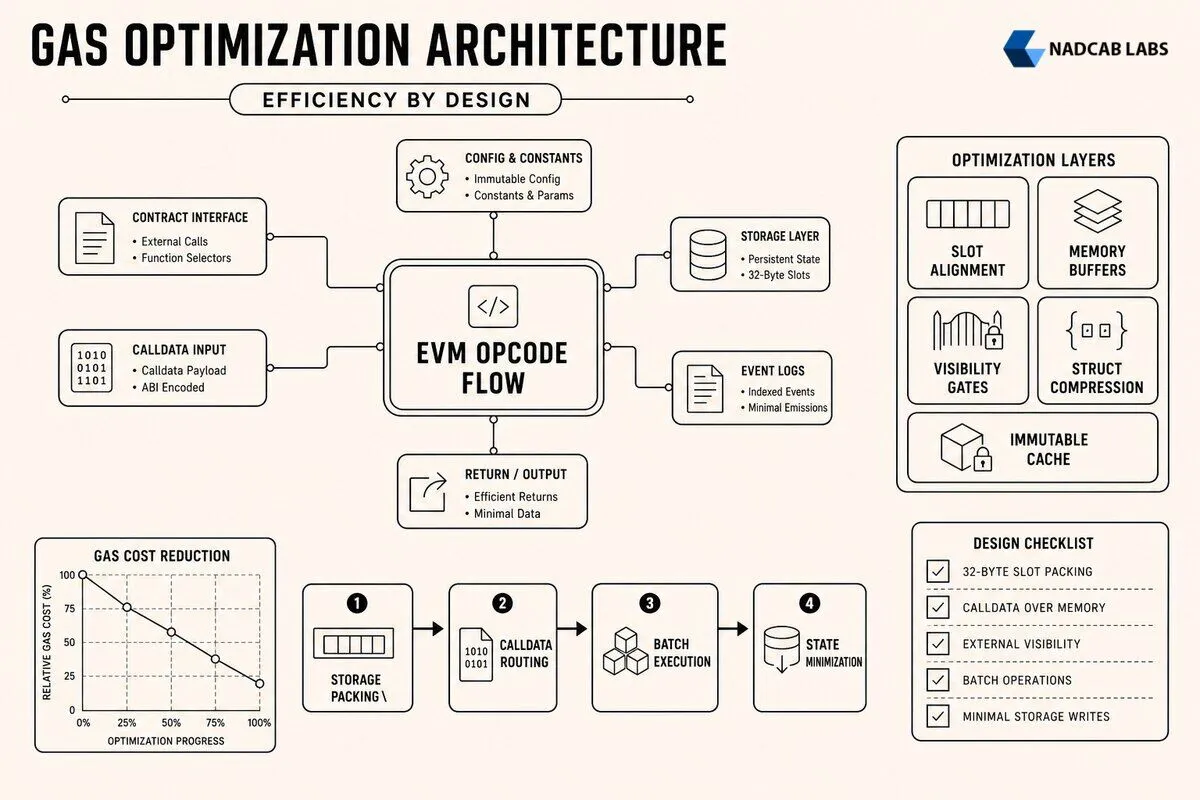
What Are the Core Storage Packing Patterns That Reduce Gas Costs?
Storage packing exploits the EVM’s 32-byte (256-bit) slot architecture by fitting multiple variables into a single slot. Each storage slot costs 20,000 gas to initialize and 5,000 gas to update. When you pack three uint64 variables into one slot instead of using three separate slots, you transform three storage writes (60,000 gas) into one (20,000 gas) — a 40,000 gas savings per transaction.
The key principle is ordering struct members by size to minimize wasted space. Solidity allocates storage sequentially, so placing a uint128 followed by a uint128 fills one complete slot. But placing a uint256 followed by a uint128 wastes 128 bits in the second slot. Here’s the gas impact:
| Struct Layout | Slots Used | Cold Read Gas | Write Gas (New) |
|---|---|---|---|
| uint256, uint128, uint64 | 3 slots | 6,300 gas | 60,000 gas |
| uint128, uint128, uint64, uint64 | 2 slots | 4,200 gas | 40,000 gas |
| uint64, uint64, uint128, address (20 bytes) | 2 slots | 4,200 gas | 40,000 gas |
| bool, uint8, uint16, uint32, uint64, uint128 | 1 slot | 2,100 gas | 20,000 gas |
Mappings versus arrays present a different architectural trade-off. Mappings provide O(1) access but consume a full 32-byte slot per key-value pair, even if values are small. Arrays allow iteration and packing but have O(n) search complexity for unsorted data. For user balance tracking in a token contract, mappings are optimal: you need direct address-to-balance lookup and never iterate all users. For a whitelist of 50 addresses checked on every mint, an array with linear search might be more gas-efficient than 50 separate mapping slots.
Nested mappings add complexity. A mapping(address => mapping(uint256 => uint256)) for user-specific token approvals costs two storage reads per access. An alternative architecture using a single mapping(bytes32 => uint256) with keccak256(abi.encodePacked(address, uint256)) as the key reduces it to one storage read, saving 2,000 gas per cold access. The trade-off is slightly higher computation cost for hashing and reduced code readability.
Storage pointers versus memory copies represent another critical pattern. When you declare a function parameter as storage, you get a reference to the actual storage location. Modifying it directly updates on-chain state. Declaring it as memory creates a copy, which costs gas proportional to the data size but isolates changes until you explicitly write back. For read-only operations, storage pointers are cheaper. For complex manipulations, memory copies prevent redundant storage writes.
Storage Packing Process Flow
Identify all state variables and their size requirements
Group variables to fill 32-byte slots completely
Measure gas costs for read/write operations
Compare against unpacked baseline implementation
The practical application requires understanding your contract’s access patterns. If you frequently read three variables together, pack them in the same slot to pay one cold read cost instead of three. If variables are accessed independently, packing might increase costs because the EVM must perform bitwise operations to extract individual values from the packed slot. Profiling your contract under realistic usage scenarios reveals the optimal packing strategy.
Advanced patterns include bit-packing boolean flags into a single uint256, allowing 256 boolean states in one storage slot. This technique is powerful for permission systems, feature flags, or status indicators. The trade-off is increased code complexity: you must manually shift and mask bits to read and write individual flags. For contracts with dozens of boolean states, the gas savings justify the complexity. For three or four booleans, the simpler approach of packing them naturally with other small integers is usually sufficient.
How Do Memory and Calldata Strategies Optimize Function Execution?
Function parameter location — memory, storage, or calldata — directly impacts gas costs through different mechanisms. Calldata is read-only data passed with external function calls. It costs 4 gas per zero byte and 16 gas per non-zero byte to include in transaction data, but accessing calldata within the function costs only 3 gas per word. Memory is mutable scratch space that costs 3 gas per word plus quadratic expansion costs as you use more memory. Storage, as discussed, is the expensive persistent state.
For arrays and structs passed to external functions, calldata is almost always cheaper than memory. When you declare a parameter as calldata, the function reads directly from transaction data without copying it into memory. Declaring it as memory forces a copy operation that costs gas proportional to the data size. A 1 KB array passed as calldata costs roughly 16,000 gas in transaction data. The same array as memory adds another 3,000+ gas for the copy operation.
Function visibility modifiers create surprising gas differences. An external function can only be called from outside the contract, and its parameters are automatically read from calldata. A public function can be called both externally and internally, so Solidity must support both calldata (external calls) and memory (internal calls). This dual-mode support adds ABI encoding overhead: roughly 200-500 gas per call depending on parameter complexity.
Real transaction comparisons illustrate the impact. Consider a function that accepts an array of addresses:
| Function Signature | Call Type | Gas Cost (10 addresses) | Gas Cost (100 addresses) |
|---|---|---|---|
| external function(address[] calldata) | External | 23,400 gas | 51,200 gas |
| public function(address[] memory) | External | 24,100 gas | 54,800 gas |
| public function(address[] memory) | Internal | 22,900 gas | 50,100 gas |
Short-circuiting patterns minimize gas consumption in conditional logic. When you write if (condition1 && condition2), Solidity evaluates condition1 first and skips condition2 if condition1 is false. Placing the cheaper or more likely-to-fail condition first saves gas. If condition1 is a simple comparison (50 gas) and condition2 is a storage read (2,100 gas), ordering matters. Evaluating the comparison first avoids the storage read 90% of the time if the comparison usually fails.
Early return strategies extend this principle. Instead of nesting multiple if statements, validate preconditions at the start of a function and revert immediately if they fail. This prevents wasting gas on subsequent operations that will never complete. A function that checks user balance, verifies permissions, and then performs a transfer should validate balance and permissions first, before loading any additional state or performing expensive computations.
Memory expansion costs create non-obvious optimization opportunities. The EVM charges quadratic costs as memory usage grows beyond 724 bytes. For functions that manipulate large data structures, reusing memory slots instead of allocating new ones can prevent crossing into higher cost tiers. Advanced developers use assembly to manually manage memory pointers, but this requires deep EVM knowledge and introduces security risks if done incorrectly.
The practical approach for most developers is to prefer external functions with calldata parameters for user-facing entry points, use internal functions for code reuse within the contract, and carefully consider whether public visibility is necessary. Many contracts default to public functions when external would suffice, paying unnecessary gas overhead on every call. Profiling your contract’s call patterns reveals whether the internal call capability of public functions is actually used or just wasted gas.
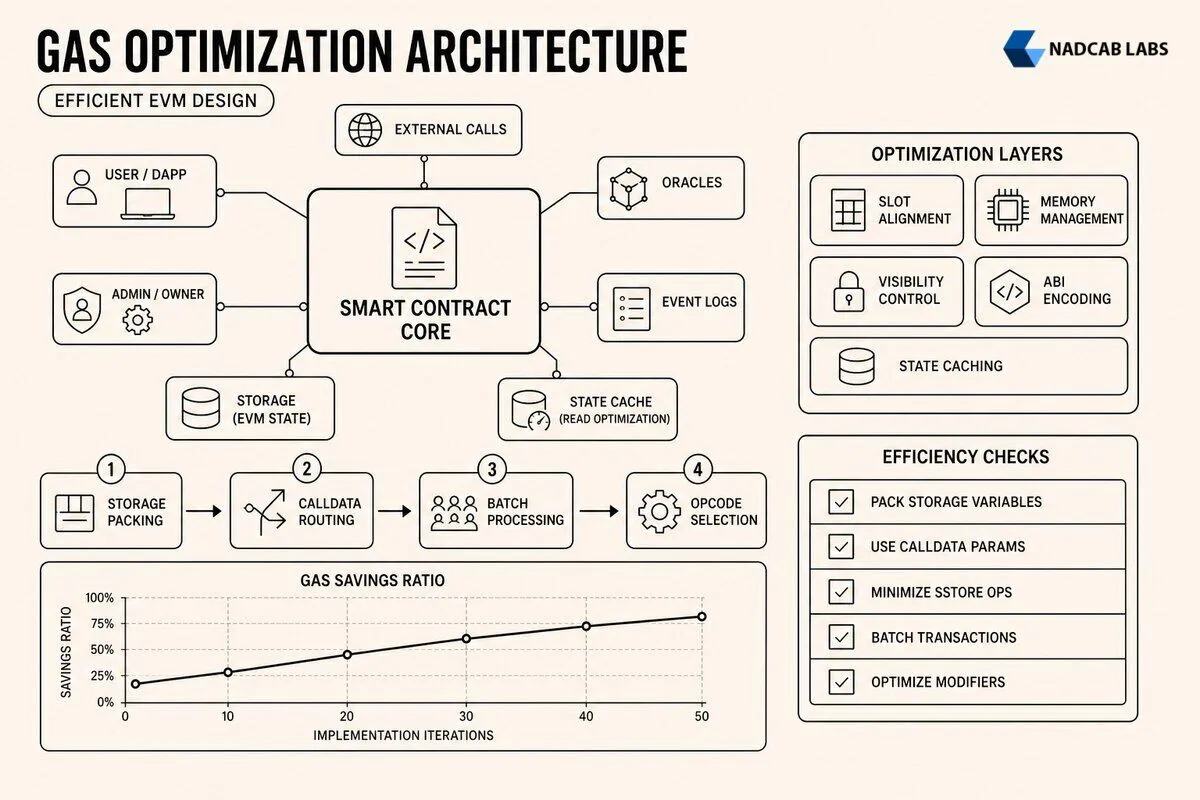
Which Batch Operation Patterns Maximize Gas Savings for Users?
Batch operations amortize fixed transaction costs across multiple actions, dramatically reducing per-action gas consumption. Every transaction pays a base fee of 21,000 gas regardless of what it does. A user making ten separate token transfers pays 210,000 gas in base fees alone. A batch transfer function that processes all ten in one transaction pays 21,000 gas once, saving 189,000 gas — a 90% reduction in base fee overhead.
Multi-call patterns extend this concept beyond simple transfers. A multi-call function accepts an array of encoded function calls and executes them sequentially in a single transaction. This pattern is powerful for complex workflows: approve a token, swap it on a DEX, stake the output, and claim rewards — all in one transaction. The user pays one base fee and benefits from warm storage access across operations that touch the same state variables.
The gas amortization calculation depends on transaction volume and fixed versus variable costs. Consider a token transfer that costs 45,000 gas: 21,000 base fee plus 24,000 for the transfer logic. A batch transfer of N addresses costs approximately 21,000 + (N × 24,000) gas. The per-transfer cost drops from 45,000 to (21,000/N) + 24,000. At N=10, that’s 26,100 gas per transfer — a 42% savings. At N=100, it’s 24,210 gas per transfer — a 46% savings.
Gas Savings by Batch Size
Loop optimization techniques are critical for batch operations to realize these savings. The naive approach of iterating with for (uint i = 0; i < array.length; i++) pays a storage read cost for array.length on every iteration. Caching the length in a local variable saves 2,000+ gas per iteration. Using unchecked arithmetic for the increment saves another 120 gas per iteration when you know overflow is impossible.
Gas-efficient iteration patterns also involve minimizing storage access within loops. If you need to update a counter or accumulator, load it once before the loop, modify the memory copy inside the loop, and write back once after. Loading and storing on every iteration multiplies storage costs by the loop count. For a 100-iteration loop updating a storage variable, the difference is 2 storage operations (22,100 gas) versus 200 operations (1,010,000 gas) — a 45x cost difference.
Event emission strategies balance query performance with execution costs. Events cost approximately 375 gas for the base event plus 375 gas per indexed parameter and 8 gas per byte of non-indexed data. Indexed parameters enable efficient log filtering but are limited to three per event. For batch operations, you must decide whether to emit one event per action or one event for the entire batch. One event per action provides granular tracking but multiplies event costs by batch size. One batch event is cheaper but requires parsing a data array to extract individual action details.
The optimal strategy depends on your use case. For a batch payment system where each recipient needs proof of payment, individual events are worth the cost. For an internal state update batch where events are only used for monitoring, a single batch event with a data array is more efficient. Some contracts emit both: a detailed event per action for user-facing operations and a summary batch event for analytics.
Real-world implementations must handle partial failures gracefully. If a batch of 100 transfers includes one invalid recipient, should the entire transaction revert or should it skip the invalid transfer and continue? The gas-efficient answer is often to revert: trying to continue requires additional conditional logic and state management that costs more gas than simply validating inputs before execution. Pre-validation loops that check all conditions before performing any state changes are usually cheaper than mid-execution error handling.
Batch operations also interact with Gas Optimization strategies in complex systems like multi-level marketing smart contracts, where hierarchical reward distributions benefit significantly from batching. The key is understanding your contract’s usage patterns and designing batch interfaces that match how users actually interact with your system.
What Advanced Patterns Balance Optimization with Security and Upgradeability?
Custom error types introduced in Solidity 0.8.4 provide substantial gas savings over traditional revert strings. A revert string like require(balance >= amount, “Insufficient balance”) costs approximately 24,000 gas: 21,000 for the base transaction plus roughly 3,000 for encoding and storing the error string. A custom error like revert InsufficientBalance(balance, amount) costs approximately 11,000 gas: 21,000 base minus the string encoding overhead, saving about 13,000 gas per revert.
The debugging trade-off is minimal in modern development environments. Tools like Hardhat and Foundry automatically decode custom errors and display them with parameter values, providing the same debugging experience as string reverts. The production benefit extends beyond gas savings: custom errors can return structured data that front-ends parse programmatically, enabling better user error messages than generic string parsing.
Proxy pattern gas overhead presents a complex optimization challenge. Upgradeable contracts using the proxy pattern pay an extra DELEGATECALL on every function invocation, costing roughly 2,600 gas. For high-frequency operations like token transfers, this 5-6% overhead compounds quickly. The architectural decision is whether upgradeability is worth this permanent gas tax on every user transaction.
Optimization strategies differ fundamentally between immutable and upgradeable contracts. Immutable contracts can use aggressive storage packing, hardcoded constants, and other techniques that assume the storage layout never changes. Upgradeable contracts must maintain storage layout compatibility across versions, limiting packing opportunities and requiring careful slot management to avoid collisions. Understanding immutable vs upgradeable smart contracts trade-offs is essential for architectural planning.
For upgradeable contracts, one optimization is to move gas-intensive operations into separate immutable helper contracts called via CALL instead of DELEGATECALL. The main proxy handles state and upgradeability, while helper contracts provide pure computation. This hybrid architecture allows aggressive optimization of computational logic without sacrificing upgradeability for state management. The trade-off is increased deployment complexity and the need to coordinate multiple contract addresses.
Assembly-level optimizations offer the ultimate gas efficiency for critical paths but introduce significant security risks. Writing inline assembly allows direct EVM opcode access, bypassing Solidity’s safety checks. Common assembly optimizations include manual memory management, custom storage slot calculations, and optimized cryptographic operations. A well-optimized assembly block can save 20-30% gas compared to equivalent Solidity code.
The security trade-off is substantial. Assembly code is difficult to audit, easy to get wrong, and bypasses Solidity’s built-in protections against common vulnerabilities. A single assembly mistake can introduce reentrancy vulnerabilities, storage collisions, or arithmetic errors that Solidity would prevent. The industry best practice is to use assembly only for proven patterns in isolated, heavily audited functions, never for complex business logic.
| Optimization Technique | Gas Savings | Security Risk | Audit Complexity |
|---|---|---|---|
| Custom errors vs strings | 13,000 gas per revert | None | Low |
| Storage packing | 20,000+ gas per write | Low (overflow risks) | Medium |
| Unchecked arithmetic | 120 gas per operation | High (overflow/underflow) | High |
| Assembly optimizations | 20-30% function cost | Very high (multiple vectors) | Very high |
| Batch operations | 42-46% per action | Medium (DoS, partial failure) | Medium |
Code auditability must be preserved even when optimizing aggressively. The most gas-efficient code is worthless if it contains exploitable vulnerabilities. Professional Smart Contract Audit services focus heavily on optimized code because it’s where developers most often introduce bugs while chasing gas savings. The optimal approach is to write clear, correct Solidity first, then selectively optimize hot paths after profiling reveals bottlenecks.
Security best practices include using proven libraries like OpenZeppelin for standard functionality, even if custom implementations might save gas. The gas savings from reinventing ERC-20 are typically 5-10%, while the security risk of introducing a novel vulnerability is substantial. For custom logic where libraries don’t exist, extensive testing and formal verification become critical. Understanding formal verification smart contract techniques helps validate that optimizations preserve correctness.
The balance between optimization and security is context-dependent. A high-value DeFi protocol handling millions in TVL should prioritize security over gas savings, using conservative patterns and extensive audits. A gaming contract with low financial stakes can justify more aggressive optimization. The key is making conscious trade-offs based on your contract’s risk profile, not blindly optimizing every function.
Upgradeability adds another dimension to this balance. If you can upgrade a contract, you can fix optimization mistakes or adapt to new gas pricing models as the EVM evolves. If your contract is immutable, every optimization decision is permanent. This reality makes immutable contracts paradoxically safer to optimize aggressively: you test exhaustively before deployment because you can’t fix mistakes later, reducing the risk of optimization-induced bugs reaching production.
Advanced developers also consider cross-layer optimization strategies. With Layer-2 solutions offering dramatically lower gas costs, some operations make sense to move off mainnet entirely. Architectures that separate settlement (mainnet) from execution (L2) can optimize each layer differently. Mainnet contracts prioritize security and minimize storage, while L2 contracts can afford more complex logic. Understanding modular blockchain interoperability patterns helps design these hybrid architectures effectively.
The practical workflow for balancing optimization with security starts with a secure baseline implementation using standard patterns and libraries. Profile the contract under realistic usage to identify gas bottlenecks. Apply conservative optimizations first: custom errors, storage packing, function visibility. Measure the impact. If further optimization is needed, move to medium-risk techniques like unchecked arithmetic in proven-safe contexts. Reserve assembly for last-resort optimization of truly critical paths, and only after extensive testing and professional audit.
This disciplined approach prevents the common mistake of premature optimization that introduces bugs or makes code unmaintainable. Gas efficiency is important, but it’s never worth compromising security or creating technical debt that hampers future development. The goal is gas-efficient smart contracts that users trust and developers can maintain, not the absolute minimum gas cost at any cost.
Final Thoughts
Architecting gas-efficient smart contracts requires systematic decision-making at every layer of your design. Storage packing patterns, memory versus calldata strategies, batch operation architectures, and careful trade-offs between optimization and security all compound to create contracts that are both economically viable and secure. The difference between naive and optimized implementations can mean 10x cost differences that determine whether your dApp succeeds or fails in the market.
The key insight is that architectural decisions made during initial design have exponentially greater impact than code-level optimizations applied later. By understanding EVM fundamentals, profiling your contract’s access patterns, and applying proven optimization patterns, you create contracts that deliver better user experiences through lower transaction costs. When you need expert guidance implementing these patterns, working with experienced teams who offer Hire Smart contract developer services ensures your architecture is both gas-efficient and secure from day one.
As the blockchain ecosystem evolves with Layer-2 solutions, new EVM opcodes, and changing gas pricing models, the principles of gas-efficient architecture remain constant: minimize storage operations, batch where possible, use appropriate data structures for your access patterns, and balance optimization with security and maintainability. These fundamentals will serve you regardless of which blockchain or scaling solution you target.
Frequently Asked Questions
Q1.What is the difference between storage packing and memory optimization in smart contracts?
Storage packing arranges state variables to fit multiple values in single 32-byte slots, reducing costly SSTORE operations (20,000 gas). Memory optimization manages temporary data structures during execution to minimize memory expansion costs (3 gas per word). Storage affects persistent blockchain data; memory impacts runtime efficiency. Packing uint128 pairs saves ~20,000 gas versus separate uint256 slots.
Q2.How much gas can I save by using custom errors instead of revert strings?
Custom errors save approximately 13,000-15,000 gas per revert compared to string-based require statements. Traditional revert strings cost ~24,000 gas due to ABI encoding overhead, while custom errors use only ~9,000 gas through 4-byte selectors. For contracts with multiple validation points, cumulative savings exceed 50,000 gas across typical transaction flows in production environments.
Q3.When should I use memory versus calldata for function parameters?
Use calldata for external function parameters containing arrays or structs that won’t be modified—it avoids copying costs (3 gas per word). Memory is required when you modify parameter data or call internal functions expecting memory references. Calldata saves 2,000-10,000 gas depending on data size. Public functions automatically copy calldata to memory, increasing costs unnecessarily.
Q4.Do batch operations always reduce gas costs per transaction?
Batch operations reduce per-item gas costs by amortizing fixed transaction overhead (21,000 base gas) across multiple operations. However, large batches risk hitting block gas limits (30 million) or causing out-of-gas failures. Optimal batch sizes typically range from 50-200 operations depending on complexity. Batching saves 15,000-20,000 gas per additional item versus separate transactions.
Q5.How does function visibility affect gas consumption in Solidity?
External functions are most gas-efficient for calldata parameters, saving ~1,000-2,000 gas versus public functions that copy data to memory. Private and internal functions avoid JUMP operations required for external calls, reducing overhead by ~200 gas. Public functions create both external and internal interfaces, adding bytecode size. Choose external for user-facing functions with complex parameters.
Q6.Can gas optimization techniques compromise smart contract security?
Yes—aggressive optimization can introduce vulnerabilities. Unchecked arithmetic blocks save 120 gas per operation but risk overflows. Storage packing creates collision risks if variables share slots improperly. Inline assembly bypasses Solidity safety checks, enabling reentrancy or type confusion. Always audit optimized contracts thoroughly, maintain comprehensive test coverage, and prioritize security over marginal gas savings in critical logic paths.
Explore Services
Related Services
Reviewed by

Aman Vaths
Founder of Nadcab Labs
Aman Vaths is the Founder & CTO of Nadcab Labs, a global digital engineering company delivering enterprise-grade solutions across AI, Web3, Blockchain, Big Data, Cloud, Cybersecurity, and Modern Application Development. With deep technical leadership and product innovation experience, Aman has positioned Nadcab Labs as one of the most advanced engineering companies driving the next era of intelligent, secure, and scalable software systems. Under his leadership, Nadcab Labs has built 2,000+ global projects across sectors including fintech, banking, healthcare, real estate, logistics, gaming, manufacturing, and next-generation DePIN networks. Aman’s strength lies in architecting high-performance systems, end-to-end platform engineering, and designing enterprise solutions that operate at global scale.