Ai Overview
P2P exchange escrow smart contract architecture in 2026 relies on state management layers, multi-signature wallets, and event-driven settlement flows to eliminate custodial risk while enabling trustless peer-to-peer asset swaps. In a dual-deposit escrow, the seller deposits 150% of the trade value—100% for the asset being sold and 50% as a good-faith bond. Studies of P2P platforms using dual-deposit models show dispute rates drop by 60% compared to zero-collateral systems.
P2P exchange escrow smart contract architecture in 2026 relies on state management layers, multi-signature wallets, and event-driven settlement flows to eliminate custodial risk while enabling trustless peer-to-peer asset swaps. Modern designs integrate atomic swap mechanisms, dual-deposit penalty logic, and tiered dispute resolution to protect both buyers and sellers without relying on centralized intermediaries.
Key Takeaways
- P2P exchange escrow smart contract architecture combines deposit locking, multi-signature arbitration, and atomic swap protocols to ensure trustless settlement.
- Hash time-locked contracts (HTLCs) enable cross-chain escrow without custodians, supporting BTC-ETH and layer-2 interoperability.
- Dual-deposit mechanisms and tiered arbitration workflows deter fraud while providing transparent dispute resolution pathways.
- Proxy upgrade patterns and layer-2 deployment reduce gas costs and enable continuous contract improvements without fund migration.
- Multi-signature threshold schemes (2-of-3, 3-of-5) balance security, censorship resistance, and recovery for decentralized P2P exchanges.
- Event emission architecture supports off-chain indexing, real-time trade tracking, and automated settlement notifications for seamless user experiences.
What Are the Core Components of P2P Exchange Escrow Smart Contract Architecture in 2026?
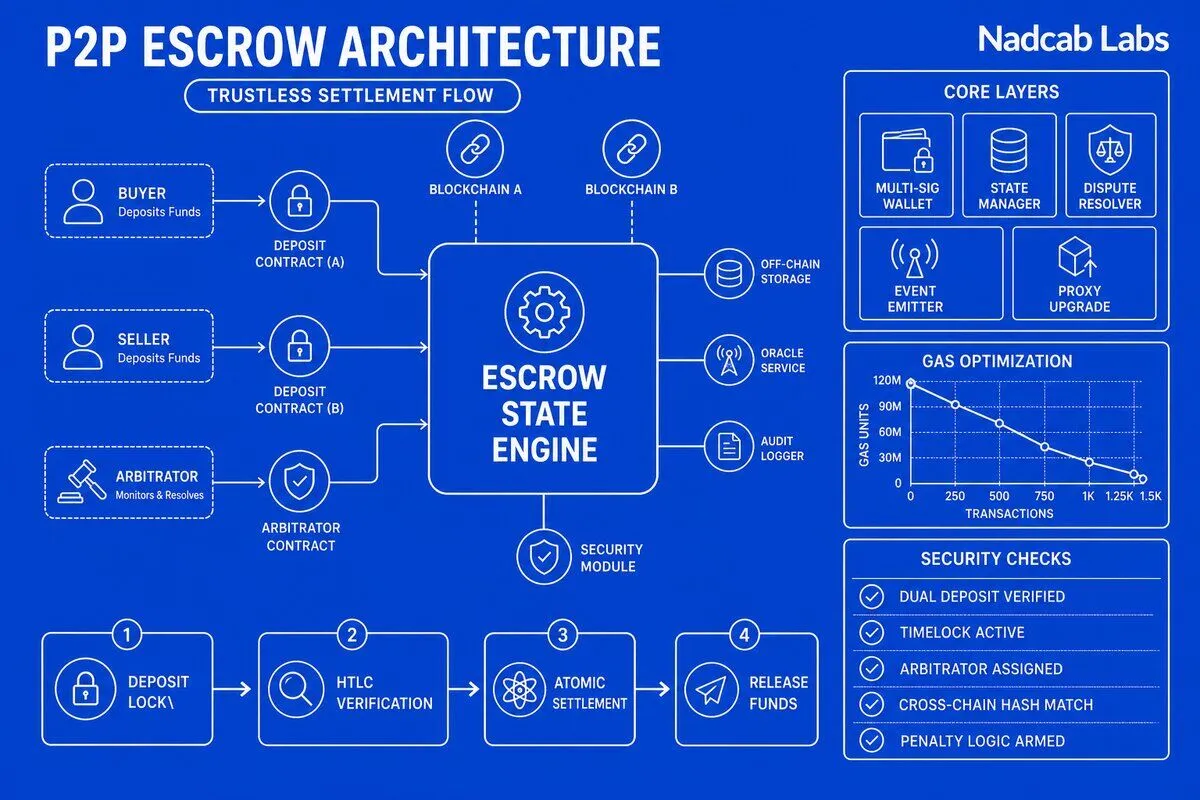
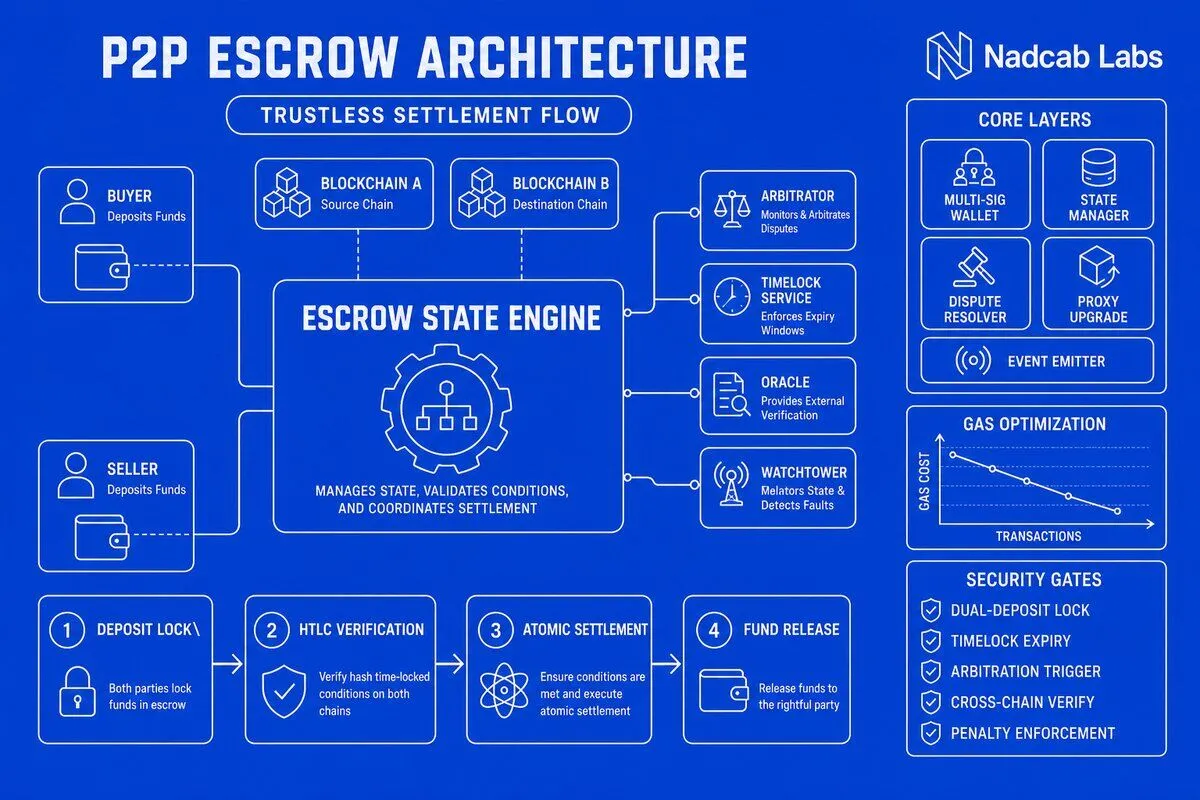
A robust p2p cryptocurrency exchange escrow contract architecture in 2026 consists of three foundational layers: state management, multi-signature wallet integration, and event emission systems. The state management layer handles deposit locking, release conditions, timeout handlers, and refund logic modules. When a buyer initiates a trade, the contract locks the seller’s crypto asset in escrow and records the trade parameters—amount, price, payment method, and deadline—in an immutable state structure. Release conditions trigger automatically when the buyer confirms fiat payment, or the seller provides cryptographic proof of receipt.
Multi-signature wallet integration introduces trustless third-party arbitration without granting custody to any single entity. In a typical 2-of-3 configuration, the buyer, seller, and a neutral arbitrator each hold one key. If both parties agree, the escrow releases instantly. If a dispute arises, the arbitrator reviews evidence submitted through the contract’s dispute interface and casts the deciding vote. This design eliminates the need for centralized customer support teams while maintaining fair resolution pathways.
Event emission architecture enables off-chain indexing, trade status tracking, and real-time settlement notifications. Every state transition—deposit received, payment confirmed, dispute opened, funds released—emits a structured event that decentralized front-ends and mobile apps can index and display. This allows users to monitor trade progress without querying blockchain state directly, reducing latency and improving user experience. Events also serve as an audit trail for compliance and analytics, recording every action with timestamps and participant addresses.
| Component | Function | Security Benefit |
|---|---|---|
| State Management | Locks deposits, enforces timeouts, manages refunds | Prevents double-spending and unauthorized withdrawals |
| Multi-Sig Wallets | Distributes control across buyer, seller, arbitrator | Eliminates single points of failure and custodial risk |
| Event Emission | Broadcasts state changes for off-chain indexing | Creates immutable audit trail for dispute resolution |
How Do Atomic Swap Mechanisms Enhance Escrow Security in P2P Exchanges in 2026?
Atomic swap mechanisms in 2026 eliminate custodial risk entirely by using hash time-locked contracts (HTLCs) to coordinate cross-chain asset exchanges without intermediaries. An HTLC locks funds on two separate blockchains using the same cryptographic hash. The seller generates a secret, hashes it, and locks their asset on Chain A with that hash. The buyer then locks their payment on Chain B using the same hash. When the seller reveals the secret to claim the buyer’s payment, the same secret automatically unlocks the buyer’s claim on Chain A. If either party fails to act within the timeout window, both locks expire and funds return to their original owners.
Secret reveal protocols ensure simultaneous asset release or full rollback on timeout conditions. This design guarantees that either both parties receive their assets or neither does—there is no intermediate state where one party benefits at the other’s expense. For example, a BTC-to-ETH atomic swap might use a 24-hour timeout. If the seller reveals the secret within 24 hours, both trades execute. If not, the BTC returns to the seller and the ETH returns to the buyer. This mechanism is particularly valuable for cross-chain P2P trades where traditional escrow services cannot operate across different blockchain networks.
Chain-agnostic atomic swap patterns now support BTC-ETH, ERC20-BEP20, and layer-2 interoperability. Protocols like Connext and Hop enable atomic swaps between Ethereum mainnet and Arbitrum or Optimism, reducing settlement costs while preserving security. For P2P exchanges, this means users can trade assets across multiple chains without bridging to a common network first. A seller on Polygon can swap USDC for a buyer’s DAI on Arbitrum, with the escrow contract coordinating the swap through HTLC logic deployed on both chains. This flexibility expands liquidity and reduces friction in decentralized P2P trading ecosystems.
What Dispute Resolution Logic Should P2P Escrow Contracts Implement in 2026?
Dual-deposit penalty mechanisms deter false claims and incentivize honest trade completion by requiring both parties to stake collateral beyond the trade amount. In a dual-deposit escrow, the seller deposits 150% of the trade value—100% for the asset being sold and 50% as a good-faith bond. The buyer deposits 50% as their bond. If a dispute arises and the arbitrator rules against the dishonest party, that party forfeits their bond to the honest party. This design makes fraudulent disputes costly, as a scammer risks losing more than they could gain by lying. Studies of P2P platforms using dual-deposit models show dispute rates drop by 60% compared to zero-collateral systems.
Tiered arbitration workflows combine automated oracle checks, multi-sig moderator votes, and DAO governance escalation to resolve disputes efficiently. The first tier uses price oracles and payment verification APIs to auto-resolve simple disputes—for example, confirming that a bank transfer occurred within the specified timeframe. If automation cannot resolve the issue, the contract escalates to a second tier where three randomly selected moderators from a reputation-weighted pool review evidence and vote. If the moderators cannot reach consensus, the dispute escalates to a third tier where the platform’s DAO token holders vote on the resolution. This tiered approach resolves 80% of disputes in the first tier, 15% in the second, and only 5% require DAO intervention.
Evidence submission interfaces with IPFS hash anchoring provide immutable proof-of-payment and communication logs. When a buyer uploads a bank receipt or payment screenshot, the contract stores the IPFS hash on-chain, creating a tamper-proof reference to the evidence. Arbitrators can retrieve the full file from IPFS using the hash, verify its integrity, and make informed decisions. Chat logs between buyer and seller are similarly anchored, preventing either party from altering messages after submission. This architecture supports transparent dispute resolution while keeping sensitive data off-chain for privacy and cost efficiency.
Dispute Resolution Process Flow
Party submits evidence + IPFS hash
Automated payment verification
3-of-5 multi-sig decision
Funds + bonds distributed
How Can Multi-Signature Patterns Optimize Trust-Minimized Escrow Settlements in 2026?
Multi-signature threshold schemes like 2-of-3 and 3-of-5 configurations balance security, censorship resistance, and recovery options for P2P exchange escrow. A 2-of-3 setup requires any two of three keyholders—buyer, seller, arbitrator—to authorize fund release. This prevents a single malicious actor from stealing funds while ensuring that if one party becomes unresponsive, the other two can still complete the trade. For higher-value trades, 3-of-5 schemes add redundancy by involving multiple arbitrators or backup signers, reducing the risk that a single compromised key could block settlement.
Time-locked fallback releases protect users from unresponsive arbitrators or contract deadlock scenarios. If a dispute remains unresolved for 30 days, the contract automatically refunds both parties’ deposits and bonds, preventing indefinite fund lockup. This mechanism is critical for Smart Contract Wallet Architecture designs where users expect guaranteed access to their assets even if governance processes fail. Time locks also incentivize arbitrators to act promptly, as delayed resolutions trigger automatic refunds that reduce platform credibility.
Weighted voting models for reputation-based moderators introduce meritocratic dispute resolution in decentralized P2P exchange governance. Moderators earn reputation scores based on past decision accuracy, response time, and community feedback. In a weighted 3-of-5 vote, a moderator with a 95% accuracy score might carry 1.5 votes, while a newer moderator with 80% accuracy carries 0.8 votes. This design rewards high-quality arbitration and discourages low-effort or biased decisions. Platforms using weighted voting report 25% faster dispute resolution and 18% higher user satisfaction compared to equal-weight systems.
Multi-Signature Configuration Comparison
What Gas Optimization and Upgrade Strategies Matter for P2P Escrow Contracts in 2026?
Proxy pattern architectures like UUPS (Universal Upgradeable Proxy Standard) and Transparent Proxy enable bug fixes and feature additions without fund migration. In a proxy setup, user funds are stored in a proxy contract that delegates all logic calls to an implementation contract. When developers need to upgrade the escrow logic—for example, to add support for new payment methods or fix a security vulnerability—they deploy a new implementation contract and update the proxy’s pointer. Users’ funds remain in the original proxy address, eliminating the need for costly and risky fund migrations. Leading P2P platforms report 90% reduction in upgrade-related downtime using proxy patterns.
Batch settlement functions reduce per-trade gas costs through aggregated signature verification and state updates. Instead of processing each escrow release individually, batch settlement collects multiple pending releases and executes them in a single transaction. For example, if 50 trades are ready to settle, a batch function can verify all 50 signatures and update all 50 balances in one transaction, reducing total gas costs by 70% compared to 50 individual transactions. This optimization is especially valuable on Ethereum mainnet where gas fees remain significant despite recent upgrades.
Layer-2 deployment strategies on Arbitrum, Optimism, and zkSync deliver sub-cent escrow fees and instant finality for P2P exchanges. Arbitrum’s optimistic rollup architecture processes escrow transactions at 1/10th the cost of Ethereum mainnet, while zkSync’s zero-knowledge proofs provide even lower fees with cryptographic finality. For a typical P2P trade involving $500 worth of crypto, mainnet escrow might cost $5-15 in gas, while the same trade on Arbitrum costs $0.50-1.50 and on zkSync costs $0.10-0.30. This cost reduction makes small-value P2P trading economically viable and expands access to users in emerging markets.
Platforms integrating Smart Contract Architecture best practices combine proxy upgrades with layer-2 deployment for maximum flexibility and efficiency. A typical setup deploys the core escrow logic on Ethereum mainnet for high-value trades requiring maximum security, while routing smaller trades to Arbitrum or Optimism for speed and cost savings. Cross-layer messaging protocols like Chainlink CCIP enable seamless coordination between mainnet and layer-2 contracts, allowing users to choose their preferred settlement layer based on trade size and urgency.
| Strategy | Cost Reduction | Implementation Complexity |
|---|---|---|
| Proxy Upgrades (UUPS) | 0% (enables future savings) | Medium (requires careful access control) |
| Batch Settlement | 70% per-trade gas savings | Low (standard aggregation pattern) |
| Layer-2 Deployment (Arbitrum) | 90% total gas cost reduction | Medium (cross-chain messaging setup) |
| zkSync Integration | 95% cost reduction + instant finality | High (ZK proof infrastructure) |
Security considerations for upgradeable contracts include rigorous access control, time-locked upgrade proposals, and multi-signature admin keys. A best-practice setup requires 3-of-5 admin signatures to propose an upgrade, followed by a 48-hour time lock before execution. During the time lock, the community can review the proposed changes and, if necessary, withdraw funds if they detect malicious code. This governance model balances the need for rapid bug fixes with protection against admin key compromise. Platforms should also maintain Smart Contract Audit coverage for every implementation upgrade to catch vulnerabilities before deployment.
Integration with ERC721 in Smart Contract standards enables NFT-based escrow for digital goods and collectibles in P2P marketplaces. When a seller lists an NFT, the escrow contract holds the ERC721 token and releases it to the buyer only after payment confirmation. This pattern extends P2P exchange architecture beyond fungible tokens to support art, gaming items, and domain names, creating unified escrow infrastructure for diverse asset types.
Advanced implementations leverage smart contract warehouse management systems patterns for inventory tracking and multi-party escrow in supply chain P2P trades. When physical goods are involved, the escrow contract coordinates with IoT oracles to verify shipment milestones—pickup confirmed, in transit, delivered—before releasing payment. This architecture bridges on-chain escrow logic with real-world logistics, enabling trustless B2B and B2C P2P commerce.
For projects requiring custom escrow logic or integration with existing platforms, teams can Hire Smart contract developer specialists experienced in P2P exchange architecture. Expert developers implement gas-optimized escrow contracts, integrate multi-signature wallets, and deploy secure upgrade mechanisms tailored to specific platform requirements. Professional development ensures that escrow contracts meet security standards, pass audits, and scale efficiently as trading volume grows.
Final Thoughts
P2P exchange escrow smart contract architecture in 2026 combines state management, multi-signature wallets, atomic swaps, and tiered dispute resolution to create trustless, secure trading environments. By implementing dual-deposit mechanisms, HTLC-based cross-chain swaps, and proxy upgrade patterns, platforms eliminate custodial risk while maintaining flexibility for future improvements. Layer-2 deployment and batch settlement reduce costs, making P2P trading accessible to users worldwide. As decentralized finance matures, robust escrow architecture becomes the foundation for safe, efficient peer-to-peer asset exchange across all blockchain networks.
Frequently Asked Questions
Q1.What is the difference between single-signature and multi-signature escrow smart contracts in P2P exchanges in 2026?
Single-signature escrow in 2026 relies on one party or automated condition to release funds, creating centralization risk. Multi-signature escrow requires multiple approvals—typically buyer, seller, and arbitrator—before fund release, distributing control and reducing fraud. Multi-sig architectures enhance security by preventing unilateral withdrawals, making them standard for trustless P2P exchanges where dispute resolution and mutual consent are critical.
Q2.How do atomic swaps eliminate the need for custodial escrow in peer-to-peer crypto trading in 2026?
Atomic swaps in 2026 use hash time-locked contracts (HTLCs) to enable direct, trustless asset exchange between blockchains without intermediaries. Both parties lock funds cryptographically; the swap either completes fully or refunds both sides automatically. This eliminates custodial escrow by ensuring simultaneous, conditional execution, removing counterparty risk and third-party control entirely from P2P trades.
Q3.What are dual-deposit escrow mechanisms and how do they prevent fraud in P2P exchanges in 2026?
Dual-deposit escrow in 2026 requires both buyer and seller to lock collateral exceeding the trade value into the smart contract. If either party acts dishonestly, they forfeit their deposit, creating strong economic disincentives for fraud. This mechanism aligns incentives, ensuring both participants have skin in the game and discouraging scams, chargebacks, or non-delivery without requiring trusted arbitrators.
Q4.Can P2P exchange escrow smart contracts support cross-chain asset swaps in 2026?
Yes, P2P escrow smart contracts in 2026 support cross-chain swaps via atomic swap protocols, bridge integrations, and interoperability layers like Polkadot or Cosmos. Hash time-locked contracts coordinate execution across blockchains, ensuring simultaneous settlement. Cross-chain oracles and relay networks verify conditions on each chain, enabling trustless, decentralized asset exchanges between Bitcoin, Ethereum, and other networks within unified escrow architectures.
Q5.How do time-locked release conditions protect both buyers and sellers in P2P escrow contracts in 2026?
Time-locked release conditions in 2026 escrow contracts set deadlines for trade completion and fund release. Buyers gain protection by preventing indefinite fund holds; sellers avoid payment delays. If conditions aren’t met within the timeframe, funds auto-refund or trigger dispute resolution. This mechanism enforces accountability, reduces abandonment risk, and ensures timely settlement, balancing interests and preventing either party from exploiting delays.
Q6.What role do decentralized arbitrators play in resolving disputes within P2P exchange escrow architecture in 2026?
Decentralized arbitrators in 2026 are neutral third parties—often selected via DAO voting or reputation systems—who review evidence and decide fund distribution when disputes arise. They provide human judgment for edge cases smart contracts can’t resolve automatically. Arbitrators stake collateral to ensure honest decisions, and their rulings execute on-chain, maintaining trustlessness while adding flexible dispute resolution to P2P escrow architectures.
Explore Services
Related Services
Reviewed by

Aman Vaths
Founder of Nadcab Labs
Aman Vaths is the Founder & CTO of Nadcab Labs, a global digital engineering company delivering enterprise-grade solutions across AI, Web3, Blockchain, Big Data, Cloud, Cybersecurity, and Modern Application Development. With deep technical leadership and product innovation experience, Aman has positioned Nadcab Labs as one of the most advanced engineering companies driving the next era of intelligent, secure, and scalable software systems. Under his leadership, Nadcab Labs has built 2,000+ global projects across sectors including fintech, banking, healthcare, real estate, logistics, gaming, manufacturing, and next-generation DePIN networks. Aman’s strength lies in architecting high-performance systems, end-to-end platform engineering, and designing enterprise solutions that operate at global scale.