Ai Overview
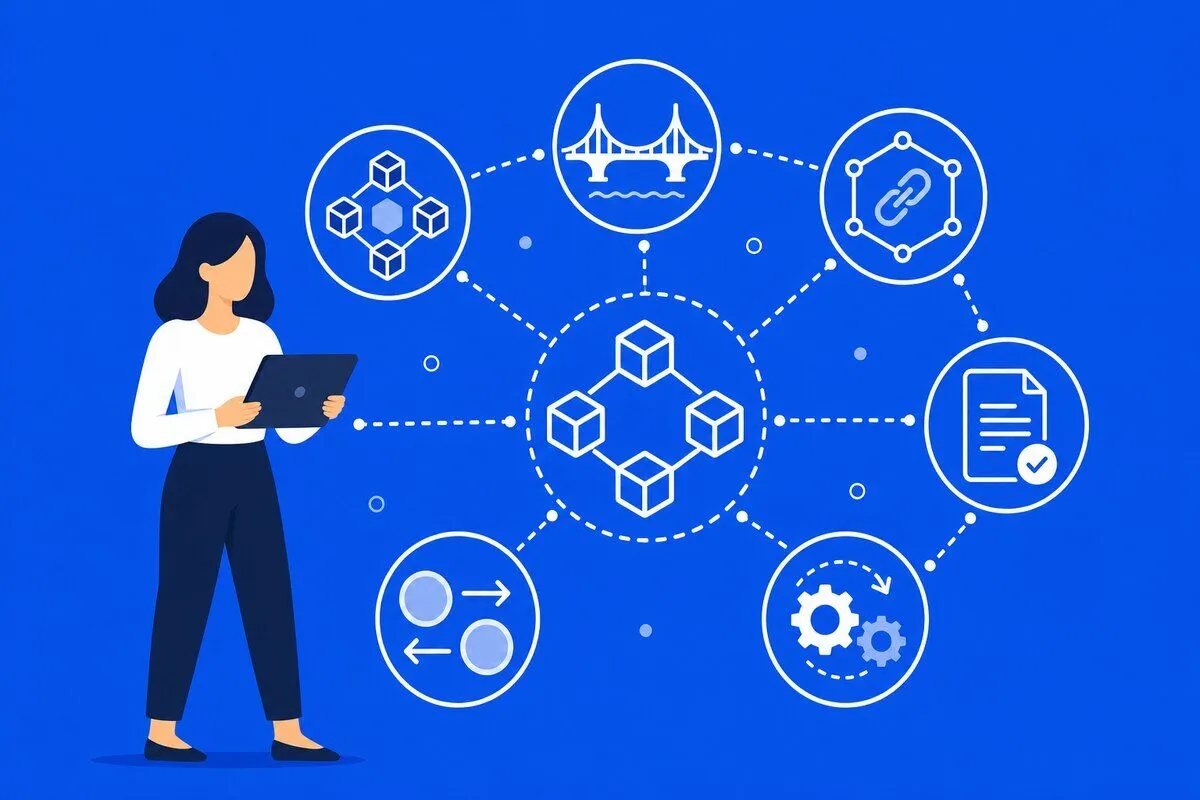
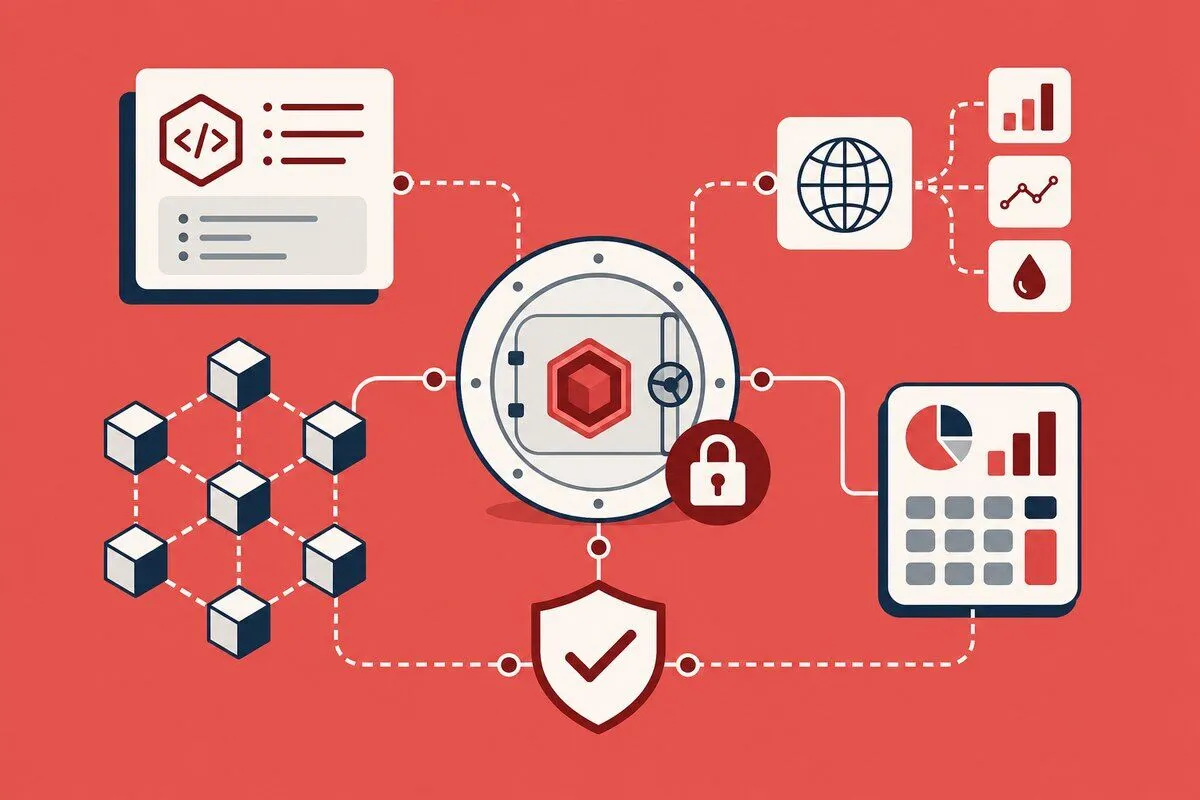
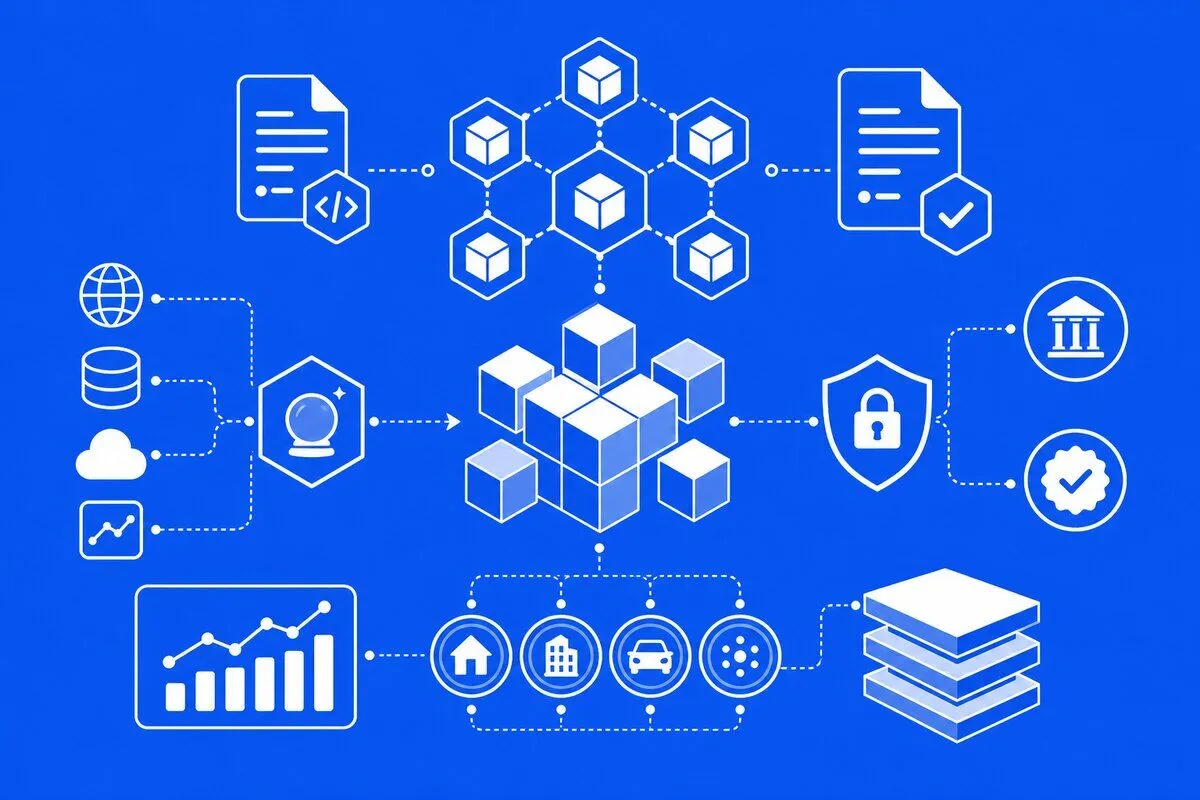
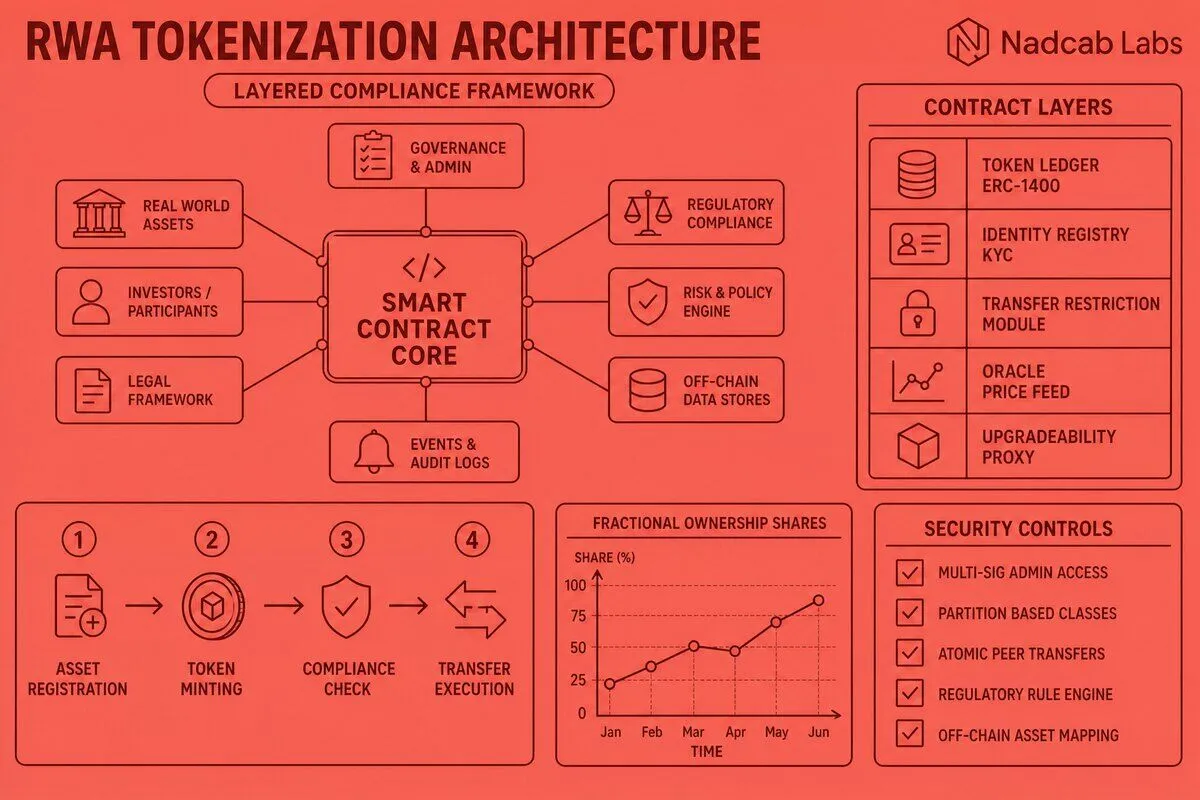
RWA tokenization smart contract architecture defines the technical foundation for representing real-world assets—real estate, commodities, art, bonds—as blockchain tokens. A well-designed architecture separates concerns into distinct layers: the token ledger, compliance enforcement, oracle connectivity, and upgradeability mechanisms. Each layer must balance regulatory requirements, security, and operational flexibility while ensuring that off-chain asset ownership maps accurately to on-chain tokens.
RWA tokenization smart contract architecture defines the technical foundation for representing real-world assets—real estate, commodities, art, bonds—as blockchain tokens. A well-designed architecture separates concerns into distinct layers: the token ledger, compliance enforcement, oracle connectivity, and upgradeability mechanisms. Each layer must balance regulatory requirements, security, and operational flexibility while ensuring that off-chain asset ownership maps accurately to on-chain tokens.
Key Takeaways
- RWA smart contracts layer token logic, compliance enforcement, and oracle integration to bridge off-chain assets with on-chain representations.
- Compliance modules use identity registries, transfer restrictions, and pluggable rule engines to meet KYC, AML, and jurisdiction-specific regulations.
- Fractional ownership relies on partition-based standards like ERC-1400, enabling share classes, voting rights, and atomic peer-to-peer transfers.
- Oracle architectures combine decentralized price feeds with off-chain attestations for asset valuations, custody proofs, and legal event triggers.
- Upgradeability strategies—proxy patterns, modular periphery design, and governance-controlled changes—preserve token state while allowing policy updates.
- Security and flexibility trade-offs require careful separation of immutable core logic from upgradeable compliance and oracle adapters.
What are the core architectural layers in RWA tokenization smart contracts?
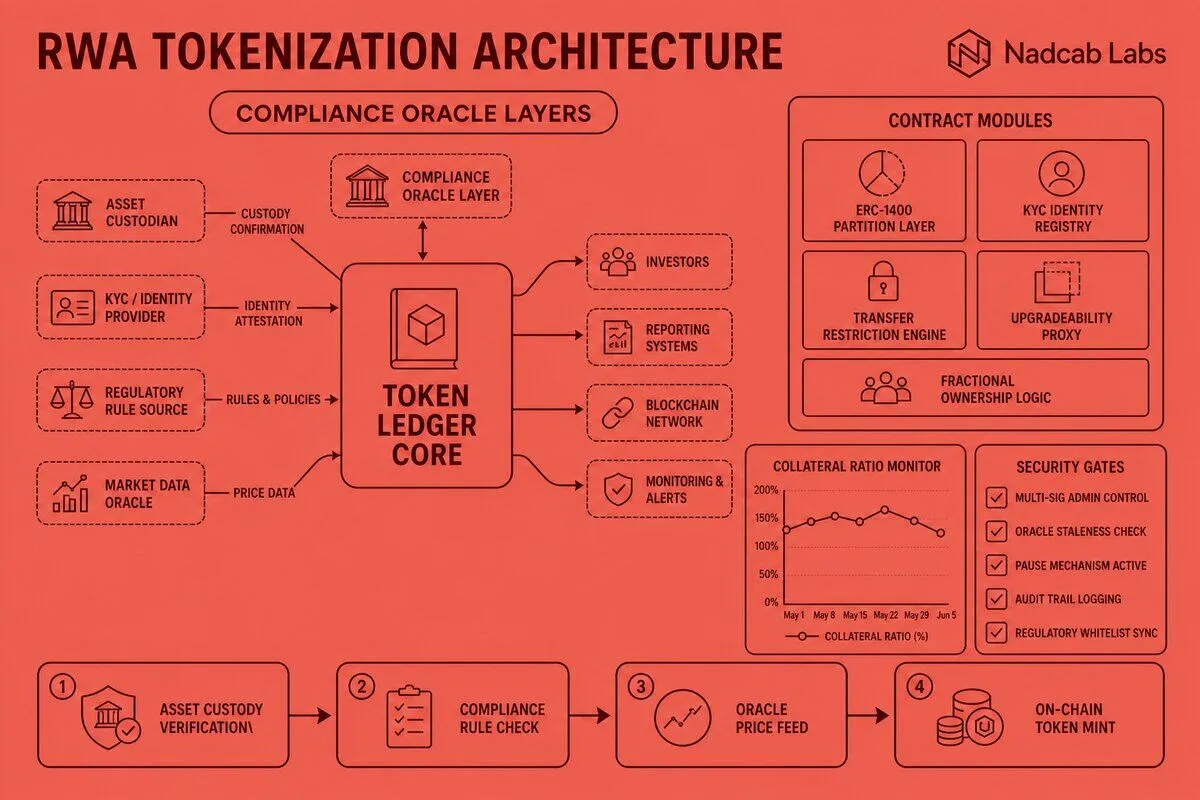
RWA tokenization smart contract architecture divides responsibilities across three foundational layers: the token layer, the compliance layer, and the oracle integration layer. Each layer addresses a specific technical challenge in bridging physical assets with blockchain-based ownership records.
The token layer defines how ownership is represented on-chain. While base standards like ERC-20 (fungible) and ERC-721 (non-fungible) provide simple ledger functionality, RWA use cases demand richer semantics. ERC-3643 (T-REX) and ERC-1400 (Security Token Standard) extend these foundations with features like partitioned balances, forced transfers, and document management. ERC-3643 embeds identity claims directly into the token contract, linking each holder to an on-chain identity registry. ERC-1400 introduces partitions—subdivisions of a token supply that can carry different rights, lock-up periods, or transfer rules. For example, a tokenized real estate fund might issue Class A shares with voting rights and Class B shares with dividend preferences, each managed as a separate partition within a single contract. The token layer also handles minting (when a new asset is tokenized), burning (when an asset is redeemed or retired), and balance queries, serving as the immutable ledger of record.
The compliance layer enforces regulatory requirements that govern who can hold, transfer, or trade RWA tokens. Unlike permissionless DeFi tokens, RWA tokens must comply with securities laws, anti-money laundering rules, and investor accreditation standards. This layer typically includes an identity registry—a separate smart contract that maintains a whitelist of verified addresses, each linked to KYC data, accreditation status, and jurisdiction. Before any transfer, the token contract queries the identity registry to confirm both sender and receiver meet eligibility criteria. Transfer restriction logic encodes rules such as lock-up periods (preventing sales for six months post-issuance), geographic restrictions (blocking transfers to sanctioned countries), and accredited investor gates (requiring proof of income or net worth thresholds). Advanced implementations use modular compliance hooks: the token contract calls external rule engines that can be updated or replaced without redeploying the core token logic. The T-REX protocol exemplifies this pattern, allowing issuers to plug in new compliance modules as regulations evolve.
The oracle integration layer connects on-chain token logic to off-chain asset data. RWA tokens derive their value from physical assets held in custody, appraised by third parties, and subject to legal events like defaults or foreclosures. Oracles feed this information onto the blockchain, enabling smart contracts to react programmatically. For instance, a tokenized bond contract might query an oracle for the issuer’s credit rating; if the rating drops below investment grade, the contract could automatically trigger a margin call or halt secondary trading. Oracle data includes asset valuations (updated quarterly by appraisers), custody confirmations (signed attestations from custodians that the asset remains in storage), and legal status updates (court rulings, lien filings, insurance claims). The architecture must handle data latency, disputes, and the risk of oracle manipulation—challenges addressed through decentralized oracle networks, multi-signature attestations, and fallback mechanisms.
These three layers interact continuously. When a user initiates a token transfer, the token layer checks balances, the compliance layer verifies eligibility, and the oracle layer may provide real-time asset status to inform the transaction. This separation of concerns allows teams to iterate on compliance rules or oracle providers without touching the core token ledger, reducing upgrade risk and simplifying audits. Real World Asset Tokenization services typically architect these layers as distinct smart contracts linked by well-defined interfaces, ensuring modularity and maintainability.
| Layer | Primary Function | Key Standards/Patterns | Example Use Case |
|---|---|---|---|
| Token Layer | Ownership ledger and balance management | ERC-3643, ERC-1400, ERC-20/721 | Minting 1,000 tokens representing $1M real estate fund |
| Compliance Layer | KYC/AML enforcement and transfer restrictions | Identity registry, T-REX modular hooks | Blocking transfer to non-accredited investor |
| Oracle Integration | Off-chain asset data feeds | Chainlink, hybrid attestation oracles | Updating token valuation from quarterly appraisal |
How do compliance modules enforce regulatory requirements in RWA contracts?
Compliance modules translate legal and regulatory obligations into executable smart contract logic. The core challenge is encoding rules that vary by jurisdiction, asset class, and investor type while maintaining flexibility to adapt as regulations change. Three design patterns dominate: identity registries, transfer restriction logic, and modular compliance hooks.
An identity registry is a separate smart contract that stores verified investor information. Each address on the blockchain is linked to an identity claim: a cryptographic attestation that the holder has passed KYC checks, holds accredited investor status, or resides in an approved jurisdiction. The registry is maintained by a trusted third party—often a licensed transfer agent or KYC provider—who adds or revokes claims based on ongoing verification. When a user attempts to transfer RWA tokens, the token contract queries the identity registry: “Is the sender verified? Is the receiver verified? Do both meet the asset’s eligibility criteria?” If any check fails, the transfer reverts. This pattern separates identity management from token logic, allowing the same registry to serve multiple token contracts and enabling identity updates without touching token balances. Role-based access control (RBAC) further refines permissions: the registry might grant “issuer” roles the ability to force transfers (for legal enforcement), “agent” roles the ability to update claims, and “investor” roles the ability to hold tokens.
Transfer restriction logic encodes specific rules that govern when and how tokens can move between addresses. Common restrictions include lock-up periods (tokens cannot be transferred for six months after issuance), geographic blocks (transfers to addresses in sanctioned countries are prohibited), and accredited investor gates (only addresses with an “accredited” claim can receive tokens). More sophisticated logic handles secondary market controls: for instance, a tokenized private equity fund might limit total outstanding transfers per quarter to comply with securities exemptions, or require issuer approval for any transfer above a certain threshold. These rules are often implemented as modifier functions in Solidity—reusable code blocks that run before every transfer, checking conditions and reverting if violated. For example, a lock-up modifier might compare the current block timestamp against a release date stored in the contract, rejecting transfers until the date passes.
Modular compliance hooks provide the ultimate flexibility. Instead of hardcoding transfer restrictions into the token contract, the token delegates compliance checks to an external compliance module—a separate smart contract that implements a standard interface. Before each transfer, the token contract calls the compliance module’s “canTransfer” function, passing sender, receiver, and amount as parameters. The module evaluates its rules and returns true or false. If false, the transfer reverts. This architecture allows issuers to upgrade compliance logic without redeploying the token contract: they simply point the token to a new compliance module address. The T-REX protocol exemplifies this pattern, defining a suite of pluggable modules for different rules (country restrictions, investor limits, transfer volume caps) that can be combined and updated independently. Governance mechanisms—multi-signature wallets or on-chain voting—control which modules are active, ensuring that compliance changes follow a transparent, auditable process.
Compliance modules must also handle edge cases and legal overrides. Forced transfers allow issuers or regulators to move tokens in response to court orders, bankruptcy proceedings, or regulatory enforcement actions. Pause mechanisms freeze all transfers during investigations or system upgrades. Document management features link tokens to legal agreements, prospectuses, and disclosures, ensuring holders can access required information. These capabilities require careful access control: only authorized roles (issuer, legal counsel, regulator) should trigger forced transfers or pauses, and every such action should emit an on-chain event for auditability. The Smart Contract Audit Architecture process verifies that compliance logic matches legal requirements and that access controls prevent unauthorized overrides.
Compliance Check Process Flow
User calls transfer()
Check sender/receiver KYC
Lock-up, geo, accreditation
canTransfer() hook
Update balances or reject
What design patterns enable fractional ownership and secondary trading?
Fractional ownership—dividing a single asset into multiple tradeable shares—is the economic engine of RWA tokenization. Smart contract design patterns must support diverse ownership structures, enable peer-to-peer transfers with built-in compliance, and integrate with decentralized liquidity mechanisms. Three patterns dominate: partition-based architecture, atomic swap and escrow logic, and liquidity pool integration.
Partition-based architecture, standardized in ERC-1400, allows a single token contract to manage multiple share classes with distinct rights and restrictions. Each partition functions as a sub-ledger within the main contract: Class A tokens might carry voting rights and a 12-month lock-up, while Class B tokens offer higher dividends but no governance participation. The contract tracks balances per partition, and transfers specify which partition is moving. This design mirrors traditional securities structures (common vs. preferred stock) while maintaining a unified on-chain registry. Partitions also enable dividend distribution logic: when the issuer deposits funds into the contract, the contract calculates each partition’s share based on predefined ratios and credits holders’ accounts. Voting rights are similarly partition-aware: a governance proposal might query the contract for all holders in the “voting” partition, weighting votes by balance. This pattern eliminates the need for separate token contracts per share class, reducing deployment costs and simplifying cross-partition operations like conversions or mergers.
Atomic swap and escrow patterns facilitate peer-to-peer secondary trading with settlement finality and compliance enforcement. In a traditional swap, two parties agree to exchange tokens off-chain, then execute simultaneous on-chain transfers. For RWA tokens, this must include compliance checks: the swap contract verifies that both parties are eligible to hold the asset, that no transfer restrictions are violated, and that any required approvals (from the issuer or a regulator) are in place. Escrow contracts add a layer of security: the buyer deposits funds (stablecoins or ETH) into an escrow, the seller deposits RWA tokens, and the contract releases both only when all conditions are met—compliance checks pass, both parties confirm, and any oracle-provided asset data (current valuation, custody status) is within acceptable bounds. If conditions fail, the contract refunds both parties. This pattern is closely related to P2P exchange escrow smart contract architecture, which handles trustless peer-to-peer trades with built-in dispute resolution.
Liquidity pool integration connects RWA tokens to decentralized exchanges and automated market makers (AMMs). Because RWA tokens carry transfer restrictions, they cannot be freely traded on standard AMMs like Uniswap without modification. Compliant liquidity pools implement two strategies: whitelisted pools (only verified addresses can add liquidity or swap) and wrapper tokens (the RWA token is wrapped in a compliant layer that enforces rules before unwrapping). Whitelisted pools query the identity registry before every swap, ensuring both liquidity providers and traders meet eligibility criteria. Wrapper tokens act as intermediaries: a user deposits RWA tokens into a wrapper contract, which mints a compliant derivative token that can be traded freely within a restricted ecosystem. When the user wants to redeem, the wrapper checks compliance and returns the underlying RWA token. Order book connectors offer an alternative: instead of AMM pools, the RWA token integrates with decentralized order books (like 0x or dYdX) where bids and asks are matched off-chain and settled on-chain with compliance checks at settlement time. Each approach balances liquidity, compliance, and decentralization differently, and the choice depends on the asset’s regulatory profile and target market.
Fractional ownership also raises questions about governance and asset management. If 1,000 token holders own shares in a tokenized building, who decides when to sell, refinance, or renovate? Smart contracts can encode governance rules: token holders vote on proposals, with votes weighted by balance and partition. A quorum threshold (e.g., 30% of tokens must participate) and approval threshold (e.g., 66% must vote yes) are enforced on-chain. Proposals might trigger automatic actions: if a sale proposal passes, the contract could initiate an auction, accept bids, and distribute proceeds to holders proportionally. This mirrors corporate governance structures but executes entirely on-chain, reducing administrative overhead and ensuring transparency. The token vesting smart contract architecture provides related patterns for time-based token releases, which can be adapted for dividend vesting or staggered ownership transfers.
How should oracle integration be architected for real-world asset data feeds?
Oracle integration is the bridge between off-chain asset reality and on-chain token logic. RWA tokens depend on external data—asset valuations, custody proofs, legal status updates—to maintain accuracy and enforce rules. Architecting this layer requires balancing data reliability, latency, cost, and security. Three patterns emerge: decentralized oracle networks, hybrid oracle designs, and fallback mechanisms.
Decentralized oracle networks, exemplified by Chainlink, aggregate data from multiple independent sources before delivering it on-chain. For RWA use cases, this might mean querying three licensed appraisers for a property valuation, computing the median, and posting that value to the blockchain. The token contract reads this oracle-provided price to calculate net asset value (NAV) per token, which holders can query before trading. Decentralization reduces single points of failure: if one appraiser is compromised or submits stale data, the median of multiple sources remains reliable. Oracle networks also provide cryptographic proofs of data provenance: each data point is signed by the source, and the aggregation contract verifies signatures before accepting updates. This architecture suits high-value assets where accuracy is critical and multiple independent data providers exist. However, it introduces latency (aggregation takes time) and cost (multiple oracle nodes charge fees), so it is typically used for periodic updates (monthly or quarterly) rather than real-time feeds.
Hybrid oracle patterns combine on-chain price feeds with off-chain API attestations for data that cannot be fully decentralized. Consider a tokenized invoice: the oracle must confirm that the invoice was paid by the debtor. No public data feed exists for this, so the system relies on an off-chain API—perhaps the debtor’s accounting system or a payment processor—that signs an attestation (“Invoice #12345 paid on 2026-03-15”). This signed message is posted on-chain, and the token contract verifies the signature against a whitelist of trusted attesters. If valid, the contract updates the invoice status and triggers any dependent logic (releasing collateral, distributing proceeds). Hybrid oracles are pragmatic: they accept that some data sources cannot be decentralized but mitigate risk through cryptographic signatures, multi-signature requirements (two out of three attesters must agree), and on-chain audit trails. This pattern is common in supply chain tokenization, where smart contract architecture for supply chain integrates IoT sensors, logistics APIs, and customs databases.
Fallback and dispute resolution mechanisms handle oracle failures, data conflicts, and malicious inputs. A time-weighted average smooths out short-term volatility: instead of accepting the latest oracle price immediately, the contract averages the last five updates, reducing the impact of a single erroneous reading. Multi-signature overrides allow a governance committee to manually update data if the oracle fails or produces obviously incorrect results—for example, if an appraisal oracle reports a $10M property as worth $1, the committee can override with a corrected value. Dispute resolution contracts enable stakeholders to challenge oracle data: if a token holder believes an asset valuation is wrong, they can stake collateral and initiate a dispute, triggering a review by an independent arbitrator (human or algorithmic). If the dispute is upheld, the oracle is corrected and the challenger is refunded; if rejected, the challenger forfeits their stake. These mechanisms add complexity but are essential for high-stakes RWA applications where incorrect data could trigger liquidations, force sales, or legal disputes.
Oracle integration also intersects with custody and legal verification. For a tokenized gold bar, the oracle must confirm that the bar remains in a secure vault, has not been sold or pledged elsewhere, and matches the serial number linked to the token. This requires integration with custodian APIs, insurance registries, and audit reports. The smart contract might query a custodian’s API daily for a signed attestation of asset presence, and if no attestation arrives within 48 hours, the contract could pause transfers pending investigation. Legal event oracles monitor court dockets, lien filings, and regulatory announcements, triggering contract logic when relevant events occur—for instance, automatically freezing a token if the underlying asset is subject to a foreclosure proceeding. These integrations demand robust API design, secure key management (custodian signing keys must be protected), and clear legal agreements defining oracle responsibilities and liabilities. Hire Smart contract developer teams with experience in oracle integration to ensure these systems are resilient and compliant.
Oracle Data Reliability by Source Type
Reliability percentages reflect typical uptime and accuracy across enterprise RWA deployments in 2025–2026, based on industry benchmarks.
What upgradeability strategies balance flexibility with security in RWA contracts?
RWA tokenization smart contracts face a unique upgradeability challenge: they must remain secure and immutable enough to preserve token holder trust and regulatory compliance, yet flexible enough to adapt to evolving laws, oracle providers, and market conditions. Three strategies dominate: proxy patterns, immutable core with modular periphery, and governance-controlled upgrades.
Proxy patterns separate the contract’s logic from its storage. A proxy contract holds all token balances and state variables, while a separate implementation contract contains the executable code. When a user calls a function on the proxy, the proxy delegates the call to the implementation contract using Solidity’s delegatecall opcode, which executes the implementation’s code in the proxy’s storage context. To upgrade, the issuer deploys a new implementation contract and updates the proxy to point to the new address. Token balances and compliance history remain intact in the proxy’s storage. Two proxy variants are common: transparent proxies (where the proxy itself decides whether to forward calls or handle admin functions) and UUPS (Universal Upgradeable Proxy Standard, where the implementation contract contains upgrade logic). UUPS is more gas-efficient and places upgrade control in the implementation, reducing the risk of admin key compromise. However, proxy patterns introduce complexity: storage layout must be carefully managed across upgrades (adding new variables is safe, reordering existing ones is not), and the proxy’s delegatecall mechanism can be a source of subtle bugs if not thoroughly tested. The Smart Contract Audit process for proxy-based RWA contracts includes storage collision checks, upgrade simulation, and verification that admin functions are properly access-controlled.
Immutable core with modular periphery is an alternative strategy that avoids proxy complexity. The token ledger—the contract that tracks balances, mints, and burns—is deployed as an immutable contract that never changes. Compliance rules, oracle adapters, and secondary market integrations are separate contracts that the token contract calls via well-defined interfaces. To upgrade compliance logic, the issuer deploys a new compliance module and updates a pointer in the token contract (or uses a registry pattern where the token queries a registry contract for the current compliance module address). This approach preserves the integrity of the core ledger while allowing peripheral systems to evolve. It is conceptually simpler than proxies and reduces the risk of storage corruption, but it requires foresight: the token contract’s interface to periphery modules must be designed upfront to accommodate future changes. If a new compliance requirement demands a function signature that the token contract does not support, the only recourse is to migrate to a new token contract—a disruptive process that requires reissuing tokens and updating all integrations.
Governance-controlled upgrades add a layer of decentralized oversight to either proxy or modular architectures. Instead of a single admin key controlling upgrades, a multi-signature wallet or on-chain governance contract (where token holders vote) must approve changes. A typical flow: the issuer proposes an upgrade by submitting the new implementation contract address to the governance contract. Token holders review the proposal and vote over a defined period (e.g., seven days). If the proposal reaches quorum and approval thresholds, the governance contract executes the upgrade. Timelock contracts add another safeguard: even after approval, the upgrade is queued for a delay period (e.g., 48 hours), giving stakeholders time to exit if they disagree with the change. This pattern aligns with the ethos of decentralization and regulatory expectations for investor protection, but it introduces coordination costs and slows response to urgent issues (like security patches). Some architectures use tiered governance: routine parameter changes (adjusting transfer fees, updating oracle addresses) can be executed by a small multi-sig, while fundamental logic changes (altering compliance rules, changing token supply) require full token holder votes.
Security considerations are paramount in any upgradeability strategy. Upgrades can introduce new vulnerabilities, bypass compliance checks, or alter token economics in ways that harm holders. Best practices include: rigorous testing of upgrade paths (deploy the new implementation on a testnet, simulate the upgrade, verify all functions work as expected), formal verification of critical invariants (total supply never changes unexpectedly, balances always sum to total supply), and transparent communication (publish upgrade proposals, code diffs, and audit reports well before execution). Immutable components—those that should never change—should be clearly documented and protected by access control. For example, the total supply cap of a tokenized bond should be immutable, while the interest rate calculation (which might depend on an external index) could be upgradeable. The smart contract modules for MLM compensation article explores related modularity patterns, though in a different domain.
| Strategy | Flexibility | Security Risk | Complexity | Best For |
|---|---|---|---|---|
| Transparent Proxy | High (full logic swap) | Medium (storage collision risk) | High | Frequent updates, mature dev teams |
| UUPS Proxy | High (logic in implementation) | Medium (upgrade logic bugs) | High | Gas optimization, advanced use cases |
| Immutable Core + Modular Periphery | Medium (periphery only) | Low (core never changes) | Medium | Regulatory stability, long-term assets |
| Governance-Controlled Proxy | High (with delays) | Low (community oversight) | Very High | Decentralized projects, high-value assets |
Upgradeability also intersects with legal and regulatory considerations. Some jurisdictions require that tokenized securities contracts be immutable to prevent issuers from unilaterally altering terms. Others mandate the ability to freeze or seize tokens in response to court orders, which requires upgradeable logic. Issuers must work with legal counsel to determine which components can be upgradeable and which must be locked down, then architect the contract suite accordingly. Documentation is critical: every upgrade path, admin role, and governance mechanism should be described in plain language and linked to the contract’s source code, so regulators, auditors, and investors can verify that the system behaves as promised. The smart contract warehouse management systems article discusses similar modularity and upgrade challenges in a logistics context, offering cross-domain insights.
In practice, most RWA tokenization platforms adopt a hybrid approach: the core token ledger is immutable or governed by strict multi-sig controls, compliance modules are upgradeable via governance, and oracle adapters are modular and swappable. This balances the need for trust (token holders know their balances cannot be arbitrarily changed) with the need for adaptability (compliance rules can evolve as regulations change). The architecture should be documented in detail, audited by multiple firms, and tested extensively before launch. Post-launch, any upgrade should follow a transparent process: announce the change, publish the new code, allow community review, execute the upgrade, and publish a post-mortem report. This level of rigor is essential for institutional adoption and regulatory approval.
Final Thoughts
RWA tokenization smart contract architecture is a multi-layered system that bridges physical assets with blockchain-based ownership. By separating token logic, compliance enforcement, oracle integration, and upgradeability mechanisms into distinct layers, teams can build flexible, secure, and regulatory-compliant platforms. Partition-based standards enable fractional ownership with diverse share classes, while modular compliance hooks allow rules to evolve without redeploying core contracts. Oracle architectures combine decentralized data feeds with hybrid attestations to link on-chain tokens to off-chain asset reality. Upgradeability strategies—proxy patterns, immutable cores, and governance controls—balance the need for adaptability with the imperative of security and trust. As RWA tokenization matures, these architectural patterns will continue to evolve, driven by regulatory developments, technological advances, and market demands. Teams building in this space must prioritize modularity, transparency, and rigorous testing to deliver systems that meet the high standards of both blockchain ecosystems and traditional financial markets.
Frequently Asked Questions
Q1.What token standards are best suited for RWA tokenization smart contracts?
ERC-1400 and ERC-3643 (T-REX) are purpose-built for regulated securities, offering transfer restrictions, partitioning, and compliance hooks. ERC-20 with custom compliance modules works for simpler assets. ERC-721 or ERC-1155 suit unique or fractionalized real estate. Choose standards supporting on-chain identity verification, jurisdiction checks, and investor whitelisting to meet regulatory requirements while maintaining interoperability.
Q2.How do RWA smart contracts handle cross-border compliance and multi-jurisdictional transfer rules?
RWA contracts integrate modular compliance engines that check sender/receiver jurisdictions, accreditation status, and local securities laws before transfers. Identity oracles or on-chain attestations (e.g., ERC-735) verify investor eligibility. Transfer logic queries jurisdiction-specific rulesets stored on-chain or via external compliance providers, blocking non-compliant transactions automatically. This ensures adherence to GDPR, MiFID II, Reg D, and other frameworks simultaneously.
Q3.What are the security risks in upgradeable RWA token architectures?
Upgradeable proxies (e.g., UUPS, Transparent) introduce admin key risks—malicious or compromised owners can alter token logic, freeze assets, or bypass compliance. Storage collisions during upgrades can corrupt balances. Mitigation requires multi-sig governance, timelocks, audited upgrade paths, immutable core functions (e.g., total supply), and formal verification. Over-reliance on upgradeability undermines trust in tokenized asset immutability.
Q4.How can fractional ownership be implemented without sacrificing regulatory compliance?
Deploy ERC-1155 or ERC-20 tokens representing fractional shares, each tied to a legal entity holding the underlying asset. Embed transfer restrictions enforcing accredited investor checks, lock-up periods, and jurisdiction whitelists. Use partition-based tokens (ERC-1400) to separate tranches with distinct compliance rules. Off-chain legal wrappers (SPVs, trusts) ensure fractional tokens map to enforceable ownership rights under securities law.
Q5.What role do oracles play in linking off-chain asset custody to on-chain tokens?
Oracles feed real-time custody proofs, valuations, and audit reports onto the blockchain, anchoring token legitimacy to physical assets. Chainlink, API3, or custom oracles verify asset existence, ownership transfers, and condition (e.g., property inspections). Decentralized oracle networks reduce single points of failure. Smart contracts use oracle data to trigger minting, burning, or compliance actions, ensuring on-chain tokens reflect off-chain reality accurately.
Q6.How do modular compliance layers differ from hardcoded transfer restrictions in RWA contracts?
Modular compliance layers use separate contracts or libraries (e.g., compliance modules, registries) that RWA tokens call during transfers, enabling updates without redeploying core token logic. Hardcoded restrictions embed rules directly in token code, requiring upgrades or migrations for regulatory changes. Modular designs offer flexibility, easier audits, and jurisdiction-specific rule swaps, while hardcoded approaches provide immutability but lack adaptability to evolving laws.
Explore Services
Related Services
Reviewed by

Aman Vaths
Founder of Nadcab Labs
Aman Vaths is the Founder & CTO of Nadcab Labs, a global digital engineering company delivering enterprise-grade solutions across AI, Web3, Blockchain, Big Data, Cloud, Cybersecurity, and Modern Application Development. With deep technical leadership and product innovation experience, Aman has positioned Nadcab Labs as one of the most advanced engineering companies driving the next era of intelligent, secure, and scalable software systems. Under his leadership, Nadcab Labs has built 2,000+ global projects across sectors including fintech, banking, healthcare, real estate, logistics, gaming, manufacturing, and next-generation DePIN networks. Aman’s strength lies in architecting high-performance systems, end-to-end platform engineering, and designing enterprise solutions that operate at global scale.