Ai Overview
Designing smart contract modules for MLM compensation in 2026 requires a modular, upgradeable architecture that separates user registry, commission calculation, and payout distribution into distinct, testable components. This approach, common in airdrop contracts, cuts gas from ~50,000 per transfer to ~30,000 per claim when batching hundreds of users. Use Hardhat or Foundry test suites with 100+ test cases covering normal flows, boundary conditions, and failure modes, aiming for >95% code coverage.
Designing smart contract modules for MLM compensation in 2026 requires a modular, upgradeable architecture that separates user registry, commission calculation, and payout distribution into distinct, testable components. This approach enables gas-efficient, secure automation of binary, matrix, and unilevel compensation plans while allowing future logic updates without redeploying the entire system.
Key Takeaways
- Modular smart contract design separates user registry, commission logic, and payout functions for easier upgrades and testing
- Binary and matrix plans require recursive tree mappings, spillover handlers, and event-driven accrual to minimize gas costs
- Gas optimization techniques like Merkle proofs, off-chain computation, and storage packing are essential for large-scale MLM payouts
- Security patterns—reentrancy guards, role-based access, time-locks—protect against common attack vectors in MLM contracts
- Comprehensive unit tests, fuzz testing, and third-party audits ensure commission fairness and economic resilience
Multi-level marketing platforms moving to blockchain in 2026 face unique technical challenges: deep genealogy trees, frequent commission calculations, and high transaction volumes. A well-architected set of MLM Software smart contract modules addresses these by isolating concerns, enabling incremental upgrades, and optimizing for the gas costs inherent in on-chain compensation logic. This guide walks through the core modules, implementation patterns, optimization strategies, security measures, and testing practices that define production-ready MLM compensation systems.
What Are the Core Smart Contract Modules Required for MLM Compensation in 2026?
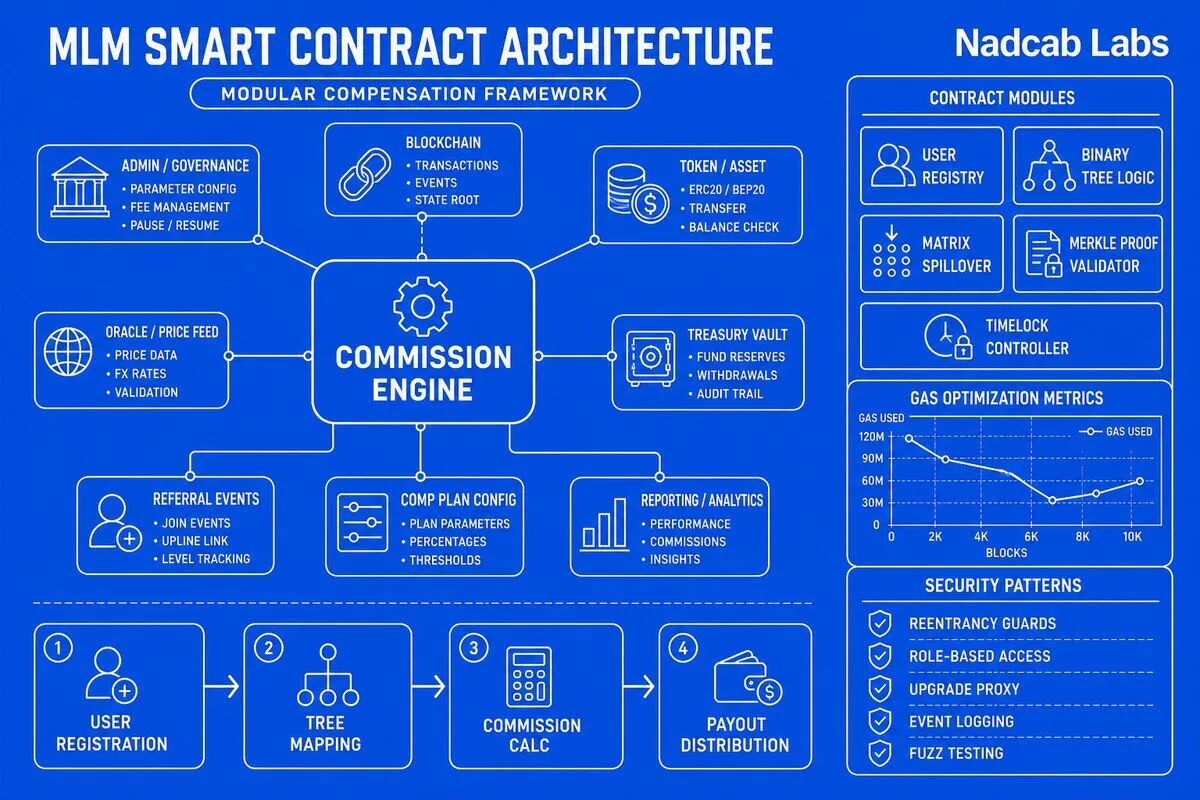
A robust MLM compensation system on blockchain divides responsibilities across three primary modules: user registry, commission calculation engine, and payout distribution. The user registry module maintains on-chain genealogy trees, tracking parent-child relationships, downline counts, and membership tiers. Each user address maps to a struct containing sponsor address, join timestamp, level, and pointers to left/right children in binary plans or an array of direct referrals in unilevel structures. This module emits events on every new registration, enabling off-chain indexers to build full tree visualizations without expensive on-chain queries.
The commission calculation engine module implements the specific compensation plan logic—binary, matrix, unilevel, or hybrid. For binary plans, it uses recursive mappings to traverse left and right legs, calculate weaker-leg volume, and apply matching bonuses. Matrix plans require depth tracking with level-cap enforcement; when a user’s matrix fills, a cycle-completion event triggers and the user may advance to the next level. Unilevel plans iterate through direct referral arrays up to a defined depth, applying percentage commissions per level. Event-driven accrual patterns record commission amounts in user balances without immediate transfers, reducing state updates and gas costs during high-activity periods.
The payout distribution module handles withdrawals and batch processing. Users call a withdraw function that checks their accrued balance, applies any minimum thresholds or time locks, then transfers tokens or native currency. For platforms with thousands of active users, batch payout functions process multiple withdrawals in a single transaction using loops or Merkle tree proofs. A withdrawal queue manages pending requests, prioritizing by timestamp or balance size. This separation of concerns—registry, calculation, payout—mirrors best practices seen in P2P exchange escrow smart contract architecture, where modular design simplifies audits and upgrades.
Core Module Interaction Flow
Genealogy & Relationships
Commission Logic
Withdrawals & Batching
How Do You Implement Binary and Matrix Compensation Logic in Smart Contracts?
Binary tree balancing algorithms in smart contracts use recursive mappings to track left and right leg volumes. Each user struct stores leftVolume and rightVolume counters, updated whenever a new member joins their downline. A placement function determines whether a new recruit goes left or right based on current leg sizes, implementing spillover rules: if one leg is full or significantly larger, the system places the recruit in the weaker leg. Solidity’s call stack limits recursive depth to around 1024, so production contracts often cap binary tree depth at 10–15 levels and use iterative loops for deeper traversals, storing intermediate results in memory arrays.
Matrix compensation plans require depth tracking with level-cap enforcement. A user’s matrix is represented as a fixed-width tree (e.g., 3×7 matrix = 3 direct positions, 7 levels deep). The contract maintains a matrixLevel mapping and a positionsFilled counter per user. When positionsFilled reaches the matrix capacity, a CycleComplete event fires, crediting a cycle bonus and optionally advancing the user to a higher matrix tier. Spillover in matrix plans follows similar logic to binary: excess recruits from a full position spill to the next available slot in the sponsor’s upline, tracked via a queue or linked-list structure stored in mappings.
Event-driven commission accrual minimizes gas costs by deferring actual token transfers. Instead of sending funds on every sale or recruitment, the calculation engine emits CommissionEarned events with user address and amount, updating an internal pendingCommissions mapping. Users later call a claimCommissions function to withdraw accrued balances in a single transaction. This pattern, also used in smart contract architecture for supply chain incentives, reduces per-transaction overhead and allows batch processing during off-peak gas periods. Off-chain workers listen to events, update databases, and provide real-time dashboards without querying expensive on-chain state.
| Plan Type | Tree Structure | Spillover Logic | Gas per Placement |
|---|---|---|---|
| Binary | 2 legs, unlimited depth | Weaker leg fill first | ~80,000–120,000 |
| Matrix (3×7) | 3 direct, 7 levels | Queue to upline on full | ~100,000–150,000 |
| Unilevel | Unlimited width, capped depth | No spillover | ~60,000–90,000 |
| Hybrid (Binary + Unilevel) | Dual tracking | Binary spillover + unilevel direct | ~130,000–180,000 |
What Gas Optimization Techniques Are Essential for Large-Scale MLM Payouts in 2026?
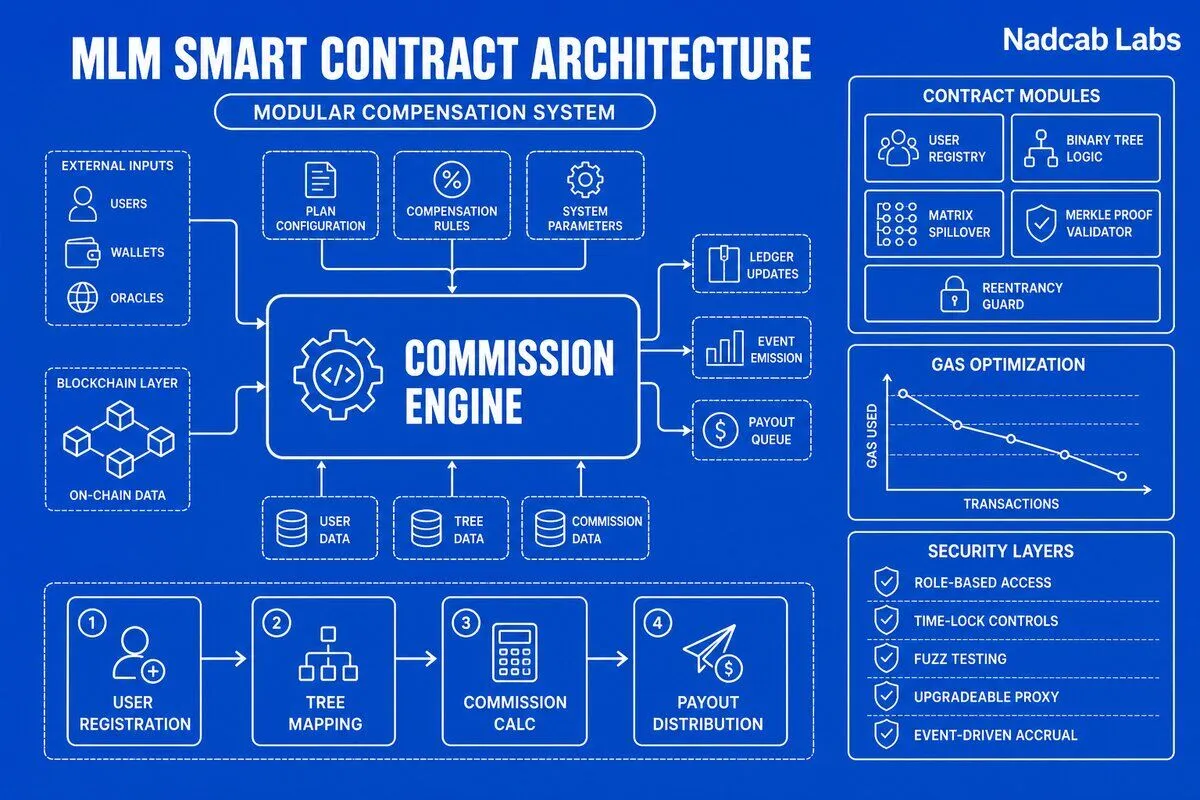
Merkle tree-based batch payout verification drastically reduces per-user transaction overhead. Instead of executing individual transfers for each commission recipient, the contract accepts a Merkle root representing all pending payouts and a set of proofs. Users submit their proof and amount; the contract verifies against the root, marks the claim as processed in a bitmap, and transfers funds. This approach, common in airdrop contracts, cuts gas from ~50,000 per transfer to ~30,000 per claim when batching hundreds of users. The Merkle root is computed off-chain from the latest commission snapshot, and the contract stores only the root hash plus a mapping of claimed indices.
Off-chain computation with on-chain proof submission handles deep genealogy calculations without hitting Solidity’s gas limits. For example, calculating commissions across 10+ levels in a unilevel plan can exceed block gas limits if done recursively on-chain. Instead, an off-chain service (using a trusted oracle or decentralized compute network) traverses the full tree, computes each user’s commission, generates a cryptographic proof (e.g., zk-SNARK or optimistic rollup fraud proof), and submits only the proof and final balances to the contract. The contract verifies the proof and updates balances in a single transaction. This pattern mirrors techniques in smart contract warehouse management systems, where complex inventory calculations happen off-chain and only state diffs are posted on-chain.
Storage slot packing and uint optimization reduce storage costs, which dominate gas usage in write-heavy MLM contracts. Solidity allocates 32-byte slots; packing multiple small variables into one slot saves gas. For example, instead of separate uint256 fields for leftVolume, rightVolume, and level, use uint64 for volumes and uint8 for level, fitting all three in one slot. Downline counters rarely exceed 2^64, and level caps are typically under 20, so smaller uints suffice. Similarly, use uint128 for commission balances if the token has 18 decimals and max supply fits in 128 bits. Bitwise operations and bitmaps track user states (active, suspended, cycle-complete) in a single uint256, where each bit represents a boolean flag. These optimizations can cut storage gas by 30–50% in high-frequency update scenarios.
Gas Cost Comparison: Traditional vs Optimized Payout
How Can You Secure MLM Smart Contracts Against Reentrancy and Manipulation Attacks?
The Checks-Effects-Interactions pattern prevents reentrancy exploits in withdrawal functions. Before transferring funds, the contract first checks conditions (sufficient balance, no active withdrawal), updates state (subtract from user balance, mark withdrawal as processed), then interacts with external contracts (transfer tokens). This ordering ensures that if the recipient’s fallback function calls back into the contract, the balance is already zeroed, blocking double-withdrawals. OpenZeppelin’s ReentrancyGuard modifier adds a mutex lock, setting a _status flag to “entered” at function start and “not entered” at end, reverting if called recursively. Every payout and claim function should inherit this guard, a lesson reinforced by historical exploits in DeFi and MLM contracts.
Access control modifiers and role-based permissions protect admin and upgrade functions. Use OpenZeppelin’s AccessControl or custom modifiers to restrict functions like setPlanParameters, pauseContract, and upgradeImplementation to designated admin addresses. Define roles such as ADMIN_ROLE, OPERATOR_ROLE, and AUDITOR_ROLE, granting each only the permissions necessary for their tasks. For example, operators can trigger batch payouts but cannot change commission rates; auditors have read-only access to verify calculations. This separation of duties, common in enterprise Smart Contract Audit practices, limits damage from compromised keys and satisfies regulatory compliance requirements in jurisdictions scrutinizing MLM operations.
Time-lock mechanisms and multi-signature governance add friction to critical parameter changes. A time-lock contract delays execution of admin functions by a predefined period (e.g., 48 hours), giving the community time to review and potentially veto changes via a governance vote. Multi-signature wallets require M-of-N signatures to authorize upgrades or fund withdrawals, distributing trust across multiple stakeholders. For proxy-based upgradeable contracts, the upgrade function should be behind both a time-lock and a multisig, ensuring no single party can maliciously alter commission logic. These patterns, also seen in Ai proof of Inference systems, balance flexibility with security, a critical trade-off for long-lived MLM platforms.
What Testing and Auditing Strategies Should You Follow for MLM Compensation Contracts in 2026?
Unit tests for edge cases in commission splits, level caps, and overflow scenarios form the foundation of contract reliability. Write tests that verify correct commission distribution when a binary tree is perfectly balanced versus heavily skewed, when a matrix cycles complete exactly at capacity, and when unilevel depth reaches the cap. Test arithmetic overflow by simulating users with maximum uint256 balances and ensuring SafeMath or Solidity 0.8+ overflow checks revert appropriately. Verify that spillover logic places recruits in the correct leg or upline position under all tree configurations. Use Hardhat or Foundry test suites with 100+ test cases covering normal flows, boundary conditions, and failure modes, aiming for >95% code coverage.
Fuzz testing genealogy tree functions with randomized downline structures uncovers bugs that manual tests miss. Tools like Echidna or Foundry’s fuzz runner generate thousands of random inputs—user addresses, join orders, referral links—and assert invariants: total commissions paid never exceed total deposits, every user’s upline chain terminates at the root, no orphaned nodes exist in the tree. Fuzz tests might discover that a specific sequence of joins and withdrawals leaves the contract in an inconsistent state, such as a user’s balance negative due to unchecked subtraction. Run fuzz campaigns for 10,000+ iterations, logging any invariant violations for immediate fix. This approach, borrowed from Smart Contract Vulnerabilities research, is essential for contracts handling complex state machines.
Third-party smart contract audits focusing on economic attack vectors and payout fairness provide external validation. Engage reputable audit firms (e.g., CertiK, Quantstamp, OpenZeppelin) to review the contract for reentrancy, access control flaws, gas griefing, front-running risks, and economic exploits like commission manipulation or Sybil attacks. Auditors simulate adversarial scenarios: a whale joining and immediately withdrawing to drain liquidity, a user creating fake downlines to inflate commissions, or a malicious operator pausing the contract to lock funds. Request a detailed report with severity ratings and remediation steps, then publish the audit publicly to build trust. Many investors and regulators now require audits before participating in or approving crypto MLM platforms, making this step non-negotiable for serious projects. For teams building Hire Smart contract developer capacity in-house, pair internal testing with at least one external audit per major release.
Testing Pipeline for MLM Compensation Contracts
Final Thoughts
Designing smart contract modules for MLM compensation in 2026 demands a disciplined approach: separate user registry, calculation engine, and payout distribution into distinct, upgradeable modules; implement binary and matrix logic with recursive mappings, spillover handlers, and event-driven accrual; optimize gas through Merkle proofs, off-chain computation, and storage packing; secure against reentrancy and manipulation with proven patterns and role-based access; and validate through comprehensive unit tests, fuzz campaigns, and third-party audits. Platforms that master these techniques—like those built with Smart Contract expertise from leading development firms—deliver transparent, efficient, and trustworthy compensation systems that scale to thousands of users. For teams ready to implement these architectures, partnering with experienced developers and leveraging Smart Contract Audit services ensures production-ready, future-proof MLM solutions.
Frequently Asked Questions
Q1.What is the best smart contract architecture for binary MLM compensation plans in 2026?
The best architecture in 2026 uses modular contracts: a Registry for user nodes, a Genealogy contract managing left/right placements, and a Compensation module calculating binary payouts. Employ upgradeable proxies (EIP-1967) for flexibility, off-chain indexers for tree traversal, and batch processing to minimize gas. Store only critical placement data on-chain while computing deep genealogy off-chain, then verify proofs on-chain for payouts.
Q2.How do you calculate commissions on-chain for unilevel and matrix MLM structures?
For unilevel plans, store each user’s sponsor in a mapping and iterate upward through levels, applying percentage rates per tier. For matrix structures, maintain position arrays (e.g., 3×9 matrix) and track spillover logic. Use events to log placements, calculate commissions in batches via off-chain workers, then submit Merkle proofs or aggregated payouts on-chain to reduce gas and ensure accuracy across deep genealogies.
Q3.What are the most common security vulnerabilities in MLM smart contracts?
Common vulnerabilities include reentrancy during payout loops, integer overflow in commission calculations, unchecked external calls, and front-running of placement transactions. Genealogy manipulation—where users exploit tree positions—and admin key compromise are critical risks. Lack of rate limiting enables spam attacks, while missing access controls allow unauthorized withdrawals. Always audit with tools like Slither, MythX, and conduct formal verification before mainnet deployment in 2026.
Q4.How can Layer 2 solutions reduce gas costs for MLM payout transactions in 2026?
Layer 2 solutions like Polygon, Arbitrum, or Optimism batch thousands of transactions off-chain, settling proofs on Ethereum mainnet. In 2026, deploy MLM compensation modules on L2 to cut per-transaction costs by 90–99%. Use rollups for high-frequency payouts and state channels for real-time genealogy updates. ZK-rollups offer privacy for sensitive commission data while maintaining security and drastically lowering gas fees for participants.
Q5.What testing frameworks are recommended for MLM compensation smart contracts?
In 2026, use Hardhat or Foundry for unit and integration tests, covering edge cases like deep genealogies and maximum payouts. Employ Chai assertions and Waffle matchers for Solidity. Add fuzz testing with Echidna or Foundry’s fuzzer to detect overflow and logic flaws. Use Tenderly or Ganache for mainnet forking simulations. Integrate Slither and MythX for static analysis, and conduct third-party audits before production deployment.
Q6.How do you handle genealogy tree depth limits in Solidity for large MLM networks?
Solidity’s gas limits prevent deep recursive loops. Store genealogy as mappings (user → sponsor/children) and compute tree traversal off-chain using subgraphs or indexers. Submit Merkle proofs or snapshots on-chain for verification. Limit on-chain depth to 10–20 levels; for deeper networks, batch calculations and use events to reconstruct trees externally. In 2026, hybrid on-chain/off-chain models balance transparency, scalability, and cost efficiency for massive MLM genealogies.
Explore Services
Related Services
Reviewed by

Aman Vaths
Founder of Nadcab Labs
Aman Vaths is the Founder & CTO of Nadcab Labs, a global digital engineering company delivering enterprise-grade solutions across AI, Web3, Blockchain, Big Data, Cloud, Cybersecurity, and Modern Application Development. With deep technical leadership and product innovation experience, Aman has positioned Nadcab Labs as one of the most advanced engineering companies driving the next era of intelligent, secure, and scalable software systems. Under his leadership, Nadcab Labs has built 2,000+ global projects across sectors including fintech, banking, healthcare, real estate, logistics, gaming, manufacturing, and next-generation DePIN networks. Aman’s strength lies in architecting high-performance systems, end-to-end platform engineering, and designing enterprise solutions that operate at global scale.