Ai Overview
Multi-chain MLM smart contract architecture enables network marketing platforms to operate seamlessly across Ethereum, BSC, Polygon, Avalanche, and other blockchains, synchronizing compensation logic, genealogy tracking, and token rewards through bridge contracts and unified state layers. This approach aggregates liquidity, reduces gas costs, and expands user access while maintaining consistent commission calculations and downline structures across all supported networks.
Multi-chain MLM smart contract architecture enables network marketing platforms to operate seamlessly across Ethereum, BSC, Polygon, Avalanche, and other blockchains, synchronizing compensation logic, genealogy tracking, and token rewards through bridge contracts and unified state layers. This approach aggregates liquidity, reduces gas costs, and expands user access while maintaining consistent commission calculations and downline structures across all supported networks.
Key Takeaways
- Cross-chain MLM architecture uses bridge contracts and chain-specific adapters to synchronize compensation logic across multiple blockchains simultaneously
- Lock-and-mint mechanisms enable secure transfer of MLM tokens and reward balances between networks while maintaining accurate genealogy tracking
- Unified state management requires event-driven synchronization through protocols like Chainlink CCIP or LayerZero to aggregate data from all chains
- Deploying core compensation logic on low-gas chains (Polygon, BSC) while using Ethereum for governance optimizes costs and performance
- Security risks include bridge exploits and replay attacks, requiring multi-signature validation and conflict resolution strategies across chains
- Technical trade-offs balance increased architectural complexity against broader user access and lower transaction fees across multiple networks
What is Multi-Chain MLM Smart Contract Architecture?
Multi-chain MLM smart contract architecture refers to the technical framework that allows network marketing platforms to deploy and operate compensation logic, genealogy tracking, and token distribution systems across multiple blockchain networks simultaneously. Unlike single-chain deployments that confine all operations to one network (such as Ethereum or BSC), a multi-chain architecture distributes smart contract instances across several blockchains, enabling users to interact with the platform using whichever network offers the best combination of speed, cost, and liquidity for their specific needs.
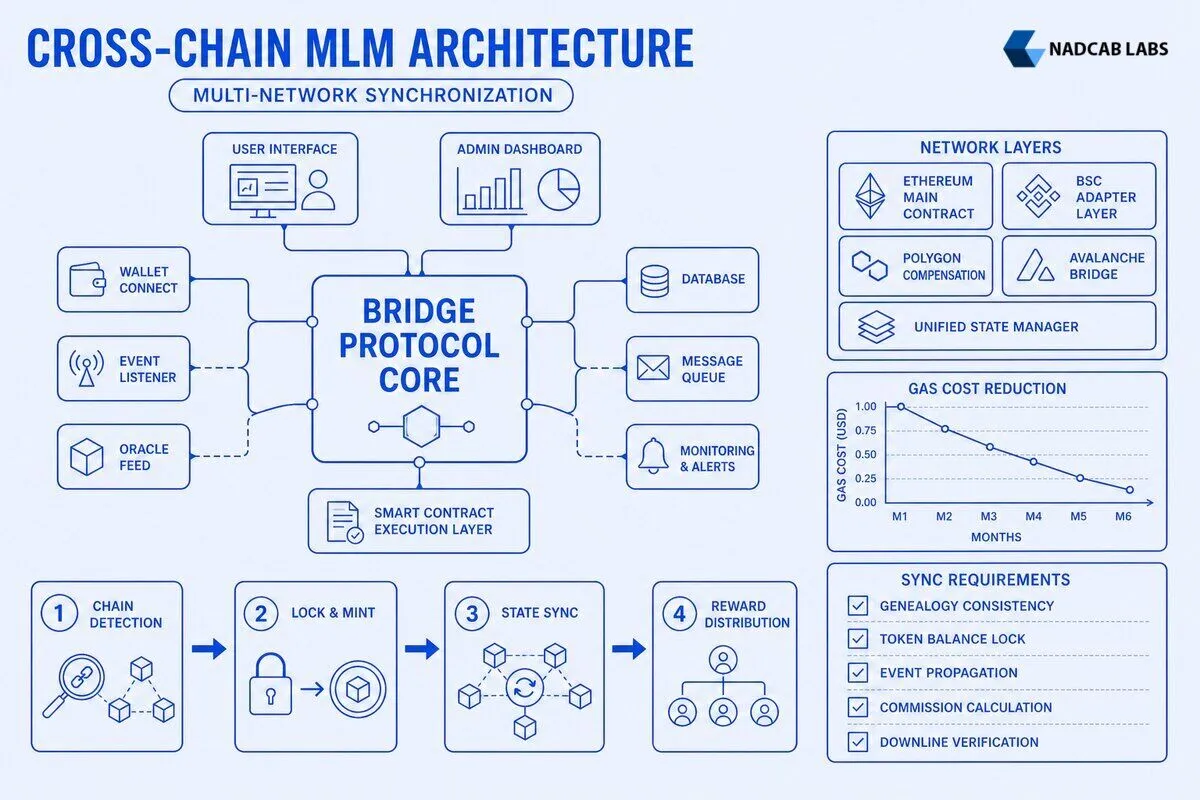
The core architectural components include bridge contracts that facilitate asset and data transfer between chains, chain-specific adapters that translate universal MLM logic into network-compatible code, a unified state layer that aggregates genealogy and commission data from all chains, and cross-chain message protocols that synchronize events and state changes across the entire system. For example, when a user on Polygon recruits a new member who joins via BSC, the bridge contracts must communicate this genealogy update to all other chains where the upline structure exists, ensuring commission calculations remain accurate regardless of which network processes the payout transaction.
The primary architectural goals center on liquidity aggregation, gas optimization, and seamless user experience. By supporting multiple chains, platforms can pool token liquidity from Ethereum’s deep markets, Polygon’s low-fee environment, and BSC’s high-throughput infrastructure, giving users flexibility to claim rewards on the network that best suits their transaction size and urgency. Gas optimization occurs naturally when users choose lower-cost chains for routine operations while reserving Ethereum for high-value settlements or governance votes. The seamless experience depends on sophisticated state synchronization—users should see consistent downline structures, commission balances, and rank progression whether they access the platform through a Polygon wallet, BSC interface, or Ethereum dApp, without needing to understand the underlying multi-chain complexity.
This architecture becomes essential when single-chain deployments hit scalability limits. A platform processing thousands of daily commission payouts on Ethereum may face prohibitive gas costs during network congestion, while the same operations on Polygon cost fractions of a cent. However, abandoning Ethereum entirely means losing access to its established DeFi ecosystem, institutional liquidity, and security guarantees. Multi-chain architecture solves this dilemma by letting the platform operate where each function performs best, connected through secure bridge infrastructure that maintains data consistency across all supported networks.
How Do Cross-Chain Bridges Enable MLM Compensation Logic Across Networks?
Cross-chain bridges serve as the communication backbone for multi-chain MLM platforms, enabling compensation logic to execute correctly even when users and their downlines operate on different blockchain networks. The fundamental challenge is synchronizing commission calculations, genealogy updates, and token distributions across chains that don’t natively share state or communicate directly. Bridge contracts solve this by creating secure channels for transferring both assets (MLM tokens, reward balances) and data (genealogy events, rank changes) between networks, ensuring that a commission earned on Polygon can be verified and paid out on BSC, or that a new recruit joining via Avalanche correctly updates the upline structure stored on Ethereum.
Two primary bridge mechanisms handle token and balance transfers in MLM systems. The lock-and-mint pattern works by locking tokens on the source chain in a bridge contract, then minting an equivalent wrapped version on the destination chain. When a user wants to move 1000 MLM tokens from Ethereum to Polygon, the Ethereum bridge contract locks those tokens in escrow and emits an event. Bridge validators (or relayers) detect this event and trigger the Polygon bridge contract to mint 1000 wrapped MLM tokens to the user’s Polygon address. This approach maintains total supply consistency—the original tokens remain locked while the wrapped versions circulate on the destination chain. The alternative burn-and-mint mechanism destroys tokens on the source chain and mints native tokens on the destination, often used when the platform wants to treat all chains as equals rather than having one “canonical” chain. For MLM platforms, lock-and-mint typically works better because it preserves a clear audit trail on the primary chain (often Ethereum) where governance and high-value settlements occur.
Compensation logic synchronization requires more than just token transfers—it demands real-time genealogy tracking across chains. When a user on BSC makes a purchase that triggers commissions for their upline, the bridge must communicate this event to all chains where upline members hold accounts. Consider a scenario where Alice (on Ethereum) recruited Bob (on Polygon) who recruited Carol (on BSC). When Carol makes a purchase, the BSC contract calculates her direct sponsor’s commission (Bob on Polygon) and sends a cross-chain message via the bridge. The Polygon contract receives this message, updates Bob’s balance, calculates the next level commission for Alice, and sends another cross-chain message to Ethereum. This multi-hop communication happens through bridge validators who monitor events on all chains and submit proof-of-event transactions to destination chains, creating an auditable trail of commission flows across the network.
Bridge latency and finality differences create unique challenges for real-time MLM operations. Ethereum transactions achieve probabilistic finality after several block confirmations (roughly 12-15 minutes for strong confidence), while Polygon offers faster finality (around 2 minutes) and Avalanche even quicker (under 2 seconds). When a genealogy update originates on Avalanche but needs to propagate to Ethereum, the bridge must wait for sufficient Ethereum confirmations before considering the update final. During this latency window, the system operates with temporarily inconsistent state—Avalanche knows about the new recruit immediately, but Ethereum won’t reflect this change for 15+ minutes. MLM platforms handle this through optimistic state updates with rollback mechanisms. The Avalanche contract can immediately show the new downline member and calculate provisional commissions, but marks these as “pending cross-chain confirmation.” If the Ethereum bridge transaction fails or gets reorganized due to a chain reorg, the Avalanche contract rolls back the optimistic update and recalculates affected commissions. This approach balances user experience (showing updates quickly) with data integrity (ensuring all chains eventually agree on the canonical genealogy).
| Bridge Mechanism | Token Transfer Method | Finality Time | Best Use Case |
|---|---|---|---|
| Lock-and-Mint (Ethereum→Polygon) | Lock on ETH, mint wrapped on Polygon | 12-15 min | High-value commission settlements |
| Burn-and-Mint (BSC↔Avalanche) | Burn on source, mint native on destination | 3-5 min | Routine commission payouts between fast chains |
| Optimistic Relay (Polygon→Avalanche) | Immediate provisional, confirmed later | 2 min (provisional), 5 min (final) | Real-time genealogy updates and rank changes |
| Atomic Swap (Any EVM chains) | Hash time-locked contracts on both chains | Varies by slowest chain | Peer-to-peer token exchanges without bridge trust |
The cross-chain bridge development process for MLM platforms requires careful validator design. Most production bridges use a multi-signature validator set—a group of independent nodes that must reach consensus before approving cross-chain messages. For example, a 7-of-10 threshold means at least 7 validators must sign off on a bridge transaction before it executes on the destination chain. This prevents single points of failure and makes bridge exploits much harder, since an attacker would need to compromise multiple independent validators simultaneously. Some platforms enhance security further by combining validator signatures with zero-knowledge proofs that cryptographically verify the source chain state, eliminating the need to trust validators entirely—they can only relay messages that are provably valid according to the source chain’s consensus rules.
What Are the Best Chain-Specific Deployment Strategies for MLM Contracts?
Choosing which chains to designate as primary versus secondary deployment targets fundamentally shapes a multi-chain MLM platform’s performance, cost structure, and user accessibility. The decision matrix weighs transaction cost, block finality speed, existing user base distribution, and the chain’s DeFi ecosystem maturity. Ethereum typically serves as the primary chain for governance, high-value settlements, and integration with established DeFi protocols, despite its higher gas costs. Its deep liquidity pools, institutional adoption, and battle-tested security make it ideal for functions where cost takes a backseat to trust and composability—such as governance token voting, treasury management, and integration with Uniswap or Aave for liquidity provision. Secondary chains like Polygon, BSC, and Avalanche handle high-frequency, low-value operations where gas costs would be prohibitive on Ethereum: daily commission payouts, routine genealogy updates, and new user onboarding.
A practical deployment strategy places core compensation logic on low-gas chains while reserving Ethereum for critical functions. For instance, the genealogy tree structure, rank calculation algorithms, and commission distribution logic might deploy on Polygon where each transaction costs $0.01-0.05, making it economically feasible to process thousands of daily payouts. The platform’s governance token and treasury contracts remain on Ethereum, where users vote on compensation plan changes, approve budget allocations, and participate in protocol upgrades. This hybrid approach means a user joining the platform via Polygon pays minimal fees for daily operations, but when they want to participate in governance or move large token amounts to Ethereum-based DeFi protocols, they bridge their assets to the primary chain and accept higher transaction costs in exchange for Ethereum’s security and liquidity advantages.
The technical implementation requires deploying slightly different contract versions on each chain while maintaining logical consistency. EVM-compatible chains (Ethereum, Polygon, BSC, Avalanche) can run nearly identical Solidity code with minor adjustments for gas optimization and chain-specific opcodes. For example, Polygon’s lower gas costs allow more complex on-chain calculations that would be too expensive on Ethereum—a Polygon contract might calculate commission splits for 10 genealogy levels in a single transaction, while the Ethereum version batches these calculations or moves some logic off-chain. Non-EVM chains like Solana or Cosmos require completely rewritten contracts in Rust or Go, but the business logic remains consistent: the same compensation percentages, rank requirements, and genealogy rules apply regardless of implementation language. Maintaining this consistency across heterogeneous chains demands rigorous testing and formal verification to ensure that a commission calculated on Polygon matches what the Ethereum contract would produce for the same genealogy state.
Multi-Chain MLM Contract Deployment Process
Deploy governance & treasury contracts on Ethereum mainnet
Deploy compensation logic on Polygon & BSC with gas optimizations
Configure bridge contracts on all chains with multi-sig validators
Test cross-chain message relay & state sync in testnet environment
Gradual mainnet rollout: enable one chain pair at a time, monitor for 48hrs before adding next chain
Managing contract upgrades across multiple chains simultaneously presents significant coordination challenges. When a compensation plan changes—say, adjusting commission percentages or adding a new rank tier—every chain must implement the update in a synchronized manner to prevent arbitrage opportunities or state inconsistencies. The standard approach uses a tiered upgrade schedule: first deploy and test the new contract version on a fast, low-cost chain like Polygon, monitor for bugs or unexpected behavior for 24-48 hours, then roll out to BSC and Avalanche, and finally upgrade the Ethereum contracts after confirming stability across all secondary chains. This staged rollout limits blast radius if a bug slips through testing—better to catch an issue on Polygon where fixes cost pennies than discover it on Ethereum where emergency upgrades might cost thousands in gas fees.
Version control becomes critical when different chains run different contract versions during the upgrade window. The bridge contracts must handle version mismatches gracefully, either by rejecting cross-chain messages that reference outdated genealogy structures or by translating between old and new data formats on the fly. For instance, if Polygon upgrades to a new rank system with 12 tiers while Ethereum still runs the old 10-tier system, the bridge must map the new tiers to old equivalents when syncing data to Ethereum, then reverse the mapping when Ethereum eventually upgrades. This temporary translation layer adds complexity but allows the platform to upgrade chains independently rather than requiring a risky simultaneous upgrade across all networks. Professional MLM Software development teams often implement upgrade proxies—contracts that forward calls to the current implementation version—so that upgrades can happen by changing a pointer rather than migrating state, reducing downtime and gas costs across all chains.
How Can You Achieve Unified State Management in Multi-Chain MLM Systems?
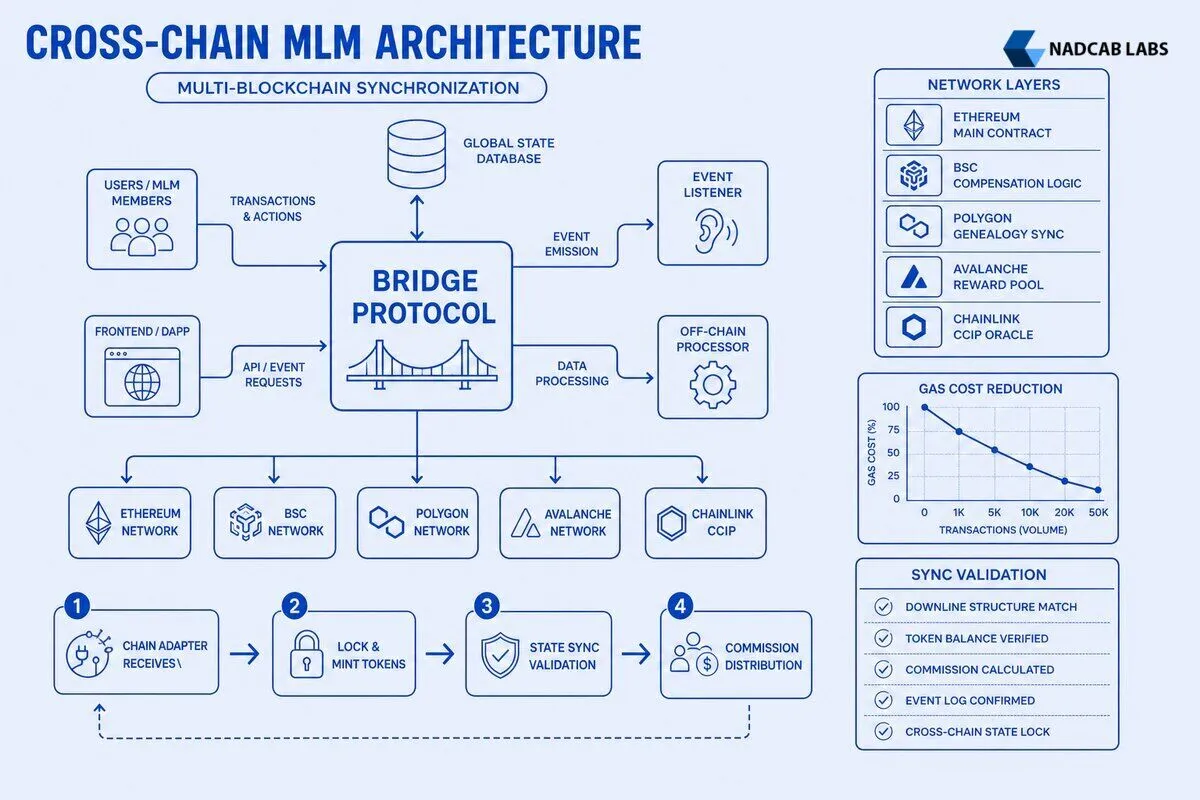
Unified state management solves the fundamental problem of maintaining a single, consistent view of genealogy structures, commission balances, and user ranks when the underlying data lives on multiple independent blockchains. Without a unified state layer, each chain operates with only partial information—Polygon knows about users who joined via Polygon, Ethereum knows about Ethereum users, but neither has a complete picture of the entire downline network. This fragmentation breaks MLM compensation logic, which depends on accurate genealogy tracking to calculate multi-level commissions correctly. The architectural challenge is aggregating state from all chains into a coherent whole while handling the reality that different chains finalize transactions at different speeds and may temporarily disagree about recent events.
Two primary architectural patterns address this challenge: centralized off-chain indexers and decentralized oracle networks. The centralized approach runs database servers that monitor events on all supported chains, extract genealogy updates and commission transactions, and merge them into a unified relational database. When a user queries their downline structure, the frontend hits this centralized API which returns the complete genealogy by joining data from all chains. This pattern offers fast queries and simple implementation—standard database tools handle the aggregation logic—but introduces centralization risks. If the indexer goes offline or gets compromised, the platform loses its unified view even though the underlying blockchain data remains intact. Many platforms mitigate this by running multiple redundant indexers in different geographic regions and making the indexer code open-source so anyone can verify the aggregation logic matches the on-chain state.
Decentralized oracle networks provide a trust-minimized alternative by using blockchain-based consensus to aggregate cross-chain state. Protocols like Chainlink CCIP, LayerZero, and Axelar deploy oracle nodes that monitor multiple chains simultaneously, submit state proofs to a consensus contract, and relay verified data to any chain that needs it. For example, when the Polygon MLM contract needs to know the complete genealogy for commission calculation, it sends a query to the oracle network. Oracle nodes fetch genealogy data from Ethereum, BSC, and Avalanche contracts, cryptographically prove this data is valid (often using Merkle proofs or light client verification), reach consensus on the aggregated result, and submit it to Polygon. The Polygon contract can then trust this cross-chain data because multiple independent oracles verified it, and the consensus mechanism prevents any single oracle from submitting false information. This approach trades some query speed (oracle consensus takes time) for decentralization and censorship resistance—no single entity can manipulate the unified state view.
Event-driven state synchronization keeps the unified layer current as new genealogy updates occur across chains. Rather than periodically polling all chains for changes, the system subscribes to events emitted by MLM contracts on each network. When a new user joins via BSC, the BSC contract emits a NewMember event containing the user’s address, sponsor ID, and timestamp. Bridge relayers or oracle nodes detect this event, verify it reached finality on BSC, and propagate it to the unified state layer and all other chains where it affects commission calculations. This event-driven pattern minimizes latency—state updates propagate within minutes of the triggering transaction rather than waiting for the next polling cycle—and reduces computational overhead since the system only processes actual changes rather than repeatedly scanning for updates that haven’t happened.
Conflict resolution strategies handle the inevitable edge cases when the same user performs actions on different chains before state propagation completes. Imagine Alice initiates a rank upgrade transaction on Polygon at the same time she claims a commission on BSC, and both transactions reference her current rank. If Polygon processes the upgrade first but BSC hasn’t received the update yet, BSC calculates the commission using Alice’s old rank, creating a temporary inconsistency. The unified state layer must detect this conflict when both events arrive and apply a deterministic resolution rule. Common approaches include timestamp ordering (the transaction with the earlier timestamp takes precedence), chain priority (designate one chain as the source of truth for rank data), or optimistic execution with rollback (allow both transactions to execute provisionally, then roll back the one that violated consistency when the conflict is detected). The smart contract modules for MLM compensation must implement these conflict resolution rules consistently across all chains to ensure the system eventually converges to a single canonical state.
Cross-Chain State Synchronization Performance Comparison
The technical implementation of unified state management often combines multiple approaches for different data types. Critical genealogy data that affects commission calculations might use decentralized oracles for maximum trust, while less critical metadata like user profile information relies on centralized indexers for speed. Rank changes and high-value commission payouts trigger cross-chain messages through Chainlink CCIP with full finality guarantees, while routine daily payouts use faster optimistic relays with delayed finality. This hybrid architecture balances security, speed, and cost—expensive oracle queries for data that must be provably correct, cheap centralized indexing for data where speed matters more than trustlessness, and optimistic relays for the high-volume middle ground where occasional rollbacks are acceptable as long as they’re rare and handled gracefully.
What Are the Technical Trade-Offs When Architecting Cross-Chain MLM Platforms?
Security risks top the list of technical trade-offs in multi-chain MLM architecture, with bridge exploits representing the most significant threat vector. Cross-chain bridges hold billions in locked assets and process countless messages daily, making them prime targets for attackers. Historical bridge hacks like Ronin (622 million stolen) and Poly Network (611 million stolen, later returned) demonstrate the catastrophic impact when bridge security fails. For MLM platforms, a bridge exploit could drain the entire treasury, steal user commission balances, or corrupt genealogy data across all chains. The attack surface expands with each additional chain—more bridge contracts mean more code to audit, more validator sets to secure, and more potential points of failure. Mitigation strategies include multi-signature validation requiring consensus from geographically distributed validators, time-locked withdrawals that give the platform 24-48 hours to detect and halt suspicious bridge transactions, and circuit breakers that automatically pause bridge operations if abnormal activity is detected (such as a sudden spike in outbound transfers or messages that violate genealogy constraints).
Replay attacks pose a specific threat when the same transaction could be valid on multiple chains. If an attacker captures a signed commission payout transaction from Polygon, they might try to replay it on BSC to claim the same commission twice. Prevention requires chain-specific nonces and transaction IDs that make each cross-chain message unique to its source and destination pair. The bridge contracts must track which message IDs have been processed on each chain and reject duplicates, even if the signature is valid. More sophisticated attacks involve exploiting timing windows during state synchronization—if the attacker can submit conflicting transactions on different chains before they sync, they might temporarily create inconsistent states that allow double-spending of commission balances or manipulation of genealogy positions. Defense requires atomic cross-chain operations where possible (using hash time-locked contracts that either complete on all chains or none) and robust conflict resolution that detects and reverses any inconsistencies that slip through.
Performance trade-offs balance architectural complexity against the user benefits of multi-chain access. A single-chain MLM platform has straightforward architecture—one set of contracts, one state database, no bridge coordination—making development, testing, and maintenance significantly simpler. Adding multi-chain support multiplies complexity: bridge contracts to develop and audit, cross-chain message protocols to integrate, state synchronization logic to implement and test across all chain combinations, and monitoring systems to track the health of validators and relayers on each network. This complexity translates to higher development costs (more specialized developers needed, longer timelines), increased operational overhead (monitoring multiple networks, managing validator infrastructure), and greater attack surface (more code means more potential bugs and vulnerabilities). The Smart Contract Audit Architecture process becomes more involved, as auditors must verify not just individual contract logic but also the correctness of cross-chain message handling and state synchronization across all supported chain pairs.
The benefits that justify this complexity include user access to lower-fee networks and broader liquidity pools. A user on Polygon pays $0.02 per commission claim versus $15-50 on Ethereum during peak congestion, making micro-commissions economically viable. Geographic distribution matters too—users in regions where Ethereum is prohibitively expensive can participate via BSC or Polygon, expanding the platform’s addressable market. Liquidity benefits arise from aggregating token pools across chains: the platform’s native token might have 2 million in liquidity on Ethereum, 1 million on BSC, and 500k on Polygon, giving users 3.5 million total liquidity to trade against versus being confined to a single chain’s pool. This aggregation reduces slippage for large trades and provides arbitrage opportunities that help maintain price consistency across chains.
| Architecture Approach | Development Cost | User Gas Savings | Security Risk Level |
|---|---|---|---|
| Single-chain (Ethereum only) | $80k-120k | Baseline (high gas) | Low (no bridge risk) |
| Layer 2 scaling (Optimism/Arbitrum) | $95k-140k | 85-95% reduction | Medium (L2 bridge risk) |
| Multi-chain (ETH + 2 sidechains) | $150k-220k | 90-98% on sidechains | High (multiple bridge risks) |
| Full cross-chain (5+ networks) | $250k-400k | 95-99% user choice | Very High (complex bridge matrix) |
Cost-benefit analysis of multi-chain deployment versus single-chain with Layer 2 scaling reveals nuanced trade-offs. Layer 2 solutions like Optimism and Arbitrum offer 85-95% gas savings compared to Ethereum mainnet while maintaining stronger security guarantees than independent sidechains, since L2s inherit Ethereum’s security through fraud proofs or validity proofs. For many MLM platforms, deploying on Ethereum mainnet for governance and an Ethereum L2 for operations provides the best balance—significant gas savings without the complexity of managing multiple independent chains and bridges. However, this approach confines users to the Ethereum ecosystem; they can’t easily interact with BSC or Polygon DeFi protocols or tap into those chains’ user bases. Multi-chain deployment makes sense when the platform specifically wants to reach users on non-Ethereum chains, integrate with chain-specific DeFi ecosystems (such as PancakeSwap on BSC or Trader Joe on Avalanche), or hedge against any single chain’s technical or regulatory risks by spreading operations across multiple networks.
The decision ultimately depends on the platform’s specific goals and user base. A platform targeting crypto-native users comfortable with multiple wallets and bridge operations benefits from full multi-chain deployment, offering maximum flexibility and access to all major DeFi ecosystems. A platform focused on mainstream adoption might prefer single-chain deployment on a user-friendly L2, minimizing complexity and reducing the learning curve for non-technical users. Hybrid approaches are increasingly common: start with a single chain to validate product-market fit and build initial user base, then gradually expand to additional chains as the platform scales and user demand for specific networks becomes clear. This staged expansion limits initial complexity and development costs while preserving the option to go multi-chain as the platform matures. Teams considering this path should engage experienced developers who can Hire Smart contract developer talent with proven multi-chain expertise to architect the initial contracts with future cross-chain expansion in mind, avoiding costly refactoring when the time comes to bridge to additional networks.
Multi-chain MLM smart contract architecture represents a sophisticated approach to building network marketing platforms that operate seamlessly across blockchain ecosystems. By deploying compensation logic on low-cost chains, maintaining governance on secure primary networks, and synchronizing state through bridge contracts and oracle networks, platforms achieve the best of all worlds: low transaction costs, broad user access, deep liquidity, and robust security. The technical complexity and security risks are real and substantial, requiring expert development, rigorous auditing, and ongoing monitoring. For platforms with the resources and technical expertise to implement multi-chain architecture correctly, the benefits—expanded market reach, optimized costs, and enhanced user experience—justify the investment. As blockchain interoperability protocols mature and bridge security improves, multi-chain MLM platforms will likely become the standard architecture for serious network marketing operations in the decentralized economy.
Frequently Asked Questions
Q1.What is the difference between multi-chain and cross-chain MLM smart contract architecture?
Multi-chain architecture deploys separate, independent MLM contracts on multiple blockchains without direct interaction. Cross-chain architecture enables contracts on different chains to communicate and share state via bridges or relayers. Multi-chain requires manual reconciliation; cross-chain synchronizes commission data, user balances, and referral trees automatically across networks, offering unified user experience but higher complexity.
Q2.Which blockchain networks are best suited for deploying MLM compensation contracts?
Ethereum offers security and liquidity but high gas costs. Polygon and BSC provide low fees with EVM compatibility, ideal for frequent commission distributions. Avalanche delivers sub-second finality for real-time payouts. Solana suits high-throughput MLM systems needing thousands of transactions per second. Choice depends on budget, speed requirements, and target user base across ecosystems.
Q3.How do cross-chain bridges handle commission payouts in real-time MLM systems?
Bridges lock tokens on the source chain and mint wrapped equivalents on the destination chain via validator networks or relay contracts. For MLM payouts, commission calculations occur on one chain, then bridge protocols transmit payout instructions cross-chain. Latency ranges from minutes to hours depending on bridge security model—optimistic bridges delay finality, while fast bridges use trusted validators for near-instant settlement.
Q4.What are the security risks of using bridges in multi-chain MLM platforms?
Bridge exploits have caused billions in losses through validator collusion, smart contract bugs, and oracle manipulation. MLM platforms face risks of locked funds, double-spending during bridge delays, and loss of commission data if bridge fails mid-transaction. Centralized bridges introduce custodial risk; decentralized bridges may lack insurance. Always use audited bridges with proven track records and implement fallback mechanisms.
Q5.Can MLM smart contracts operate on both EVM and non-EVM chains simultaneously?
Yes, through hybrid architecture using chain-specific contract implementations that share logic via cross-chain messaging protocols like LayerZero or Wormhole. EVM contracts (Solidity) run on Ethereum/Polygon, while non-EVM chains like Solana require Rust-based programs. A central coordinator contract or off-chain indexer synchronizes referral trees and commission states, ensuring consistency despite different execution environments and programming languages.
Q6.How does unified state management work when users interact with MLM contracts on different blockchains?
Unified state uses a primary chain as source of truth, with secondary chains syncing via cross-chain messages or off-chain relayers. When users join on Chain B, the event triggers a message to Chain A’s master contract updating the global referral tree. Merkle proofs verify cross-chain states. Alternatively, decentralized indexers aggregate events from all chains into a unified database, enabling contracts to query consolidated state before executing payouts.
Explore Services
Related Services
Reviewed by

Aman Vaths
Founder of Nadcab Labs
Aman Vaths is the Founder & CTO of Nadcab Labs, a global digital engineering company delivering enterprise-grade solutions across AI, Web3, Blockchain, Big Data, Cloud, Cybersecurity, and Modern Application Development. With deep technical leadership and product innovation experience, Aman has positioned Nadcab Labs as one of the most advanced engineering companies driving the next era of intelligent, secure, and scalable software systems. Under his leadership, Nadcab Labs has built 2,000+ global projects across sectors including fintech, banking, healthcare, real estate, logistics, gaming, manufacturing, and next-generation DePIN networks. Aman’s strength lies in architecting high-performance systems, end-to-end platform engineering, and designing enterprise solutions that operate at global scale.