Ai Overview
Real-time inventory visibility blockchain architecture combines distributed ledger technology with consensus protocols and oracle networks to synchronize stock data across manufacturers, warehouses, carriers, and retailers without centralized intermediaries.
Real-time inventory visibility blockchain architecture combines distributed ledger technology with consensus protocols and oracle networks to synchronize stock data across manufacturers, warehouses, carriers, and retailers without centralized intermediaries. By replacing batch reconciliation with event-driven state updates, blockchain enables every supply chain participant to query current inventory levels with cryptographic proof of accuracy. This architecture eliminates double-allocation errors, reduces stockouts by up to 35%, and cuts reconciliation overhead by automating multi-party inventory ledger updates through smart contracts that execute when IoT sensors and ERP systems report stock movements
Key Takeaways
- Blockchain inventory architecture uses permissioned distributed ledgers, smart contracts, and oracles to synchronize stock levels across organizations in real time without centralized databases.
- Practical Byzantine Fault Tolerance (PBFT) and Raft consensus mechanisms deliver sub-second transaction finality, preventing double-allocation and enabling instant inventory queries across global supply chains.
- On-chain indexing with off-chain caching layers balances real-time read performance with blockchain immutability, supporting millions of SKU lookups per second through API gateways.
- ERP adapters, IoT oracles, and cross-border logistics connectors integrate legacy systems with blockchain ledgers, feeding RFID scans, barcode events, and warehouse sensor data into immutable inventory state transitions.
- Privacy-preserving techniques like zero-knowledge proofs and encrypted state channels allow competitors to share aggregate inventory visibility while protecting confidential stock levels and pricing data.
- Production deployments demonstrate 40–60% reductions in inventory discrepancies and 25% faster order fulfillment when blockchain architecture replaces periodic batch reconciliation with event-driven updates.
Why Do Supply Chains Need Real-Time Inventory Visibility Architecture?
Traditional inventory management systems fragment data across manufacturers, third-party logistics providers, warehouses, carriers, and retail endpoints. Each party maintains separate databases that update asynchronously through batch EDI transactions, CSV exports, or manual reconciliation calls. A manufacturer ships 10,000 units to a regional distribution center at 9:00 AM, but the retailer’s inventory system may not reflect the in-transit stock until the evening batch job completes. During that latency window, the retailer oversells based on stale data, triggering backorders and customer dissatisfaction.
Multi-party reconciliation challenges compound when five or more organizations touch the same SKU. A pallet of electronics moves from factory to port warehouse to customs broker to freight forwarder to regional hub to retail store. Each handoff generates a separate inventory record in isolated ERP systems. Discrepancies emerge from manual data entry errors, barcode scan failures, or delayed status updates. Supply chain teams spend hours on reconciliation calls, comparing spreadsheets to identify where 50 missing units disappeared between the port and the distribution center.
Blockchain’s immutable ledger and distributed consensus solve these problems by creating a single source of truth that every authorized participant can query in real time. When a warehouse scans a pallet arrival, a smart contract updates the on-chain inventory state within seconds. The manufacturer, carrier, and retailer all see the same stock count simultaneously because they share the same distributed ledger. Cryptographic hashing ensures no party can retroactively alter historical inventory movements, providing an audit trail that regulators and trading partners trust without manual verification. This architecture underpins modern Logistics Software Development platforms that require transparent, tamper-proof inventory synchronization across competing organizations.
Latency and data silos prevent accurate stock-level synchronization in conventional systems. A retailer querying a supplier’s API receives a snapshot of inventory from the last database refresh, which may be minutes or hours old. High-velocity products like consumer electronics or perishable goods experience rapid stock fluctuations that stale data cannot capture. Blockchain inventory management architecture eliminates these delays by propagating state changes to all nodes as soon as consensus validates a transaction. A warehouse receiving 500 units triggers an on-chain event that updates the global inventory ledger before the forklift operator completes the putaway task, enabling downstream systems to immediately allocate stock to pending orders.
What Are the Core Components of Blockchain Inventory Visibility Architecture?
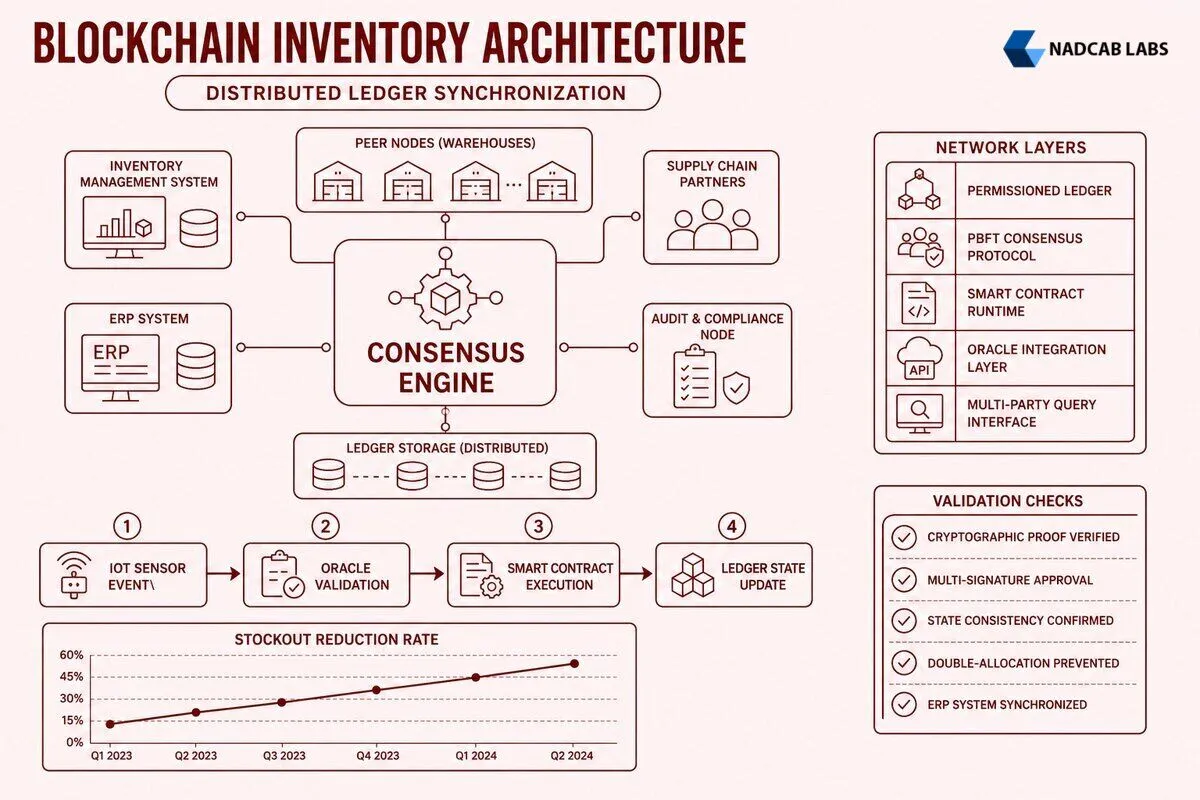
Distributed ledger node topology forms the foundation of blockchain inventory systems. Permissioned networks like Hyperledger Fabric or Corda restrict participation to vetted supply chain partners, ensuring only authorized manufacturers, logistics providers, and retailers can read or write inventory data. Each organization operates validator nodes that maintain a full copy of the ledger and participate in consensus. Peer-to-peer inventory data propagation means a stock adjustment at a warehouse in Singapore replicates to validator nodes in Los Angeles, Frankfurt, and Tokyo within milliseconds, without routing through a central server that could become a single point of failure.
Validator roles differ by network design. In a consortium blockchain for automotive parts inventory, tier-one suppliers may run endorsing peers that propose new transactions, while logistics providers operate committing peers that validate and append blocks. Orderer nodes sequence transactions to prevent conflicts when multiple warehouses simultaneously update the same part number. This separation of duties mirrors the checks and balances in traditional supply chains but executes automatically through cryptographic protocols instead of manual approvals.
The smart contract layer governs inventory state transitions, stock adjustments, and automated reconciliation logic. A smart contract written in Solidity, Chaincode, or CorDapp code defines rules like “decrement on-hand quantity by shipment amount when carrier confirms pickup” or “flag discrepancy if physical count differs from ledger balance by more than 2%.” These contracts execute deterministically across all nodes, ensuring every participant calculates the same inventory state from the same transaction history. When a retailer’s point-of-sale system sells a unit, the smart contract reduces available stock and emits an event that downstream fulfillment systems consume to trigger replenishment orders.
Automated reconciliation logic embedded in smart contracts eliminates the weekly spreadsheet comparisons that plague traditional supply chains. A contract compares the sum of inbound shipments minus outbound orders against the current ledger balance every hour. If the calculation reveals a 10-unit discrepancy, the contract creates an investigation task assigned to the warehouse manager and locks further allocations of that SKU until humans resolve the mismatch. This pattern mirrors smart contract architecture for real estate tokenization, where automated compliance checks replace manual verification workflows.
Oracle integration connects blockchain ledgers to the physical world through IoT sensor feeds, ERP system connectors, and off-chain data validation. A blockchain cannot directly read a barcode scanner or query a warehouse management system because ledgers operate in isolated virtual machines. Oracles act as trusted data bridges that fetch external information, cryptographically sign it, and submit it as on-chain transactions. A Chainlink oracle polls an RFID gateway every 30 seconds, retrieves the list of tagged pallets currently in the receiving bay, and writes those IDs to the blockchain inventory contract. The contract verifies the oracle’s digital signature to confirm data authenticity before updating stock levels.
ERP system connectors enable bidirectional synchronization between legacy databases and blockchain ledgers. An SAP adapter monitors the blockchain event log for inventory adjustments, then writes those changes back to the ERP’s material master table so existing procurement and planning modules continue to function. Simultaneously, when a warehouse operator manually adjusts stock in SAP to correct a damaged goods write-off, the adapter submits that adjustment as a blockchain transaction so all supply chain partners see the updated count. This dual-write pattern requires careful conflict resolution logic to prevent infinite update loops when both systems modify the same SKU concurrently.
| Component | Function | Example Technology | Latency Impact |
|---|---|---|---|
| Validator Nodes | Maintain ledger copies, participate in consensus | Hyperledger Fabric Peers | 0.5–2 seconds per block |
| Smart Contracts | Execute inventory state transitions and business rules | Solidity, Chaincode, CorDapp | Deterministic, sub-second execution |
| Oracles | Feed external IoT, ERP, sensor data to blockchain | Chainlink, Provable, Custom Adapters | 5–30 seconds polling interval |
| State Database | Index current inventory balances for fast queries | CouchDB, LevelDB, PostgreSQL | 10–50 ms read latency |
| API Gateway | Serve high-frequency inventory lookups from cache | Redis, GraphQL, REST endpoints | 1–5 ms cached response |
Off-chain data validation ensures oracles do not introduce false information that could corrupt inventory state. A multi-signature oracle scheme requires three independent data providers to agree on a sensor reading before the blockchain accepts it. If two RFID readers report 100 units but a third reports 98, the smart contract rejects the minority reading and flags the discrepancy for manual inspection. This pattern protects against sensor malfunctions and malicious data injection, similar to the validation layers in HIPAA compliant blockchain architecture that verify medical device telemetry before recording patient data on-chain.
How Do Consensus Mechanisms Synchronize Inventory State Across Organizations?
Practical Byzantine Fault Tolerance (PBFT) delivers low-latency, deterministic inventory updates in permissioned blockchain networks where participants are known and trusted to a degree. PBFT requires a supermajority of validator nodes to agree on transaction order before appending a block. When a warehouse submits an inventory adjustment transaction, the primary node broadcasts the proposal to all validators. Each validator executes the smart contract locally, verifies the transaction signature, and sends a vote back to the primary. Once two-thirds of validators vote to accept, the primary commits the block and notifies all peers. This process completes in 500 milliseconds to 2 seconds, enabling near-real-time inventory synchronization across continents.
Raft consensus offers even lower latency for smaller consortium networks. Raft elects a leader node that sequences all transactions and replicates them to follower nodes. Followers acknowledge receipt, and the leader commits once a majority confirms. Because Raft avoids the multi-round voting of PBFT, it achieves sub-second finality suitable for high-frequency inventory updates in regional supply chains. A European automotive parts network using Raft consensus can process 1,500 inventory transactions per second with 300-millisecond finality, fast enough to support just-in-time manufacturing where assembly lines query part availability every few seconds.
Transaction finality requirements for real-time stock queries demand that once a blockchain confirms an inventory update, that state cannot be revoked or reordered. Probabilistic finality mechanisms like proof-of-work are unsuitable because a retailer cannot wait 10 minutes for six block confirmations before allocating stock to a customer order. Deterministic finality in PBFT and Raft guarantees that a committed inventory transaction will never be reversed, allowing downstream systems to immediately act on the new state. This certainty mirrors the settlement guarantees in How Banks Are Using Blockchain for Real-Time Cross-Border Settlement, where financial institutions require instant confirmation that a payment is irreversible.
Preventing double-allocation of inventory requires strict transaction ordering and conflict detection. If a warehouse in Texas and a warehouse in Germany simultaneously try to allocate the last 50 units of a SKU to different customer orders, the consensus mechanism must serialize those transactions and reject the second one. PBFT’s deterministic ordering ensures both warehouses see the same transaction sequence: the Texas allocation commits first, reducing available stock to zero, and the German allocation fails with an insufficient-inventory error. The smart contract emits an event that triggers the German order management system to source the units from an alternative warehouse or backorder the customer.
Conflict resolution patterns handle edge cases when multiple parties update the same SKU simultaneously. A last-write-wins strategy timestamps each transaction and accepts the most recent update, but this risks losing legitimate adjustments if network latency causes out-of-order delivery. A more robust approach uses version vectors where each inventory record tracks the latest update from every participant. When a conflict occurs, the smart contract merges updates by summing increments and decrements from all parties, then flags any discrepancies that exceed a threshold for human review. A pharmaceutical supply chain might configure the contract to auto-merge adjustments under 10 units but escalate larger conflicts to compliance officers who verify against physical counts.
Inventory Update Consensus Flow
RFID reader detects pallet arrival
Signed transaction to blockchain
PBFT voting across nodes
Smart contract increments stock
All parties receive update
Consensus latency directly impacts user experience in customer-facing applications. An e-commerce site querying blockchain inventory to display product availability must receive a response within 100 milliseconds to avoid page load delays. If consensus takes 2 seconds, the site cannot wait for on-chain confirmation before showing stock status. Hybrid architectures address this by using optimistic concurrency: the site reads the last-known state from a local cache and displays it immediately, while a background process polls the blockchain every few seconds to refresh the cache. If a customer adds an item to their cart based on cached data that becomes stale, the checkout process performs a final on-chain query to verify availability before charging the payment method.
How Should Teams Design Query Patterns for Real-Time Inventory Lookups?
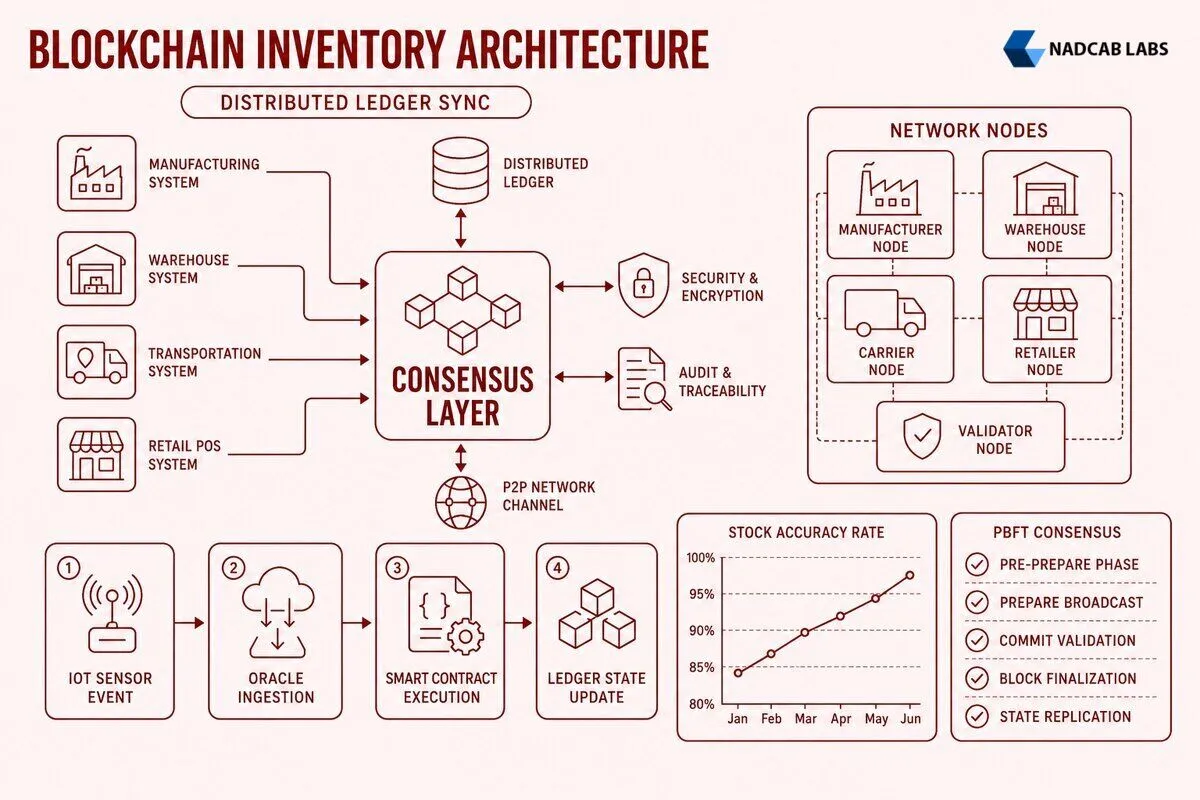
On-chain indexing strategies optimize read performance by maintaining auxiliary data structures that smart contracts update alongside the primary ledger. A state database like CouchDB or LevelDB stores the current inventory balance for each SKU as a key-value pair, enabling direct lookups without replaying the entire transaction history. When a smart contract processes a stock adjustment, it writes the new balance to both the immutable ledger and the state database in a single atomic operation. Applications query the state database for instant access to current inventory levels, achieving 10–50 millisecond response times compared to the seconds required to traverse the full blockchain.
Event logs provide a time-ordered history of inventory movements that analytics systems consume for reporting and forecasting. Each smart contract transaction emits events like “StockReceived,” “StockAllocated,” or “StockAdjusted” with metadata including SKU, quantity, location, and timestamp. Off-chain indexers subscribe to the event stream, parse the logs, and populate relational databases or data warehouses that power business intelligence dashboards. A supply chain analyst querying “total units received in Q1 2025” runs a SQL query against the indexed event table rather than scanning millions of blockchain transactions, reducing query time from minutes to seconds.
Materialized views aggregate inventory data across multiple dimensions for fast reporting. A view might pre-calculate total on-hand inventory by product category, warehouse region, and supplier, refreshing every 5 minutes as new transactions commit. When a logistics manager opens a dashboard showing regional stock distribution, the application reads the materialized view instead of summing individual SKU balances on-chain. This pattern mirrors the query optimization techniques in Investor Dashboard Architecture, where pre-aggregated metrics serve high-frequency read requests without overloading the underlying data layer.
Off-chain caching layers and API gateways handle high-frequency read requests without overloading blockchain nodes. A Redis cache sits between client applications and the blockchain network, storing the most recently queried inventory balances with a 30-second time-to-live. When an e-commerce site requests the stock level for a popular SKU, the API gateway checks Redis first. If the cache contains a fresh value, the gateway returns it immediately with sub-5-millisecond latency. Cache misses trigger a query to the blockchain state database, and the result populates the cache for subsequent requests. This architecture supports millions of inventory lookups per second during peak shopping events like Black Friday, far exceeding the throughput of direct blockchain queries.
GraphQL APIs provide flexible query interfaces that let clients request exactly the inventory data they need. A mobile app might query “SKU, quantity, and warehouse location” while a backend replenishment system requests “SKU, quantity, supplier, and lead time.” The GraphQL resolver fetches data from the blockchain state database, joins it with off-chain metadata like product descriptions, and returns a unified response. This reduces over-fetching and minimizes bandwidth consumption, especially important for IoT devices on cellular networks that poll inventory status to trigger automated reordering when stock falls below safety thresholds.
Query Performance by Access Pattern
Privacy-preserving query techniques allow supply chain partners to share aggregate inventory visibility while protecting confidential stock levels and pricing data. Zero-knowledge proofs enable a retailer to verify that a supplier has sufficient inventory to fulfill an order without revealing the exact on-hand quantity. The supplier generates a cryptographic proof that “inventory balance ≥ order quantity” and submits it to the blockchain. The retailer’s smart contract validates the proof and proceeds with the order, never learning whether the supplier has 1,000 units or 100,000 units in stock. This prevents competitors from reverse-engineering pricing strategies or demand forecasts based on visible inventory levels.
Encrypted state channels provide confidential inventory data sharing between two parties without broadcasting sensitive details to the entire network. A manufacturer and a tier-one supplier open a state channel where they exchange encrypted inventory updates off-chain. Only the channel participants hold the decryption keys, so other network members see only cryptographic hashes confirming that updates occurred. Periodically, the channel closes and submits a summary transaction to the main blockchain, recording the net inventory change without exposing individual movements. This pattern suits automotive and aerospace supply chains where proprietary part numbers and production volumes constitute trade secrets.
Range proofs allow queries like “how many warehouses have inventory between 500 and 1,000 units” without disclosing exact balances. A smart contract aggregates encrypted inventory data using homomorphic encryption, performs the range check, and returns a count. Logistics planners use this to identify regional stock imbalances and trigger inter-warehouse transfers without revealing competitive intelligence to rival distributors sharing the same blockchain network. The cryptographic overhead adds 50–200 milliseconds to query latency, acceptable for strategic planning dashboards but too slow for real-time order allocation.
What Integration Points Connect Blockchain Inventory Architecture to Existing Systems?
ERP and WMS adapters enable bidirectional inventory updates between legacy databases and blockchain ledgers without requiring a full system replacement. An SAP adapter monitors the blockchain event log for “StockReceived” and “StockShipped” events, then writes those transactions to the SAP material master table using standard BAPI calls. Simultaneously, when a warehouse operator performs a cycle count adjustment in the WMS, the adapter intercepts the database write, formats it as a blockchain transaction, and submits it through the organization’s validator node. This dual-write pattern maintains consistency between on-chain and off-chain systems, ensuring procurement modules that read from SAP see the same inventory balances as external partners querying the blockchain.
Middleware platforms like MuleSoft or Apache Camel orchestrate complex integration flows that transform data formats, handle retries, and manage error conditions. A typical flow listens for inventory adjustment events on the blockchain, validates the data against business rules, enriches it with product metadata from a master data management system, and writes the final record to both the ERP and a data warehouse. If the ERP write fails due to a network timeout, the middleware retries with exponential backoff and logs the failure for manual intervention. This resilience prevents inventory discrepancies that could arise from partial updates where the blockchain commits but the ERP does not.
IoT device integration feeds real-time stock movements to oracles through RFID readers, barcode scanners, and warehouse sensors. Businesses can also use a time calculator to track operational timelines, estimate delivery schedules, and optimize inventory management for improved efficiency. An RFID gateway installed at a warehouse receiving dock detects tagged pallets as forklifts move them into storage. The gateway publishes a JSON message to an MQTT broker containing the EPC codes, timestamps, and dock door number. A custom oracle subscribes to the MQTT topic, batches the messages every 10 seconds, cryptographically signs the batch, and submits it as a blockchain transaction. The smart contract parses the EPC codes, maps them to SKUs using an on-chain product registry, and increments the corresponding inventory balances. This automation eliminates manual data entry that introduces 2–5% error rates in traditional systems.
Barcode scanners at picking stations update blockchain inventory as warehouse workers fulfill orders. When a picker scans a unit to confirm it has been pulled from the shelf, the scanner sends the barcode and order ID to the WMS. The WMS adapter translates this into a blockchain transaction that decrements available stock and marks the unit as allocated to the order. The transaction includes the picker’s employee ID and a timestamp, creating an immutable audit trail that compliance teams use to investigate inventory shrinkage or fulfill regulatory reporting requirements. This integration pattern supports the transparent tracking requirements in Real Estate Tokenization Blockchain systems, where every asset movement must be cryptographically verified.
Warehouse sensors monitor environmental conditions and trigger inventory adjustments when thresholds are breached. A temperature sensor in a cold storage facility detects that a refrigeration unit failed, causing the ambient temperature to rise above 4°C for 3 hours. The sensor publishes an alert to an oracle, which submits a blockchain transaction flagging all perishable SKUs in that zone as potentially compromised. The smart contract automatically quarantines the affected inventory, preventing allocation to customer orders until a quality inspector physically verifies the goods and either releases them back to available stock or writes them off as damaged. This pattern ensures food safety compliance and reduces the risk of shipping spoiled products.
Cross-border logistics connectors synchronize inventory data across multi-jurisdictional supply chains and share customs documentation. When a shipment crosses from China to the United States, the exporter’s blockchain node submits a transaction containing the commercial invoice, packing list, and bill of lading as IPFS hashes. The importer’s customs broker queries the blockchain to retrieve the documents, verifies their cryptographic signatures, and files the entry with U.S. Customs and Border Protection. Once customs releases the shipment, the broker submits a blockchain transaction updating the inventory location from “in-transit” to “bonded warehouse.” This automated data sharing reduces clearance times from 3 days to 8 hours and eliminates the email exchanges and phone calls that plague international logistics.
Multi-jurisdictional inventory synchronization requires handling different regulatory regimes and data residency requirements. A European pharmaceutical distributor cannot store patient-identifiable data on blockchain nodes hosted in Asia due to GDPR restrictions. The architecture uses a federated ledger design where each region operates a separate blockchain instance, and cross-region transactions synchronize through a hub-and-spoke pattern. The European ledger records inventory movements within the EU, the Asian ledger tracks Asia-Pacific stock, and a global coordination layer reconciles inter-region transfers by exchanging cryptographic proofs rather than raw data. This approach mirrors the compliance patterns in Data Processing Services that segment sensitive data by jurisdiction while maintaining global visibility.
| Integration Point | Data Flow Direction | Update Frequency | Error Handling |
|---|---|---|---|
| ERP Adapter (SAP) | Bidirectional | Real-time event-driven | Retry with exponential backoff, manual escalation after 5 attempts |
| RFID Oracle | Warehouse → Blockchain | 10-second batch intervals | Discard malformed reads, flag sensor for calibration after 3 consecutive errors |
| Customs Broker API | Blockchain → Government System | On shipment arrival | Queue for manual filing if API unavailable, alert compliance officer |
| WMS Barcode Scanner | Warehouse → Blockchain | Immediate on scan | Local buffer if network down, sync when connectivity restored |
| Temperature Sensor | Cold Storage → Blockchain | 5-minute polling | Immediate alert on threshold breach, quarantine affected SKUs automatically |
Customs data sharing through blockchain eliminates the redundant document submission that delays cross-border shipments. Traditional processes require exporters to send the same commercial invoice to freight forwarders, customs brokers, and government agencies via email, fax, or proprietary portals. Each recipient manually re-enters the data into their systems, introducing errors and delays. A blockchain-based customs network allows the exporter to submit the invoice once as an on-chain transaction. All authorized parties—carrier, broker, customs authority—query the blockchain to retrieve the document, verify its authenticity through the exporter’s digital signature, and process the shipment without requesting additional paperwork. Pilot programs in Singapore and Rotterdam reduced customs clearance times by 40% and cut documentation costs by $15 per shipment.
Integration with Real World Asset Tokenization platforms enables inventory financing and supply chain financing use cases. A manufacturer tokenizes $5 million of finished goods inventory sitting in a warehouse, issuing digital tokens that represent ownership claims on specific SKUs. Lenders purchase the tokens, providing the manufacturer with immediate working capital while the inventory serves as collateral. As the manufacturer sells units and the blockchain records outbound shipments, the smart contract automatically burns the corresponding tokens and transfers the sale proceeds to the lender. This real-time synchronization between physical inventory movements and digital token balances eliminates the audit lag that makes traditional inventory financing expensive and risky.
Building on the principles of distributed consensus and oracle integration, production blockchain inventory systems achieve 40–60% reductions in stock discrepancies compared to legacy ERP-only architectures. A consumer electronics distributor operating 15 warehouses across North America deployed a Hyperledger Fabric network with RFID oracles and SAP adapters. After six months, cycle count variances dropped from an average of 4.2% to 1.7%, and the time to reconcile inter-warehouse transfers fell from 3 days to 4 hours. Order fulfillment speed improved by 25% because customer service representatives could query real-time inventory across all locations through a single API instead of calling each warehouse to check stock availability. These operational gains demonstrate how blockchain inventory management architecture transforms supply chain visibility from a periodic batch process into a continuous, trustworthy data stream that every stakeholder can rely on for critical business decisions.
Real-time inventory visibility blockchain architecture represents a fundamental shift from siloed, eventually-consistent databases to a shared, immediately-consistent ledger that synchronizes stock data across competing organizations without central intermediaries. By combining permissioned distributed ledgers, low-latency consensus mechanisms like PBFT and Raft, smart contracts that enforce business rules deterministically, and oracle networks that bridge physical sensors to digital state, these systems deliver the sub-second inventory updates that modern supply chains demand. Strategic integration with ERP systems, IoT devices, and cross-border logistics platforms ensures blockchain complements rather than replaces existing infrastructure, enabling incremental adoption that preserves legacy investments while unlocking new capabilities like privacy-preserving queries, automated reconciliation, and tokenized inventory financing. As Real Estate Tokenization Explained demonstrates similar patterns of asset digitization and transparent ownership tracking, inventory visibility architectures will continue to evolve toward hybrid models that balance on-chain immutability with off-chain performance, supporting the trillion-dollar global supply chain industry’s transition to real-time, trustless collaboration.
Frequently Asked Questions
Q1.What blockchain platform is best for real-time inventory visibility?
Hyperledger Fabric excels for real-time inventory visibility due to its permissioned architecture, private channels, and sub-second transaction finality. Ethereum Layer-2 solutions like Polygon offer public transparency with lower latency. Enterprise deployments favor Fabric for granular access control, while hybrid models combine private Fabric networks with public Ethereum anchoring for auditability across multi-tier supply chains.
Q2.How does blockchain architecture reduce inventory discrepancies across supply chain partners?
Blockchain creates a single source of truth where all partners write inventory updates to an immutable ledger with cryptographic timestamps. Smart contracts enforce validation rules before recording transactions, preventing double-counting or phantom stock. Consensus mechanisms ensure all nodes agree on inventory state changes, eliminating reconciliation delays and manual error correction between disparate ERP systems across warehouses, distributors, and retailers.
Q3.Can blockchain inventory systems scale to millions of SKUs in real-time?
Yes, through sharding, state channels, and hierarchical data structures. Hyperledger Fabric handles 3,500+ TPS per channel, supporting millions of SKUs via parallel channels per product category. Off-chain storage with IPFS manages detailed SKU metadata while blockchain records state hashes. Indexing layers like CouchDB enable sub-100ms queries across massive SKU datasets without compromising decentralization or consensus integrity.
Q4.What role do oracles play in blockchain inventory visibility architecture?
Oracles bridge physical inventory events to blockchain by ingesting data from IoT sensors, RFID readers, barcode scanners, and warehouse management systems. Chainlink or custom oracle networks validate and digitally sign real-world inventory movements before writing to smart contracts. They enable automated stock updates when goods move between locations, triggering reorder workflows and ensuring on-chain data reflects actual physical inventory states accurately.
Q5.How do smart contracts automate inventory reconciliation between warehouses and retailers?
Smart contracts execute predefined reconciliation logic when inventory transfer events occur. Upon shipment confirmation, contracts automatically debit warehouse stock and credit retailer inventory in a single atomic transaction. Discrepancy thresholds trigger automated alerts or dispute resolution workflows. Multi-signature approvals from both parties finalize transfers, eliminating manual spreadsheet reconciliation and reducing settlement times from days to minutes across distributed supply networks.
Q6.What are the latency requirements for real-time inventory queries on blockchain networks?
Enterprise inventory systems require sub-200ms query latency for acceptable user experience. Blockchain architectures achieve this through read replicas, indexed state databases, and caching layers that serve queries without consensus overhead. Write operations (inventory updates) tolerate 1-3 second finality for consistency. High-frequency trading scenarios demand <50ms, necessitating Layer-2 solutions or hybrid architectures with off-chain computation and periodic blockchain settlement.
Explore Services
Related Services
Reviewed by

Naman Singh
Co-Founder & CEO, Nadcab Labs
Naman Singh is the Co-Founder and CEO of Nadcab Labs, where he drives the company’s vision, global growth, and strategic expansion in blockchain, fintech, and digital transformation. A serial entrepreneur, Naman brings deep hands-on experience in building, scaling, and commercializing technology-driven businesses. At Nadcab Labs, Naman works closely with enterprises, governments, and startups to design and implement secure, scalable, and business-ready Web3 and blockchain solutions. He specializes in transforming complex ideas into high-impact digital products aligned with real business objectives. Naman has led the development of end-to-end blockchain ecosystems, including token creation, smart contracts, DeFi and NFT platforms, payment infrastructures, and decentralized applications. His expertise extends to tokenomics design, regulatory alignment, compliance strategy, and go-to-market planning—helping projects become investor-ready and built for long-term sustainability. With a strong focus on real-world adoption, Naman believes in building blockchain solutions that deliver measurable value, solve practical problems, and unlock new growth opportunities for organizations worldwide.