Ai Overview
Smart contract architecture for real estate tokenization requires a multi-layered design that separates ownership logic, compliance enforcement, financial distribution, and data integration into distinct, interoperable modules. Teams building these systems must balance security, flexibility, and real-world legal integration to create platforms that institutional investors and regulators will trust.
Smart contract architecture for real estate tokenization requires a multi-layered design that separates ownership logic, compliance enforcement, financial distribution, and data integration into distinct, interoperable modules. Unlike simple token contracts, property tokenization demands upgradeability patterns, oracle-fed property data, automated dividend mechanisms, and regulatory compliance modules that restrict transfers based on investor jurisdiction and accreditation status. Teams building these systems must balance security, flexibility, and real-world legal integration to create platforms that institutional investors and regulators will trust.
Key Takeaways
- Real estate tokenization contract design uses layered architecture: ownership registry, compliance module, asset management, and financial distribution contracts work together as a cohesive system
- Dividend distribution smart contracts automate rental income splitting proportionally to token holdings, using stablecoin integration and escrow reserves for property expenses
- Upgradeability patterns like transparent proxies and UUPS allow logic updates without token migration, essential for adapting to regulatory changes and property lifecycle events
- Real estate oracle integration feeds off-chain property valuations, occupancy rates, and legal status into on-chain contracts through decentralized data verification mechanisms
- Security patterns including multi-signature custody, time-lock delays, and formal verification protect high-value property assets and token holder funds from exploits
- Fractional ownership contract architecture must enforce transfer restrictions, accreditation checks, and jurisdiction rules while maintaining liquidity for compliant secondary markets
What are the core contract layers in real estate tokenization architecture?
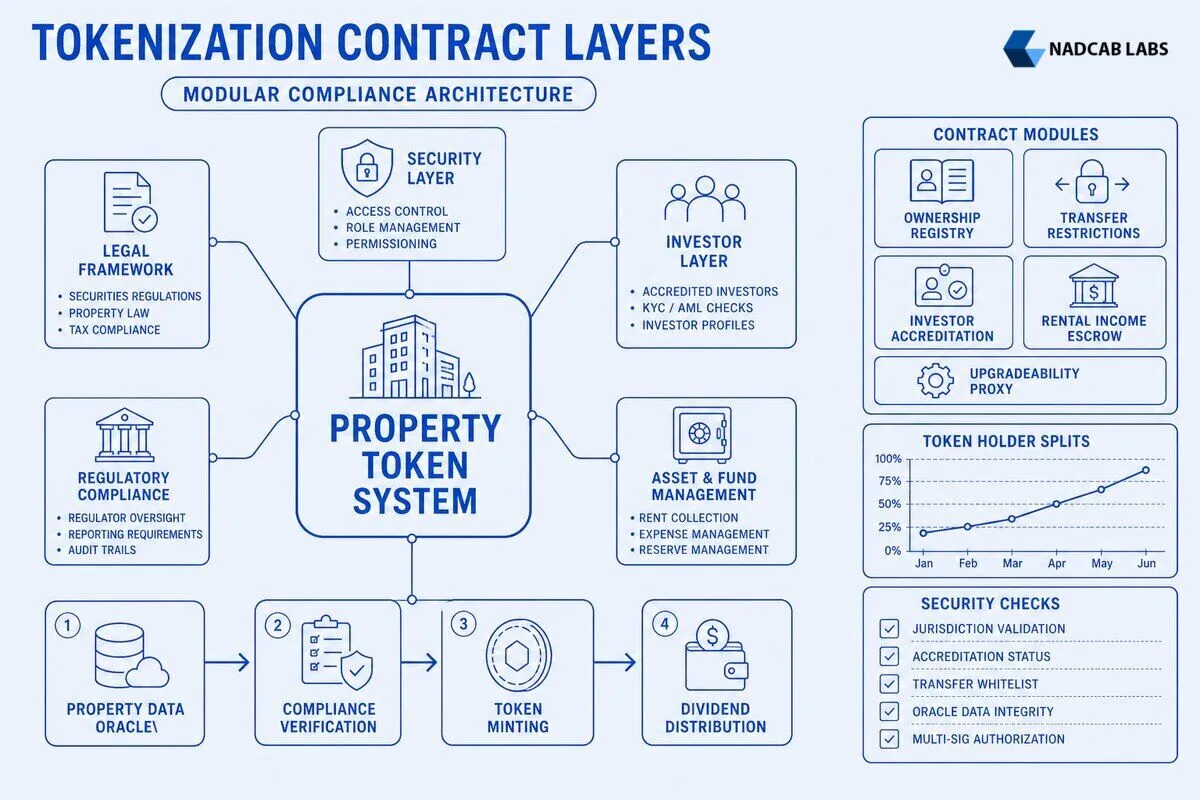
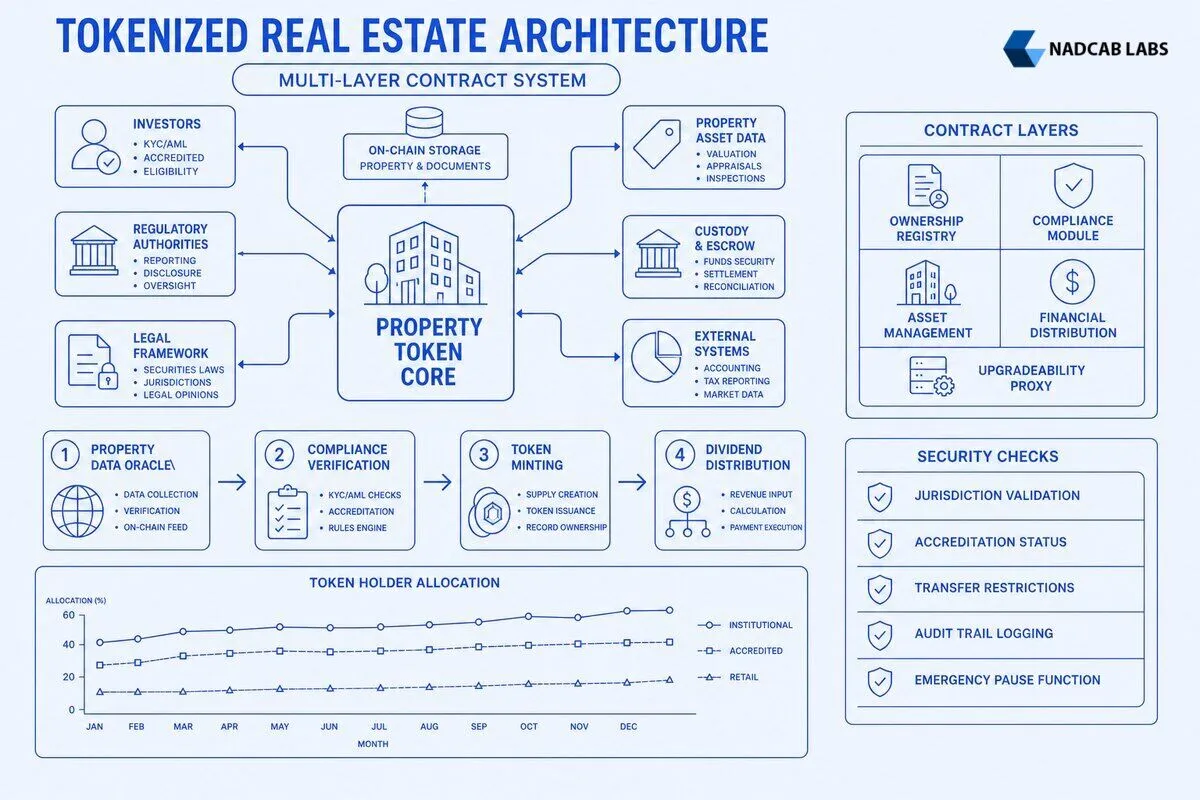
The foundation of any robust real estate tokenization platform rests on a carefully separated set of smart contract layers, each handling a distinct aspect of property ownership and management. This modular approach allows teams to update individual components without disrupting the entire system, a critical requirement when regulations change or property conditions evolve.
The ownership registry layer serves as the single source of truth for who holds fractional shares in a tokenized property. Unlike standard ERC-20 tokens that allow unrestricted transfers, property token smart contract layers implement transfer hooks that check compliance status before allowing any movement of tokens. This registry maintains a mapping of addresses to token balances, but it also stores metadata about each holder’s verification status, accreditation level, and jurisdiction. When Alice attempts to transfer 100 tokens representing 1% of a commercial building to Bob, the registry contract first queries the compliance module to confirm Bob meets all legal requirements for that specific property type and location.
The compliance module acts as the gatekeeper for all token operations. This layer enforces KYC (Know Your Customer) and AML (Anti-Money Laundering) checks by maintaining a whitelist of verified addresses. Each address receives attributes: accredited investor status, country of residence, entity type (individual, trust, corporation), and verification expiry dates. The module integrates with off-chain identity providers through oracle feeds or API gateways, updating on-chain status when an investor’s credentials change. For example, if a jurisdiction implements new restrictions on foreign property ownership, the compliance module can immediately flag affected addresses and prevent further transfers until those holders re-verify under the new rules. This asset tokenization approach ensures regulatory alignment across multiple markets.
The asset management layer creates the bridge between on-chain tokens and off-chain property reality. This contract stores immutable references to property deeds, title documents, appraisal reports, and lease agreements—typically as IPFS hashes or links to decentralized storage. It also maintains the current state of the property: occupancy percentage, maintenance schedule, insurance policy details, and property manager contact information. When a property undergoes renovation or changes tenants, authorized property managers update this layer through multi-signature transactions, creating an auditable history of all property events. The asset management contract emits events that trigger updates in the financial distribution layer, such as when a new lease increases expected rental income or when emergency repairs require tapping reserve funds.
These three layers communicate through well-defined interfaces, creating a separation of concerns that mirrors traditional real estate operations. The ownership registry doesn’t need to understand compliance rules—it simply asks the compliance module “can this transfer proceed?” before executing. The compliance module doesn’t track property details—it queries the asset management layer when determining if a holder’s token balance entitles them to voting rights on property decisions. This architecture allows teams to swap out individual modules as requirements evolve, a flexibility essential for long-term platform viability in the rapidly changing Real Estate Tokenization Explained landscape.
Contract Layer Communication Flow
Transfer Request
Check Balance
Verify Eligibility
Update Records
Transfer Complete
| Contract Layer | Primary Function | Gas Cost (avg) | Update Frequency |
|---|---|---|---|
| Ownership Registry | Token balance tracking and transfer execution | 65,000 gas | Every transfer |
| Compliance Module | KYC/AML verification and jurisdiction checks | 45,000 gas | Quarterly or on regulatory change |
| Asset Management | Property metadata and document references | 80,000 gas | Monthly or on property event |
| Financial Distribution | Dividend calculation and disbursement | 120,000 gas | Quarterly distribution cycles |
Teams implementing this architecture often start with a minimal viable product that combines all layers into a single contract, then gradually separate concerns as the platform scales. The initial monolithic approach reduces deployment complexity and gas costs for early testing, but the long-term benefits of modular design—especially when dealing with RWA tokenization smart contract architecture complexity—far outweigh the upfront engineering investment. Each layer can be audited independently, reducing the attack surface and making security reviews more manageable for third-party firms.
How do dividend distribution and rental income smart contracts work?
Automated revenue distribution represents one of the most compelling use cases for real estate tokenization, eliminating the manual accounting and delayed payments that plague traditional property syndications. A well-designed dividend distribution smart contract calculates each token holder’s proportional share of rental income, deducts operating expenses and reserve contributions, and disburses payments in stablecoins on a predetermined schedule—all without human intervention.
The core mechanism relies on a snapshot of token holdings at a specific block height, typically taken at the end of each quarter. When the property manager deposits rental income into the distribution contract (usually in USDC or USDT to avoid cryptocurrency volatility), the contract reads the total supply of property tokens and each holder’s balance from the ownership registry layer. The proportional calculation logic is straightforward: if Alice holds 500 tokens out of a 10,000 total supply, she receives 5% of the distributable income. However, the contract must account for several complications that make real-world implementation more nuanced than simple division.
First, the contract deducts operating expenses before calculating distributions. Property management fees, insurance premiums, property taxes, and utility costs are subtracted from gross rental income based on pre-approved budgets stored in the asset management layer. If a commercial building generates $100,000 in quarterly rent but incurs $25,000 in operating expenses, only $75,000 enters the distribution pool. The contract maintains a detailed expense ledger, emitting events for each deduction that token holders can verify against off-chain property management reports. This transparency builds trust and allows holders to audit whether their returns match the property’s actual performance.
Second, the contract allocates a percentage of net income to a reserve fund for future capital expenditures. Real estate requires ongoing maintenance—roof replacements, HVAC upgrades, parking lot resurfacing—that can’t be predicted with perfect accuracy. The reserve fund contract acts as an escrow, accumulating funds over time until the property manager submits a multi-signature request to withdraw money for approved repairs. Token holders vote on major expenditures above a certain threshold (say, $50,000), with voting power proportional to token holdings. This governance mechanism ensures that reserve funds can’t be misused while maintaining the flexibility to address urgent property needs. The Layer 2 Architecture approach can significantly reduce the gas costs of these frequent voting and distribution operations.
The actual disbursement process uses a pull-based pattern rather than pushing payments to every holder. After the contract calculates each holder’s share, it updates a mapping of addresses to claimable amounts. Token holders then call a claim function to withdraw their dividends, paying their own gas costs for the transaction. This design prevents the contract from running out of gas when distributing to hundreds or thousands of holders, a common failure mode in naive push-based implementations. The contract sets a claim deadline (typically 90 days after distribution), after which unclaimed funds roll into the next quarter’s distribution pool, preventing capital from sitting idle indefinitely.
Quarterly Distribution Breakdown (Sample $100K Property)
Stablecoin integration solves the volatility problem that would make native cryptocurrency distributions impractical for income-focused investors. A retiree holding tokenized apartment building shares expects predictable quarterly income, not wild swings based on Ethereum’s price movements. By denominating all financial operations in USDC or USDT, the platform provides dollar-denominated returns that match traditional real estate investment expectations. The distribution contract accepts stablecoin deposits from property managers and disburses the same stablecoin to token holders, creating a closed loop that isolates real estate performance from crypto market fluctuations.
Advanced implementations add tax optimization features, such as tracking each holder’s cost basis and generating annual tax reports. The contract can emit events containing all the data needed for 1099 forms or international equivalents, reducing the accounting burden on token holders. Some platforms integrate with off-chain tax software APIs, automatically populating forms based on on-chain transaction history. This level of automation transforms real estate tokenization from a technical novelty into a viable alternative to REITs and traditional syndications, particularly for cross-border investors who face complex tax reporting requirements. The principles behind Real Estate Token Smart Contract implementations on Ethereum provide a foundation for these advanced features.
Which upgradeability patterns ensure long-term contract flexibility?
Real estate assets have lifespans measured in decades, but smart contracts are immutable by default—a fundamental tension that upgradeability patterns resolve. When a jurisdiction changes securities regulations, when a property undergoes a major renovation that changes its income profile, or when a critical bug is discovered in the dividend calculation logic, teams need the ability to update contract code without forcing thousands of token holders to migrate to new addresses.
The transparent proxy pattern separates contract storage from logic, using a proxy contract that delegates all calls to an implementation contract. Token holders interact with the proxy address, which never changes, while administrators can point the proxy to new implementation contracts as needed. The proxy maintains all state variables—token balances, compliance whitelists, property metadata—in its own storage, ensuring that upgrades preserve existing data. When a team deploys a new implementation contract with improved dividend distribution logic, they call an upgrade function on the proxy (protected by multi-signature or governance controls), and all subsequent calls automatically use the new code. Token holders don’t need to approve anything or move their tokens; the upgrade is seamless from their perspective.
The UUPS (Universal Upgradeable Proxy Standard) pattern improves on the transparent proxy by moving the upgrade logic into the implementation contract itself, reducing gas costs and simplifying the proxy contract. This approach prevents certain attack vectors where malicious actors might try to trick the proxy into calling upgrade functions when it shouldn’t. UUPS has become the preferred pattern for new real estate tokenization projects because it offers better security guarantees and lower deployment costs. Teams using OpenZeppelin’s upgradeable contract libraries get UUPS functionality out of the box, along with initialization functions that replace constructors in the upgradeable context.
Modular architecture takes upgradeability a step further by allowing independent updates to different system components. Instead of a monolithic contract that handles ownership, compliance, and distributions in one codebase, the platform separates these concerns into distinct contracts that communicate through interfaces. When compliance requirements change—say, a new jurisdiction demands additional investor disclosures—the team deploys an updated compliance module without touching the ownership registry or distribution contracts. This surgical approach to updates minimizes risk and reduces the scope of security audits, since only the changed module needs re-verification. The Smart Contract Audit Architecture benefits significantly from this modular approach.
| Upgradeability Pattern | Deployment Cost | Upgrade Complexity | Best Use Case |
|---|---|---|---|
| Transparent Proxy | 1.2M gas | Medium | Simple ownership tokens with infrequent updates |
| UUPS Proxy | 950K gas | Low | Production platforms with regular feature additions |
| Diamond Pattern | 1.8M gas | High | Large platforms with many independent modules |
| Modular Contracts | 2.5M gas | Low per module | Enterprise systems requiring granular update control |
Governance mechanisms add a democratic layer to the upgrade process, preventing centralized control over critical contract functions. Token holders vote on proposed upgrades using their property tokens as voting power, typically requiring a supermajority (say, 67%) to approve major changes. The governance contract enforces a time delay between proposal submission and execution, giving the community time to review code changes and exit their positions if they disagree with the direction. This approach mirrors traditional real estate syndication governance, where limited partners vote on major decisions but defer day-to-day management to the general partner.
Some platforms implement a hybrid model where routine parameter changes (like adjusting the reserve fund percentage from 15% to 20%) can be executed by a multi-signature wallet of trusted administrators, while structural changes (like switching from quarterly to monthly distributions) require full token holder votes. This balance between agility and decentralization reflects the practical reality that most token holders don’t want to vote on every minor adjustment, but they do want veto power over fundamental changes to their investment terms. The governance contract maintains a registry of parameter types and their required approval thresholds, creating a transparent framework for all stakeholders.
The upgradeability patterns real estate tokens employ must account for legal considerations beyond pure technical functionality. If a contract upgrade changes the economic terms of the investment—say, increasing management fees or altering distribution schedules—it may require formal consent from token holders under securities law. Smart contract governance can’t override legal requirements, so platforms typically include legal review as a mandatory step in the upgrade workflow. The governance contract might require that a cryptographic hash of a legal opinion be submitted alongside the upgrade proposal, creating an auditable record that proper legal process was followed. This integration of legal and technical governance represents the maturation of real estate tokenization from experimental technology to institutional-grade infrastructure, similar to patterns seen in multi-chain MLM smart contract architecture for complex distributed systems.
What security patterns protect property token holders and assets?
High-value real estate assets demand security measures that go beyond standard smart contract best practices. When a single tokenized property represents tens of millions of dollars, the attack surface extends from technical exploits to social engineering, key compromise, and governance manipulation. A comprehensive security architecture layers multiple protective mechanisms, ensuring that no single point of failure can drain funds or transfer ownership without authorization.
Multi-signature custody forms the foundation of administrative security for property token platforms. Critical operations—minting new tokens when a property is tokenized, burning tokens when a property is sold, updating compliance whitelists, and withdrawing reserve funds—require approval from multiple independent signers. A typical configuration might use a 3-of-5 multi-sig wallet where the property manager, legal counsel, a token holder representative, and two independent security key holders each control one key. Any three of these parties must sign a transaction before it executes, preventing a single compromised account or malicious insider from unilaterally taking harmful actions. The multi-sig contract emits detailed events for every signature and execution, creating an audit trail that regulators and token holders can review.
Time-lock delays add a temporal dimension to security, giving the community a window to detect and respond to malicious proposals before they execute. When administrators submit a critical transaction—like upgrading the contract implementation or changing the property manager address—the time-lock contract enforces a mandatory waiting period (commonly 48 to 72 hours) before execution. During this window, token holders can review the proposed change, verify its legitimacy, and trigger an emergency pause if something looks suspicious. The time-lock mechanism creates a natural checkpoint where social consensus can override technical authority, a crucial safeguard when dealing with irreversible blockchain transactions.
Emergency pause mechanisms provide a circuit breaker for the entire platform when a critical vulnerability is discovered. The pause function, callable only by designated security guardians or through governance vote, freezes all token transfers, dividend distributions, and administrative operations until the threat is assessed and mitigated. This pattern saved millions of dollars in other DeFi protocols when zero-day exploits were discovered, giving teams time to deploy fixes before attackers could drain funds. The pause mechanism must be carefully designed to prevent abuse—a malicious actor shouldn’t be able to freeze the platform indefinitely—so most implementations include a maximum pause duration (say, 7 days) after which normal operations automatically resume unless the pause is renewed through proper governance channels.
Security Incident Response Flow
Automated monitoring alerts security team
Guardian triggers circuit breaker (max 7 days)
Security audit identifies root cause and impact
Upgraded contract via time-locked multi-sig
Unpause after community verification period
At the code level, reentrancy guards prevent one of the most common smart contract exploits. When a dividend distribution contract sends stablecoins to a token holder, it must update the holder’s claimable balance before making the external call, not after. Otherwise, a malicious contract could recursively call the claim function during the payout, draining the distribution pool before the balance update occurs. OpenZeppelin’s ReentrancyGuard modifier provides a simple mutex pattern that prevents any function from being called again until the first invocation completes, eliminating this entire class of vulnerabilities with minimal gas overhead.
Overflow and underflow checks, now built into Solidity 0.8+ by default, prevent arithmetic errors that could corrupt token balances or distribution calculations. In earlier Solidity versions, adding one to the maximum uint256 value would wrap around to zero, potentially allowing attackers to mint unlimited tokens or claim dividends they didn’t earn. Modern Solidity reverts transactions when arithmetic operations would overflow, but teams working with legacy contracts or custom math libraries must explicitly include SafeMath operations to achieve the same protection. Financial logic in real estate tokenization contracts—especially dividend calculations involving percentages and fractional shares—must be thoroughly tested with edge cases like single-wei balances and maximum supply scenarios.
Formal verification takes security to the mathematical level, using automated theorem provers to verify that contract code behaves exactly as specified under all possible inputs. Teams working with high-value property tokenization increasingly adopt formal verification for critical financial functions, writing mathematical specifications that describe intended behavior (like “the sum of all token holder balances must always equal total supply”) and proving that the code satisfies these invariants. While formal verification requires specialized expertise and adds development time, it provides a level of assurance that traditional testing can never achieve, particularly valuable when a single bug could cost millions of dollars. The Zero Knowledge Proof Real Estate Tokenization approach adds another layer of privacy-preserving security for sensitive investor data.
Access control patterns ensure that only authorized addresses can call sensitive functions. The ownership registry contract might allow only the compliance module to update KYC status, only the property manager multi-sig to deposit rental income, and only the governance contract to trigger upgrades. Role-based access control (RBAC) systems define granular permissions—MINTER_ROLE, PAUSER_ROLE, UPGRADER_ROLE—and assign these roles to specific addresses or multi-sig wallets. The access control contract emits events when roles are granted or revoked, creating transparency around who has permission to do what. This pattern mirrors traditional corporate governance structures while leveraging blockchain’s transparency to make all permission changes publicly auditable, a significant improvement over opaque traditional systems where insider access is often poorly documented.
How do oracles integrate off-chain property data with on-chain contracts?
Smart contracts exist in a deterministic, isolated environment where they can only access data that’s already on the blockchain. Real estate properties, by contrast, exist in the physical world with constantly changing attributes—current market value, occupancy rates, lease status, maintenance condition, and legal encumbrances. Oracles serve as the bridge between these two worlds, feeding verified off-chain data into on-chain contracts in a way that preserves the security and trust assumptions of the blockchain.
Chainlink represents the most widely adopted decentralized oracle network for real estate tokenization, offering data feeds that aggregate information from multiple sources before pushing it on-chain. A property valuation oracle might collect appraisal data from three independent real estate appraisal firms, calculate the median value to filter out outliers, and submit this consensus value to the asset management contract. The contract then uses this valuation to update the net asset value per token, which investors reference when deciding whether to buy or sell on secondary markets. Chainlink’s decentralized architecture prevents any single data provider from manipulating valuations, a critical protection when property values directly impact token prices and investor decisions.
Custom oracle networks offer more flexibility for specialized real estate data that general-purpose oracle providers don’t support. A platform tokenizing commercial office buildings might deploy its own oracle network that monitors occupancy sensors, lease management systems, and property tax databases, aggregating this data through a network of trusted nodes operated by property managers, auditors, and technology partners. Each oracle node stakes collateral that gets slashed if they submit provably false data, creating economic incentives for honest reporting. The oracle contract requires a supermajority (say, 5 of 7 nodes) to agree on a data point before accepting it as valid, implementing a Byzantine fault-tolerant consensus mechanism that can tolerate some malicious or offline nodes.
Event-driven triggers allow smart contracts to automatically respond to real-world property milestones without manual intervention. When a property is sold, the title company submits a cryptographically signed transaction to the oracle contract confirming the sale price and closing date. This triggers the asset management contract to update the property status to “sold” and initiates the token redemption process, where token holders exchange their tokens for their proportional share of the sale proceeds. Similarly, when a major lease is signed, the property manager submits lease terms to the oracle, which triggers the distribution contract to update expected future income and recalculate dividend projections. These automated workflows reduce administrative overhead and ensure that on-chain data stays synchronized with off-chain reality.
| Data Type | Update Frequency | Oracle Source | Verification Method |
|---|---|---|---|
| Property Valuation | Quarterly | 3 independent appraisers via Chainlink | Median consensus |
| Occupancy Rate | Monthly | Property management system API | Cross-check with utility usage data |
| Lease Status | On event | Legal document signing service | Cryptographic signature verification |
| Tax Assessment | Annually | County assessor public records | Multiple node attestation |
| Insurance Claims | On event | Insurance company direct feed | Multi-sig approval from insurer + property manager |
Decentralized data verification mechanisms address the fundamental challenge that oracle data comes from centralized, potentially untrustworthy sources. Even if a property appraisal firm has a stellar reputation, a single corrupt employee could submit inflated valuations to manipulate token prices. To mitigate this risk, advanced oracle systems implement cryptographic attestations where data providers sign their submissions with private keys, creating an auditable chain of custody. The oracle contract verifies these signatures before accepting data, ensuring that submissions genuinely come from authorized sources and haven’t been tampered with in transit. Some platforms go further by requiring data providers to stake tokens that get slashed if their submissions deviate significantly from the consensus, creating skin-in-the-game incentives for accuracy.
The oracle integration pattern typically follows a request-response cycle. When the asset management contract needs updated property data—say, to calculate the quarterly net asset value—it emits a DataRequest event specifying what information it needs and by when. Oracle nodes monitoring the blockchain see this event, fetch the requested data from their off-chain sources, and submit responses to the oracle contract. Once enough nodes have responded (meeting the required consensus threshold), the oracle contract aggregates the data and calls back into the asset management contract with the result. This asynchronous pattern allows contracts to request data on-demand rather than paying for continuous data feeds they might not need, reducing oracle costs for properties with infrequent valuation updates.
Real estate oracle integration presents unique challenges compared to simpler price feeds for cryptocurrencies or commodities. Property data is heterogeneous—each building has unique attributes—and often subjective, especially for valuations that depend on comparable sales analysis and market forecasts. Oracles must handle this complexity by supporting flexible data schemas that can represent diverse property types (residential, commercial, industrial, land) and by implementing dispute resolution mechanisms when oracle nodes disagree on subjective assessments. Some platforms use a two-tier oracle system where objective data (like lease expiration dates) flows through automated feeds, while subjective data (like property condition ratings) requires manual review and multi-signature approval from designated experts. This hybrid approach balances automation with the human judgment that real estate inherently requires, creating a bridge between blockchain determinism and real-world complexity that teams building Real Estate Tokenization platforms must carefully architect.
The future of real estate oracles likely involves integration with IoT sensors and smart building systems, creating real-time data streams that update property status continuously rather than in discrete snapshots. Imagine a tokenized apartment building where occupancy sensors automatically report vacancy rates, smart meters track utility usage as a proxy for tenant activity, and HVAC systems report maintenance needs before equipment fails. These data streams feed into the oracle network, which aggregates and verifies the information before pushing it to the asset management contract. This level of automation transforms property management from a reactive, manual process into a proactive, data-driven operation that maximizes property value and investor returns. Teams implementing these advanced oracle architectures often work with Real World Asset Tokenization specialists who understand both blockchain infrastructure and traditional real estate operations, ensuring that the technical architecture serves genuine business needs rather than pursuing technology for its own sake.
Smart contract architecture for real estate tokenization represents the convergence of blockchain technology, securities law, property management, and financial engineering. Teams building these systems must master layered contract design, automated financial distribution, upgradeability patterns, comprehensive security measures, and oracle integration—all while maintaining compliance with evolving regulations across multiple jurisdictions. The platforms that succeed will combine technical excellence with deep understanding of real estate operations, creating infrastructure that institutional investors trust and that regulators can audit. As the technology matures and more properties move on-chain, the architectural patterns established today will form the foundation for a global, liquid real estate market accessible to investors worldwide, democratizing access to an asset class that has historically been the preserve of the wealthy and well-connected.
Frequently Asked Questions
Q1.What is the difference between ERC-20 and ERC-1400 for real estate tokens?
ERC-20 is a basic fungible token standard lacking compliance controls, making it unsuitable for regulated securities. ERC-1400 adds partition-based transfers, document management, and controller functions that enforce KYC/AML rules and transfer restrictions required for real estate security tokens. ERC-1400 supports granular investor permissions, regulatory compliance hooks, and forced transfers for legal recovery scenarios that ERC-20 cannot natively provide.
Q2.How do compliance modules restrict token transfers based on investor jurisdiction?
Compliance modules maintain whitelists mapping wallet addresses to verified jurisdictions and accreditation status. Before each transfer, the smart contract queries this registry to check sender and receiver eligibility against jurisdiction rules and holding-period locks. If either party fails compliance checks—such as restricted country codes or missing KYC—the transaction reverts. This ensures only qualified investors in permitted regions can hold tokens.
Q3.Can smart contracts automatically distribute rental income to token holders?
Yes. Property managers deposit rental proceeds into the contract’s treasury wallet. A distribution function calculates each holder’s pro-rata share based on token balance, then batch-transfers stablecoins or native tokens proportionally. Automated triggers can execute monthly payouts on-chain, recording every distribution immutably. Gas-optimized batch transfers reduce costs, and holders claim dividends permissionlessly without intermediary delays or manual reconciliation.
Q4.What happens if a property needs major repairs—how do smart contracts handle reserve funds?
Smart contracts allocate a percentage of rental income to a dedicated reserve fund address. Governance proposals allow token holders to vote on releasing funds for approved repairs. Once a proposal passes, a multi-signature wallet or DAO executor transfers the reserved amount to contractors. All transactions are recorded on-chain, ensuring transparent capital expenditure tracking and preventing unauthorized withdrawals from operating or reserve accounts.
Q5.How do upgradeability proxies work without requiring investors to swap tokens?
Upgradeability proxies use a proxy contract holding the token state and a separate logic contract containing business rules. The proxy delegates calls to the logic contract via delegatecall, preserving storage. Admins can point the proxy to a new logic implementation, updating functionality while the token address and balances remain unchanged. Investors never migrate tokens; upgrades happen transparently behind the proxy interface, maintaining continuity.
Q6.Which oracles are most reliable for feeding property valuation data into smart contracts?
Chainlink and API3 are widely trusted for real-world data feeds, offering decentralized oracle networks that aggregate multiple appraisal sources. Chainlink’s Proof of Reserve and external adapters can pull verified property valuations from licensed appraisers. API3’s first-party oracles connect directly to data providers, reducing intermediary risk. Hybrid models combining on-chain attestations with off-chain signed reports from accredited valuers offer the highest reliability and auditability.
Explore Services
Related Services
Reviewed by

Aman Vaths
Founder of Nadcab Labs
Aman Vaths is the Founder & CTO of Nadcab Labs, a global digital engineering company delivering enterprise-grade solutions across AI, Web3, Blockchain, Big Data, Cloud, Cybersecurity, and Modern Application Development. With deep technical leadership and product innovation experience, Aman has positioned Nadcab Labs as one of the most advanced engineering companies driving the next era of intelligent, secure, and scalable software systems. Under his leadership, Nadcab Labs has built 2,000+ global projects across sectors including fintech, banking, healthcare, real estate, logistics, gaming, manufacturing, and next-generation DePIN networks. Aman’s strength lies in architecting high-performance systems, end-to-end platform engineering, and designing enterprise solutions that operate at global scale.