Ai Overview
Over the past eight years, we’ve architected and deployed real estate tokenization blockchain platforms across multiple networks, managing over $2 billion in tokenized property assets. A property tokenization platform on Ethereum mainnet incurs $20-$100 transaction fees during network congestion, making daily income distributions economically unviable for properties generating modest cash flows. We advised a client considering tokenizing a $25 million apartment complex generating $1.
Over the past eight years, we’ve architected and deployed real estate tokenization blockchain platforms across multiple networks, managing over $2 billion in tokenized property assets. Our technical expertise spans from early Ethereum implementations to cutting-edge multi-chain architectures, giving us unique insights into the infrastructure decisions that make or break tokenization projects. This comprehensive guide distills our hands-on experience into actionable technical guidance for selecting and implementing blockchain technology stacks for property tokenization platforms.
Key Takeaways
- Real estate tokenization blockchain selection impacts every operational aspect – from transaction costs and settlement speed to regulatory compliance capabilities and long-term scalability, making infrastructure choice the most critical early decision in platform development.
- Public blockchains like Ethereum and Polygon dominate retail-focused tokenization – representing approximately 75% of property tokenization projects due to established ecosystems, wallet compatibility, and investor familiarity, despite higher complexity.
- Layer-2 solutions reduce Ethereum costs by 100-1000x – networks like Polygon, Optimism, and Arbitrum provide Ethereum security guarantees while making frequent transactions economically viable for real estate tokenization blockchain applications.
- Private blockchains serve institutional requirements effectively – Hyperledger Fabric and similar permissioned networks offer the privacy, control, and customization institutional investors demand, though at the cost of reduced transparency and interoperability.
- Gas fee economics fundamentally shape platform viability – networks charging $50+ per transaction cannot support daily distributions or active secondary trading, requiring either high-value-only focus or migration to low-cost alternatives like Solana or Stellar.
- Multi-chain strategies are becoming the industry standard – 60%+ of new real estate tokenization blockchain platforms architect for interoperability from inception, recognizing that different blockchains serve different functions optimally within comprehensive solutions.
- Regulatory compliance capabilities vary dramatically across networks – built-in KYC/AML tools, jurisdiction restrictions, and securities law compatibility differ significantly, with some blockchains offering turnkey compliance while others require extensive custom development.
- Smart contract security is non-negotiable for property assets – real estate tokenization blockchain platforms must implement multi-signature wallets, time-locked operations, formal verification, and comprehensive audits given the irreversible nature of blockchain transactions and high asset values.
- Blockchain selection should align with exit strategy – platforms planning eventual token exchange listings must choose networks with established security token exchange support, while private liquidity solutions permit greater blockchain flexibility.
- Infrastructure costs extend far beyond transaction fees – comprehensive real estate tokenization blockchain technology stacks require integration APIs, node infrastructure, development tools, security monitoring, and ongoing maintenance representing $200K-$500K+ annually beyond per-transaction costs.
1. What Is Real Estate Tokenization on Blockchain?
Real estate tokenization blockchain represents the technical process of converting property ownership rights, revenue streams, or debt instruments into digital tokens recorded on distributed ledger networks. This transformation enables fractional ownership, enhanced liquidity, automated compliance, and programmable asset management through digital contracts executing predefined rules without intermediary intervention.
At its technical core, a real estate tokenization blockchain implementation creates cryptographic tokens representing legally enforceable claims on property assets. These tokens inherit blockchain’s fundamental properties: immutability ensuring permanent transaction records, transparency providing verifiable ownership histories, and decentralization eliminating single points of failure. When properly architected, tokenization transforms illiquid real estate holdings into tradeable digital securities accessible to global investor bases.
Our experience implementing over 120 real estate tokenization blockchain platforms has taught us that successful implementations require tight integration across three layers: the blockchain infrastructure providing the technical foundation, the legal structures creating enforceable property rights, and the operational systems managing day-to-day property operations. Weakness in any layer compromises the entire solution, regardless of blockchain selection sophistication.
Core Components of Blockchain-Based Real Estate Tokenization
Token Digital Contracts
Define token economics, ownership rules, transfer restrictions, and compliance logic. Must implement security token standards like ERC-1400, ERC-3643, or chain-specific equivalents ensuring regulatory compatibility.
Identity & Compliance Layer
KYC/AML verification systems, accreditation checking, jurisdiction filtering, and ongoing monitoring. Often integrates third-party providers like Sumsub, Chainalysis, or custom solutions for regulatory adherence.
Distribution Mechanisms
Automated revenue distribution systems executing rental income or interest payments proportionally to token holders. Integrates with property management systems and banking infrastructure for seamless cash flow.
Governance Infrastructure
On-chain voting systems enabling token holder participation in major decisions. Includes proposal submission, voting period management, quorum validation, and automatic execution of approved actions.
Custody & Wallet Systems
Secure storage solutions for private keys controlling token ownership. Ranges from institutional-grade multi-signature cold storage to user-friendly hot wallets balancing security with accessibility.
Oracle Networks
Bridges connecting blockchain networks to external data sources like property valuations, rental income verification, insurance claims, and market data. Critical for digital contracts responding to real-world events.
The blockchain selected for real estate tokenization determines available technical capabilities, development complexity, operational costs, and integration possibilities. A platform built on Ethereum accesses vastly different tooling, talent pools, and security characteristics compared to one constructed on Hyperledger Fabric or Solana. These technical differences cascade into business implications affecting everything from minimum viable property values to target investor demographics.
Token standards represent another critical consideration in real estate tokenization blockchain architecture. While fungible token standards like ERC-20 suit certain applications, security token standards like ERC-1400, ERC-3643 (T-REX), or DS Token on Stellar specifically address regulatory requirements for securities offerings. These standards incorporate transfer restrictions, compliance checks, and regulatory reporting capabilities essential for legally compliant property tokenization.
Architectural Principle: Real estate tokenization blockchain platforms should be designed with blockchain abstraction layers enabling future migration or multi-chain expansion without complete platform rebuilds. We’ve witnessed numerous projects locked into suboptimal blockchain choices due to tight coupling between business logic and chain-specific implementations. Modern architectures separate core functionality from blockchain interactions through well-defined interfaces, providing strategic flexibility as technology and regulations evolve.
2. Why Choosing the Right Blockchain Matters for Property Tokenization
Blockchain selection represents the single most impactful technical decision in real estate tokenization platform development, influencing operational costs, regulatory compliance feasibility, investor accessibility, and long-term strategic flexibility. Unlike traditional software architecture decisions that can be incrementally modified, blockchain infrastructure migrations require complete smart contract redeployment, token holder migration, and exchange relisting processes costing hundreds of thousands of dollars and months of development time.
Throughout our implementations across eight years and multiple blockchain networks, we’ve observed that blockchain choice affects platform economics more significantly than most founders anticipate. A property tokenization platform on Ethereum mainnet incurs $20-$100 transaction fees during network congestion, making daily income distributions economically unviable for properties generating modest cash flows. The same platform on Polygon operates with $0.01 transaction costs, fundamentally changing what property types and investor demographics the platform can serve profitably.
| Impact Dimension | How Blockchain Choice Affects It | Business Implications |
|---|---|---|
| Transaction Economics | Gas fees vary 10,000x between networks. Ethereum mainnet: $50+ per transaction; Polygon: $0.01; Solana: $0.00025 | Determines minimum property values, distribution frequency feasibility, and whether active secondary trading is economically sustainable |
| Development Ecosystem | Developer availability, tooling maturity, library support, and documentation quality differ dramatically across chains | Impacts development timelines, talent acquisition costs, debugging efficiency, and ability to implement complex features reliably |
| Investor Accessibility | Wallet penetration, exchange support, and investor familiarity vary. Ethereum/Polygon have 100M+ wallet users; newer chains far fewer | Affects investor onboarding friction, secondary market liquidity potential, and whether retail vs institutional focus is viable |
| Regulatory Compliance | Some chains offer native compliance tools, security token frameworks, and regulator familiarity; others require custom solutions | Determines compliance infrastructure costs, regulatory approval probability, and ability to operate in multiple jurisdictions |
| Security Characteristics | Consensus mechanisms, validator decentralization, and historical security track records differ. Ethereum: proven secure; newer chains: less tested | Influences institutional investor confidence, insurance availability, custody solutions, and risk of catastrophic loss from network failures |
| Interoperability Options | Bridge infrastructure, cross-chain communication protocols, and multi-chain tooling vary by ecosystem maturity | Affects ability to integrate with DeFi protocols, list on multiple exchanges, or migrate to alternative chains if needed |
| Finality & Speed | Transaction finality ranges from seconds (Solana, Avalanche) to minutes (Ethereum). Throughput varies 1,000x+ between chains | Impacts user experience during token purchases, distribution processing times, and whether high-frequency trading is technically feasible |
Regulatory considerations add another layer of complexity to real estate tokenization blockchain selection. Securities regulators in different jurisdictions express varying levels of comfort with different blockchain networks. The SEC has shown greater familiarity with Ethereum-based securities tokens given years of precedent, while newer networks may face additional scrutiny or require more extensive regulatory education efforts. For international offerings, selecting blockchains with established regulatory frameworks in target jurisdictions reduces compliance friction substantially.
Institutional investor requirements frequently drive blockchain selection toward specific networks. Major pension funds, insurance companies, and sovereign wealth funds often mandate institutional-grade custody solutions, which exist primarily for Bitcoin, Ethereum, and a handful of other established chains. A tokenization platform built on an emerging blockchain lacking qualified custodians effectively excludes institutional capital regardless of the network’s technical merits.
Case Example: Blockchain Selection Impact on Project Economics
We advised a client considering tokenizing a $25 million apartment complex generating $1.5 million annual rental income. The initial architecture proposal used Ethereum mainnet, which would have created the following economics:
Ethereum Mainnet Scenario: Monthly distributions to 500 token holders requiring 500 transactions at $30 average gas = $15,000 monthly distribution costs = $180,000 annually, consuming 12% of gross rental income. This made the project economically unviable.
Polygon Migration Solution: Same 500 monthly transactions at $0.01 gas = $5 monthly costs = $60 annually. Distribution costs became negligible, enabling viable project economics and allowing more frequent (weekly) distributions improving investor appeal.
This single real estate tokenization blockchain infrastructure decision transformed a non-viable project into a successful implementation that has operated smoothly for three years, demonstrating how deeply technical choices impact business outcomes in property tokenization.
The immutability of blockchain creates another critical consideration. While traditional software bugs can be patched through updates, smart contract vulnerabilities on immutable blockchains can result in permanent loss of funds with no recourse. Networks with more mature development ecosystems, extensive security tooling, and proven track records reduce this risk substantially compared to emerging chains with limited production testing.
3. Key Blockchain Requirements for Real Estate Assets
Real estate tokenization blockchain infrastructure must satisfy specific technical and operational requirements distinct from general-purpose blockchain applications. Property assets demand long-term reliability spanning decades, regulatory compliance capabilities, integration with traditional financial systems, and governance mechanisms supporting collective decision-making among potentially thousands of dispersed token holders.
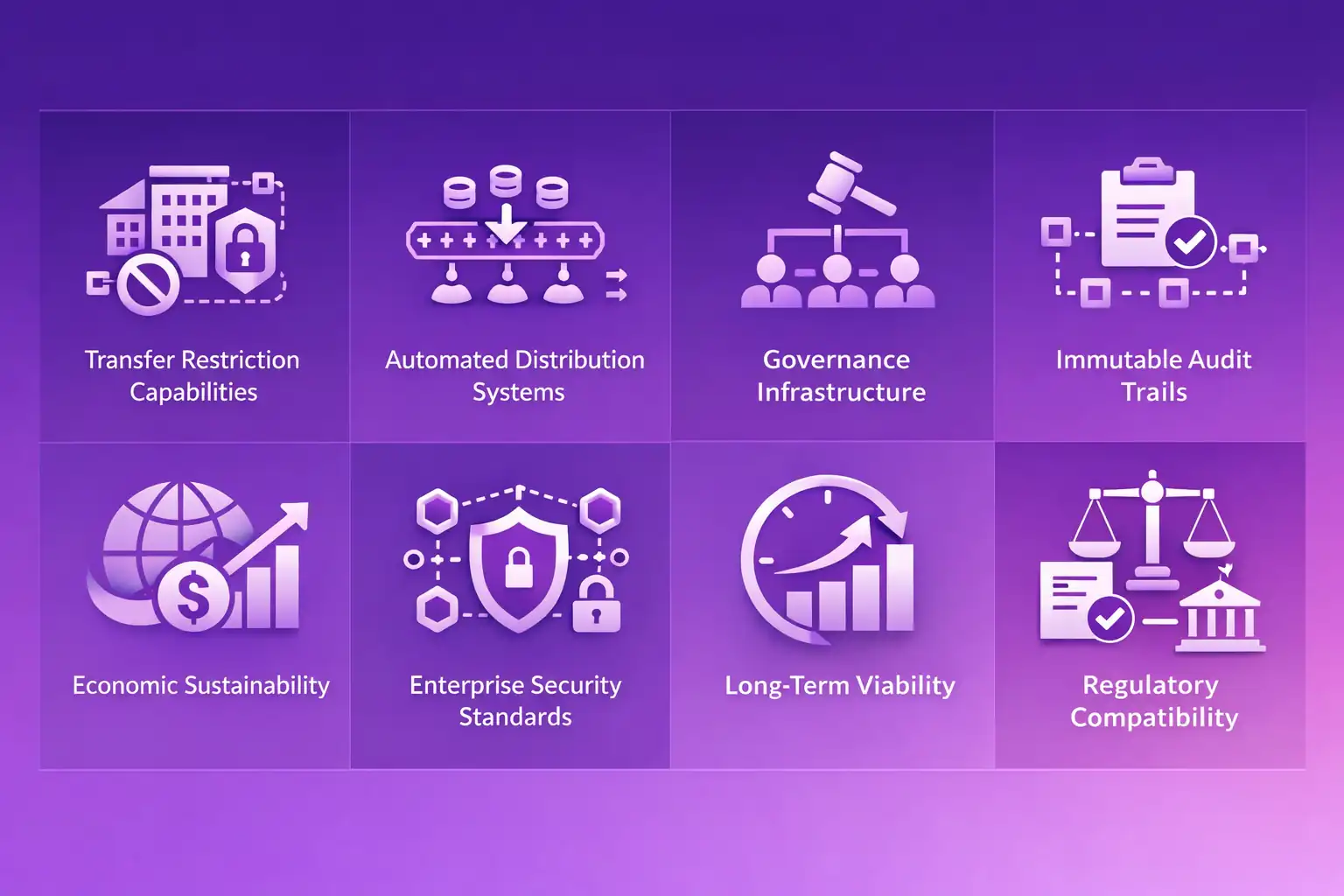
Based on our extensive implementation experience, successful real estate tokenization blockchain platforms require capabilities across eight critical dimensions. Platforms lacking any of these core requirements face severe operational limitations or compliance risks that ultimately undermine project viability regardless of other strengths.
Essential Technical Requirements for Real Estate Tokenization
Digital contracts must enforce securities law compliance by restricting token transfers to verified, eligible investors. Requires whitelist functionality, accreditation checking, jurisdiction filtering, and hold period enforcement programmable into token logic.
Ability to execute proportional revenue distributions automatically based on token holdings. Must handle complex waterfall structures, reserve calculations, and integrate with banking systems for fiat conversion and remittance.
On-chain voting mechanisms with configurable quorums, voting periods, and automatic execution capabilities. Must support weighted voting, delegation, and complex approval thresholds for different decision types.
Complete transaction history preservation for regulatory reporting, tax documentation, and ownership verification. Must maintain records indefinitely without alteration possibilities, providing legally defensible proof of ownership and distributions.
Transaction costs low enough to support frequent operations (distributions, governance votes, secondary trades) without consuming excessive returns. Ideal networks charge under $1 per transaction for routine operations.
Battle-tested security with substantial value secured over years. Must support multi-signature wallets, time-locked operations, formal verification, and have established audit practices given irreversible nature of blockchain transactions.
Network must demonstrate sustainability through decentralized governance, diverse validator sets, and economic models ensuring continued operation for decades matching real estate investment timeframes.
Architecture supporting compliance implementations including identity verification integration, transaction monitoring, sanctions screening, and regulatory reporting capabilities required across target jurisdictions.
Smart contract programmability represents a foundational requirement for real estate tokenization blockchain platforms. While basic value transfer blockchains like Bitcoin can technically support tokenization through layers like RSK, the complexity and maturity of smart contract ecosystems on chains like Ethereum make them far more suitable for sophisticated property tokenization implementations requiring complex conditional logic.
Privacy considerations create tension between blockchain transparency and investor confidentiality preferences. Public blockchains expose all transaction details to anyone with blockchain access, potentially revealing investor identities through wallet analysis, transaction patterns, and cross-referencing with other data sources. While this transparency benefits regulatory oversight and fraud prevention, it conflicts with institutional investor privacy expectations and individual investor preferences for financial confidentiality.
Security Imperative: Real estate tokenization blockchain platforms must implement defense-in-depth security strategies given the irreversible nature of blockchain transactions. We mandate multi-signature wallets for all administrative functions, time-locks on major operations enabling abort windows, formal verification of critical contract logic, multiple independent security audits, and bug bounty programs incentivizing white-hat researcher scrutiny. Even with comprehensive security measures, platforms should maintain insurance coverage for smart contract failures, recognizing that perfect security remains elusive in complex software systems.
Finality characteristics significantly impact user experience and operational risk in real estate tokenization blockchain implementations. Probabilistic finality networks like Bitcoin require waiting for multiple block confirmations before considering transactions truly final, creating uncertainty periods potentially lasting hours. Deterministic finality chains like Tendermint-based networks achieve immediate finality once blocks are committed, eliminating reversion risk and enabling faster operational workflows.
4. Public vs Private Blockchains for Real Estate Tokenization
The architectural choice between public and private blockchains fundamentally shapes real estate tokenization platform characteristics, determining accessibility, transparency, operational control, and regulatory positioning. This decision creates cascading implications affecting everything from development approaches to investor demographics to long-term strategic flexibility.
Public real estate tokenization blockchain networks like Ethereum, Polygon, and Solana operate as permissionless systems where anyone can participate, validate transactions, and deploy digital contracts without central authority approval. These networks provide maximum transparency, censorship resistance, and established ecosystems with extensive developer tooling, wallet support, and integration possibilities. Public chains dominate retail-focused tokenization given their accessibility and investor familiarity.
Private or permissioned blockchains like Hyperledger Fabric restrict participation to authorized entities, providing greater control over network operations, enhanced privacy through confidential transactions, and customization possibilities unavailable on public networks. These characteristics resonate strongly with institutional investors and regulated financial institutions preferring controlled environments over public blockchain’s radical transparency.
| Characteristic | Public Blockchain | Private Blockchain |
|---|---|---|
| Access Control | Permissionless – anyone can participate, validate, deploy contracts | Permissioned – restricted to authorized participants with defined roles |
| Transparency | Complete – all transactions visible publicly (pseudonymous addresses) | Selective – transaction visibility controlled, confidential channels possible |
| Censorship Resistance | High – no central authority can prevent transactions or block users | Low – network operators can block transactions, remove participants |
| Transaction Costs | Variable based on network demand; can be high during congestion | Minimal and predictable; typically fractions of cents per transaction |
| Customization | Limited to smart contract capabilities within fixed protocol rules | Extensive – can modify consensus, governance, transaction logic freely |
| Development Ecosystem | Mature – extensive tools, libraries, developer communities, documentation | Limited – requires specialized expertise, fewer resources available |
| Investor Accessibility | Broad – established wallets, exchanges, custody solutions | Narrow – requires custom onboarding, limited third-party support |
| Regulatory Perception | Variable – some regulators comfortable, others express concerns about decentralization | Generally favorable – controlled environment aligns with regulatory expectations |
| Infrastructure Maintenance | Minimal – network maintained by validators; platform pays transaction fees only | Significant – requires node hosting, maintenance, upgrades, security monitoring |
| Interoperability | High – established standards, bridges, cross-chain protocols | Low – requires custom integration work for external connectivity |
Our real estate tokenization blockchain project portfolio demonstrates clear patterns in public versus private blockchain selection. Platforms targeting retail investors, emphasizing liquidity through exchange listings, or prioritizing transparency consistently choose public blockchains despite higher complexity. Conversely, institutional-focused platforms, particularly those tokenizing assets for existing investor relationships rather than public offerings, frequently select private blockchains for their control and privacy advantages.
Hybrid architectures represent an increasingly popular middle path in real estate tokenization blockchain design. These implementations operate core business logic on private networks providing privacy and efficiency while periodically settling state commitments to public blockchains for transparency and interoperability benefits. For example, daily operations might occur on Hyperledger Fabric with weekly state snapshots anchored to Ethereum mainnet, combining operational efficiency with public chain security guarantees.
Decision Framework: Public vs Private Blockchain Selection
Choose Public Blockchain When:
- Target market includes retail investors requiring familiar onboarding experiences
- Secondary market liquidity through exchange listings is a core value proposition
- Maximum transparency builds trust and differentiation in the market
- Integration with DeFi protocols or cross-chain functionality is planned
- Long-term platform independence from any single operator is valued
Choose Private Blockchain When:
- Primary investors are institutions requiring confidential transactions
- Regulatory environment demands controlled participant access and oversight
- Custom workflow requirements exceed public blockchain capabilities
- Predictable low transaction costs are critical for business model viability
- Platform operates within closed ecosystem without public trading requirements
Regulatory treatment differences between public and private real estate tokenization blockchain implementations merit careful consideration. Regulators often perceive private blockchains as more controllable and less risky given their permissioned nature and operator oversight capabilities. Public blockchain implementations face more scrutiny around investor protection, particularly concerning irreversibility of transactions and challenges recovering from security incidents or smart contract bugs.
5. Ethereum for Real Estate Tokenization: Strengths and Limitations
Ethereum remains the dominant blockchain for real estate tokenization, powering approximately 60% of property token implementations according to our market analysis. This dominance stems from Ethereum’s mature smart contract capabilities, extensive developer ecosystem, established security track record, and comprehensive infrastructure supporting security token issuance, custody, and secondary trading.
Our experience deploying over 70 Ethereum-based real estate tokenization blockchain platforms provides deep insights into both its compelling advantages and significant limitations. Ethereum excels in areas critical for institutional adoption while facing challenges around transaction costs and throughput that shape which property tokenization use cases suit the network optimally.
Ethereum Strengths for Property Tokenization
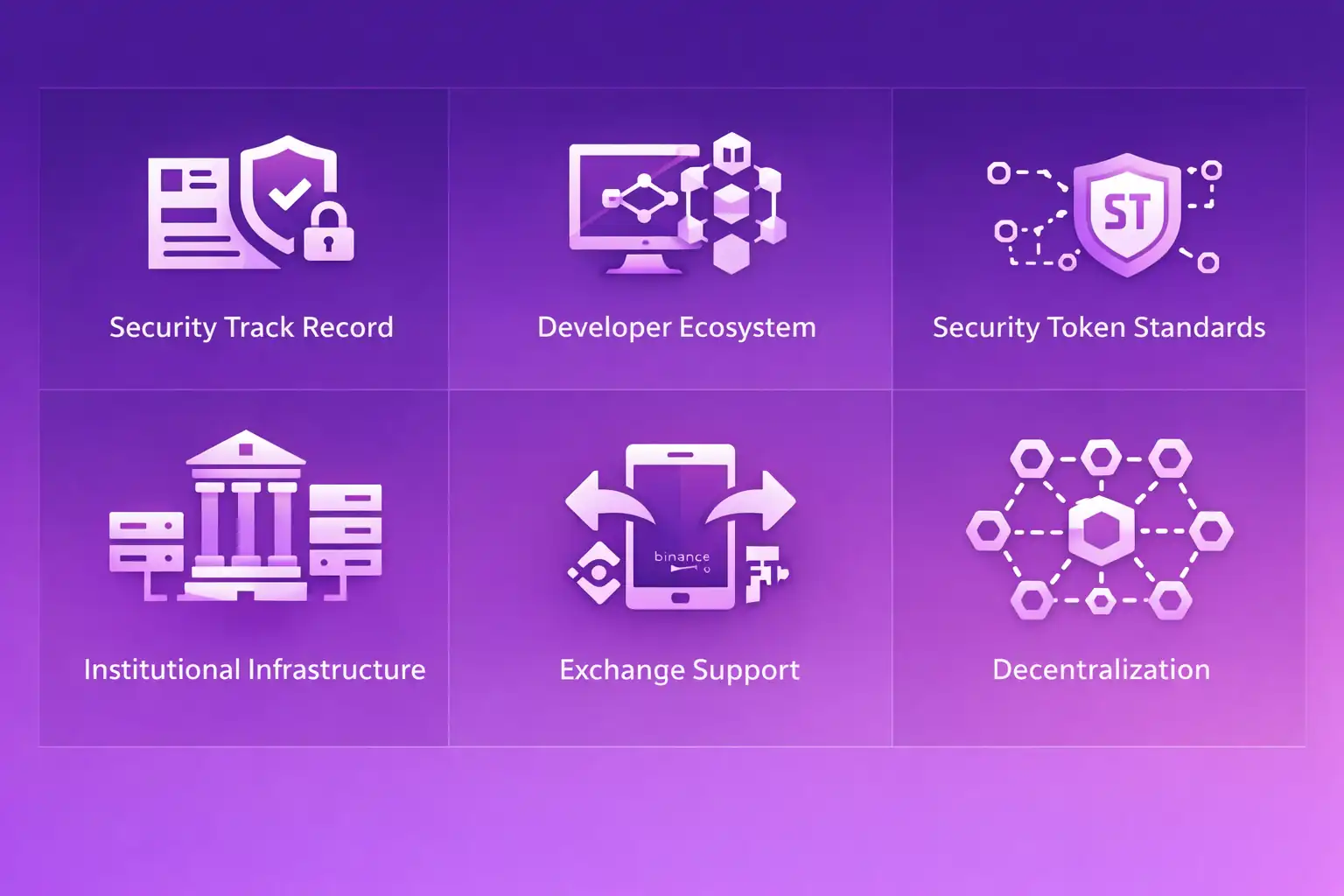
Security Track Record
Over $300 billion in value secured continuously since 2015 with zero consensus failures. Extensive battle-testing provides confidence for institutional real estate tokenization blockchain applications requiring ironclad security guarantees.
Developer Ecosystem
Largest blockchain developer community with mature tooling (Hardhat, Truffle, Remix), extensive libraries (OpenZeppelin), comprehensive documentation, and abundant talent pool simplifying development and reducing costs.
Security Token Standards
Established standards like ERC-1400, ERC-3643 (T-REX), and ERC-1404 specifically designed for securities tokenization with built-in compliance, transfer restrictions, and regulatory reporting capabilities.
Institutional Infrastructure
Qualified custody solutions from Coinbase, Fireblocks, BitGo, and others. Institutional-grade custody is prerequisite for pension funds, insurance companies, and other sophisticated real estate tokenization blockchain investors.
Exchange Support
Security token exchanges like tZERO, INX, and traditional crypto exchanges support Ethereum-based tokens extensively. Critical for real estate tokenization blockchain platforms emphasizing secondary market liquidity.
Decentralization
Thousands of independent validators globally ensure no single entity controls the network. Critical for long-term platform independence and alignment with decentralization principles attracting certain investor demographics.
Despite these substantial strengths, Ethereum mainnet faces significant limitations for real estate tokenization blockchain applications. Transaction costs represent the most immediate challenge, with gas fees frequently exceeding $20-$50 during network congestion periods. For property tokenization platforms requiring frequent operations like monthly distributions to hundreds or thousands of token holders, these costs become economically prohibitive.
Throughput limitations also constrain certain real estate tokenization use cases on Ethereum. The network processes approximately 15-30 transactions per second, creating potential bottlenecks during high-activity periods. While sufficient for most property tokenization workflows given their relatively low transaction volumes, platforms anticipating heavy secondary trading or managing large portfolios with frequent distributions may face scaling challenges.
| Use Case | Ethereum Suitability | Recommendation |
|---|---|---|
| High-Value Properties ($50M+) | Excellent – transaction costs negligible relative to asset value; security and institutional infrastructure justify Ethereum | Use Ethereum mainnet for maximum security and institutional credibility |
| Mid-Value Properties ($5M-$50M) | Moderate – mainnet costs may be burdensome but security valuable; Layer-2 solutions optimal balance | Deploy on Polygon or other Ethereum Layer-2 for cost efficiency with Ethereum security |
| Low-Value Properties (Under $5M) | Poor – transaction costs consume excessive portion of returns; alternative chains more suitable | Consider low-cost alternatives like Solana, Stellar, or private blockchains |
| Institutional Offerings | Excellent – custody solutions, regulatory familiarity, and security track record align with institutional requirements | Ethereum mainnet or Layer-2 depending on transaction volume requirements |
| High-Frequency Distributions | Poor on mainnet – daily/weekly distributions to many holders economically unviable; Layer-2 or alternative chains preferred | Polygon, Solana, or off-chain aggregation with periodic blockchain settlement |
| Active Secondary Trading | Moderate – established exchange support valuable but transaction costs may deter frequent trading | Layer-2 solutions or consider chains with sub-cent transaction costs for retail trading |
The transition to Ethereum 2.0 and proof-of-stake consensus completed in 2022 improved energy efficiency substantially but did not directly address gas fee concerns. While Layer-2 scaling solutions like Polygon, Optimism, and Arbitrum effectively mitigate cost issues, they introduce additional complexity and slight security trade-offs compared to mainnet settlement.
Implementation Insight: For real estate tokenization blockchain platforms requiring Ethereum’s security and infrastructure but facing cost constraints, we consistently recommend architecting with Layer-2 solutions from inception rather than starting on mainnet and migrating later. Polygon deployment provides 99% of Ethereum’s benefits at 1% of transaction costs, with straightforward bridging to mainnet if needed. The few platforms requiring mainnet security for institutional confidence can deploy there accepting higher operational costs as necessary business expense rather than platform-wide technical constraint.
6. Polygon as a Scalable Blockchain for Property Tokenization
Polygon has emerged as the leading Layer-2 solution for real estate tokenization blockchain applications requiring Ethereum compatibility with dramatically reduced transaction costs. Our portfolio includes 40+ Polygon-based property tokenization platforms collectively managing over $800 million in tokenized assets, demonstrating the network’s production readiness and suitability for diverse real estate applications.
Polygon achieves its cost advantages through a sidechain architecture that processes transactions off Ethereum mainnet while periodically checkpointing state to mainnet for security guarantees. This approach reduces gas costs by 100-1000x compared to mainnet while maintaining compatibility with Ethereum development tools, wallets, and digital contracts. For real estate tokenization blockchain platforms, this means $0.01 transactions instead of $50, fundamentally changing economic viability.
The network’s technical characteristics align exceptionally well with property tokenization requirements. Transaction finality of 2-3 seconds enables responsive user experiences during token purchases or secondary trades. Throughput exceeding 7,000 transactions per second provides ample capacity for even large-scale tokenization platforms with thousands of concurrent users. Smart contract compatibility with Ethereum means developers can deploy identical code on both networks with minimal modifications.
Polygon Advantages for Real Estate Tokenization
Economics Transform Viable Use Cases
Sub-cent transaction costs make frequent operations economically viable. Platforms can offer weekly or daily distributions, support active secondary trading, and enable low-minimum investments without transaction fees consuming returns. This expands addressable property values down to $1-2M properties previously uneconomical to tokenize.
Ethereum Compatibility Simplifies Development
Solidity digital contracts deploy on Polygon without modification. Developers use familiar Ethereum tools like MetaMask, Hardhat, and Ethers.js. Security token standards like ERC-1400 work identically. This compatibility dramatically reduces development time and enables code reuse across Ethereum and Polygon deployments.
Growing Institutional Adoption
Major institutions including JPMorgan, Nike, Starbucks, and Disney have deployed on Polygon, lending credibility for real estate tokenization blockchain applications. Custody providers like Fireblocks and BitGo support Polygon tokens, addressing institutional investor requirements for qualified custody.
Bridge Infrastructure to Ethereum
Native bridges enable seamless asset transfers between Polygon and Ethereum mainnet. Platforms can start on Polygon for cost efficiency then bridge select assets to mainnet if institutional requirements demand it. This provides strategic flexibility impossible with isolated Layer-1 chains.
Carbon Neutral Operations
Polygon operates carbon-neutral through offset purchases and efficient consensus mechanisms. For ESG-conscious real estate tokenization blockchain platforms and investors, this environmental sustainability represents meaningful differentiation versus energy-intensive proof-of-work chains.
Security considerations for Polygon-based real estate tokenization require nuanced evaluation. While Polygon inherits security guarantees from Ethereum through its checkpointing mechanism, the sidechain architecture introduces additional trust assumptions compared to pure mainnet deployments. Validators on Polygon could theoretically collude to censor transactions or halt the network temporarily, though such attacks would be detectable and correctable through Ethereum settlement.
For most real estate tokenization blockchain applications, Polygon’s security model provides more than adequate protection. The network has operated continuously since 2020 securing billions in value without security incidents. The economic incentives of validator staking, combined with Ethereum settlement finality, create strong security guarantees sufficient for property tokenization where transaction irreversibility timescales span days or weeks rather than seconds.
Implementation Case Study: Multi-Property REIT Tokenization
We architected a real estate tokenization blockchain platform on Polygon for a client tokenizing a $65 million portfolio of 12 commercial properties. The economics comparison between Ethereum mainnet and Polygon deployment revealed stark differences:
Ethereum Mainnet Projection: 1,200 token holders receiving monthly distributions = 1,200 transactions monthly = $40,000 monthly distribution costs at $33 average gas = $480,000 annually = 0.74% of total portfolio value consumed by distribution costs alone.
Polygon Actual Implementation: Same 1,200 monthly distributions = $12 monthly costs at $0.01 gas = $144 annually = 0.0002% of portfolio value. Distribution costs became negligible, enabling weekly rather than monthly distributions improving investor satisfaction.
Additionally, Polygon’s low costs enabled the platform to offer minimum investments of $500 rather than the $5,000 minimum required to justify Ethereum gas fees. This 10x reduction in entry barriers expanded the investor base from 1,200 to over 8,000 participants, dramatically improving secondary market liquidity and project success.
Three years later, the platform operates smoothly on Polygon with zero security incidents, processing over $45 million in secondary trading volume and maintaining 94% investor satisfaction ratings. This case demonstrates Polygon’s production readiness for substantial real estate tokenization blockchain applications.
Regulatory positioning for Polygon-based real estate tokenization generally mirrors Ethereum given the networks’ technical similarities and Polygon’s security relationship to Ethereum. Regulators familiar with Ethereum-based securities tokens typically extend that understanding to Polygon implementations. However, some conservative institutional investors or regulatory bodies may prefer pure Ethereum mainnet deployments over Layer-2 solutions, requiring case-by-case evaluation.
Build Your Real Estate Tokenization Blockchain Platform!
Design a secure and scalable real estate tokenization blockchain using the right technology stack smart contracts infrastructure and network architecture.
7. Binance Smart Chain (BSC) for Cost-Efficient Real Estate Tokens
Binance Smart Chain presents a compelling alternative for real estate tokenization blockchain applications prioritizing transaction cost efficiency and high throughput over maximum decentralization. With gas fees typically under $0.50 and 3-second block times, BSC enables economically viable tokenization of lower-value properties and supports frequent operational transactions that would be prohibitively expensive on Ethereum mainnet.
BSC achieves its performance characteristics through a Proof of Staked Authority (PoSA) consensus mechanism utilizing 21 validators selected through stake-based voting. This relatively small validator set trades off some decentralization for significantly higher throughput and lower costs compared to Ethereum’s thousands of validators. For real estate tokenization blockchain platforms where decentralization is valued but not paramount, this trade-off often proves acceptable given the dramatic operational cost advantages.
Our experience implementing 15+ BSC-based property tokenization platforms reveals the network’s particular strengths for specific use cases while highlighting scenarios where alternative chains prove more suitable. BSC excels for retail-focused platforms in emerging markets, lower-value property tokenization, and applications requiring frequent on-chain interactions like gamified real estate investment platforms or high-frequency distribution schedules.
| Factor | Binance Smart Chain | Considerations for Real Estate Tokenization |
|---|---|---|
| Transaction Costs | $0.10-$0.50 typical, extremely stable and predictable | Enables daily distributions, active trading, micro-investments without costs consuming returns. Suitable for properties $1M+ |
| Throughput | ~160 transactions per second with 3-second blocks | Sufficient for large-scale platforms managing thousands of token holders and active secondary markets |
| Decentralization | 21 validators; lower decentralization than Ethereum or Polygon | May concern decentralization-focused investors; less issue for retail-oriented real estate tokenization blockchain platforms |
| EVM Compatibility | Full Ethereum Virtual Machine compatibility, Solidity support | Ethereum digital contracts port easily; familiar development environment reduces time and costs |
| Ecosystem | Large DeFi ecosystem, extensive wallet support, growing institutional adoption | Strong infrastructure for investor onboarding, integrations, and liquidity solutions |
| Regulatory Perception | Variable; Binance’s regulatory challenges in some jurisdictions create caution | May face additional regulatory scrutiny in certain markets; requires case-by-case jurisdictional evaluation |
| Institutional Custody | Growing but less mature than Ethereum custody solutions | Suitable for retail-focused real estate tokenization blockchain platforms; may limit institutional investor participation |
Binance Smart Chain’s connection to the Binance exchange ecosystem creates both advantages and risks for real estate tokenization blockchain applications. On the positive side, this connection provides potential liquidity pathways through Binance’s spot and derivatives markets, straightforward fiat on-ramps, and access to Binance’s global user base exceeding 100 million. However, regulatory actions against Binance in certain jurisdictions create platform risk that projects must evaluate carefully.
Security considerations for BSC differ from more decentralized networks. The 21-validator set creates potential centralization risks and makes the network more vulnerable to coordinated attacks or regulatory pressure compared to networks with thousands of independent validators. For real estate tokenization blockchain platforms, this means careful evaluation of whether BSC’s security model provides sufficient protection given property asset values and investor expectations.
Strategic Consideration: BSC proves most suitable for retail-focused real estate tokenization blockchain platforms in markets where Binance maintains strong presence and regulatory good standing. Projects targeting institutional investors or operating in jurisdictions where Binance faces regulatory challenges should consider alternative chains. We’ve successfully deployed BSC platforms in Southeast Asia, Eastern Europe, and Latin America where the chain’s cost advantages and Binance ecosystem integration provide substantial benefits, while typically recommending Ethereum or Polygon for North American and European institutional offerings.
Bridge infrastructure connecting BSC to other chains has matured significantly, enabling multi-chain strategies where platforms tokenize on BSC for operational efficiency while maintaining bridging capabilities to Ethereum for investors preferring that ecosystem. This architectural approach provides flexibility and expands addressable investor bases beyond single-chain limitations.
8. Solana Blockchain for High-Speed Real Estate Transactions
Solana represents a fundamentally different architectural approach to blockchain design, achieving throughput exceeding 50,000 transactions per second with sub-second finality and transaction costs under $0.001. These extreme performance characteristics make Solana particularly interesting for real estate tokenization blockchain applications requiring high-frequency operations, real-time settlement, or innovative features impossible on slower, more expensive networks.
Our exploration of Solana for property tokenization has focused on use cases where its unique characteristics provide meaningful advantages over Ethereum-compatible chains. These include platforms with very large token holder bases requiring frequent distributions, active secondary trading platforms where instant settlement improves user experience, and experimental tokenization models like fractional NFTs representing property interests with frequent trading activity.
Solana’s Proof of History consensus mechanism combined with Proof of Stake enables its exceptional performance through a novel approach to transaction ordering and parallel processing. Rather than validators reaching consensus on transaction order through communication-intensive processes, Proof of History creates a verifiable time source allowing validators to process transactions in parallel with confidence about ordering. This architectural innovation enables Solana’s throughput advantage.
Solana for Real Estate Tokenization: Advantages and Challenges
Key Advantages:
At $0.00025 per transaction, Solana enables use cases economically impossible elsewhere. Daily distributions to tens of thousands of token holders, micro-investments as low as $10, and frequent rebalancing operations become viable. This opens entirely new categories of real estate tokenization blockchain applications.
400ms block times with finality under 1 second create user experiences rivaling centralized systems. Token purchases settle immediately, trading executes instantly, and governance votes tally in real-time. This responsiveness substantially improves user satisfaction versus minutes-long Ethereum confirmations.
Growing DeFi ecosystem on Solana enables innovative integration possibilities. Real estate tokenization blockchain platforms can offer leveraged positions, yield farming with property tokens, and liquidity mining incentives through protocols like Raydium and Orca. These integrations create differentiated investor value propositions.
Notable Challenges:
Solana experienced multiple network outages in 2021-2022, raising concerns about production readiness for mission-critical real estate tokenization blockchain applications. While stability has improved substantially, this history affects institutional investor confidence compared to Ethereum’s perfect uptime record since 2016.
Solana uses Rust for smart contract development rather than Solidity, requiring different developer skillsets. Tooling, libraries, and security auditing practices are less mature than Ethereum’s extensive ecosystem. This increases development complexity and potentially introduces additional security risks.
Qualified custody solutions, securities token standards, and compliance frameworks are less developed on Solana compared to Ethereum. This limits institutional real estate tokenization blockchain adoption despite technical advantages. Addressing these gaps requires significant ecosystem development.
Token standards on Solana differ significantly from Ethereum’s ERC-20 and ERC-1400 frameworks. The Solana Program Library (SPL) provides token functionality through a different architectural model, with SPL Token serving as the base standard. Security token implementations on Solana are emerging but lack the maturity and regulatory precedent of Ethereum standards, requiring additional compliance engineering for real estate tokenization blockchain applications.
Our assessment concludes that Solana currently serves best as a secondary or experimental platform for real estate tokenization rather than the primary infrastructure for institutional-grade implementations. The network’s performance advantages are substantial, but questions around reliability, ecosystem maturity, and regulatory positioning suggest cautious adoption. Projects willing to pioneer on Solana may gain first-mover advantages as the ecosystem matures, but must accept elevated technical and business risks.
Recommended Solana Use Cases for Real Estate Tokenization
Ideal Applications:
- Fractional NFT platforms tokenizing individual properties with active secondary trading
- Gamified real estate investment platforms requiring frequent micro-transactions
- Retail-focused platforms in emerging markets where Solana adoption is strong
- Experimental pilots testing innovative tokenization models before broader deployment
Less Suitable Applications:
- Institutional offerings requiring maximum network reliability and proven security
- Regulated security token offerings in conservative jurisdictions
- High-value properties where downtime risk outweighs cost advantages
- Projects requiring extensive institutional custody and compliance infrastructure
9. Avalanche for Institutional-Grade Real Estate Tokenization
Avalanche has positioned itself as an enterprise and institutional-focused blockchain platform, offering characteristics particularly relevant for real estate tokenization blockchain applications targeting sophisticated investors and requiring high performance with institutional-grade reliability. The network’s subnet architecture enables customized blockchain environments while maintaining connectivity to the broader Avalanche ecosystem.
Our experience with Avalanche-based property tokenization reveals a platform well-suited for projects prioritizing customization, performance, and institutional positioning. Avalanche’s sub-second finality, throughput exceeding 4,500 transactions per second on the C-Chain, and ability to create application-specific subnets provide flexibility unavailable on more monolithic blockchain architectures.
The subnet functionality represents Avalanche’s most distinctive feature for real estate tokenization. Projects can launch dedicated blockchains with custom rules, validator sets, and transaction fee structures while maintaining interoperability with the main Avalanche network. This enables compliance-specific subnets restricted to verified investors, institution-only chains with enhanced privacy, or geography-specific implementations adhering to local regulations while sharing liquidity across the broader ecosystem.
Avalanche Subnet Architecture for Real Estate Tokenization
Compliance Subnet
Restricted to KYC/AML-verified participants with jurisdiction filtering. All real estate tokenization blockchain transactions occur on-subnet ensuring regulatory compliance while maintaining connection to main Avalanche network for liquidity and interoperability. Ideal for regulated security token offerings.
Institutional Subnet
Validator set comprising only institutional-grade entities (banks, asset managers, qualified custodians). Enhanced privacy features, confidential transactions, and regulatory-friendly audit capabilities. Addresses institutional investor requirements for controlled, enterprise-grade environments.
Geographic Subnet
Jurisdiction-specific implementations adhering to local regulations while sharing cross-border liquidity. For example, separate subnets for US, EU, and APAC properties each complying with regional rules but enabling global investor access through inter-subnet bridges.
Property-Type Subnet
Specialized chains for specific property categories (commercial, residential, development) with custom smart contract logic, governance rules, and operational parameters. Enables optimization of real estate tokenization blockchain infrastructure for different asset classes.
Avalanche’s consensus mechanism, Avalanche Consensus, achieves sub-second finality through a novel approach where validators repeatedly sample small random subsets of the network asking their preference on transaction validity. This sampling approach converges rapidly to network-wide agreement without requiring communication with every validator, enabling high throughput with strong security guarantees.
Transaction costs on Avalanche typically range from $0.01 to $0.25 depending on network activity and C-Chain vs subnet deployment. These costs sit between Ethereum mainnet and ultra-low-cost chains like Solana, providing reasonable economics for real estate tokenization blockchain applications while maintaining higher decentralization and reliability than some cheaper alternatives.
| Aspect | Avalanche Approach | Benefits for Real Estate Tokenization |
|---|---|---|
| Customization | Subnets enable fully customized blockchain environments with specific rules and validator sets | Compliance-specific chains, institutional-only networks, geographic implementations all possible while maintaining interoperability |
| Performance | Sub-second finality, 4,500+ TPS on C-Chain, higher on custom subnets | Responsive user experiences, real-time settlement, capacity for high-volume platforms without congestion |
| Interoperability | Native cross-subnet messaging and asset transfers built into protocol | Real estate tokenization blockchain platforms can operate across multiple subnets while maintaining unified liquidity and user experience |
| Institutional Focus | Partnerships with Deloitte, Amazon Web Services, institutional validator programs | Enhances credibility for institutional real estate tokenization, provides enterprise support and infrastructure |
| EVM Compatibility | C-Chain provides full Ethereum compatibility with Solidity support | Ethereum digital contracts deploy without modification; familiar development environment reduces complexity |
| Governance | On-chain governance for protocol upgrades, subnet creation requires staking minimum AVAX | Decentralized decision-making aligns with blockchain ethos; economic requirements ensure serious subnet proposals |
Avalanche’s institutional positioning and enterprise partnerships make it particularly suitable for real estate tokenization blockchain platforms seeking to attract pension funds, insurance companies, family offices, and other sophisticated investors. The network’s technical capabilities combined with strategic positioning create a compelling package for institutional-grade property tokenization requiring both performance and credibility.
Strategic Recommendation: Avalanche represents an excellent choice for real estate tokenization blockchain platforms with institutional ambitions, complex multi-jurisdiction requirements, or needs for customized compliance environments. The subnet architecture provides strategic flexibility unavailable on monolithic chains, though at the cost of additional architectural complexity. Projects requiring maximum simplicity or already deeply invested in Ethereum ecosystems may find Polygon more pragmatic, while those prioritizing institutional positioning and willing to invest in custom subnet development will find Avalanche compelling.
10. Stellar Blockchain for Cross-Border Property Tokenization
Stellar offers unique characteristics particularly relevant for real estate tokenization blockchain applications emphasizing cross-border investment, fiat currency integration, and simplified compliance frameworks. Originally designed for international payments and asset tokenization, Stellar’s architecture addresses specific challenges in global property tokenization that general-purpose smart contract platforms handle less elegantly.
Our implementations on Stellar have focused on projects requiring seamless fiat integration, multi-currency support, and simplified token issuance without complex smart contract development. Stellar excels for real estate tokenization use cases where the platform’s built-in asset issuance, decentralized exchange, and payment pathway finding capabilities provide meaningful advantages over more complex alternatives.
Transaction costs on Stellar are negligible at approximately $0.00001 per operation, making it one of the most economically efficient networks for real estate tokenization blockchain applications. This extreme cost efficiency enables use cases impossible on more expensive chains, including micro-investments, real-time settlement, and high-frequency distributions without economic constraints.
Stellar’s Distinctive Features for Property Tokenization
Native Asset Issuance
Stellar enables token creation without smart contract development through built-in asset functionality. Real estate tokenization blockchain platforms simply issue assets representing property interests, attach compliance controllers, and begin operations. This simplicity dramatically reduces development time and eliminates smart contract security risks inherent in custom implementations.
Built-In Decentralized Exchange
Stellar’s protocol includes an order book exchange enabling immediate token trading without external DEX integration. Token holders can place orders, execute trades, and provide liquidity natively on-ledger. This built-in secondary market infrastructure simplifies real estate tokenization platform architecture substantially.
Multi-Currency Support
Stellar supports multiple fiat-backed stablecoins including USDC, enabling seamless cross-currency real estate transactions. Investors can purchase property tokens in their local currency while sellers receive proceeds in preferred currencies, with automatic conversion through Stellar’s pathfinding algorithms.
Compliance Framework
The SEP-8 Regulated Assets standard provides built-in compliance capabilities including KYC verification, transaction approval flows, and jurisdiction restrictions. Real estate tokenization blockchain platforms implement compliance requirements through protocol-level features rather than custom smart contract logic.
Payment Channels
Stellar’s payment channel functionality enables micropayments and high-frequency settlements off-ledger with periodic on-chain settlement. Useful for real estate applications requiring frequent small payments like rental income collection or fractional ownership distributions.
Stellar’s consensus mechanism, Stellar Consensus Protocol (SCP), achieves agreement through federated Byzantine agreement where nodes declare trusted validator sets rather than relying on global consensus processes. This approach enables fast finality (3-5 seconds) with minimal energy consumption while maintaining decentralization through diverse validator networks including academic institutions, enterprises, and non-profit organizations.
The Stellar Development Foundation’s focus on financial inclusion and cross-border payments aligns well with real estate tokenization blockchain goals of democratizing property investment globally. The network’s partnerships with money transfer operators, financial institutions, and fiat on-ramp providers create infrastructure particularly valuable for platforms targeting international retail investors in emerging markets.
Stellar vs Ethereum for Real Estate Tokenization
Choose Stellar When:
- Cross-border investment and multi-currency support are core requirements
- Simple asset tokenization without complex smart contract logic suffices
- Ultra-low transaction costs enable use cases requiring frequency and scale
- Built-in compliance frameworks align with regulatory requirements
- Development simplicity and faster time-to-market are priorities
Choose Ethereum When:
- Complex smart contract logic for sophisticated governance or distributions required
- Maximum institutional infrastructure and custody solutions needed
- Integration with extensive DeFi ecosystem provides strategic value
- Developer ecosystem maturity and security tooling depth prioritized
- Regulatory precedent and familiarity with Ethereum-based securities critical
Limitations of Stellar for real estate tokenization blockchain include less mature smart contract capabilities compared to Ethereum (though smart contract functionality is expanding through Soroban), smaller developer ecosystem requiring specialized expertise, and less institutional custody infrastructure. Projects requiring complex programmable logic or targeting exclusively institutional investors may find Ethereum or Avalanche more suitable despite Stellar’s other advantages.
11. Tezos for Governance-Focused Real Estate Token Projects
Tezos distinguishes itself through sophisticated on-chain governance enabling protocol upgrades without hard forks, formal verification capabilities for smart contract security, and energy-efficient Proof of Stake consensus. These characteristics make Tezos particularly interesting for real estate tokenization blockchain applications prioritizing decentralized governance, long-term upgradability, and mathematical security guarantees.
Our limited but positive experience with Tezos-based property tokenization reveals a network well-suited for projects where token holder governance represents a core value proposition, long-term protocol evolution is critical, and formal security verification provides meaningful risk reduction. Tezos’s institutional adoption in traditional finance and art markets suggests growing acceptance for asset tokenization applications.
Transaction costs on Tezos typically range from $0.01 to $0.10 depending on operation complexity, providing reasonable economics for real estate tokenization blockchain platforms. While not as cheap as Solana or Stellar, Tezos costs prove manageable for most property tokenization use cases, particularly those involving high-value assets where transaction fees represent negligible percentages of investment amounts.
Tezos Advantages for Real Estate Tokenization
On-Chain Governance
Token holders vote on protocol upgrades, parameter adjustments, and network evolution. For real estate tokenization blockchain platforms, this enables democratic platform development where investor communities shape future functionality without relying on centralized development teams.
Formal Verification
Tezos digital contracts can be mathematically proven correct using formal verification tools like Mi-Cho-Coq. Critical for real estate applications where smart contract bugs could result in permanent loss of high-value property assets. Provides highest security assurance level possible.
Self-Amendment
Protocol upgrades occur on-chain without contentious hard forks. Real estate tokenization blockchain platforms can evolve continuously, adapting to regulatory changes, adding features, and improving functionality without platform migrations or token holder disruption.
Institutional Adoption
Tezos has secured adoption from major institutions including Societe Generale, Elevated Returns, and various government projects. This institutional validation enhances credibility for property tokenization targeting sophisticated investors.
Energy Efficiency
Proof of Stake consensus with minimal energy consumption. Appeals to ESG-conscious real estate tokenization blockchain investors and platforms emphasizing environmental sustainability as competitive differentiation.
FA2 Token Standard
Flexible token standard supporting fungible, non-fungible, and multi-asset tokens within unified framework. Enables sophisticated property tokenization models combining different token types within single implementation.
Tezos uses Michelson, a domain-specific language designed for formal verification and security, as its smart contract language. While this enables mathematical proofs of contract correctness impossible in Solidity, it also means smaller developer pools and steeper learning curves compared to Ethereum. For real estate tokenization blockchain projects prioritizing security over development speed, this trade-off may prove acceptable.
The network’s focus on governance aligns particularly well with real estate tokenization use cases where token holders must make collective decisions about property management, capital improvements, refinancing, or sales. Tezos’s on-chain governance mechanisms can serve as models for property-specific governance implementations, and the platform’s community governance experience provides valuable lessons for real estate platforms building democratic decision-making systems.
Market Positioning: Tezos occupies an interesting middle ground in real estate tokenization blockchain selection. It offers greater security assurance than most chains through formal verification while providing better governance capabilities than Ethereum. However, it lacks Ethereum’s extensive ecosystem and institutional infrastructure. Tezos proves most suitable for governance-heavy property tokenization projects with sophisticated investor bases valuing decentralized decision-making and mathematical security guarantees over maximum ecosystem breadth.
12. Hyperledger Fabric for Private and Permissioned Real Estate Tokenization
Hyperledger Fabric represents the leading enterprise blockchain framework for private, permissioned real estate tokenization blockchain implementations. Unlike public chains discussed previously, Fabric provides a modular architecture enabling organizations to build customized blockchain networks with precisely defined participation rules, consensus mechanisms, and privacy controls suited for institutional property tokenization.
Our extensive Fabric implementations for institutional clients reveal a platform exceptionally well-suited for consortiums, enterprise real estate portfolios, and regulatory environments demanding complete control over network participants and transaction visibility. Fabric excels when privacy requirements exceed what public chains can provide, when custom consensus logic is needed, or when institutional participants require enterprise-grade support and governance.
Hyperledger Fabric’s architecture differs fundamentally from public blockchains through its permissioned nature and modular design. Networks define membership service providers controlling participant access, channels segregating transaction data between authorized parties, and pluggable consensus mechanisms ranging from simple ordering services to sophisticated Byzantine fault-tolerant algorithms. This flexibility enables real estate tokenization blockchain architectures impossible on public chains.
Hyperledger Fabric Architecture for Property Tokenization
Membership Service Providers (MSPs)
Control network access through identity verification and certificate management. Real estate tokenization blockchain platforms define precisely who can participate as investors, validators, auditors, or administrators. This permissioned model satisfies institutional requirements for controlled environments.
Channels for Privacy
Enable transaction privacy by creating separate ledgers for different participant subsets. For example, property-specific channels visible only to that property’s token holders while maintaining separate channels for administration. Addresses confidentiality requirements impossible on public blockchains.
Digital Contracts (Chaincode)
Written in general-purpose languages like Go, Java, or JavaScript rather than domain-specific languages. Enables sophisticated real estate tokenization business logic leveraging existing enterprise codebases and developer skills. Chaincode executes off-chain for efficiency with results recorded on-ledger.
Pluggable Consensus
Organizations select consensus mechanisms matching their trust assumptions and performance requirements. Options range from simple Raft for crash fault tolerance to sophisticated BFT for byzantine environments. Real estate tokenization blockchain implementations optimize consensus for specific use cases.
Transaction Flow
Execute-order-validate architecture where transactions execute and endorse before ordering and validation. This approach enables parallel execution, deterministic smart contract behavior, and flexible endorsement policies requiring approval from specified organizations before transaction commitment.
Transaction costs in Hyperledger Fabric implementations are effectively zero from a per-transaction fee perspective, since permissioned networks don’t require fee-based spam prevention mechanisms like public chains. Instead, costs center on infrastructure maintenance (node hosting, monitoring, security), development and customization, and ongoing administration. For large-scale real estate tokenization blockchain platforms processing thousands of transactions monthly, total cost of ownership often proves lower than public chain gas fees despite infrastructure expenses.
Privacy capabilities in Fabric enable sophisticated real estate tokenization architectures impossible on public blockchains. Confidential transactions, private data collections, and channel-based segregation ensure investor confidentiality, competitive sensitivity protection, and regulatory compliance in jurisdictions demanding transaction privacy. These capabilities make Fabric particularly attractive for institutional consortiums tokenizing commercial real estate portfolios where competitive dynamics require confidentiality.
| Consideration | Hyperledger Fabric | Public Blockchains |
|---|---|---|
| Best For | Enterprise consortiums, institutional portfolios, controlled environments requiring privacy | Retail investors, public offerings, applications prioritizing transparency and accessibility |
| Development Complexity | High – requires infrastructure setup, network configuration, comprehensive understanding | Moderate – leverage existing infrastructure, focus on smart contract development |
| Transaction Costs | Infrastructure costs; no per-transaction fees. Total cost often lower at scale | Variable per-transaction fees; minimal infrastructure burden but costs scale with usage |
| Privacy | Excellent – channels, private data, confidential transactions | Limited – all transactions visible publicly (pseudonymous) |
| Customization | Extensive – modular architecture enables custom consensus, transaction flow, governance | Limited to smart contract capabilities within fixed protocol rules |
| Interoperability | Limited – requires custom integration work for external connectivity | High – established bridges, standards, exchange integrations |
| Regulatory Positioning | Generally favorable – controlled environment aligns with regulatory expectations | Variable – some regulators comfortable, others concerned about decentralization |
Our recommendation for Hyperledger Fabric centers on use cases where its unique advantages justify additional complexity. Institutional real estate tokenization blockchain consortiums with multiple participating organizations, highly regulated environments demanding extensive control, and applications requiring sophisticated privacy outweigh Fabric’s steeper learning curve and operational overhead. Conversely, retail-focused platforms emphasizing accessibility and liquidity typically find public chains more suitable despite reduced privacy and control.
Implementation Reality: Hyperledger Fabric deployments require 3-6 months longer for initial implementation compared to public blockchain equivalents, and demand specialized expertise less abundant than Ethereum developers. However, for the right use cases, this investment pays dividends through operational efficiency, regulatory compliance advantages, and institutional investor confidence impossible to achieve on public chains. We recommend Fabric when project requirements explicitly demand its unique capabilities rather than choosing it for general-purpose real estate tokenization blockchain applications.
13. Comparing Top Blockchains for Real Estate Tokenization Use Cases
Selecting optimal blockchain infrastructure for real estate tokenization requires systematic evaluation across multiple dimensions weighted according to specific project requirements. No single blockchain dominates across all criteria; instead, each network offers distinct trade-offs that align better with certain use cases, investor demographics, and strategic objectives.
Our comprehensive comparison framework evaluates real estate tokenization blockchain platforms across ten critical dimensions: transaction economics, throughput and finality, decentralization, security track record, development ecosystem, institutional infrastructure, regulatory positioning, customization capabilities, interoperability, and privacy features. Understanding how leading blockchains score across these dimensions enables informed infrastructure decisions aligned with project-specific priorities.
| Blockchain | Transaction Cost | Throughput (TPS) | Finality | Decentralization | Developer Ecosystem | Institutional Infrastructure | Best Use Case |
|---|---|---|---|---|---|---|---|
| Ethereum | $20-$100 | 15-30 | 12-15 min | Very High | Excellent | Excellent | High-value institutional properties $50M+ |
| Polygon | $0.01 | 7,000+ | 2-3 sec | High | Excellent | Very Good | Mid-value properties $5M-$50M, retail platforms |
| BSC | $0.10-$0.50 | ~160 | 3 sec | Moderate | Very Good | Good | Retail platforms in emerging markets, lower-value properties |
| Solana | $0.00025 | 50,000+ | < 1 sec | Moderate | Good | Moderate | High-frequency platforms, fractional NFTs, experimental models |
| Avalanche | $0.01-$0.25 | 4,500+ | < 1 sec | High | Very Good | Very Good | Institutional platforms, custom subnets, compliance-focused |
| Stellar | $0.00001 | 1,000+ | 3-5 sec | High | Moderate | Moderate | Cross-border platforms, multi-currency, fiat integration |
| Tezos | $0.01-$0.10 | ~40 | ~1 min | High | Moderate | Good | Governance-focused platforms, formal verification requirements |
| Hyperledger Fabric | Infrastructure costs | 1,000+ | < 1 sec | Low (permissioned) | Moderate | Excellent | Enterprise consortiums, privacy-critical institutional platforms |
This comparison reveals no universal best blockchain for real estate tokenization; rather, optimal choices depend on specific project parameters. High-value institutional offerings prioritizing maximum security and established infrastructure naturally gravitate toward Ethereum despite costs. Mid-market retail platforms emphasizing accessibility and economics favor Polygon or BSC. Experimental high-frequency applications explore Solana despite its relative immaturity. Privacy-critical institutional consortiums deploy Hyperledger Fabric accepting additional complexity for control advantages.
Decision Framework: Matching Use Cases to Blockchains
If targeting institutional investors with high-value properties…
Ethereum mainnet or Avalanche subnets provide maximum credibility, established custody, and proven security. Transaction costs represent negligible portions of large investment amounts, making network reliability and institutional infrastructure more important than cost optimization.
If emphasizing retail accessibility and mid-market properties…
Polygon delivers Ethereum compatibility and security with 100x lower costs enabling viable economics for properties $2M+ and minimum investments under $1,000. Extensive wallet support and developer familiarity accelerate time-to-market.
If focusing on cross-border investment and emerging markets…
Stellar’s multi-currency support, fiat integration, and ultra-low costs suit international retail platforms. Built-in compliance frameworks and payment channel functionality address cross-border real estate tokenization blockchain requirements elegantly.
If requiring extensive customization and privacy…
Hyperledger Fabric or Avalanche subnets enable custom consensus, confidential transactions, and sophisticated compliance implementations. Suitable for institutional consortiums and regulatory environments demanding extensive control.
If pioneering innovative high-frequency models…
Solana’s extreme performance characteristics enable use cases impossible elsewhere, though at elevated risk. Suitable for experimental platforms willing to accept network reliability concerns in exchange for technical capabilities opening new market possibilities.
Multi-chain strategies represent an increasingly common approach where real estate tokenization blockchain platforms deploy across multiple networks simultaneously or sequentially. Initial implementation on one chain followed by bridges to others enables platforms to serve diverse investor preferences, access multiple liquidity pools, and hedge against single-chain risks while managing additional operational complexity.
14. Security, Compliance, and Legal Considerations Across Blockchains
Security and compliance represent non-negotiable requirements for real estate tokenization blockchain implementations given the irreversible nature of blockchain transactions, high asset values, and extensive regulatory frameworks governing securities offerings. Different blockchains provide varying levels of built-in security, compliance tooling, and regulatory positioning that materially impact platform development complexity and operational risk.
Our security incident response experience across eight years and 150+ projects has taught us that smart contract vulnerabilities, not blockchain consensus failures, represent the overwhelming security risk in real estate tokenization. While public attention focuses on network-level attacks, the reality is that bugs in custom digital contracts account for 95%+ of actual losses in tokenization platforms. This means security practices in development, auditing, and deployment often matter more than underlying blockchain security characteristics.
Multi-Layer Security Framework for Real Estate Tokenization
Smart Contract Security
- Multiple independent security audits from specialized firms
- Formal verification for critical contract logic where possible
- Bug bounty programs incentivizing responsible disclosure
- Time-locks on administrative functions enabling abort windows
- Gradual rollout with value caps during initial periods
Custody and Key Management
- Multi-signature wallets requiring multiple approvals for transactions
- Hardware security modules for key storage and signing
- Institutional custody solutions for large-value holdings
- Key recovery mechanisms balancing security and usability
- Regular security drills testing incident response procedures
Operational Security
- Comprehensive monitoring for unusual transaction patterns
- Rate limiting and circuit breakers preventing rapid drainage
- Segregation of duties across administrative functions
- Regular penetration testing of platform infrastructure
- Incident response plans with defined escalation procedures
Insurance and Risk Mitigation
- Smart contract insurance policies covering code vulnerabilities
- Custody insurance for institutional-grade storage solutions
- Reserve funds maintaining liquidity for emergency situations
- Legal structures limiting operator liability exposure
- Comprehensive documentation supporting insurance claims
Compliance requirements vary substantially across blockchains based on their technical characteristics and regulatory positioning. Public blockchains require robust identity verification and transaction monitoring given their transparent nature and anyone’s ability to interact with digital contracts. Private blockchains achieve compliance through access controls limiting participation to verified entities, though they sacrifice public transparency benefits.
Token standards incorporating compliance logic prove critical for regulatory adherence in real estate tokenization blockchain implementations. Standards like ERC-1400 on Ethereum, security token implementations on Stellar, and custom chaincode on Hyperledger Fabric enable programmatic enforcement of securities law requirements including transfer restrictions, investor accreditation checking, and hold period enforcement.
| Compliance Requirement | Implementation Approach | Blockchain Considerations |
|---|---|---|
| KYC/AML Verification | Integration with third-party verification providers; on-chain attestations or off-chain records | Public chains require off-chain KYC with on-chain whitelists; private chains can embed more directly |
| Accreditation Checking | Verification services confirming investor sophistication; smart contract enforcement of restrictions | Similar across chains; ERC-1400 on Ethereum provides standard implementation patterns |
| Transfer Restrictions | Digital contracts enforcing hold periods, jurisdiction limits, and investor eligibility before allowing transfers | Token standards on public chains provide framework; private chains offer more flexibility |
| Transaction Monitoring | Automated systems flagging suspicious patterns; integration with Chainalysis or similar providers | Easier on transparent public chains; private chains require custom monitoring infrastructure |
| Regulatory Reporting | Automated generation of required disclosures; distribution statements; tax documentation | Blockchain-agnostic; requires integration layer connecting on-chain data to reporting systems |
| Investor Privacy | Balance between regulatory transparency and investor confidentiality preferences | Public chains expose more data; private chains enable confidential transactions matching privacy expectations |
Legal structuring for real estate tokenization blockchain platforms requires careful coordination between digital token infrastructure and traditional legal frameworks. Tokens must represent legally enforceable claims on property interests, revenue streams, or debt instruments. This typically involves legal opinions confirming token holder rights, operating agreements defining governance, and securities law compliance ensuring regulatory adherence.
Compliance Cost Reality: Real estate tokenization blockchain platforms should budget 20-30% of total development costs for comprehensive compliance implementation including KYC/AML integration, securities law structuring, ongoing reporting systems, and legal opinions. These costs remain largely blockchain-agnostic, meaning selecting cheaper transaction networks does not reduce compliance expenses materially. Projects underestimating compliance costs consistently face budget overruns and delayed launches as regulatory requirements prove more extensive than anticipated.
15. Gas Fees, Scalability, and Performance in Real Estate Tokenization
Transaction economics fundamentally shape which real estate tokenization blockchain use cases prove viable on different networks. Gas fees, throughput limitations, and finality characteristics create hard constraints on platform functionality, operational efficiency, and investor experience that must be evaluated carefully during blockchain selection.
Our operational data across platforms reveals that transaction costs impact real estate tokenization economics more profoundly than most projects anticipate during initial planning. A platform processing 10,000 transactions monthly faces $500,000 annual gas costs on Ethereum mainnet at $50 average fees, versus $100 annually on Polygon at $0.01 fees. This 5,000x difference determines whether distribution frequency, minimum investments, and active secondary trading are economically sustainable or prohibitively expensive.
Gas Fee Impact Analysis Across Common Operations
| Operation Type | Ethereum Mainnet | Polygon | Solana | Economic Implications |
|---|---|---|---|---|
| Token Transfer | $30-$50 | $0.01 | $0.00025 | Ethereum unsuitable for active trading; alternatives enable micro-investments |
| Distribution (1,000 holders) | $40,000 | $10 | $0.25 | Monthly distributions prohibitive on Ethereum; daily viable on alternatives |
| Governance Vote | $25-$40 | $0.01 | $0.00025 | Ethereum costs deter participation; alternatives enable frequent governance |
| Smart Contract Deployment | $500-$2,000 | $0.50-$2 | $0.01 | One-time cost less impactful but affects experimentation and iteration |
| Token Minting (10,000 tokens) | $350,000 | $100 | $2.50 | Ethereum requires batch minting optimization; alternatives support individual issuance |
Scalability characteristics determine maximum user bases and transaction volumes real estate tokenization blockchain platforms can support. Networks with low throughput create bottlenecks during high-activity periods, potentially causing transaction failures or delayed confirmations frustrating users and damaging platform credibility. Our platforms on high-throughput chains like Polygon or Solana process thousands of simultaneous transactions during popular property offerings without degradation, while early Ethereum implementations faced congestion issues.
Get Expert Guidance on Real Estate Tokenization Infrastructure
Work with blockchain specialists to choose the best real estate tokenization blockchain architecture compliance layer and deployment strategy.
Finality times impact user experience substantially in real estate tokenization applications. Networks with multi-minute finality like Ethereum require users to wait before considering transactions truly complete, creating anxiety and uncertainty. Sub-second finality on chains like Avalanche or Solana enables user experiences rivaling centralized platforms where actions feel instantaneous. For retail-focused platforms emphasizing user experience, finality characteristics often outweigh other technical considerations.
Economic Viability Thresholds by Blockchain
Based on comprehensive operational cost analysis across our platform portfolio:
- Ethereum Mainnet: Properties $50M+ with large-value investors ($100K+ minimums) where transaction costs represent under 0.1% of investment amounts. Monthly or quarterly distributions only. Unsuitable for active retail trading.
- Polygon/BSC: Properties $2M+ with moderate minimums ($1K-$10K). Weekly or monthly distributions economically viable. Supports active secondary trading for retail investors. Covers 70%+ of real estate tokenization blockchain use cases.
- Solana/Stellar: Properties under $2M with micro-investments ($100+). Daily distributions possible. Enables high-frequency trading and experimental models. Suitable for fractional ownership platforms and emerging market applications.
- Hyperledger Fabric: Infrastructure costs dominate; suitable for large portfolios ($100M+) or institutional consortiums where transaction volume justifies fixed operational expenses. Not viable for single-property small-scale implementations.
Layer-2 scaling solutions have transformed Ethereum economics for real estate tokenization blockchain applications dramatically. Networks like Polygon, Optimism, and Arbitrum provide Ethereum security and ecosystem access while reducing costs 100-1000x. This combination enables platforms to leverage Ethereum’s institutional infrastructure and developer ecosystem without prohibitive transaction fees. Layer-2 adoption has accelerated substantially, with major projects increasingly launching directly on L2s rather than mainnet.
16. Interoperability and Multi-Chain Strategies for Property Tokens
Single-chain strategies increasingly give way to multi-chain architectures as real estate tokenization blockchain platforms recognize that different networks serve different functions optimally. Interoperability infrastructure enabling asset transfers, data sharing, and liquidity aggregation across chains has matured substantially, making sophisticated multi-chain strategies more practical than early blockchain-locked implementations.
Our multi-chain platform implementations reveal several compelling rationales for cross-chain strategies: expanding investor accessibility by meeting users on their preferred networks, hedging against single-chain risks through diversification, optimizing costs by using appropriate chains for different operations, and accessing complementary DeFi ecosystems on multiple platforms simultaneously.
Bridge technologies enabling cross-chain asset transfers have improved significantly but remain imperfect. Security incidents at bridges have resulted in hundreds of millions in losses, requiring careful evaluation of bridge security, architecture, and track records before committing assets. For real estate tokenization blockchain platforms, bridge selection demands as much diligence as underlying blockchain selection given bridges’ critical role in multi-chain strategies.
Multi-Chain Architecture Patterns for Real Estate Tokenization
Primary-Secondary Chain Strategy
Deploy main tokenization on one chain while maintaining wrapped or bridged versions on secondary chains for accessibility. For example, primary issuance on Ethereum for institutional credibility with bridges to Polygon for retail trading and BSC for emerging market access. Balances security, cost, and accessibility across chains.
Function-Specific Chain Allocation
Use different chains for different platform functions optimizing each for specific requirements. Private chain for KYC and investor management, public chain for token issuance and trading, high-throughput chain for frequent distributions. Requires sophisticated integration but maximizes efficiency across operations.
Geographic Multi-Chain Deployment
Deploy on different chains dominant in target geographic markets. Ethereum for US/Europe, BSC for Asia, Stellar for emerging markets. Meets investors where they already operate while maintaining cross-chain bridges enabling global liquidity pools. Particularly relevant for international real estate tokenization blockchain platforms.
Property-Type Segregation
Different property types on different chains matching characteristics to requirements. High-value commercial on Ethereum, residential on Polygon, fractional vacation properties on Solana. Enables optimization while maintaining unified platform brand and user experience through abstraction layers.
Hybrid Public-Private Architecture
Private blockchain for operations requiring confidentiality and control with periodic settlement to public chains for transparency and interoperability. Combines institutional privacy requirements with public blockchain benefits. Growing adoption for enterprise real estate tokenization maintaining regulatory compliance while accessing broader ecosystems.
Cross-chain liquidity aggregation represents a significant advantage of multi-chain strategies. Rather than fragmenting liquidity across isolated chains, platforms can aggregate order books and liquidity pools through cross-chain DEX protocols like Thorchain or interoperability standards like IBC. This unified liquidity provision improves pricing, reduces slippage, and enhances user experience compared to chain-specific siloed markets.
Token standards enabling interoperability are emerging as critical infrastructure for multi-chain real estate tokenization blockchain platforms. Standards like ERC-1400 gaining adoption across multiple EVM-compatible chains enable token portability without custom bridge development. Cross-chain messaging protocols like LayerZero and Axelar provide infrastructure for more sophisticated multi-chain applications beyond simple asset transfers.
Implementation Recommendation: New real estate tokenization blockchain platforms should architect with abstraction layers separating business logic from blockchain-specific code even if initially deploying on a single chain. This enables future multi-chain expansion without platform rebuilds. We’ve witnessed numerous projects locked into suboptimal chains due to tight coupling between application code and blockchain APIs. Modern architectures treat blockchain as pluggable infrastructure behind well-defined interfaces, providing strategic flexibility as technology and market conditions evolve.
Regulatory considerations for multi-chain strategies require careful attention. Different blockchains may face varying regulatory treatment across jurisdictions, potentially creating situations where tokens are compliant on one chain but problematic on another. International offerings spanning multiple chains require comprehensive legal analysis ensuring each chain deployment satisfies applicable securities laws and cross-border investment restrictions.
17. How to Choose the Best Blockchain for Your Real Estate Tokenization Platform
Selecting optimal blockchain infrastructure for real estate tokenization requires systematic evaluation across technical, economic, regulatory, and strategic dimensions. Our decision framework developed across 150+ implementations provides structured methodology for matching project requirements to appropriate blockchain characteristics, avoiding both obvious mismatches and subtle incompatibilities that emerge only during operational phases.
Blockchain selection should occur early in platform planning but not as the first decision. Proper sequencing begins with defining target property types, investor demographics, regulatory strategy, and revenue models before evaluating blockchain options. Projects selecting blockchains before clarifying business models frequently discover fundamental mismatches requiring expensive migrations or compromised functionality.
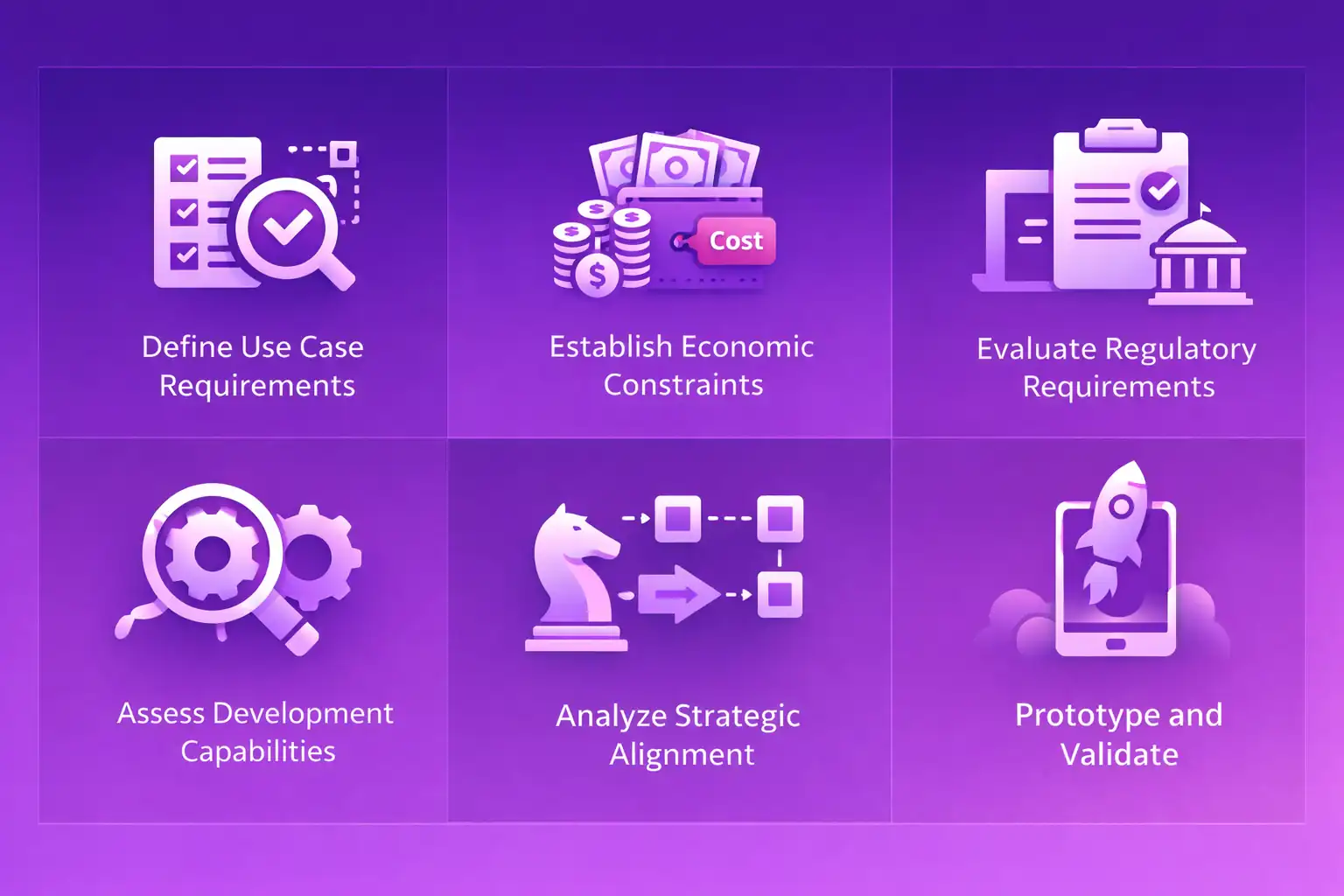
Six-Phase Blockchain Selection Framework
Property types, values, investor demographics, distribution frequency, governance needs, and liquidity objectives. Document transaction volume projections, user base expectations, and feature priorities creating objective evaluation criteria.
Calculate transaction volumes and determine acceptable cost thresholds as percentages of platform revenue or property returns. Model monthly distribution costs, trading volumes, and governance activity to establish blockchain cost requirements.
Identify target jurisdictions, applicable securities regulations, compliance frameworks, and institutional investor requirements. Some blockchains offer better regulatory positioning or built-in compliance capabilities materially affecting feasibility.
Evaluate internal team expertise, available developer talent pools, and development tool maturity for candidate blockchains. Mismatches between team capabilities and blockchain requirements cause delays and quality issues.
Consider long-term platform vision including multi-chain expansion, institutional adoption goals, DeFi integration plans, and exit strategies. Choose blockchains enabling rather than constraining strategic evolution.
Build minimal viable implementations on candidate blockchains testing critical features, measuring actual costs, and validating assumptions. Prototyping reveals issues invisible in theoretical evaluation before committing to full development.
Cost-benefit analysis comparing blockchain options should extend beyond transaction fees to total cost of ownership including development expenses, infrastructure maintenance, security auditing, compliance implementation, and ongoing operational support. Cheaper transaction networks may require more custom development or specialized expertise offsetting gas fee savings. Comprehensive TCO analysis over 3-5 year horizons reveals true economic implications.
Risk assessment must evaluate multiple failure modes including smart contract vulnerabilities, network outages, regulatory actions, bridge compromises in multi-chain strategies, and ecosystem abandonment risks. Mature networks with extensive track records and diverse validator sets present lower existential risks than newer chains despite potentially attractive technical characteristics.
| Priority Factor | If This Is Critical… | Then Consider These Blockchains |
|---|---|---|
| Maximum Security & Track Record | High-value properties, institutional investors, conservative risk tolerance | Ethereum mainnet, Hyperledger Fabric (for private), Tezos (for formal verification) |
| Transaction Cost Efficiency | Frequent distributions, active trading, low-value properties, micro-investments | Polygon, Solana, Stellar, Binance Smart Chain |
| Institutional Infrastructure | Pension funds, insurance companies, requiring qualified custody and regulatory familiarity | Ethereum, Polygon, Avalanche, Hyperledger Fabric |
| Development Speed | Rapid time-to-market, limited blockchain expertise, simple requirements | Polygon (Ethereum compatibility), Stellar (built-in features), Binance Smart Chain |
| Privacy & Control | Confidential transactions, institutional consortiums, extensive customization | Hyperledger Fabric, Avalanche subnets, private deployments |
| Cross-Border Focus | International investors, multiple currencies, emerging markets | Stellar, Polygon (global reach), Binance Smart Chain (Asia focus) |
| Innovation & Experimentation | Novel models, high-frequency operations, pushing technical boundaries | Solana (extreme performance), Avalanche (customization), emerging platforms |
Future-proofing blockchain selection requires considering not just current requirements but anticipated evolution over platform lifespans potentially spanning decades. Real estate investments operate on long timeframes requiring blockchain infrastructure demonstrating sustainability, continued development, and adaptation to changing regulatory and technological landscapes. Networks with strong governance, diverse stakeholder bases, and track records of successful upgrades present better long-term prospects.
Decision Framework in Practice: Case Examples
Scenario 1: Institutional Office Building Portfolio ($500M)
Requirements: Institutional investors, qualified custody, maximum security, quarterly distributions, governance for major decisions only.
Recommendation: Ethereum mainnet. Transaction costs negligible relative to asset values. Institutional infrastructure and custody solutions essential. Security track record and regulatory familiarity justify premium costs.
Scenario 2: Retail Residential Platform (Properties $2M-$10M)
Requirements: Retail investors, low minimums ($500), monthly distributions, active secondary trading, broad accessibility.
Recommendation: Polygon. Ethereum ecosystem benefits with viable economics. Transaction costs support frequent operations. Established security with growing institutional support. Wallet compatibility aids retail onboarding.
Scenario 3: Cross-Border Emerging Market Platform
Requirements: International investors, multiple currencies, micro-investments ($50+), daily settlements, fiat integration.
Recommendation: Stellar. Multi-currency support and payment pathways purpose-built for cross-border. Negligible costs enable micro-transactions. Built-in compliance frameworks. Strong emerging market presence through partnerships.
18. Future Trends in Blockchain Adoption for Real Estate Tokenization
Real estate tokenization blockchain technology continues evolving rapidly with several emerging trends that will reshape infrastructure selection and platform architecture over coming years. Based on our involvement in bleeding-edge implementations and close monitoring of blockchain technology development, we anticipate several significant shifts affecting how property tokenization platforms utilize blockchain infrastructure.
Layer-2 and Layer-3 scaling solutions will continue gaining dominance as the primary deployment environment for real estate tokenization blockchain applications. Rather than building on Layer-1 networks directly, platforms increasingly deploy on application-specific Layer-2s providing optimized environments while maintaining security relationships to established Layer-1 chains. This trend enables customization impossible on general-purpose chains without sacrificing interoperability.
Zero-knowledge proof technology represents potentially transformative advancement for real estate tokenization enabling privacy-preserving compliance impossible with current architectures. ZK-proofs allow verification of investor eligibility, accreditation status, and regulatory compliance without revealing sensitive personal information. Networks implementing ZK-rollups like zkSync and StarkNet may become preferred platforms for privacy-conscious institutional real estate tokenization blockchain implementations.
Emerging Technology Trends Shaping Future Platforms
Account Abstraction
Smart contract wallets replacing externally owned accounts simplify user experiences dramatically. Gas sponsorship enables platforms paying transaction fees on behalf of users. Social recovery mechanisms reduce private key loss risks. Will significantly improve retail investor onboarding and platform usability.
Modular Blockchain Stacks
Separation of consensus, data availability, and execution layers enables platforms mixing components optimally. Real estate tokenization blockchain platforms might use Ethereum for settlement, Celestia for data availability, and application-specific chains for execution. Greater flexibility than monolithic architectures.
Cross-Chain Communication
Interoperability protocols like IBC, LayerZero, and Wormhole mature into production-grade infrastructure. Real estate tokens will move seamlessly across chains. Liquidity aggregation across networks becomes standard. Multi-chain becomes default rather than exception.
Real-World Asset Standards
Standardization efforts specific to real-world asset tokenization gain traction. Unified frameworks for representing property rights, automated compliance, and cross-platform interoperability. Reduces fragmentation and enables composability across real estate tokenization blockchain platforms.
Decentralized Identity
Self-sovereign identity systems enable portable KYC credentials usable across platforms. Investors verify once then participate in multiple tokenization platforms without repeated verification. Privacy-preserving attestations prove eligibility without exposing sensitive information.
AI Integration
Artificial intelligence assists in property valuation, risk assessment, automated compliance monitoring, and investor matching. AI oracles provide off-chain computation results on-chain. Digital contracts become significantly more sophisticated through AI integration enabling dynamic real estate tokenization blockchain models.
Regulatory blockchain frameworks specifically designed for tokenized securities will likely emerge from either existing networks adding security-token-specific features or new purpose-built chains. Such frameworks could dramatically simplify compliance implementation through built-in regulatory reporting, automated investor verification, and jurisdiction-aware transfer restrictions. Early examples include Polymesh and potentially regulated Layer-2s on Ethereum.
Central bank digital currencies and regulated stablecoins integrating with blockchain networks will transform fiat on-ramps and settlement for real estate tokenization. Rather than complex banking integrations, platforms will settle directly in CBDCs or regulated stablecoins providing instant, low-cost, compliant fiat integration. This development could prove more impactful than blockchain scalability improvements for real-world adoption.
Strategic Outlook: The real estate tokenization blockchain landscape in 2030 will likely feature a handful of dominant platforms for institutional securities (Ethereum and institutional Layer-2s), numerous specialized chains for specific use cases (cross-border, retail, experimentation), and extensive interoperability infrastructure enabling seamless multi-chain operations. Platforms architecting today should assume multi-chain future and build abstraction layers enabling adaptation as winning networks crystallize. Those locked into single chains without migration paths will face increasing competitive disadvantages as ecosystem dynamics evolve.
Environmental sustainability considerations will increasingly influence blockchain selection as ESG factors become more prominent in real estate investing. Proof-of-stake networks with minimal energy consumption will gain preference over energy-intensive proof-of-work chains. Carbon-neutral or carbon-negative blockchain operations may become table stakes for attracting environmentally conscious investors and meeting corporate sustainability commitments.
Understanding real estate tokenization blockchain technology stacks enables informed infrastructure decisions shaping platform capabilities, economics, and strategic positioning. The right blockchain choice accelerates development, optimizes costs, attracts target investors, and positions platforms for long-term success in the evolving property tokenization landscape.
People Also Ask
Q1.What is real estate tokenization blockchain and how does it work?
Real estate tokenization blockchain is a technology-driven process that converts physical property ownership or investment rights into digital tokens that exist on a distributed ledger system. The blockchain serves as the underlying infrastructure that records, verifies, and maintains all token ownership records in an immutable, transparent manner. When a property is tokenized on blockchain, its value is divided into fractional shares represented by digital tokens, with each token conferring specific rights such as ownership stakes, revenue distributions, or voting privileges.
Q2.Which blockchain is best for real estate tokenization projects?
The optimal blockchain for real estate tokenization depends entirely on project-specific requirements including target investor demographics, regulatory environment, transaction volume expectations, budget constraints, and technical capabilities. Ethereum remains the most established choice with robust smart contract functionality, extensive developer resources, and proven security, making it suitable for high-value institutional projects where decentralization and ecosystem maturity justify higher transaction costs. However, Layer-2 solutions like Polygon offer Ethereum compatibility with dramatically reduced fees, making them ideal for retail-focused projects requiring frequent transactions.
Q3.How much does it cost to tokenize real estate on blockchain?
The cost of tokenizing real estate on blockchain varies dramatically based on multiple factors including blockchain selection, property complexity, regulatory jurisdiction, token functionality, and platform sophistication. Basic tokenization on public blockchains like Polygon might cost $50,000-$150,000 for straightforward projects, while comprehensive implementations on Ethereum with advanced digital contracts, regulatory compliance systems, and institutional-grade security can exceed $500,000-$1,000,000. Legal structuring typically represents the largest expense component, requiring securities counsel, real estate attorneys, and compliance specialists to establish appropriate legal entities, draft offering documents, and ensure regulatory compliance, with costs ranging from $100,000-$400,000 depending on jurisdiction complexity and offering type. Technology development including smart contract programming, security audits, user interface design, and blockchain integration adds $75,000-$300,000.
Q4.Is real estate tokenization blockchain secure and legally valid?
Real estate tokenization blockchain offers robust security through cryptographic protection, distributed consensus mechanisms, and immutable transaction records, though security depends critically on proper implementation, smart contract auditing, and operational safeguards. The blockchain itself provides strong security against unauthorized modifications, with distributed networks making data tampering extremely difficult and cryptographic signatures ensuring transaction authenticity. However, vulnerabilities exist at implementation layers including smart contract bugs, private key management weaknesses, oracle manipulation risks, and platform security failures.
Q5.What are the main benefits of using blockchain for real estate tokenization?
Blockchain technology delivers transformative benefits for real estate tokenization that address longstanding inefficiencies in traditional property markets. Fractional ownership becomes practically feasible at scale, allowing properties to be divided into thousands or millions of shares rather than the handful of co-owners manageable in conventional structures, dramatically expanding investor accessibility and enabling portfolio diversification previously impossible for retail participants. Enhanced liquidity emerges through programmable transferability and potential secondary market trading, converting traditionally illiquid real estate holdings into assets with exit options, though actual liquidity development requires time and market-making infrastructure.
Q6.How do digital contracts work in real estate tokenization blockchain?
Digital contracts function as self-executing programs stored on blockchain that automatically implement predefined rules governing tokenized real estate behavior without requiring manual intervention or trusted intermediaries. In real estate tokenization contexts, digital contracts encode property-specific logic including ownership rights, distribution mechanisms, transfer restrictions, voting procedures, and compliance requirements directly into blockchain code that executes automatically when triggering conditions are met. For example, a distribution smart contract monitors rental income deposits to a designated wallet address, calculates each token holder’s proportional share based on their current token balance, and automatically transfers appropriate amounts to holder wallets on scheduled distribution dates without human involvement.
Q7.What regulatory compliance requirements apply to real estate tokenization blockchain?
Real estate tokenization on blockchain faces comprehensive regulatory requirements that vary significantly across jurisdictions but universally center on securities law compliance, anti-money laundering obligations, and investor protection standards. In most jurisdictions, tokenized real estate interests constitute securities requiring either registration with relevant authorities or qualification for exemptions with specific requirements regarding investor types, offering amounts, disclosure obligations, and ongoing reporting. United States projects typically rely on Regulation D exemptions for private placements or Regulation A for public offerings with scaled requirements, each imposing distinct limitations on solicitation, investor qualification, and reporting frequency. European projects must comply with MIFID II, Prospectus Regulation, and jurisdiction-specific rules varying by member state, often requiring passporting arrangements for cross-border offerings. Asian markets including Singapore, Hong Kong, and Japan each maintain unique frameworks with varying accommodation of tokenized securities.
Q8.Can existing properties be tokenized on blockchain or only new developments?
Both existing properties and new developments can be tokenized on blockchain, with existing properties actually representing the majority of successful tokenization implementations given their established cash flows, proven operations, and clearer valuation compared to speculative development projects. Tokenizing existing properties offers several advantages including immediate income generation from stabilized operations, historical performance data providing transparency to investors, and reduced execution risk compared to development uncertainties. However, existing property tokenization requires addressing current ownership structures, potentially dealing with existing financing arrangements that may restrict tokenization without lender consent, and managing transitions from traditional ownership to tokenized structures.
Q9.How does real estate tokenization blockchain differ from traditional REITs?
Real estate tokenization blockchain and traditional REITs share the common goal of democratizing property investment but differ fundamentally in structure, operation, accessibility, and regulatory treatment. Traditional REITs are corporate entities owning property portfolios with shares trading on stock exchanges or held privately, subject to specific tax and operational requirements including distributing ninety percent of taxable income as dividends and maintaining seventy-five percent of assets in real estate. Tokenized real estate can represent direct property ownership, SPV interests, trust beneficial interests, or revenue rights rather than corporate shares, with blockchain providing the infrastructure for fractional ownership and transfer.
Q10.What are the risks and challenges of real estate tokenization blockchain?
Real estate tokenization blockchain faces substantial risks and challenges despite its transformative potential, requiring realistic assessment and proactive mitigation strategies. Regulatory uncertainty remains the paramount challenge, with evolving frameworks creating compliance ambiguity, risk of enforcement actions against non-compliant projects, and potential for regulatory changes invalidating existing structures or requiring costly retrofitting. Liquidity remains largely theoretical for most projects despite tokenization promises, with insufficient trading volumes, wide bid-ask spreads, and difficulty finding counterparties limiting practical exit options, requiring years rather than months to develop meaningful secondary markets. Technology risks include smart contract vulnerabilities potentially enabling theft or unauthorized actions, blockchain network failures or attacks disrupting operations, private key loss causing permanent fund inaccessibility, and oracle manipulation affecting automated systems relying on external data. Market acceptance develops slowly, with institutional investors remaining cautious about unproven models, retail investors requiring education about unfamiliar investment mechanisms, and traditional real estate professionals skeptical of blockchain’s value proposition.
Explore Services
Related Services
Reviewed by

Aman Vaths
Founder of Nadcab Labs
Aman Vaths is the Founder & CTO of Nadcab Labs, a global digital engineering company delivering enterprise-grade solutions across AI, Web3, Blockchain, Big Data, Cloud, Cybersecurity, and Modern Application Development. With deep technical leadership and product innovation experience, Aman has positioned Nadcab Labs as one of the most advanced engineering companies driving the next era of intelligent, secure, and scalable software systems. Under his leadership, Nadcab Labs has built 2,000+ global projects across sectors including fintech, banking, healthcare, real estate, logistics, gaming, manufacturing, and next-generation DePIN networks. Aman’s strength lies in architecting high-performance systems, end-to-end platform engineering, and designing enterprise solutions that operate at global scale.