Ai Overview
Blockchain disaster recovery architecture refers to the systematic design patterns and infrastructure strategies that ensure blockchain networks can survive and recover from catastrophic failures, security incidents, or infrastructure disruptions. For example, a production blockchain network might maintain 40% of validators in North America, 35% in Europe, and 25% in Asia-Pacific regions. Incremental backups record only state changes between snapshots, reducing storage requirements by 80-90%.
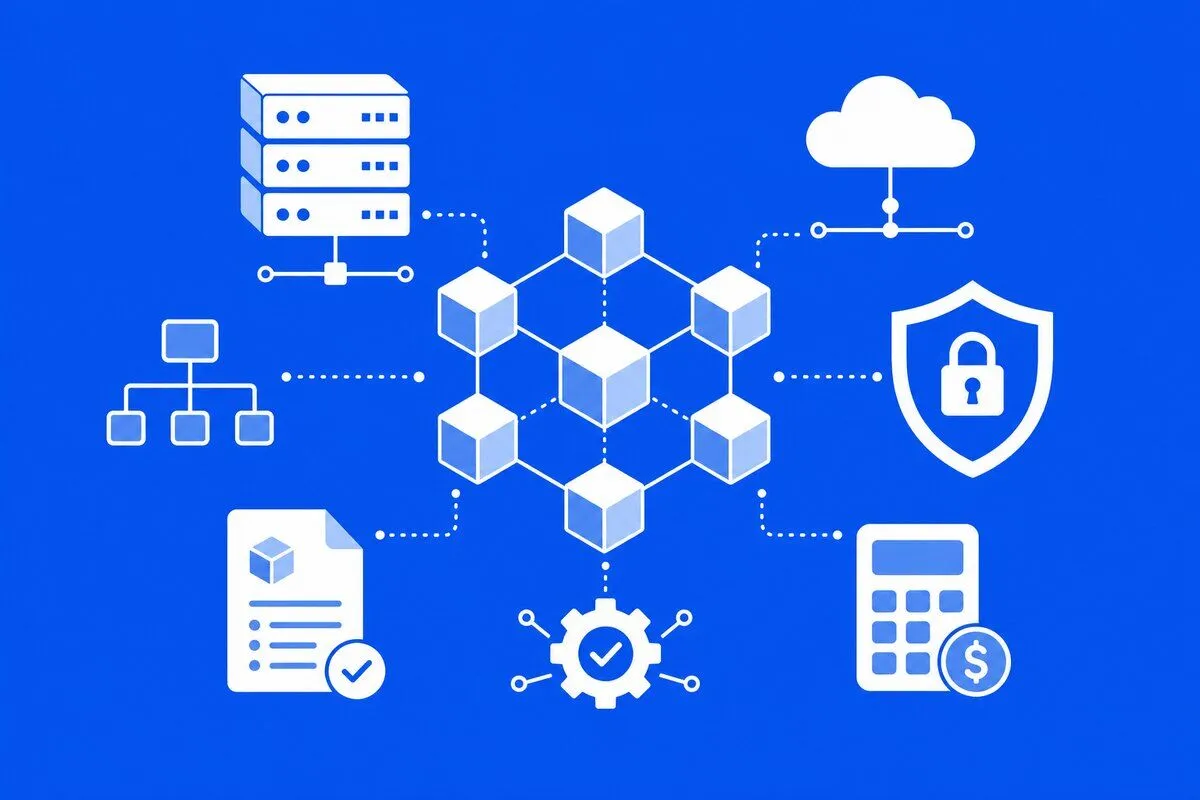
Blockchain disaster recovery architecture refers to the systematic design patterns and infrastructure strategies that ensure blockchain networks can survive and recover from catastrophic failures, security incidents, or infrastructure disruptions. Unlike traditional centralized systems, distributed ledger failover design must account for consensus continuity, validator coordination, and state consistency across geographically distributed nodes while maintaining network security and data integrity throughout recovery processes.
Key Takeaways
- Multi-region node distribution and hot-warm-cold standby configurations form the foundation of blockchain resilience patterns
- Consensus mechanisms directly influence recovery strategies, with PoS requiring validator key protection and Byzantine fault tolerance thresholds
- Full node replication, Merkle tree verification, and distributed storage integration ensure blockchain state consistency during recovery
- Smart contract recovery requires upgradeable proxy patterns, circuit breakers, and multi-signature wallet procedures
- Regular chaos engineering, RTO/RPO benchmarking, and coordinated tabletop exercises validate disaster recovery effectiveness
What Are the Core Architecture Patterns for Blockchain Disaster Recovery?
Effective blockchain disaster recovery architecture begins with multi-region node distribution patterns that ensure geographic redundancy. Organizations deploy validator nodes across at least three distinct geographic regions, each with independent power grids, network providers, and data centers. This distribution prevents single points of failure from natural disasters, regional outages, or targeted attacks. For example, a production blockchain network might maintain 40% of validators in North America, 35% in Europe, and 25% in Asia-Pacific regions.
State snapshot and incremental backup architectures enable rapid chain reconstruction after failures. Full state snapshots capture the complete blockchain state at specific block heights, typically stored in compressed formats ranging from 50GB to 500GB depending on chain history. Incremental backups record only state changes between snapshots, reducing storage requirements by 80-90%. These backups integrate with modular blockchain architectures where different layers can be recovered independently.
Hot-warm-cold standby configurations provide layered redundancy with different recovery speeds. Hot standbys maintain fully synchronized nodes ready for immediate failover within seconds, consuming significant resources but enabling zero-downtime transitions. Warm standbys keep nodes partially synchronized, requiring 5-15 minutes to achieve full consensus participation. Cold standbys store configuration and genesis data, taking 30-60 minutes for complete restoration. Automated failover triggers monitor node health metrics like block production rates, peer connectivity, and memory utilization to initiate transitions without manual intervention.
Standby Configuration Recovery Process
Health monitors trigger alerts
Warm nodes sync to current state
Validators resume block production
Merkle proofs confirm integrity
How Do Consensus Mechanisms Impact Disaster Recovery Design Choices?
Proof-of-Stake validator key management presents unique disaster recovery challenges compared to traditional systems. Validator private keys must remain accessible for block signing while protected from unauthorized access during recovery scenarios. Hardware security modules (HSMs) distributed across multiple secure locations provide key redundancy, with threshold signature schemes requiring 3-of-5 key shares to reconstitute signing capability. Slashing protection databases prevent double-signing during failover events, maintaining historical attestation records to avoid penalties that can reach 1-5% of staked assets.
Byzantine fault tolerance thresholds define minimum viable node requirements for network restoration. Most blockchain networks require at least 67% of validators to maintain consensus, meaning disaster recovery plans must ensure sufficient nodes survive any single failure scenario. A network with 100 validators needs 67 operational nodes minimum, so recovery architectures typically target 75-80 validator availability to provide safety margins. The relationship between Block Validation processes and fault tolerance determines how quickly networks can resume normal operations.
Cross-chain bridge recovery protocols address the complexity of multi-chain disaster scenarios. When bridge validators fail, locked assets on source chains require coordinated recovery procedures involving governance votes and time-locked withdrawals. Oracle data integrity verification becomes critical post-incident, with multiple independent oracle nodes re-validating price feeds and external data before resuming automated transactions. Recovery procedures typically implement 24-48 hour delays for large value transfers, allowing time for anomaly detection.
| Consensus Type | Minimum Nodes | Recovery Time | Key Challenge |
|---|---|---|---|
| PoS (Ethereum-style) | 67% of validators | 5-15 minutes | Slashing protection coordination |
| PoA (Authority-based) | 51% of authorities | 2-5 minutes | Authority key distribution |
| BFT (Tendermint) | 67% of voting power | 1-3 minutes | State machine synchronization |
| PoW (Bitcoin-style) | 51% of hashrate | 10-60 minutes | Mining pool coordination |
Which Data Replication Strategies Ensure Blockchain State Consistency?
Full node versus archive node replication presents fundamental trade-offs for crypto infrastructure disaster recovery. Full nodes maintain complete current state and recent transaction history (typically 128-256 blocks), requiring 200-400GB storage and enabling 10-15 minute recovery times. Archive nodes preserve entire blockchain history from genesis, consuming 2-8TB storage but providing complete audit trails and historical state queries. Organizations typically deploy 70% full nodes for operational redundancy and 30% archive nodes for compliance and deep recovery scenarios.
Merkle tree verification patterns enable partial state recovery without downloading complete blockchain history. Each block header contains a Merkle root summarizing all transactions, allowing nodes to verify specific account states using Merkle proofs of just 32-64KB. This approach reduces recovery bandwidth by 95% compared to full chain synchronization. When combined with state snapshots, nodes can verify current state integrity within 2-3 minutes, then incrementally sync missing blocks. Similar verification patterns appear in NFT game smart contract architecture for efficient state management.
IPFS and distributed storage integration provides off-chain data persistence for large files, metadata, and historical archives. Smart contract states reference IPFS content identifiers (CIDs) rather than storing large data on-chain, reducing blockchain bloat by 80-90%. During disaster recovery, nodes retrieve off-chain data from multiple IPFS pinning services distributed globally, ensuring data availability even if primary storage fails. Redundancy configurations typically maintain 5-7 geographically distributed IPFS nodes, with automatic re-pinning when node counts drop below thresholds.
What Are the Best Practices for Smart Contract Recovery and Rollback?
Upgradeable proxy patterns with emergency pause mechanisms provide the foundation for smart contract disaster recovery. The proxy pattern separates contract logic from data storage, allowing logic upgrades without losing state. Emergency pause functions, controlled by multi-signature wallets, can halt contract operations within seconds of exploit detection. Governance-controlled recovery typically requires 3-of-5 or 5-of-9 signatures from trusted parties, with time-locks of 24-48 hours for non-emergency upgrades. This architecture appears in production systems managing over $2 billion in locked value.
Time-locked transaction queues and circuit breaker implementations provide automated exploit mitigation. Circuit breakers monitor transaction patterns for anomalies like withdrawal amounts exceeding 10% of total value locked within 1-hour windows, or repeated failed transaction attempts indicating attack patterns. When triggered, circuit breakers impose cooling periods of 6-24 hours before large transactions execute, allowing security teams to investigate. The fee engine for crypto exchange systems often implement similar rate-limiting patterns for withdrawal protection.
Multi-signature wallet recovery procedures and social recovery module architectures address key loss scenarios. Social recovery allows users to designate 3-7 trusted guardians who can collectively restore account access if primary keys are lost. Guardian approval requires majority consensus (e.g., 4-of-7), preventing single-party account takeovers. Recovery processes typically span 7-14 days, with notification periods allowing legitimate owners to cancel fraudulent recovery attempts. Organizations should document guardian contact procedures and test recovery workflows quarterly to ensure effectiveness.
Smart Contract Recovery Time Comparison
How Can Organizations Test and Validate Blockchain Disaster Recovery Plans?
Chaos engineering for blockchain networks applies controlled failure injection to validate recovery procedures. Validator failure simulations randomly terminate 10-20% of nodes to test automated failover triggers and consensus recovery. Network partition testing isolates geographic regions to verify cross-region communication fallback paths and state synchronization after reconnection. These tests run monthly in staging environments mirroring production configurations, with results documented for continuous improvement. Organizations like Hire Disaster Recovery Engineer teams to design and execute these validation programs.
Recovery Time Objective (RTO) and Recovery Point Objective (RPO) benchmarking establishes measurable disaster recovery targets. RTO measures maximum acceptable downtime, typically 5-15 minutes for high-availability blockchain networks and 30-60 minutes for less critical systems. RPO defines acceptable data loss, usually 0-2 blocks for financial applications and 10-20 blocks for non-critical use cases. Benchmarking involves measuring actual recovery times across scenarios: single node failure (target: 2 minutes), regional outage (target: 10 minutes), and complete network restart (target: 45 minutes). These metrics guide infrastructure investment decisions.
Tabletop exercises coordinate response across validator operators, infrastructure teams, and governance bodies. Quarterly exercises simulate realistic disaster scenarios like simultaneous data center failures, smart contract exploits, or coordinated validator attacks. Participants follow documented runbooks, identifying gaps in communication protocols, decision authority, and technical procedures. Post-exercise reviews capture lessons learned and update recovery documentation. Exercises typically involve 15-25 participants and span 2-4 hours, with scenarios rotating between technical failures, security incidents, and governance challenges. Integration with Blockchain Identity Management systems ensures proper access controls during recovery operations.
Continuous monitoring and alerting systems provide early warning of potential failures. Prometheus and Grafana dashboards track validator uptime (target: 99.9%), block production rates (expected: 1 block per 12 seconds), and peer connectivity (minimum: 25 peers). Alert thresholds trigger notifications when metrics deviate from baselines: validator offline >30 seconds, memory usage >85%, or peer count <15. Alert routing follows escalation policies, notifying on-call engineers within 60 seconds and escalating to senior staff after 5 minutes without acknowledgment. This monitoring infrastructure draws patterns from Machine Learning Architecture for anomaly detection.
Blockchain disaster recovery architecture continues evolving as networks scale and new attack vectors emerge. Organizations must balance redundancy costs against availability requirements, regularly test recovery procedures, and maintain updated documentation. The decentralized nature of blockchain systems requires coordination mechanisms that traditional centralized disaster recovery plans don’t address, making validator communication protocols and governance frameworks as critical as technical infrastructure. Successful recovery depends on preparation, testing, and continuous improvement of both technical systems and human processes.
Frequently Asked Questions
Q1.What is the difference between blockchain disaster recovery and traditional database backup strategies?
Blockchain disaster recovery architecture relies on distributed consensus and multiple node replicas across the network, eliminating single points of failure. Traditional database backups use centralized snapshots stored in specific locations. Blockchain’s immutable ledger and peer-to-peer synchronization enable automatic recovery from remaining nodes, while traditional systems require manual restoration from backup files with potential data loss between backup intervals.
Q2.How long does it typically take to recover a blockchain network after a catastrophic node failure?
Recovery time varies by network size and architecture. Individual node recovery typically takes 2-48 hours for full synchronization, depending on blockchain size and bandwidth. Network-wide consensus disruptions can resolve within minutes to hours as remaining validators continue operation. Modern blockchain disaster recovery architecture with snapshot mechanisms can reduce recovery to under one hour for properly configured nodes.
Q3.Can smart contracts be rolled back after a security breach or exploit?
Smart contracts cannot be rolled back on immutable blockchains without network-wide consensus through hard forks, which are controversial and rare. Most blockchain disaster recovery architecture focuses on prevention through audits, upgrades via proxy patterns, and emergency pause functions. Post-exploit recovery typically involves deploying patched contracts and migrating assets rather than reversing transactions already committed to the blockchain.
Q4.What are the minimum hardware requirements for maintaining disaster recovery nodes?
Minimum requirements depend on the blockchain: Ethereum archive nodes need 12TB+ storage, 16GB RAM, and multi-core processors. Standard full nodes require 2-4TB storage and 8GB RAM. Disaster recovery nodes should match validator specifications with redundant storage (RAID configurations), reliable network connectivity (100+ Mbps), and uninterruptible power supplies to ensure continuous synchronization and rapid failover capabilities.
Q5.How do decentralized networks coordinate disaster recovery without central authority?
Decentralized networks use consensus protocols and automated mechanisms for disaster recovery. Nodes independently verify and synchronize the longest valid chain. Byzantine fault tolerance algorithms enable recovery from up to one-third malicious nodes. Governance proposals coordinate major recovery efforts through token-holder voting. Network participants follow predetermined protocol rules encoded in blockchain software, ensuring coordinated recovery without centralized control.
Q6.What role do validator incentives play in maintaining redundant infrastructure for disaster recovery?
Validator incentives drive redundant infrastructure by rewarding uptime and penalizing downtime through slashing mechanisms. Staking rewards motivate validators to maintain backup nodes, diverse geographic locations, and robust hardware. Networks like Ethereum penalize offline validators, encouraging redundancy. Economic incentives align individual validator interests with network resilience, creating naturally distributed disaster recovery architecture without mandating specific backup configurations.
Explore Services
Related Services
Reviewed by

Aman Vaths
Founder of Nadcab Labs
Aman Vaths is the Founder & CTO of Nadcab Labs, a global digital engineering company delivering enterprise-grade solutions across AI, Web3, Blockchain, Big Data, Cloud, Cybersecurity, and Modern Application Development. With deep technical leadership and product innovation experience, Aman has positioned Nadcab Labs as one of the most advanced engineering companies driving the next era of intelligent, secure, and scalable software systems. Under his leadership, Nadcab Labs has built 2,000+ global projects across sectors including fintech, banking, healthcare, real estate, logistics, gaming, manufacturing, and next-generation DePIN networks. Aman’s strength lies in architecting high-performance systems, end-to-end platform engineering, and designing enterprise solutions that operate at global scale.