Ai Overview
DePIN hardware requirements span a wide spectrum depending on network type, from low-power wireless sensor nodes costing a few hundred dollars to enterprise-grade GPU compute servers exceeding fifty thousand dollars. However, NVMe drives cost approximately $100–$150 per terabyte, while enterprise HDDs run $20–$40 per terabyte. Storage nodes generally cost $2,000–$15,000 depending on capacity and redundancy configuration.
DePIN hardware requirements span a wide spectrum depending on network type, from low-power wireless sensor nodes costing a few hundred dollars to enterprise-grade GPU compute servers exceeding fifty thousand dollars. Understanding these specifications, capital outlays, and recurring operational expenses is critical for teams planning deployments, as hardware choices directly influence network participation economics, token reward capture, and break-even timelines.
This guide dissects the hardware specifications, upfront capital investment, and ongoing operating costs for storage, compute, wireless, and sensor DePIN networks. You will learn how to budget for node deployment, evaluate cost-performance trade-offs, and calculate total cost of ownership under different market and geographic conditions. DePIN hardware requirements.
Key Takeaways
- Storage nodes require 2–100 TiB capacity with NVMe or HDD arrays, costing $2,000–$15,000 upfront depending on redundancy and throughput targets.
- Compute nodes demand high-end GPUs or CPUs with 32–256 GB RAM, ranging from $5,000 to $50,000 per unit for AI inference and edge processing workloads.
- Wireless and sensor networks deploy low-cost edge devices ($300–$3,000) with specialized antennas, environmental hardening, and mesh topology multipliers.
- Recurring operational expenses include electricity (50–500 watts per node), bandwidth (100 GB–10 TB monthly), and annual maintenance cycles for firmware updates and component replacement.
- Break-even periods vary from six months to three years based on token reward volatility, network maturity, energy tariffs, and hardware depreciation schedules.
- Enterprise-scale deployments benefit from bulk discounts, vendor negotiations, and optimized rack infrastructure to reduce per-node capital expenditure by 15–30 percent.
What hardware specifications do different DePIN network types require?
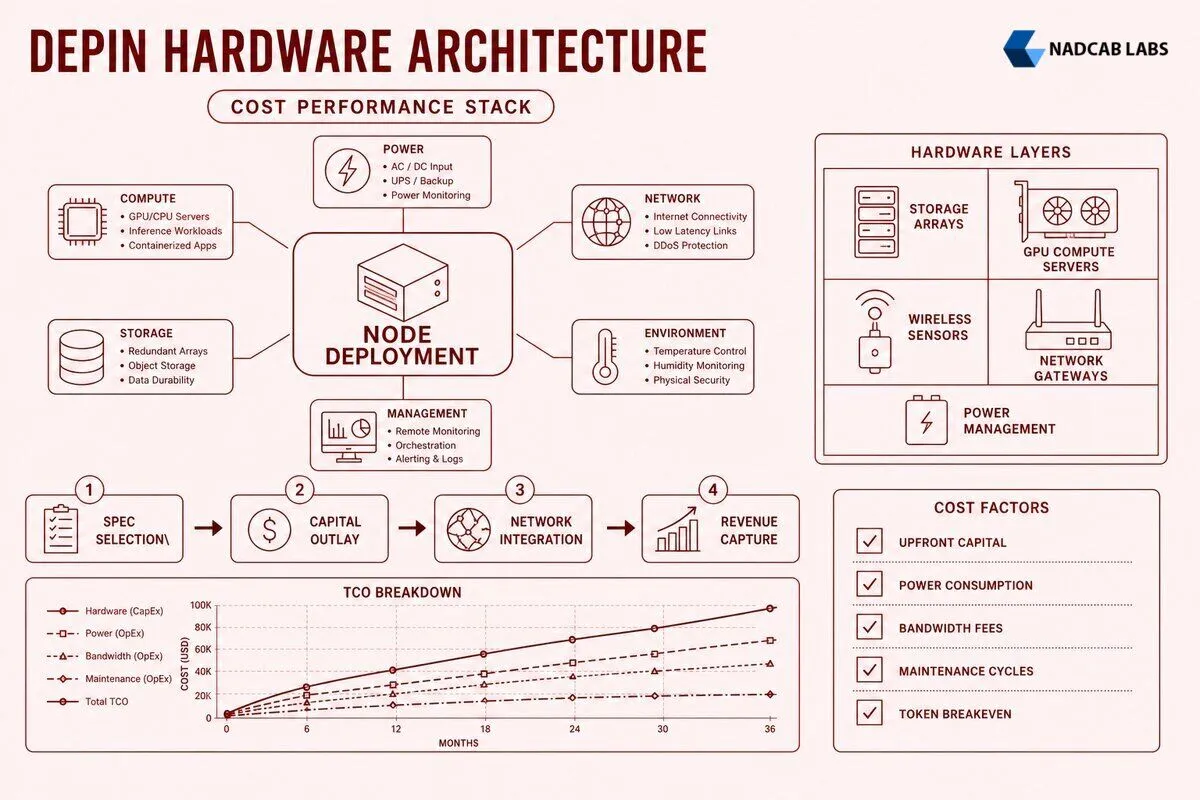
Hardware requirements diverge sharply across DePIN categories. Storage networks prioritize high-capacity drives, redundancy arrays, and minimum throughput thresholds. Compute networks demand powerful processors, substantial RAM, and thermal management systems. Wireless and sensor networks rely on low-power system-on-chip (SoC) modules, specialized antennas, and environmental hardening to operate in diverse physical conditions. DePIN hardware requirements.
Storage networks typically mandate at least 2 TiB of usable capacity per node, with many protocols requiring 10–100 TiB to qualify for meaningful token rewards. NVMe solid-state drives deliver superior read/write speeds (3,000–7,000 MB/s) compared to traditional hard disk drives (100–200 MB/s), making them ideal for latency-sensitive applications like distributed content delivery or database sharding. However, NVMe drives cost approximately $100–$150 per terabyte, while enterprise HDDs run $20–$40 per terabyte. Redundancy configurations such as RAID 5 or RAID 6 add overhead, reducing usable capacity by 20–33 percent but protecting against drive failures. Nodes must also meet uptime guarantees (99.5–99.9 percent) and bandwidth minimums (100 Mbps upload) to remain eligible for rewards. DePIN hardware requirements.
Compute networks impose strict CPU and GPU specifications depending on workload type. AI inference tasks favor NVIDIA A100 or H100 GPUs with 40–80 GB VRAM, while general-purpose edge processing can run on AMD Ryzen 9 or Intel Xeon processors paired with 32–64 GB DDR4 RAM. Thermal management becomes critical when operating multiple GPUs in enclosed racks; inadequate cooling causes throttling, reducing effective compute throughput by 15–30 percent. Liquid cooling systems add $500–$2,000 per node but maintain stable clock speeds under sustained load. Some protocols require Trusted Execution Environments (TEE) such as Intel SGX or AMD SEV to ensure confidential computation, limiting hardware choices to specific processor families. DePIN hardware requirements.
Wireless and sensor networks deploy low-power SoCs like Raspberry Pi Compute Module 4 or custom ARM-based boards drawing 5–15 watts under full load. Antenna specifications vary by frequency band: LoRaWAN gateways use 868 MHz or 915 MHz omnidirectional antennas with 3–8 dBi gain, while 5G small cells require MIMO arrays operating at 3.5 GHz or mmWave bands. Environmental hardening standards (IP65 or IP67 ingress protection) protect outdoor nodes from dust, moisture, and temperature extremes ranging from -40°C to +85°C. Mesh topology deployments multiply hardware costs linearly with node count, as each additional gateway extends coverage by 2–5 kilometers in urban environments or 10–15 kilometers in rural areas. DePIN hardware requirements.
Choosing between consumer-grade and enterprise-grade hardware involves trade-offs. Consumer components cost 30–50 percent less but carry shorter warranties (1–3 years vs. 5 years) and higher failure rates (annual failure rate of 2–5 percent vs. 0.5–1 percent). Enterprise drives include advanced error correction, power-loss protection, and higher mean time between failures (MTBF of 2.5 million hours vs. 1 million hours). For large-scale deployments, the lower replacement frequency of enterprise hardware often offsets the higher upfront cost within 18–24 months. DePIN hardware requirements.
Process Flow: Hardware Selection for DePIN Node Deployment
How much capital investment is needed to deploy a DePIN node?
Upfront capital expenditure varies dramatically by network type and deployment scale. Storage nodes generally cost $2,000–$15,000 depending on capacity and redundancy configuration. Compute nodes range from $5,000 for CPU-based edge inference to $50,000 for multi-GPU AI training rigs. Wireless and sensor nodes occupy the low end at $300–$3,000, with gateway devices and mesh repeaters adding incremental costs. Beyond core hardware, ancillary equipment such as networking gear, uninterruptible power supplies (UPS), rack infrastructure, and cooling solutions contribute 15–30 percent of total capital outlay. DePIN hardware requirements.
A typical 20 TiB storage node using enterprise HDDs costs approximately $4,500 in raw drives (20 × $225 per 1 TiB drive), plus $800 for a motherboard, CPU, and 16 GB RAM, $200 for a power supply, $150 for a chassis, and $300 for a RAID controller or HBA card. Adding a $400 UPS to protect against power outages and a $200 managed switch for network redundancy brings the total to $6,550. Scaling to NVMe drives increases drive costs to $12,000 (20 × $600 per 1 TiB NVMe), pushing the total to approximately $14,000 per node. Operators targeting higher reward tiers with 100 TiB capacity face proportionally higher costs, often exceeding $30,000 when factoring in enterprise-grade components and redundant power supplies. DePIN hardware requirements.
Compute nodes exhibit wider cost variance. A mid-range CPU node with an AMD Ryzen 9 5950X ($500), 64 GB DDR4 RAM ($200), a 2 TiB NVMe SSD ($300), and a modest GPU like an NVIDIA RTX 3060 ($400) totals around $5,000 including motherboard, PSU, and cooling. High-end GPU nodes for AI inference or rendering workloads require NVIDIA A100 GPUs ($10,000–$15,000 each), with dual-GPU configurations exceeding $35,000 before adding supporting components. Specialized accelerators such as Google TPUs or Intel FPGAs introduce additional costs and vendor lock-in but deliver superior performance for niche workloads like neural network training or real-time video transcoding.
Wireless and sensor networks deploy low-cost edge devices. A basic LoRaWAN gateway built on a Raspberry Pi 4 ($75) with a LoRa concentrator module ($150), omnidirectional antenna ($50), and weatherproof enclosure ($75) totals around $350. Higher-throughput 5G small cells cost $2,000–$3,000 due to MIMO antenna arrays, licensed spectrum requirements, and backhaul connectivity modules. Mesh topologies multiply these costs by node count; a 10-gateway urban deployment covering 20 square kilometers costs $3,500–$30,000 depending on gateway tier and overlap requirements.
Ancillary equipment adds significant cost. Managed network switches with VLAN support and redundant uplinks cost $200–$800 per node. UPS systems rated for 1,000–2,000 VA (sufficient for 30–60 minutes of runtime) range from $300 to $1,200. Rack-mounted deployments require 42U server racks ($400–$1,200), cable management kits ($100), and environmental monitoring sensors ($150). Cooling solutions vary from passive airflow ($0 additional cost) to active exhaust fans ($50–$200) to liquid cooling loops ($500–$2,000). Operators deploying 10+ nodes in a colocation facility incur additional costs for rack space ($100–$300 per U per month), cross-connects ($50–$150 per connection), and remote hands support ($75–$150 per hour).
Bulk deployment discounts reduce per-node costs for enterprise-scale rollouts. Purchasing 50+ drives from a single vendor typically yields 10–15 percent discounts. OEM partnerships with server manufacturers (Dell, Supermicro, HPE) unlock 20–30 percent savings on pre-configured systems compared to assembling individual components. Negotiating multi-year service contracts with ISPs can reduce bandwidth costs by 15–25 percent. Teams deploying 100+ nodes should engage procurement specialists to structure volume purchase agreements and secure extended warranties at favorable terms.
| Network Type | Hardware Component | Unit Cost (USD) | Total Node Cost (USD) |
|---|---|---|---|
| Storage (20 TiB HDD) | 20× 1TB enterprise HDD, motherboard, CPU, RAM, PSU, UPS | $225 per drive | $6,550 |
| Storage (20 TiB NVMe) | 20× 1TB NVMe SSD, motherboard, CPU, RAM, PSU, UPS | $600 per drive | $14,000 |
| Compute (CPU mid-range) | Ryzen 9, 64GB RAM, 2TB NVMe, RTX 3060, cooling | — | $5,000 |
| Compute (dual A100 GPU) | 2× NVIDIA A100, Xeon CPU, 256GB RAM, 4TB NVMe, liquid cooling | $12,500 per GPU | $48,000 |
| Wireless (LoRaWAN gateway) | Raspberry Pi 4, LoRa module, antenna, enclosure | — | $350 |
| Wireless (5G small cell) | MIMO antenna array, backhaul module, licensed spectrum support | — | $2,800 |
What are the recurring operational expenses for running DePIN infrastructure?
Operational expenses recur monthly and compound over multi-year deployment horizons. Electricity consumption dominates ongoing costs, with wattage profiles ranging from 5 watts for low-power sensor nodes to 500+ watts for dual-GPU compute servers. Bandwidth and connectivity requirements vary by network type, from 100 GB monthly for wireless gateways to 10 TB for high-throughput storage nodes. Maintenance cycles encompass hardware replacement schedules, firmware updates, and on-site or remote support costs, typically consuming 5–15 percent of annual revenue.
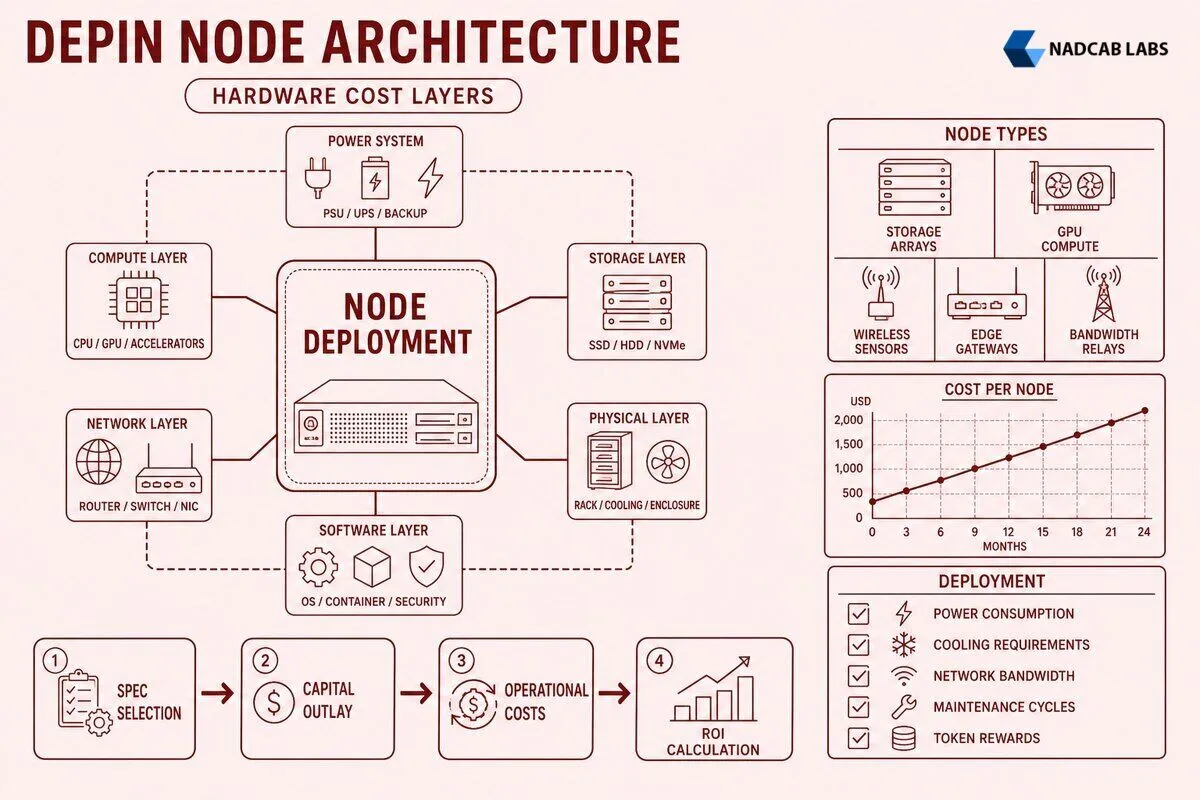
Electricity costs depend on node wattage and regional kilowatt-hour (kWh) pricing. A 20 TiB storage node drawing 150 watts under continuous operation consumes 3.6 kWh daily or 108 kWh monthly. At $0.12 per kWh (US residential average), monthly electricity costs reach $13. In regions with higher tariffs such as Germany ($0.35 per kWh) or California ($0.25 per kWh), costs rise to $38 or $27 respectively. Dual-GPU compute nodes drawing 500 watts consume 360 kWh monthly, costing $43 at $0.12 per kWh or $126 at $0.35 per kWh. Low-power wireless gateways drawing 10 watts cost under $1 per month even in high-tariff regions. Operators in jurisdictions with time-of-use pricing can reduce costs by 20–40 percent by scheduling compute-intensive tasks during off-peak hours.
Bandwidth requirements vary by protocol. Storage nodes serving content delivery or backup services upload 1–10 TB monthly, requiring ISP plans with symmetrical speeds (100 Mbps upload minimum) and generous or unlimited data caps. Residential ISPs typically impose 1–2 TB monthly caps with overage fees of $10 per 50 GB, making dedicated business fiber ($100–$300 per month) more economical for high-throughput nodes. Compute nodes performing AI inference or video rendering upload 500 GB–5 TB monthly, while wireless gateways relay sensor telemetry totaling 50–200 GB monthly. Selecting the correct ISP tier prevents unexpected overage charges that can erode 30–50 percent of monthly token rewards.
Maintenance cycles include hardware replacement, firmware updates, and support labor. Enterprise HDDs carry a 5-year warranty but exhibit annual failure rates of 0.5–1 percent, meaning a 20-drive array statistically replaces 1–2 drives every five years at $225 each. NVMe drives endure write-cycle limits (600–1,200 TBW for consumer models, 3,000–10,000 TBW for enterprise), requiring replacement after 3–7 years depending on workload intensity. Firmware updates for RAID controllers, network cards, and motherboard BIOS occur quarterly and take 15–30 minutes per node. Remote management tools (IPMI, iLO) enable zero-touch updates, but on-site visits for component swaps cost $75–$150 per hour in labor. Budgeting 10–15 percent of annual hardware cost for maintenance aligns with industry norms for self-hosted infrastructure.
Additional recurring costs include software licensing, insurance, and compliance fees. Some DePIN protocols charge node registration fees ($50–$500 annually) or require staking deposits (equivalent to 1–3 months of expected rewards). Cybersecurity insurance covering data breaches or ransomware attacks costs $500–$2,000 annually for small deployments. Regulatory compliance in jurisdictions requiring business licenses, tax reporting, or data sovereignty measures adds legal and accounting fees of $1,000–$5,000 annually. Teams operating in colocation facilities pay monthly rack rental ($100–$300 per U), cross-connect fees ($50–$150 per connection), and remote hands support ($75–$150 per hour).
Annual Operating Cost Breakdown (20 TiB Storage Node, US Residential)
How do hardware costs vary across storage, compute, wireless, and sensor DePIN models?
Hardware economics diverge sharply across DePIN categories due to fundamental differences in workload characteristics, capacity economics, and component lifespan. Storage networks optimize for cost per terabyte and drive longevity, balancing redundancy overhead against total usable capacity. Compute networks prioritize cost-performance ratios for GPUs and CPUs, with specialized accelerators serving niche workloads. Wireless and sensor networks deploy low-cost edge devices but incur mesh topology multipliers as node count scales.
Storage networks measure cost per terabyte as the primary economic metric. Enterprise HDDs deliver $20–$40 per TB raw cost, but RAID 6 redundancy reduces usable capacity by 33 percent, raising effective cost to $30–$60 per TB. NVMe SSDs cost $100–$150 per TB raw, or $150–$225 per TB after redundancy overhead. Drive lifespan quantified by mean time between failures (MTBF) ranges from 1 million hours (114 years) for consumer HDDs to 2.5 million hours (285 years) for enterprise models. In practice, annual failure rates of 0.5–2 percent mean operators replace 1–4 drives per 20-drive array annually. Write-endurance limits for NVMe drives (measured in terabytes written, or TBW) constrain lifespan for write-heavy workloads; a 1 TB consumer NVMe rated for 600 TBW lasts 3–5 years under 100 GB daily writes, while enterprise models rated for 3,000 TBW endure 15–20 years under the same load.
Compute networks evaluate GPU and CPU cost-performance ratios using metrics like floating-point operations per second per dollar (FLOPS/$) or inferences per second per dollar. NVIDIA A100 GPUs deliver 312 teraFLOPS (FP16) at $12,500, yielding 24.96 gigaFLOPS per dollar. AMD Radeon Instinct MI250X GPUs deliver 383 teraFLOPS at $10,000, yielding 38.3 gigaFLOPS per dollar, but narrower software ecosystem support limits adoption. CPU-based inference using AMD EPYC or Intel Xeon processors costs $2,000–$5,000 and delivers 1–5 teraFLOPS, suitable for latency-tolerant batch processing. Specialized accelerators such as Google TPUs (available only via cloud) or Intel FPGAs ($5,000–$15,000) excel at specific tasks like neural network training or real-time video transcoding but require custom software stacks and vendor lock-in.
Wireless and sensor networks deploy low-cost edge devices with minimal compute requirements. A Raspberry Pi 4 with 4 GB RAM ($75) paired with a LoRa concentrator module ($150) and omnidirectional antenna ($50) totals $275, delivering coverage for 2–5 kilometers in urban environments or 10–15 kilometers in rural areas. High-throughput 5G small cells cost $2,000–$3,000 but serve 100–500 concurrent users within a 500-meter radius. Mesh topology deployments multiply costs linearly with node count; covering a 50-square-kilometer urban area requires 20–50 gateways depending on overlap requirements, costing $5,500–$150,000 depending on gateway tier. Outdoor deployments add weatherproof enclosures ($75–$200), pole mounting kits ($50–$150), and solar panels with battery backup ($300–$800) for off-grid operation.
Component lifespan and replacement cycles influence total cost of ownership. Consumer-grade components carry 1–3 year warranties and higher failure rates (2–5 percent annually), while enterprise-grade components offer 5-year warranties and lower failure rates (0.5–1 percent annually). Over a 5-year deployment, consumer hardware incurs 10–25 percent replacement costs, while enterprise hardware incurs 2.5–5 percent. For large-scale deployments, the lower replacement frequency of enterprise components offsets higher upfront costs within 18–24 months. However, rapid technological obsolescence in compute markets (GPU performance doubles every 18–24 months) can render hardware economically uncompetitive before physical failure, favoring shorter depreciation schedules and modular upgrade paths.
Evaluating hardware tiers requires modeling expected token rewards, hardware depreciation, and replacement costs over 3–5 year horizons. A $6,550 storage node earning $150 monthly in token rewards generates $1,800 annually before operating expenses ($554), netting $1,246 annually and breaking even in 5.3 years. A $14,000 NVMe node earning $300 monthly (due to higher throughput and reward tier) generates $3,600 annually, netting $3,046 and breaking even in 4.6 years. A $48,000 dual-GPU compute node earning $800 monthly generates $9,600 annually, netting $8,500 after $1,100 in operating expenses and breaking even in 5.6 years. These calculations assume stable token prices; a 50 percent price decline doubles break-even periods, while a 2× price increase halves them.
What factors influence total cost of ownership and break-even timelines for DePIN nodes?
Total cost of ownership (TCO) and break-even timelines depend on token reward volatility, network maturity, geographic variables, and hardware depreciation schedules. Token price fluctuations directly impact revenue, with 50–80 percent swings common during market cycles. Network maturity affects per-node earnings as early-stage protocols distribute high rewards to attract operators, while saturated markets dilute rewards across thousands of nodes. Geographic factors such as energy tariffs, regulatory compliance costs, and physical security requirements create 30–60 percent TCO variance between regions. Hardware depreciation and technological obsolescence shorten effective lifespan, requiring reinvestment every 3–5 years to maintain competitiveness.
Token reward volatility introduces significant revenue uncertainty. A storage node earning 10 tokens monthly at $15 per token generates $150 in monthly revenue. If token price drops to $7.50, revenue halves to $75, extending break-even from 5.3 years to 10.6 years. Conversely, a price increase to $30 per token doubles revenue to $300, shortening break-even to 2.7 years. Operators can hedge volatility by converting a portion of rewards to stablecoins monthly, locking in fiat-denominated returns and reducing exposure to price swings. Some protocols implement reward stabilization mechanisms that adjust token emission rates based on price, smoothing revenue fluctuations but introducing governance risk if parameters change unexpectedly.
Network maturity profoundly affects per-node economics. Early-stage protocols with fewer than 1,000 active nodes distribute rewards across a small operator base, yielding high per-node earnings (often 20–50 percent annual ROI). As networks mature and node count grows to 10,000–100,000, rewards dilute proportionally unless demand for network services scales commensurately. Filecoin, for example, saw per-node storage rewards decline 60–80 percent between 2021 and 2023 as total network capacity grew from 2 exabytes to 18 exabytes while storage deal volume lagged. Operators entering mature networks face lower absolute returns but benefit from reduced protocol risk, established token liquidity, and proven product-market fit.
Geographic variables create substantial TCO differences. Electricity costs range from $0.03 per kWh in regions with hydroelectric power (Pacific Northwest, Iceland, Norway) to $0.35 per kWh in areas reliant on imported fossil fuels (Germany, Japan). A 500-watt compute node costs $11 monthly in low-tariff regions versus $126 monthly in high-tariff regions, a $1,380 annual difference that can swing break-even from profitable to underwater. Regulatory compliance costs vary similarly; jurisdictions requiring business licenses, tax reporting, or data sovereignty measures add $1,000–$5,000 annually, while permissive regions impose minimal overhead. Physical security requirements in high-crime areas necessitate alarm systems ($500–$2,000), surveillance cameras ($300–$1,500), and secure facilities ($200–$800 monthly rent premium), adding 15–30 percent to TCO.
Hardware depreciation schedules affect reinvestment requirements. Straight-line depreciation over 5 years reduces a $6,550 storage node’s book value by $1,310 annually. However, technological obsolescence often outpaces physical depreciation; a 2020-era HDD array with 100 MB/s throughput may remain functional in 2025 but earn 50–70 percent lower rewards than 2025-era NVMe arrays delivering 3,000 MB/s. Compute nodes face even steeper obsolescence curves, as GPU performance doubles every 18–24 months. Operators must budget for hardware refresh cycles every 3–5 years to maintain competitive reward capture, effectively shortening economic lifespan below physical lifespan.
Calculating break-even requires modeling all cost components and revenue scenarios. A comprehensive TCO model includes upfront capital expenditure, monthly operating expenses (electricity, bandwidth, maintenance), annual compliance costs, and hardware refresh cycles, discounted against projected token rewards under multiple price scenarios (bear case, base case, bull case). Sensitivity analysis reveals which variables most impact profitability; for storage nodes, electricity costs and token price dominate, while for compute nodes, GPU performance-per-dollar and network demand drive outcomes. Operators should model 3-year, 5-year, and 7-year horizons to capture different market cycles and technological refresh windows.
Optimizing TCO involves strategic hardware selection, geographic arbitrage, and operational efficiency. Selecting enterprise-grade components reduces replacement frequency and downtime costs. Deploying in low-tariff regions with favorable regulatory environments cuts operating expenses by 30–60 percent. Negotiating bulk discounts, multi-year ISP contracts, and colocation agreements reduces capital and recurring costs by 15–30 percent. Implementing remote monitoring and automated firmware updates minimizes on-site support labor. For teams planning large-scale deployments, partnering with a DePIN Development specialist can streamline hardware procurement, optimize DePIN network architecture integration, and model TCO under various deployment scenarios.
Understanding how DePIN tokenomics design impacts reward structures helps operators forecast revenue more accurately. Cross-referencing hardware requirements with broader infrastructure cost frameworks, such as RWA tokenization infrastructure costs or EHR interoperability blockchain cost, provides context for capital planning. Operators evaluating token liquidity should review exchange listing cost breakdown to understand how listing fees and liquidity depth affect reward monetization. Teams building custom DePIN solutions can leverage insights from supply chain API integration costs and RWA tokenization smart contract architecture to design efficient data pipelines and smart contract interfaces. For operators in regulated markets, consulting guides like Start a Crypto Exchange in India clarifies compliance overhead that may apply to DePIN node operation.
Final Thoughts
DePIN hardware requirements span a wide cost spectrum, from $350 wireless gateways to $50,000 multi-GPU compute servers. Upfront capital expenditure, recurring operational expenses, and hardware depreciation schedules determine total cost of ownership and break-even timelines. Storage nodes optimize for cost per terabyte and drive longevity, compute nodes prioritize GPU cost-performance ratios, and wireless networks deploy low-cost edge devices with mesh topology multipliers. Token reward volatility, network maturity, and geographic variables introduce 30–80 percent variance in profitability across deployments. Teams planning DePIN infrastructure should model multiple cost scenarios, negotiate bulk discounts, and select hardware tiers aligned with expected reward capture and technological refresh cycles to maximize return on investment over 3–5 year horizons.
Explore our white label NFT marketplace development services for launch-ready platforms.
Frequently Asked Questions
Q1.What is the minimum hardware investment to start a DePIN storage node?
Entry-level DePIN storage nodes typically require $500–$1,500 for consumer NAS devices with 4–8TB capacity, network interface cards, and basic redundancy. Enterprise-grade setups with 20TB+ drives, ECC RAM, and dual power supplies start around $3,000–$5,000. Costs vary by protocol requirements—Filecoin demands higher specs than Storj. Budget for drives, chassis, UPS, and networking gear separately.
Q2.How much electricity does a typical DePIN compute node consume monthly?
Standard DePIN compute nodes draw 150–300W continuously, costing $15–$40 monthly at $0.12/kWh residential rates. GPU-accelerated nodes for AI inference consume 400–800W ($50–$100/month). Industrial setups with multiple GPUs can exceed 2,000W. Actual costs depend on local electricity rates, hardware efficiency, cooling overhead, and network uptime requirements—factor 10–15% extra for HVAC in warm climates.
Q3.Do DePIN wireless networks require specialized antenna hardware?
Yes, most DePIN wireless protocols mandate certified radio hardware. Helium hotspots need LoRaWAN gateways ($400–$600) with specific frequency bands per region. 5G DePIN nodes require CBRS radios or licensed-spectrum equipment ($2,000–$10,000). Antenna placement, gain specifications, and outdoor enclosures are protocol-defined. Generic WiFi routers cannot substitute—networks enforce hardware attestation and cryptographic proof-of-coverage validation.
Q4.What is the average break-even period for DePIN node operators?
Break-even timelines range from 8–24 months depending on protocol token economics, network maturity, and operating costs. Early-stage networks with high token rewards may break even in 6–12 months; mature networks take 18–30 months. Factor hardware depreciation, electricity, bandwidth, and token price volatility. Storage nodes typically recover costs faster than compute nodes due to lower power consumption and steadier demand.
Q5.Can consumer-grade hardware meet DePIN network requirements?
Many DePIN protocols accept consumer hardware for entry-level participation—Raspberry Pi 4 (4GB+ RAM) works for lightweight storage or sensor networks. However, compute-intensive tasks (AI inference, video transcoding) demand workstation CPUs, discrete GPUs, and 32GB+ RAM. Check protocol whitepapers for minimum specs: CPU cores, RAM, storage IOPS, and network throughput. Consumer gear limits earnings and uptime guarantees.
Q6.How do bandwidth costs impact DePIN node profitability?
Bandwidth is often the second-largest operating expense after electricity. Storage nodes serving 10TB monthly at $0.05/GB incur $500 bandwidth costs—exceeding typical residential ISP caps. Business fiber (1Gbps symmetrical) costs $100–$300/month with unlimited data. CDN-style DePIN nodes may transfer 50–100TB monthly, requiring colocation ($200–$800/month). Calculate upload/download ratios and protocol-specific egress fees before deployment.
Explore Services
Related Services
Reviewed by

Naman Singh
Co-Founder & CEO, Nadcab Labs
Naman Singh is the Co-Founder and CEO of Nadcab Labs, where he drives the company’s vision, global growth, and strategic expansion in blockchain, fintech, and digital transformation. A serial entrepreneur, Naman brings deep hands-on experience in building, scaling, and commercializing technology-driven businesses. At Nadcab Labs, Naman works closely with enterprises, governments, and startups to design and implement secure, scalable, and business-ready Web3 and blockchain solutions. He specializes in transforming complex ideas into high-impact digital products aligned with real business objectives. Naman has led the development of end-to-end blockchain ecosystems, including token creation, smart contracts, DeFi and NFT platforms, payment infrastructures, and decentralized applications. His expertise extends to tokenomics design, regulatory alignment, compliance strategy, and go-to-market planning—helping projects become investor-ready and built for long-term sustainability. With a strong focus on real-world adoption, Naman believes in building blockchain solutions that deliver measurable value, solve practical problems, and unlock new growth opportunities for organizations worldwide.