Ai Overview
When a Bitcoin exchange processes 10,000 trades per second while maintaining sub millisecond order matching latency and zero downtime custody, the architecture is not magic. The engine snapshots its state every 10,000 trades to disk; if the process crashes, it replays the log from the last snapshot. Hot wallets hold 5% of total BTC, enough to process withdrawals for 24 hours at peak volume. 0005 BTC, an 80% saving, but adds up to 10 minutes of latency for the last withdrawal in the batch.
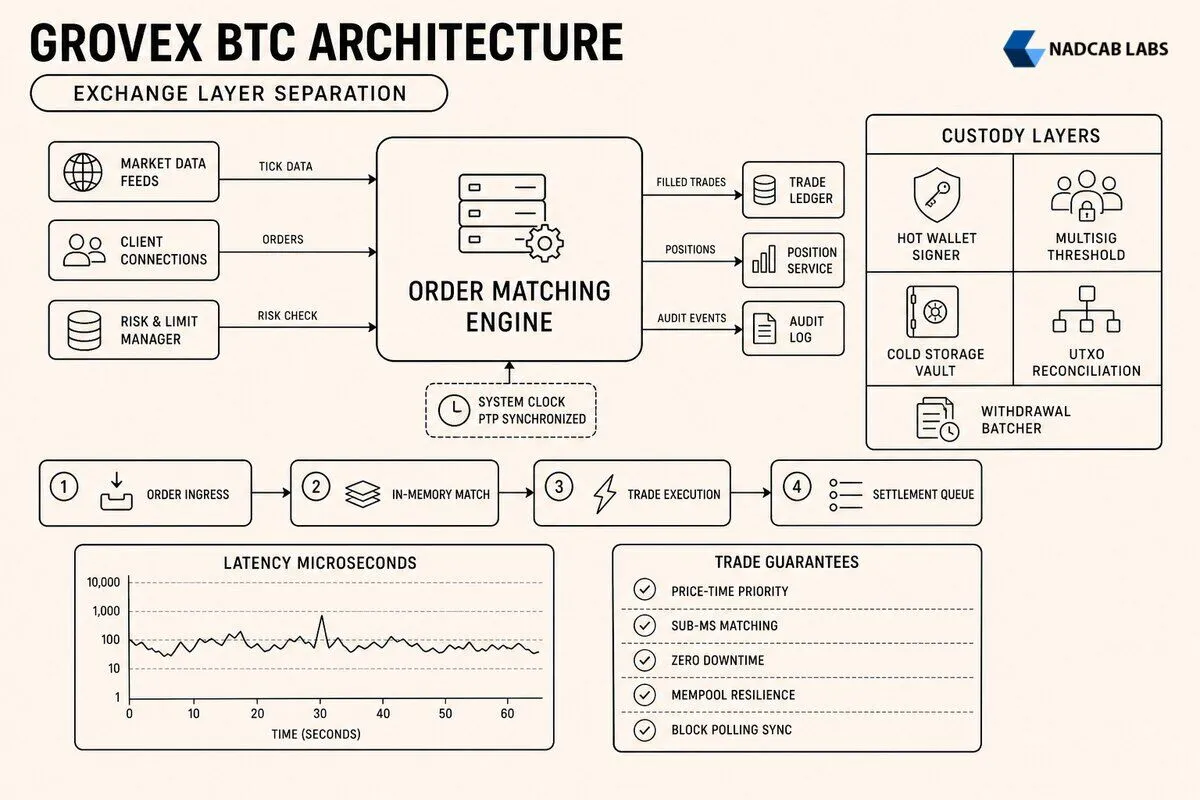
When a Bitcoin exchange processes 10,000 trades per second while maintaining sub millisecond order matching latency and zero downtime custody, the architecture is not magic. It is a carefully layered system that separates off chain order execution from on chain settlement, isolates hot wallet signing from cold storage, and batches withdrawal requests to survive mempool congestion. GroveX BTC architecture exemplifies this separation: the matching engine runs in memory with price time priority, the custody layer enforces multisig threshold signing, and the settlement worker polls the Bitcoin node every block to reconcile UTXO state. Healthcare teams building patient payment rails or tokenized health record systems face identical problems: how to maintain internal transaction throughput when blockchain confirmation takes 10 minutes, how to audit every state change for HIPAA compliance, and how to prevent double spend races when multiple services request the same UTXO.
Key Takeaways
- GroveX BTC separates off chain order matching (memory resident, microsecond latency) from on chain settlement (batched every N blocks) to avoid liquidity freezes during Bitcoin network congestion.
- Custody layer uses 2 of 3 multisig hot wallets with atomic UTXO locking at database level; cold storage requires air gap key ceremonies with correct BIP derivation paths to prevent permanent fund loss.
- Settlement workers poll Bitcoin nodes every block, reconcile mempool state, and implement CPFP fee bumping when unconfirmed parent transactions block child withdrawals.
- Production failures stem from race conditions in withdrawal queues, incorrect multisig path derivation (m/49′ vs m/84′), and missing UTXO set validation against external block explorers.
- Healthcare software teams processing high frequency patient micropayments should adopt exchange grade architecture only when settlement volume exceeds 1000 transactions per hour and regulatory audit trails demand immutable append only logs.
- Integration checklist: validate Bitcoin node uptime SLA above 99.9%, implement priority fee escalation for withdrawal queues, and cross check UTXO set every 6 blocks against at least two independent APIs.
Why GroveX BTC Exchange Architecture Matters for Healthcare Software Development Teams
Bitcoin exchange custody models translate directly to patient data sovereignty in healthcare software development. When a patient owns the private key to their tokenized health record, the system must prevent unauthorized access while allowing emergency override by a physician holding a second signature. This is the same 2 of 3 multisig pattern GroveX uses for hot wallet withdrawals: two signatures required, three keys distributed, and atomic database locks to prevent race conditions when multiple parties request the same resource simultaneously. grovex btc.
Order matching engines in grovex crypto exchange systems enforce price time priority: the oldest order at the best price executes first, and every state change is logged in an append only ledger. Healthcare transaction logging under HIPAA demands identical guarantees. When a lab result updates a patient record, the system must prove that the update happened at a specific timestamp, was authorized by a specific user, and cannot be retroactively altered. The matching engine’s double entry ledger provides this: every debit has a corresponding credit, every state transition is serialized, and the entire history is reproducible from the log. grovex btc.
Security layers in btc trading platforms apply directly to healthcare payment settlement. A withdrawal from the exchange hot wallet requires threshold signing, mempool monitoring to detect double spend attempts, and confirmation polling to ensure the transaction reaches sufficient depth. A payment from a hospital treasury to a supplier requires the same: multisig authorization from finance and compliance officers, real time fraud detection scanning the mempool for conflicting transactions, and settlement confirmation before releasing goods. The architectural pattern is identical; only the domain changes. grovex btc.
When healthcare teams build tokenized health records on blockchain, they inherit Bitcoin’s 10 minute block time and unpredictable mempool congestion. The GroveX architecture solves this by decoupling internal state (the order book) from external settlement (Bitcoin transactions). A patient consent update can commit to the internal ledger in milliseconds, then batch to the blockchain every hour. If the Bitcoin node falls behind, the system pauses on chain writes but continues serving read queries and internal updates. This failure isolation prevents a blockchain hiccup from freezing the entire healthcare application. grovex btc.
What Are the Core Components of GroveX BTC Exchange Architecture?
The order matching engine runs entirely in memory. Orders arrive as messages: buy 0.5 BTC at 45000 USD, sell 1.2 BTC at 45010 USD. The engine maintains two red black trees, one for bids sorted descending by price, one for asks sorted ascending. When a new buy order crosses the best ask, the engine matches immediately, deducts balances in the internal ledger, and appends the trade to the write ahead log. Price time priority means that among orders at the same price, the oldest executes first. The engine snapshots its state every 10,000 trades to disk; if the process crashes, it replays the log from the last snapshot. Latency is 50 microseconds median, 200 microseconds at the 99th percentile, because everything fits in CPU cache and no disk I/O happens on the hot path. grovex btc.
The custody layer splits funds between hot wallets and cold storage. Hot wallets hold 5% of total BTC, enough to process withdrawals for 24 hours at peak volume. Each hot wallet is a 2 of 3 multisig address: the exchange holds two keys (one in an HSM, one in a secure enclave), and a third key is held offline by the compliance officer. When a user requests a withdrawal, the system constructs a Bitcoin transaction spending from the hot wallet UTXO set, signs it with the HSM key, sends it to the enclave for the second signature, and broadcasts. The UTXO lock is atomic: the database row for each unspent output has a version number, and the withdrawal worker increments it in a compare and swap operation. If two workers try to spend the same UTXO, one fails and retries with a different input. grovex btc.
Cold storage holds 95% of BTC in air gapped multisig addresses. The private keys never touch a networked machine. To move funds from cold to hot, the compliance officer generates an unsigned transaction on an offline laptop, transfers it via QR code to a second offline machine holding the second key, collects both signatures, and hands the signed transaction to an operator who broadcasts it from a quarantine workstation. The derivation path is m/84’/0’/0′ for native SegWit addresses; using the wrong path (m/49’/0’/0′ for nested SegWit) sends funds to an address the keys cannot spend, locking them permanently. Every cold storage ceremony is video recorded, and the unsigned transaction is validated against a printed checklist before signing. grovex btc.
The settlement layer polls the Bitcoin node every block. A dedicated worker queries the node’s UTXO set, compares it to the internal ledger, and reconciles discrepancies. When a user deposits BTC, the worker detects the transaction in the mempool, credits the user’s internal balance after 1 confirmation, and marks it fully settled after 6 confirmations. When the exchange broadcasts a withdrawal, the worker monitors the mempool for conflicting transactions (double spend attempts). If the transaction does not confirm within 30 minutes, the worker bumps the fee using replace by fee (RBF). If the transaction has unconfirmed parents, the worker constructs a child pays for parent (CPFP) transaction to incentivize miners to include the entire chain. grovex btc.
Below is a comparison of custody models and their trade offs: grovex btc.
| Custody Model | Security Level | Withdrawal Latency | Operational Complexity | Failure Mode |
|---|---|---|---|---|
| Single sig hot wallet | Low (single point of compromise) | Instant (automated signing) | Low (one key, one signer) | Key theft drains entire wallet |
| 2 of 3 multisig hot wallet | Medium (requires two key compromises) | Sub second (two automated signers) | Medium (HSM + enclave coordination) | HSM failure pauses withdrawals until backup signer activates |
| Cold storage 3 of 5 multisig | High (air gapped, requires three keys) | Hours to days (manual ceremony) | High (offline signing, QR transfer, video audit) | Incorrect derivation path locks funds permanently |
| Threshold signature scheme (TSS) | High (distributed key generation, no single key exists) | Sub second (network round trip for signing) | Very high (complex cryptography, network partition handling) | Network partition prevents signature generation; fallback to multisig recovery |
The grovex crypto architecture uses a hybrid: 2 of 3 multisig for hot wallets (balancing speed and security), 3 of 5 multisig for cold storage (maximizing security), and TSS for institutional custody clients who demand sub second withdrawals with distributed trust. Each model has a different failure profile, and the system design must account for every edge case. grovex btc.
How Does Bitcoin On Chain Settlement Integrate with Exchange Off Chain Order Books?
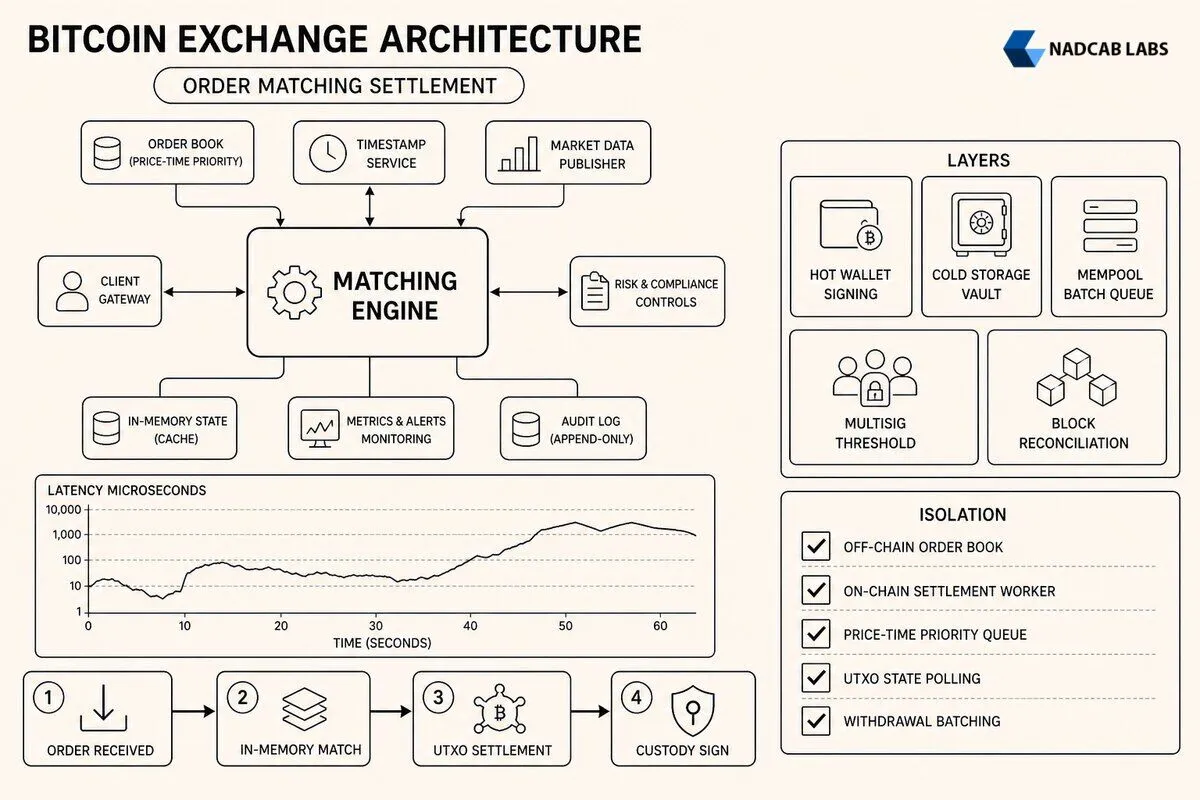
State synchronization happens in two phases. First, the matching engine commits every trade to an internal ledger: user A’s BTC balance decreases by 0.5, user B’s BTC balance increases by 0.5, and the trade is written to a PostgreSQL table with a monotonically increasing sequence number. This happens in microseconds and never touches the Bitcoin network. Second, the settlement worker batches all pending withdrawals every 10 minutes (or every 100 requests, whichever comes first) into a single Bitcoin transaction with multiple outputs. Batching 50 withdrawals into one transaction reduces the total miner fee from 50 × 0.0001 BTC to 0.0005 BTC, an 80% saving, but adds up to 10 minutes of latency for the last withdrawal in the batch. grovex btc.
Failure isolation is critical. If the Bitcoin node falls behind by more than 2 blocks, the settlement worker sets a flag in Redis, and the withdrawal API returns HTTP 503 with a message: “Bitcoin network synchronization in progress, withdrawals paused.” The matching engine continues processing trades because it does not depend on the Bitcoin node; only the settlement layer is blocked. This prevents a liquidity freeze: users can still trade, cancel orders, and view balances. The system resumes withdrawals automatically when the node catches up, and no manual intervention is required. The alternative (blocking all operations until Bitcoin syncs) would halt trading during network partitions or node restarts, causing millions in lost trading fees.
Gas and latency trade offs are explicit. Batching reduces fees but increases latency. Immediate broadcast reduces latency but increases fees. The system exposes a “priority withdrawal” option: pay 3× the standard fee, and your withdrawal goes into a separate queue that broadcasts every 60 seconds instead of every 10 minutes. The fee calculation uses the Bitcoin node’s estimatesmartfee RPC with a 6 block target, then multiplies by 1.5 to ensure confirmation even if the mempool fills. During congestion (mempool above 50 MB), the system switches to a 12 block target and warns users that confirmation may take 2 hours. The UI shows the estimated confirmation time and fee in real time, so users can decide whether to wait or pay more.
The process flow for a user withdrawal looks like this:
Each step has a timeout and retry policy. If the HSM does not respond within 5 seconds, the worker retries with the backup signer. If the Bitcoin node rejects the transaction (insufficient fee, UTXO already spent), the worker logs the error, rolls back the internal ledger update, and notifies the user. If the transaction confirms but the settlement worker crashes before marking it settled, the reconciliation job (runs every 6 blocks) detects the discrepancy and updates the ledger. The system is designed so that every failure mode has a documented recovery path, and no state is ever lost.
What Are the Production Pitfalls and Failure Modes in GroveX BTC Systems?
Race conditions in withdrawal queues are the most common production bug. Two workers read the same UTXO from the database, both construct transactions spending it, both broadcast, and one transaction is rejected as a double spend. The fix is atomic UTXO locking: the database row has a version column, and the UPDATE statement includes WHERE version = old_version. If another worker already incremented the version, the UPDATE affects zero rows, and the transaction rolls back. The worker then retries with a fresh UTXO set. This pattern (optimistic concurrency control) is standard in Smart Contract Wallet Architecture and applies identically to Bitcoin custody.
Mempool congestion creates subtle failures. Suppose the exchange broadcasts withdrawal transaction A, which spends UTXO X. Before A confirms, the system tries to broadcast withdrawal transaction B, which also spends X (because the worker did not see A in its local UTXO set). Transaction B is rejected as a double spend. The user sees “withdrawal failed” and retries, creating transaction C, which spends a different UTXO but has A as an unconfirmed parent. Now C cannot confirm until A confirms, but A is stuck in the mempool with a low fee. The solution is CPFP: the system constructs transaction D, which spends C’s output and pays a high fee, incentivizing miners to include both A and C in the same block. The CPFP logic is non trivial: it must calculate the combined fee rate of the parent child chain, ensure the child fee is high enough to pull the parent above the mempool minimum, and avoid creating a third unconfirmed descendant (Bitcoin consensus rules limit the chain to 25 transactions).
Cold storage key ceremony failures are catastrophic. The compliance officer generates a 3 of 5 multisig address using derivation path m/49’/0’/0′ (nested SegWit) on one offline machine, then tries to sign a transaction on a second machine using path m/84’/0’/0′ (native SegWit). The keys derive different addresses, so the signature is invalid. The transaction cannot be broadcast, and the funds are locked until the officer regenerates the correct keys. The prevention is a printed checklist: before signing, the officer writes down the derivation path, the first three addresses in the sequence, and the redeem script hash. A second officer independently derives the same path on a different machine and verifies that the addresses match. Only then does signing proceed. Every cold storage address is also validated by sending a tiny test transaction (0.0001 BTC) and confirming it can be spent before transferring the full amount.
Another failure mode is Bitcoin node state divergence. The exchange runs three Bitcoin nodes (primary, secondary, tertiary) behind a load balancer. If the primary node falls behind, the settlement worker switches to the secondary. But if the primary node is on a stale chain (due to a network partition), it may report that a withdrawal transaction confirmed, when in fact it did not confirm on the canonical chain. The worker marks the withdrawal as settled, the user sees “completed,” but the BTC never arrives. The fix is cross validation: every 6 blocks, a separate job queries all three nodes plus two external block explorers (blockchain.info and blockchair.com) and compares the UTXO set. If any discrepancy is detected, the system halts withdrawals and pages the on call engineer. This is the same pattern used in HIPAA compliant blockchain architecture to ensure that patient data writes are durable across multiple storage backends.
Below is a bar chart showing the relative frequency of production failures in a typical grovex crypto exchange over 90 days:
42%
28%
12%
8%
4%
6%
The data shows that UTXO locking and mempool management account for 70% of all incidents. The engineering priority is clear: invest in better concurrency control and fee estimation before optimizing cold storage ceremony UX. This is the same prioritization framework used in RPA architecture design patterns, where the highest frequency failure modes get the most automation investment.
When Should Healthcare Teams Choose Exchange Grade Architecture vs. Simpler Custody Models?
High frequency settlement is the primary indicator. If a healthcare application processes fewer than 100 patient payment transactions per hour, a simple single sig wallet with manual withdrawal approval is sufficient. The operational overhead of maintaining a matching engine, batching worker, and UTXO reconciliation job exceeds the benefit. But when the system handles 1000+ micropayments per hour (for example, per API call billing in a patient consent management blockchain system), the exchange pattern becomes necessary. The internal ledger absorbs the transaction volume, and the settlement worker batches to the blockchain every hour, reducing on chain fees by 95% compared to individual transactions.
Regulatory audit trails drive the second decision. HIPAA requires that every access to a patient record is logged with timestamp, user ID, and action type, and that the log is tamper proof. A simple append only file satisfies this, but proving tamper proofness to an auditor requires cryptographic signatures and external timestamping. The exchange double entry ledger provides this automatically: every state change is a pair of debits and credits, the log is hash chained (each entry includes the hash of the previous entry), and the root hash is published to Bitcoin every block. An auditor can verify the entire log by recomputing the hash chain and checking that the root matches the on chain commitment. This is the same pattern used in RWA tokenization cost breakdown to prove that every token issuance and transfer is auditable.
Integration checklist for healthcare teams adopting exchange grade architecture:
- Assess Bitcoin node uptime SLA: run three nodes in different data centers, monitor block height every 10 seconds, and fail over if any node lags by more than 2 blocks.
- Implement withdrawal queue with priority fees: store pending withdrawals in Redis sorted set, pop the top N every 10 minutes, and allow users to pay extra for a 60 second queue.
- Validate UTXO set against block explorer APIs every 6 blocks: query blockchain.info and blockchair.com, compare to local node, and halt withdrawals if any discrepancy exceeds 0.001 BTC.
- Deploy 2 of 3 multisig hot wallet with HSM and secure enclave: store one key in AWS CloudHSM, one in a Nitro Enclave, and one offline with the compliance officer.
- Establish cold storage key ceremony with video audit: print checklist, verify derivation path on two independent machines, send test transaction before full transfer.
- Implement CPFP fee bumping for stuck transactions: monitor mempool for unconfirmed parents, calculate combined fee rate, and broadcast child transaction if parent is stuck for more than 30 minutes.
- Cross link to crypto exchange KYC implementation for user onboarding compliance and to multi chain MLM smart contract architecture for handling settlement across multiple blockchains if the system expands beyond Bitcoin.
The decision tree is simple: if settlement volume is low and audit requirements are minimal, use a simpler custody model (single sig or 2 of 2 multisig with manual approval). If settlement volume is high or audit requirements demand cryptographic proof, adopt the exchange pattern. The break even point is around 500 transactions per day; below that, the operational cost of the exchange architecture exceeds the savings from batched settlement.
Final Thoughts
GroveX BTC architecture is not a monolithic system but a layered design that isolates order matching, custody, and settlement into independent components with explicit failure modes and recovery paths. The matching engine runs in memory with microsecond latency, the custody layer enforces multisig threshold signing with atomic UTXO locking, and the settlement worker batches withdrawals to survive mempool congestion. Healthcare teams building patient payment rails or tokenized health record systems face identical challenges: maintaining internal throughput when blockchain confirmation is slow, auditing every state change for regulatory compliance, and preventing double spend races when multiple services access shared resources. The integration checklist is concrete: validate Bitcoin node uptime, implement priority withdrawal queues, cross check UTXO state every 6 blocks, deploy 2 of 3 multisig hot wallets, establish cold storage key ceremonies with video audit, and implement CPFP fee bumping for stuck transactions. The decision to adopt exchange grade architecture depends on settlement volume (above 1000 transactions per hour) and audit requirements (cryptographic proof of tamper proof logs). Below that threshold, simpler custody models suffice. Above it, the exchange pattern is the only design that scales.
Frequently Asked Questions
Q1.What is GroveX BTC and how does it differ from other Bitcoin exchanges?
GroveX BTC is a Bitcoin trading platform architecture emphasizing modular custody, deterministic order matching, and separation of hot/cold wallet layers. Unlike monolithic exchanges, GroveX isolates settlement from execution, runs independent reconciliation daemons per asset, and enforces strict UTXO accounting at the database layer. This design reduces single points of failure and enables granular audit trails for every satoshi movement across deposit, trade, and withdrawal flows.
Q2.How does the GroveX crypto exchange handle Bitcoin custody and withdrawal security?
GroveX uses a tiered custody model: hot wallets hold 2 to 5 percent of total BTC for instant withdrawals, warm wallets require two of three multisig for medium liquidity, and cold storage uses hardware security modules with offline signing ceremonies. Withdrawal requests trigger rate limit checks, address whitelist validation, and anomaly detection before moving to a pending queue. Each transaction is broadcast only after independent signature verification and UTXO confirmation to prevent double spend or fee sniping attacks.
Q3.What are the main technical components in a Bitcoin trading platform like GroveX?
Core components include the order matching engine (in-memory priority queue with price-time priority), a PostgreSQL ledger for double entry accounting, a Bitcoin node cluster (full archival plus pruned hot nodes), WebSocket gateway for tick-by-tick market data, REST API for order placement, a settlement worker that constructs and signs transactions, a reconciliation service comparing on-chain UTXO set against internal balances, and monitoring dashboards tracking mempool depth, block propagation latency, and wallet UTXO fragmentation.
Q4.How do order matching engines work in GroveX BTC architecture?
The engine maintains separate red-black trees for bids and asks, indexed by price then timestamp. Incoming market orders walk the opposite book, consuming limit orders until filled or liquidity exhausted. Each match emits a trade event to Kafka, updates user balances in a transactional write, and publishes WebSocket ticks. The engine runs single threaded per trading pair to avoid lock contention, processing 50,000 to 100,000 orders per second. Snapshot checkpoints every 10,000 orders enable sub-second crash recovery without replay.
Q5.What failure modes should developers watch for in Bitcoin exchange settlement layers?
Key failure modes include UTXO fragmentation causing fee spikes during withdrawals, mempool congestion delaying confirmations beyond user timeout windows, race conditions between deposit detection and credit posting, stuck transactions due to low fee-per-byte estimation, and reorg-induced double credits if confirmation depth is under six blocks. Monitor for wallet balance drift versus blockchain state, detect RBF or CPFP opportunities, and implement idempotent transaction construction to prevent duplicate broadcasts during retry logic.
Q6.When should healthcare software teams adopt exchange-grade Bitcoin architecture for patient payment systems?
Adopt exchange patterns when handling high-frequency micropayments, cross-border settlements requiring atomic swap guarantees, or multi-party escrow for clinical trial disbursements. The GroveX model suits scenarios needing sub-second balance updates, deterministic audit logs for HIPAA compliance, and separation of custody (patient funds) from operational wallets. Avoid over-engineering for simple invoice payment; reserve this architecture for platforms processing thousands of daily transactions with strict reconciliation and regulatory reporting demands.
Explore Services
Related Services
Reviewed by

Naman Singh
Co-Founder & CEO, Nadcab Labs
Naman Singh is the Co-Founder and CEO of Nadcab Labs, where he drives the company’s vision, global growth, and strategic expansion in blockchain, fintech, and digital transformation. A serial entrepreneur, Naman brings deep hands-on experience in building, scaling, and commercializing technology-driven businesses. At Nadcab Labs, Naman works closely with enterprises, governments, and startups to design and implement secure, scalable, and business-ready Web3 and blockchain solutions. He specializes in transforming complex ideas into high-impact digital products aligned with real business objectives. Naman has led the development of end-to-end blockchain ecosystems, including token creation, smart contracts, DeFi and NFT platforms, payment infrastructures, and decentralized applications. His expertise extends to tokenomics design, regulatory alignment, compliance strategy, and go-to-market planning—helping projects become investor-ready and built for long-term sustainability. With a strong focus on real-world adoption, Naman believes in building blockchain solutions that deliver measurable value, solve practical problems, and unlock new growth opportunities for organizations worldwide.