Ai Overview
Building a Bitcoin exchange demands more than generic cloud hosting. This playbook walks you through the specialized cloud topology, security layers, and operational controls that keep a high volume crypto exchange online, compliant, and secure. 99% uptime SLAs, which allows only 52 minutes of downtime per year. A typical web application tolerates brief downtime during deployments.
Building a Bitcoin exchange demands more than generic cloud hosting. When GroveX BTC processes thousands of trades per second while safeguarding millions in digital assets, every network hop, IAM policy, and failover path becomes critical infrastructure. This playbook walks you through the specialized cloud topology, security layers, and operational controls that keep a high volume crypto exchange online, compliant, and secure.
Key Takeaways
- Bitcoin exchanges require multi tier VPC segmentation to isolate public APIs, private matching engines, and air gapped wallet infrastructure.
- IAM policies must enforce least privilege access with short lived tokens, hardware MFA, and condition keys to prevent credential theft.
- Automated secrets rotation and health check driven failover are non negotiable for 99.99% uptime SLAs and regulatory compliance.
- Production failures often stem from overly permissive security groups, hard coded credentials, or missing cross region replication strategies.
- Specialized Cloud consulting services translate business uptime goals into auditable infrastructure blueprints.
Why Bitcoin Exchange Infrastructure Needs Specialized Cloud Design
A typical web application tolerates brief downtime during deployments. A Bitcoin exchange like grovex btc cannot. Market volatility moves fast. When Bitcoin swings $2,000 in an hour, your matching engine must stay online. Exchange operators commit to 99.99% uptime SLAs, which allows only 52 minutes of downtime per year. Generic cloud setups, designed for stateless microservices or batch workloads, lack the topology rigor and failure isolation needed to meet that target.
Bitcoin exchange infrastructure juggles three concurrent workflows, each with distinct security and latency requirements. Real time order matching processes order book updates in sub millisecond time frames, so it lives in a private subnet with dedicated compute instances and low latency networking. Hot wallet signers hold private keys for immediate withdrawals. They sit in an isolated subnet with no direct internet access and strict egress rules. KYC services call third party identity verification APIs, requiring controlled outbound traffic and audit logging. Each workflow has different blast radius implications if compromised. grovex btc.
Misconfigured cloud topology creates attack vectors. Place the matching engine in a public subnet with an overly permissive security group, and an attacker who compromises a single API endpoint can pivot laterally to the order book database and manipulate trade data. Grant IAM roles wildcard S3 permissions, and a compromised service account can delete backup snapshots of wallet keys. Hard code secrets in application code instead of rotating them automatically, and a leaked GitHub repository exposes API keys to liquidity providers, allowing unauthorized fund transfers. I’ve seen each of these scenarios play out in production. grovex btc.
Specialized Cloud consulting services translate business requirements into auditable infrastructure. A consultant maps each workflow to a network zone, defines IAM boundaries for every service account, and implements automated rotation for every secret. They document traffic flows, failure modes, and detection mechanisms so that when something breaks at 3 AM, the on call engineer knows exactly which CloudWatch alarm fired and which runbook to follow. Without this documentation, a 10 minute incident becomes a 4 hour outage. grovex btc.
Network Segmentation for Trading Operations
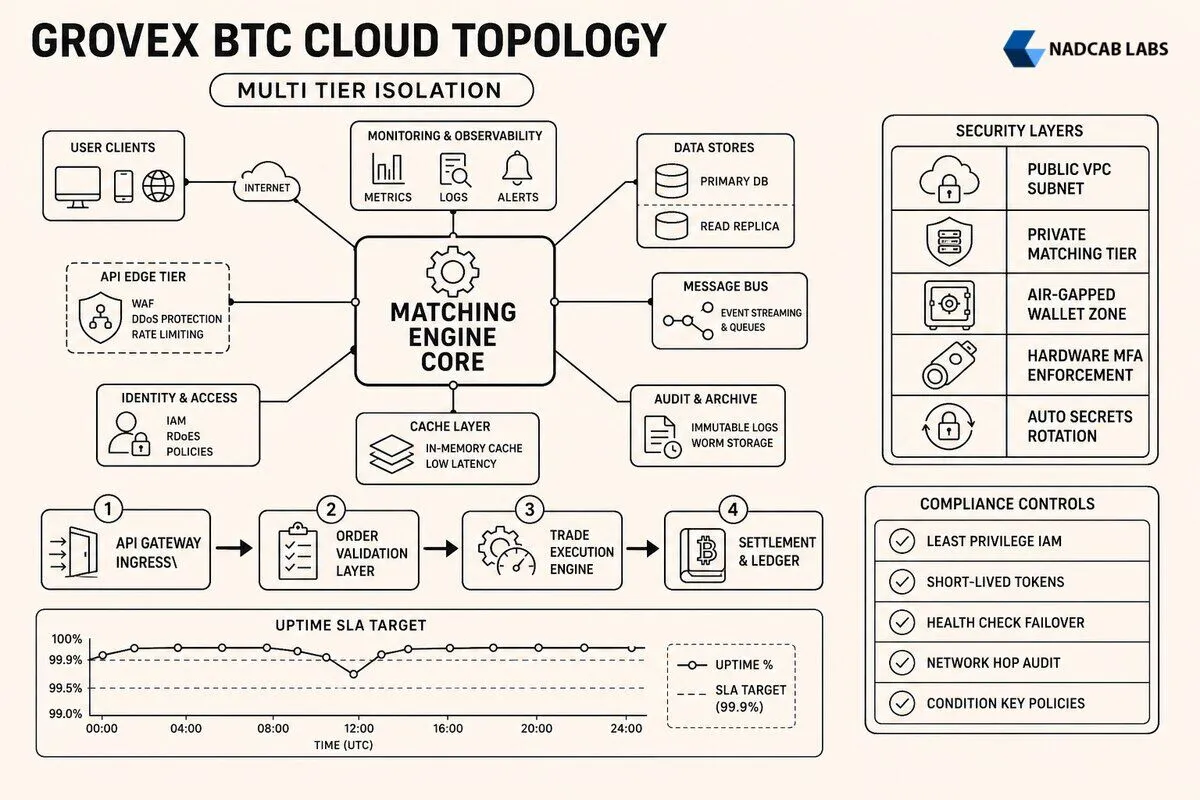
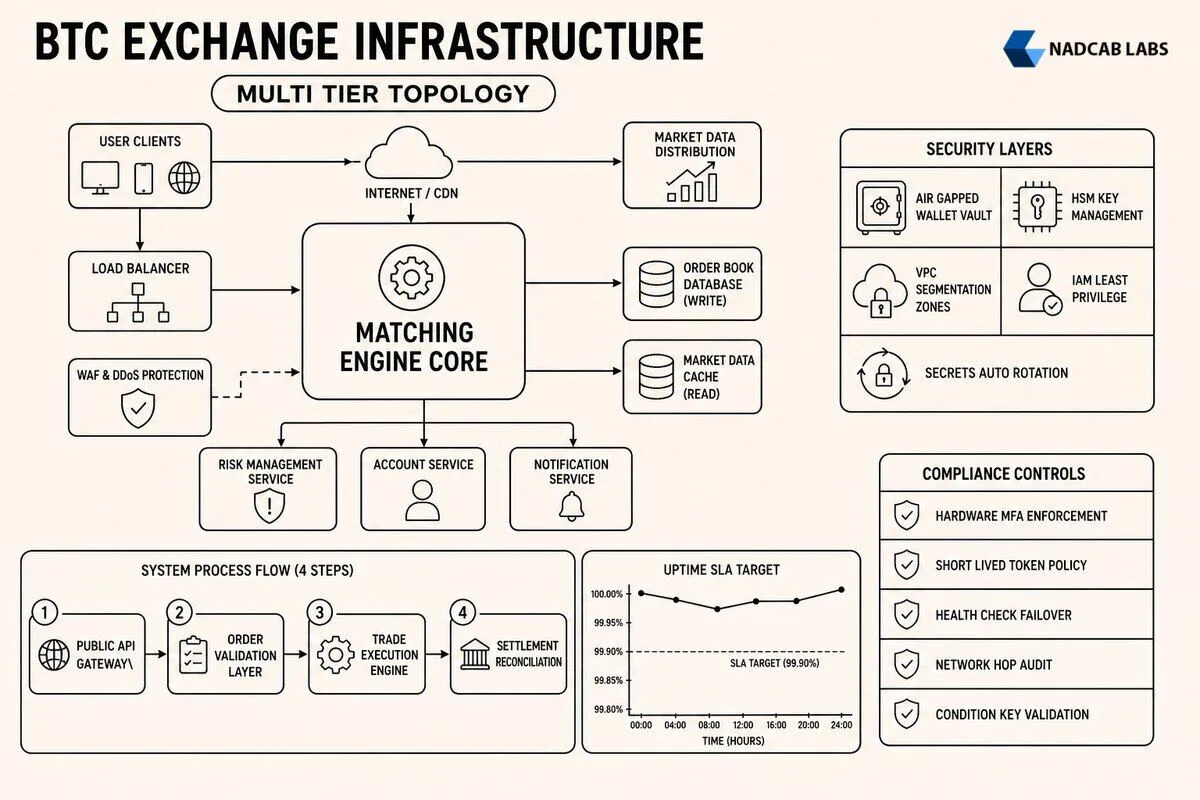
A multi tier VPC design for GroveX BTC starts with distinct subnets. The public subnet contains an Application Load Balancer (ALB) and a Web Application Firewall (WAF). The WAF inspects incoming HTTP requests, blocks SQL injection attempts, and rate limits aggressive bots. The ALB terminates TLS connections and forwards validated requests to API gateways in the private subnet. The private subnet hosts the matching engine, order book database, and API gateway instances. These components have no public IP addresses; they can only receive traffic from the ALB. The isolated subnet contains hot wallet nodes and cold wallet HSMs. These nodes have no inbound internet access and can only send signed transactions to a whitelisted set of blockchain nodes via a NAT gateway with strict egress rules.
A user submits a buy order via the web interface. The request hits the WAF, which checks for malicious payloads. The ALB routes the request to an API gateway instance in the private subnet. The API gateway validates the user’s JWT token, checks rate limits in Redis, and forwards the order to the matching engine. The matching engine updates the order book in the database, calculates the trade price, and triggers a settlement event. The settlement service calls the hot wallet signer in the isolated subnet via a private VPC endpoint. The signer retrieves the private key from memory (never from disk), signs the Bitcoin transaction, and broadcasts it to the blockchain via a dedicated node connection. Each hop is logged. Each security group rule is explicit. grovex btc.
Security groups enforce these boundaries at every hop. The ALB security group allows inbound HTTPS from 0.0.0.0/0 (the internet) and outbound TCP 8080 to the API gateway security group. The API gateway security group allows inbound 8080 only from the ALB and outbound 5432 to the database security group. The wallet signer security group allows inbound connections only from the settlement service and outbound HTTPS only to a hardcoded list of blockchain node IPs. If an attacker compromises the API gateway, they cannot directly connect to the wallet signer because the security group denies that path. Multiple layers, not a single chokepoint. grovex btc.
A DevOps engineer accidentally adds a rule to the wallet signer security group allowing inbound SSH from 0.0.0.0/0 for debugging. An automated scanner finds the open port within hours. The attacker brute forces the SSH key, gains shell access, and dumps the hot wallet private keys from process memory. Detection relies on VPC Flow Logs, which record every accepted and rejected connection. An anomaly detection rule in CloudWatch triggers an alert when the wallet signer receives inbound traffic from an unexpected source IP. The incident response runbook instructs the engineer to revoke the security group rule, rotate wallet keys, and audit recent transactions for unauthorized withdrawals. You test your runbooks quarterly, not after an incident. grovex btc.
| Subnet Tier | Components | Inbound Allowed From | Outbound Allowed To |
|---|---|---|---|
| Public | ALB, WAF, NAT Gateway | 0.0.0.0/0 (Internet) | Private subnet (API gateway) |
| Private | API Gateway, Matching Engine, Database | Public subnet (ALB only) | Isolated subnet (wallet signer via VPC endpoint) |
| Isolated | Hot Wallet Signer, Cold Wallet HSM | Private subnet (settlement service only) | Whitelisted blockchain node IPs via NAT |
IAM Controls for Admin and Service Accounts
IAM is the gatekeeper for every action in the cloud. Every API call, every resource read, every configuration change passes through IAM policy evaluation. The matching engine reads order data from S3; IAM verifies the service account’s policy allows s3:GetObject on that specific bucket. A compliance officer downloads audit logs; IAM enforces MFA and logs the access event. A DevOps engineer provisions a new database instance; IAM checks whether their role includes the rds:CreateDBInstance permission. Weak IAM policies turn every compromised credential into a full infrastructure breach. grovex btc.
Role based access starts with job function mapping. DevOps engineers get an InfrastructureProvisioner role with permissions to create EC2 instances, modify security groups, and update Route 53 records. They cannot read wallet private keys or modify IAM policies. Traders get a DashboardViewer role with read only access to CloudWatch metrics and order book snapshots. Compliance officers get an AuditLogReader role with permissions to query CloudTrail logs and download S3 bucket access reports. Wallet operators get a WalletSigner role with permissions to invoke the signing Lambda function and read encrypted keys from Secrets Manager. Each role is scoped to the minimum permissions needed to perform the job. No wildcards. No broad grants. grovex btc.
Service accounts use short lived STS tokens instead of long term access keys. The matching engine runs on an EC2 instance with an attached IAM role. On startup, the application calls the EC2 metadata endpoint to retrieve a temporary token valid for 15 minutes. The token includes a session policy that restricts actions to the specific S3 bucket and DynamoDB table the matching engine needs. After 15 minutes, the token expires and the application automatically requests a new one. If an attacker steals the token, they have a narrow time window and limited permissions. Long term access keys for production services are a liability.
Condition keys add context aware restrictions. The WalletSigner role includes a condition that requires requests to originate from a specific VPC endpoint and include a valid MFA token. If an attacker compromises the service account credentials and tries to invoke the signing function from their laptop, IAM denies the request because the source IP does not match the VPC endpoint. Human administrators must use hardware MFA devices (YubiKey or similar) to assume privileged roles. The IAM policy includes aws:MultiFactorAuthPresent: true as a condition, so stolen passwords alone cannot grant access.
A developer copies an IAM policy from a tutorial and grants s3:* permissions on all buckets. The policy is intended to allow read access for log analysis, but the wildcard action includes s3:DeleteBucket and s3:PutBucketPolicy. An attacker who compromises the service account can delete backup snapshots of wallet keys or modify bucket policies to grant themselves permanent access. Detection relies on IAM Access Analyzer, which scans policies daily and flags overly broad permissions. The security team receives an alert, reviews the policy, and replaces the wildcard with explicit actions: s3:GetObject, s3:ListBucket. They also implement a policy boundary that blocks any role from granting delete permissions, even if a developer tries to add them later. Policy boundaries are underutilized but essential for preventing privilege escalation.
IAM Policy Enforcement Flow
Automated Secrets Rotation for API Keys and Credentials
Hard coded secrets are the fastest path to a breach. A developer commits database credentials to a public GitHub repository. An automated scanner finds the leak within minutes. The attacker connects to the production database, dumps the order book, and sells the data to a competitor. Secrets Manager eliminates this risk by storing credentials in an encrypted vault and rotating them automatically on a schedule.
Secrets Manager holds sensitive data for GroveX BTC in distinct categories. Database credentials include the master password for the PostgreSQL order book database and read only credentials for analytics replicas. Third party API keys include tokens for liquidity providers (Binance, Coinbase Pro), identity verification services (Onfido, Jumio), and payment processors (Stripe, PayPal). Internal service tokens include JWT signing keys for API authentication and webhook secrets for settlement notifications. Each secret is encrypted at rest using a KMS key that only authorized IAM roles can decrypt. The KMS key itself is protected by hardware security modules in AWS data centers.
Automatic rotation follows a multi step workflow. Every 30 days, Secrets Manager triggers a Lambda function that generates a new secret version. For database credentials, the function connects to the PostgreSQL instance, creates a new user with the same permissions, updates the password, and stores the new credentials in Secrets Manager. For API keys, the function calls the third party provider’s API to issue a new token and revokes the old one. The new secret version is tagged as AWSCURRENT, while the old version is tagged as AWSPREVIOUS. This dual tagging allows for graceful cutover.
Canary deployment tests the new secret before fully cutting over. The matching engine deployment includes a canary instance that pulls the AWSCURRENT secret and attempts to connect to the database. If the connection succeeds and health checks pass for 10 minutes, the deployment proceeds to the remaining instances. If the canary fails, the deployment rolls back and the old secret version remains active. This prevents a bad rotation from taking down the entire exchange. Canary testing catches rotation bugs before they impact production traffic.
After a 7 day grace period, the old secret version is deprecated. Applications should have migrated to the new version by then. If an application still references AWSPREVIOUS, CloudWatch logs capture the access and trigger an alert. The DevOps team investigates, finds the stale reference, and updates the application configuration. If no alerts fire, the old secret is deleted to reduce the attack surface. This grace period is tunable based on your deployment velocity, but 7 days works for most teams.
If the matching engine crashes immediately after a rotation, the error log shows a database authentication failure. The engineer checks Secrets Manager and discovers the Lambda function generated a password with special characters that PostgreSQL rejected. The fix is to update the Lambda function to escape special characters and re run the rotation. If a third party API key rotation fails because the provider’s API is down, the Lambda function retries with exponential backoff and sends a Slack notification to the on call engineer. The engineer manually generates a new key via the provider’s dashboard and updates Secrets Manager. Rotation logic must be idempotent and include retry logic.
GroveX BTC integrates with a liquidity provider that requires API key rotation every 60 days. The provider’s API returns a new key and a revocation timestamp for the old key. The Lambda function stores the new key in Secrets Manager, updates the AWSCURRENT tag, and schedules a CloudWatch event to revoke the old key at the specified timestamp. The trading bot pulls the new key on its next health check cycle. If the bot tries to use the old key after revocation, the provider’s API returns a 401 error. The bot logs the error, falls back to the AWSCURRENT secret, and retries the request. The incident is logged but does not disrupt trading. Without this fallback logic, a rotation becomes a single point of failure.
Multi Region Disaster Recovery for Uptime and Data Integrity
A single region deployment is a single point of failure. If an AWS Cloud availability zone loses power, your exchange goes offline. If a regional internet backbone fails, users cannot connect. If a misconfigured deployment wipes the order book database, you lose trade history. Multi region disaster recovery eliminates these risks by replicating critical state to a standby region and automating failover when the primary region fails.
GroveX BTC runs an active passive setup across two regions: us east 1 (primary) and eu west 1 (standby). The primary region handles all live trading. Every trade, deposit, and withdrawal writes to the order book database in us east 1. The database uses cross region replication to copy data to a read replica in eu west 1 with a 5 second lag. The wallet state, including hot wallet balances and cold wallet key metadata, replicates to S3 in eu west 1 using versioned bucket replication. The replication lag defines the Recovery Point Objective (RPO): if us east 1 fails, the standby region has data as of 5 seconds ago. Acceptable for most exchanges. If you need sub second RPO, you must use synchronous replication, which adds latency to every write.
Route 53 health checks monitor the primary region. Every 30 seconds, Route 53 sends an HTTPS request to the ALB in us east 1. If three consecutive health checks fail, Route 53 updates the DNS record to point to the ALB in eu west 1. The DNS TTL is set to 60 seconds, so most clients cut over within 2 minutes. The standby region’s matching engine starts processing orders from the replicated order book. The hot wallet signer in eu west 1 retrieves the private keys from a hardware security module (HSM) that stores encrypted key shares. The HSM requires two operator keys to unlock, enforcing a two person rule. The operators follow a runbook to retrieve their physical keys from a safe, authenticate to the HSM, and authorize the signer to load the keys into memory. This process completes within 15 minutes, defining the Recovery Time Objective (RTO). If you need faster RTO, you must keep the standby wallet signer hot, which increases cost and attack surface.
Cost guardrails prevent runaway cloud bills during failover. The primary region uses reserved instances for the baseline load: 10 EC2 instances for the matching engine, 5 instances for API gateways, and 3 RDS database instances. Reserved instances provide a 40% discount compared to on demand pricing. The standby region runs minimal infrastructure: a single matching engine instance in stopped state, a read replica database, and a cold wallet HSM. When failover occurs, an Auto Scaling policy launches additional instances in eu west 1 to handle the traffic. The policy caps the maximum instance count at 3x the baseline to prevent a flash crash or DDoS attack from triggering unlimited scaling. Spot instances handle batch settlement jobs, which reconcile blockchain transactions with the internal ledger. Spot instances cost 70% less than on demand but can be interrupted with 2 minutes notice. The settlement job is designed to checkpoint progress every minute, so an interruption causes minimal rework. You design batch jobs to be interruptible from day one.
A developer deploys a buggy matching engine version to us east 1 that corrupts the order book by writing negative balances. The bug triggers within seconds, and Route 53 health checks start failing because the API returns 500 errors. Route 53 cuts over to eu west 1. The standby matching engine loads the last clean order book snapshot from 5 seconds before the corruption. The operations team investigates the primary region, identifies the buggy deployment, and rolls back to the previous version. They verify the order book integrity by comparing checksums between the primary and standby databases. Once the primary region is stable, they manually fail back by updating the Route 53 record. Total user facing downtime: 3 minutes. You test failover quarterly, not after an incident.
Disaster Recovery Capacity by Region
The disaster recovery architecture also addresses data integrity beyond replication. Every hour, a Lambda function computes a Merkle tree hash of the order book and wallet state, then stores the hash in an immutable S3 bucket with object lock enabled. If an attacker compromises the database and modifies historical trades, the Merkle tree verification detects the tampering. The operations team restores the database from the most recent clean snapshot and re applies transactions from the blockchain to rebuild the order book. This process is tested quarterly in a dedicated staging environment to ensure the runbook is accurate and the team can execute it under pressure. Merkle trees are not just for blockchains; they are a powerful tool for detecting data corruption in any system where append only logs are critical.
Putting It All Together
Building resilient infrastructure for a Bitcoin exchange like GroveX BTC requires more than spinning up cloud instances. It demands layered defenses: network segmentation that isolates critical components, IAM policies that enforce least privilege access, automated secrets rotation that eliminates hard coded credentials, and multi region disaster recovery that keeps trading online when a region fails. Each layer addresses specific failure modes, from lateral movement attacks to credential theft to data corruption. The architecture is not theoretical; it is validated through health checks, anomaly detection, and quarterly disaster recovery drills.
When you are ready to design or audit your exchange infrastructure, Cloud consulting services translate these principles into a production ready blueprint tailored to your compliance requirements and uptime SLAs. For teams building on Azure Cloud Services or extending infrastructure with generative AI infrastructure, the same segmentation and IAM patterns apply. The goal is always the same: turn business uptime goals into auditable, testable infrastructure that your on call engineer can debug at 3 AM. That separates an exchange that survives a market crash from one that becomes a cautionary tale on Twitter. grovex btc.
Frequently Asked Questions
Q1.What is GroveX BTC and how does it differ from other Bitcoin exchanges?
GroveX BTC is a Bitcoin exchange platform designed with infrastructure first architecture, separating hot wallet signing services from order matching engines at the network layer. Unlike monolithic exchanges, GroveX isolates transaction broadcast nodes in dedicated VPCs, uses hardware security modules for key custody, and enforces strict egress filtering on wallet servers. This separation reduces attack surface: a compromised trading API cannot directly access private keys.
Q2.Why do Bitcoin exchanges like GroveX need specialized cloud consulting services?
Bitcoin exchanges handle irreversible transactions and face constant targeted attacks on wallet infrastructure. Specialized cloud consulting ensures correct implementation of multi region replication for order books, sub millisecond latency between matching engines and liquidity feeds, encrypted snapshot backups of UTXO databases, and compliance with SOC 2 audit trails. Generic DevOps teams lack experience in UTXO accounting reconciliation, mempool monitoring, and Bitcoin Core RPC hardening required for production custody.
Q3.How does network segmentation prevent unauthorized access to GroveX BTC wallet infrastructure?
Network segmentation places hot wallet signing nodes in a private subnet with no internet gateway, accessible only via a bastion host in a separate security group. Security group rules whitelist specific IP ranges and ports: only the order settlement service on port 8332 can reach Bitcoin RPC endpoints. VPC flow logs capture every connection attempt. Even if an attacker breaches the web tier, they cannot route packets to the wallet subnet without compromising the bastion and passing MFA.
Q4.What IAM policies are essential for securing a Bitcoin exchange cloud environment?
Enforce least privilege with separate roles: TradingAPIRole can read order tables but not invoke wallet Lambda functions; WalletSignerRole can call KMS Decrypt and access HSM partitions but has no S3 or RDS permissions; AuditorRole has read only CloudTrail and VPC Flow Log access. Use policy conditions requiring MFA for any KMS key operations. Deny all by default, then grant specific actions per service. Rotate service account credentials every 48 hours and log every AssumeRole event to SIEM.
Q5.How often should secrets and API keys be rotated in a crypto exchange like GroveX?
Database credentials and internal service tokens rotate every 24 to 48 hours via automated secret manager workflows. API keys for external liquidity providers rotate weekly. HSM partition passwords and KMS master keys rotate quarterly with zero downtime key migration. Hot wallet private keys never rotate; instead, sweep funds to fresh addresses every 12 hours and retire old keys. Emergency rotation playbooks execute in under 10 minutes if a credential appears in threat intelligence feeds or audit logs show anomalous usage.
Q6.What is the recommended disaster recovery RPO and RTO for a Bitcoin trading platform?
Target RPO of 1 second for order book state using synchronous multi region replication of the matching engine database. RTO under 60 seconds for trading APIs via active active deployment with health check failover. Wallet infrastructure accepts higher RTO of 5 minutes because withdrawal queues buffer requests; RPO of 10 seconds using continuous WAL shipping to standby regions. Test failover monthly: simulate primary region loss, verify order matching resumes in secondary, confirm UTXO database consistency, and validate withdrawal signing from backup HSM.
Explore Services
Related Services
Reviewed by

Wazid Khan
Director & Co-Founder
Wazid Khan is the Director & Co-Founder of Nadcab Labs, a forward-thinking digital engineering company specializing in Blockchain, Web3, AI, and enterprise software solutions. With a strong vision for innovation and scalable technology, Wazid has played a key role in building Nadcab Labs into a trusted global technology partner. His expertise lies in strategic planning, business development, and delivering client-centric solutions that drive real-world impact. Under his leadership, the company has successfully delivered numerous projects across industries such as fintech, healthcare, gaming, and logistics. Wazid is passionate about leveraging emerging technologies to create secure, efficient, and future-ready digital ecosystems for businesses worldwide.