Ai Overview
Understanding the RWA tokenization cost breakdown is essential for sponsors evaluating whether blockchain-based asset digitization delivers meaningful ROI. A typical tokenization project budget ranges from $150,000 to $500,000 depending on asset class, jurisdictional complexity, and platform requirements. Delaware statutory trusts cost $15,000-$25,000 for formation including trust agreement drafting, trustee appointment, and initial state filings.
Understanding the RWA tokenization cost breakdown is essential for sponsors evaluating whether blockchain-based asset digitization delivers meaningful ROI. A typical tokenization project budget ranges from $150,000 to $500,000 depending on asset class, jurisdictional complexity, and platform requirements. This guide provides granular cost structures across legal setup, smart contract development, compliance integration, and infrastructure deployment so decision-makers can build realistic financial models.
Key Takeaways
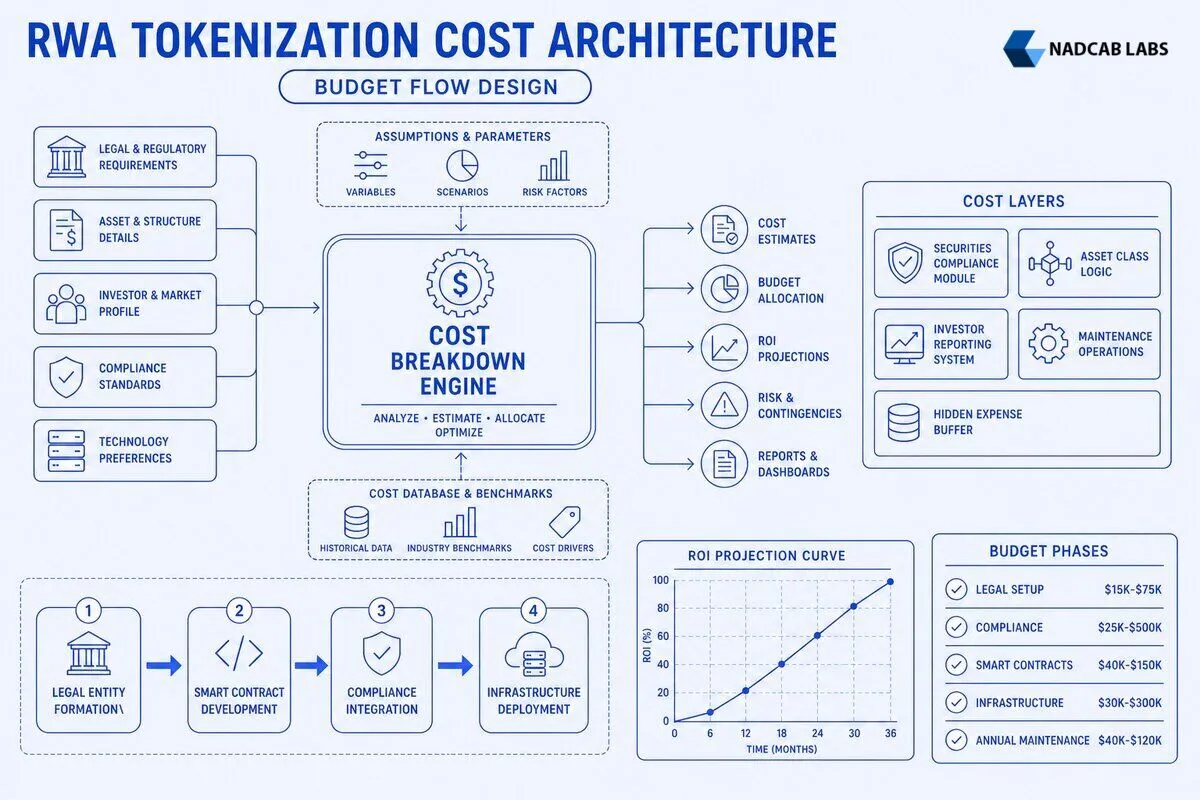
- Total tokenization costs split into five phases: legal entity formation ($15K-$75K), securities compliance ($25K-$500K), smart contract development ($40K-$150K), infrastructure deployment ($30K-$300K), and ongoing maintenance ($40K-$120K annually)
- Asset class drives cost variance—real estate tokenization averages $180K-$320K while private equity fund structures require $250K-$450K due to complex distribution logic and investor reporting
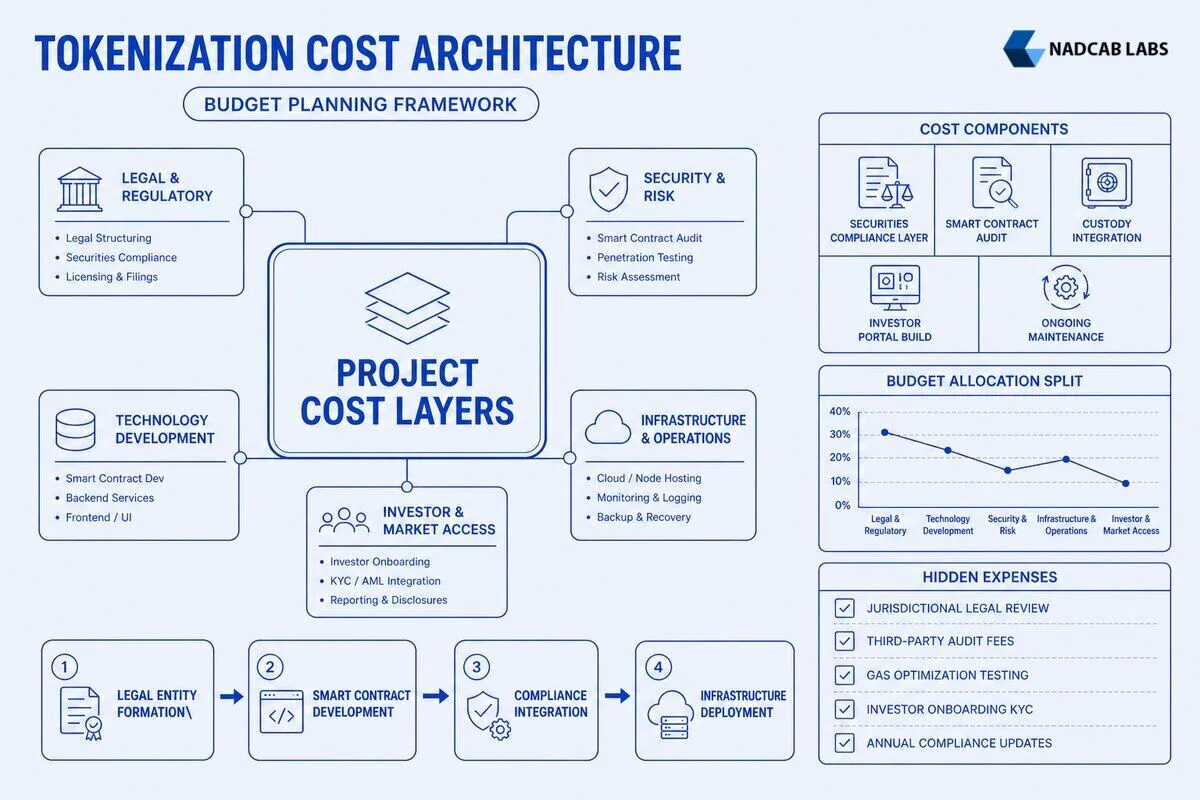
- Hidden expenses account for 20-35% of budgets: oracle integration for price feeds ($5K-$80K annually), third-party KYC providers ($3-$8 per verification), and security audits ($50K-$150K) often exceed initial estimates
- ROI timelines vary by use case: real estate projects break even in 18-24 months via 3.5% fee reduction, while commodity tokenization achieves 8-12% margin improvement within 12 months through settlement acceleration
- Blockchain selection creates 4-10x cost differences in gas fees—Ethereum mainnet operations cost $8K-$25K annually versus $2K-$8K on Polygon, but liquidity and institutional trust trade-offs must be evaluated
- Amortizing development costs across multiple asset offerings reduces per-project expenses by 40-60% after the initial implementation, making platform reusability critical for portfolio sponsors
What drives the total cost of an RWA tokenization project?
The RWA tokenization cost breakdown follows a phase-based structure that mirrors traditional asset securitization but introduces blockchain-specific expenses. Pre-tokenization legal setup establishes the entity framework—typically a special purpose vehicle (SPV) that holds the underlying asset and issues digital securities representing fractional ownership. This phase includes drafting operating agreements, filing formation documents, and securing necessary regulatory exemptions. Smart contract development follows, translating legal ownership rules into executable code that enforces transfer restrictions, manages distributions, and automates compliance checks.
Compliance integration represents the bridge between traditional finance and blockchain rails. This phase involves connecting on-chain tokens to off-chain identity verification systems, implementing Know Your Customer (KYC) and Anti-Money Laundering (AML) checks, and building reporting mechanisms that satisfy securities regulators. Custody infrastructure setup determines how private keys controlling token issuance and treasury functions are secured—options range from multi-signature wallets to institutional-grade Hardware Security Modules (HSMs). Post-launch maintenance includes ongoing legal compliance, smart contract upgrades, investor relations support, and blockchain network fees. rwa tokenization.
Variable cost factors create wide budget ranges across projects. Asset class complexity drives significant variance: tokenizing a single commercial property with straightforward cash flows costs substantially less than structuring a multi-tranche private credit fund with waterfall distributions and performance-based fees. Real estate tokenization typically requires simpler legal structures and fewer compliance touchpoints than securities offerings. Commodities and carbon credits introduce unique challenges around physical custody verification and quality assurance that necessitate specialized oracle solutions. rwa tokenization.
Jurisdictional requirements multiply costs when projects span multiple regulatory regimes. A U.S.-only offering under Regulation D exemption involves federal and state securities filings but avoids cross-border coordination. Adding European investors triggers MiFID II compliance, GDPR data handling requirements, and potential prospectus obligations under EU securities law. Asian markets introduce additional KYC standards and local custody mandates. Each jurisdiction adds $30,000-$100,000 in legal structuring and $15,000-$40,000 in annual compliance overhead. rwa tokenization.
Blockchain selection impacts both upfront development costs and ongoing operational expenses. Ethereum mainnet offers maximum liquidity and institutional familiarity but carries higher gas fees—deploying a complex security token contract costs $5,000-$15,000 in network fees alone, with annual transaction costs reaching $8,000-$25,000 for moderately active projects. Layer-2 solutions like Polygon reduce gas expenses by 90% but require bridging infrastructure and may limit access to certain DeFi protocols. Private consortium chains eliminate public gas fees but demand dedicated infrastructure costing $40,000-$120,000 annually for node operation and maintenance. rwa tokenization.
Custody model selection creates divergent cost profiles. Traditional custodians charge $50,000-$200,000 for integration plus 0.15%-0.50% of assets under management annually, providing insurance coverage and regulatory comfort that institutional investors expect. Self-custody models using multi-signature wallets reduce fees to $20,000-$80,000 setup costs but shift security risk to the sponsor and may limit investor participation. Hybrid approaches combining institutional custody for fiat on-ramps with smart contract escrow for token transfers offer middle-ground economics but add coordination complexity. rwa tokenization.
Hidden expenses often derail initial budgets. Oracle integration for off-chain data feeds—property valuations, commodity prices, credit ratings—costs $5,000-$20,000 for standard Chainlink implementations but escalates to $30,000-$80,000 annually for custom oracle networks serving illiquid assets. Third-party KYC/AML providers charge $3-$8 per investor verification plus monthly platform fees of $500-$2,000, creating variable costs that scale with investor base growth. Security audits by reputable firms like Trail of Bits or OpenZeppelin range from $50,000-$150,000 for comprehensive smart contract reviews, with additional economic security analysis adding $20,000-$50,000. Liquidity provision incentives for secondary markets can require $50,000-$500,000 in initial capital to establish meaningful trading depth. rwa tokenization.
| Cost Category | Budget Range | Key Variables | Typical % of Total |
|---|---|---|---|
| Legal Entity Formation | $15,000 – $75,000 | Jurisdiction, asset type, multi-entity structures | 8-15% |
| Securities Compliance | $25,000 – $500,000 | Registration type, exemptions, cross-border scope | 15-40% |
| Smart Contract Development | $40,000 – $150,000 | Token standard, compliance modules, custom logic | 20-30% |
| Security Audits | $50,000 – $150,000 | Audit firm tier, contract complexity, formal verification | 15-25% |
| Infrastructure & Platform | $30,000 – $300,000 | Blockchain choice, custom vs white-label, custody model | 15-25% |
| Ongoing Maintenance (Annual) | $40,000 – $120,000 | Compliance reporting, gas fees, platform hosting, support | N/A (recurring) |
How much does legal and compliance setup cost for tokenized assets?
Entity structuring forms the legal foundation for any tokenization project. Sponsors typically establish a special purpose vehicle (SPV) to isolate the tokenized asset from other business operations and provide bankruptcy-remote protection for investors. Delaware statutory trusts cost $15,000-$25,000 for formation including trust agreement drafting, trustee appointment, and initial state filings. Wyoming Series LLCs offer multi-asset flexibility at $20,000-$35,000 for master entity formation plus $5,000-$10,000 per additional series. Offshore structures in jurisdictions like the Cayman Islands or British Virgin Islands range from $35,000-$75,000 due to higher legal fees and ongoing registered agent requirements. rwa tokenization.
Multi-jurisdictional structures escalate costs significantly. A sponsor tokenizing assets for both U.S. and European investors might establish a Delaware SPV for domestic holders and a parallel Luxembourg vehicle for EU compliance, adding $30,000-$60,000 in cross-border structuring. Asian market access often requires local fund vehicles or distribution agreements, contributing another $40,000-$100,000 per region. These parallel structures demand ongoing coordination between legal teams and introduce operational complexity in managing investor communications and distributions across entities. rwa tokenization.
Securities registration determines the largest variable in compliance budgets. Regulation D private placements under Rule 506(b) or 506(c) represent the most cost-effective path for U.S. issuers, requiring Form D filings and state Blue Sky notices totaling $25,000-$45,000 in legal fees. Regulation S offerings for non-U.S. persons add $15,000-$30,000 for opinion letters and compliance procedures. Regulation A+ mini-IPOs allowing up to $75 million in annual offerings cost $80,000-$150,000 for SEC qualification plus $30,000-$60,000 in ongoing reporting. Full SEC registration statements for public offerings start at $150,000-$300,000 for initial filing and can exceed $500,000 for complex structures requiring extensive financial disclosures. rwa tokenization.
Ongoing compliance reporting creates substantial annual expenses. Regulation D issuers face relatively light burdens—annual Form D amendments and state renewals cost $8,000-$15,000. Regulation A+ Tier 2 issuers must file semi-annual reports and audited financials, generating $40,000-$70,000 in annual compliance costs. Fully registered securities trigger quarterly 10-Q filings, annual 10-K reports, and current event 8-K disclosures, with total annual compliance expenses reaching $80,000-$120,000 for straightforward offerings and exceeding $200,000 for complex multi-tranche structures. rwa tokenization.
Asset custody arrangements vary dramatically in cost and risk profile. Traditional financial institutions like BNY Mellon or State Street provide institutional-grade custody with insurance coverage, charging $50,000-$120,000 for initial integration work to connect their systems with blockchain infrastructure. Annual custody fees typically run 0.15%-0.50% of assets under management, meaning a $50 million tokenized real estate portfolio incurs $75,000-$250,000 in annual custody costs. These custodians handle both the underlying asset (property deeds, securities certificates) and digital token custody, providing comprehensive solutions that satisfy institutional investor due diligence requirements. rwa tokenization.
Specialized digital asset custodians like Anchorage Digital or Fireblocks offer crypto-native solutions at lower price points. Setup costs range from $30,000-$80,000 for enterprise accounts with dedicated support, multi-signature wallet configuration, and API integration. Custody fees typically follow tiered structures: 0.10%-0.25% for assets under $50 million, declining to 0.05%-0.15% above $100 million. These providers excel at token custody and blockchain transaction management but may not handle underlying asset custody, requiring parallel arrangements with traditional custodians for physical assets. rwa tokenization.
DeFi custody alternatives using smart contract escrow and multi-signature wallets reduce costs to $20,000-$50,000 for initial security architecture design and $5,000-$15,000 annually for ongoing key management services. This approach eliminates third-party custody fees but shifts security responsibility to the sponsor’s technical team. Institutional investors often resist self-custody models due to operational risk concerns and regulatory uncertainty around digital asset safekeeping obligations. The cost savings must be weighed against potential limitations in investor pool and increased insurance premiums to cover key loss or theft scenarios. rwa tokenization.
Transfer agent services bridge traditional securities administration and blockchain token management. Specialized providers like Pacific Stock Transfer or Computershare offer tokenization-compatible platforms charging $25,000-$60,000 for initial setup and $15,000-$40,000 annually for cap table management, distribution processing, and investor communications. These services become particularly valuable for securities offerings requiring detailed investor recordkeeping and regulatory reporting. Fully decentralized approaches using smart contracts for all transfer agent functions reduce costs but may not satisfy certain securities law requirements around investor recordkeeping and transfer restrictions. Our Real World Asset Tokenization services help sponsors navigate these custody and transfer agent decisions based on asset type and investor profile. rwa tokenization.
What are the smart contract development and audit expenses?
Core tokenization contract development costs vary based on the token standard and compliance requirements. ERC-20 tokens with basic transfer functionality cost $15,000-$30,000 for development and testing but lack the compliance features necessary for regulated securities. ERC-3643 (formerly ERC-1400) compliant security tokens implementing the T-REX standard require $40,000-$70,000 in development time to build identity registry integration, transfer restriction logic, and compliance claim verification. ERC-1400 tokens with partition logic allowing different investor classes with distinct rights (voting vs non-voting shares, preferred vs common equity) range from $60,000-$120,000 due to increased complexity in managing multiple token sub-classes within a single contract.
Custom fractional ownership models for unique asset types push development budgets to $80,000-$150,000. Real estate tokenization often requires specialized logic for rental income distributions, property expense allocations, and voting mechanisms for major decisions like property sales or refinancing. Private equity fund tokens need waterfall distribution calculations, carried interest tracking, and capital call functionality. Commodity tokenization demands redemption mechanisms linking tokens to physical inventory, quality verification workflows, and delivery coordination. These custom requirements extend development timelines from 8-12 weeks for standard implementations to 16-24 weeks for complex structures.
Compliance module integration adds layers of functionality that satisfy regulatory requirements. On-chain KYC/AML verification systems cost $25,000-$60,000 to develop, creating smart contract interfaces that check investor credentials against approved identity registries before allowing token transfers. These modules typically integrate with third-party verification providers through oracle connections, requiring careful design to maintain privacy while proving compliance. Transfer restriction logic implementing securities law requirements—accredited investor status, holding periods, transfer volume limits—adds $15,000-$40,000 in development costs. More sophisticated implementations allowing dynamic restriction updates based on changing regulations or investor status require additional investment.
Regulatory reporting automation through smart contract event emission and off-chain data aggregation costs $30,000-$70,000 to implement properly. These systems capture every token transfer, distribution, and compliance check in structured formats that can be automatically compiled into regulatory filings. Real-time reporting capabilities allow sponsors to generate investor statements, tax documents, and regulatory reports on-demand rather than through manual quarterly processes. The upfront investment in reporting automation typically pays for itself within 18-24 months through reduced accounting and legal time spent on compliance activities.
Security audits represent non-negotiable expenses for any tokenization project handling significant value. Tier-1 audit firms like Trail of Bits, OpenZeppelin, or ConsenSys Diligence charge $50,000-$100,000 for comprehensive smart contract reviews covering common vulnerabilities, business logic errors, and gas optimization. These audits typically require 2-4 weeks and produce detailed reports with severity-ranked findings and remediation recommendations. Complex multi-contract systems with intricate interactions between token contracts, compliance modules, and distribution logic can push audit costs to $100,000-$150,000.
Economic security analysis examines game-theoretic attack vectors and incentive misalignments that traditional code audits miss. Specialized firms like Gauntlet or Chaos Labs charge $20,000-$50,000 to model potential economic exploits, stress-test distribution mechanisms under extreme market conditions, and validate that tokenomics align with intended outcomes. This analysis proves particularly valuable for projects with complex fee structures, liquidity incentives, or governance mechanisms where misaligned incentives could lead to value extraction by sophisticated actors.
Formal verification using mathematical proofs to guarantee contract correctness represents the highest tier of security assurance. Runtime Verification and Certora offer formal verification services starting at $80,000-$150,000 for critical contract components. This approach mathematically proves that contracts behave according to specifications under all possible inputs, providing stronger guarantees than testing-based audits. The high cost limits formal verification to the most security-critical functions—token minting/burning, transfer restrictions, and treasury management—rather than entire codebases.
Bug bounty programs create ongoing security incentives by rewarding external researchers who discover vulnerabilities. Platforms like Immunefi or Code4rena host competitions with prize pools of $10,000-$100,000 depending on project value and risk tolerance. A typical structure offers $2,000-$5,000 for low-severity findings, $5,000-$20,000 for medium issues, $20,000-$50,000 for high-severity vulnerabilities, and $50,000-$100,000 for critical exploits that could drain funds or freeze contracts. Bug bounties complement formal audits by providing continuous security review after launch when contracts are exposed to real-world conditions and attack vectors that auditors may not have anticipated. The RWA Tokenization Smart Contract Architecture guide provides additional technical context on these development considerations.
Smart Contract Development Process
How do infrastructure and platform costs scale with asset size?
Blockchain network selection creates the most significant infrastructure cost variance. Ethereum mainnet offers maximum security, liquidity, and institutional recognition but carries substantial gas fees. Deploying a typical security token contract with compliance modules costs $5,000-$15,000 in network fees at moderate gas prices (30-50 gwei). Annual operational costs for a moderately active project—processing 500-1000 transfers, 12 distribution events, and periodic compliance updates—range from $8,000-$25,000 in gas fees. High-activity projects with thousands of investors and frequent trading can see gas costs exceed $50,000 annually, making Ethereum economically viable primarily for larger asset pools above $10 million where gas represents under 0.5% of assets annually.
Layer-2 scaling solutions like Polygon, Arbitrum, or Optimism reduce gas costs by 90-95% while maintaining Ethereum security guarantees through periodic settlement to mainnet. Deploying the same security token contract costs $200-$800 on Polygon, with annual operational expenses of $2,000-$8,000 for similar transaction volumes. The primary trade-off involves liquidity fragmentation—tokens on Layer-2 networks have less access to DeFi protocols and institutional custody solutions compared to Ethereum mainnet. Bridging assets between Layer-2 and mainnet adds complexity and introduces security assumptions around bridge contracts that have historically been exploit targets.
Private consortium chains like Hyperledger Besu or R3 Corda eliminate public gas fees entirely but require dedicated infrastructure investment. Running a validator node cluster for high availability costs $40,000-$80,000 annually in cloud infrastructure, monitoring tools, and DevOps support. Multi-organization consortiums can distribute these costs across participants, reducing per-member expenses to $15,000-$30,000 annually. Private chains offer superior privacy and transaction finality but sacrifice the transparency and censorship resistance that public blockchains provide. Institutional investors often prefer private chains for pre-IPO securities and other sensitive assets where public visibility is undesirable.
Oracle and data feed expenses scale with asset complexity and data update frequency. Standard Chainlink price feeds for liquid assets like gold or major real estate indices cost $5,000-$10,000 for initial integration and $3,000-$8,000 annually in node operator fees. Custom oracle networks for illiquid or unique assets—individual property valuations, private company share prices, specialty commodity grades—require dedicated oracle infrastructure costing $30,000-$80,000 annually. These custom solutions typically involve multiple independent data providers, reputation systems to identify unreliable sources, and dispute resolution mechanisms for conflicting valuations.
Real-time data feeds for high-frequency use cases like commodity trading or derivatives increase costs substantially. Updating price feeds every block (12 seconds on Ethereum) can cost $50,000-$150,000 annually in oracle fees and gas costs for on-chain updates. Most RWA projects use less frequent updates—daily for real estate valuations, hourly for commodity prices—to balance data freshness with cost efficiency. Smart contract design can further optimize costs by only updating on-chain prices when deviations exceed certain thresholds (1-2% for stable assets, 5-10% for volatile commodities) rather than on fixed schedules.
Investor portal and secondary market integration costs depend heavily on build-versus-buy decisions. White-label platforms like Securitize, Tokeny, or Polymath offer pre-built investor portals with KYC integration, wallet management, and basic trading functionality for $30,000-$80,000 setup fees plus $3,000-$10,000 monthly platform charges. These solutions work well for standard securities offerings but offer limited customization for unique asset types or complex distribution logic. The monthly fees scale with investor count and transaction volume, potentially reaching $15,000-$25,000 monthly for large projects with thousands of active users.
Custom-built platforms provide maximum flexibility at significantly higher cost. A bespoke investor portal with integrated KYC, wallet management, document storage, distribution tracking, and secondary market functionality requires $100,000-$300,000 in initial development. Ongoing maintenance, hosting, and feature enhancements add $30,000-$60,000 annually. Custom builds make economic sense for sponsors planning multiple tokenization projects who can amortize development costs across a portfolio of assets, or for unique asset types that white-label platforms cannot accommodate.
DEX liquidity provisioning represents a substantial hidden cost for projects seeking secondary market trading. Automated market makers like Uniswap or Balancer require initial liquidity pools of $50,000-$500,000 depending on expected trading volume and desired price stability. A $100,000 liquidity pool for a $5 million token offering (2% depth) allows trades up to $5,000-$10,000 with minimal slippage but struggles with larger transactions. Insufficient liquidity creates poor trading experiences that discourage investor participation and reduce the liquidity premium that tokenization promises. Sponsors must either commit significant capital to liquidity provision or implement incentive programs (liquidity mining) that distribute tokens to external liquidity providers, adding 1-3% annually to the token supply.
The Cross-Border RWA Tokenization framework discusses how multi-jurisdictional operations amplify infrastructure complexity and costs through additional compliance integrations and regional platform requirements.
What ROI can sponsors expect from different asset tokenization scenarios?
Real estate tokenization delivers compelling economics for properties above $2 million where fractional ownership creates meaningful liquidity benefits. Consider a $2 million commercial property tokenized into 1,000 investor units at $2,000 each. Total implementation costs—legal entity formation ($25,000), securities compliance ($45,000), smart contract development ($50,000), security audit ($60,000), platform setup ($40,000), and initial marketing ($30,000)—total approximately $250,000. Adding contingency for unexpected legal issues and extended timelines brings realistic budgets to $280,000-$320,000.
Traditional real estate syndication for a similar property involves 6-8% in total fees: 3-4% acquisition fees, 1-2% annual asset management fees, and 2% disposition fees. On a $2 million property held for 5 years, these fees total $120,000-$160,000. Tokenization reduces intermediary fees to approximately 2.5% total: 1% issuance costs (absorbed in the $280K-$320K implementation), 0.5% annual platform and compliance costs, and 1% disposition costs for secondary market facilitation. Over the same 5-year period, tokenization fees total $50,000-$70,000, generating $70,000-$90,000 in fee savings.
The liquidity premium from fractional ownership and secondary market trading adds substantial value. Academic research suggests illiquid real estate trades at 20-30% discounts compared to liquid alternatives with similar risk-return profiles. Tokenization providing monthly or quarterly liquidity windows can capture 5-10% of this discount as incremental value—$100,000-$200,000 on a $2 million property. Combined with fee savings, total economic benefit reaches $170,000-$290,000 over 5 years, delivering break-even in 18-24 months and 15-25% IRR improvement compared to traditional structures.
Private equity and venture fund tokenization targets different economics focused on operational efficiency rather than liquidity premiums. A $50 million fund with 200 limited partners faces $150,000-$250,000 in annual fund administration costs for capital call processing, distribution calculations, K-1 tax document preparation, and quarterly reporting. Tokenization implementation costs $250,000-$450,000: legal structuring ($60,000), securities compliance ($80,000), smart contract development with complex waterfall logic ($100,000), audit ($70,000), and platform integration ($90,000).
Smart contract automation reduces ongoing administration costs by 30-40% to $90,000-$175,000 annually through automated capital calls, distribution processing, and real-time reporting that eliminates quarterly manual reconciliation. Annual savings of $60,000-$75,000 deliver payback in 3-4 years on implementation costs. More significantly, automated distributions enable 12-18 month faster capital deployment—funds can distribute realized gains immediately upon exit events rather than waiting for quarterly distribution cycles. This velocity improvement increases fund IRR by 8-12% through earlier reinvestment of proceeds, adding $4 million-$6 million in incremental returns over a typical 7-year fund life.
Commodity and carbon credit tokenization achieves ROI through settlement acceleration and counterparty risk reduction. A $10 million inventory pool of agricultural commodities or industrial metals faces 5-7 day settlement cycles in traditional markets, tying up working capital and creating counterparty exposure during the settlement window. Tokenization implementation costs $150,000-$280,000: legal structuring for commodity-backed tokens ($35,000), smart contract development with redemption mechanisms ($60,000), oracle integration for quality verification ($40,000), audit ($50,000), and platform setup ($45,000).
Blockchain settlement reduces cycle time to same-day or T+1, freeing $1.4 million-$2 million in working capital (assuming 14% of inventory in settlement at any time). At 8% cost of capital, this creates $110,000-$160,000 in annual value. Eliminating counterparty default risk through atomic settlement (delivery-versus-payment enforced by smart contracts) reduces credit losses and insurance costs by an estimated 0.5-1% of transaction volume. On $50 million annual trading volume, this saves $250,000-$500,000. Combined benefits of $360,000-$660,000 annually deliver payback in 3-6 months and 8-12% margin improvement from disintermediation of settlement intermediaries and real-time pricing transparency.
Carbon credit tokenization offers similar economics with additional benefits from fraud prevention. Traditional carbon credit registries face double-counting and fraudulent credit issuance that erode market confidence. Blockchain-based registries with cryptographic proof of retirement and transparent issuance tracking reduce verification costs and command 3-5% price premiums from buyers seeking high-integrity offsets. On a $10 million carbon credit portfolio, this premium generates $300,000-$500,000 in incremental value annually while implementation costs of $180,000-$320,000 (similar to commodity tokenization with additional registry integration) pay back in under 12 months.
Tokenization ROI by Asset Class
Portfolio sponsors planning multiple tokenization projects achieve dramatically better economics through platform reusability. The first asset implementation carries full development costs of $200,000-$400,000, but subsequent assets using the same legal structure and smart contract framework reduce incremental costs to $80,000-$150,000 (primarily legal entity formation, asset-specific compliance, and deployment costs). By the third asset, per-project costs decline 40-60% compared to standalone implementations. A sponsor tokenizing five properties over two years spreads the initial $300,000 platform investment across $10 million-$15 million in total assets, reducing effective implementation cost to 2-3% of assets versus 12-15% for single-asset projects.
Cost amortization creates competitive advantages for institutional sponsors entering tokenization systematically rather than experimentally. Real estate investment trusts (REITs) tokenizing 10-20 properties annually can justify $500,000-$800,000 investments in custom platforms and dedicated legal/compliance teams that would be uneconomical for single-asset sponsors. Private equity firms managing multiple funds can implement standardized tokenization frameworks that reduce per-fund costs to $100,000-$150,000 while delivering superior investor experiences through consistent interfaces and reporting across portfolio companies.
The Tokenization Cost Factors guide explores additional variables affecting project economics, while the What is RWA Tokenization overview provides foundational context for sponsors new to blockchain-based asset digitization. Understanding these cost structures enables realistic financial modeling and informed decisions about when tokenization delivers meaningful ROI versus when traditional structures remain more efficient.
Sponsors should also consider the broader dApp development cost breakdown when planning investor-facing applications, and evaluate crypto exchange KYC implementation costs if building proprietary verification systems rather than using third-party providers. The blockchain development budget planning process should incorporate these interconnected components to avoid underestimating total project costs.
Final Thoughts
The RWA tokenization cost breakdown reveals a complex financial landscape where implementation budgets range from $150,000 for straightforward single-asset offerings to over $500,000 for multi-jurisdictional securities with sophisticated compliance requirements. Legal and regulatory expenses typically consume 25-55% of total budgets, with securities compliance and entity structuring representing the largest variable costs. Smart contract development and security audits account for another 35-45% of expenses, while infrastructure and platform costs vary dramatically based on blockchain selection and build-versus-buy decisions. Hidden costs around oracle integration, KYC providers, and liquidity provision frequently add 20-35% to initial estimates, making contingency planning essential.
ROI analysis demonstrates that tokenization economics improve significantly with asset size and portfolio scale. Real estate projects above $2 million achieve break-even in 18-24 months through fee reduction and liquidity premiums, while commodity tokenization delivers 3-6 month payback through settlement acceleration and working capital optimization. Private equity fund tokenization requires longer payback periods of 3-4 years but generates substantial IRR improvements through automated distributions and faster capital deployment. Portfolio sponsors implementing systematic tokenization programs across multiple assets reduce per-project costs by 40-60% after initial platform development, creating sustainable competitive advantages in capital formation efficiency.
Successful tokenization projects balance upfront investment against long-term operational savings and investor experience improvements. Sponsors should prioritize compliance and security over cost minimization—inadequate legal structuring or unaudited smart contracts create existential risks that dwarf initial savings. The optimal approach combines proven legal frameworks, audited smart contract templates, and scalable infrastructure that supports multiple assets over time. As tokenization matures and standardized solutions emerge, implementation costs will decline while ROI timelines compress, making blockchain-based asset digitization increasingly compelling for sponsors across real estate, private equity, commodities, and alternative asset classes.
Frequently Asked Questions
Q1.What is the minimum viable budget for a pilot RWA tokenization project?
A pilot RWA tokenization project typically requires $150,000–$300,000 minimum. This covers smart contract development ($40K–$80K), legal structuring and compliance ($50K–$100K), blockchain integration ($30K–$60K), and basic custody setup ($30K–$60K). Smaller pilots on testnets or permissioned chains may start at $100K but lack production-grade security and regulatory readiness for real asset deployment.
Q2.How do tokenization costs compare between public and private blockchains?
Public blockchains incur higher ongoing gas fees ($5K–$50K annually depending on transaction volume) but lower infrastructure costs. Private or permissioned chains require dedicated node hosting ($20K–$100K/year) and maintenance but eliminate per-transaction gas costs. Public chains offer better liquidity and composability; private chains provide greater control, privacy, and predictable operational expenses for enterprise RWA deployments.
Q3.What percentage of total cost should be allocated to ongoing compliance and maintenance?
Allocate 25–35% of total annual budget to ongoing compliance and maintenance for tokenized RWAs. This includes regulatory reporting, KYC/AML monitoring, smart contract audits, security updates, and legal reviews. For a $500K initial deployment, expect $125K–$175K yearly. High-value or cross-border assets may require 40%+ due to multi-jurisdictional compliance, investor servicing, and continuous regulatory adaptation.
Q4.Can tokenization costs be amortized across multiple asset offerings?
Yes, core infrastructure costs—smart contract templates, compliance frameworks, custody integrations, and platform development—can be amortized across multiple RWA offerings. First asset deployment costs $200K–$500K; subsequent offerings drop to $50K–$150K each by reusing audited contracts and legal structures. Shared infrastructure reduces per-asset cost by 60–80%, making multi-asset tokenization platforms highly cost-efficient at scale.
Q5.What are the cost differences between security tokens and utility token structures for RWAs?
Security token structures cost 40–60% more due to regulatory compliance. Security tokens require SEC registration or exemption filings ($50K–$200K), transfer restrictions, investor accreditation checks, and ongoing reporting ($30K–$100K/year). Utility token structures avoid securities regulations but face challenges proving non-security status. Security tokens suit equity and debt; utility tokens work for access rights or commodity-backed assets with careful legal design.
Q6.How do custody solution choices impact total cost of ownership for tokenized assets?
Custody solutions range from self-custody (minimal cost but high operational risk) to institutional-grade services ($50K–$500K setup plus 0.15–0.50% AUM annually). Multi-signature wallets cost $10K–$30K to implement; hardware security modules add $20K–$100K. Third-party custodians like Fireblocks or Anchorage charge basis points on assets under management, making them expensive for high-value RWAs but reducing liability and insurance costs significantly.
Explore Services
Related Services
Reviewed by

Aman Vaths
Founder of Nadcab Labs
Aman Vaths is the Founder & CTO of Nadcab Labs, a global digital engineering company delivering enterprise-grade solutions across AI, Web3, Blockchain, Big Data, Cloud, Cybersecurity, and Modern Application Development. With deep technical leadership and product innovation experience, Aman has positioned Nadcab Labs as one of the most advanced engineering companies driving the next era of intelligent, secure, and scalable software systems. Under his leadership, Nadcab Labs has built 2,000+ global projects across sectors including fintech, banking, healthcare, real estate, logistics, gaming, manufacturing, and next-generation DePIN networks. Aman’s strength lies in architecting high-performance systems, end-to-end platform engineering, and designing enterprise solutions that operate at global scale.