Ai Overview
Not long ago, the idea that crypto exchanges might one day compete with the New York Stock Exchange or NASDAQ would have been dismissed as wishful thinking. Exchanges that depend entirely on crypto transaction fees saw revenues drop by over 50% during bear markets. Now manages over $500 million in tokenized assets and is actively pushing tokenized Treasury products across multiple blockchain networks.
Key Takeaways
- Crypto exchanges are no longer just crypto platforms. They are evolving into full-service investment platforms offering tokenized stocks, bonds, ETFs, and commodities.
- Tokenized real-world assets (RWAs) represent one of the fastest-growing segments in blockchain finance, with projections pointing to a $16 trillion market by 2030.
- BlackRock, JPMorgan, Fidelity, and Goldman Sachs have all launched on-chain financial products, signaling that Wall Street’s shift to blockchain is already well underway.
- 24/7 trading, fractional ownership, and near-instant settlement are core advantages that blockchain-based investing offers over traditional Wall Street market structures.
- Regulatory clarity, smart contract security, and institutional-grade custody solutions remain the three biggest challenges slowing the full convergence of TradFi and DeFi.
- Stablecoins are emerging as the settlement layer connecting traditional financial instruments with blockchain-native trading ecosystems, enabling seamless value transfer.
- Traditional stockbrokers face growing competitive pressure as crypto exchanges offer lower fees, global access, and digital-first experiences that appeal to younger investors.
- The convergence of AI, blockchain, and on-chain securities is set to create a new generation of 24/7 global capital markets that operate without geographic or time restrictions.
Introduction
Not long ago, the idea that crypto exchanges might one day compete with the New York Stock Exchange or NASDAQ would have been dismissed as wishful thinking. Today it is being seriously discussed in boardrooms on Wall Street itself. The line between decentralized finance and traditional investment markets is getting thinner every year, and the pace of that convergence is accelerating faster than most analysts predicted.
Crypto exchanges have spent the last decade building the infrastructure to handle massive trading volumes, global user bases, and complex financial instruments. Now they are turning those capabilities toward something far bigger: becoming the investment platforms of the future. By bringing tokenized stocks, bonds, ETFs, and real estate onto the blockchain, these platforms are not just adding new products. They are proposing an entirely different model for how global capital markets could function.
In this article, we walk through everything you need to understand about this shift. From the basics of what crypto exchanges and Wall Street actually are, to the technologies powering this convergence, to how major institutions and platforms are already making it real, this guide covers the full landscape.
Understanding Crypto Exchanges
What Is a Crypto Exchange?
A crypto exchange is a digital platform where users can buy, sell, and trade cryptocurrencies and other blockchain-based assets. Think of it as a digital marketplace that matches buyers with sellers and facilitates the transfer of value between them. Unlike traditional stock exchanges, crypto platforms typically operate around the clock, seven days a week, and are accessible to anyone with an internet connection and a digital wallet.
How Crypto Exchanges Work
Crypto exchanges use an order book model or automated market maker (AMM) model to match buyers and sellers. When you place a buy order for Bitcoin at a certain price, the platform matches it with a corresponding sell order. Centralized platforms process this matching internally, while decentralized platforms use smart contracts to handle matching and settlement on-chain. Settlement is typically near-instant on blockchain, compared to the T+2 settlement cycle in traditional stock markets.
What Is Wall Street?
What Wall Street Represents
Wall Street is both a literal street in lower Manhattan and a global symbol for the world’s financial system. It is home to the New York Stock Exchange, NASDAQ, major investment banks, hedge funds, and asset managers that collectively manage trillions of dollars in assets. When people say Wall Street, they typically mean the entire ecosystem of traditional finance including institutional investors, brokers, regulators, and financial markets.
Key Financial Instruments
| Instrument | What It Is | Tokenizable on Blockchain? |
|---|---|---|
| Stocks | Ownership shares in publicly listed companies | Yes – Tokenized equity |
| ETFs | Baskets of securities traded on exchanges | Yes – Tokenized ETF baskets |
| Bonds | Debt instruments issued by governments or companies | Yes – Digital bonds on-chain |
| Commodities | Physical goods like gold, oil, and agricultural products | Yes – Tokenized gold and oil |
| Derivatives | Contracts based on the value of an underlying asset | Emerging – DeFi options and futures |
Why Crypto Exchanges Are Evolving Beyond Cryptocurrency
The shift away from pure-play crypto trading is being driven by a combination of market pressure, user demand, and strategic ambition. The bear markets of 2022 and 2023 taught exchange operators a hard lesson: relying entirely on crypto trading volumes is extremely risky. Smart platforms diversified aggressively, and tokenized traditional assets became the most logical expansion target.
Declining Retail Trading Activity
When crypto prices fall, retail trading volumes collapse. Exchanges that depend entirely on crypto transaction fees saw revenues drop by over 50% during bear markets. Adding traditional financial assets to their platforms creates revenue streams that are not correlated with crypto market cycles.
Institutional Adoption Accelerating
Hedge funds, family offices, and pension funds want to participate in blockchain markets but need regulated, familiar asset types. Offering tokenized bonds and equities on crypto infrastructure bridges that gap and makes crypto exchanges viable partners for institutional capital.
Regulatory Progress
Regulatory frameworks for digital assets are maturing in Europe, the UAE, Singapore, and increasingly in the US. As compliance pathways become clearer, exchanges can offer regulated tokenized asset products with legal certainty, unlocking massive institutional market segments.
Rising Demand for Tokenized Assets
Younger investors and global users who cannot easily access US or European stock markets want exposure to Apple, Tesla, and government bonds. Tokenized assets give them fractional, 24/7 access without needing a traditional brokerage account in a specific country.
What Are Tokenized Assets?
Definition and How Tokenization Works
Asset tokenization is the process of converting ownership rights in a real-world asset into a digital token on a blockchain. The token is a programmable representation of the asset that can be transferred, traded, and fractionalized just like any other blockchain token. The underlying asset itself is typically held in custody by a regulated entity, and the smart contract governing the token enforces ownership rules automatically.
How Crypto Exchanges Are Bringing Wall Street to Blockchain
The practical execution of the TradFi-to-blockchain migration is already happening across multiple asset classes. Here is how leading exchanges are putting each category of Wall Street instruments onto the blockchain.
Tokenized Stocks
Crypto platforms offer tokens pegged 1:1 to real company shares. Bybit and Binance have both experimented with tokenized stock products in regulated markets. Coinbase is building institutional infrastructure to support regulated equity tokens at scale for its institutional clients.
Tokenized ETFs
Blockchain-based ETF tokens mirror traditional fund baskets but can be traded 24/7 without broker intermediaries. Franklin Templeton and BlackRock have both launched on-chain fund products that function similarly to tokenized ETFs with blockchain-native settlement mechanisms.
Tokenized Bonds
Multiple governments and corporations have issued bonds directly on blockchain networks. The World Bank, European Investment Bank, and several Asian governments have all issued digital bonds that settle on-chain, reducing costs and increasing accessibility significantly.
Tokenized Commodities
Gold is the most mature tokenized commodity, with PAXG and Tether Gold holding physical gold in vaults. Oil and agricultural tokens are emerging as exchanges partner with commodity custodians to create blockchain-tradeable representations of physical goods markets.
Tokenized Money Market Funds
BlackRock’s BUIDL fund on Ethereum is the leading example. Institutional investors can hold tokenized money market fund shares that earn yield from T-bills while sitting on-chain, ready to be used as collateral or transferred instantly across DeFi protocols.
Stablecoins as Settlement Layers
USDC, USDT, and PayPal’s PYUSD are being used as settlement currencies for tokenized asset trades. They function as the on-chain equivalent of US dollars, enabling instant, cost-efficient settlement of tokenized securities trades between counterparties anywhere in the world.
Technologies Powering This Transformation
The convergence of Wall Street and blockchain is not accidental. It is built on a specific technology stack that makes institutional-grade digital asset markets possible. Understanding these layers helps clarify why this transformation is durable rather than speculative.
| Technology | Role in Tokenized Finance | Leading Examples |
|---|---|---|
| Blockchain Networks | Underlying ledger for recording asset ownership and transfers | Ethereum, Polygon, Solana, Stellar |
| Smart Contracts | Automate issuance, transfers, dividends, and compliance rules | Solidity, Rust-based contracts |
| Token Standards | Define how tokenized securities behave and interoperate | ERC-3643, ERC-1400, ERC-20 |
| Oracles | Feed real-world price data onto the blockchain for accurate valuations | Chainlink, Pyth Network |
| Layer-2 Scaling | Reduce transaction costs and increase throughput for high-volume trading | Arbitrum, Optimism, zkSync |
| Digital Identity (KYC/AML) | Ensure only verified investors can access regulated tokenized assets | Onfido, Civic, Polygon ID |
| Custody Solutions | Secure storage for both the underlying assets and the digital tokens | Fireblocks, Anchorage, BitGo |
Benefits for Investors
An investor can buy 0.001 of a $3,000 Amazon share for just $3. Tokenization removes the minimum investment barrier that has long kept smaller investors out of premium assets globally.
A user in Nigeria, Vietnam, or Colombia can invest in US Treasuries or German corporate bonds without needing a foreign brokerage account or clearing relationships, using only a crypto wallet.
Traditional equity settlement takes two business days (T+2). Blockchain settlement happens in seconds, reducing counterparty risk, freeing up capital faster, and enabling more efficient portfolio management.
Removing brokers, clearinghouses, and custodian intermediaries reduces transaction fees significantly. Blockchain-native trading can cut settlement costs by 40 to 80% compared to traditional financial infrastructure.
Every transaction is recorded immutably on the blockchain and visible to all participants. Investors can verify ownership, transaction history, and asset backing in real-time, eliminating information asymmetry.
Benefits for Financial Institutions
Smart contracts automate compliance checks, settlement, and reporting, drastically reducing back-office headcount and manual processing costs for large financial institutions running legacy systems.
International wire transfers through correspondent banking take 3 to 5 days and cost significant fees. Blockchain settlement collapses this to seconds at a fraction of the cost, even for large institutional transactions.
Banks that adopt tokenization can earn fees from asset issuance, custody, secondary market trading, and on-chain lending. These new revenue streams are additive to existing business without requiring entirely new infrastructure.
Major Crypto Exchanges Leading the Transformation
Several major crypto exchanges have moved well beyond pure crypto trading and are building the infrastructure for tokenized real-world financial markets. Here is what the leading platforms are actually doing.
| Exchange | Key Initiative | Status |
|---|---|---|
| Coinbase | Building institutional tokenized asset infrastructure on Base Layer-2. Partnering with BlackRock for BUIDL fund distribution and providing institutional-grade digital asset custody. | Active |
| Kraken | Pursuing a US banking charter that would allow it to offer a full suite of traditional financial services alongside crypto. Pushing for regulatory status to offer tokenized securities to US investors legally. | In Progress |
| Binance | Previously offered tokenized stocks for Tesla, Apple, Coinbase, and Microsoft. Paused due to regulatory pressure but continues to expand tokenized RWA products in compliant markets through its BNB Chain ecosystem. | Selective |
| Bybit | Introduced tokenized stock trading in eligible jurisdictions, giving users 24/7 access to major US equities. Also actively expanding RWA yield products including tokenized treasury bill instruments for institutional clients. | Active |
| OKX | Expanding its institutional product suite with RWA tokenization partnerships. The OKX Ventures arm has invested in multiple tokenized asset protocols and is building out compliance-first institutional trading infrastructure globally. | Expanding |
| Robinhood | Announced plans to offer tokenized stocks for European and global users, allowing international investors to access US equities through blockchain. Robinhood is bridging its traditional brokerage identity with blockchain-native product expansion. | Launched EU |
| Gemini | Focuses on institutional-grade security and regulatory compliance. Gemini is building towards being a licensed digital asset bank, offering custody, trading, and tokenized asset services under full regulatory oversight in multiple jurisdictions. | Building |
Wall Street Firms Entering Blockchain
The movement is not one-directional. As crypto exchanges move toward traditional finance, Wall Street firms are simultaneously moving toward blockchain. This convergence from both sides is what makes the structural shift so significant and lasting.
Launched the BUIDL fund on Ethereum, the first tokenized money market fund from a major asset manager. Now manages over $500 million in tokenized assets and is actively pushing tokenized Treasury products across multiple blockchain networks.
Offers institutional Bitcoin and Ethereum custody through Fidelity Digital Assets. Has applied for and received approval for crypto ETFs. Actively exploring tokenized equity and bond products for its institutional client base of pension funds and asset managers.
Launched the FOBXX fund on Stellar and Polygon, an on-chain US government money market fund. This was one of the first regulated, on-chain mutual funds from a major traditional asset manager and proved the model is legally viable in the US.
Built Onyx, a private blockchain platform, and JPM Coin, a digital dollar for interbank settlements. JPMorgan processes billions in daily transactions through its blockchain infrastructure and is a leader in tokenized repo and collateral management on-chain.
Has executed tokenized bond issuances for European institutions on private blockchain networks. Goldman’s Digital Assets Platform supports institutional clients in issuing, distributing, and trading tokenized debt instruments at scale.
Citi has developed proprietary blockchain infrastructure for trade finance and token issuance. UBS has issued tokenized bonds for institutional clients in Switzerland and Singapore, working within local digital asset regulatory frameworks to ensure full legal compliance.
The Role of Real-World Asset (RWA) Tokenization
What Is RWA and Why It Matters
Real-world asset (RWA) tokenization refers specifically to placing off-chain physical or financial assets onto a blockchain as digital tokens. Unlike native crypto assets, RWAs derive their value from something tangible in the real world. The tokenization of RWAs is widely seen as the most important bridge between DeFi and TradFi because it brings the stability and scale of traditional markets to the efficiency and accessibility of blockchain infrastructure.
Institutions prefer RWAs because they understand the underlying assets. A pension fund comfortable with US Treasuries is far more willing to explore on-chain T-bill tokens than to speculate on volatile crypto assets. Tokenized RWAs give institutions the blockchain efficiency they want with the asset familiarity they require.
Challenges and Risks
Despite the enormous promise of this convergence, significant challenges remain. Teams and investors entering this space need to understand these risks clearly before committing capital or building infrastructure around blockchain-based traditional finance.
Critical Risk Factors in Tokenized Finance
Regulatory Uncertainty: Laws governing tokenized securities vary widely by country. A product legal in Singapore may be prohibited in the US. Operating globally requires navigating dozens of overlapping regulatory regimes simultaneously, which is costly and complex.
Smart Contract Vulnerabilities: Bugs in smart contract code can lead to loss of funds with no recourse. The tokenized finance ecosystem requires rigorous, repeated security auditing of all contracts that handle real-world asset ownership and transfers.
Custody Issues: Who holds the real-world asset underlying the token? If a custodian fails, becomes insolvent, or is fraudulent, token holders may have limited legal recourse, especially across international borders where laws differ significantly.
Market Volatility: Even tokenized stable assets can face price dislocations due to liquidity issues, oracle failures, or smart contract exploits. Investors must distinguish between volatility of the token and stability of the underlying asset.
Liquidity Risks: Many tokenized asset markets are thin. A large sell order in a tokenized real estate or bond market could cause significant price impact, especially on smaller or newer platforms with limited market-making activity.
Investor Protection: Traditional financial markets have SIPC, FDIC, and other investor protection mechanisms. Tokenized finance currently lacks equivalent protections in most jurisdictions, leaving retail investors more exposed to platform risk.
Impact on Traditional Stock Brokers
Traditional stockbrokers are facing a structural challenge that goes beyond just competition on fees. Crypto exchanges are not just cheaper; they are fundamentally different business models that eliminate several layers of the traditional financial intermediary stack.
Crypto exchanges that offer tokenized stocks can undercut traditional brokers on price dramatically. A commission of near zero with 24/7 access versus $0 commissions but limited hours and geographic access is a meaningful competitive advantage.
Younger investors in their 20s and 30s prefer crypto-native interfaces over traditional brokerage apps. The UX of platforms like Coinbase or Bybit is more intuitive to digital natives than legacy brokerage platforms built for desktop web browsers.
The traditional brokerage of the future will likely be a hybrid: licensed for both securities and digital assets, offering tokenized and traditional investments side by side on a single platform with blockchain settlement infrastructure running beneath the surface.
Future Trends
AI agents will autonomously manage portfolios of tokenized assets, executing trades, rebalancing allocations, and optimizing yield across on-chain financial instruments without human intervention, making sophisticated investing accessible to everyone.
Regulatory approvals for fully on-chain securities issuance are advancing globally. Within five years, it is likely that major companies will conduct primary stock offerings directly on public blockchain networks with smart contract-managed cap tables.
Blockchain-based initial public offerings would allow companies to raise capital globally from any investor with a wallet, eliminating the exclusive club nature of traditional IPO allocation processes dominated by institutional investors and underwriting banks.
Central bank digital currencies will serve as the settlement currency for tokenized asset markets, providing government-backed, on-chain money rails that reduce counterparty risk and enable programmable monetary policy in digital capital markets.
As blockchain interoperability improves, tokenized assets on Ethereum will flow freely to Solana, Polygon, or private chains. This cross-chain liquidity will create a unified global financial network spanning every major blockchain platform.
The opening bell and closing bell will become historical curiosities. As tokenized equity and bond markets reach critical liquidity mass, global capital markets will shift to continuous, around-the-clock operation with no geographic or time-zone constraints.
Expert Predictions
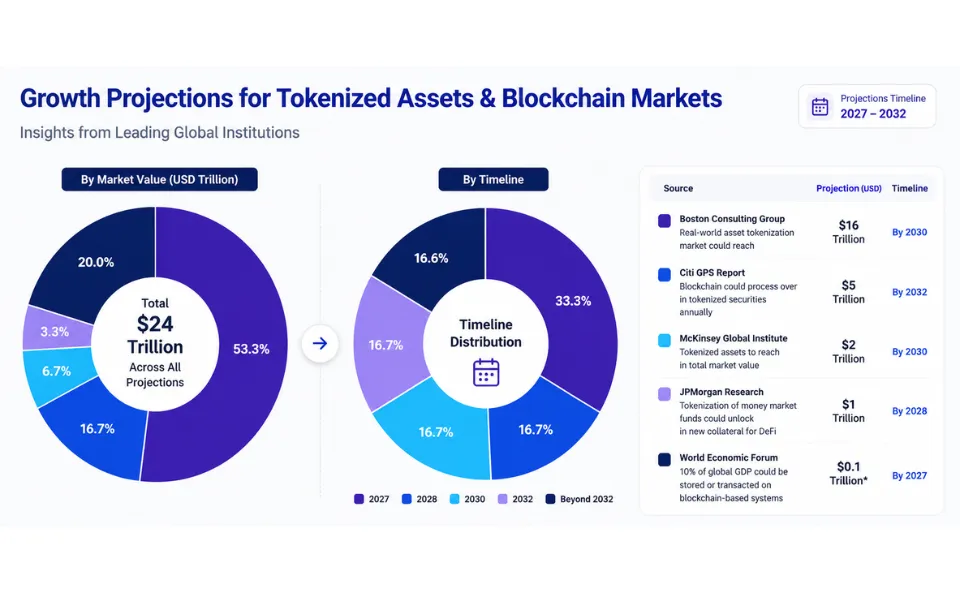
| Source | Projection | Timeline |
|---|---|---|
| McKinsey Global Institute | Tokenized assets to reach $2 trillion in total market value driven by institutional adoption | By 2030 |
| Boston Consulting Group | Real-world asset tokenization market could reach $16 trillion across all asset classes | By 2030 |
| Citi GPS Report | Blockchain could process over $5 trillion in tokenized securities annually within 8 years | By 2032 |
| World Economic Forum | 10% of global GDP could be stored or transacted on blockchain-based systems | By 2027 |
| JPMorgan Research | Tokenization of money market funds alone could unlock $1 trillion in new collateral for DeFi | By 2028 |
Final Thoughts
The transformation of crypto exchanges into multi-asset investment platforms is not a future possibility. It is already underway, and the pace of change is accelerating. BlackRock has tokenized a money market fund. Robinhood is offering tokenized stocks to European users. JPMorgan is settling billions in blockchain transactions daily. The question is no longer whether this shift will happen, but how quickly regulation, security infrastructure, and institutional confidence will allow it to reach its full potential.
For investors, this convergence opens up a world of opportunity: fractional access to global assets, 24/7 markets, near-instant settlement, and dramatically lower costs. For traditional financial institutions, it is both a threat and an opportunity depending on whether they choose to adapt or resist.
The crypto exchange of 2030 will look very different from the platforms we know today. It will be licensed, regulated, and capable of offering everything from Bitcoin to Tesla stock to tokenized US Treasuries to a fractional stake in a commercial real estate fund, all settled on-chain in seconds. That is not a disruption of Wall Street. That is the next generation of Wall Street itself, running on blockchain infrastructure built by the crypto industry.
Frequently Asked Questions
Q1.What are tokenized Wall Street assets?
Tokenized Wall Street assets are traditional financial instruments, including stocks, bonds, ETFs, and real estate, converted into blockchain tokens. Each token represents ownership in the underlying asset and can be traded 24/7 on crypto platforms with instant settlement and fractional ownership capabilities unavailable in traditional markets.
Q2.Can crypto exchanges legally offer tokenized stocks?
It depends entirely on jurisdiction. In the US, strict SEC regulations govern securities offerings, making tokenized stocks legally complex. In Europe, Singapore, UAE, and other regions with clearer digital asset laws, licensed exchanges can legally offer tokenized equity products. Regulatory clarity varies significantly and continues to evolve globally.
Q3.Are tokenized stocks safe?
Tokenized stocks carry both traditional market risks and blockchain-specific risks like smart contract vulnerabilities and custody concerns. When issued by regulated entities with one-to-one asset backing and proper audit oversight, they can match the safety of traditional equities. Always verify the custodian, smart contract audit status, and regulatory compliance of any platform.
Q4.How do tokenized assets work?
A regulated custodian holds the real-world asset. A smart contract mints a corresponding digital token on a blockchain representing that ownership. Investors buy, sell, and transfer these tokens just like crypto. Dividends or interest can be distributed automatically. Tokens can typically be redeemed for the underlying asset through the issuing platform under specific conditions.
Q5.Which crypto exchanges support tokenized assets?
Coinbase, Bybit, OKX, Binance, Kraken, Robinhood, and Gemini are all actively pursuing or already offering tokenized asset products. Robinhood launched tokenized US stocks for European users in 2024. Coinbase provides institutional tokenized asset infrastructure. Bybit offers tokenized treasury products. The landscape is expanding rapidly as more exchanges obtain regulatory approvals globally.
Explore Services
Related Services
Reviewed by

Aman Vaths
Founder of Nadcab Labs
Aman Vaths is the Founder & CTO of Nadcab Labs, a global digital engineering company delivering enterprise-grade solutions across AI, Web3, Blockchain, Big Data, Cloud, Cybersecurity, and Modern Application Development. With deep technical leadership and product innovation experience, Aman has positioned Nadcab Labs as one of the most advanced engineering companies driving the next era of intelligent, secure, and scalable software systems. Under his leadership, Nadcab Labs has built 2,000+ global projects across sectors including fintech, banking, healthcare, real estate, logistics, gaming, manufacturing, and next-generation DePIN networks. Aman’s strength lies in architecting high-performance systems, end-to-end platform engineering, and designing enterprise solutions that operate at global scale.