Ai Overview
Marriage has long served as one of the most enduring institutions in human civilisation, rooted in tradition, legal frameworks, and cultural rituals. However, in an era defined by rapid technological advancement, even the institution of marriage is undergoing a remarkable transformation. The concept of a blockchain wedding has emerged as a compelling fusion of technology and commitment, allowing couples to record their union on an immutable digital ledger that can never be altered, deleted, or tampered with.
Marriage has long served as one of the most enduring institutions in human civilisation, rooted in tradition, legal frameworks, and cultural rituals. However, in an era defined by rapid technological advancement, even the institution of marriage is undergoing a remarkable transformation. The concept of a blockchain wedding has emerged as a compelling fusion of technology and commitment, allowing couples to record their union on an immutable digital ledger that can never be altered, deleted, or tampered with. From the first blockchain wedding in 2014 to India’s pioneering Pune couple blockchain wedding in 2021, this trend is gaining global momentum.
Key Takeaways
- A blockchain wedding is a modern concept where blockchain technology is used to digitally record and verify marriage details on a decentralized ledger.
- The blockchain wedding meaning revolves around transparency, immutability, and secure digital proof of marriage that cannot be easily altered or tampered with.
- A blockchain wedding works by creating digital wallets, deploying a smart contract with marriage details on a blockchain network such as Ethereum, minting an NFT marriage certificate, and recording the final transaction on a decentralized ledger as a permanent and verifiable proof of union.
- The first India blockchain wedding gained attention when a Pune couple securely recorded their marriage details on a decentralized ledger, marking a major step in combining traditional ceremonies with emerging technology.
- The first world blockchain wedding was reported in the United States, where a couple chose to register their marriage certificate on a blockchain network to create a tamper-proof digital record.
A blockchain wedding represents far more than a technological novelty. It is a statement of transparency, permanence, and autonomy. Couples who choose to marry on the blockchain are embracing a decentralised approach to one of life’s most significant commitments. Whether it involves exchanging NFT-based digital rings, executing an Ethereum smart contract containing wedding vows, or receiving a marriage certificate as a soulbound token, the blockchain wedding is redefining what it means to say “I do” in the digital age.
In this comprehensive guide, we will explore the blockchain wedding meaning in full detail, explain how the process works from a technical and ceremonial standpoint, review the leading platforms that facilitate blockchain marriages, and examine real-world examples that have captured international attention. Whether you are a technology enthusiast, a curious couple, or a professional in the wedding industry, this article provides everything you need to understand about blockchain weddings in 2026 and beyond.
What Is a Blockchain Wedding?
To understand the blockchain wedding meaning more thoroughly, it is essential to appreciate what blockchain technology itself offers. A blockchain is a distributed digital ledger that records transactions across a network of computers. Each transaction is stored in a “block” that is cryptographically linked to the previous one, forming an unbreakable chain. When this technology is applied to a wedding, the couple’s commitment is etched into this chain permanently, ensuring that no government, institution, or third party can modify or erase the record.
Definition
A blockchain wedding is a technology-enabled marriage ceremony in which a couple’s vows, agreement, or digital marriage certificate are securely recorded on a decentralized blockchain network such as Ethereum or Bitcoin.
The appeal of a blockchain wedding lies in several core principles. First, it offers permanence; the marriage record exists for as long as the blockchain network itself exists. Second, it provides transparency, since anyone with access to the blockchain can verify the record. Third, it grants autonomy, as couples are not dependent on any central authority to validate their union. This combination of features has made blockchain weddings increasingly attractive to technology-forward couples around the world.
The core structure of a blockchain wedding is built around a few essential technological components, which include:
| Component | Role in Blockchain Wedding |
|---|---|
| Digital Marriage Record or NFT | Serves as the tamper-proof marriage certificate stored on-chain |
| Smart Contract Agreement | Self-executing code containing vows, terms, and conditions of the union |
| Digital Wallets | Each partner’s blockchain identity is used to sign and receive the marriage token |
| Decentralized Verification | The blockchain network independently validates and permanently records the transaction |
| Virtual or Hybrid Ceremony | The wedding event can be conducted in-person, online, or in a metaverse environment |
How Does a Blockchain Wedding Work?
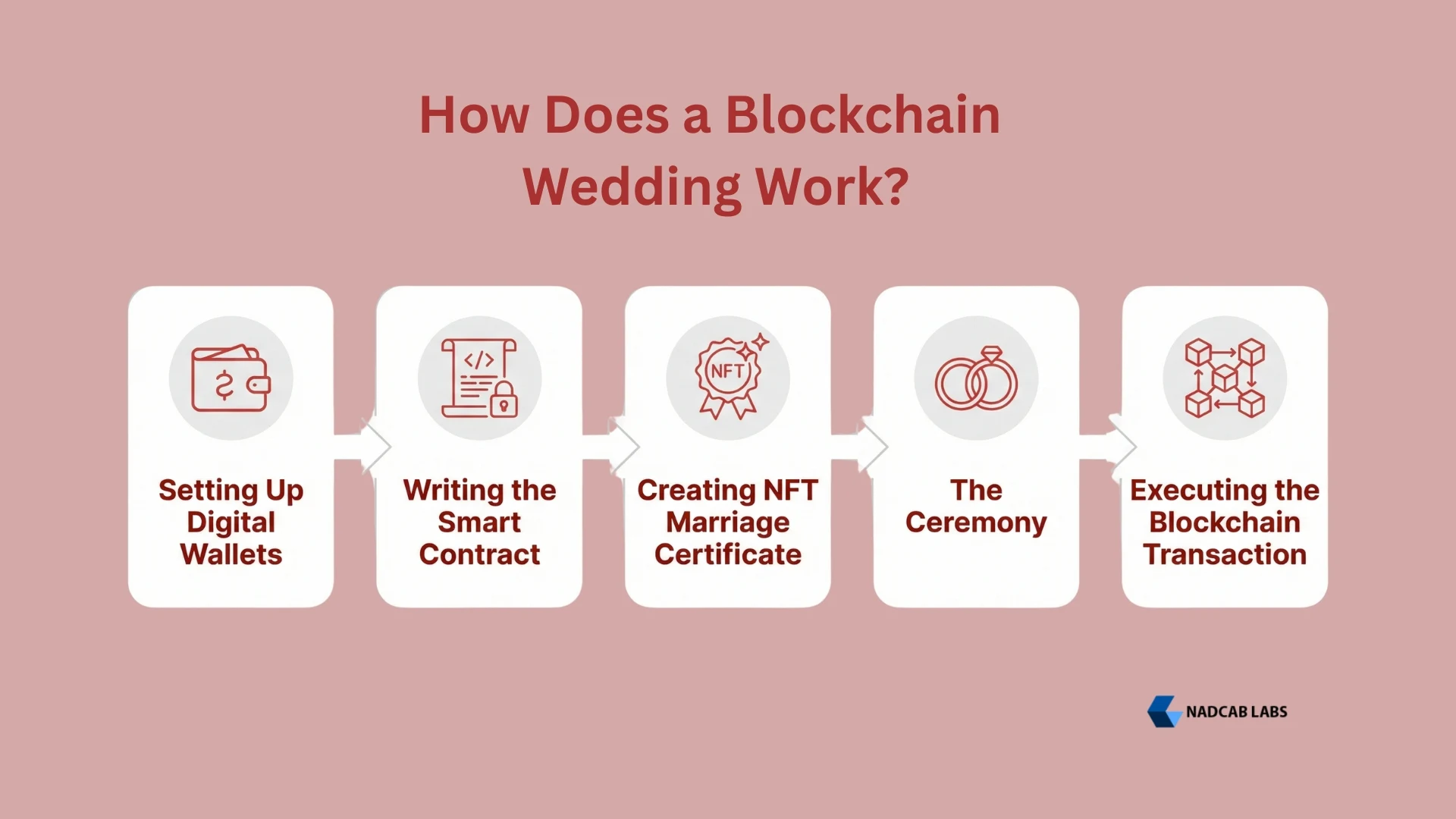
The process of conducting a blockchain wedding involves several distinct steps, each combining elements of traditional ceremony with modern technology. While the exact procedure may vary depending on the platform or blockchain network used, the following is a comprehensive overview of how a blockchain wedding typically unfolds.
Step 1: Setting Up Digital Wallets
Both partners create cryptocurrency wallets, most commonly through services such as MetaMask. These digital wallets serve as the couple’s identity on the blockchain and are required to send, receive, and store digital assets, including NFTs and tokens associated with the marriage.
Step 2: Writing the Smart Contract
A smart contract is a self-executing programme stored on the blockchain that contains the terms and conditions agreed upon by both parties. In the context of a blockchain wedding, the smart contract may include the couple’s vows, the date of the ceremony, the names of witnesses, and, in some cases, provisions for the management of shared assets or the terms of dissolution. Popular blockchain networks for this purpose include Ethereum and Polygon.
Step 3: Creating the NFT Marriage Certificate
Many blockchain weddings involve the creation of a Non-Fungible Token that serves as the digital marriage certificate. This NFT is a unique, one-of-a-kind digital asset that may contain an image, artwork, or text representing the couple’s union. The NFT is minted on a marketplace such as OpenSea and can include personalised elements such as a photograph of the engagement ring, a transcript of the wedding vows, or custom digital art.
Step 4: The Ceremony
The ceremony itself may take place in person or virtually. Some couples conduct their blockchain wedding over video conferencing platforms such as Google Meet or Zoom, with family and friends joining remotely. A “digital priest” or online officiant may preside over the ceremony, guiding the couple through the reading of their vows and the execution of the blockchain transaction.
Step 5: Executing the Transaction
Once the vows have been read and the digital officiant has given the blessing, one partner initiates the blockchain transaction to transfer the NFT to the other partner’s wallet. This transfer is recorded on the blockchain as a permanent, immutable, and publicly verifiable record of their commitment. The transaction typically incurs a small gas fee, which varies depending on the network’s congestion at the time.
Is a Blockchain Wedding Legally Binding?
No, blockchain weddings are not legally recognised or binding in most jurisdictions around the world as of 2026. They serve primarily as a symbolic commitment between partners. Couples who wish to obtain legal recognition of their marriage must also complete the traditional marriage registration process as required by the laws of their country or state. However, some legal professionals and governments, such as Washoe County in Nevada (United States), have begun experimenting with recording marriage certificates on the blockchain as supplementary official records.
Despite the lack of legal standing, the symbolic value of a blockchain wedding should not be underestimated. For couples who face legal or societal barriers to traditional marriage, including same-sex couples in countries where such unions are not recognised, the blockchain offers a powerful, borderless alternative to affirm their bond publicly.
Top Platforms for Blockchain Wedding Services
A growing number of platforms now offer couples the ability to conduct a blockchain wedding with relative ease. The following are among the most prominent services available in 2026.
| Platform | Key Feature | Blockchain Used | Best For |
|---|---|---|---|
| MarryOnChain | Soulbound token (SBT) marriage certificate; partnered with Courtly for legal weddings | Ethereum | Couples wanting legal + blockchain ceremony combined |
| Web3Wed | Smart contract marriage on Polygon; NFT engagement ring collections | Polygon | Couples wanting symbolic commitment without legal obligations |
| Marriage Unblocked (Björn Borg) | Digital platform for LGBTQ+ couples to marry on-chain globally | Ethereum | LGBTQ+ couples in countries without legal recognition |
| Marriage-Chain (Open Source) | Open-source GitHub project for self-managed blockchain marriages | Multiple | Developers and tech enthusiasts |
| Closeup Virtual Wedding | Metaverse wedding with digital avatars and NFT certificate | Ethereum | Couples wanting an immersive virtual ceremony |
Real Examples of Blockchain Weddings Around the World
Since the inception of blockchain weddings in 2014, numerous couples across the globe have embraced this innovative approach to marriage. The following are some of the most notable examples.
| Couple | Year | Country | Significance | Blockchain / Platform |
|---|---|---|---|---|
| David Mondrus & Joyce Bayo | 2014 | United States | World’s first blockchain wedding | Bitcoin |
| Gaurang Torvekar & Sayalee Kaluskar | 2016 | India | First blockchain prenuptial agreement | Ethereum (Attores) |
| Vasily Lifanovsky & Alla Tkachenko | 2017 | Russia | Russia’s first blockchain wedding; shared crypto budget via smart contract | Ethereum (MyWish) |
| Brock Pierce & Crystal Rose | 2017 | United States | Renewable blockchain marriage with annual smart contract renewal | Ethereum |
| Rebecca Rose & Peter Kacherginsky | 2021 | United States | Coinbase NFT wedding with tokenised rings (“Tabaat”) | Ethereum |
| Anil Narasipuram & Shruti Nair | 2021 | India (Pune) | India’s first blockchain wedding; NFT “Ekatvam” on OpenSea | Ethereum (OpenSea) |
David Mondrus and Joyce Bayo (2014) — The World’s First Blockchain Wedding
The very first blockchain wedding took place on 5 October 2014, when David Mondrus and Joyce Bayo married at a private Bitcoin conference held at Walt Disney World in Orlando, Florida, United States. The ceremony was officiated by Austrian school economist Jeffrey Tucker. To formalise the marriage on the blockchain, the couple scanned and confirmed a QR code, which was then permanently recorded on the Bitcoin blockchain.
Gaurang Torvekar and Sayalee Kaluskar (2016) — First Blockchain Prenuptial Agreement
In December 2016, Indian technology professionals Gaurang Torvekar and Sayalee Kaluskar created one of the earliest blockchain-based prenuptial agreements. The couple uploaded their marriage contract to the Ethereum blockchain using the Attores platform. Their agreement, called “Prenup With Love,” included provisions related to daily activities, household responsibilities, and shared decision-making, demonstrating the practical applications of smart contracts in personal relationships.
Vasily Lifanovsky and Alla Tkachenko (2017) — Russia’s First Blockchain Wedding
In October 2017, Vasily Lifanovsky and Alla Tkachenko became the first couple in Russia to register their marriage on the blockchain. Using the MyWish Platform on the Ethereum network, the couple combined their cryptocurrency savings into a single family budget governed by a smart contract. The agreement stipulated that in the event of dissolution, all accumulated funds would be divided equally, with a three-month cooling-off period to prevent impulsive decisions.
Rebecca Rose and Peter Kacherginsky (2021) — Coinbase NFT Wedding
In April 2021, Coinbase employees Rebecca Rose and Peter Kacherginsky incorporated blockchain technology into their traditional Jewish wedding ceremony. The couple wrote a custom Ethereum smart contract named “Tabaat” (the Hebrew word for ring) that issued tokenised NFT rings to each partner’s wallet. The blockchain portion of the ceremony lasted approximately four minutes.
Brock Pierce and Crystal Rose (2017) — Renewable Blockchain Marriage
Billionaire entrepreneur Brock Pierce and Crystal Rose introduced an innovative concept when they married on the blockchain in 2017. Their smart contract was designed to be renewed, modified, or dissolved on an annual basis, offering a flexible and evolving approach to the marriage commitment.
Read Also: What is Private Key QR Code and How to Use It →
Pune Couple Blockchain Wedding: India’s First Blockchain Marriage
Key Fact
On 15 November 2021, Anil Narasipuram and Shruti Nair from Pune, Maharashtra, became the first couple in India to conduct a blockchain wedding, using an Ethereum smart contract and an NFT minted on OpenSea.
The Pune couple blockchain wedding of Anil Narasipuram and Shruti Nair is widely regarded as a landmark event in the adoption of blockchain technology in India’s wedding landscape. The couple first completed a traditional court marriage at the Registrar’s Office in Pune on 15 November 2021. Motivated by the possibilities of blockchain technology and inspired by similar ceremonies conducted abroad, they decided to immortalise their union digitally on the same day.
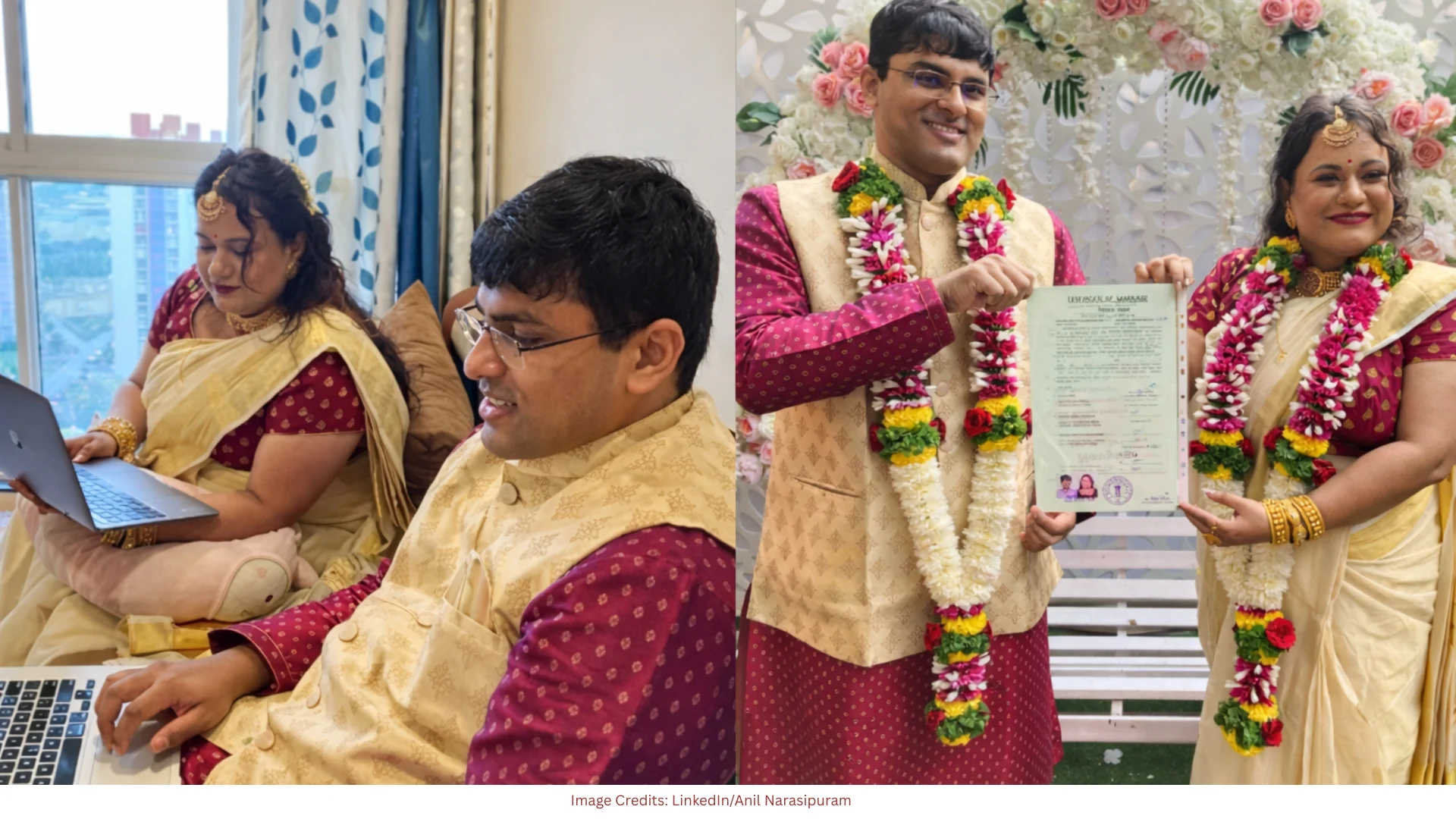
To prepare for the blockchain ceremony, both Anil and Shruti set up MetaMask cryptocurrency wallets. Their digital priest, Anoop Pakki, minted an NFT on the OpenSea marketplace. The NFT, named “Ekatvam,” featured a photograph of Shruti’s engagement ring with the couple’s wedding vows embedded within the image.
The ceremony was conducted online, with family and friends joining through a Google Meet session. The couple sat next to each other before their laptops and read their vows aloud. Upon receiving the blessing of the digital priest, Anil initiated the blockchain transaction to transfer the NFT to Shruti’s digital wallet, formally completing the blockchain marriage. The entire ceremony lasted approximately 15 minutes — a stark contrast to the elaborate, multi-day celebrations traditionally associated with Indian weddings.
In his LinkedIn post documenting the event, Anil Narasipuram stated that the blockchain transaction serves as a permanent, immutable, and public record of their commitment on the Ethereum blockchain. He further expressed that while they may be the first Indian couple to marry on the blockchain, they would certainly not be the last. The event attracted widespread media coverage and sparked considerable public interest in the concept of blockchain weddings in India.
Benefits of a Blockchain Wedding
Blockchain weddings offer several distinct advantages over traditional marriage documentation methods. Understanding these benefits helps explain why an increasing number of couples are choosing this innovative approach.
| Benefit | Description |
|---|---|
| Immutability and Permanence | Once written to the blockchain, the marriage record cannot be altered, deleted, or forged. It exists as long as the network remains active. |
| Transparency and Public Verifiability | Any individual with access to the blockchain can independently verify the existence and authenticity of the marriage record. |
| Decentralisation and Autonomy | Couples are not dependent on any government body, religious institution, or central authority to validate their union. |
| Global Accessibility | Blockchain weddings are borderless. Couples from any country can participate, regardless of local legal restrictions. |
| Inclusivity | Particularly significant for LGBTQ+ couples and others facing legal or societal barriers to traditional marriage. |
| Cost-Effectiveness | Can be conducted for USD 20 to USD 100 in transaction fees — a fraction of traditional ceremony costs. |
| Smart Contract Flexibility | Couples can encode financial arrangements, asset management, and renewal or dissolution terms directly into the contract. |
Challenges and Limitations of Blockchain Weddings
Despite their appeal, blockchain weddings face several challenges that prospective couples should carefully consider. Navigating blockchain adoption challenges requires realistic expectations alongside technical and legal planning.
| Challenge | Details |
|---|---|
| Lack of Legal Recognition | Not legally binding in most countries as of 2026. Traditional marriage registration is still required for legal standing. |
| Technical Complexity | Setting up wallets, understanding smart contracts, and executing transactions requires technical knowledge unfamiliar to many couples. |
| Volatility and Network Fees | Gas fees on networks like Ethereum can fluctuate significantly depending on congestion. |
| Security Concerns | While blockchain is highly secure, poorly coded smart contracts can contain vulnerabilities. |
| Cultural Acceptance | In regions with strong traditional wedding customs, blockchain weddings may face scepticism from family and communities. |
The Future of Blockchain Weddings
The global blockchain market is projected to grow from USD 20.1 billion in 2024 to approximately USD 248.9 billion by 2029, and the wedding industry is likely to feel the impact of this expansion. As blockchain technology becomes more mainstream and user-friendly, the barriers to conducting a blockchain wedding will continue to diminish.
Several developments could accelerate the adoption of blockchain weddings in the coming years. Government recognition and regulatory frameworks for blockchain-based documents could lend legal weight to on-chain marriage records. The continued growth of the metaverse and virtual reality platforms may create immersive digital wedding venues that go far beyond current video-conferencing ceremonies. Additionally, the development of more accessible, no-code blockchain platforms will lower the technical barrier, enabling couples without programming knowledge to conduct their own blockchain weddings with ease.
Blockchain weddings are no longer a fringe experiment confined to technology conferences and cryptocurrency enthusiasts. They are an emerging, meaningful expression of commitment that reflects the values of a new generation: permanence, transparency, autonomy, and innovation. As the technology matures and societal acceptance grows, the blockchain wedding may well become a standard option alongside traditional ceremonies in the decades ahead.
Ready to Build Your Blockchain Wedding Solution?
Whether you need to create an NFT marriage certificate, deploy a smart contract for vows, or build a full blockchain wedding platform, our blockchain development team has the expertise to help. From enterprise integration to custom smart contract development, we deliver solutions that bring your vision to life.
Disclaimer: This article is intended for informational purposes only. A blockchain wedding does not constitute a legally binding marriage in most jurisdictions. Couples should consult with a qualified legal professional in their region to ensure compliance with applicable marriage laws.
Frequently Asked Questions About Blockchain Weddings
Q1.What is the meaning of a blockchain wedding?
The blockchain wedding meaning refers to a ceremony in which the marriage commitment, vows, and certificate are recorded on a blockchain network as a permanent, tamper-proof digital record. It uses technologies such as smart contracts and NFTs to represent the union. While it is not legally binding in most countries, it serves as a powerful symbolic commitment.
Q2.How much does a blockchain wedding cost?
The cost of a blockchain wedding varies depending on the platform and blockchain network used. A basic smart contract transaction on Ethereum or Polygon may cost between USD $20 and USD $100 in gas fees. More elaborate ceremonies involving custom NFT artwork, digital officiants, and premium platform services may cost several hundred dollars. This is significantly less than the average cost of a traditional wedding.
Q3.Can you get legally married on the blockchain?
Currently, blockchain marriages are not legally recognised in most jurisdictions. However, some regions are beginning to explore the integration of blockchain technology with official marriage records. Washoe County in Nevada, United States, has experimented with recording marriage certificates on the Ethereum blockchain through a partnership with the startup Titan Seal. Couples who wish to have legal recognition must also complete a traditional marriage registration.
Q4.What is the difference between an NFT wedding and a blockchain wedding?
An NFT wedding is a specific type of blockchain wedding in which the couple’s marriage certificate, vows, or digital rings are represented as Non-Fungible Tokens. While all NFT weddings are blockchain weddings, not all blockchain weddings necessarily involve NFTs. Some may only use a smart contract to record the marriage, without creating NFT-based digital assets.
Q5.Who conducted the first blockchain wedding in India?
Anil Narasipuram and Shruti Nair from Pune, Maharashtra, conducted India’s first blockchain wedding on 15 November 2021. The couple used an Ethereum smart contract and minted an NFT on OpenSea, with the ceremony officiated by digital priest Anoop Pakki and attended by family and friends via Google Meet.
Explore Services
Related Services
Reviewed by

Aman Vaths
Founder of Nadcab Labs
Aman Vaths is the Founder & CTO of Nadcab Labs, a global digital engineering company delivering enterprise-grade solutions across AI, Web3, Blockchain, Big Data, Cloud, Cybersecurity, and Modern Application Development. With deep technical leadership and product innovation experience, Aman has positioned Nadcab Labs as one of the most advanced engineering companies driving the next era of intelligent, secure, and scalable software systems. Under his leadership, Nadcab Labs has built 2,000+ global projects across sectors including fintech, banking, healthcare, real estate, logistics, gaming, manufacturing, and next-generation DePIN networks. Aman’s strength lies in architecting high-performance systems, end-to-end platform engineering, and designing enterprise solutions that operate at global scale.