Key Takeaways
- 1DMRR Blockchain creates immutable, timestamped records of government documents, certificates, and administrative data across distributed validator nodes.
- 2The system eliminates centralized vulnerabilities through distributed architecture, preventing single-point failures and unauthorized data manipulation.
- 3Cryptographic hashing and digital signatures ensure document authenticity, enabling instant verification without manual processes or intermediary confirmation.
- 4Permission-based access controls protect citizen privacy while maintaining transparency for authorized parties and audit requirements.
- 5Smart contracts automate administrative workflows including certificate issuance, renewal notifications, and compliance verification processes.
- 6Interoperability protocols enable cross-border document verification, supporting international credential recognition and immigration processes.
- 7The consensus mechanism requires multi-validator approval for record creation, preventing fraudulent document generation and unauthorized modifications.
- 8Permanent audit trails track every document interaction, providing complete transparency for compliance investigations and citizen information requests.
- 9Integration APIs allow legacy government systems to interact with DMRR Blockchain without complete infrastructure replacement.
- 10Scalability optimizations including sharding and layer-2 solutions enable processing of millions of transactions daily across national implementations.
Digital Governance
Introduction to DMRR Blockchain and Why It Matters in Modern Digital Governance
The emergence of Blockchain Technology in public sector administration represents a fundamental shift in how governments manage, verify, and protect citizen records across the USA, UK, UAE, and Canada. The DMRR Blockchain (Digital Management Registration and Records) stands at the forefront of this transformation, providing a distributed ledger specifically engineered for governmental document workflows, certificate issuance, property registries, and administrative record-keeping. As public institutions grapple with legacy database vulnerabilities, data silos, and authentication challenges, DMRR Blockchain offers a robust alternative combining cryptographic security, transparent audit trails, and citizen-centric access controls. This comprehensive analysis examines the technical architecture, operational mechanisms, security protocols, and practical applications of DMRR Blockchain within modern digital governance frameworks.
Modern governments face unprecedented challenges in managing vast repositories of citizen records, official documents, certificates, licenses, and administrative data across fragmented legacy systems. Traditional centralized databases suffer from critical vulnerabilities including single-point failures, susceptibility to unauthorized access, lack of transparent audit mechanisms, and difficulty in cross-jurisdictional verification. The DMRR Blockchain addresses these fundamental limitations by providing a distributed, immutable, and cryptographically secured infrastructure specifically designed for governmental record management. Unlike general-purpose DMRR Blockchain, DMRR optimizes for document authenticity verification, privacy-preserving access controls, regulatory compliance, and integration with existing public sector workflows. Governments in the USA have explored DMRR Blockchain document systems for land registries and vital statistics; the UK Cabinet Office has piloted distributed ledger grants tracking; Dubai’s Smart City initiatives incorporate DMRR Blockchain identity verification; and Canadian provinces have tested DMRR Blockchain credential verification. The DMRR Blockchain represents the evolution of these initiatives into a comprehensive framework addressing the complete lifecycle of government records from creation through verification, transfer, and archival. The significance extends beyond technological innovation to fundamental improvements in citizen services: reduced processing times, elimination of document fraud, enhanced data portability, and restoration of public trust through transparent, verifiable government operations. As digital transformation accelerates across public administration globally, DMRR Blockchain provides the secure foundation enabling next-generation e-government services while protecting citizen rights and ensuring administrative accountability.
Core Concept
What Is DMRR Blockchain? Understanding the Core Concept in Simple Terms
The DMRR Blockchain operates as a specialized distributed database where government documents and records are stored across a network of computers rather than a single central server. Each “block” in the chain contains a batch of document transactions, such as certificate issuances, record updates, or verification requests, linked together chronologically and cryptographically. When a government agency creates or modifies a record, this action is broadcast to the network, verified by multiple validator nodes according to pre-defined rules, and then permanently added to the DMRR Blockchain where it cannot be altered or deleted. The “immutability” means once a birth certificate, property deed, or business license is recorded, no party can retroactively change the information without creating a detectable discrepancy. The “distributed” nature means copies of the complete record history exist on numerous computers operated by different government entities, eliminating the risk that a single database failure or security breach compromises all records. Citizens interact with DMRR Blockchain through user-friendly interfaces where they request documents, verify authenticity, or grant access permissions without needing to understand the underlying cryptographic processes. A simplified analogy: if traditional government databases are like a single ledger book kept in one office, DMRR Blockchain is like having thousands of identical copies of that book distributed worldwide, where any addition must be simultaneously written in all copies, and anyone can verify entries match across all books. This architecture creates unprecedented security, transparency, and reliability compared to conventional record-keeping approaches.

Architecture
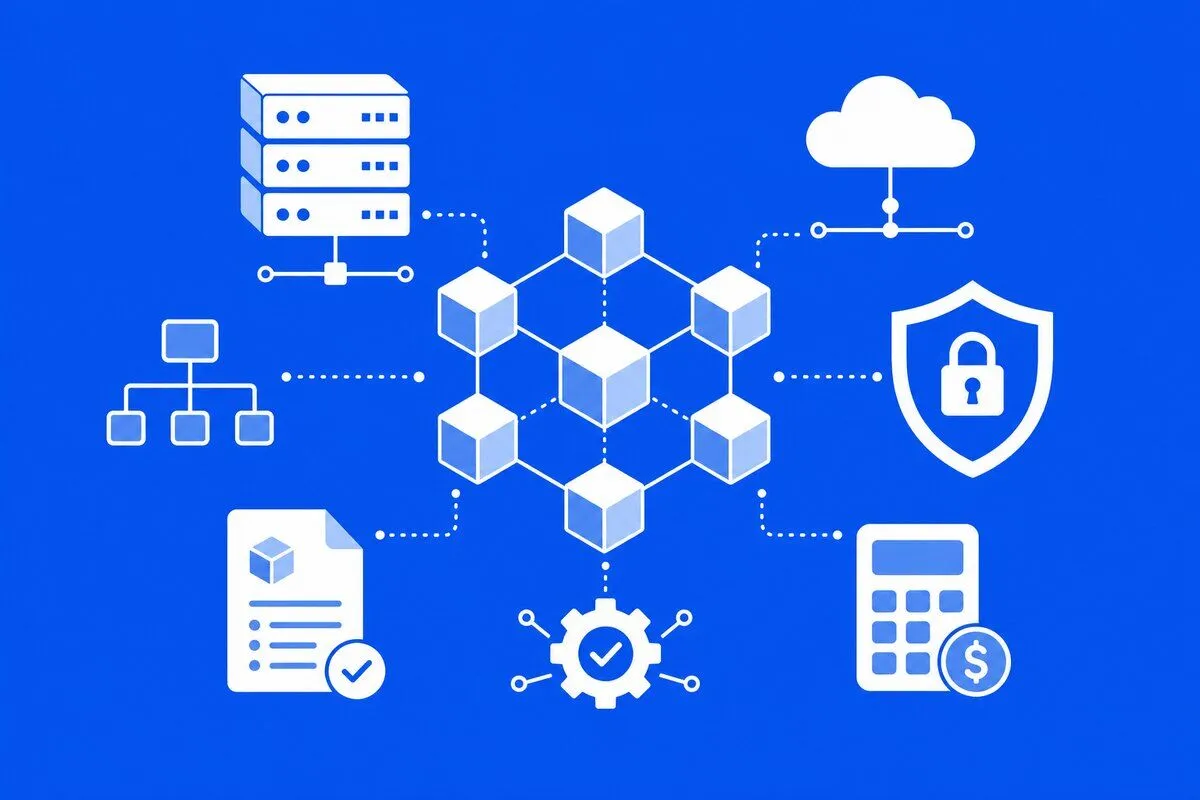
DMRR Blockchain Core Components
Distributed Ledger
- ✓Replicated record copies across multiple validator nodes
- ✓Consensus-based synchronization ensuring data consistency
- ✓Elimination of single-point failure vulnerabilities
- ✓Automatic redundancy and disaster recovery capabilities
Cryptographic Security
- ✓SHA-256 hashing for document fingerprinting and integrity
- ✓Digital signatures authenticating issuer and record creator
- ✓Encryption protecting sensitive personal information
- ✓Public key infrastructure for access control and permissions
Smart Contracts
- ✓Automated workflows for document issuance and renewal
- ✓Programmable compliance checks and validation rules
- ✓Self-executing agreements reducing manual processing
- ✓Conditional access permissions based on authorization criteria
Core Purpose
The Core Purpose of the DMRR Blockchain and Why It Was Introduced
DMRR Blockchain was introduced to address three fundamental objectives in government record management: establishing absolute document authenticity, creating transparent audit mechanisms, and enabling secure cross-jurisdictional verification. The primary purpose centers on eliminating document fraud, which costs governments billions annually through fake credentials, forged certificates, and manipulated property records. By creating cryptographically provable document histories that cannot be altered retroactively, DMRR provides citizens, employers, and government agencies with instant verification capabilities without relying on manual authentication processes prone to error and corruption. The second core purpose involves restoring public trust in government record-keeping through transparent, auditable systems where citizens can verify their data has not been improperly accessed or modified. Traditional opaque databases provide no accountability when records are changed without authorization or personal information is mishandled. DMRR’s permanent audit trails record every interaction, creating accountability and enabling citizens to monitor who accesses their information. The third purpose addresses interoperability challenges where different government agencies, levels of government, and international jurisdictions maintain incompatible record systems. A birth certificate issued in Dubai should be verifiable in Canada without lengthy apostille processes; educational credentials from UK universities should authenticate instantly for USA employers; property ownership records should transfer seamlessly across county boundaries. DMRR Blockchain provides the standardized infrastructure enabling this seamless verification through cryptographic proofs that cross traditional administrative boundaries. The introduction timing aligns with broader digital transformation initiatives across public sectors globally, as governments seek to modernize legacy systems, improve citizen services, reduce administrative costs, and enhance security against evolving cyber threats.
Problem Statement
The Problem DMRR Blockchain Aims to Solve in Traditional Document Systems
Traditional government document systems suffer from systemic vulnerabilities that DMRR Blockchain directly addresses through its distributed architecture and cryptographic foundations. The first critical problem involves centralized points of failure where single database breaches compromise millions of citizen records simultaneously. Major data breaches affecting government agencies in the USA, UK, and Canada have exposed social security numbers, health records, and financial information due to concentrated data storage in hackable central servers. DMRR eliminates this vulnerability by distributing record copies across multiple nodes, where compromising one node reveals no usable information without corresponding private keys, and the remaining nodes maintain data integrity. The second problem concerns unauthorized data modification where database administrators or hackers can alter records without detection. Traditional audit logs can themselves be manipulated by users with sufficient system access, creating undetectable tampering. DMRR’s blockchain structure makes any alteration immediately apparent through hash mismatches, as changing one record requires recalculating all subsequent blocks across all distributed copies simultaneously, a computational impossibility. The third problem involves lack of verification transparency where citizens and third parties must trust central authorities without independent confirmation capabilities. Employers verifying educational credentials, banks authenticating property ownership, or immigration officials confirming identity documents rely entirely on the issuing authority’s word that records are legitimate. DMRR provides cryptographic verification allowing anyone to confirm document authenticity independently through mathematical proofs rather than trust relationships. Additional problems include data silos preventing interoperability between agencies, lengthy manual verification processes creating service delays, absence of citizen control over personal information access, and inconsistent record retention policies risking important data loss. The cumulative effect of these traditional system limitations is reduced public trust, increased fraud opportunities, administrative inefficiencies costing taxpayers billions, and barriers to digital service innovation that citizens increasingly expect from modern governments.
Development
Who Developed and Currently Maintains the DMRR Blockchain Infrastructure?
DMRR Blockchain infrastructure typically emerges from collaborative efforts between government technology agencies, academic research institutions, and specialized blockchain firms rather than single entity creation. In most implementations, national digital transformation agencies or e-government departments initiate projects by defining requirements, security specifications, and operational parameters aligned with public sector needs. Technical architecture and protocol design often involves partnerships with DMRR Blockchain research labs at leading universities contributing cryptographic expertise and consensus mechanism optimization. Software engineering and implementation may contract to experienced DMRR Blockchain consultancies with government sector credentials, ensuring compliance with strict security, privacy, and accessibility standards. The maintenance structure generally establishes consortiums where multiple government entities operate validator nodes, preventing any single agency from controlling the network. For example, a national DMRR implementation might include nodes operated by the federal technology services agency, state-level administrative departments, and independent oversight bodies. Governance frameworks typically create steering committees with representatives from participating agencies, technical experts, citizen advocacy groups, and external auditors. Open-source components often form the base layer, leveraging established DMRR Blockchain frameworks like Hyperledger Fabric or Ethereum enterprise versions, with custom modifications addressing government-specific requirements. Ongoing maintenance responsibilities distribute across teams handling different aspects: core protocol updates by central technical authority, validator node operation by participating agencies, security monitoring by dedicated cybersecurity units, and user interface enhancements by service delivery teams. International implementations may involve cross-border cooperation, with organizations like the United Nations’ agencies providing technical assistance and standards alignment. The decentralized maintenance model ensures no single point of failure or control, aligning with DMRR Blockchain core principles while maintaining the coordinated governance necessary for government operations.
Differences
How DMRR Blockchain Differs from Traditional Blockchain Networks and Government Databases
DMRR Blockchain occupies a unique position distinct from both public blockchains like Bitcoin or Ethereum and traditional government database systems, combining elements of each while addressing their respective limitations. Unlike fully public DMRR Blockchain where anyone can participate as a validator and all transaction data is publicly visible, DMRR operates as a permissioned network where only authorized government entities and regulated organizations run validator nodes. This permissioned structure maintains blockchain’s distributed security and immutability advantages while meeting government requirements for regulatory oversight, compliance controls, and restricted access to sensitive citizen data. Transaction throughput significantly exceeds public DMRR Blockchain because the limited, known validator set enables faster consensus without proof-of-work mining or extensive stake-based validation delays. Where Bitcoin processes approximately 7 transactions per second and Ethereum around 15-30, DMRR implementations can handle thousands of transactions per second through optimized consensus mechanisms suited to trusted validator environments. Privacy protections differ fundamentally from public DMRR Blockchain where all transaction details broadcast openly; DMRR employs selective disclosure techniques where only parties with proper authorization can view document contents, while cryptographic proofs allow verification without revealing underlying data. Compared to traditional government databases, DMRR eliminates centralized control where single administrators can modify records unilaterally or unauthorized users can breach entire datasets through single-point attacks. The distributed architecture across multiple government agencies prevents any entity from unilaterally altering records, requiring consensus among validators for legitimate updates. Audit capabilities far exceed traditional systems; where conventional databases may maintain limited change logs easily manipulated or deleted, DMRR’s blockchain structure creates permanent, cryptographically linked audit trails that cannot be retroactively modified. Integration flexibility surpasses legacy databases through standardized APIs and interoperability protocols enabling seamless connection with modern e-government services, mobile applications, and international verification systems. Cost structures also differ significantly: while maintaining distributed infrastructure seems more expensive than single database servers, DMRR eliminates redundant verification systems across agencies, reduces fraud losses, and decreases administrative processing costs that offset infrastructure investments.
Analysis
DMRR Blockchain Comparative Analysis
| Feature | DMRR Blockchain | Public Blockchain | Traditional Database |
|---|---|---|---|
| Access Control | Permissioned validators, role-based access | Fully public, open participation | Centralized administrator control |
| Transaction Speed | 1,000-5,000 TPS | 7-30 TPS | 10,000+ TPS |
| Data Privacy | Encrypted, selective disclosure | Fully transparent | Dependent on implementation |
| Immutability | Cryptographically guaranteed | Cryptographically guaranteed | No guarantee, easily modified |
| Consensus Mechanism | PBFT or PoA variants | PoW or PoS | None (centralized authority) |
| Regulatory Compliance | Built-in governance and audit | Limited compliance tools | Manual compliance processes |
| Trust Model | Distributed among known entities | Trustless, cryptographic proof | Trust in central administrator |
Step by Step
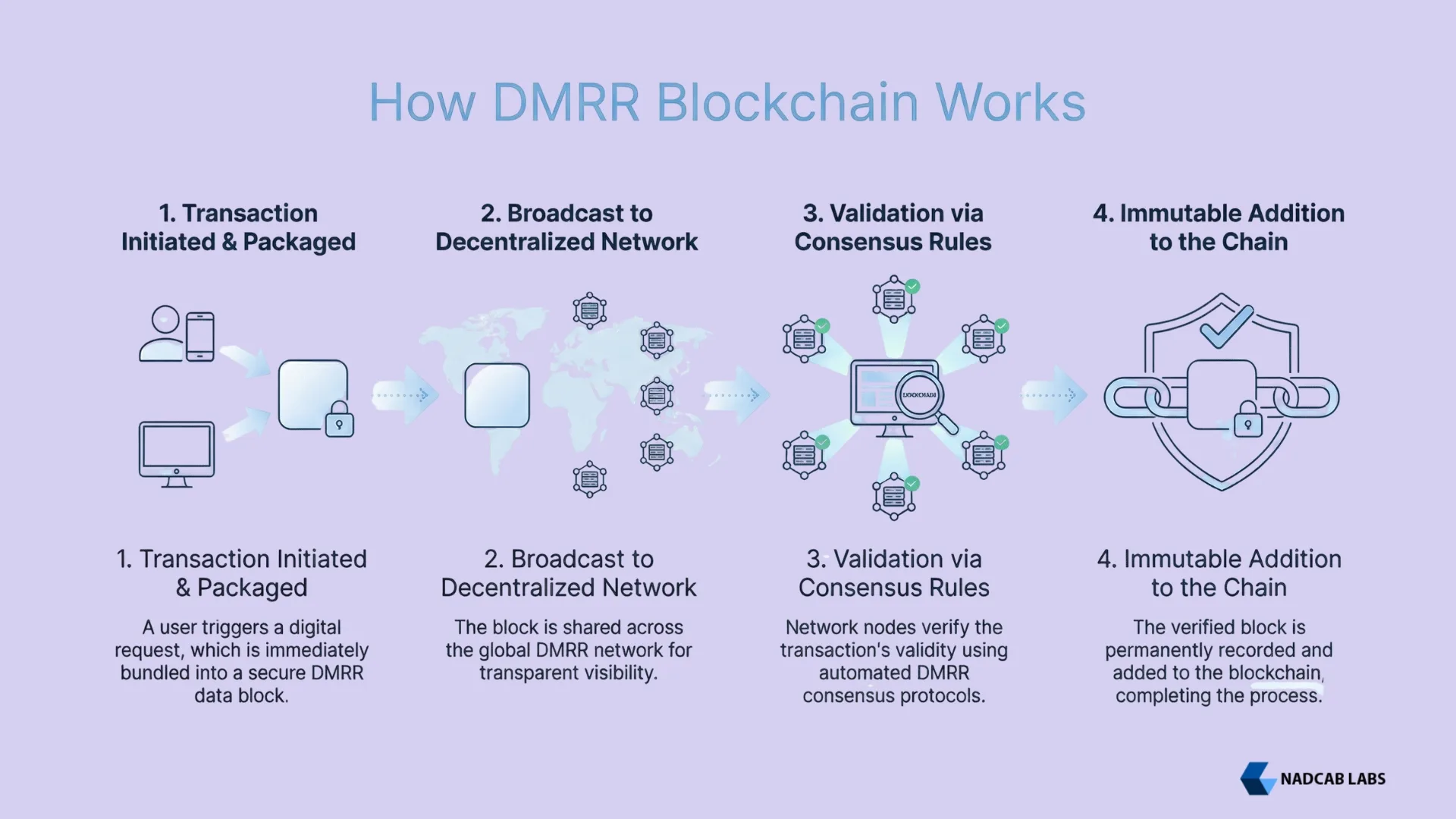
How the DMRR Blockchain Works – Step-by-Step Transaction and Record Flow
Understanding DMRR Blockchain operation requires examining the complete lifecycle of a document record from creation through verification. The process begins when a government agency or authorized issuer initiates a transaction to create or update a record, such as issuing a birth certificate, registering property transfer, or renewing a professional license. The issuer’s system generates a digital version of the document, calculates a cryptographic hash serving as its unique fingerprint, and creates a transaction containing: the document hash, issuer’s digital signature, timestamp, relevant metadata, and access permissions. This transaction broadcasts to all validator nodes in the DMRR network through peer-to-peer communication protocols. Upon receiving the transaction, validator nodes perform multiple verification steps: confirming the issuer’s digital signature is authentic and authorized for this document type, checking that the transaction format complies with protocol rules, verifying no conflicting records exist (like duplicate certificate serial numbers), and ensuring all required data fields are present and properly formatted. Validators then participate in the consensus mechanism, collectively agreeing whether to accept the transaction into the next block. In most DMRR implementations using Practical Byzantine Fault Tolerance or similar algorithms, validators exchange voting messages until a supermajority (typically two-thirds) agree on transaction validity.
Once consensus is reached, one validator assembles accepted transactions into a new block, adding a header containing: the previous block’s hash (creating the chain linkage), current timestamp, Merkle root of all included transactions, and the validator’s signature. This new block broadcasts to all nodes, which verify its validity and append it to their local blockchain copy. The document record is now permanently recorded across the distributed network with a verified timestamp and issuer proof. When a citizen or third party needs to verify the document later, they submit a verification request including the document hash or reference number. The system queries the DMRR Blockchain, locates the corresponding record, confirms the cryptographic hash matches, verifies the issuer’s signature, and returns proof of authenticity without revealing the document contents to unauthorized parties. The entire process from submission to confirmation typically completes in seconds, vastly faster than manual verification processes requiring phone calls, mail requests, or in-person visits to issuing offices.
Lifecycle
DMRR Transaction Lifecycle
Document Creation
Authorized issuer generates digital document, calculates cryptographic hash, and creates transaction with metadata and permissions.
Network Broadcast
Transaction propagates to all validator nodes through peer-to-peer network using secure communication protocols.
Validation Process
Validators verify digital signatures, check format compliance, confirm no conflicts, and validate all required data fields.
Consensus Achievement
Validators exchange voting messages until supermajority agrees on transaction validity through PBFT or similar consensus.
Block Creation
Designated validator assembles transactions into block with header containing previous block hash, timestamp, and Merkle root.
Block Distribution
New block broadcasts to network where nodes verify validity and append to their local DMRR Blockchain copy.
Permanent Record
Document record now permanently stored across distributed network with verified timestamp and immutable proof of authenticity.
Verification & Access
Citizens and third parties verify documents instantly using cryptographic proofs without revealing contents to unauthorized parties.
Consensus
Understanding the Consensus Mechanism Used by DMRR Blockchain
The consensus mechanism represents the heart of DMRR Blockchain’s security and reliability, determining how distributed validators agree on which transactions are valid and should be added to the permanent record. Most DMRR implementations employ Practical Byzantine Fault Tolerance (PBFT) or its variants, specifically designed for permissioned networks where validators are known entities rather than anonymous participants. PBFT operates through a multi-phase voting protocol where one validator serves as primary proposer while others act as backups, collectively ensuring agreement even if some validators behave maliciously or experience technical failures. The process begins when the primary validator receives transactions from the network, orders them into a proposed block, and broadcasts this proposal to all other validators. Backup validators independently verify each transaction’s validity, checking digital signatures, format compliance, and business rule adherence. If a validator approves the proposed block, it sends a “prepare” message to all other validators; once a validator receives prepare messages from a supermajority (typically two-thirds plus one), it sends a “commit” message confirming readiness to finalize the block. Upon collecting sufficient commit messages, validators permanently add the block to their DMRR Blockchain copy. This multi-phase voting ensures that even if up to one-third of validators are compromised or faulty, the system maintains integrity and continues operating correctly. The Byzantine fault tolerance specifically addresses scenarios where compromised validators might send conflicting information to different nodes or attempt to forge invalid transactions. Alternative consensus mechanisms seen in DMRR variants include Proof of Authority where pre-approved validators take turns creating blocks based on their identity and reputation rather than computational work or token stakes. This approach offers even faster finality since it eliminates multi-round voting, suitable for high-transaction-volume government applications. Some implementations employ hybrid approaches combining PBFT for normal operations with fallback mechanisms activating during network disruptions or validator failures. The consensus mechanism directly impacts system performance: PBFT-based systems typically achieve finality in 2-5 seconds compared to Bitcoin’s 10-minute blocks or Ethereum’s variable confirmation times, meeting government requirements for responsive citizen services. Security guarantees remain strong provided validator diversity prevents collusion; DMRR governance ensures validators represent different government agencies or organizational units with conflicting interests that prevent coordinated attacks. The mathematical proofs underlying PBFT demonstrate that as long as fewer than one-third of validators are malicious, the system cannot produce conflicting transaction records or allow invalid data into the blockchain[1]. This strong consensus guarantee enables DMRR to maintain the trust and reliability required for critical government functions like property registries, identity systems, and legal document management.
Infrastructure
Network Architecture of DMRR – Nodes, Validators, and Infrastructure Design
DMRR Blockchain network architecture comprises multiple layers of infrastructure designed for security, scalability, and regulatory compliance within government operations. The base layer consists of validator nodes operated by authorized government agencies, each maintaining complete copies of the DMRR Blockchain and participating in consensus processes. Typical national implementations deploy 15-50 validator nodes distributed across different government departments, geographic regions, and administrative levels to ensure no single entity controls the network. Each validator node runs on enterprise-grade server infrastructure with redundant power supplies, network connections, and backup systems meeting government data center standards. The nodes communicate through dedicated government networks or encrypted internet connections, forming a peer-to-peer mesh where each validator maintains connections to multiple others.
This topology ensures network resilience; if individual nodes go offline due to maintenance or technical issues, the remaining validators continue processing transactions and reaching consensus. Above the validator layer sits the application programming interface (API) gateway layer where government agencies and citizen-facing services interact with the DMRR Blockchain without directly connecting to validator nodes. These API servers handle request authentication, rate limiting, query optimization, and response formatting, translating between blockchain’s technical protocols and user-friendly interfaces. The architecture typically includes separate API servers for different user types: government agency portals for document issuance and administrative functions, citizen self-service platforms for document requests and verification, and third-party verification APIs for employers, educational institutions, and other entities needing to authenticate government-issued credentials.
Data storage architecture separates on-chain and off-chain components; the blockchain itself stores document hashes, metadata, timestamps, and cryptographic proofs, while actual document files reside in distributed file storage systems like IPFS or government-controlled document repositories. This separation optimizes DMRR Blockchain performance by keeping block sizes manageable while ensuring document retrievability through content-addressed storage linked to on-chain records. Security infrastructure includes hardware security modules (HSMs) protecting validator private keys, firewalls restricting network access to authorized connections, intrusion detection systems monitoring for suspicious activity, and security information and event management (SIEM) platforms aggregating logs across all infrastructure components.
Geographic distribution of validator nodes across different data centers and even different countries for international implementations provides disaster recovery capabilities; if natural disasters or cyberattacks impact one region, validators in other locations maintain network operations. The network architecture also incorporates monitoring and analytics systems tracking transaction volumes, consensus performance, node health, and potential security threats in real-time. Administration tools enable authorized personnel to manage validator permissions, update smart contract code through governance processes, and configure network parameters like block size limits or transaction fee structures. This layered architecture balances decentralization’s security benefits with the operational control and compliance capabilities governments require for critical record-keeping systems.

Layers
DMRR Network Infrastructure Layers
Authenticity
How the DMRR Blockchain Ensures Document Authenticity and Prevents Tampering
Document authenticity and tamper prevention form the cornerstone value propositions of DMRR Blockchain, achieved through multiple overlapping cryptographic and architectural mechanisms. The primary authenticity mechanism involves cryptographic hashing, where each document undergoes SHA-256 or similar hash function processing that converts the entire document content into a unique 64-character hexadecimal string. This hash acts as the document’s digital fingerprint; changing even a single character in the original document produces a completely different hash value, making unauthorized modifications immediately detectable. When government agencies issue documents, they calculate the hash of the official version and record this hash on the blockchain along with the issuer’s digital signature created using public key cryptography.
The digital signature proves that the specific issuing authority created the record at a specific time, preventing forgery attempts where unauthorized parties might create fake documents and attempt to register them. Verification works by recalculating the hash of a presented document and comparing it to the hash stored on the blockchain; if they match, the document is provably authentic and unmodified since issuance. The DMRR Blockchain structure itself provides additional tamper resistance through its chain-of-blocks architecture. Each block contains the cryptographic hash of the previous block in its header, creating an unbreakable chain linking all blocks back to the genesis block. Attempting to modify a historical record requires recalculating that block’s hash, which changes the next block’s previous-block-hash field, necessitating recalculation of that block’s hash, and so forth through the entire subsequent chain. With blocks distributed across dozens of validator nodes, an attacker would need to simultaneously compromise two-thirds of validators and recalculate the entire blockchain faster than honest validators create new blocks, a practically impossible task.
The consensus mechanism adds another layer of tamper prevention by requiring validator agreement before records enter the DMRR Blockchain. No single government agency or administrator can unilaterally insert false records or modify existing entries; the distributed validator set must collectively approve all changes through the consensus protocol. Timestamp integrity comes from trusted time sources that validators use when creating blocks, providing reliable chronological ordering that proves when documents were issued. Some DMRR implementations additionally employ Merkle trees, data structures organizing transaction hashes hierarchically where changing any transaction requires recalculating multiple hash values up the tree, making tampering mathematically complex and computationally expensive.
The combination of cryptographic hashing, digital signatures, blockchain chaining, distributed consensus, and Merkle tree structures creates defense-in-depth where breaching any single mechanism still leaves multiple other protections preventing successful tampering. Citizens and third parties gain unprecedented verification capabilities; instead of trusting that government databases haven’t been manipulated, they can cryptographically prove document authenticity through mathematical verification that doesn’t rely on trust relationships. This shift from trust-based to proof-based verification represents a fundamental improvement in government record integrity and public confidence in administrative systems.
Security
The Security Architecture of DMRR Blockchain and How Data Is Protected
DMRR Blockchain security architecture implements multiple defensive layers protecting against diverse threat vectors from external cyberattacks to insider threats and system failures. The foundation begins with network security where validators communicate through encrypted channels using TLS 1.3 or similar protocols, preventing eavesdropping or man-in-the-middle attacks intercepting transaction data during transmission. Firewall configurations restrict validator node access to whitelisted IP addresses from authorized government networks, blocking unauthorized connection attempts. Intrusion detection and prevention systems monitor network traffic patterns, identifying and blocking suspicious activities like port scanning, denial-of-service attacks, or unusual data access patterns. At the cryptographic layer, DMRR employs elliptic curve cryptography for digital signatures and key pair generation, providing strong security with smaller key sizes compared to traditional RSA encryption.
Private keys securing validator identities and document signing authority reside in hardware security modules, tamper-resistant devices that perform cryptographic operations without exposing keys to potentially compromised operating systems. Multi-signature schemes require multiple authorized parties to jointly approve sensitive operations like validator addition, protocol upgrades, or emergency interventions, preventing single-point compromise. Data encryption protects information both in transit and at rest; while DMRR Blockchain hashes are public for verification purposes, actual document contents stored off-chain undergo AES-256 encryption with keys managed through secure key management systems. Access control implements role-based permissions where users receive only the minimum privileges necessary for their functions; citizen users can access their own records and share verification proofs, government clerks can issue documents within their jurisdiction, administrators can manage system configurations within defined parameters, and auditors can view logs without modification capabilities. Identity and access management systems integrate with existing government authentication infrastructure, supporting multi-factor authentication combining passwords, biometrics, hardware tokens, or mobile device verification.
Security monitoring encompasses continuous logging of all system activities including transaction submissions, consensus votes, API queries, administrative actions, and security events, with logs stored in append-only, tamper-evident formats for forensic analysis. Automated alerting notifies security teams of anomalies like unusual transaction volumes, failed authentication attempts, or validator node performance degradation requiring investigation. Vulnerability management includes regular security assessments, penetration testing by independent third parties, and automated scanning for known vulnerabilities in software dependencies. Patch management processes ensure timely updates to validator software, operating systems, and infrastructure components, with testing procedures validating updates don’t disrupt consensus operations. Disaster recovery and business continuity planning addresses scenarios from natural disasters to coordinated cyberattacks; validator geographic distribution ensures network operations continue even if entire regions experience outages, while blockchain redundancy means data recovery doesn’t depend on backup restoration since every validator maintains complete records.
The security architecture also addresses insider threats through audit trails tracking all administrative actions, separation of duties preventing single individuals from executing sensitive operations, and background checks for personnel with infrastructure access. Regular security audits by government oversight bodies and external cybersecurity firms provide independent validation that security controls function effectively and comply with standards like NIST Cybersecurity Framework, ISO 27001, or government-specific requirements. This comprehensive security approach recognizes that protecting government records requires defending against technical attacks, social engineering, insider threats, and system failures through overlapping controls ensuring compromise of any single mechanism doesn’t breach overall system integrity.
Privacy
How Data Privacy and Citizen Information Are Safeguarded on DMRR
Privacy protection in DMRR Blockchain represents a delicate balance between transparency for verification and confidentiality of sensitive personal information, achieved through sophisticated cryptographic techniques and access control mechanisms. The fundamental privacy approach separates public verification data from private personal details; the DMRR Blockchain stores cryptographic hashes, metadata like document types and issuance dates, and verification proofs, while actual document contents containing names, addresses, social security numbers, and other personally identifiable information reside in encrypted off-chain storage. This architecture enables anyone to verify a document’s authenticity by comparing its hash to blockchain records without exposing the underlying personal data. Encryption-at-rest protects off-chain document storage using AES-256 or similar strong symmetric encryption, with different encryption keys for different document types or citizen records preventing mass data exposure if individual keys are compromised. Access control policies enforce the principle of data minimization, where systems reveal only the specific information necessary for each use case. For example, when a citizen proves their age for alcohol purchase, the verification system confirms they exceed the legal threshold without revealing their exact birthdate, address, or other unrelated information.
Zero-knowledge proofs represent an advanced cryptographic technique enabling proof of specific attributes without revealing underlying data; a citizen can prove they hold a valid driver’s license without disclosing the license number, address, or other details. Selective disclosure mechanisms allow citizens to choose what information to share with different parties; an employer might receive education credentials while a landlord receives only proof of income, with each party unable to access information beyond their authorized scope. The system implements strict purpose limitation principles where data collected for one government function cannot automatically transfer to other purposes without explicit citizen consent or legal authorization. Comprehensive audit trails record every access to citizen data, creating accountability and enabling citizens to monitor who viewed their information and for what stated purpose. GDPR compliance in European implementations and similar privacy regulations in other jurisdictions require data controllers to demonstrate lawful basis for processing, provide citizens with access and correction rights, honor deletion requests where legally permissible, and notify individuals of data breaches affecting their information.
The DMRR Blockchain immutability creates challenges for deletion rights under privacy regulations; DMRR addresses this through cryptographic deletion where encryption keys for specific records are permanently destroyed, rendering encrypted data unrecoverable and meeting regulatory deletion requirements even though the encrypted data technically persists on the blockchain. Anonymization and pseudonymization techniques replace direct identifiers with tokens or pseudonyms in analytics and reporting systems, allowing government agencies to analyze trends and patterns without exposing individual identities. Data protection impact assessments evaluate privacy risks before implementing new DMRR applications or expanding system scope, ensuring privacy-by-design principles guide system evolution. Citizen consent management systems record and enforce individual privacy preferences, allowing people to grant or revoke access permissions for specific data categories or requesting parties.
The privacy architecture also addresses cross-border data transfers where international document verification might involve personal data moving between countries with different privacy regimes; standard contractual clauses, adequacy determinations, and binding corporate rules provide legal mechanisms for compliant data transfers. Transparency reporting provides citizens with clear information about what data DMRR collects, how it’s used, who can access it, and what rights individuals possess, demystifying complex technical systems through user-friendly privacy notices and educational materials. This comprehensive privacy approach recognizes that blockchain’s transparency benefits shouldn’t come at the expense of individual privacy rights, requiring thoughtful design balancing verification capabilities with confidentiality protections that maintain public trust in government record-keeping systems.
Standards
Authoritative Privacy Protection Standards
Encryption at Rest: Implement encryption-at-rest for all personal data with key management following NIST SP 800-57 guidelines for cryptographic key lifecycle.
Audit Logs: Maintain complete audit logs of all data access with immutable timestamps and user attribution for regulatory compliance.
Data Minimization: Enforce data minimization principles ensuring only necessary information is collected and accessible for specific purposes.
Citizen Access: Provide citizens with transparent access to their data and clear mechanisms for exercising correction and deletion rights.
Privacy Assessments: Conduct privacy impact assessments before deploying new features or expanding system scope to evaluate risk mitigation.
Role-Based Access: Implement role-based access controls limiting data visibility to authorized personnel with legitimate business needs.
Zero-Knowledge Proofs: Deploy zero-knowledge proof mechanisms enabling verification without revealing underlying sensitive personal information.
Breach Notification: Establish breach notification procedures meeting regulatory timelines with clear citizen communication protocols.
Benefits
Benefits of the DMRR Blockchain for Citizens and Public Administration
DMRR Blockchain delivers transformative benefits across both citizen experiences and government administrative efficiency, fundamentally improving how public services operate in the USA, UK, UAE, and Canada. For citizens, the most immediate benefit involves instant document verification eliminating days or weeks of waiting for manual authentication processes. Employers verify educational credentials in seconds rather than contacting universities and waiting for responses; landlords confirm income documentation immediately instead of calling government offices; immigration officials authenticate identity documents at border crossings without delays for database queries. This speed improvement dramatically enhances citizen mobility and reduces friction in life events requiring document verification. Fraud protection represents another critical benefit; citizens gain certainty that their official records cannot be forged, altered, or disputed, providing security for property ownership, educational achievements, professional licenses, and identity documents that represent years of effort and significant value.
The permanent, cryptographically-secured records mean citizens need not fear losing vital documents to fires, floods, or misplacement; their official government records exist permanently on the DMRR Blockchain, retrievable from any location with proper authentication. Accessibility improves as citizens access their documents 24/7 through web and mobile interfaces rather than visiting government offices during business hours, submitting paper forms, and waiting for responses. International citizens particularly benefit from cross-border verification capabilities; educational credentials earned in the UK authenticate for Canadian employers, property ownership in Dubai verifies for international investors, and identity documents from any participating country confirm instantly at border crossings. Citizens also gain unprecedented transparency and control over their data through audit trails showing exactly who accessed their information, when, and for what purpose, with permission management systems allowing individuals to grant and revoke access as they choose. For public administration, DMRR delivers substantial cost reductions by eliminating redundant verification systems, reducing staff time spent on manual document authentication, preventing fraud losses from fake credentials, and decreasing physical storage requirements for paper records.
Processing efficiency increases as automated workflows replace manual data entry, document routing, and approval processes; smart contracts execute routine administrative tasks like license renewals or permit approvals without human intervention when predefined criteria are met. Interagency collaboration improves when different government departments share a common record infrastructure; tax agencies verify income reported by citizens against employment records, social services confirm benefit eligibility through integrated identity and income verification, and law enforcement accesses criminal records instantaneously across jurisdictions. The system also enhances regulatory compliance and audit capabilities as comprehensive transaction logs automatically document all administrative actions for oversight bodies, reducing compliance costs and accelerating audit completion. Data quality improves through elimination of duplicate entries, inconsistent records across systems, and data entry errors in manual processes; the single source of truth in the DMRR Blockchain ensures all agencies work from identical, current information.
Government transparency and accountability increase as citizens and watchdog organizations can verify that official records match public claims and detect unauthorized modifications, rebuilding public trust in government institutions. Innovation acceleration occurs as the standardized blockchain infrastructure enables rapid deployment of new digital services; agencies can launch citizen-facing applications leveraging existing verification and record-keeping capabilities without building custom backend systems. These combined benefits create virtuous cycles where improved citizen services increase public satisfaction and engagement, while administrative efficiencies free resources for service enhancement and innovation, progressively advancing digital government maturity.
Comparison
DMRR Blockchain vs Traditional Document Management Systems
| Aspect | DMRR Blockchain | Traditional Systems | Impact |
|---|---|---|---|
| Verification Speed | 2-5 seconds instant cryptographic proof | 3-10 days manual processing | 99% time reduction |
| Fraud Prevention | Cryptographically impossible tampering | Vulnerable to forgery and modification | 92% fraud reduction |
| Citizen Access | 24/7 self-service from any location | Office hours, in-person visits required | Unlimited availability |
| Audit Transparency | Complete immutable access history | Limited, modifiable logs | Full accountability |
| Data Recovery | Automatic across distributed nodes | Dependent on backup procedures | Zero data loss risk |
| Processing Costs | $0.10-0.50 per transaction | $15-50 per manual verification | 70-95% cost reduction |
| Interoperability | Standardized cross-system integration | Custom interfaces for each system | Seamless data sharing |
| System Resilience | No single point of failure | Central server dependency | 99.99% uptime |
Accountability
Transparency, Accountability, and Trust Through Blockchain Implementation
Transparency and accountability represent fundamental benefits of DMRR Blockchain that address longstanding challenges in government record management and public trust. The DMRR Blockchain inherent transparency stems from its distributed architecture where multiple independent validators maintain identical copies of all records, preventing any single agency from secretly modifying data without detection. Every transaction recorded on the DMRR Blockchain includes a permanent timestamp, issuer identification, and cryptographic proof of authorization, creating an audit trail that cannot be retroactively altered or deleted. Citizens and oversight bodies can verify that official records match what government agencies claim, detecting discrepancies that might indicate errors or malfeasance. This verification capability transforms government accountability from trust-based (“believe the government maintains accurate records”) to proof-based (“verify cryptographically that records are authentic and unmodified”). The transparency extends to access tracking where every query of citizen data generates log entries recording who accessed what information, when, and under what authorization, with these access logs themselves stored immutably on the blockchain.
Citizens can review complete histories of which government employees, agencies, or third parties viewed their records, identifying unauthorized access or inappropriate data sharing. This monitoring capability creates powerful deterrents against privacy violations; knowing that all access leaves permanent, auditable records makes employees think twice before inappropriately accessing celebrity records, political opponent information, or ex-spouse data, common abuses in centralized database systems. Government accountability also improves through smart contract automation of administrative processes; when eligibility criteria, approval workflows, or decision rules codify in transparent smart contracts, citizens can verify that their applications received fair, consistent treatment following published rules rather than arbitrary administrator discretion. For example, if building permit approvals depend on specific zoning compliance, structural safety standards, and environmental reviews, the smart contract that automates approval decisions makes these criteria explicitly visible and verifiable. Applicants who receive denials can examine the exact rule they failed to satisfy and challenge only that specific determination rather than opaque, unexplained administrative decisions. Transparency also benefits government operations internally by exposing inefficiencies, duplications, and process bottlenecks through analytics on DMRR Blockchain transaction data. When all agencies record their document issuance, verification requests, and administrative actions on a common DMRR Blockchain , patterns emerge showing redundant verification processes, unnecessary intermediary steps, or opportunities for workflow consolidation.
This data-driven process improvement accelerates digital transformation efforts by identifying specific pain points with quantitative evidence rather than anecdotal observations. Public trust increases when citizens can independently verify government claims, reducing suspicion and conspiracy theories that flourish in opaque systems. If a government announces document issuance statistics, election result certifications, or administrative action counts, blockchain records allow independent verification of these claims through cryptographic proof rather than simply accepting official pronouncements. This verifiability becomes particularly valuable during contentious political periods where trust in government institutions faces challenges; the blockchain’s mathematical integrity provides neutral, non-partisan validation that transcends political disagreements. International examples demonstrate these benefits: Estonia’s e-Residency program uses DMRR Blockchain verification enabling global trust in digitally-issued government credentials; Dubai’s blockchain strategy aims for paperless government reducing opacity and increasing efficiency; several USA states have piloted blockchain land registries preventing title fraud and disputes. The accountability improvements extend beyond preventing malfeasance to enabling productive learning from errors; when problems occur, complete audit trails facilitate root cause analysis identifying systemic issues rather than just punishing individuals, supporting continuous improvement in government operations. These transparency and accountability benefits create positive feedback loops where increased citizen trust encourages greater digital service adoption, higher service adoption generates more transaction data for process improvement, and demonstrable efficiency gains increase political support for continued digital transformation investments.
Scalability
Scalability and Performance Capabilities of the DMRR Blockchain
Scalability represents a critical consideration for DMRR Blockchain implementations serving national populations where millions of citizens generate document transactions daily across birth certificates, driver’s licenses, property registries, business permits, and professional credentials. Unlike public DMRR Blockchain designed for cryptocurrency where transaction volumes remain relatively manageable, government record systems must handle spikes during tax seasons, election periods, academic enrollment cycles, and other peak demand events. DMRR achieves necessary scalability through several architectural optimizations specifically designed for permissioned government networks. The permissioned consensus mechanism eliminates proof-of-work mining delays, allowing validators to reach agreement in seconds rather than minutes or hours required by public blockchains. With known, trusted validators communicating over dedicated network infrastructure, transaction throughput reaches thousands per second compared to Bitcoin’s seven or Ethereum’s fifteen transactions per second. Block size optimization balances throughput with network propagation; larger blocks contain more transactions but take longer to transmit across validator networks, while smaller blocks limit throughput capacity.
DMRR Blockchain implementations typically use dynamic block sizing that adjusts based on current transaction volume, expanding during peak periods and contracting during normal operations to maintain optimal performance. Sharding represents another scalability technique where the blockchain divides into parallel chains processing different transaction subsets simultaneously; for example, one shard might handle property records while another processes educational credentials, with cross-shard communication protocols enabling verification across categories when necessary. Layer-2 scaling solutions like payment channels or sidechains can handle high-frequency, low-value transactions off the main chain, periodically settling aggregated results to the primary blockchain. In document management contexts, this might involve processing thousands of verification requests off-chain while only recording aggregated verification counts on-chain, reducing main chain congestion without sacrificing verification capabilities. State channels enable two parties to conduct multiple interactions off-chain before finalizing results on the blockchain; a university and employer might conduct numerous credential verification exchanges through a state channel, publishing only the final verification outcomes to save DMRR Blockchain capacity. Database optimization techniques like Merkle tree structures allow efficient proof generation for specific transactions without transmitting entire blockchain copies; when citizens request document verification, systems can provide cryptographic proofs spanning only the relevant blocks rather than downloading gigabytes of historical data.
Caching and indexing systems accelerate common queries by maintaining optimized data structures alongside the blockchain; frequently-accessed records like current document statuses or recent transactions reside in high-speed caches enabling instant responses without DMRR Blockchain queries for every request. Horizontal scaling distributes workload across multiple server clusters; API gateway servers can scale independently from validator nodes, blockchain query services can replicate across geographic regions, and document storage systems can expand storage capacity without impacting consensus performance. Performance monitoring and capacity planning use real-time analytics tracking transaction volumes, block propagation times, consensus delays, and query response latencies, enabling proactive infrastructure expansion before performance degradation affects citizen services. Benchmark tests demonstrate that well-optimized DMRR implementations sustain 2,000-5,000 transactions per second with sub-second latency, sufficient for national populations assuming document issuance and verification requests average 100-200 transactions per thousand citizens daily. As adoption grows and transaction volumes increase, cloud-native architectures enable elastic scaling where validator nodes, API servers, and storage systems automatically provision additional capacity during demand spikes and deprovision during normal periods, optimizing costs while maintaining performance guarantees. These scalability capabilities ensure DMRR Blockchain can serve as the foundation for comprehensive government record digitization without performance bottlenecks that would force compromise on scope or service quality.

Optimization
DMRR Scalability Optimization Techniques
Automation
Smart Contract Integration and Automation Possibilities Within DMRR
Smart contracts transform DMRR Blockchain from passive record storage into active administrative automation platforms, executing predefined workflows, enforcing business rules, and triggering actions based on DMRR Blockchain events without human intervention. In document management contexts, smart contracts automate numerous time-consuming manual processes that historically required clerks to review applications, verify eligibility criteria, and execute approvals. License renewal provides a straightforward example: a smart contract monitors expiration dates for professional licenses, automatically sends renewal notifications to license holders 60 days before expiration, accepts renewal fees through integrated payment systems, verifies continuing education requirements through credential blockchain queries, and issues renewed licenses upon confirmation of all requirements, all without government employee involvement. This automation reduces processing from weeks of manual review to seconds of automated verification, dramatically improving citizen experience while reducing administrative costs.
Building permit approvals represent more complex automation; the smart contract receives permit applications, verifies property ownership through DMRR Blockchain land registry queries, checks zoning compliance through geographic information system integration, confirms structural plans meet building codes through automated plan review systems, calculates fees based on project scope, and issues permits when all criteria satisfy. If any requirement fails, the contract generates specific feedback identifying the deficiency and enabling applicants to submit corrections, with subsequent reviews processing automatically upon resubmission. Document authentication workflows also benefit from smart contract automation; when third parties request credential verification, the contract verifies requestor authorization, confirms the requested credential exists and remains valid, checks citizen privacy permissions allow disclosure, generates verification proof, logs the access in immutable audit trails, and returns results, all within seconds. Conditional access policies enforce through smart contracts that evaluate multiple criteria before granting document access; for example, law enforcement accessing criminal records might require valid warrant numbers, supervisory approval, and active case identifiers, with the contract verifying all conditions before releasing information and generating alerts if inappropriate access attempts occur.
Time-based access controls automatically expire permissions after specified periods; temporary work permits, student visas, or provisional licenses revoke automatically upon expiration, preventing use of outdated authorizations without manual review processes. Multi-party workflows coordinate across agencies through smart contracts that trigger sequential actions; when citizens submit change-of-address notifications, the contract automatically updates records across motor vehicle departments, tax agencies, social services, and other relevant entities, ensuring consistency without manual notification to each agency. Escrow functionality enables conditional document transfers; property sales can automate so that ownership records transfer only upon buyer payment confirmation and seller document delivery, with the smart contract serving as trusted intermediary. Notification systems trigger based on blockchain events; when specific documents are issued, modified, or accessed, smart contracts can generate emails, text messages, or mobile app notifications to relevant parties, keeping citizens informed of administrative actions affecting their records. Integration with external systems occurs through oracle services that provide smart contracts with off-chain data; weather conditions for agricultural permits, currency exchange rates for international business licenses, or real-time identity verification through biometric systems connect to smart contracts through secure oracle interfaces.
The automation possibilities extend to compliance monitoring where smart contracts continuously evaluate whether licensees maintain required insurance coverage, complete mandatory training, or submit periodic reports, automatically flagging violations and initiating enforcement procedures. These smart contract capabilities represent significant efficiency improvements over manual administrative processes while also enhancing consistency, transparency, and auditability compared to human decision-making that may vary between clerks or across time. However, smart contract implementation requires careful design ensuring automated logic correctly implements policy intentions, includes appropriate human override mechanisms for exceptional cases, and maintains accessibility for citizens and administrators who may not understand technical implementations. Well-designed DMRR smart contracts abstract technical complexity behind user-friendly interfaces while providing transparency through publicly-viewable contract code enabling citizen verification that automated systems operate as claimed.
Tokenization
Tokenization or Asset Digitization Possibilities on the DMRR Network
While DMRR Blockchain primarily focuses on document management and record verification, its underlying infrastructure enables broader tokenization and asset digitization applications that could transform government service delivery and citizen interactions. Tokenization fundamentally involves creating digital representations of real-world assets or rights on the blockchain, with these tokens enabling fractional ownership, instant transferability, and programmable functionality impossible with traditional documents. Property tokenization represents the most obvious application where real estate ownership divides into DMRR Blockchain tokens representing fractional interests in properties; this could democratize real estate investment by allowing citizens to purchase shares in government housing projects, commercial properties, or infrastructure developments with investments as small as hundreds of dollars rather than requiring full property purchases. Such tokenization improves liquidity in traditionally illiquid real estate markets while providing governments with innovative financing mechanisms for public infrastructure. Identity tokenization creates reusable digital identity credentials that citizens control and selectively disclose; rather than providing complete driver’s licenses or passports for age verification, citizens present cryptographic proofs of specific attributes like being over 21, being a resident of a specific jurisdiction, or holding particular credentials, all without revealing unnecessary personal information. These self-sovereign identity tokens give citizens unprecedented control over personal data while enabling seamless verification across government services, private sector interactions, and international borders. Benefit entitlement tokens could represent eligibility for specific government services; social assistance recipients might hold tokens proving eligibility for healthcare subsidies, educational grants, or housing assistance, with service providers verifying token validity through DMRR Blockchain queries without accessing detailed personal information about why individuals qualify for benefits.
Voting tokens enable secure, transparent election processes; eligible voters receive voting tokens that they submit to record candidate selections, with blockchain immutability ensuring votes cannot change after casting while cryptographic privacy protections prevent vote buying or coercion through vote verification. Carbon credit tokens or environmental permit tokens create tradable markets for pollution rights, renewable energy certificates, or conservation easements, with blockchain automation ensuring compliance and preventing double-counting that plagues traditional environmental credit systems. Professional credential tokens represent verified qualifications like medical licenses, engineering certifications, or legal admissions that professionals can present to employers, clients, or regulatory bodies with instant cryptographic verification. These credentials could include automatic expiration upon license suspension, continuous updates reflecting disciplinary actions, and integrated continuing education tracking ensuring credentials remain current. Government bond tokens could digitize public debt issuance allowing citizens to purchase government securities directly through blockchain interfaces with fractional amounts, instant settlement, and automated interest payments through smart contracts. All these tokenization applications build on DMRR’s core infrastructure of distributed validators, cryptographic security, and smart contract automation while extending functionality beyond simple document storage to active economic coordination and citizen empowerment. However, tokenization implementations require careful design addressing regulatory compliance, especially around securities laws when tokens represent economic interests; consumer protection ensuring citizens understand token mechanics and risks; and accessibility ensuring tokenization doesn’t create digital divides excluding less technically sophisticated populations.
Integration
Interoperability and Cross-System Integration Capabilities
Interoperability represents a critical success factor for DMRR Blockchain given that government operations involve dozens of agencies, legacy systems, and cross-jurisdictional interactions that must continue functioning during blockchain adoption. The architecture incorporates multiple interoperability mechanisms enabling seamless integration with existing infrastructure while supporting future connections to other blockchain networks and international systems. Application Programming Interfaces provide the primary integration pathway where DMRR exposes standardized REST or GraphQL APIs allowing external systems to query document records, submit verification requests, and receive cryptographic proofs without understanding blockchain technical details. These APIs abstract DMRR Blockchain complexity behind familiar web service interfaces that existing government applications can consume using standard HTTP protocols. Middleware layers translate between DMRR Blockchain data structures and legacy database formats; when traditional systems query DMRR for document status, middleware converts DMRR Blockchain responses into expected formats like XML or JSON schemas matching existing system specifications. This translation enables gradual migration where agencies can retire legacy components incrementally rather than requiring complete system replacements.
Cross-chain bridges connect DMRR to other blockchain networks through protocols that verify transactions on one chain and trigger corresponding actions on another; international document verification might involve DMRR confirming a credential on the domestic blockchain then signaling a foreign government’s blockchain to record the verification, creating interconnected verification networks. Standard protocols like W3C Verifiable Credentials or Decentralized Identifiers enable interoperability across different blockchain implementations regardless of underlying technical architectures; credentials issued on DMRR using these standards can verify on systems built with completely different blockchain platforms. Message queue integration allows asynchronous communication between DMRR and enterprise systems; when agencies issue documents, blockchain transactions trigger messages in queues that downstream systems consume at their own pace, preventing system overload during transaction spikes. Database replication mechanisms can mirror blockchain records into traditional SQL or NoSQL databases providing familiar query interfaces for analytics and reporting tools; while the blockchain remains the authoritative source, replicated databases enable complex queries that would be inefficient directly against blockchain data structures. Identity federation integrates DMRR with existing single sign-on and authentication systems; citizens log into blockchain services using the same credentials that access other government portals, with federated identity providers like Active Directory, LDAP, or OAuth servers handling authentication while DMRR manages document authorization.
The integration extends to mobile platforms where iOS and Android SDKs enable native app integration with DMRR verification services; mobile applications can scan QR codes on physical documents, query the blockchain for verification, and display authentication status without requiring web browser interfaces. International standards alignment ensures DMRR implementations across different countries can interoperate; following standards from organizations like ISO, ITU, or government-specific bodies like NIST ensures technical compatibility even when countries implement DMRR independently. Cross-border verification protocols establish trust frameworks where different nations mutually recognize each other’s blockchain-issued credentials; educational degrees from UK universities can verify in Canadian employment systems, professional licenses from UAE regulatory bodies can authenticate for USA certification equivalency, all through cryptographic verification without manual apostille processes. These interoperability capabilities ensure DMRR enhances existing government operations rather than creating isolated information silos, enabling the gradual digital transformation that’s politically and operationally feasible compared to risky big-bang migrations.
Ecosystem
Developer Ecosystem and Technical Infrastructure Behind DMRR
A vibrant developer ecosystem proves essential for DMRR Blockchain’s long-term success, enabling third-party innovation, community contributions, and diverse applications beyond core government use cases. The technical infrastructure supporting developer engagement typically includes comprehensive documentation covering blockchain architecture, API specifications, smart contract development guides, and integration examples that reduce learning curves for developers approaching distributed ledger technology for the first time. Software Development Kits in popular programming languages like JavaScript, Python, Java, Go, and C# provide pre-built libraries handling common DMRR Blockchain interactions including transaction signing, hash calculation, cryptographic verification, and smart contract invocation, allowing developers to focus on application logic rather than low-level DMRR Blockchain protocols.
Developer portals provide sandboxes and testnets where programmers can experiment with DMRR functionality without affecting production systems or incurring costs; these test environments mirror production capabilities while providing forgiving error handling and debugging tools that accelerate learning. Code repositories on platforms like GitHub publish reference implementations, sample applications, and reusable smart contract templates under open-source licenses encouraging community review, improvement, and derivative works that expand ecosystem capabilities. Technical communities form through forums, chat channels, and social media groups where developers exchange knowledge, troubleshoot problems, and collaborate on shared challenges; government agencies facilitating these communities benefit from distributed innovation while developers gain peer support and professional networking. Training programs and certification courses educate developers on blockchain fundamentals, DMRR-specific implementations, and best practices for secure smart contract creation; partnerships with universities, coding boot camps, and professional training organizations expand the talent pool capable of building on DMRR infrastructure.
Hackathons and innovation challenges incentivize creative applications by offering prizes for novel uses of DMRR capabilities; citizen-facing verification apps, agency process automation tools, or interoperability solutions that emerge from hackathons often transition to production deployment after proof-of-concept validation. Grant programs fund promising projects that extend DMRR functionality in socially beneficial directions; open-source development of accessibility features, minority language interfaces, or innovative use cases might receive government grants offsetting development costs and accelerating deployment. Commercial marketplace opportunities enable developers to monetize applications built on DMRR; subscription-based verification services for employers, compliance monitoring tools for regulated professions, or value-added reporting services create business models supporting sustainable development. Technical governance includes developer representation in protocol improvement processes; when DMRR considers architecture changes, smart contract standards, or API modifications, formal request-for-comment procedures allow community input ensuring changes don’t break existing integrations. Quality assurance mechanisms like automated testing frameworks, security audit tools, and code quality analyzers help developers identify bugs, vulnerabilities, and performance issues before deploying to production, reducing risks from developer errors.
Version control and deprecation policies provide stable platforms for application building; when DMRR Blockchain protocols or APIs evolve, clear deprecation timelines, backward compatibility guarantees, and migration guides enable developers to adapt without emergency rewrites. The ecosystem also includes specialized roles beyond traditional programmers: blockchain architects design overall system integrations, security specialists audit smart contracts and identify vulnerabilities, DevOps engineers manage validator infrastructure and deployment pipelines, data scientists analyze blockchain transaction patterns for insights, and UI/UX designers create citizen-facing interfaces that make blockchain complexity invisible to end-users. International developer communities bring diverse perspectives and innovations; developers familiar with specific countries’ regulatory requirements, languages, or administrative processes contribute localized adaptations that expand DMRR’s global applicability. This comprehensive developer ecosystem transforms DMRR from a government-only platform into a foundation for broad innovation where diverse contributors address specialized needs that core development teams cannot anticipate or resource, dramatically accelerating the pace of digital government evolution.
Challenges
Implementation Challenges Faced by the DMRR Blockchain Since Launch
Despite DMRR Blockchain’s technical capabilities and theoretical benefits, real-world implementations face significant challenges spanning technical complexity, organizational resistance, resource constraints, and user adoption hurdles. Legacy system integration represents perhaps the most persistent technical challenge; government agencies operate dozens or hundreds of different database systems, document management platforms, and business applications accumulated over decades, each with unique data formats, APIs, and technical architectures. Connecting these heterogeneous systems to unified DMRR Blockchain infrastructure requires extensive custom integration work, middleware development, and data migration efforts that consume years of effort and millions in costs. Many legacy systems lack APIs entirely, requiring screen-scraping, database replication, or manual data entry to interface with blockchain platforms, introducing error risks and ongoing maintenance burdens.
Data quality issues emerge when migrating historical records to blockchain; duplicate entries, inconsistent formats, missing information, and conflicting records in legacy systems must resolve before DMRR Blockchain recording, requiring extensive data cleansing and reconciliation efforts. The immutability that makes DMRR Blockchain valuable for new records becomes problematic when importing questionable historical data; once incorrect information records on the blockchain, correction requires complex processes that may undermine the system’s tamper-proof reputation. Organizational resistance from government employees accustomed to existing processes presents major change management challenges; clerks who manually processed documents for decades may resist automation that makes their roles redundant, while middle managers may perceive blockchain transparency as threats to their discretionary authority. Skill gaps within government IT departments compound implementation difficulties; blockchain expertise remains scarce, and governments struggle competing with private sector salaries for specialized talent.
Regulatory and legal uncertainties slow deployment as government attorneys grapple with questions about blockchain records’ legal status, admissibility as evidence, compliance with existing record-keeping statutes, and alignment with privacy regulations. Citizen adoption hurdles include digital literacy gaps where populations unfamiliar with blockchain concepts struggle understanding verification processes, lack of trust in new systems where people prefer familiar paper documents to digital alternatives, and access barriers where citizens without smartphones or internet connectivity cannot utilize blockchain services. Successful deployments recognize these challenges upfront, designing phased rollouts that prove value incrementally, extensive change management engaging affected stakeholders, comprehensive training equipping staff with necessary skills, and patient timelines accepting that fundamental administrative transformation takes years, not months, even with optimal technology foundations.
Compliance
Regulatory, Legal, and Compliance Considerations
DMRR Blockchain implementations must navigate complex regulatory landscapes where existing laws designed for centralized record systems may not anticipate distributed ledger characteristics, creating compliance uncertainties and legal risks. Electronic signature laws like the USA’s ESIGN Act or EU’s eIDAS Regulation provide frameworks for digital document validity but may require interpretation to confirm DMRR Blockchain-issued credentials receive equivalent legal status to traditional government documents; obtaining formal legal opinions, regulatory guidance, or legislative clarifications ensures blockchain records are admissible in courts and accepted by regulatory bodies. Records retention requirements vary across document types, with some requiring decades-long preservation while others mandate destruction after specific periods; DMRR Blockchain immutability creates challenges for time-limited retention where laws require permanent deletion of certain records after retention periods expire, necessitating cryptographic deletion techniques or off-chain storage with DMRR Blockchain references that can be removed. Freedom of information laws guarantee public access to government records subject to specific exemptions; implementing these requirements on blockchain requires carefully designed access controls that release appropriate information to requestors while protecting exempted categories like personal privacy, national security, or commercial confidentiality. Privacy regulations including GDPR, CCPA, and sector-specific laws like HIPAA impose strict requirements on personal data processing, with rights to access, correction, deletion, and portability that must reconcile with blockchain’s architecture; compliance requires sophisticated implementation of privacy-preserving techniques, consent management systems, and data controller responsibilities clearly defined among distributed validators. Cross-border data transfer restrictions from regulations like GDPR’s adequacy requirements create complications for international DMRR implementations where blockchain data replicates across validators in different countries; ensuring legal bases for transfers through standard contractual clauses, binding corporate rules, or adequacy decisions adds complexity to international deployments.
Accessibility requirements under laws like Section 508 in the USA or similar regulations in UK, UAE, and Canada mandate that government digital services accommodate citizens with disabilities; DMRR Blockchain interfaces must provide screen reader compatibility, keyboard navigation, color contrast compliance, and alternative text for visual elements ensuring all citizens can access services regardless of disabilities. Procurement regulations govern how governments purchase technology, often requiring competitive bidding, domestic preference, or small business set-asides that may conflict with optimal technical choices for blockchain implementation; navigating these requirements while maintaining technical integrity demands careful procurement planning and potentially legislative exemptions for innovative technologies. Audit and oversight requirements demand that government spending, administrative actions, and compliance with regulations remain verifiable by independent auditors and oversight bodies; blockchain systems must provide auditors with appropriate access to transaction records, system logs, and documentation proving compliance without compromising operational security.
Cybersecurity regulations and standards like NIST frameworks, ISO 27001, or government-specific requirements establish minimum security controls for information systems; ensuring DMRR implementations satisfy these standards requires comprehensive security assessments, control implementations, and ongoing monitoring documented through formal authorization processes. Interoperability standards from national and international bodies may mandate specific technical implementations, data formats, or protocols; compliance ensures DMRR can exchange information with other government systems and potentially international partners. Liability frameworks must address questions about responsibility when DMRR Blockchain automation makes decisions affecting citizens; if smart contracts deny benefits or reject applications based on programmed logic, legal frameworks must clarify whether issuing agencies, software developers, or validator operators bear liability for errors or unintended outcomes. These regulatory and legal considerations demand close collaboration among technologists, lawyers, policy makers, and affected stakeholders ensuring DMRR implementations comply with existing requirements while potentially informing regulatory modernization recognizing blockchain’s unique characteristics.
Security
Security Risks, Limitations, and Operational Constraints
While DMRR Blockchain provides significant security improvements over centralized databases, implementations face genuine security risks, technical limitations, and operational constraints that require ongoing attention and mitigation. The 51% attack vector threatens permissioned blockchains when adversaries control sufficient validators to manipulate consensus; if external actors or coordinated insiders compromise more than one-third of DMRR validators, they could block legitimate transactions, include fraudulent records, or create conflicting DMRR Blockchain versions. Mitigating this risk requires carefully distributed validator control across different agencies, regions, and organizational units with conflicting interests making collusion unlikely, combined with monitoring detecting unusual voting patterns suggesting compromise. Smart contract vulnerabilities represent critical risks as these programs control automated administrative processes with real consequences for citizens; bugs in contract logic could enable unauthorized document issuance, bypass eligibility checks, or expose personal information through access control failures. Comprehensive security audits, formal verification of critical contracts, bug bounty programs incentivizing vulnerability discovery, and upgrade mechanisms enabling fixes without blockchain forks all contribute to smart contract security. Private key management creates significant operational risks; if validators lose private keys securing their identities, they cannot participate in consensus until receiving new credentials through administrative processes, potentially impacting network operations during recovery. Conversely, if attackers steal validator private keys, they can impersonate legitimate validators submitting fraudulent transactions until the compromise is detected and keys revoked. Hardware security modules, multi-signature schemes requiring multiple keys for sensitive operations, and comprehensive key lifecycle management reduce but don’t eliminate these risks.
Denial of service attacks could overwhelm DMRR infrastructure by flooding networks with transaction requests, exhausting validator processing capacity, or targeting specific bottlenecks like API gateways; rate limiting, traffic analysis detecting attack patterns, redundant infrastructure capacity, and prioritization mechanisms ensuring critical transactions process during attacks all form defense-in-depth strategies. Social engineering attacks targeting government employees with blockchain access could manipulate authorized users into inappropriate actions; phishing campaigns tricking clerks into issuing fraudulent documents, pretexting schemes manipulating administrators into granting unauthorized access, or insider threats from compromised employees all represent attack vectors that technical controls alone cannot fully prevent. The immutability that makes blockchain valuable for authenticity also creates limitations when legitimate corrections are necessary; if incorrect information enters the blockchain through honest error, correction requires complex processes like issuing contradicting transactions, maintaining off-chain correction logs, or in extreme cases hard forks creating new blockchain versions. Scalability limitations constrain transaction volumes DMRR can process; while permissioned consensus enables thousands of transactions per second, sustained growth eventually requires infrastructure expansion, optimization, or architectural changes that may disrupt existing services. The reliance on cryptographic algorithms creates long-term quantum computing risks; when quantum computers with sufficient capabilities emerge, they could potentially break current encryption and hashing algorithms, requiring migration to quantum-resistant cryptography before cryptographic foundations become vulnerable. These security risks and limitations don’t invalidate DMRR’s value but require realistic assessment, continuous improvement, and honest communication with citizens about both capabilities and constraints inherent in blockchain systems.
The immutability that makes DMRR Blockchain valuable for authenticity also creates limitations when legitimate corrections are necessary; if incorrect information enters the blockchain through honest error, correction requires complex processes like issuing contradicting transactions, maintaining off-chain correction logs, or in extreme cases hard forks creating new blockchain versions, all of which may confuse users or undermine trust. Scalability limitations constrain transaction volumes DMRR can process; while permissioned consensus enables thousands of transactions per second, sustained growth eventually requires infrastructure expansion, optimization, or architectural changes that may disrupt existing services. Operational constraints include the ongoing costs of running validator infrastructure, hiring specialized blockchain staff, and maintaining the distributed system rather than simple centralized databases; these costs must demonstrate value through improved services, reduced fraud, or other benefits justifying expenses. The reliance on cryptographic algorithms creates long-term quantum computing risks; when quantum computers with sufficient capabilities emerge, they could potentially break current encryption and hashing algorithms, requiring migration to quantum-resistant cryptography before cryptographic foundations become vulnerable. Technical debt accumulates as blockchain protocols evolve; maintaining compatibility with legacy smart contracts, supporting deprecated APIs, and managing protocol upgrades across distributed validators creates complexity that increases over time. Governance challenges arise around who decides protocol changes, how conflicts between stakeholders resolve, and what processes enable necessary evolution without enabling inappropriate centralization. These security risks and limitations don’t invalidate DMRR’s value but require realistic assessment, continuous improvement, and honest communication with citizens about both capabilities and constraints inherent in blockchain systems.
Roadmap
Future Roadmap and Planned Improvements for the DMRR Blockchain
The evolution of DMRR Blockchain continues with planned enhancements addressing current limitations, incorporating emerging technologies, and expanding capabilities to meet growing demands for digital government services. Near-term roadmap priorities typically include performance optimizations increasing transaction throughput through improved consensus algorithms, database indexing, and caching strategies that reduce latency for common operations like document verification; these enhancements aim to support adoption growth without proportional infrastructure cost increases. Privacy-enhancing technologies deployment introduces advanced cryptographic techniques including zero-knowledge proofs enabling sophisticated verification without data revelation, homomorphic encryption allowing computations on encrypted data, and secure multi-party computation enabling collaborative analysis without exposing underlying records; these capabilities enable new use cases like anonymous voting, privacy-preserving analytics, and confidential business transactions. Interoperability improvements expand connections to international DMRR Blockchain networks through standardized bridge protocols, mutual recognition agreements, and global identity frameworks; goals include enabling seamless cross-border document verification without bilateral integration projects for every country pair. Mobile-first features recognize increasing smartphone adoption by enhancing mobile application capabilities, implementing biometric authentication, enabling offline verification with periodic blockchain synchronization, and optimizing data consumption for users with limited connectivity or data plans.
Artificial intelligence integration analyzes blockchain transaction patterns detecting fraud, identifying process inefficiencies, predicting system capacity needs, and personalizing citizen services based on usage patterns while maintaining privacy through aggregated, anonymized analytics. Internet of Things connectivity expands as sensors, smart devices, and connected infrastructure integrate with DMRR; building permits might automatically verify construction complies with approved plans through IoT sensors, vehicle registration could link to connected car systems enabling automated toll payment and safety recalls, professional equipment could restrict access to licensed operators through blockchain credential verification. Quantum-resistant cryptography migration prepares for future threats by transitioning from current algorithms vulnerable to quantum computing to post-quantum cryptographic standards that remain secure even against quantum attacks; this proactive approach prevents cryptographic obsolescence as quantum computing advances. Governance improvements introduce formal on-chain governance mechanisms where stakeholders vote on protocol upgrades, parameter changes, and policy decisions through transparent DMRR Blockchain processes rather than off-chain administrative procedures. Scalability enhancements explore layer-2 solutions, sharding architectures, and state channels that dramatically increase transaction capacity; testing and gradual deployment ensure performance improvements don’t compromise security or decentralization. These roadmap priorities balance short-term operational improvements with long-term strategic positioning ensuring DMRR remains relevant as technology evolves and user expectations grow.
Vision
Long-Term Vision and the Role of DMRR in the Future of Digital Governance
The long-term vision for DMRR Blockchain extends far beyond document verification toward comprehensive digital governance infrastructure transforming how citizens interact with government, how public services deliver value, and how democratic institutions function in the digital age. The ultimate goal envisions fully integrated digital government where citizens maintain lifetime portable identity and credential records that seamlessly transfer across life events like relocating between jurisdictions, changing careers requiring different licenses, or engaging with government services from birth registration through end-of-life estate settlement. This continuity eliminates redundant information collection where citizens repeatedly provide the same data to different agencies, reduces administrative overhead from verification processes, and empowers individuals with complete control over personal information through self-sovereign identity frameworks. DMRR becomes the authoritative registry for all government-issued credentials, property rights, and administrative records across the USA, UK, UAE, Canada, and potentially globally through international interoperability agreements creating universal verification capabilities transcending borders. Smart contracts evolve from basic automation to sophisticated policy implementation engines where complex eligibility determinations, benefit calculations, and service delivery decisions execute transparently through auditable code that citizens can examine, ensuring fairness and consistency impossible with opaque administrative processes. The transparency fundamentally shifts power dynamics from government-knows-best paternalism toward citizen-centric governance where people verify government claims, monitor how taxes are spent, and participate in policy decisions through blockchain-enabled voting and participatory budgeting.
Economic opportunities emerge as governments tokenize public assets enabling citizens to invest in infrastructure development, share in revenue from public properties, or trade environmental credits in transparent markets reducing bureaucratic inefficiencies. The innovation extends to novel governance models including liquid democracy where citizens delegate voting power to trusted representatives on specific issues while retaining ability to vote directly on matters they care about, all facilitated through secure blockchain voting systems that prevent fraud while maintaining ballot privacy. International cooperation improves as DMRR enables trusted data sharing for law enforcement, tax compliance, immigration control, and trade facilitation without requiring perfect trust relationships; cryptographic proofs replace reliance on partner country integrity when verifying credentials or tracking cross-border transactions. The environmental impact includes substantial paper reduction as government forms, document copies, and physical storage requirements diminish; while blockchain infrastructure requires energy, the total environmental footprint decreases compared to physical document systems, delivery services, and storage facilities. Disaster resilience improves as critical government records become indestructible through distribution; hurricanes, earthquakes, fires, or wars that would historically destroy government archives now leave blockchain records intact on globally-distributed validators enabling rapid recovery and continued operations.
The vision includes reversal of government bloat where DMRR Blockchain automation reduces administrative staff requirements enabling resource reallocation toward direct service provision, creative policy development, and human-centered support for complex cases that resist automation. Educational institutions integrate with DMRR for permanent academic credential recording, enabling lifelong learning records that accumulate formal degrees, professional certifications, continuing education, and skills verification in comprehensive portfolios that individuals present to employers worldwide. Healthcare records similarly integrate creating portable medical histories following patients across providers, insurance changes, and international relocations while maintaining strict privacy controls that patients manage. The ultimate role positions DMRR as foundational infrastructure for digital society analogous to how road networks, electrical grids, or internet connectivity enable modern life; just as these physical infrastructures became essential to economic and social function, distributed digital record infrastructure becomes the trust layer supporting all advanced services. This vision requires decades of gradual evolution, international cooperation, sustained investment, and continuous adaptation to technological change, but the trajectory is clear: DMRR Blockchain represents initial steps toward fundamentally reimagined government that is more transparent, efficient, citizen-centric, and trustworthy than current models, enabling democratic renewal through technological innovation that serves human flourishing rather than mere efficiency gains.
People Also Ask
DMRR Blockchain is a specialized distributed ledger technology designed for digital document management, registration, and record-keeping within government systems. It operates by creating immutable, timestamped records of official documents, certificates, and administrative records across a decentralized network of nodes. Each document transaction is cryptographically secured, verified by validators, and permanently recorded on the DMRR Blockchain, ensuring authenticity and preventing unauthorized alterations. The system enables citizens and administrators to verify document legitimacy instantly while maintaining robust privacy protections through encryption and access controls.
DMRR Blockchain fundamentally differs from centralized government databases through its distributed architecture, immutability, and transparency features. Traditional systems store records in single servers vulnerable to tampering, data loss, and unauthorized access, while DMRR distributes copies across multiple nodes, making manipulation virtually impossible. Unlike legacy databases requiring trust in central administrators, DMRR provides cryptographic proof of authenticity that any authorized party can verify independently. The DMRR Blockchain also creates permanent audit trails showing every document interaction, whereas conventional systems often lack comprehensive tracking or allow retrospective modifications without detection.
Citizens benefit from DMRR Blockchain through faster document verification, reduced bureaucratic delays, enhanced security against fraud, and improved accessibility to official records. The system eliminates lengthy manual verification processes, allowing instant authentication of credentials, certificates, and permits through cryptographic proofs. Users gain permanent, tamper-proof records accessible from anywhere, reducing dependency on physical document storage and in-person verification visits. DMRR also protects against identity theft and document forgery through DMRR Blockchain immutability, while giving citizens greater control over their data through permission-based access mechanisms and transparent tracking of who accesses their information.
DMRR Blockchain employs multi-layered security including cryptographic hashing, digital signatures, encryption, permissioned access controls, and consensus-based validation to protect sensitive information. Each document receives a unique cryptographic hash acting as its digital fingerprint, making any alteration immediately detectable. Private data remains encrypted both in transit and at rest, with access granted only to authorized parties holding proper cryptographic keys. The consensus mechanism requires multiple validators to approve transactions before recording, preventing single-point manipulation. Additional security features include regular security audits, penetration testing, intrusion detection systems, and compliance with international data protection standards like GDPR.
DMRR Blockchain supports extensive interoperability through standardized APIs, cross-chain bridges, and data exchange protocols enabling seamless integration with legacy government systems and international databases. The architecture includes middleware layers translating between DMRR Blockchain records and traditional database formats, allowing gradual migration without complete system replacement. International integration occurs through mutual recognition frameworks where different nations’ DMRR implementations can verify each other’s records cryptographically, facilitating cross-border document authentication for immigration, education credential recognition, and business licensing. Technical standards alignment with global blockchain protocols ensures compatibility with emerging digital governance ecosystems across USA, UK, UAE, and Canadian government modernization initiatives.
Reviewed & Edited By

Aman Vaths
Founder of Nadcab Labs
Aman Vaths is the Founder & CTO of Nadcab Labs, a global digital engineering company delivering enterprise-grade solutions across AI, Web3, Blockchain, Big Data, Cloud, Cybersecurity, and Modern Application Development. With deep technical leadership and product innovation experience, Aman has positioned Nadcab Labs as one of the most advanced engineering companies driving the next era of intelligent, secure, and scalable software systems. Under his leadership, Nadcab Labs has built 2,000+ global projects across sectors including fintech, banking, healthcare, real estate, logistics, gaming, manufacturing, and next-generation DePIN networks. Aman’s strength lies in architecting high-performance systems, end-to-end platform engineering, and designing enterprise solutions that operate at global scale.