Ai Overview
The India AI Impact Summit 2026 is officially underway in New Delhi, and it is already being called one of the most important global AI events of the decade. From $200+ billion in AI investment announcements to the viral robodog controversy involving Galgotias University, the summit has delivered both serious policy discussions and headline-grabbing drama.
The India AI Impact Summit 2026 is officially underway in New Delhi, and it is already being called one of the most important global AI events of the decade. Hosted at Bharat Mandapam, New Delhi, from February 16–20, 2026, this five-day global AI conference has brought together world leaders, top tech CEOs, policymakers, researchers, startups, and investors. From $200+ billion in AI investment announcements to the viral robodog controversy involving Galgotias University, the summit has delivered both serious policy discussions and headline-grabbing drama.
Key Takeaways from the India AI Impact Summit 2026
- The summit attracted over $200 billion in combined AI investment commitments, with Adani pledging $100 billion for renewable energy data centers, Microsoft committing $50 billion for Global South AI infrastructure, Blackstone investing $600 million in Indian cloud startup Neysa, and the Indian government earmarking $1.1 billion for an AI venture capital fund.
- Sam Altman revealed that India now has 100 million weekly active ChatGPT users, making it the second-largest market globally after the United States, while Anthropic confirmed India is also the second-largest market for its Claude AI model, cementing India’s position as a global AI consumption powerhouse.
- Google DeepMind CEO Demis Hassabis warned the world is at a “threshold moment” and predicted Artificial General Intelligence could arrive within five to eight years, while describing current AI systems as “jagged intelligences” that excel at some tasks but fail unpredictably at others.
- Vinod Khosla delivered the most provocative statement of the summit, declaring that by 2030, there will be no IT services industry and no BPO industry left, calling this shift “very, very disruptive to the Indian economy” and urging India’s 250 million young people to build and sell AI products globally instead.
- India officially released its AI Governance Guidelines anchored in seven principles, including trust, people-first governance, innovation over restraint, fairness, accountability, understandability by design, and safety, resilience and sustainability
Here’s everything happening at the AI Summit 2026 in India till 18 Feb 2026.
What Is the India AI Impact Summit 2026?
The India AI Impact Summit 2026 is an international artificial intelligence conference hosted by the Government of India under the IndiaAI Mission of the Ministry of Electronics and Information Technology (MeitY).
Prime Minister Narendra Modi first announced the summit during the AI Action Summit in Paris (2025), highlighting India’s ambition to become a global leader in AI governance, innovation, and responsible development.
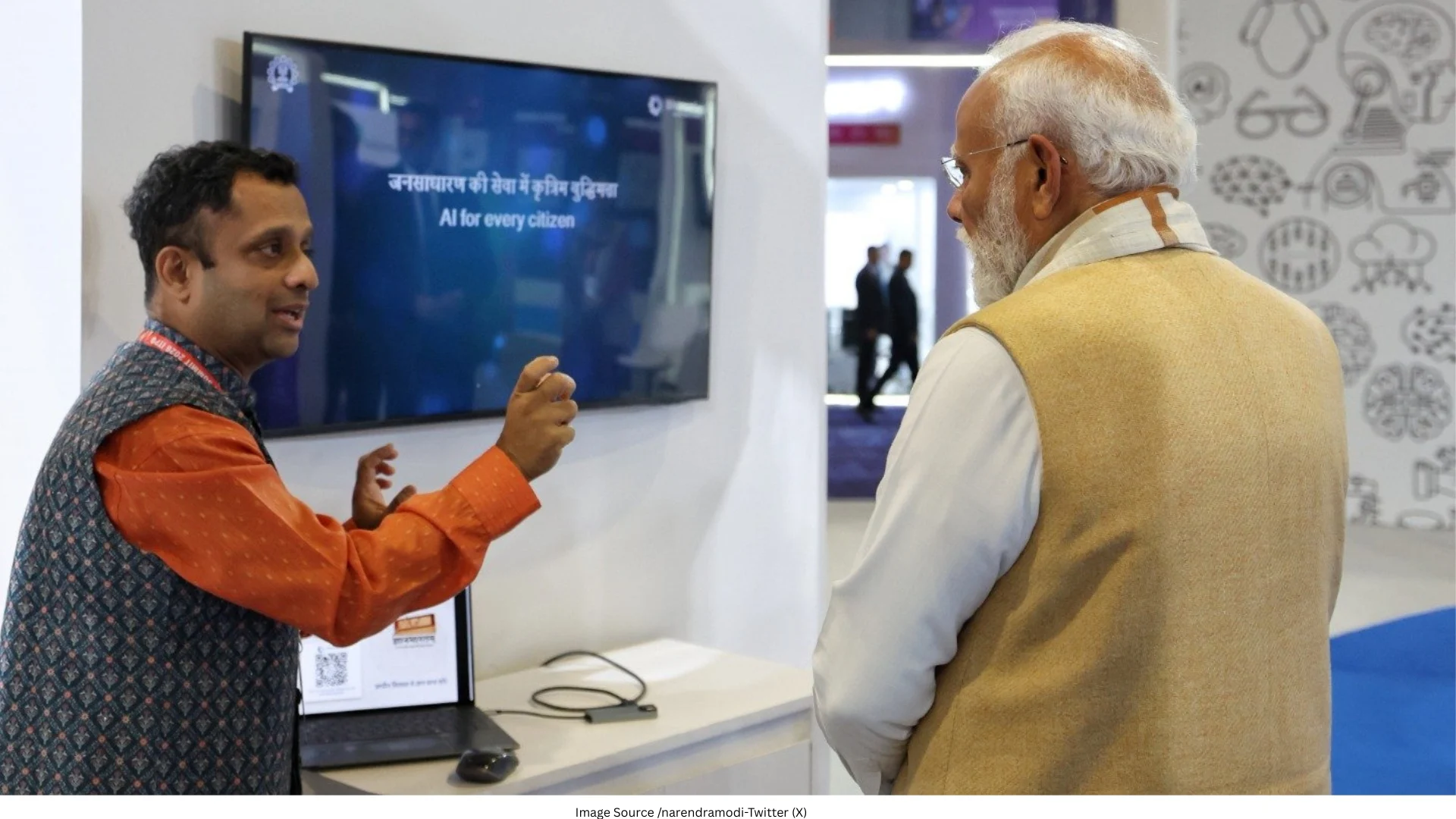
AI Summit 2026 — Quick Facts
| Event Name | India AI Impact Summit 2026 |
|---|---|
| Dates | February 16–20, 2026 (5 days) |
| Venue | Bharat Mandapam, New Delhi, India |
| Hosted By | Ministry of Electronics & IT (MeitY) under IndiaAI Mission |
| Inaugurated By | Prime Minister Narendra Modi (Feb 16) |
| Theme | “Sarvajana Hitaya, Sarvajana Sukhaya” (Welfare for All, Happiness for All) |
| Speakers | 3,250+ speakers across 500+ sessions |
| Exhibitors | 300+ exhibitors from 30+ countries |
| Expected Visitors | 2.5 lakh (250,000) |
| Countries Participating | 100+ |
Why This Summit Matters
This summit is historic because it is the first-ever global AI summit hosted in the Global South, shifting global AI leadership conversations beyond Europe and the United States.
| Year | Summit Name | Location | Focus Theme |
|---|---|---|---|
| 2023 | AI Safety Summit | Bletchley Park, UK | AI risk and safety discussions |
| 2024 | AI Seoul Summit | Seoul, South Korea | Policy coordination and AI frameworks |
| 2025 | AI Action Summit | Paris, France | Moving from discussion to implementation |
| 2026 | AI Impact Summit | New Delhi, India | Real-world AI deployment and measurable outcomes |
AI Summit 2026 Schedule: February 16–20, New Delhi
The five-day event is structured to move from expos and showcases in the first days to high-level leader sessions in the final days.
| Day | Key Highlights |
|---|---|
| Day 1 — Feb 16 (Sunday) | India AI Impact Expo inauguration at Bharat Mandapam by PM Modi. 300+ exhibition pavilions opened. Robotics demos, AI healthcare tools, agritech platforms, multilingual language models showcased. Over 600 startups participated. |
| Day 2 — Feb 17 (Monday) | Major investment announcements. Adani pledged $100B for AI data centers. Blackstone led $600M investment in Neysa. India allocated $1.1B for AI startup VC fund. Anthropic opened its Bengaluru office. Sarvam AI launched first devices. |
| Day 3 — Feb 18 (Tuesday) | Policy sessions and governance discussions. Microsoft announced $50B investment plan for the Global South. Sessions on AI governance, cybersecurity, and women’s empowerment. Galgotias University controversy regarding Unitree robodog. Release of India AI Governance Guidelines. |
| Day 4 — Feb 19 (Wednesday) | Main Summit Day 1. High-level plenaries with Heads of State, 60+ ministers, and 500+ global AI leaders. Joint address by PM Modi and French President Macron expected. Leaders’ Declaration anticipated. |
| Day 5 — Feb 20 (Thursday) | Main Summit Day 2 and closing. Working group outcomes, hackathon winners announcement, and closing declarations. IndiaAI Hackathon on Mineral Targeting winners to be revealed. |
Source: Official Summit Agenda
Who Is Attending the AI Summit in Delhi? The Complete Breakdown
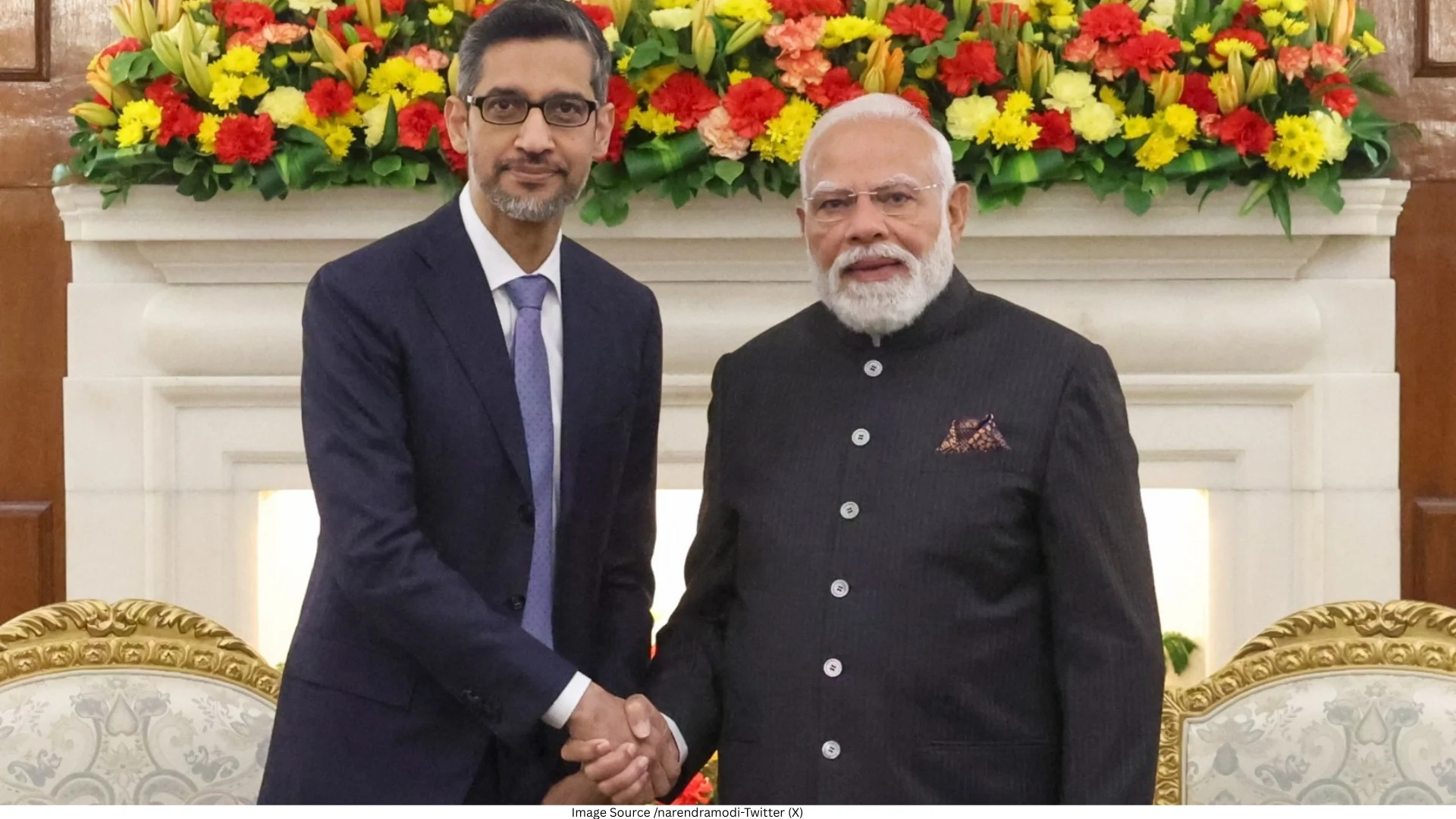
This is arguably the most star-studded AI event of 2026. With 20+ Heads of State, global tech CEOs, Indian business tycoons, UN officials, and over 250,000 visitors, the India AI Impact Summit has attracted an unprecedented cross-section of global power. Here’s the full category-wise breakdown of confirmed and expected attendees.
Global Tech CEOs & AI Pioneers
The biggest names in artificial intelligence building the world’s leading models and platforms are present in New Delhi:
| Name | Designation | Company |
|---|---|---|
| Sam Altman | CEO | OpenAI |
| Sundar Pichai | CEO | Alphabet / Google |
| Dario Amodei | CEO | Anthropic |
| Demis Hassabis | CEO | Google DeepMind |
| Brad Smith | Vice Chair & President | Microsoft |
| Cristiano Amon | CEO | Qualcomm |
| Yann LeCun | Executive Chairman | AMI Labs / Meta AI |
Notable absence: Nvidia CEO Jensen Huang and Bill Gates were initially expected but are not on the final confirmed list.
Indian Business Tycoons & Entrepreneurs
| Name | Designation | Company / Announcement |
|---|---|---|
| Mukesh Ambani | Chairman & MD | Reliance Industries |
| Jeet Adani | Director | Adani Airport Holdings — $100B AI pledge |
| Pratyush Kumar | CEO | Sarvam AI — Launched Kaze devices |
| Vinod Khosla | Founder | Khosla Ventures |
World Leaders & Heads of State
| Leader | Country |
|---|---|
| Emmanuel Macron | France |
| Luiz Inácio Lula da Silva | Brazil |
| Pedro Sánchez | Spain |
| Kyriakos Mitsotakis | Greece |
By The Numbers
| Category | Participation |
|---|---|
| Heads of State / Government | 20+ Leaders |
| Ministerial Delegations | 45+ Countries |
| Global AI Leaders & CEOs | 500+ |
| Expected Visitors | 2.5 lakh (250,000) |
Major Announcements & Billion-Dollar Investments
The summit has already triggered an unprecedented wave of AI investment commitments in India. Here are the biggest announcements so far:
Adani announced a massive plan to build AI data centers powered by renewable energy in India by 2035. The company stated this would trigger an additional $150 billion in investment across server manufacturing, advanced electrical infrastructure, sovereign cloud platforms, and related industries.
Source: TechCrunch
Microsoft announced a plan to invest $50 billion by the end of this decade to expand AI infrastructure across the Global South, including data centers, skill development initiatives, and language-focused AI systems.
Source: News9
Blackstone led a $600 million equity investment in Indian AI cloud startup Neysa, which plans to deploy over 20,000 GPUs for AI training and seek additional debt financing.
Source: Fortune
India earmarked $1.1 billion for a state-backed venture capital fund under the IndiaAI Mission, targeting artificial intelligence and advanced manufacturing startups nationwide.
Source: TechCrunch
AMD expanded its partnership with TCS to deploy up to 200 megawatts of AI infrastructure capacity in India, supporting sovereign AI and enterprise deployments.
Source: Fortune
Anthropic confirmed India as its second-largest market for Claude AI, with revenue doubling since October 2025. The company opened its second Asian office in Bengaluru.
Source: Fortune
Micron is expected to begin semiconductor production at its Gujarat facility, marking a milestone for India’s semiconductor ambitions. India Semiconductor Mission 2.0 was also announced.
Source: AckoDrive
Other Notable Announcements
Sarvam AI launched “Sarvam Kaze” — its first AI devices designed and built in India. Cohere Labs launched a family of multilingual models supporting over 70 languages. Cartesia (Voice AI company) partnered with India’s Blue Machines for enterprise voice solutions with local data residency. India also announced the creation of a National AI Research Grid to strengthen the computing infrastructure and enable collaboration between universities, startups, and public institutions.
Key Quotes in AI Impact Summit 2026
Prime Minister Modi has positioned India at the center of the global AI conversation. Below are his most powerful statements from the summit outlining India’s long-term AI vision.
“AI will help define India’s future, and India will help define AI’s future — in a way only a democracy can.”
“My message is one of cautious optimism. We’re on the cusp of an absolutely incredible transformation that’s going to bring incredible benefits in science and medicine.”
“There’s a big gap between an AI model that works in a demo and one that works in a regulated industry — and if you want to close that gap, you need domain expertise.”
Summit Themes: The 3 Sutras and 7 Chakras
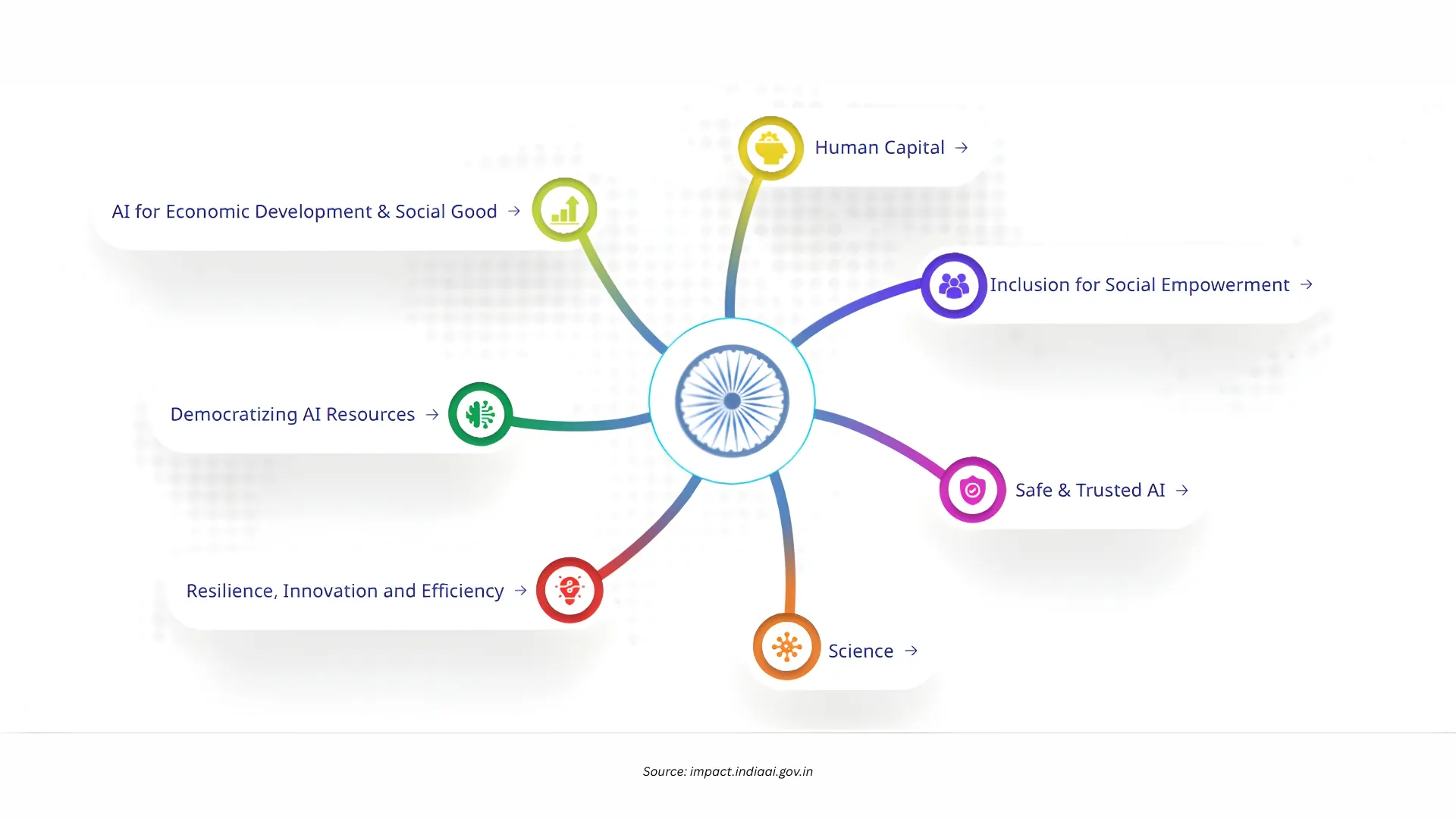
The India AI Impact Summit is organized around three guiding “Sutras” (principles) and seven “Chakras” (thematic working groups).
The 3 Sutras (Guiding Principles)
1. People Sutra — AI must serve humanity in all its diversity, preserving dignity and ensuring inclusivity.
2. Planet Sutra — AI innovation must align with environmental stewardship and sustainability.
3. Progress Sutra — AI’s benefits must be equitably shared, advancing global development and prosperity.
The 7 Chakras (Thematic Working Groups)
1. Human Capital — Building an equitable AI reskilling ecosystem.
2. Inclusion — Ensuring AI benefits reach all sections of society.
3. Trust — Developing safe and trustworthy AI systems.
4. Resilience — Cybersecurity, deepfakes, and AI-enabled threats.
5. Science — AI applications in research, healthcare, and climate.
6. Resources — Compute infrastructure, data, and energy for AI.
7. Social Good — AI for governance, agriculture, and education.
Summit Still Ongoing — Stay Updated
The main leader sessions take place on February 19–20.
PM Modi and French President Macron are expected to deliver a joint address.
Follow the live sessions on the official summit website or their YouTube channel.
Visit Official Website
This article will be updated with Day 4 and Day 5 highlights as they happen.
FAQs - AI Impact Summit India
Q1.What is the Galgotias University controversy at the AI Summit 2026?
Galgotias University showcased a surveillance robotic dog called “Orion” at its expo pavilion, but it was later identified as a commercially available Unitree Go2 manufactured by Chinese robotics company Unitree, purchasable for approximately ₹2.5 lakh ($2,800). A professor initially claimed on camera that the robodog was developed at their Centre of Excellence. After backlash went viral on social media, the university reversed course, stating it had “recently acquired Robodog from Unitree” and never claimed to have built the device. Government sources confirmed Galgotias was directed to vacate its expo stall on Day 3 (February 18).
Q2.What is the Unitree Go2 robodog shown at the AI Summit?
The Unitree Go2 is a commercially available quadruped robot developed by Chinese robotics company Unitree Robotics, priced at approximately $2,800. It is widely used by universities and robotics labs worldwide as a programmable platform for research and education. At the AI Summit, it became the center of controversy when Galgotias University allegedly presented it as an indigenous innovation.
Q3.What are India's AI Governance Guidelines released at the summit?
India released principle-based AI Governance Guidelines anchored in seven sutras: trust, people-first governance, innovation over restraint, fairness and equity, accountability, understandability by design, and safety/resilience/sustainability. The framework calls for structured mechanisms to collect and analyse AI-related incidents, with special attention to protecting children and women from deepfakes and exploitative AI systems. Unlike the EU’s regulation-heavy approach, India’s model favors a lighter-touch, innovation-first stance.
Q4.Who attended the India AI Summit 2026?
The summit drew over 20 heads of state (including France’s Macron and Brazil’s Lula), tech CEOs like Sam Altman (OpenAI), Sundar Pichai (Google), Dario Amodei (Anthropic), Demis Hassabis (DeepMind), and Brad Smith (Microsoft), plus Indian leaders like Mukesh Ambani, Nandan Nilekani, and Vinod Khosla. Jensen Huang (Nvidia) withdrew last minute. Over 2.5 lakh visitors attended the expo and 100+ countries participated.
Q5.When and where is the AI Summit 2026?
The India AI Impact Summit 2026 runs from February 16–20, 2026 at Bharat Mandapam, New Delhi, India. The expo opened on Feb 16, investment announcements dominated Days 2–3, and the main leader sessions with heads of state take place on February 19–20.
Q6.What is the next AI Summit after India?
The India AI Impact Summit is the fourth in the global AI summit series, following Bletchley Park UK (2023), Seoul South Korea (2024), and Paris France (2025). The host for the 2027 edition has not yet been officially announced. It is expected to be declared during the Leaders’ Summit sessions on Feb 19–20.
Explore Services
Related Services
Reviewed by

Aman Vaths
Founder of Nadcab Labs
Aman Vaths is the Founder & CTO of Nadcab Labs, a global digital engineering company delivering enterprise-grade solutions across AI, Web3, Blockchain, Big Data, Cloud, Cybersecurity, and Modern Application Development. With deep technical leadership and product innovation experience, Aman has positioned Nadcab Labs as one of the most advanced engineering companies driving the next era of intelligent, secure, and scalable software systems. Under his leadership, Nadcab Labs has built 2,000+ global projects across sectors including fintech, banking, healthcare, real estate, logistics, gaming, manufacturing, and next-generation DePIN networks. Aman’s strength lies in architecting high-performance systems, end-to-end platform engineering, and designing enterprise solutions that operate at global scale.