Ai Overview
Gas optimization techniques are architectural decisions that determine whether your decentralized application (dApp) remains affordable and competitive or becomes prohibitively expensive for users. Poor optimization can inflate transaction costs by 300-500%, driving users to cheaper alternatives. Every 32-byte storage slot costs 20,000 gas to initialize (SSTORE from zero to non-zero) and 5,000 gas to update an existing value.
Gas optimization techniques are architectural decisions that determine whether your decentralized application (dApp) remains affordable and competitive or becomes prohibitively expensive for users. Every smart contract interaction on Ethereum and EVM-compatible chains costs gas—a fee paid in the network’s native token to compensate validators for computational resources. Poor optimization can inflate transaction costs by 300-500%, driving users to cheaper alternatives. This guide walks through proven storage patterns, opcode strategies, batching methods, off-chain computation approaches, and contract design patterns that reduce gas consumption without sacrificing functionality or security.
Key Takeaways
- Storage slot packing can reduce SSTORE operations by 40-60% by grouping smaller data types into single 32-byte slots
- Strategic use of calldata instead of memory for read-only function parameters cuts gas by 20-30% per call
- Batching multiple contract interactions into a single multicall transaction saves 21,000 base gas per avoided transaction
- Off-chain Merkle proof verification moves bulk data storage off-chain while maintaining cryptographic integrity, reducing costs by 80-90%
- Layer 2 rollup integration can lower per-transaction gas fees from $5-50 on mainnet to $0.01-0.50 on optimistic or zk-rollups
- Cold storage access (first read) costs 2,100 gas while warm access (subsequent reads) costs only 100 gas—caching patterns matter
How Do Storage Layout Decisions Impact Gas Consumption in Smart Contracts?
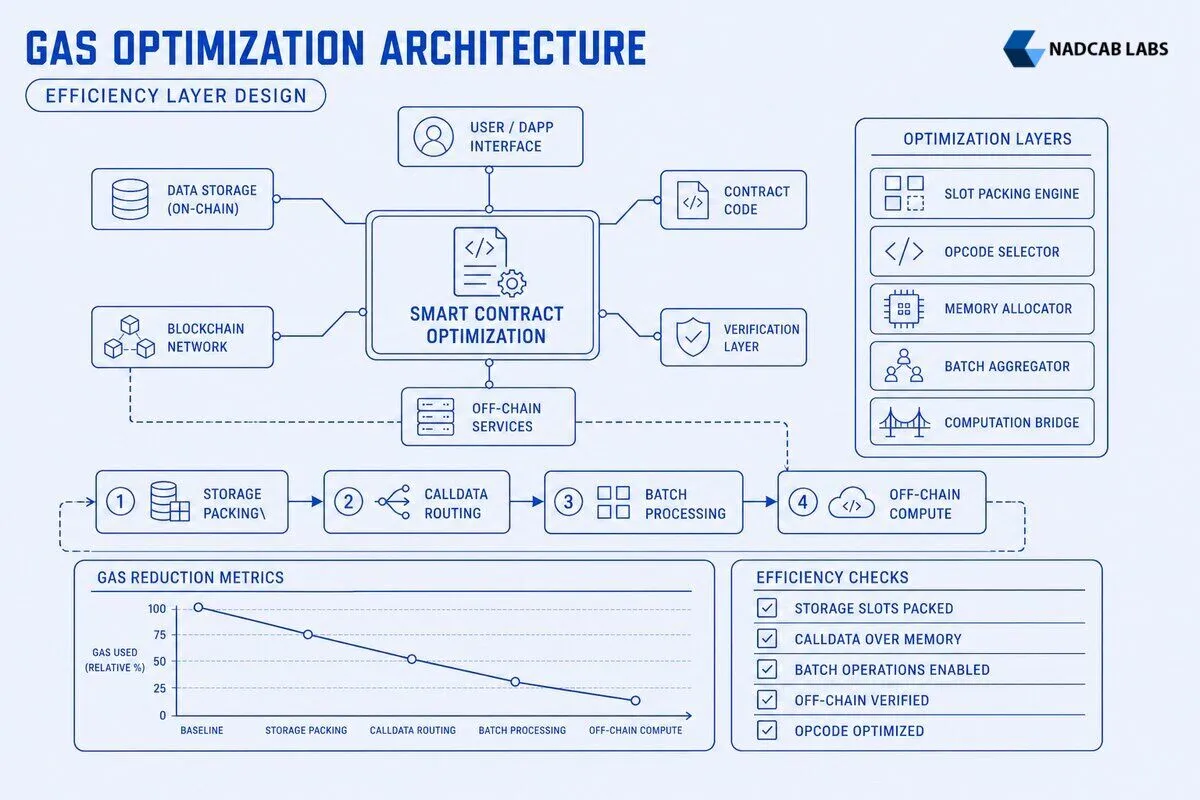
Storage is the most expensive resource in the Ethereum Virtual Machine (EVM). Every 32-byte storage slot costs 20,000 gas to initialize (SSTORE from zero to non-zero) and 5,000 gas to update an existing value. The EVM reads and writes data in 256-bit (32-byte) chunks called storage slots. When you declare state variables in Solidity, the compiler assigns them to these slots sequentially. Understanding this mechanism is the foundation of storage optimization solidity strategies.
Storage slot packing is the practice of grouping multiple smaller variables into a single 32-byte slot. For example, a uint256 occupies one full slot, but you can pack a uint128, a uint64, a uint32, and a uint32 into that same slot because 128 + 64 + 32 + 32 = 256 bits. When you pack variables, a single SSTORE operation writes all of them at once, saving 15,000-19,000 gas per avoided SSTORE. Consider this comparison:
| Storage Pattern | Gas Cost (First Write) | Variables per Slot | Total Slots Used |
|---|---|---|---|
| Unpacked (uint256, uint256, uint256) | 60,000 gas | 1 per slot | 3 slots |
| Packed (uint128, uint64, uint32, uint32) | 20,000 gas | 4 per slot | 1 slot |
| Packed (address, bool, uint88) | 20,000 gas | 3 per slot | 1 slot |
| Mixed (uint256, address, bool) | 40,000 gas | Varies | 2 slots |
Address types occupy 160 bits (20 bytes), leaving 96 bits in the slot. You can pack an address with a bool (8 bits) and a uint88, or with multiple smaller uints. The order of declaration matters: Solidity packs variables in the order you declare them, so group tightly related small types together. Real-world example: a token contract storing user balances (uint128), last transaction timestamp (uint64), and a frozen flag (bool) can fit all three in one slot instead of three, saving 40,000 gas per user on first write and 10,000 gas on updates.
Mapping versus array trade-offs depend on access patterns. Mappings use a hash function to compute storage locations, costing one SLOAD (2,100 gas cold, 100 gas warm) per access with no iteration capability. Arrays store elements sequentially, enabling iteration but costing extra gas to manage length. For sparse data where you access individual elements by key, mappings win. For dense collections you need to loop over, arrays are better. Nested mappings (mapping(address => mapping(uint => Data))) cost two SLOADs per access but avoid array length overhead. If you need both random access and iteration, consider maintaining a separate array of keys alongside your mapping—this costs extra storage but enables efficient enumeration.
Memory versus storage versus calldata distinctions are critical for function parameters and temporary variables. Storage refers to persistent contract state (expensive). Memory is temporary scratch space cleared after function execution (cheaper, ~3 gas per 32-byte word). Calldata is read-only input data from transaction payload (cheapest, direct access without copying). When a function takes an array or struct as input and only reads it, use calldata instead of memory to avoid the copy operation. Example: function processBatch(uint[] calldata ids) saves 20-30% gas versus function processBatch(uint[] memory ids) because calldata skips the memory allocation and copy. Use memory for temporary variables you modify within the function. Use storage pointers (Data storage item = items[id]) when you need to update state variables directly—this avoids copying the entire struct to memory and back. This approach is central to Gas Optimization in Smart Contract development practices.
Which EVM Opcode Patterns Deliver the Highest Gas Savings?
Every operation in a smart contract compiles to EVM opcodes, each with a fixed gas cost. Low-cost opcodes like ADD (3 gas), MUL (5 gas), SUB (3 gas), and ISZERO (3 gas) are cheap. Expensive operations include SSTORE (20,000 cold, 5,000 warm), SLOAD (2,100 cold, 100 warm), CREATE (32,000 base plus deployment code), and CALL (2,600 base plus value transfer). Strategic use means structuring logic to minimize expensive opcodes and maximize cheap ones.
Short-circuiting with logical operators is a simple but powerful technique. Solidity evaluates && (AND) and || (OR) expressions left-to-right and stops as soon as the result is determined. In require(cheapCheck() && expensiveCheck()), if cheapCheck() returns false, expensiveCheck() never executes, saving its gas cost. Place the least expensive or most likely to fail condition first. Example: require(msg.value > 0 && balances[msg.sender] >= amount) checks the cheap msg.value first before reading storage. For OR conditions, place the most likely to succeed condition first: if (cachedResult || computeExpensiveResult()), the expensive computation only runs when the cache misses. This pattern can save 2,000-5,000 gas per conditional depending on what operations you avoid.
Bitwise operations and bit-shifting replace expensive arithmetic for powers of two. Multiplying or dividing by 2, 4, 8, 16, etc., can use bit shifts instead of MUL/DIV opcodes. Left shift (x <> n) divides x by 2^n. Example: amount * 4 costs 5 gas (MUL), but amount <> 3. The savings per operation are small (2-3 gas), but in loops or frequently called functions, this adds up. Bitwise AND, OR, XOR, and NOT operations (3 gas each) are also cheaper than equivalent arithmetic. Use bitmasks for flags: instead of storing eight separate bool variables (eight storage slots, 160,000 gas), pack them into a single uint8 and use bitwise operations to check/set individual bits (one slot, 20,000 gas).
Here is a comparison of opcode gas consumption for common operations:
Caching storage reads in memory or stack variables is another high-impact pattern. Reading the same storage slot multiple times in a function wastes gas. Load the value once into a local variable and reuse it. Example: instead of if (balances[user] > 0) { total += balances[user]; }, write uint balance = balances[user]; if (balance > 0) { total += balance; }. This saves one SLOAD (2,000+ gas). In loops, cache array length: uint len = items.length; for (uint i = 0; i < len; i++) instead of for (uint i = 0; i < items.length; i++), because items.length reads storage on every iteration. These EVM gas efficient patterns are essential for professional dApp Development teams.
What Batching and Aggregation Strategies Reduce Multi-Transaction Costs?
Every Ethereum transaction pays a base fee of 21,000 gas regardless of what it does. If a user needs to perform five separate actions—approve a token, stake it, claim rewards, vote in governance, and update a profile—that is 105,000 gas in base fees alone before any actual work happens. Batching combines multiple operations into a single transaction, paying the 21,000 base fee once and executing all operations in sequence. This technique is fundamental to reduce gas costs dApp architectures.
Multicall patterns aggregate multiple contract calls into one transaction. The multicall contract accepts an array of target addresses and calldata payloads, loops through them, and executes each via delegatecall or call. Users sign one transaction that triggers the multicall, which then fans out to the actual contracts. Example: a DeFi aggregator might batch approve(tokenA), approve(tokenB), swap(tokenA, tokenB), and addLiquidity(tokenA, tokenB) into a single multicall. Savings: three avoided base fees (63,000 gas) plus reduced overhead from wallet interactions. Implementation: function multicall(address[] calldata targets, bytes[] calldata data) external returns (bytes[] memory results). Loop through targets, execute each call, collect results. This pattern is widely used in Uniswap, Aave, and other protocols. Security note: ensure reentrancy protection and validate all target addresses to prevent malicious calls.
Event log optimization reduces the cost of emitting data. Events use LOG opcodes (LOG0 through LOG4), costing 375 gas per log plus 8 gas per byte of data and 375 gas per indexed topic. Indexed parameters (up to three per event) enable efficient filtering but cost more. Non-indexed parameters are cheaper but require scanning all logs. Strategy: index only the fields you will filter on (user addresses, token IDs), and leave large data blobs non-indexed. Minimize emitted data size: instead of emitting entire structs, emit only changed fields or use event IDs that map to off-chain data. Example: emit Transfer(from, to, amount) costs ~1,500 gas; adding indexed to all three parameters increases it to ~2,600 gas. If you only filter by from and to, index those two and leave amount non-indexed.
Loop unrolling and fixed-size iterations eliminate dynamic gas costs from unbounded loops. Variable-length loops (for (uint i = 0; i < array.length; i++)) can consume unpredictable gas, risking block gas limit failures. Fixed-size loops or unrolled operations provide predictable costs. Example: instead of looping to sum five values, write total = a + b + c + d + e. For larger fixed sets, unroll in chunks: process items 0-9 in one function, 10-19 in another, and combine results. This approach is critical in smart contract architecture for real estate tokenization where batch processing of property shares must remain predictable.
Here is a process flow for implementing a multicall batching strategy:
Batching strategies blockchain implementations can reduce total gas by 40-70% in scenarios requiring multiple transactions. The exact savings depend on the ratio of base fees to execution costs—simple operations like token approvals see higher percentage savings than complex computations.
How Can Off-Chain Computation Architecture Lower On-Chain Gas Fees?
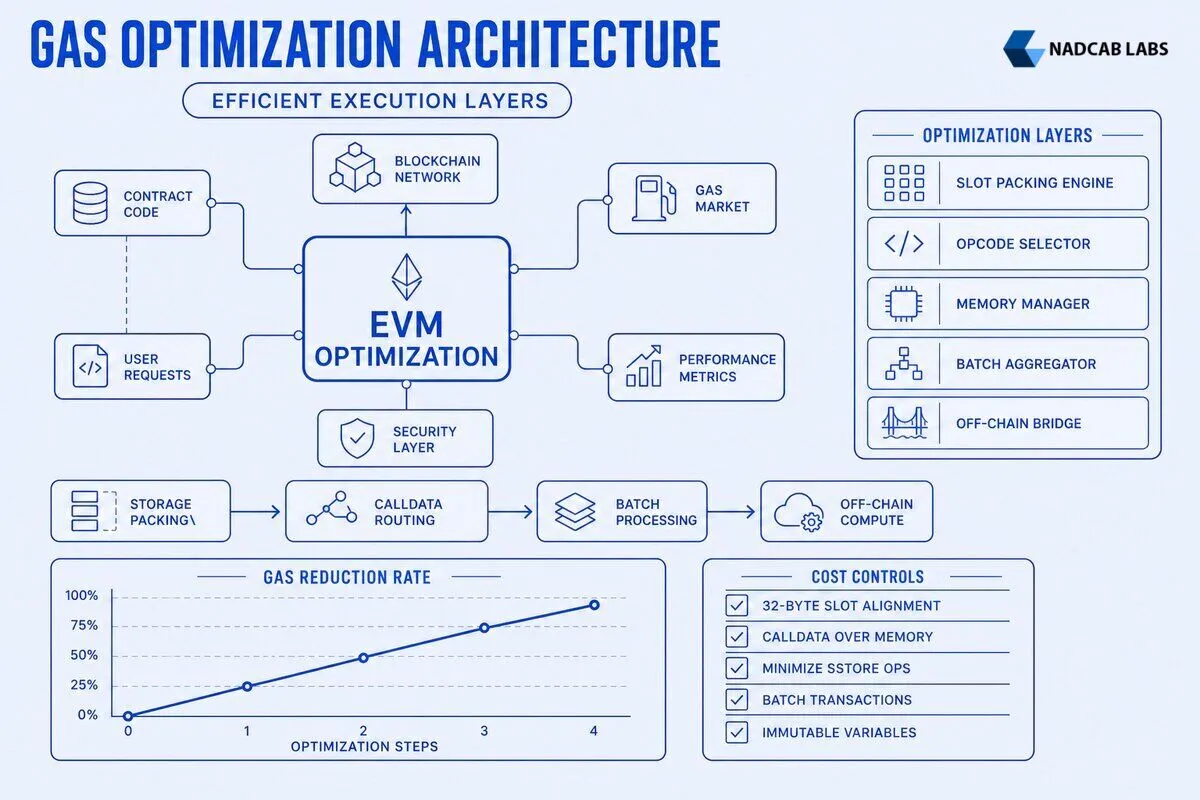
The most effective gas optimization is not doing the work on-chain at all. Off-chain computation moves expensive operations—data storage, complex calculations, bulk processing—outside the blockchain while maintaining trust through cryptographic proofs. This architectural approach is central to transaction cost reduction strategies in modern dApps.
Merkle proof verification enables storing large datasets off-chain while proving inclusion on-chain with minimal gas. A Merkle tree hashes data into a tree structure where each parent node is the hash of its children, culminating in a single root hash stored on-chain. To prove a specific data item exists, you provide the item plus a proof path (sibling hashes from leaf to root). The contract recomputes the root and compares it to the stored root. Example: an airdrop contract distributing tokens to 10,000 addresses. Storing all addresses on-chain costs 10,000 SSTORE operations (200,000,000 gas). Instead, build a Merkle tree off-chain, store only the root (20,000 gas), and let users submit proofs when claiming. Each claim verifies the proof (~5,000 gas) instead of checking a stored list. Total savings: 199,950,000 gas across all claims. Implementation: use libraries like OpenZeppelin’s MerkleProof.sol for secure verification. This pattern is used in Uniswap airdrops, ENS claims, and NFT minting allowlists.
Signature-based authorization replaces on-chain access control storage with cryptographic verification. Instead of storing a whitelist mapping (mapping(address => bool) whitelist), have an authorized signer create off-chain signatures for permitted addresses. Users submit the signature with their transaction, and the contract verifies it via ecrecover. Example: a minting function checks require(recoverSigner(message, signature) == authorizedSigner) instead of require(whitelist[msg.sender]). Savings: no SSTORE to add addresses (20,000 gas each), no SLOAD to check them (2,100 gas each). The signature verification costs ~3,000 gas but eliminates all storage. For 1,000 whitelisted users, this saves 20,000,000 gas on setup and 2,100 gas per mint. Security: use EIP-712 typed data signatures to prevent replay attacks and ensure message uniqueness. This approach is common in multi-chain MLM smart contract architecture where authorization must scale across thousands of participants.
Layer 2 rollup integration points identify which contract logic can migrate to optimistic or zk-rollups. Layer 2 solutions batch hundreds of transactions off-chain, post compressed data or proofs to Ethereum mainnet, and inherit Ethereum’s security. Optimistic rollups (Arbitrum, Optimism) assume transactions are valid unless challenged; zk-rollups (zkSync, StarkNet) use zero-knowledge proofs to guarantee validity. Gas costs on L2 are 10-100x cheaper than mainnet. Example: a DeFi protocol with frequent small trades can deploy core logic on L2, reducing per-trade costs from $10-50 to $0.10-0.50. Integration: deploy contracts on L2, use canonical bridges for asset transfers, and keep only critical settlement or governance on mainnet. Consider hybrid architectures: high-frequency operations on L2, final settlement on L1. This strategy is essential for KYC verification P2P exchanges where transaction volume demands low per-user costs.
Off-chain indexing and caching reduce redundant on-chain queries. Instead of calling contract view functions repeatedly (each costs gas when called from another contract), run an off-chain indexer (The Graph, custom node) that watches events and maintains a queryable database. Frontend queries the indexer for historical data, only sending transactions for state changes. Example: a portfolio tracker that shows user balances across 20 DeFi protocols. Querying 20 contracts on-chain costs 20 external calls (~50,000 gas if done in a transaction). An indexer provides instant results with zero on-chain cost. This pattern is standard in production dApps and complements RWA tokenization smart contract architecture where asset metadata and transaction history need frequent access.
What Contract Design Patterns Prevent Gas Waste at Scale?
Architectural decisions at the contract design level determine long-term gas efficiency. Choosing the right patterns for upgrades, deployment, and initialization can save millions of gas over a contract’s lifetime. These gas efficient architecture principles are critical for teams planning to Hire Smart contract developer resources.
Proxy pattern gas considerations involve trade-offs between delegatecall overhead and upgrade flexibility. Proxy contracts use delegatecall to forward calls to an implementation contract, enabling upgrades by swapping the implementation address. The delegatecall opcode costs 2,600 gas per call, adding overhead to every function. For high-frequency contracts (token transfers, DEX swaps), this 2,600 gas per transaction adds up. Example: a token with 1 million transfers pays an extra 2.6 billion gas over its lifetime compared to a direct implementation. When to use: governance-heavy contracts where upgrade capability justifies the cost (DAOs, protocol treasuries). When to avoid: high-frequency, stable contracts where logic rarely changes (established tokens, simple vaults). Alternative: use immutable contracts for core logic and proxy patterns only for peripheral modules. Ensure any proxy implementation undergoes thorough Smart Contract Audit to prevent storage collision and delegatecall vulnerabilities.
Factory pattern optimization uses CREATE2 for deterministic addresses and reduced deployment gas. Standard CREATE opcode costs 32,000 gas plus deployment code size. CREATE2 costs the same but allows precomputing contract addresses before deployment, enabling counterfactual instantiation (interact with a contract before deploying it). Example: a token factory deploys 1,000 instances. Using a minimal proxy (EIP-1167 clone) instead of deploying full bytecode each time reduces per-instance cost from ~500,000 gas to ~50,000 gas. Savings: 450,000 gas per instance, 450 million total. Implementation: deploy a master implementation once, then use create2 with minimal proxy bytecode that delegatecalls to the master. This pattern is used in Uniswap V3 pool creation and Gnosis Safe wallet deployment. Security: validate initialization parameters to prevent front-running attacks on CREATE2 addresses.
Lazy initialization and pay-per-use models defer expensive operations until absolutely necessary. Instead of initializing all state variables in the constructor (paying SSTORE costs upfront), initialize them on first use. Example: a contract with 10 optional features. Initializing all 10 in the constructor costs 200,000 gas even if a user only needs one feature. Lazy initialization: check if (featureState == 0) { initializeFeature(); } on first access, spreading costs over actual usage. This reduces deployment gas and lets users pay only for what they use. Another approach: pay-per-use storage where users provide gas for their own storage slots. Example: a registry contract where users register data. Instead of the contract owner paying for all SSTORE operations, require users to send gas with their registration transaction. This scales storage costs linearly with usage rather than front-loading them. These patterns are relevant in entertainment app development cost breakdown scenarios where feature adoption varies widely across users.
Here is a comparison of deployment and per-call costs for different contract patterns:
| Pattern | Deployment Gas | Per-Call Overhead | Best Use Case |
|---|---|---|---|
| Direct Implementation | 500,000 – 2,000,000 gas | 0 gas | Stable, high-frequency contracts |
| Transparent Proxy (EIP-1967) | 600,000 – 2,200,000 gas | 2,600 gas | Upgradeable governance contracts |
| Minimal Proxy (EIP-1167) | 50,000 – 100,000 gas | 2,600 gas | Factory-deployed instances |
| Beacon Proxy | 80,000 – 150,000 gas | 5,200 gas | Multiple proxies sharing one implementation |
Function modifier optimization reduces repeated checks. Modifiers like onlyOwner or nonReentrant compile to inline code, adding gas to every function that uses them. For frequently called functions, consider consolidating checks or using internal functions instead of modifiers. Example: instead of applying onlyOwner to 10 functions, apply it to a single internal _checkOwner() function and call that explicitly. This can save 200-500 gas per call by reducing bytecode duplication. However, readability and security often outweigh these small savings—use this technique only in hot paths where gas is critical. The cost-benefit analysis here parallels considerations in RPA implementation cost breakdown where operational efficiency must balance against development complexity.
Immutable and constant variables eliminate storage reads. Variables declared as constant are embedded directly into bytecode at compile time (no storage slot, no SLOAD). Variables declared as immutable are set once in the constructor and then embedded in bytecode (20,000 gas SSTORE in constructor, but zero SLOAD thereafter). Use constant for values known at compile time (fixed addresses, magic numbers). Use immutable for values set at deployment (factory addresses, initial parameters). Example: address constant WETH = 0xC02aaA39b223FE8D0A0e5C4F27eAD9083C756Cc2 costs zero gas to access. address public weth costs 2,100 gas (cold) or 100 gas (warm) per read. For a contract accessed 1,000 times, that is 100,000-2,100,000 gas saved.
Final Thoughts
Gas optimization is not a one-time task but an architectural discipline that spans storage layout, opcode selection, transaction batching, off-chain computation, and contract design patterns. Teams that master storage slot packing, calldata usage, multicall batching, Merkle proofs, and proxy pattern trade-offs can reduce user transaction costs by 50-80% compared to naive implementations. The EVM’s transparent cost model rewards developers who understand opcode gas consumption and structure logic to minimize expensive operations like SSTORE and SLOAD. As Layer 2 adoption grows and gas prices fluctuate, these techniques remain essential for building competitive, user-friendly decentralized applications. Whether you are optimizing an existing contract or designing a new protocol, applying these patterns systematically will deliver measurable cost savings and improved user experience at scale.
Frequently Asked Questions
Q1.What is the most expensive operation in terms of gas cost on Ethereum?
Writing to storage (SSTORE) is the most expensive operation, costing 20,000 gas for setting a storage slot from zero to non-zero. Storage modifications consume significantly more gas than computational operations or memory usage. Contract deployment and SSTORE operations dominate gas costs in most smart contracts, making storage optimization critical for cost efficiency.
Q2.How much gas can storage slot packing save in a typical smart contract?
Storage slot packing can save 15,000-20,000 gas per additional variable packed into a single 32-byte slot. By grouping smaller data types (uint128, uint64, address) together, you reduce SSTORE operations. A well-optimized contract with 5-10 packed variables can save 100,000+ gas on deployment and 5,000-15,000 gas per transaction involving those variables.
Q3.Should I use memory or calldata for function parameters to save gas?
Use calldata for external function parameters—it’s significantly cheaper because data isn’t copied into memory. Calldata is read-only and references data directly from transaction input. Memory costs ~3 gas per word plus expansion costs, while calldata costs ~16 gas per non-zero byte. For arrays and structs in external functions, calldata saves 200-1,000+ gas depending on size.
Q4.What is the difference between cold and warm storage access costs?
Cold storage access (first read in a transaction) costs 2,100 gas, while warm access (subsequent reads) costs only 100 gas—a 21x difference. After EIP-2929, accessing the same storage slot multiple times within one transaction is dramatically cheaper. Caching frequently-accessed storage variables in memory can eliminate repeated cold access penalties and save thousands of gas.
Q5.How do Layer 2 solutions reduce gas fees compared to Ethereum mainnet?
Layer 2 solutions reduce gas fees by 90-99% by processing transactions off-chain and batching proofs to mainnet. Optimistic rollups like Arbitrum and ZK-rollups like zkSync bundle hundreds of transactions into single mainnet submissions. Execution happens on L2 where computational costs are minimal, while Ethereum mainnet only verifies compressed proofs, drastically lowering per-transaction costs.
Q6.Can batching multiple transactions into one really save 40-70% on gas costs?
Yes, batching saves 40-70% by eliminating redundant base transaction costs (21,000 gas each) and reducing repeated storage access penalties. A single batched transaction pays one base fee instead of multiple. Multicall patterns and batch processing functions consolidate operations, share warm storage access, and optimize calldata usage, delivering substantial savings for users executing multiple related operations.
Explore Services
Related Services
Reviewed by

Aman Vaths
Founder of Nadcab Labs
Aman Vaths is the Founder & CTO of Nadcab Labs, a global digital engineering company delivering enterprise-grade solutions across AI, Web3, Blockchain, Big Data, Cloud, Cybersecurity, and Modern Application Development. With deep technical leadership and product innovation experience, Aman has positioned Nadcab Labs as one of the most advanced engineering companies driving the next era of intelligent, secure, and scalable software systems. Under his leadership, Nadcab Labs has built 2,000+ global projects across sectors including fintech, banking, healthcare, real estate, logistics, gaming, manufacturing, and next-generation DePIN networks. Aman’s strength lies in architecting high-performance systems, end-to-end platform engineering, and designing enterprise solutions that operate at global scale.