Ai Overview
Robotic process automation (RPA) delivers measurable efficiency gains, but understanding the full financial picture requires breaking down licensing fees, infrastructure investments, development labor, and ongoing support. A single unattended bot license typically ranges from $8,000 to $15,000 annually, while attended bot licenses (requiring human interaction) cost $2,000 to $5,000 per user per year.
Robotic process automation (RPA) delivers measurable efficiency gains, but understanding the full financial picture requires breaking down licensing fees, infrastructure investments, development labor, and ongoing support. Organizations that accurately model these expenses—and align them with realistic ROI timelines—make informed decisions about automation scale, vendor selection, and deployment architecture. This guide provides a granular RPA implementation cost breakdown, helping teams budget for licensing tiers, cloud versus on-premise hosting, custom bot development, and maintenance cycles while calculating payback periods and total cost of ownership.
Key Takeaways
- Licensing models—per-bot, concurrent user, enterprise unlimited—drive 30–50% of total RPA spend and vary widely by vendor and scale.
- Infrastructure costs split between cloud compute (predictable OpEx) and on-premise servers (higher CapEx, lower recurring fees).
- Development and maintenance typically consume 40–60% of budgets, including process discovery, custom bot coding, testing, and change management.
- ROI calculation frameworks should measure labor savings, error reduction, and time-to-value against a 3-year total cost of ownership projection.
- Hidden costs—integration middleware, disaster recovery, training programs, and scaling overhead—often add 15–25% to initial estimates.
- Break-even periods for enterprise RPA range from 6 to 18 months, depending on process complexity and automation maturity.
What Are the Core Cost Components in RPA Implementation?
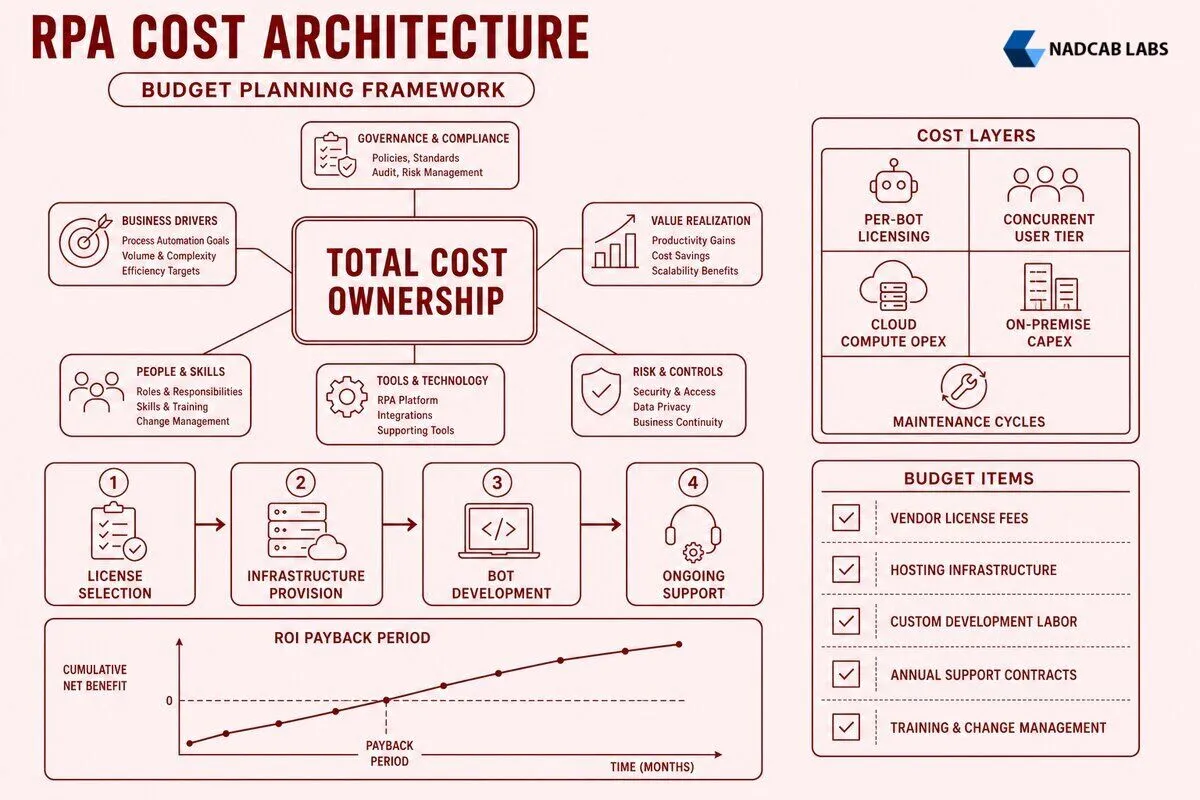
Every RPA deployment comprises three foundational expense categories: software licensing, infrastructure provisioning, and professional services. Software licensing represents the recurring fees paid to RPA platform vendors—UiPath, Automation Anywhere, Blue Prism, Microsoft Power Automate, or open-source alternatives. Vendors structure pricing around named users, concurrent bot sessions, or enterprise-wide unlimited agreements. A single unattended bot license typically ranges from $8,000 to $15,000 annually, while attended bot licenses (requiring human interaction) cost $2,000 to $5,000 per user per year. Enterprise agreements with volume discounts can reduce per-bot costs by 20–40% when committing to multi-year contracts or deploying dozens of bots across departments.
Infrastructure costs vary dramatically based on deployment model. Cloud-hosted RPA platforms charge for compute instances, storage, data egress, and managed services—AWS, Azure, or GCP hosting a bot orchestrator might incur $500 to $2,000 monthly per production environment, depending on workload intensity and redundancy requirements. On-premise deployments demand upfront capital expenditure: physical servers or virtualization clusters ($10,000–$50,000), Windows Server licenses, SQL Server or Oracle databases for bot logging and orchestration, and network bandwidth upgrades to handle API traffic. Organizations running 50+ bots often provision dedicated server racks with load balancers and disaster recovery sites, pushing infrastructure investment beyond $100,000 for enterprise-grade availability.
Professional services encompass the human expertise required to design, build, and deploy automation workflows. Implementation partners or internal development teams charge $100 to $250 per hour for RPA consultants, with typical bot development cycles consuming 80 to 300 hours depending on process complexity. Process discovery—mapping current workflows, identifying automation candidates, and documenting exception scenarios—adds another 40 to 120 hours of business analyst time. A medium-complexity bot automating invoice processing with SAP integration might require 150 development hours ($15,000–$37,500 at blended rates), plus 40 hours of testing and 20 hours of user training. Enterprises deploying 10 bots in the first year often budget $200,000 to $500,000 for combined professional services, not including internal staff time.
Integration and middleware expenses emerge when RPA bots must communicate with legacy systems lacking APIs. Screen-scraping technologies, OCR engines for document parsing, and API gateway licenses (MuleSoft, Dell Boomi, Workato) add $10,000 to $50,000 annually for enterprise deployments. Orchestration platforms that schedule bot runs, manage queues, and handle failover logic—such as Control Room in Automation Anywhere or Orchestrator in UiPath—are often bundled with licensing but may incur additional fees for advanced features like AI-driven workload balancing or real-time analytics dashboards. Teams should allocate 10–15% of the total robotic process automation budget for these ancillary tools and connectors.
Governance and compliance tooling represents a frequently overlooked cost component. Audit logging, role-based access controls, encrypted credential vaults, and regulatory compliance reporting modules (GDPR, SOX, HIPAA) may require premium licensing tiers or third-party add-ons. Financial services firms deploying RPA in trading or KYC workflows often spend an extra $20,000 to $60,000 annually on security and compliance features. When planning your enterprise automation budget planning, factor in these specialized requirements early to avoid mid-project scope creep and budget overruns.
How Do Licensing Models Impact Total RPA Investment?
Licensing structures fundamentally shape the economics of RPA scaling. Named user licensing assigns a license to a specific individual, ensuring that person can run attended bots on their workstation. This model suits scenarios where employees trigger automation workflows on demand—data entry clerks invoking a bot to validate customer records, or finance analysts running month-end reconciliation scripts. Named user licenses cost $2,000 to $5,000 per user annually, making them economical for small teams but expensive when scaling to hundreds of knowledge workers. Concurrent user licensing allows a pool of users to share a smaller number of licenses, reducing costs when not all users need simultaneous bot access. A 100-person department might purchase 30 concurrent licenses if typical usage patterns show only 30% peak concurrency, cutting licensing spend by 70%.
Attended versus unattended bot pricing creates distinct cost profiles aligned with use cases. Attended bots—triggered by humans and running on their desktops—handle tasks like form filling, data lookup, or guided troubleshooting. Unattended bots operate autonomously on server infrastructure, executing scheduled jobs like nightly batch processing, email parsing, or database synchronization without human intervention. Unattended licenses cost 2–4× more than attended licenses because they deliver 24/7 automation capacity and require robust orchestration, error handling, and logging. A retail organization automating order fulfillment might deploy 5 unattended bots ($40,000–$75,000 annually) to process 10,000 orders daily, while equipping 50 customer service agents with attended bots ($100,000–$250,000) to accelerate case resolution during business hours.
Enterprise agreements unlock volume discounts and predictable budgeting for large-scale deployments. Vendors offer tiered pricing—starter packages with 5–10 bot licenses, mid-market bundles with 25–50 licenses, and enterprise unlimited agreements for organizations automating hundreds of processes. A 3-year enterprise agreement might reduce per-bot costs from $12,000 to $7,500 annually when committing to 100+ licenses upfront, saving $450,000 over the contract term. Multi-year commitments also lock in pricing against future vendor rate increases and include upgrade rights to new platform features, AI capabilities, and cloud migration tools. However, these agreements demand accurate forecasting of automation pipeline and growth trajectory—over-purchasing licenses wastes capital, while under-provisioning forces expensive mid-contract amendments.
| Licensing Model | Typical Annual Cost | Best Use Case | Scalability |
|---|---|---|---|
| Named User (Attended) | $2,000–$5,000 per user | Desktop automation for specific roles | Linear cost increase with headcount |
| Concurrent User (Attended) | $3,000–$6,000 per license | Shared access across departments | Cost-efficient for large user bases |
| Unattended Bot | $8,000–$15,000 per bot | 24/7 back-office process automation | High ROI for high-volume tasks |
| Enterprise Unlimited | $500,000–$2,000,000 annually | Organization-wide automation programs | Predictable cost regardless of bot count |
Subscription versus perpetual licensing models influence cash flow and long-term RPA total cost of ownership. Most modern RPA vendors shifted to annual subscription pricing, bundling software updates, technical support, and cloud hosting into recurring fees. This OpEx model smooths budget allocation and ensures access to the latest features, but cumulative 5-year costs often exceed perpetual license alternatives. Legacy vendors still offer perpetual licenses with separate annual maintenance fees (18–22% of license cost), appealing to organizations preferring CapEx accounting or operating in air-gapped environments. A perpetual license for 10 unattended bots might cost $120,000 upfront plus $22,000 annually for support, totaling $230,000 over five years—comparable to subscription pricing of $100,000 annually ($500,000 total) but with different accounting treatment and upgrade flexibility.
When evaluating RPA licensing costs, teams should model scenarios across 1-year, 3-year, and 5-year horizons, accounting for anticipated automation pipeline growth, platform migration risks, and vendor lock-in implications. Building a detailed spreadsheet that maps licensing tiers to planned bot deployments—cross-referenced with infrastructure and development costs—provides the financial clarity needed for executive buy-in and budget approval. For organizations just starting their automation journey, partnering with experienced RPA Development providers can help navigate vendor negotiations and optimize licensing strategies for long-term value.
What Infrastructure and Platform Expenses Should Teams Budget For?
Cloud deployment costs for RPA platforms center on compute instances, storage, data transfer, and managed services. A typical cloud-hosted bot orchestrator running on AWS EC2 or Azure Virtual Machines consumes 4–8 vCPUs and 16–32 GB RAM per production environment, costing $300 to $800 monthly for the instance alone. High-availability configurations requiring multi-region failover, load balancers, and auto-scaling groups push monthly cloud spend to $1,500–$3,000 per environment. Storage for bot execution logs, process artifacts, and credential vaults adds $50 to $200 monthly depending on retention policies and data volume—organizations processing millions of transactions annually may accumulate terabytes of audit logs requiring archival to S3 Glacier or Azure Blob cold storage.
Data egress charges represent a hidden cloud cost that surprises teams during scaling. RPA bots frequently pull data from on-premise ERP systems or SaaS applications, then push results to cloud data warehouses or analytics platforms. AWS charges $0.09 per GB for data transfer out of the region, meaning a bot processing 500 GB monthly of invoice PDFs and database exports incurs $45 in egress fees—trivial for a single bot, but multiplying to $4,500 monthly across 100 bots. Enterprises mitigate these costs by deploying hybrid architectures: running bots in the same cloud region as target systems, using VPN tunnels or AWS Direct Connect for bulk transfers, or caching frequently accessed data in regional S3 buckets. Budgeting 10–15% of cloud compute costs for network bandwidth and data transfer provides a realistic buffer.
On-premise infrastructure demands higher upfront capital expenditure but lower recurring fees for large-scale deployments. A production RPA environment supporting 50 unattended bots typically requires a 3-node virtualization cluster (VMware vSphere or Hyper-V) with 96 vCPUs, 384 GB RAM, and 10 TB SAN storage—hardware costs of $60,000 to $120,000 depending on vendor and warranty terms. Windows Server Datacenter licenses for unlimited virtualization cost $6,155 per 2-core pack (16 cores minimum), totaling $49,240 for a dual-socket server. SQL Server Standard Edition for bot orchestration databases runs $3,717 per 2-core pack, adding another $30,000 for enterprise-grade availability groups. Factoring in network switches, UPS systems, rack space, and cooling, total on-premise infrastructure investment reaches $150,000 to $250,000 for a 50-bot deployment.
Disaster recovery and business continuity infrastructure doubles these costs for mission-critical automation. Financial services firms and healthcare providers mandate geographically separated DR sites with real-time database replication, automated failover orchestration, and tested recovery runbooks. A full DR environment mirrors production capacity—another $150,000 to $250,000 in hardware—plus annual maintenance contracts (12–18% of hardware cost) and colocation fees if using third-party data centers. Cloud-based DR using Azure Site Recovery or AWS Elastic Disaster Recovery reduces capital outlay but introduces ongoing replication and standby compute charges of $2,000 to $5,000 monthly. Teams should align DR investment with business impact analysis: automations handling payroll, customer orders, or regulatory reporting justify full redundancy, while internal productivity bots may tolerate 24-hour recovery time objectives.
RPA Infrastructure Deployment Process Flow
Requirements Analysis
(Compute, storage, network)
Platform Selection
(Cloud vs on-premise)
Provision Resources
(Servers, databases, networks)
Deploy Orchestrator
(Bot management layer)
Configure DR & Monitoring
(Failover, logging, alerts)
Integration middleware and API gateway expenses scale with the number of enterprise systems RPA bots must access. Organizations running SAP, Oracle EBS, Salesforce, ServiceNow, and legacy mainframes often deploy MuleSoft Anypoint Platform ($15,000–$50,000 annually per core) or Dell Boomi ($20,000–$60,000 for 100,000 monthly transactions) to standardize API connectivity and manage authentication. These platforms provide pre-built connectors, transformation logic, and error handling that accelerate bot development and reduce custom integration code. Alternatively, lightweight API gateways like Kong or Tyk (open-source with enterprise support at $10,000–$25,000 annually) offer REST/SOAP routing and rate limiting for simpler integration scenarios. Budgeting $15,000 to $75,000 annually for integration infrastructure depends on the breadth of your application landscape and the complexity of data transformation requirements.
Monitoring and observability tooling ensures production bots run reliably and alerts teams to failures before business impact. RPA platforms include basic dashboards showing bot execution status, queue depth, and error rates, but enterprise deployments augment these with APM tools like Dynatrace, New Relic, or Datadog ($15–$30 per monitored host monthly). These platforms correlate bot performance with underlying infrastructure metrics—CPU spikes, memory leaks, network latency—enabling root-cause analysis when automations slow or fail. Log aggregation systems (Splunk, ELK Stack, Sumo Logic) centralize bot execution logs, audit trails, and exception details, costing $100 to $500 monthly per GB ingested. A 50-bot deployment generating 20 GB of logs daily might incur $6,000 to $15,000 annually for log management, a worthwhile investment for compliance-heavy industries or high-transaction-volume processes.
How Should Organizations Calculate RPA Development and Maintenance Costs?
Development effort estimation begins with process complexity assessment. Simple automations—copying data between spreadsheets, sending templated emails, or updating database records—require 40 to 80 developer hours and minimal exception handling logic. Medium-complexity bots that integrate multiple systems, parse semi-structured documents with OCR, or implement conditional branching based on business rules consume 120 to 250 hours. High-complexity automations involving machine learning models for invoice classification, real-time decision engines, or orchestration of 10+ downstream systems demand 300 to 600 hours of development, testing, and tuning. At blended rates of $125 per hour (mixing junior and senior RPA developers), a medium-complexity bot costs $15,000 to $31,250 in labor, while high-complexity automations reach $37,500 to $75,000.
Integration points multiply development time and testing effort. Each API connection, database query, or screen-scraping interaction introduces failure modes—authentication timeouts, schema changes, UI element shifts—that require defensive coding and retry logic. A bot reading data from Salesforce, enriching it via a REST API call to an external vendor, then writing results to SAP might have 6 distinct integration points, each needing error handling, logging, and regression testing. Teams should allocate 10–15 hours per integration point for development and 5–8 hours for testing, meaning a 6-integration bot adds 90 to 138 hours beyond core workflow logic. This granular estimation prevents underbudgeting and ensures realistic project timelines that account for integration complexity.
Exception handling and edge-case coverage separate production-ready bots from proof-of-concept demos. Real-world processes encounter missing data fields, duplicate records, system downtime, and unexpected user inputs that break brittle automation logic. Robust bots implement try-catch blocks, fallback workflows, human-in-the-loop escalation queues, and detailed error logging to maintain operational resilience. Designing and testing these exception paths consumes 25–40% of total development hours—a 150-hour bot might allocate 50 hours to exception scenarios, regression testing, and user acceptance testing. Organizations that skimp on this phase face frequent production failures, eroding business confidence and inflating RPA maintenance costs as developers repeatedly patch fragile automations.
Ongoing maintenance budgets should account for bot monitoring, version updates, and process change management. Production bots require continuous oversight: daily health checks, queue monitoring, performance tuning, and incident response when failures occur. A dedicated RPA support engineer (fully loaded cost of $90,000 to $140,000 annually) can manage 20 to 40 bots depending on complexity and automation stability. Version updates—applying RPA platform patches, upgrading dependency libraries, or adapting to target application UI changes—consume 5 to 15 hours per bot annually. For a 30-bot portfolio, maintenance labor totals 150 to 450 hours yearly ($18,750 to $56,250 at $125/hour), plus the support engineer’s salary, yielding annual maintenance costs of $108,750 to $196,250.
Process change management represents a frequently underestimated maintenance driver. Business processes evolve: new regulatory requirements, system migrations, organizational restructuring, or workflow optimizations. Each change may necessitate bot logic updates, retraining of machine learning models, or reconfiguration of orchestration rules. A major ERP upgrade affecting 15 bots might require 200 to 400 hours of rework ($25,000 to $50,000), while minor process tweaks average 10 to 20 hours per affected bot. Establishing a formal change control process—impact assessment, regression testing, staged rollout—minimizes disruption but adds governance overhead. Budgeting 10–20% of initial RPA development costs annually for process change adaptation provides a realistic maintenance reserve.
Training and change management costs ensure users adopt automation effectively and internal teams build sustainable capabilities. End-user training for attended bot workflows—teaching employees when to trigger automations, how to handle exceptions, and where to escalate issues—requires 2 to 4 hours per user, delivered via classroom sessions, e-learning modules, or hands-on workshops. For a 100-person department, training delivery costs $10,000 to $20,000 (assuming $50/hour blended rate for trainers and materials). Building internal RPA development capability through certification programs (UiPath Academy, Automation Anywhere University, Blue Prism training) costs $3,000 to $8,000 per developer for courses, exams, and hands-on labs. Organizations training 5 developers invest $15,000 to $40,000 upfront, reducing dependency on external consultants and accelerating future automation delivery.
Governance programs—establishing Center of Excellence (CoE) structures, automation pipeline prioritization, reusable component libraries, and compliance frameworks—add overhead but improve long-term ROI. A well-staffed CoE includes an RPA program manager ($120,000–$180,000 annually), solution architect ($140,000–$200,000), and business analyst ($80,000–$120,000), totaling $340,000 to $500,000 in annual personnel costs. These roles standardize development practices, mentor citizen developers, manage vendor relationships, and ensure automations align with enterprise architecture. For organizations deploying 50+ bots, CoE investment pays dividends through faster delivery, higher quality, and reduced technical debt. Smaller deployments may start with a part-time governance function, scaling as the automation portfolio matures.
What ROI Frameworks Justify RPA Investment Decisions?
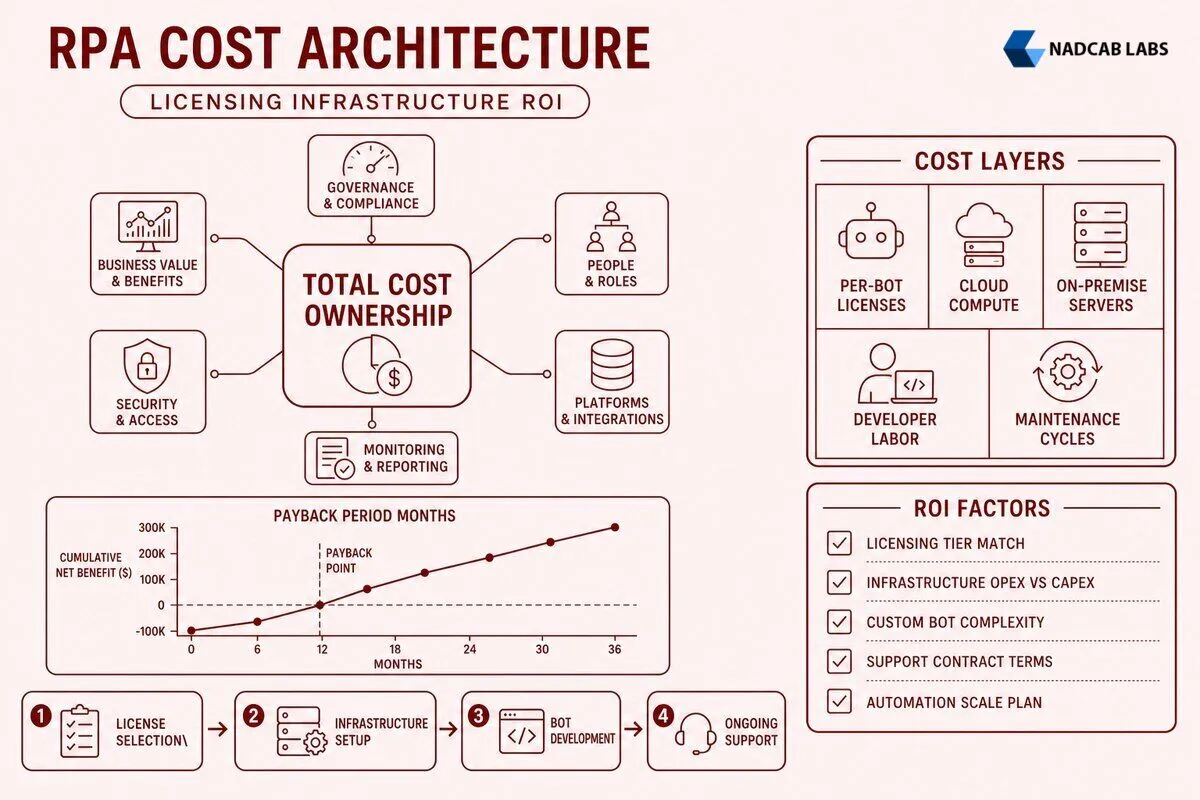
Labor cost savings calculation forms the foundation of RPA ROI analysis. Identify the FTE hours currently spent on manual tasks targeted for automation, multiply by fully loaded labor rates (salary plus benefits, typically 1.3–1.5× base salary), and project annual savings. A finance team spending 2,000 hours annually on invoice processing at a $35/hour fully loaded rate represents $70,000 in labor cost. If an RPA bot eliminates 80% of this work (1,600 hours), annual savings reach $56,000. Subtracting bot licensing ($10,000), infrastructure ($2,000), and maintenance ($8,000) yields net annual savings of $36,000—a 180% ROI in year one. Scaling this across multiple processes amplifies returns: 10 similar automations deliver $360,000 in net annual savings against a $200,000 total investment, achieving payback in 6.7 months.
Productivity gains extend beyond direct FTE reduction. Bots execute tasks 3–10× faster than humans, enabling same-day processing instead of multi-day backlogs. This acceleration improves customer experience (faster order fulfillment, quicker claim resolution), reduces working capital tied up in pending transactions, and allows staff to focus on higher-value activities like exception handling and customer engagement. Quantifying these benefits requires mapping process cycle time reductions to business outcomes: a 50% reduction in invoice processing time might enable early payment discounts worth 2% of invoice value, saving $200,000 annually on $10 million in vendor spend. Including these secondary benefits in ROI models provides a more complete financial picture and strengthens executive buy-in.
Error reduction quantification translates automation accuracy into financial impact. Manual data entry errors cost organizations through rework, compliance penalties, customer churn, and reputational damage. If a claims processing team makes errors on 2% of 50,000 annual claims, and each error costs $150 to remediate (research, correction, customer communication), total error cost reaches $150,000. RPA bots achieving 99.5% accuracy reduce error rates to 0.5%, cutting error costs to $37,500 and saving $112,500 annually. Compliance-heavy industries—healthcare, financial services, insurance—realize outsized error-reduction benefits, as automation ensures consistent application of regulatory rules and creates auditable process trails that reduce examination findings and associated fines.
RPA Cost vs. Savings Comparison (Annual, 10-Bot Deployment)
Time-to-value metrics measure how quickly automation investments generate returns. Implementation timelines vary by process complexity and organizational readiness: simple bots deploy in 4 to 8 weeks, medium-complexity automations require 10 to 16 weeks, and enterprise-scale programs with governance frameworks and multi-process orchestration span 6 to 12 months. Break-even analysis calculates the point where cumulative savings exceed total investment. A $200,000 RPA program delivering $36,000 monthly savings breaks even in 5.6 months, while a $500,000 enterprise deployment generating $60,000 monthly savings requires 8.3 months to payback. Executives typically expect payback within 12 to 18 months, making process selection critical—prioritize high-volume, rules-based, stable processes with clear ROI to build momentum and fund subsequent automation waves.
Total cost of ownership models project 3-year or 5-year cumulative expenses and benefits, accounting for scaling scenarios and hidden costs. A 3-year TCO for a 30-bot deployment might include: Year 1 ($400,000 licensing + infrastructure + development + maintenance), Year 2 ($180,000 licensing + maintenance + 10 new bots at $120,000), Year 3 ($200,000 licensing + maintenance + platform upgrade at $50,000), totaling $950,000. Cumulative savings over the same period—$500,000 (Year 1) + $750,000 (Year 2) + $900,000 (Year 3)—reach $2,150,000, yielding a 3-year net benefit of $1,200,000 and an annualized ROI of 126%. These projections should include sensitivity analysis: model best-case (savings 20% higher, costs 10% lower) and worst-case (savings 20% lower, costs 15% higher) scenarios to understand risk exposure and ensure ROI remains positive under adverse conditions.
Hidden costs that inflate TCO include technical debt remediation, platform migration expenses, and opportunity costs of failed automations. Poorly designed bots accumulate technical debt—hard-coded values, brittle selectors, missing documentation—that require costly refactoring as processes evolve. Budgeting 5–10% of annual development spend for technical debt cleanup prevents escalating maintenance burdens. Platform migration costs emerge when organizations outgrow initial RPA tools or consolidate vendors post-acquisition, requiring bot rewrites and team retraining ($50,000 to $200,000 depending on portfolio size). Opportunity costs of failed automations—processes that prove unsuitable for RPA after investment—underscore the importance of rigorous process assessment and proof-of-concept validation before full-scale development.
Benchmarking RPA ROI against industry standards provides context for investment decisions. Manufacturing and logistics firms typically achieve 200–400% ROI within 18 months by automating high-volume transactional processes like order entry, shipment tracking, and inventory reconciliation. Financial services organizations realize 150–300% ROI through compliance automation, fraud detection, and customer onboarding workflows. Healthcare providers see 100–250% ROI from claims processing, patient scheduling, and medical records management automation. These benchmarks help set realistic expectations and identify underperforming implementations requiring process redesign or tooling changes. Comparing your RPA implementation cost breakdown and ROI projections against peer organizations ensures competitive automation economics and informs strategic prioritization decisions.
For organizations seeking expert guidance on cost optimization and ROI maximization, partnering with specialized RPA Development teams accelerates value realization and reduces financial risk. Just as detailed cost breakdowns inform automation decisions, understanding broader technology investment frameworks—such as entertainment app development cost breakdown or SSI implementation cost—provides cross-domain insights into budgeting best practices. Similarly, examining infrastructure considerations like Mining Rigs or architectural patterns in smart contract architecture for real estate tokenization highlights how different technologies balance upfront investment against long-term operational efficiency.
Final Thoughts
Successful RPA implementation demands rigorous financial planning that accounts for licensing models, infrastructure choices, development labor, and ongoing maintenance across multi-year horizons. Organizations that decompose costs into granular components—per-bot licensing, cloud compute versus on-premise servers, integration middleware, governance overhead—build accurate budgets that withstand scaling and process evolution. ROI frameworks quantifying labor savings, error reduction, and productivity gains justify automation investments and guide process prioritization, while TCO models incorporating hidden costs and sensitivity analysis ensure financial resilience under adverse scenarios. By aligning licensing strategies with use-case profiles, optimizing infrastructure deployment models, and investing in sustainable development practices and governance structures, teams achieve break-even within 6 to 18 months and realize 150–400% annualized returns. Whether deploying initial proof-of-concept bots or scaling enterprise-wide automation programs, transparent cost breakdowns and evidence-based ROI calculations transform RPA from tactical efficiency play into strategic competitive advantage.
Frequently Asked Questions
Q1.What is the average cost per bot for enterprise RPA implementation?
Enterprise RPA bot costs range from $5,000 to $15,000 per bot for basic automation, while complex bots with AI integration can exceed $50,000. This includes development, testing, and deployment. Attended bots typically cost less ($3,000–$8,000) than unattended bots ($10,000–$20,000). Volume licensing and reusable components reduce per-bot expenses significantly.
Q2.How much does RPA software licensing typically cost annually?
Annual RPA licensing costs vary by vendor and deployment model. Unattended bot licenses range from $8,000 to $15,000 per bot yearly, while attended licenses cost $2,000–$5,000. Enterprise platforms like UiPath or Automation Anywhere charge $5,000–$20,000 per user annually. Cloud subscriptions often bundle infrastructure, reducing separate hosting costs.
Q3.What hidden costs should be included in an RPA budget?
Hidden RPA costs include infrastructure upgrades (servers, security), change management training ($500–$2,000 per employee), ongoing maintenance (15–20% of development costs annually), process documentation, compliance audits, and bot monitoring tools. Exception handling, system integration fees, and vendor support contracts add 25–40% to initial estimates. Factor in downtime costs during deployment.
Q4.How long does it take to achieve positive ROI from RPA implementation?
Most organizations achieve positive ROI within 6 to 12 months for straightforward automation projects. High-volume, rule-based processes deliver ROI fastest (3–6 months), while complex workflows may take 18–24 months. Factors include process complexity, labor cost savings, error reduction, and deployment scale. Typical ROI ranges from 200% to 300% over three years.
Q5.What is the difference in cost between cloud-based and on-premise RPA?
Cloud-based RPA costs $10,000–$50,000 annually with subscription pricing, minimal infrastructure investment, and faster deployment. On-premise RPA requires $50,000–$200,000 upfront for servers, licenses, and setup, plus 15–20% annual maintenance. Cloud offers scalability and lower initial costs; on-premise suits organizations with strict data sovereignty or legacy system requirements.
Q6.How do maintenance costs compare to initial RPA development expenses?
Annual RPA maintenance typically costs 15–25% of initial development expenses. For a $50,000 bot, expect $7,500–$12,500 yearly for updates, bug fixes, and process changes. Maintenance includes monitoring, exception handling, system integration updates, and compliance adjustments. Complex bots with frequent process changes require higher maintenance budgets than stable, rule-based automations.
Explore Services
Related Services
Reviewed by

Aman Vaths
Founder of Nadcab Labs
Aman Vaths is the Founder & CTO of Nadcab Labs, a global digital engineering company delivering enterprise-grade solutions across AI, Web3, Blockchain, Big Data, Cloud, Cybersecurity, and Modern Application Development. With deep technical leadership and product innovation experience, Aman has positioned Nadcab Labs as one of the most advanced engineering companies driving the next era of intelligent, secure, and scalable software systems. Under his leadership, Nadcab Labs has built 2,000+ global projects across sectors including fintech, banking, healthcare, real estate, logistics, gaming, manufacturing, and next-generation DePIN networks. Aman’s strength lies in architecting high-performance systems, end-to-end platform engineering, and designing enterprise solutions that operate at global scale.