Ai Overview
Building a production-grade Real World Asset Tokenization platform requires careful infrastructure cost planning across oracles, custody, compliance, and cross-chain bridges. Teams should budget an additional 15–25% of integration costs for ongoing maintenance, including oracle contract upgrades, data provider API changes, and node monitoring infrastructure. Integration with Cloud Cost Management strategies can reduce infrastructure expenses by 25–40% through serverless architecture and usage-based pricing models.
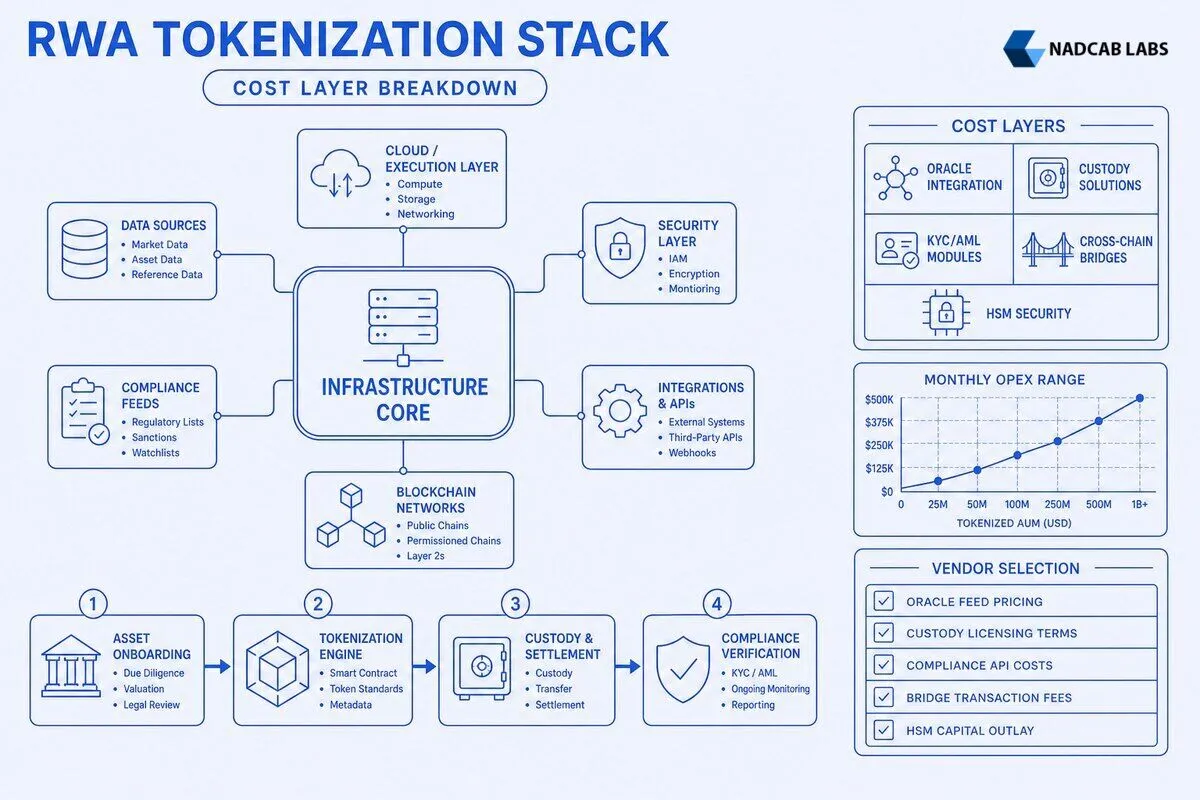
Building a production-grade Real World Asset Tokenization platform requires careful infrastructure cost planning across oracles, custody, compliance, and cross-chain bridges. Each architectural layer introduces distinct capital and operational expenses that compound over time, making vendor selection and build-versus-buy decisions critical for CFO approval and long-term project viability. This guide breaks down RWA tokenization infrastructure costs by component, providing technical teams and finance leaders with concrete numbers and decision frameworks.
Key Takeaways
- Oracle integration costs range from $500/month for basic Chainlink feeds to $15,000+ monthly for custom multi-source networks with real-time illiquid asset valuation
- Institutional custody layers add $50,000–$200,000 in annual licensing plus 10–50 basis points on assets under management, while self-custody HSM infrastructure requires $30,000–$80,000 upfront capital
- KYC/AML compliance modules cost $2–$8 per verification with embedded APIs, versus $120,000–$300,000 for custom on-chain permissioned token systems and continuous monitoring subscriptions
- Multi-chain bridge architectures introduce $40,000–$150,000 in audit and integration costs, plus ongoing relayer fees of $500–$3,000 monthly and liquidity lockup capital requirements
- Build-versus-buy TCO analysis over three years often favors managed services for oracles and compliance, but self-hosted custody and bridge infrastructure for high-volume platforms processing over $100M annually
- Hidden costs include security incident reserves (10–15% of infrastructure budget), regulatory reporting automation ($20,000–$60,000 annually), and specialized hiring premiums of 30–50% above standard blockchain developer salaries
How do oracle integration choices affect RWA tokenization budgets?
Oracle selection fundamentally shapes both upfront integration costs and recurring operational expenses for RWA tokenization smart contract architecture. Chainlink Price Feeds represent the most common starting point, with basic cryptocurrency price feeds costing approximately $500–$1,200 per month for mainnet deployments across Ethereum, Polygon, and Arbitrum. However, RWA platforms tokenizing illiquid assets like private equity, real estate, or commodities require custom oracle networks that aggregate multiple data sources, introducing licensing fees of $5,000–$15,000 monthly plus node operation costs.
Real-time asset valuation feeds for illiquid RWAs present unique cost challenges. A typical implementation for tokenized commercial real estate might integrate Zillow APIs ($0.50–$2.00 per property lookup), CoreLogic data subscriptions ($3,000–$8,000 monthly), and manual appraisal triggers costing $300–$800 per property quarterly. API integration complexity adds 120–200 development hours at $150–$250/hour, totaling $18,000–$50,000 for initial setup. Latency trade-offs matter: sub-second price updates require WebSocket connections and dedicated infrastructure ($800–$2,000 monthly server costs), while hourly batch updates reduce operational expenses by 60–70% but limit real-time trading functionality. rwa tokenization.
Decentralized oracle reputation systems introduce additional infrastructure layers. Staking requirements for oracle node operators typically demand 10,000–50,000 tokens locked per node, representing $20,000–$150,000 in capital depending on token price. Dispute resolution infrastructure costs include smart contract development for challenge mechanisms (80–120 hours at $180–$280/hour), governance token distribution systems, and arbitration processes. Annual operational costs for a five-node decentralized oracle network serving a mid-sized RWA platform range from $85,000 to $180,000, including node hosting ($400–$800/node monthly), data provider subscriptions, and staking capital opportunity cost. rwa tokenization.
Oracle Cost Comparison: Chainlink vs. Custom Network
$500–$1,200/mo
$5,000–$15,000/mo
$3,000–$8,000/mo
$85,000–$180,000/yr
Integration complexity varies significantly by oracle type. Chainlink Price Feeds require 20–40 development hours for basic integration, while custom oracle networks demand 200–400 hours including data source validation, aggregation logic, and failover mechanisms. Teams should budget an additional 15–25% of integration costs for ongoing maintenance, including oracle contract upgrades, data provider API changes, and node monitoring infrastructure. For platforms processing under $50M in tokenized assets annually, Chainlink’s managed infrastructure typically delivers better TCO than custom solutions; above $100M, custom networks justify their higher upfront costs through reduced per-transaction fees and greater control over data sources. rwa tokenization.
What are the cost implications of institutional custody layer architectures?
Custody infrastructure represents one of the largest ongoing cost centers for RWA tokenization design pattern costs, with institutional-grade solutions commanding premium pricing for security and insurance coverage. Third-party custody integration with providers like Fireblocks or Copper involves annual licensing fees of $50,000–$200,000 depending on asset volume, plus transaction-based charges of 10–50 basis points on assets under management. A platform managing $500M in tokenized real estate would incur approximately $500,000–$2,500,000 annually in custody fees alone, making vendor economics critical for unit economics.
Self-custody smart contract vaults eliminate recurring licensing fees but shift costs to upfront development and infrastructure. A production-grade multi-signature vault system requires 300–500 hours of smart contract development ($54,000–$140,000), plus 150–250 hours for frontend integration and key management tooling. Hardware security module procurement adds $8,000–$25,000 per HSM unit, with institutional deployments typically requiring 3–5 units for geographic redundancy and disaster recovery. Key ceremony costs include secure facility rental ($2,000–$5,000 per ceremony), notary services ($500–$1,500), and travel expenses for distributed signing authority holders. rwa tokenization.
| Custody Solution | Upfront Costs | Annual Operational | Transaction Fees |
|---|---|---|---|
| Fireblocks Enterprise | $15,000–$30,000 setup | $75,000–$150,000 license | 15–30 bps on AUM |
| Copper ClearLoop | $20,000–$40,000 setup | $100,000–$200,000 license | 10–25 bps on AUM |
| Self-Custody Smart Vaults | $80,000–$180,000 development + HSMs | $25,000–$60,000 maintenance | Gas fees only (~$0.50–$5/tx) |
| Hybrid (3rd-party + self-custody) | $50,000–$100,000 | $60,000–$120,000 | 8–20 bps on custodied portion |
Insurance and audit requirements dramatically affect total custody costs. Third-party custodians typically include $100M–$500M in insurance coverage within their licensing fees, while self-custody solutions require separate crime and specie insurance policies costing 0.5–2% of insured value annually. For a platform holding $200M in tokenized assets, self-custody insurance premiums range from $1,000,000 to $4,000,000 per year. Annual security audits add $40,000–$120,000 for smart contract reviews and penetration testing, with quarterly audits recommended for platforms exceeding $500M in assets under management.
Multi-signature wallet infrastructure introduces operational complexity beyond initial setup costs. A 3-of-5 multisig configuration requires secure key distribution to geographically dispersed signers, with each signing authority needing dedicated hardware wallets ($150–$300 each) and secure communication channels. Annual key rotation ceremonies cost $8,000–$15,000 including travel, facility rental, and notary services. For teams evaluating Layer 2 Architecture for real estate tokenization, custody costs on L2s like Arbitrum or Optimism run 60–80% lower than mainnet due to reduced gas fees, but require additional bridge security infrastructure discussed in the multi-chain section below.
How do KYC/AML compliance modules impact development and operational budgets?
Compliance infrastructure costs vary dramatically based on regulatory jurisdiction and token holder volume. Embedded identity verification APIs from providers like Onfido or Jumio charge $2–$8 per verification depending on check depth, with document verification costing $2–$4, biometric liveness checks adding $1–$2, and enhanced due diligence for high-net-worth individuals running $15–$40. A platform onboarding 10,000 investors annually would incur $20,000–$80,000 in verification costs alone, plus API integration development of 60–100 hours ($10,800–$25,000).
Custom KYC workflows offer greater control but require substantial upfront investment. Building an in-house identity verification system with document OCR, liveness detection, and sanctions screening requires 400–700 development hours ($72,000–$196,000), plus ongoing maintenance of 10–15% annually. However, marginal verification costs drop to $0.50–$2.00 per user after the initial 5,000 verifications, making custom solutions economically attractive for high-volume platforms. Integration with Cloud Cost Management strategies can reduce infrastructure expenses by 25–40% through serverless architecture and usage-based pricing models.
KYC/AML Compliance Implementation Process
On-chain compliance primitives using permissioned token standards like ERC-1400 or ERC-3643 introduce additional smart contract complexity. Implementing transfer restrictions, investor whitelists, and regulatory rule engines requires 120–300 development hours ($21,600–$84,000), with audit costs adding $25,000–$60,000 for security reviews. Whitelist management infrastructure needs administrative interfaces, automated compliance checks, and investor status monitoring systems, totaling 150–250 additional development hours. Annual operational costs for maintaining on-chain compliance logic include gas fees for whitelist updates ($5,000–$20,000 on Ethereum mainnet, $500–$2,000 on layer 2 solutions) and smart contract upgrades for regulatory changes.
Continuous monitoring and sanctions screening represent the largest ongoing compliance expense. Chainalysis KYT (Know Your Transaction) subscriptions start at $20,000 annually for basic monitoring and scale to $100,000+ for enterprise deployments with real-time alerting. Elliptic’s AML screening tools cost $15,000–$80,000 annually depending on transaction volume. Regulatory reporting automation adds $20,000–$60,000 in annual software costs, plus 0.5–1.0 FTE compliance analyst salary ($60,000–$120,000) for platforms processing over $100M annually. A comprehensive compliance stack for a mid-sized RWA platform totals $120,000–$300,000 in first-year costs and $80,000–$180,000 annually thereafter.
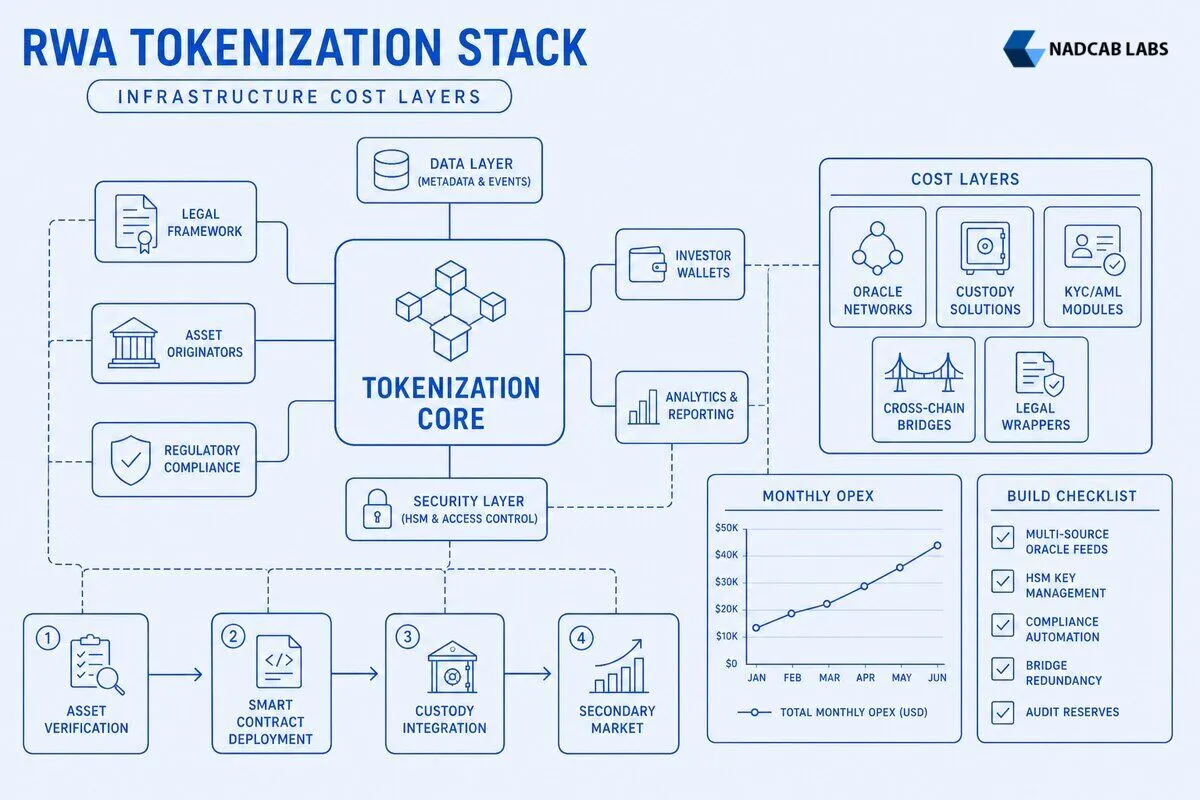
What budget factors should CFOs consider for multi-chain bridge architectures?
Cross-chain infrastructure introduces significant capital and operational costs that compound with each additional blockchain supported. LayerZero integration for omnichain token deployments requires 80–150 development hours ($14,400–$42,000) plus ongoing relayer fees of $500–$2,000 monthly depending on message volume. Axelar’s General Message Passing protocol charges similar integration costs but adds validator staking requirements of $50,000–$150,000 in AXL tokens for institutional deployments. Wormhole bridge integration costs run slightly lower at 60–120 development hours but introduce guardian network dependencies and potential centralization risks that may require additional security infrastructure.
Security audits for bridge contracts represent non-negotiable expenses given the $2B+ in bridge exploits during 2022–2023. A comprehensive audit covering bridge smart contracts, relayer infrastructure, and cross-chain message validation costs $40,000–$150,000 depending on code complexity and number of chains supported. Platforms deploying to three or more chains should budget an additional $20,000–$50,000 for formal verification of critical bridge logic. Post-deployment monitoring infrastructure adds $8,000–$20,000 annually for automated anomaly detection and circuit breaker systems.
Liquidity provisioning for wrapped asset bridges locks significant capital with opportunity costs. A bridge supporting $100M in tokenized real estate across Ethereum and Polygon requires $10M–$30M in liquidity pools to maintain 3–10% slippage tolerance. Impermanent loss on stablecoin-paired pools typically runs 0.5–2% annually, while volatile asset pairs can experience 5–15% impermanment loss during market turbulence. Liquidity mining incentives to attract third-party capital add 2–8% APY in token emissions, totaling $200,000–$2,400,000 annually for a $100M bridge. Teams should evaluate whether RWA Infrastructure requirements justify multi-chain deployment versus focusing on a single high-liquidity chain initially.
| Bridge Protocol | Integration Cost | Monthly Relayer Fees | Security Audit |
|---|---|---|---|
| LayerZero | $14,400–$42,000 | $800–$2,000 | $50,000–$120,000 |
| Axelar GMP | $16,000–$45,000 | $600–$1,800 | $55,000–$130,000 |
| Wormhole | $10,800–$33,600 | $500–$1,500 | $40,000–$100,000 |
| Custom Bridge (3 chains) | $90,000–$250,000 | $2,000–$5,000 | $80,000–$200,000 |
Bridge security infrastructure extends beyond initial audits to ongoing operational costs. Validator node operation for protocols like Axelar requires dedicated infrastructure costing $1,200–$3,500 monthly per validator, with institutional deployments running 3–5 validators for redundancy. Slashing insurance to protect against validator penalties costs 0.5–1.5% of staked capital annually. Incident response reserves should equal 10–15% of total bridge TVL to cover potential exploit scenarios, representing $10M–$15M in liquid reserves for a $100M bridge. These capital requirements make bridge economics viable only for platforms expecting sustained multi-chain volume above $50M annually.
How should teams evaluate build-vs-buy trade-offs for each infrastructure layer?
Total cost of ownership modeling over three-to-five-year horizons reveals surprising economics for different infrastructure components. Oracle infrastructure demonstrates clear TCO advantages for managed services below $50M in platform volume: Chainlink’s $500–$1,200 monthly fees total $18,000–$43,200 over three years, while custom oracle networks cost $85,000–$180,000 annually ($255,000–$540,000 over three years). However, platforms processing $100M+ annually save 40–60% with custom oracles due to eliminated per-transaction fees and greater data source flexibility.
Custody layer economics favor third-party solutions for platforms under $200M in assets under management. A $100M RWA platform using Fireblocks incurs approximately $225,000–$450,000 in three-year costs (licensing plus transaction fees), while self-custody infrastructure costs $180,000–$360,000 upfront but only $75,000–$180,000 in ongoing maintenance over three years, totaling $255,000–$540,000. The crossover point occurs around $200M AUM, where self-custody TCO becomes 25–35% lower than managed solutions. Teams should also consider Gold Tokenization Development use cases where custody costs represent 60–80% of total infrastructure spend due to physical asset backing requirements.
3-Year TCO Comparison by Platform Volume
$18,000–$43,200
$255,000–$540,000
$225,000–$450,000
$255,000–$540,000
$60,000–$240,000
$100,000–$250,000
Vendor lock-in risks introduce hidden costs that TCO models often miss. API standardization across oracle providers remains limited, with migration from Chainlink to Band Protocol or DIA requiring 60–120 development hours to refactor smart contract integrations. Custody migrations carry even higher costs: transferring $100M in tokenized assets from Fireblocks to self-custody requires 200–350 hours of smart contract redeployment, key ceremony execution, and investor communication, totaling $80,000–$150,000 in migration expenses plus 2–4 weeks of platform downtime risk. Data portability considerations matter most for compliance systems, where KYC data exports must comply with GDPR and similar regulations, potentially requiring custom ETL pipelines costing $20,000–$50,000.
In-house expertise requirements shift dramatically by infrastructure layer. Oracle engineers with Chainlink integration experience command $140,000–$220,000 annual salaries, representing 30–40% premiums over standard blockchain developers. Custody architects with HSM and key management expertise earn $160,000–$250,000 annually, while managed service premiums for third-party custody run 15–25% of the equivalent in-house salary when factoring in full-time-equivalent costs. Compliance specialists familiar with ERC-1400 and on-chain permissioning cost $120,000–$180,000 annually, but embedded API solutions reduce this to 0.3–0.5 FTE for platforms under 20,000 investors. RWA Tokenization platforms should budget 1.5–2.5 FTEs for infrastructure management when building custom solutions versus 0.5–1.0 FTE for managed service coordination.
The build-versus-buy decision framework should weigh four factors: platform volume projections, regulatory jurisdiction complexity, technical team capabilities, and capital availability. Platforms targeting under $100M in three-year volume should default to managed services for oracles and compliance, hybrid approaches for custody, and delayed multi-chain deployment. Mid-market platforms ($100M–$500M) benefit from custom oracles and self-custody with managed compliance. Enterprise platforms exceeding $500M justify full custom infrastructure across all layers, achieving 35–50% lower TCO over five years despite higher upfront capital requirements. Teams should revisit build-versus-buy decisions annually as platform volume scales and vendor pricing evolves.
Infrastructure cost modeling must account for hidden expenses that emerge during production operation. Security incident reserves should equal 10–15% of total infrastructure budget to cover potential oracle manipulation, custody breaches, or bridge exploits. Regulatory reporting automation costs $20,000–$60,000 annually for tools like Coinfirm or CipherTrace that generate jurisdiction-specific compliance reports. Specialized hiring premiums of 30–50% above standard blockchain developer salaries compound over time, with senior oracle engineers, custody architects, and compliance specialists commanding $140,000–$250,000 annual compensation. Platforms should maintain 20% budget contingency for unforeseen infrastructure scaling, security upgrades, and vendor pricing changes that typically emerge 12–18 months into production operation.
Building production-grade RWA tokenization cost breakdown infrastructure requires balancing upfront capital investment against long-term operational efficiency. Teams that carefully model TCO across oracle, custody, compliance, and bridge layers — while accounting for platform volume projections and vendor lock-in risks — achieve 30–45% lower five-year infrastructure costs compared to ad-hoc vendor selection. The optimal infrastructure stack combines managed services for commoditized layers (oracles, compliance APIs) with custom builds for differentiated components (custody, cross-chain architecture) where control and economics justify the investment. CFOs and technical leads should revisit infrastructure decisions quarterly as platform metrics evolve and vendor landscapes shift, ensuring cost optimization without compromising security or regulatory compliance. rwa tokenization.
Frequently Asked Questions
Q1.What is the typical cost range for integrating Chainlink oracles into an RWA tokenization platform?
Chainlink oracle integration for RWA platforms typically costs $15,000–$50,000 upfront for custom node setup, smart contract adapters, and data feed configuration. Ongoing operational costs range from $2,000–$8,000 monthly depending on update frequency, number of data sources, and network gas fees. High-frequency price feeds for liquid assets cost more than periodic valuation updates for illiquid real estate or private equity tokens.
Q2.How much does institutional-grade custody infrastructure add to RWA tokenization budgets?
Institutional custody solutions add $100,000–$500,000 annually for platforms managing tokenized assets. This includes HSM-based key management, multi-signature wallets, insurance coverage, and SOC 2 compliance audits. Third-party custodians like Fireblocks or Copper charge 0.1%–0.5% of assets under custody plus fixed monthly fees. Self-hosted custody reduces recurring costs but requires dedicated security personnel and infrastructure investments exceeding $200,000 initially.
Q3.What are the ongoing operational costs of KYC/AML compliance modules for tokenized assets?
KYC/AML compliance modules cost $3–$15 per verified user for identity verification services like Onfido or Jumio. Continuous transaction monitoring adds $5,000–$25,000 monthly depending on volume and jurisdictions covered. Annual compliance audits, regulatory reporting tools, and legal counsel for multi-jurisdiction operations contribute another $80,000–$300,000 yearly. Automated screening against sanctions lists and PEP databases incurs additional API costs of $0.10–$0.50 per check.
Q4.How do multi-chain bridge architectures affect the total cost of ownership for RWA platforms?
Multi-chain bridge infrastructure increases total ownership costs by 25%–40% compared to single-chain deployments. Each additional chain requires separate smart contract audits ($20,000–$50,000 per chain), liquidity provisioning, and monitoring infrastructure. Cross-chain message protocols like LayerZero or Wormhole charge per-transaction fees of $0.50–$5.00 depending on source and destination chains. Maintaining bridge security, including relayer nodes and validator sets, adds $8,000–$30,000 monthly operational overhead.
Q5.Should RWA projects build custom infrastructure or use third-party services for oracles and custody?
Third-party services offer faster deployment and regulatory compliance but cost 30%–50% more over three years. Custom infrastructure provides control and lower long-term costs but requires $500,000+ initial investment and specialized DevOps teams. For platforms under $50M AUM, third-party solutions are cost-effective. Above $200M AUM, custom infrastructure becomes economically viable. Hybrid approaches—third-party custody with custom oracle networks—balance security, compliance, and cost optimization for mid-sized platforms.
Q6.What hidden costs should CFOs anticipate when budgeting for RWA tokenization infrastructure?
Hidden costs include smart contract upgrade mechanisms ($15,000–$40,000 per major version), emergency response procedures and security incident insurance ($50,000–$200,000 annually), and regulatory change adaptation requiring legal reviews ($30,000–$100,000 yearly). Network congestion can spike gas costs 10x during volatility. Liquidity provider incentives for secondary markets add 2%–5% of TVL annually. Documentation, investor relations portals, and 24/7 technical support infrastructure contribute another $120,000–$300,000 yearly in overlooked operational expenses.
Explore Services
Related Services
Reviewed by

Aman Vaths
Founder of Nadcab Labs
Aman Vaths is the Founder & CTO of Nadcab Labs, a global digital engineering company delivering enterprise-grade solutions across AI, Web3, Blockchain, Big Data, Cloud, Cybersecurity, and Modern Application Development. With deep technical leadership and product innovation experience, Aman has positioned Nadcab Labs as one of the most advanced engineering companies driving the next era of intelligent, secure, and scalable software systems. Under his leadership, Nadcab Labs has built 2,000+ global projects across sectors including fintech, banking, healthcare, real estate, logistics, gaming, manufacturing, and next-generation DePIN networks. Aman’s strength lies in architecting high-performance systems, end-to-end platform engineering, and designing enterprise solutions that operate at global scale.