Ai Overview
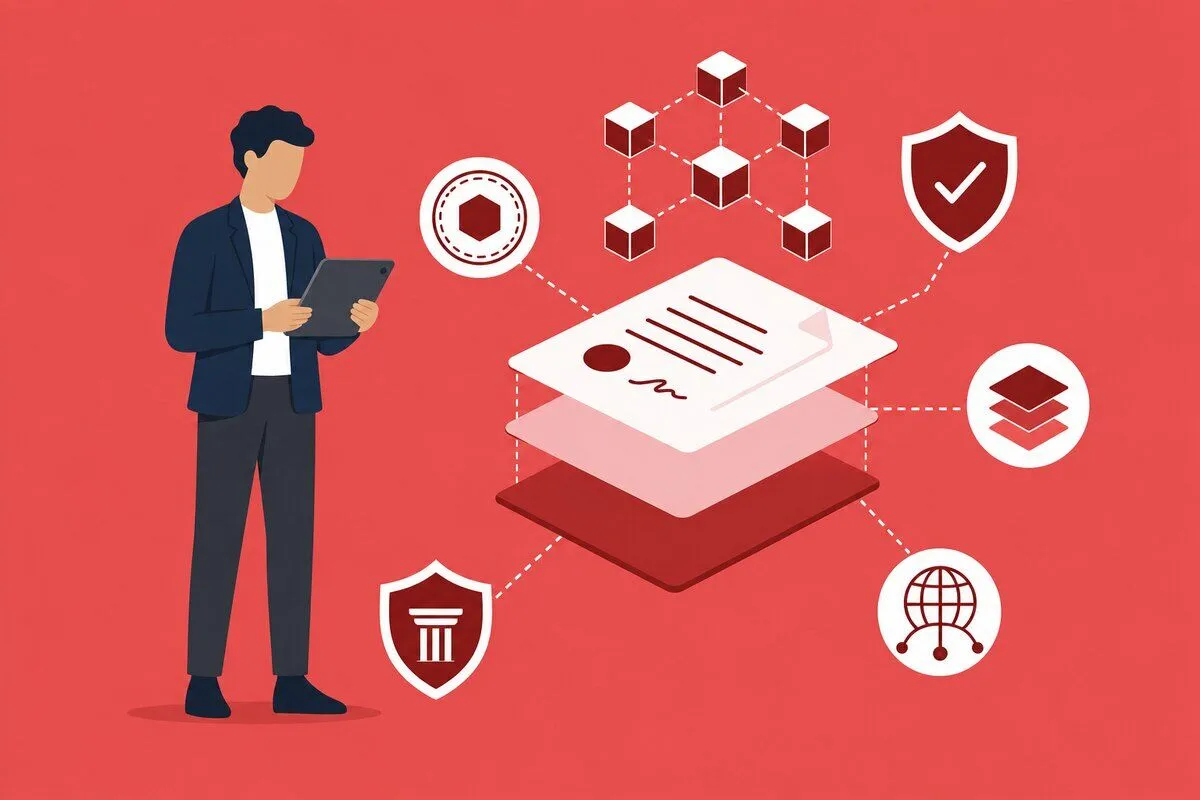
Smart contract warehouse management systems use blockchain to execute inventory rules automatically, removing manual oversight and reconciliation delays. A warehouse operator and supplier pre-agree on minimum stock levels, lead times, and pricing in a smart contract. Cost reduction flows from eliminating intermediaries and paperwork.
Smart contract warehouse management systems use blockchain to execute inventory rules automatically, removing manual oversight and reconciliation delays. In 2026, logistics operators deploy self-executing code that triggers reorders when stock falls below thresholds, validates shipment conditions, and updates ledgers in real time across every stakeholder—all without intermediaries or paper trails.
Key Takeaways
- Smart contract warehouse management systems automate inventory tracking, order fulfillment, and supplier replenishment through blockchain-based rules.
- IoT sensors feed real-time stock data to oracles, enabling automated discrepancy detection and eliminating manual audits.
- Blockchain transparency provides a single source of truth for all parties, reducing reconciliation errors and fraud risk.
- Implementation requires integrating existing ERP systems with blockchain middleware and selecting the right permissioned or public chain.
- Pilot deployments on high-value SKUs or specific zones validate ROI before full-scale warehouse rollout.
What Are Smart Contract Warehouse Management Systems in 2026?
A smart contract warehouse management system is a blockchain-enabled platform that uses self-executing code to manage inventory, order processing, and supplier coordination without manual intervention. Traditional warehouse management software relies on centralized databases and human approvals for every stock movement or reorder decision. Smart contracts flip that model by encoding business rules directly into immutable code that runs when predefined conditions are met—like automatically issuing a purchase order when inventory drops below a safety threshold or releasing payment when a shipment passes quality inspection.
Core components include on-chain inventory ledgers that record every item movement with cryptographic proof, automated reorder triggers that monitor stock levels through IoT sensor feeds, and multi-party warehouse agreements where suppliers, carriers, and warehouse operators share a single version of truth. Unlike legacy systems where data silos create reconciliation headaches, blockchain-based WMS solutions synchronize inventory counts across all stakeholders in real time. When a pallet leaves the dock, the smart contract updates the ledger, notifies the carrier, adjusts available stock, and triggers the next fulfillment step—all within seconds and without a warehouse manager clicking a button.
The key difference lies in trust architecture. Traditional WMS platforms require each party to trust the warehouse operator’s database and reconcile discrepancies later through emails and spreadsheets. Decentralized warehouse management removes that single point of control by distributing the ledger across nodes, making tampering computationally infeasible. Every participant validates transactions, and the smart contract enforces agreed rules impartially. For enterprises managing high-value goods or complex multi-vendor operations, this shift from “trust me” to “verify yourself” reduces disputes and accelerates settlement. Nadcab Labs’ Logistics Software Development practice helps operators design these systems with the right balance of transparency and privacy for their supply chain partners.
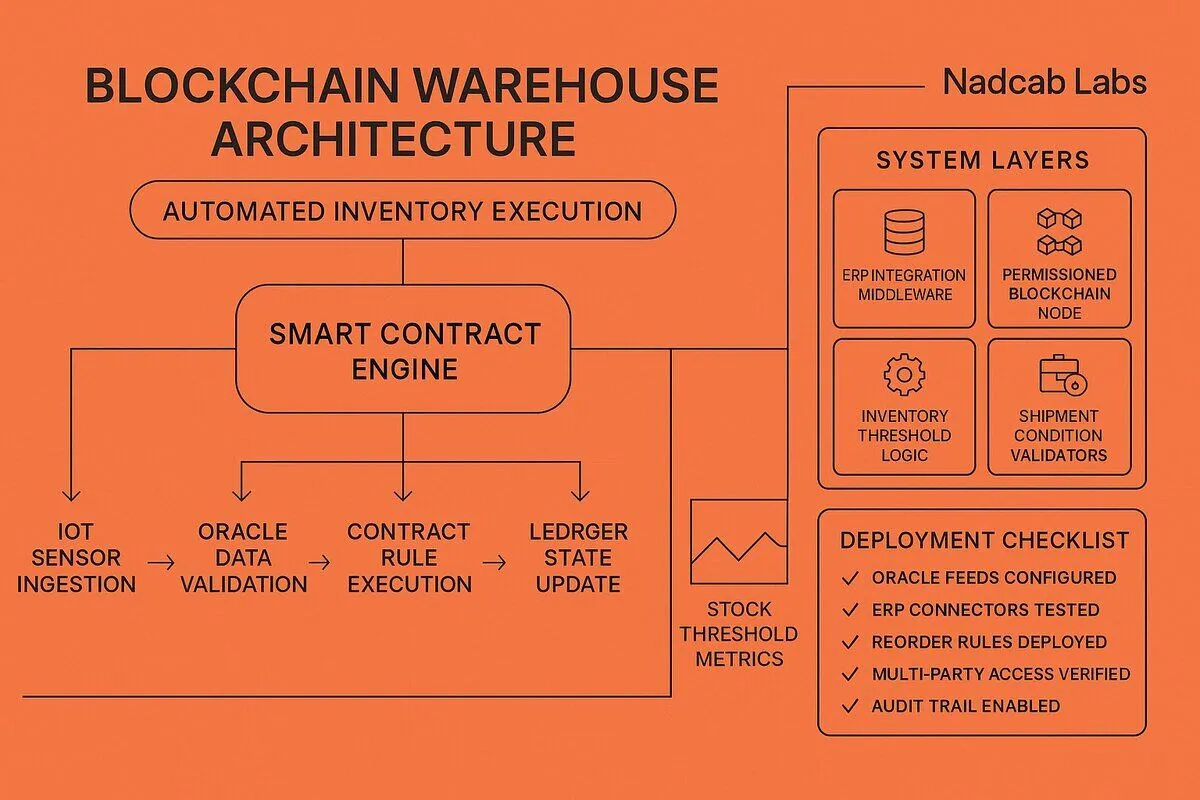
How Do Smart Contracts Automate Inventory Tracking and Reconciliation in 2026?
Real-time inventory accuracy starts with IoT sensors—RFID tags, weight scales, and barcode scanners—feeding data to blockchain oracles that write stock-level updates directly to the ledger. In a traditional warehouse, a worker scans a pallet and updates the WMS manually, creating lag and human error. Smart contracts receive sensor data continuously: when a pallet crosses a geofenced zone, the oracle triggers an on-chain transaction that timestamps the movement and adjusts available inventory. This happens every few seconds, so stakeholders see live counts rather than end-of-shift reports.
Automated discrepancy detection compares physical stock readings from sensors against the digital ledger. If a smart contract expects 500 units in Zone A but the weight sensor reports only 480, the system flags the variance immediately and can halt outbound shipments until a manual recount confirms the true figure. Because every transaction is immutable and timestamped, auditors trace the exact moment a discrepancy appeared—was it a mis-scan at receiving, a theft event, or a sensor calibration issue? Traditional systems bury these anomalies in batch updates that surface days later, long after the root cause is obscured.
Eliminating manual audits becomes feasible when the ledger itself is the audit trail. Smart contracts log every pick, pack, transfer, and shipment with cryptographic signatures from the responsible party. Instead of quarterly physical counts that freeze operations for days, warehouse managers run continuous reconciliation queries against the blockchain and only investigate flagged exceptions. The table below shows typical reconciliation frequency and error rates:
| System Type | Reconciliation Frequency | Typical Error Rate | Audit Duration |
|---|---|---|---|
| Traditional WMS | Quarterly | 2–5% | 3–5 days |
| Hybrid ERP + Blockchain | Weekly | 0.5–1% | 1 day |
| Full Smart Contract WMS | Continuous (real-time) | 0.1–0.3% | On-demand (minutes) |
For operators comparing RPA vs smart contract automation, the distinction is clear: robotic process automation mimics human clicks in existing software, while smart contracts rewrite the rules at the protocol level, making reconciliation a byproduct of every transaction rather than a separate cleanup task.
Which Warehouse Operations Benefit Most from Smart Contract Automation in 2026?
Order fulfillment workflows see the biggest efficiency gains. A smart contract can automatically generate picking lists when a customer order is confirmed, route the picker to the optimal bin locations, verify each scan against the order manifest, trigger packing instructions based on item dimensions, and release the shipping label only after all items pass weight validation. Each step is a contract condition—if the weight doesn’t match the expected total, the shipment is held and an exception alert fires. No supervisor approval loops or paper pick tickets; the blockchain enforces the sequence and logs every action with a timestamp and worker ID.
Supplier coordination becomes frictionless through self-executing replenishment contracts. A warehouse operator and supplier pre-agree on minimum stock levels, lead times, and pricing in a smart contract. When inventory for SKU X falls below 100 units, the contract automatically issues a purchase order to the supplier, reserves warehouse space, and schedules an inbound dock slot. The supplier confirms shipment by updating the contract with a carrier tracking number, and payment releases automatically when the goods arrive and pass quality inspection. This eliminates the email chains, phone calls, and manual PO approvals that traditionally add days to replenishment cycles. Operators managing multi-vendor inventories can deploy separate contracts for each supplier, all synchronized on the same blockchain ledger.
Quality assurance and compliance checkpoints are embedded as contract milestones. For regulated goods—pharmaceuticals, food, electronics—a smart contract can require temperature logs from IoT sensors during storage, certificate-of-analysis uploads before release, and inspector digital signatures at each gate. If a pallet sits outside the temperature range for more than 10 minutes, the contract marks it non-compliant and blocks outbound shipment. Regulatory reporting becomes automatic: the contract compiles all required data points and submits them to the authority’s API at month-end. This process flow illustrates a typical quality-gate sequence:
Scan & Log
IoT Sensor
Digital Cert
Release to Stock
Each box represents a contract condition that must be satisfied before the next step executes. If any condition fails, the flow halts and an exception is logged. For enterprises concerned about Smart Contract Vulnerabilities, rigorous testing and formal verification of these logic paths are essential before production deployment.
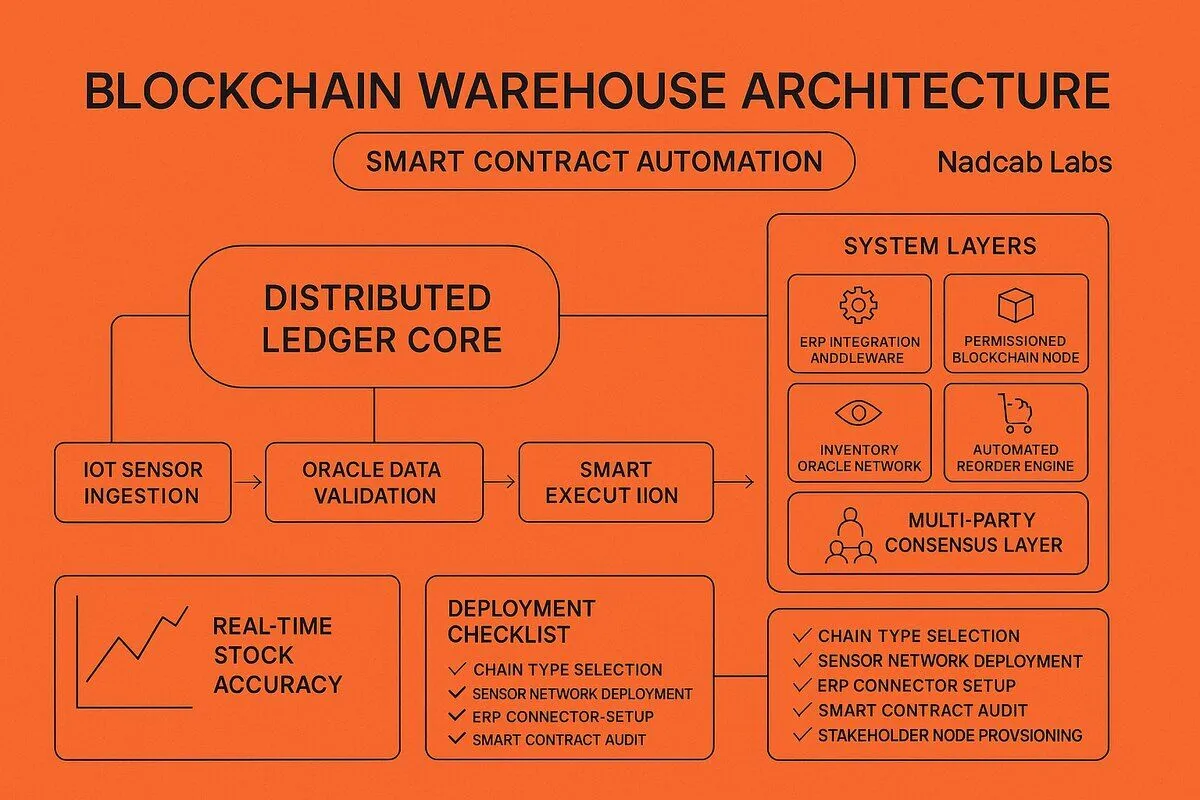
What Are the Key Advantages of Blockchain-Based Warehouse Management in 2026?
Enhanced transparency gives every authorized party—warehouse staff, suppliers, carriers, customers, auditors—access to the same real-time ledger. There’s no “my system says X, yours says Y” debate because everyone queries the same blockchain state. A supplier can see exactly when their shipment was received, inspected, and stocked without calling the warehouse. A customer can verify that their order was picked and packed within the promised SLA by checking the immutable timestamps. This single source of truth eliminates the reconciliation meetings and dispute resolution that consume hours of administrative time in traditional multi-party logistics.
Cost reduction flows from eliminating intermediaries and paperwork. Traditional warehouse operations involve clerks entering data into multiple systems, accountants reconciling invoices against packing slips, and compliance officers chasing down missing documentation. Smart contracts collapse these roles into automated workflows. When a shipment arrives, the contract updates inventory, triggers payment to the supplier, notifies the customer, and logs the transaction for tax reporting—all in one atomic operation. Labor costs drop because fewer people are needed to shepherd data between systems. Error costs drop because the contract enforces rules consistently, catching mistakes that humans miss when tired or rushed.
Improved security comes from tamper-proof records and cryptographic verification. Once a transaction is written to the blockchain, altering it requires controlling a majority of network nodes—computationally infeasible in a properly designed system. This makes fraud much harder: a dishonest warehouse worker can’t backdate a stock movement to cover a theft, and a supplier can’t claim they delivered 1,000 units when the contract logged only 900. Multi-party warehouse agreements benefit especially from this property. When multiple companies share a facility, each wants assurance that their inventory counts are accurate and that no one is cooking the books. The blockchain provides that assurance without requiring trust in a single operator. The bar chart below shows security incident rates across different WMS architectures:
These figures reflect reported fraud, data tampering, and unauthorized access events in enterprise logistics environments. The reduction stems from immutability, cryptographic signatures, and distributed consensus that make unauthorized changes detectable immediately. For operators evaluating the Smart Contract Automation business case, security savings often justify the initial blockchain investment within 18–24 months.
How Can Logistics Companies Implement Smart Contract Warehouse Systems in 2026?
Integration roadmap begins with connecting existing ERP and WMS platforms to blockchain middleware. Most warehouses already run software from SAP, Oracle, Manhattan Associates, or similar vendors. Ripping out these systems is neither practical nor necessary. Instead, deploy an oracle layer—software that reads data from your WMS database and writes it to the blockchain, and vice versa. The oracle acts as a translator: when your WMS records a stock movement, the oracle creates a corresponding blockchain transaction; when a smart contract triggers a reorder, the oracle pushes that event back into your ERP’s procurement module. This hybrid approach lets you keep familiar user interfaces while gaining blockchain benefits in the background.
Choosing the right blockchain depends on data privacy and scalability requirements. Public chains like Ethereum offer maximum decentralization but expose all transaction details to the world—acceptable for commodity goods but problematic for proprietary SKUs or pricing. Permissioned chains like Hyperledger Fabric or Corda let you control who sees what: suppliers see only their own inventory, while auditors get read-only access to everything. Throughput matters too. A busy warehouse processes thousands of transactions per hour; if your blockchain can only handle 15 transactions per second, you’ll create a bottleneck. In 2026, layer-2 scaling solutions and optimistic rollups push throughput into the thousands of TPS range, making real-time warehouse operations feasible. Nadcab Labs’ team of experts available to Hire Smart contract developer can architect the right chain configuration for your volume and privacy needs.
Pilot deployment strategies reduce risk by starting small. Identify a single product category—high-value electronics, perishable goods with strict compliance, or fast-moving SKUs with frequent stockouts—and implement smart contract automation for just that segment. Run the pilot in parallel with your existing system for 60–90 days, comparing accuracy, cycle times, and error rates. If the pilot succeeds, expand to additional SKUs or warehouse zones incrementally. This phased approach also gives your team time to learn blockchain concepts and adjust workflows. Common pilot metrics include:
- Inventory accuracy improvement: measure cycle count variance before and after smart contract deployment.
- Order fulfillment speed: track time from order placement to shipment release.
- Reconciliation effort: count hours spent resolving discrepancies per month.
- Audit readiness: time required to produce compliance reports on demand.
Before full rollout, conduct a thorough Smart Contract Audit to identify logic errors, security vulnerabilities, and edge cases that could halt operations. Auditors simulate thousands of scenarios—what happens if a sensor fails mid-transaction, if two parties submit conflicting data, or if gas fees spike during peak usage? Catching these issues in testing prevents costly downtime once the system is live. For logistics firms new to blockchain, partnering with experienced developers who understand both supply chain workflows and smart contract security is essential. Nadcab Labs offers end-to-end support from design through deployment, ensuring your warehouse automation delivers measurable ROI without operational disruption.
Final Thoughts
Smart contract warehouse management systems in 2026 transform logistics operations by automating inventory tracking, order fulfillment, and supplier coordination through blockchain-enforced rules. Real-time data from IoT sensors feeds immutable ledgers that eliminate manual audits and reconciliation delays, while multi-party transparency reduces disputes and fraud. Implementation requires careful integration with existing ERP platforms, selection of the appropriate blockchain architecture, and phased pilots that validate ROI before full-scale deployment. For logistics companies ready to move beyond legacy systems, blockchain-based warehouse management offers measurable gains in accuracy, speed, and cost efficiency—turning the warehouse from a cost center into a competitive advantage.
Frequently Asked Questions
Q1.What is a smart warehouse management system in 2026?
A smart warehouse management system in 2026 combines blockchain smart contracts with IoT sensors and automation to manage inventory, orders, and logistics autonomously. Smart contracts execute predefined rules for receiving, storing, picking, and shipping goods without manual intervention, ensuring transparency, real-time tracking, and tamper-proof records across the supply chain for enhanced efficiency and accuracy.
Q2.How do smart contracts improve inventory accuracy in warehouses in 2026?
Smart contracts improve inventory accuracy in 2026 by automatically recording every transaction on an immutable blockchain ledger when goods move. IoT sensors trigger contract execution for real-time updates, eliminating manual data entry errors. This creates a single source of truth, reduces discrepancies, prevents stock-outs or overstocking, and enables instant auditing with verifiable, tamper-proof inventory records.
Q3.What are the four types of warehouse management systems enhanced by blockchain in 2026?
The four types enhanced by blockchain in 2026 are: standalone WMS with smart contract modules for basic automation; cloud-based WMS integrating distributed ledgers for multi-party visibility; ERP-integrated systems using smart contracts for end-to-end supply chain coordination; and supply chain execution platforms leveraging blockchain for real-time tracking, compliance, and automated settlements across warehouses and partners.
Q4.Can smart contracts replace traditional warehouse software in 2026?
Smart contracts in 2026 complement rather than fully replace traditional warehouse software. They automate transactional workflows, enforce compliance, and provide transparency, but legacy WMS still handles complex user interfaces, analytics, and operational nuances. Hybrid models integrating smart contracts with existing systems deliver optimal results, combining blockchain’s trust and automation with proven warehouse management functionality and flexibility.
Q5.What blockchain platforms support warehouse management smart contracts in 2026?
Leading platforms supporting warehouse management smart contracts in 2026 include Ethereum for robust decentralized applications, Hyperledger Fabric for permissioned enterprise networks, Polygon for scalable low-cost transactions, Binance Smart Chain for fast processing, and VeChain specialized in supply chain use cases. Each offers different trade-offs in speed, cost, privacy, and ecosystem maturity for warehouse automation needs.
Q6.How do IoT sensors integrate with smart contract warehouse systems in 2026?
IoT sensors in 2026 integrate via oracles that feed real-world data—temperature, location, weight, movement—directly into smart contracts on the blockchain. When sensors detect events like goods arrival or environmental changes, they trigger contract execution automatically. This enables real-time inventory updates, condition monitoring, automated alerts, and seamless coordination between physical warehouse operations and digital blockchain records.
Explore Services
Related Services
Reviewed by

Aman Vaths
Founder of Nadcab Labs
Aman Vaths is the Founder & CTO of Nadcab Labs, a global digital engineering company delivering enterprise-grade solutions across AI, Web3, Blockchain, Big Data, Cloud, Cybersecurity, and Modern Application Development. With deep technical leadership and product innovation experience, Aman has positioned Nadcab Labs as one of the most advanced engineering companies driving the next era of intelligent, secure, and scalable software systems. Under his leadership, Nadcab Labs has built 2,000+ global projects across sectors including fintech, banking, healthcare, real estate, logistics, gaming, manufacturing, and next-generation DePIN networks. Aman’s strength lies in architecting high-performance systems, end-to-end platform engineering, and designing enterprise solutions that operate at global scale.