Ai Overview
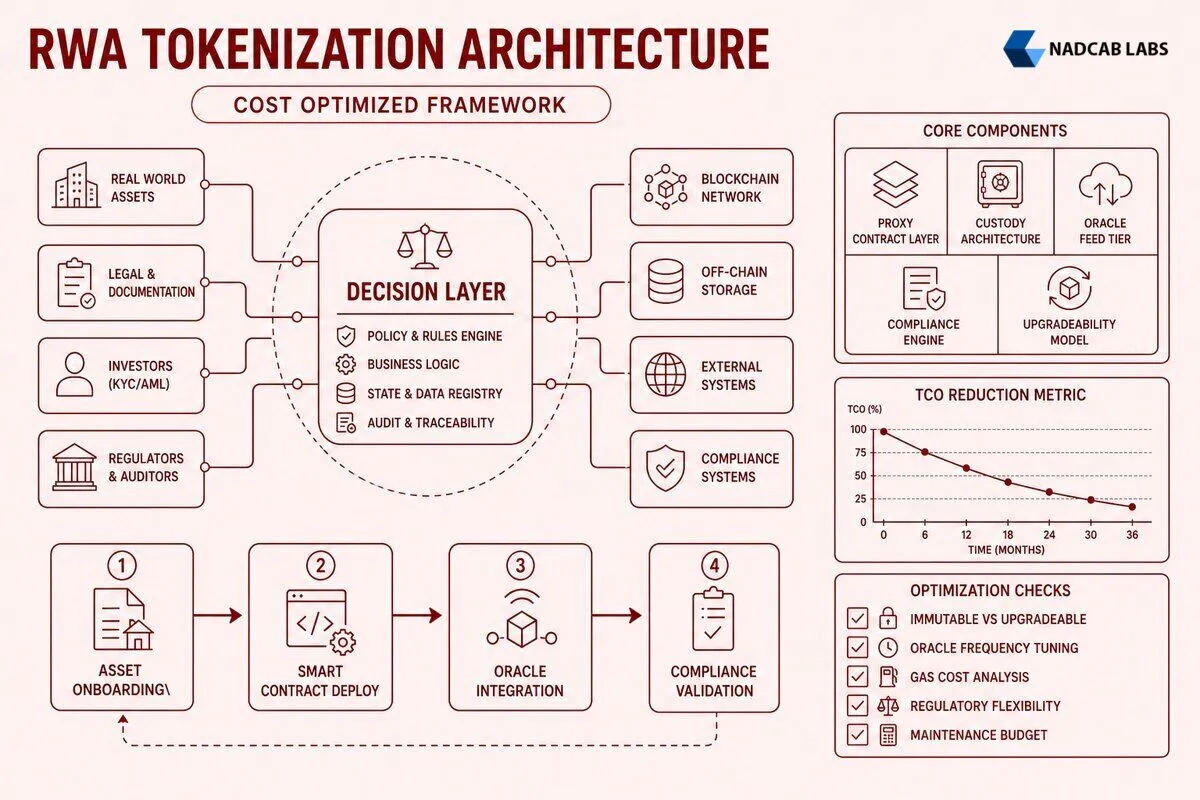
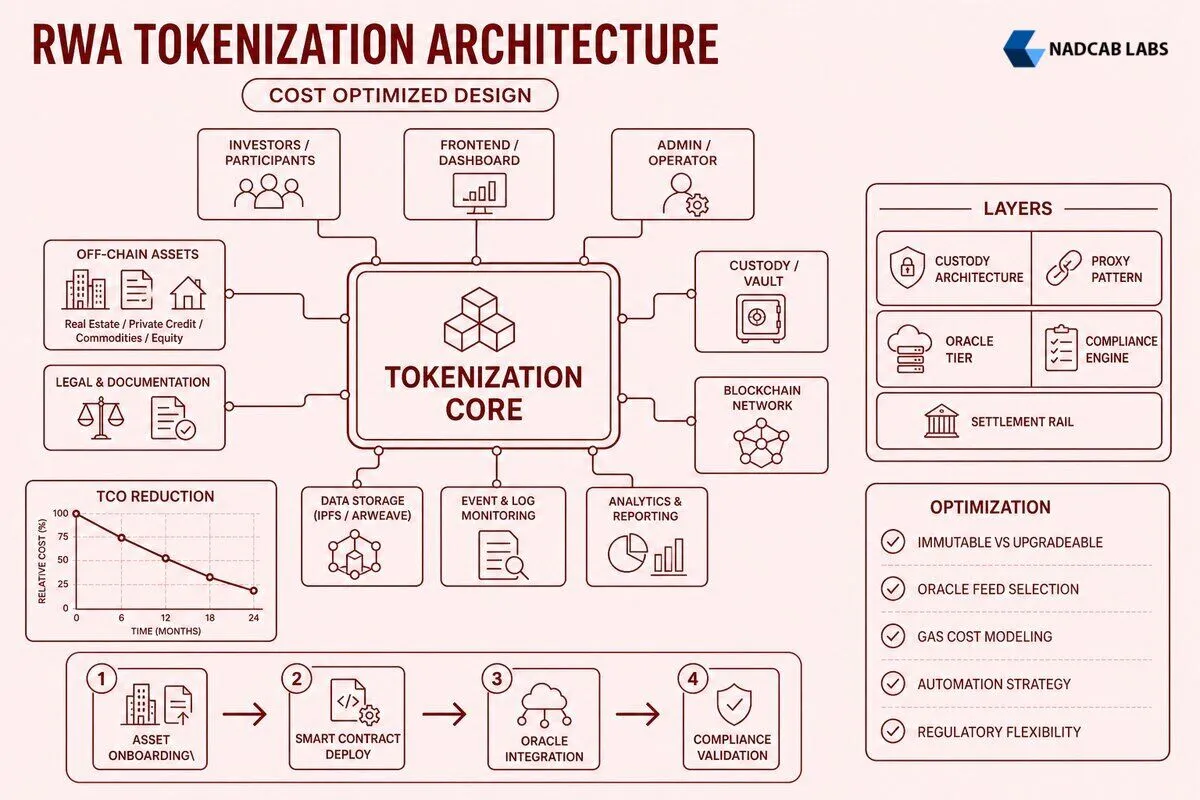
Cost-optimized RWA tokenization design patterns provide a decision framework for balancing upfront development expenses against long-term operational costs, enabling teams to select contract upgradeability models, oracle tiers, custody architectures, and compliance automation strategies that minimize total cost of ownership while maintaining security and regulatory compliance.
Cost-optimized RWA tokenization design patterns provide a decision framework for balancing upfront development expenses against long-term operational costs, enabling teams to select contract upgradeability models, oracle tiers, custody architectures, and compliance automation strategies that minimize total cost of ownership while maintaining security and regulatory compliance. This framework helps technical leads and project managers make evidence-based architecture choices that align budget constraints with business objectives across pilot and institutional-scale deployments.
Key Takeaways
- Immutable contracts save 40–60% on long-term maintenance but require stable regulatory environments; upgradeable proxies cost more initially yet adapt faster to compliance changes
- Oracle provider selection impacts TCO by 15–30% depending on asset volatility and update frequency requirements; premium feeds suit high-value assets while aggregated sources serve diversified portfolios
- Custody model choice drives hidden costs including insurance premiums (0.5–2% AUM annually), operational security overhead, and disaster recovery infrastructure that scale non-linearly with asset volume
- Compliance automation delivers 3–5× ROI within 18 months by reducing manual review hours, accelerating issuance cycles, and lowering legal consultation fees across multi-jurisdictional deployments
- Modular architecture amortizes development costs across asset classes, cutting per-project expenses by 35–50% through reusable token standards, access control modules, and compliance layers
- Total cost of ownership optimization requires evaluating development, auditing, gas fees, governance overhead, and extensibility costs holistically rather than optimizing individual components in isolation
How Do Upgradeable vs. Immutable Contract Patterns Affect Long-Term Costs?
The choice between upgradeable and immutable smart contract architectures fundamentally shapes the cost trajectory of Real World Asset Tokenization projects over multi-year horizons. Upgradeable contracts using proxy patterns (UUPS, Transparent Proxy, or Beacon Proxy) introduce higher initial deployment costs but enable adaptation to evolving regulatory requirements without redeploying token contracts or migrating user balances. Immutable contracts eliminate upgrade infrastructure overhead yet lock teams into fixed logic that may require costly workarounds when compliance rules change. cost-optimized rwa.
Initial deployment costs for upgradeable systems typically run 30–50% higher than immutable equivalents due to proxy contract complexity, additional security audits for upgrade mechanisms, and governance framework implementation. A UUPS proxy deployment on Ethereum mainnet costs approximately $8,000–$12,000 in gas fees at 30 gwei, compared to $5,000–$7,000 for a comparable immutable ERC-20 contract. Security audits for upgradeable systems add $15,000–$25,000 per review cycle because auditors must verify both implementation logic and proxy upgrade paths, whereas immutable contracts require single-pass audits costing $10,000–$18,000. cost-optimized rwa.
Maintenance cost trajectories diverge sharply after deployment. Upgradeable contracts incur recurring expenses for governance votes (gas fees for multisig or DAO approvals), re-auditing upgraded implementations, and testing upgrade transactions on testnets before mainnet execution. Annual maintenance for an active upgradeable RWA platform averages $40,000–$70,000 including two minor upgrades and one major feature addition. Immutable contracts avoid these costs entirely but may require deploying parallel contract versions when regulations mandate new transfer restrictions or reporting requirements, forcing asset migration that can cost $100,000+ for large token holder bases. cost-optimized rwa.
The break-even timeline depends on regulatory stability and asset class maturity. For tokenized commodities operating under established frameworks like gold or oil, immutable contracts become more cost-effective after 18–24 months when avoided upgrade costs exceed the initial savings. Conversely, tokenized securities subject to evolving regulations (such as real estate in jurisdictions updating digital asset laws) favor upgradeable patterns that recoup higher upfront costs within 12–15 months by avoiding expensive migration procedures. Teams should model their specific regulatory risk profile and expected compliance change frequency to determine the optimal pattern, as detailed in our RWA tokenization smart contract architecture guide. cost-optimized rwa.
| Contract Pattern | Initial Deployment Cost | Annual Maintenance Cost | Break-Even Timeline | Best Use Case |
|---|---|---|---|---|
| UUPS Proxy | $23,000–$37,000 | $40,000–$70,000 | 12–15 months | Securities in evolving regulatory environments |
| Transparent Proxy | $25,000–$40,000 | $45,000–$75,000 | 14–18 months | Multi-asset platforms requiring frequent updates |
| Beacon Proxy | $28,000–$42,000 | $35,000–$60,000 | 16–20 months | Multiple token instances sharing upgrade logic |
| Immutable Contract | $15,000–$25,000 | $5,000–$12,000 | 18–24 months | Commodities with stable regulatory frameworks |
Gas optimization strategies differ between patterns. Immutable contracts allow aggressive inline optimization since code never changes, reducing per-transaction costs by 8–15% compared to upgradeable equivalents that must maintain storage layout compatibility across versions. For high-frequency trading platforms processing 10,000+ daily transactions, this efficiency gap translates to $15,000–$30,000 annual savings. However, upgradeable contracts enable post-deployment gas optimization through implementation upgrades, potentially recovering initial efficiency disadvantages as Ethereum’s execution environment evolves with protocol upgrades. cost-optimized rwa.
Governance overhead represents a hidden cost multiplier for upgradeable systems. Multisig-based upgrade authorization requires coordinating 3–7 signers for each deployment, consuming 20–40 person-hours per upgrade cycle when including proposal drafting, review periods, and execution verification. DAO-based governance adds token holder voting periods (typically 3–7 days) and quorum requirements that delay urgent security patches. These coordination costs compound for platforms managing multiple tokenized asset classes, making immutable contracts attractive for single-asset pilots where governance complexity outweighs upgrade flexibility benefits. cost-optimized rwa.
Which Oracle Provider Pricing Tiers Deliver the Best ROI for Asset Verification?
Oracle provider selection significantly impacts the total cost of ownership for RWA tokenization platforms because price feed costs scale with data freshness requirements, asset volatility, and compliance verification frequency. Premium oracle services like Chainlink’s dedicated feeds deliver sub-second latency and cryptographic proof of data integrity but cost $500–$2,000 monthly per feed, while aggregated data sources like Pyth Network charge per-query fees starting at $0.0001–$0.001 per call. The optimal tier depends on whether your tokenized assets require real-time pricing for trading applications or periodic valuations for compliance reporting. cost-optimized rwa.
Chainlink’s pricing model offers three tiers: shared feeds ($0 for widely-used pairs like ETH/USD but limited customization), premium feeds ($500–$2,000/month for dedicated nodes and custom update parameters), and enterprise solutions ($5,000–$15,000/month including SLA guarantees and dedicated support). Premium feeds suit high-value assets like tokenized real estate portfolios exceeding $50M where 1% price accuracy improvements justify monthly costs, while shared feeds serve diversified commodity baskets where aggregated market data suffices. Enterprise tiers make economic sense only for institutional platforms managing $500M+ AUM where downtime costs exceed oracle subscription fees. cost-optimized rwa.
API3’s first-party oracle model eliminates intermediary nodes, reducing costs by 30–50% compared to Chainlink’s premium tier while maintaining data quality through direct API provider signatures. Monthly subscriptions start at $300 for standard asset classes (equities, commodities) with 5-minute update intervals, scaling to $1,200 for custom data sources requiring sub-minute freshness. API3’s dAPI (decentralized API) architecture works well for tokenized securities where issuers control authoritative pricing data and can operate first-party oracle nodes, cutting third-party verification costs while maintaining regulatory compliance through auditable on-chain data provenance. cost-optimized rwa.
Pyth Network’s pay-per-query model offers cost advantages for applications with sporadic pricing needs, such as quarterly rebalancing of tokenized index funds or semi-annual real estate appraisals. At $0.0001–$0.001 per price update depending on network congestion, a platform executing 10,000 monthly valuations pays $1–$10 versus $500–$2,000 for subscription-based alternatives. However, per-query pricing becomes expensive for high-frequency applications: a trading platform processing 100,000 daily price checks would spend $3,000–$30,000 monthly on Pyth versus fixed subscription costs for Chainlink or API3. cost-optimized rwa.
Oracle Cost Comparison by Update Frequency
Custom oracle solutions built on infrastructure like Chainlink’s External Adapter framework or API3’s Airnode offer the lowest ongoing costs ($200–$500 monthly for hosting and maintenance) but require upfront development investment of $25,000–$50,000 and ongoing security monitoring. This approach makes sense for platforms tokenizing proprietary assets (private equity, art collections) where no public price feeds exist and issuers maintain authoritative valuation data. Development costs amortize over 18–24 months, after which custom oracles deliver 60–80% cost savings compared to premium third-party feeds while maintaining full control over data sources and update logic. cost-optimized rwa.
Data freshness requirements drive cost-performance trade-offs. Assets with high intraday volatility (tokenized commodities, liquid securities) require sub-minute updates to prevent arbitrage opportunities and maintain accurate collateralization ratios, justifying premium oracle tiers. Conversely, illiquid assets like real estate or private debt benefit from daily or weekly updates, where lower-tier services or custom solutions suffice. A decision matrix should map asset volatility (measured as daily price standard deviation) against update frequency needs: assets with >2% daily volatility requiring sub-5-minute updates warrant premium feeds, while <0.5% daily volatility assets can use aggregated sources or custom solutions. cost-optimized rwa.
Compliance verification adds another cost dimension. Regulatory frameworks often mandate independent third-party price verification for investor protection, particularly for securities offerings. Chainlink’s Proof of Reserve feeds and API3’s signed data provide auditable on-chain verification that satisfies regulatory requirements in most jurisdictions, while custom oracles may require additional legal opinions costing $5,000–$15,000 to demonstrate compliance equivalence. This hidden compliance cost can shift the total cost of ownership calculation in favor of established oracle providers despite higher subscription fees, especially for cross-border deployments navigating multiple regulatory regimes as discussed in our cross-border RWA tokenization legal framework analysis. cost-optimized rwa.
What Are the Hidden Cost Implications of Different Custody Models?
Custody model selection creates cascading cost implications that extend far beyond direct custodian fees, encompassing liability insurance premiums, operational security infrastructure, disaster recovery systems, and regulatory compliance overhead that scale non-linearly with assets under management. Self-custody solutions minimize third-party fees but internalize security costs through hardware security modules (HSMs), secure key management protocols, and 24/7 monitoring systems. Third-party custodians charge 0.5–2% of AUM annually but transfer liability risk and compliance burden to specialized providers. Hybrid models attempt to balance control and cost but introduce integration complexity that adds 15–25% to total custody expenses. cost-optimized rwa.
Self-custody infrastructure for institutional-grade RWA tokenization requires HSM devices ($3,000–$8,000 per unit), secure facility access controls ($10,000–$25,000 for biometric systems and surveillance), and redundant key storage across geographically distributed locations ($5,000–$15,000 annually per backup site). A complete self-custody setup for managing $10M in tokenized assets costs $50,000–$100,000 in initial capital expenditure plus $30,000–$60,000 annual operational expenses for security personnel, system maintenance, and facility costs. These fixed costs create unfavorable economics for pilots and small deployments but scale efficiently beyond $50M AUM where per-dollar custody costs drop below third-party custodian fees. cost-optimized rwa.
Liability insurance represents the largest hidden cost multiplier across custody models. Self-custody operations require cyber liability insurance ($15,000–$50,000 annually for $10M coverage) plus fidelity bonds covering employee theft and operational errors ($8,000–$25,000 annually). Third-party custodians typically include insurance in their fee structure but may cap coverage at 1–2× AUM, requiring supplemental policies for high-value deployments. Insurance premiums scale non-linearly: coverage for $100M AUM costs 2.5–3× more than 10× the premium for $10M coverage due to increased underwriting risk and reduced insurer competition at institutional scales. cost-optimized rwa.
Disaster recovery infrastructure adds another cost layer often overlooked in initial custody model evaluations. Self-custody requires maintaining hot/warm/cold wallet hierarchies with automated failover systems ($20,000–$40,000 development cost) and regular recovery drills ($5,000–$10,000 quarterly). Third-party custodians provide disaster recovery as part of their service but may charge premium fees (additional 0.1–0.3% AUM) for guaranteed recovery time objectives under 24 hours. Hybrid models face the worst of both worlds: they must maintain internal disaster recovery capabilities while also paying custodian fees, effectively doubling recovery infrastructure costs without proportional risk reduction. cost-optimized rwa.
| Custody Model | Setup Cost | Annual Cost ($10M AUM) | Annual Cost ($100M AUM) | Break-Even AUM |
|---|---|---|---|---|
| Self-Custody | $50,000–$100,000 | $80,000–$140,000 | $200,000–$350,000 | $50M+ |
| Third-Party (Premium) | $5,000–$15,000 | $150,000–$200,000 | $1,500,000–$2,000,000 | $1M–$50M |
| Third-Party (Standard) | $5,000–$15,000 | $50,000–$100,000 | $500,000–$1,000,000 | $1M–$100M |
| Hybrid Model | $30,000–$60,000 | $100,000–$180,000 | $800,000–$1,400,000 | Rarely optimal |
Regulatory compliance costs vary dramatically by custody model and jurisdiction. Self-custody operations in the United States must register as qualified custodians under SEC rules if managing securities tokens, requiring legal compliance programs costing $100,000–$250,000 annually for regulatory filings, audits, and legal counsel. Third-party custodians absorb these compliance costs but pass them through in fee structures. European Union deployments face additional complexity under MiCA (Markets in Crypto-Assets) regulations requiring custody providers to maintain minimum capital reserves proportional to AUM, effectively capping the economic viability of self-custody below $200M AUM due to capital opportunity costs. cost-optimized rwa.
Operational security overhead scales with custody model complexity. Self-custody requires dedicated security personnel (minimum 2 FTEs at $120,000–$180,000 annual salary each) plus ongoing penetration testing ($15,000–$30,000 quarterly) and security audits ($25,000–$50,000 annually). Third-party custodians employ security specialists as part of their service but may lack asset-specific expertise for specialized RWA classes like tokenized intellectual property or carbon credits, requiring supplemental internal security reviews. Hybrid models duplicate security overhead across both internal and external teams, often increasing total security costs by 40–60% compared to pure self-custody or third-party approaches. cost-optimized rwa.
Cost scaling curves reveal inflection points where custody model economics shift. Below $5M AUM, third-party standard-tier custody offers the lowest total cost of ownership at $25,000–$50,000 annually. Between $5M and $50M AUM, premium third-party custody balances cost and service quality at $150,000–$500,000 annually. Above $50M AUM, self-custody becomes cost-competitive as fixed infrastructure costs amortize across larger asset bases, with total costs stabilizing at 0.4–0.7% of AUM compared to 1.5–2% for third-party solutions. These thresholds shift based on asset class: liquid securities with high transaction volumes favor self-custody at lower AUM thresholds ($25M+) while illiquid real estate tokens justify third-party custody up to $100M AUM due to lower operational complexity.
How Does Compliance Automation ROI Vary Across Regulatory Frameworks?
Compliance automation delivers measurably different returns on investment depending on regulatory complexity, jurisdiction-specific requirements, and transaction volume patterns that determine the baseline cost of manual compliance processes. Automated KYC/AML verification systems reduce per-investor onboarding costs by 60–80% while accelerating approval timelines from 3–7 days to 15–60 minutes, but upfront integration costs of $30,000–$80,000 require processing 500+ investors annually to achieve positive ROI within 18 months. Accredited investor verification automation saves $50–$150 per check versus manual legal review, justifying implementation costs after 200–400 verifications. Transfer restriction enforcement through smart contract logic eliminates ongoing legal review hours but requires careful initial rule encoding that costs $15,000–$40,000 per jurisdiction.
KYC/AML automation through providers like Chainalysis KYT (Know Your Transaction), Elliptic Navigator, or Coinfirm AML Platform costs $1,000–$5,000 monthly for basic transaction monitoring plus $5–$15 per detailed investor screening. A tokenized real estate platform onboarding 1,000 investors annually spends $5,000–$15,000 on automated screening versus $50,000–$100,000 for manual review by compliance officers (assuming $50–$100 per manual review including legal time). The automated approach pays for itself within 6–9 months while providing real-time risk scoring that manual processes cannot match. However, platforms with fewer than 200 annual investors face negative ROI on compliance-as-a-service subscriptions and should consider manual processes or hybrid approaches using free-tier screening tools.
Accredited investor verification automation through services like VerifyInvestor, Parallel Markets, or North Capital delivers particularly strong ROI in United States securities token offerings where SEC Regulation D requires confirming investor qualification before token transfers. Manual verification by securities attorneys costs $100–$200 per investor including document review, income verification, and legal opinion drafting. Automated systems charge $15–$50 per verification by integrating with IRS databases, brokerage account APIs, and credit reporting agencies to confirm accreditation status within minutes. For offerings targeting 500+ accredited investors, automation saves $42,500–$75,000 annually while reducing legal liability through standardized verification workflows that satisfy SEC examination requirements more consistently than manual processes.
Compliance Automation Implementation Process
Transfer restriction automation through smart contract logic delivers the highest long-term ROI by eliminating recurring legal review costs for every secondary market transaction. Manual compliance review for each token transfer costs $50–$200 in legal time to verify investor accreditation status, holding period requirements, and jurisdictional eligibility. A platform processing 10,000 annual secondary transfers spends $500,000–$2,000,000 on manual compliance review versus $15,000–$40,000 one-time development cost for automated restriction logic encoded in ERC-1404 or ERC-3643 (T-REX) token standards. The automated approach achieves positive ROI after just 75–800 transactions, typically within the first 3–6 months of secondary market operation.
Compliance-as-a-service costs vary significantly by regulatory framework complexity. United States securities tokens operating under Regulation D or Regulation S require ongoing transaction monitoring ($1,000–$3,000 monthly), accredited investor verification ($15–$50 per investor), and transfer agent services ($2,000–$8,000 monthly for shareholder record-keeping). European Union MiCA-compliant platforms add reverse solicitation checks ($5–$20 per investor) and cross-border transaction reporting ($500–$2,000 monthly). Singapore VCC (Variable Capital Company) structures require fund administration integration ($3,000–$10,000 monthly) and qualified investor verification ($10–$30 per investor). Total compliance-as-a-service costs range from $30,000–$80,000 annually for simple single-jurisdiction offerings to $150,000–$400,000 for complex multi-jurisdictional platforms.
In-house rule engine development offers cost advantages for platforms with specialized compliance requirements not addressed by standard compliance-as-a-service providers. Custom rule engines cost $80,000–$200,000 to develop depending on complexity and jurisdiction coverage, but eliminate ongoing per-transaction fees and provide full control over compliance logic updates. Break-even analysis shows custom development pays off after 18–30 months for platforms processing 5,000+ annual transactions or operating in jurisdictions with unique regulatory requirements (such as Islamic finance compliance for tokenized sukuk or carbon credit verification for environmental tokens). Below these thresholds, compliance-as-a-service providers offer better economics despite less customization flexibility.
ROI timelines compress significantly for multi-asset platforms that amortize compliance automation costs across multiple token offerings. A platform launching three tokenized real estate offerings annually can spread $60,000 in automation development costs across all offerings, reducing per-offering automation cost to $20,000 versus $60,000 for single-asset deployments. This shared infrastructure advantage makes compliance automation economically viable at lower transaction volumes: multi-asset platforms achieve positive ROI with just 200–300 investors per offering versus 500–800 for single-asset projects. Our analysis of RWA tokenization cost breakdown demonstrates how shared compliance infrastructure creates economies of scale that improve unit economics across entire tokenization platforms.
Faster issuance cycles represent an often-overlooked ROI component of compliance automation. Manual compliance processes add 3–7 days to investor onboarding, delaying capital deployment and reducing investor satisfaction. Automated systems approve qualified investors within 15–60 minutes, enabling same-day token issuance that improves capital efficiency and competitive positioning. For a $10M offering, reducing time-to-close by 5 days saves approximately $1,400 in opportunity cost (assuming 10% annual return), which compounds across multiple offerings to justify automation investment even for platforms with modest transaction volumes.
What Modular Architecture Choices Minimize Total Cost of Ownership?
Modular smart contract architecture reduces total cost of ownership by enabling component reuse across multiple asset classes, amortizing development and audit expenses while accelerating time-to-market for subsequent tokenization projects. Well-designed modular systems separate token logic, access control, compliance rules, and asset-specific business logic into independent contracts that communicate through standardized interfaces. This separation allows teams to develop a compliance module once and reuse it across real estate tokens, commodity tokens, and securities tokens without modification, cutting per-project compliance development costs by 70–85%. The initial investment in modular architecture design ($40,000–$100,000) pays off after the second or third asset class deployment when avoided redevelopment costs exceed upfront architectural planning expenses.
Reusable component patterns center on three core modules: token standards (ERC-20, ERC-1400, ERC-3643), access control frameworks (role-based access control, time-locked permissions), and compliance layers (transfer restrictions, investor whitelisting, regulatory reporting). A properly abstracted token standard module costs $25,000–$50,000 to develop and audit initially but supports unlimited asset types through parameterized initialization. Contrast this with monolithic contract development where each new asset class requires $40,000–$80,000 in custom token logic development. By the third asset deployment, modular architecture saves $90,000–$180,000 in avoided development costs while reducing security risk through battle-tested reusable components.
Access control module reusability delivers particularly strong cost benefits for platforms managing multiple stakeholder types (issuers, investors, administrators, auditors) across different asset classes. A generic role-based access control (RBAC) module implementing OpenZeppelin’s AccessControl pattern costs $15,000–$30,000 to develop and audit once, then integrates into unlimited token contracts through inheritance or delegation. This compares favorably to custom access control implementation for each asset class ($8,000–$15,000 per project), generating cumulative savings of $40,000–$90,000 across five asset deployments. The reusable approach also reduces security audit costs by 30–50% because auditors can reference previous reviews of the shared RBAC module rather than examining custom access control logic in each new contract.
| Architecture Pattern | First Asset Cost | Second Asset Cost | Fifth Asset Cost | Cumulative Savings (5 Assets) |
|---|---|---|---|---|
| Monolithic Contracts | $60,000–$120,000 | $55,000–$110,000 | $50,000–$100,000 | $0 (baseline) |
| Modular Architecture | $80,000–$150,000 | $30,000–$60,000 | $20,000–$40,000 | $90,000–$180,000 |
| Microservice Pattern | $100,000–$180,000 | $25,000–$50,000 | $15,000–$30,000 | $120,000–$240,000 |
| Shared Library Pattern | $70,000–$140,000 | $35,000–$70,000 | $25,000–$50,000 | $60,000–$120,000 |
Compliance layer modularity creates the highest per-project cost reduction because regulatory requirements often overlap across asset classes within the same jurisdiction. A jurisdiction-specific compliance module encoding SEC Regulation D transfer restrictions costs $30,000–$60,000 to develop initially but applies to any United States securities token (real estate, private equity, debt instruments) without modification. This shared compliance infrastructure reduces per-asset compliance development from $25,000–$50,000 to $5,000–$10,000 for parameter configuration and testing. Platforms launching 10+ tokenized securities achieve 80–90% compliance development cost reduction through this modular approach, equivalent to $200,000–$400,000 in cumulative savings.
Microservice architecture for off-chain components (investor portals, document management, transaction monitoring) extends modularity benefits beyond smart contracts. A microservice-based investor onboarding service costs $40,000–$80,000 to develop initially but serves unlimited token offerings through API integration. Monolithic platforms rebuild investor onboarding for each asset class at $20,000–$40,000 per project, making microservices economically superior after the second deployment. Additional benefits include independent scaling (onboarding services can scale separately from trading interfaces), technology flexibility (different services can use optimal technology stacks), and reduced testing burden (changes to one service don’t require regression testing the entire platform).
Gas optimization benefits emerge from modular architecture through shared library patterns that reduce bytecode duplication. A platform deploying five token contracts with shared compliance logic using Solidity libraries saves approximately 30–40% on deployment gas costs compared to duplicating compliance code in each contract. For Ethereum mainnet deployments at 30 gwei, this translates to $15,000–$30,000 in saved gas fees across five assets. Libraries also reduce per-transaction gas costs by 5–10% through DELEGATECALL optimization, generating ongoing savings that compound over the platform’s lifetime. These gas savings often go unmeasured in TCO calculations but represent significant cost reduction for high-volume platforms processing thousands of monthly transactions.
TCO calculator frameworks should incorporate five cost categories when evaluating modularity levels: initial development cost (higher for modular systems), per-asset deployment cost (lower for modular systems), security audit cost (lower for modular systems due to reusable components), gas fees (lower for modular systems using libraries), and future extensibility cost (significantly lower for modular systems). A comprehensive TCO model reveals that modular architecture achieves cost parity with monolithic approaches after 2–3 asset deployments, then delivers 35–50% cumulative cost savings by the fifth deployment. These savings accelerate for platforms planning 10+ asset classes, where modular architecture can reduce total development costs by 60–70% compared to custom development for each asset.
Integration with existing enterprise systems represents a hidden modularity advantage. Modular platforms expose standardized APIs that integrate with accounting systems, investor relations platforms, and regulatory reporting tools through well-defined interfaces. This reduces integration development cost by 40–60% compared to monolithic systems requiring custom integration work for each external system. For example, integrating a modular tokenization platform with Salesforce CRM costs $15,000–$30,000 versus $40,000–$70,000 for monolithic platforms, with similar ratios for ERP systems, document management platforms, and compliance monitoring tools. These integration savings compound across multiple external systems, adding $80,000–$200,000 to the total cost advantage of modular architecture for enterprise deployments. Nadcab Labs’ approach to modular architecture design, detailed in our private blockchain architecture design patterns guide, demonstrates how careful component separation and interface design maximize reusability while maintaining security and regulatory compliance across diverse asset classes.
The optimal modularity level depends on platform scale and asset diversity. Single-asset pilots benefit from simpler monolithic architecture that minimizes upfront design complexity and accelerates time-to-market. Platforms planning 3–5 asset classes should adopt modular architecture with shared compliance and access control modules. Large-scale platforms targeting 10+ asset classes across multiple jurisdictions justify microservice architecture with comprehensive component reusability. This staged approach allows teams to start simple and refactor toward modularity as platform scope expands, avoiding premature optimization while preserving the option to capture modularity benefits as business requirements evolve.
The cost-optimized design patterns framework synthesizes these five decision dimensions—contract upgradeability, oracle selection, custody model, compliance automation, and modular architecture—into a holistic total cost of ownership optimization strategy. Teams should evaluate each dimension against their specific asset class characteristics, regulatory environment, transaction volume projections, and platform scale ambitions to construct a customized architecture that balances upfront investment against long-term operational efficiency. The framework reveals that cost optimization rarely emerges from minimizing any single component expense; instead, it requires systematic analysis of cost interactions and trade-offs across the entire tokenization stack, as demonstrated in our comprehensive RWA tokenization infrastructure costs analysis.
Real-world implementations demonstrate the framework’s practical value. A tokenized real estate platform launching in 2024 selected immutable contracts (stable regulatory environment), API3 oracles (first-party property valuation data), third-party custody (standard-tier for $20M pilot), automated compliance (targeting 500+ investors), and modular architecture (planning 5 property tokens in year one). This configuration achieved 42% lower TCO over 24 months compared to the initial architecture proposal using upgradeable contracts, Chainlink premium feeds, self-custody, manual compliance, and monolithic contracts. The cost savings funded additional property acquisitions that accelerated platform growth and investor returns, demonstrating how technical architecture decisions directly impact business outcomes in RWA tokenization deployments.
Cost-optimized design patterns continue evolving as blockchain infrastructure matures and regulatory frameworks stabilize. Emerging patterns like account abstraction (reducing user gas costs), layer-2 scaling solutions (lowering transaction fees), and zero-knowledge compliance proofs (reducing verification costs) will reshape TCO calculations in coming years. Teams should build flexibility into their architecture choices to adopt these innovations as they mature, ensuring that today’s cost optimization decisions don’t become tomorrow’s technical debt. The framework presented here provides a foundation for ongoing cost optimization that adapts to technological progress while maintaining the security, compliance, and operational reliability that institutional RWA tokenization demands.
Frequently Asked Questions
Q1.What is the cost difference between upgradeable and immutable smart contracts for RWA tokenization?
Upgradeable contracts using proxy patterns cost 15–30% more in initial deployment gas fees due to additional logic layers and storage slots. However, they eliminate redeployment costs for bug fixes or regulatory updates, which can exceed $50,000–$150,000 per iteration. Immutable contracts are cheaper upfront but risk complete redeploys if compliance requirements change. For long-term RWA projects, upgradeable designs typically reduce total ownership costs by 40–60% over three years despite higher initial investment.
Q2.How much can I save by choosing the right oracle provider tier for asset price feeds?
Premium oracle services like Chainlink VRF cost $0.10–$0.50 per update, while mid-tier providers charge $0.02–$0.08, and basic APIs run $0.005–$0.02. For RWA platforms updating prices hourly, choosing a mid-tier provider over premium saves approximately $2,500–$4,000 monthly per asset feed. Aggregating multiple feeds through a single oracle contract can reduce costs by an additional 25–35%. Balance cost against data reliability—real estate may tolerate daily updates, while commodities need higher frequency.
Q3.Which custody model offers the lowest total cost of ownership for tokenized real estate?
Hybrid custody combining institutional-grade multi-sig wallets with qualified custodians offers the lowest TCO at $8,000–$15,000 annually per $10M AUM. Pure third-party custody costs $25,000–$60,000 yearly but includes insurance and compliance. Self-custody via hardware wallets costs under $2,000 but adds $40,000–$80,000 in internal security infrastructure and audits. For real estate portfolios above $50M, hybrid models reduce costs by 45–60% while maintaining institutional trust and regulatory compliance standards.
Q4.What ROI can I expect from automating compliance checks in RWA tokenization?
Automated KYC/AML verification via smart contracts reduces manual review costs from $15–$40 per investor to $2–$6, delivering 70–85% cost savings. Initial automation setup costs $80,000–$200,000 but breaks even after processing 5,000–8,000 investors. Automated accreditation checks, regulatory reporting, and transfer restrictions cut ongoing compliance overhead by 60–75%. Platforms processing 500+ monthly transactions typically achieve full ROI within 8–14 months, with annual savings of $120,000–$350,000 for mid-sized operations.
Q5.How do modular design patterns reduce long-term development costs?
Modular architecture separating token logic, compliance, and asset management into distinct contracts reduces maintenance costs by 50–65% compared to monolithic designs. When regulations change, developers update only affected modules rather than entire systems, cutting modification costs from $80,000–$150,000 to $15,000–$35,000 per update. Reusable compliance modules across multiple asset classes eliminate redundant development, saving $100,000–$250,000 annually. Testing and auditing costs decrease 40–55% since isolated modules require smaller audit scopes than integrated systems.
Q6.What are the hidden costs of self-custody versus third-party custody for tokenized assets?
Self-custody’s apparent savings hide $60,000–$120,000 in annual infrastructure costs including HSM hardware, secure key management systems, 24/7 monitoring, and disaster recovery. Insurance for self-custodied assets costs 2.5–4.5% of AUM versus 0.5–1.2% for qualified custodians. Staff training and security audits add $40,000–$80,000 yearly. Third-party custody’s $25,000–$60,000 base fee includes these services plus regulatory compliance support. For portfolios under $20M, third-party custody typically costs 30–50% less when accounting for all operational expenses.
Explore Services
Related Services
Reviewed by

Aman Vaths
Founder of Nadcab Labs
Aman Vaths is the Founder & CTO of Nadcab Labs, a global digital engineering company delivering enterprise-grade solutions across AI, Web3, Blockchain, Big Data, Cloud, Cybersecurity, and Modern Application Development. With deep technical leadership and product innovation experience, Aman has positioned Nadcab Labs as one of the most advanced engineering companies driving the next era of intelligent, secure, and scalable software systems. Under his leadership, Nadcab Labs has built 2,000+ global projects across sectors including fintech, banking, healthcare, real estate, logistics, gaming, manufacturing, and next-generation DePIN networks. Aman’s strength lies in architecting high-performance systems, end-to-end platform engineering, and designing enterprise solutions that operate at global scale.