Ai Overview
Design pattern choices directly determine whether your RWA tokenization project costs $50,000 or $150,000—and whether you’ll spend another $30,000 annually on maintenance or just $8,000. Immutable contracts—deployed once and never modified—typically cost $15,000 to $25,000 for initial development. Upgradeable contracts using proxy patterns (EIP-1967 transparent proxies or UUPS) cost $35,000 to $55,000 upfront. Compliance modules implementing KYC/AML checks and transfer restrictions cost $20,000 to $30,000.
Design pattern choices directly determine whether your RWA tokenization project costs $50,000 or $150,000—and whether you’ll spend another $30,000 annually on maintenance or just $8,000. The technical architecture you select shapes initial development expenses, ongoing operational costs, audit complexity, and long-term scalability investments. Smart pattern selection balances security requirements, regulatory compliance needs, and budget constraints while avoiding expensive architectural pivots later.
Key Takeaways
- Upgradeable contracts cost 2-2.5x more upfront ($35K-$55K vs. $15K-$25K) but reduce migration expenses by 70% for evolving regulatory requirements
- Modular architecture adds 15-25% to initial development but cuts incremental costs for new asset classes by 40-60%
- Oracle integration strategy affects monthly operational expenses by 3-5x, from $200 for single-source to $4,000 for custom networks
- Compliance automation layers range from $10K for basic off-chain verification to $50K for zero-knowledge proof systems
- Security pattern premiums add $15K-$25K to baseline costs but reduce audit cycles and insurance premiums significantly
- Pattern complexity multiplies security audit expenses by 1.5-3.5x, making simplicity a cost-optimization lever
How do upgradeable vs. immutable contract patterns affect your RWA tokenization budget?
The choice between immutable and upgradeable smart contracts creates a fundamental cost fork in Real World Asset Tokenization projects. Immutable contracts—deployed once and never modified—typically cost $15,000 to $25,000 for initial development. This includes core tokenization logic, transfer restrictions, and basic compliance hooks. Development time runs 4-6 weeks with a lean team of two Solidity engineers and one security specialist. rwa tokenization.
Upgradeable contracts using proxy patterns (EIP-1967 transparent proxies or UUPS) cost $35,000 to $55,000 upfront. The premium covers proxy contract development, initialization logic, upgrade authorization mechanisms, storage collision prevention, and comprehensive testing of upgrade paths. Development extends to 8-12 weeks because teams must architect state management carefully and implement governance controls for upgrade execution. The proxy pattern introduces additional attack surfaces that require specialized security review. rwa tokenization.
Long-term maintenance costs flip this equation. Immutable contracts incur migration expenses when regulatory requirements change or bugs surface. A typical migration involves deploying new contracts ($12K-$18K), coordinating token holder transitions, updating integrations across exchanges and wallets, and managing liquidity fragmentation during the switchover. For real estate tokenization projects facing annual compliance updates, these migrations can cost $40K-$60K per year. rwa tokenization.
Upgradeable contracts shift costs to governance overhead and recurring security audits. Each upgrade requires DAO voting or multi-sig coordination ($2K-$4K in gas and operational costs), security review of changes ($8K-$15K per audit), and regression testing ($3K-$6K). Annual maintenance typically runs $18K-$30K but eliminates disruptive migrations. For stable asset classes like gold tokenization with infrequent regulatory changes, immutable patterns save money over five-year horizons despite higher per-incident migration costs. rwa tokenization.
Cost Comparison: 5-Year Total Cost of Ownership
| Pattern Type | Initial Dev | Annual Maintenance | 5-Year TCO | Best For |
|---|---|---|---|---|
| Immutable (stable asset) | $20,000 | $8,000 | $60,000 | Gold, commodities, mature markets |
| Immutable (evolving regs) | $20,000 | $45,000 | $245,000 | High migration frequency scenarios |
| Upgradeable (UUPS) | $45,000 | $24,000 | $165,000 | Real estate, securities, multi-jurisdiction |
| Upgradeable (Transparent Proxy) | $50,000 | $28,000 | $190,000 | Enterprise with strict governance |
Risk-adjusted total cost of ownership analysis must account for regulatory uncertainty. Projects targeting European real estate face MiCA compliance evolution, making upgradeable patterns cost-effective despite higher entry costs. Conversely, tokenizing physical gold with established frameworks benefits from immutable simplicity. The RWA tokenization cost breakdown shows that pattern selection should align with asset class maturity and jurisdictional stability rather than following industry trends blindly.
What are the cost implications of modular vs. monolithic RWA architecture?
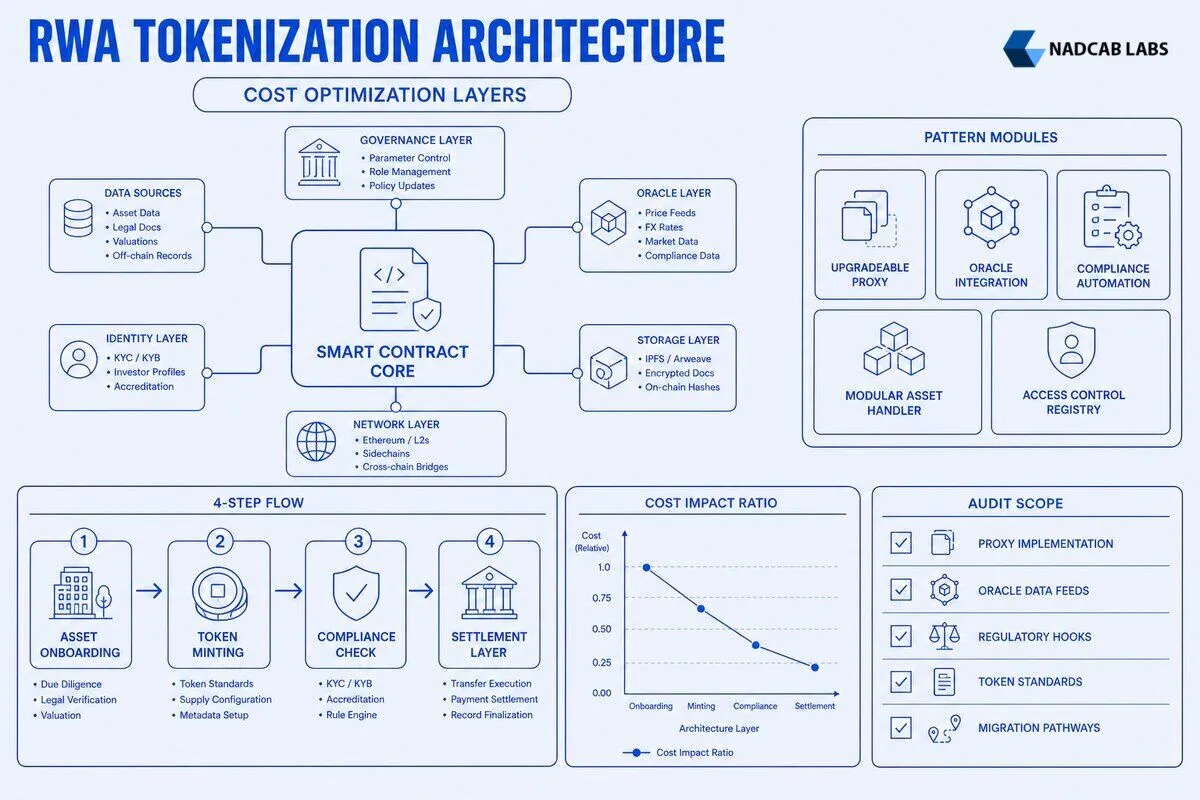
Modular architecture separates tokenization concerns into discrete contracts: custody management, compliance verification, valuation oracles, and transfer logic. A typical modular system costs $55,000 to $85,000 for initial deployment across all components. The custody module handling asset backing verification runs $12,000 to $18,000. Compliance modules implementing KYC/AML checks and transfer restrictions cost $20,000 to $30,000. Valuation modules integrating price feeds and redemption logic add $8,000 to $15,000. Core token contracts with ERC-20/ERC-1400 compatibility require another $15,000 to $22,000. rwa tokenization.
Monolithic contracts bundle all functionality into unified logic, costing $45,000 to $65,000 for equivalent feature sets. Development time shrinks to 6-8 weeks versus 10-14 weeks for modular systems. The monolith avoids inter-contract communication overhead and reduces deployment complexity. However, testing surface area expands dramatically—a single bug in compliance logic requires redeploying the entire token contract rather than swapping one module. rwa tokenization.
Integration overhead adds 20-30% to modular development costs. Teams must design stable interfaces between modules, implement access control for cross-module calls, and coordinate state synchronization. Interface standardization requires careful planning to ensure modules can be upgraded independently without breaking dependencies. Security audits become more complex because auditors must verify not just individual modules but also their interactions and potential race conditions across contract boundaries.
Modular Architecture Cost Breakdown
Total modular system: $71,500 (mid-range estimate)
Scalability return on investment justifies modular premiums for multi-asset platforms. Adding a second asset class to a monolithic system requires forking the entire codebase and redeploying everything—typically $35K-$50K per new asset. Modular systems reuse custody, compliance, and valuation modules across asset types, reducing incremental costs to $15K-$25K per asset (a 40-60% saving). A platform tokenizing both real estate and commodities breaks even on modular investment after the second asset class.
The RWA tokenization smart contract architecture demonstrates how module boundaries should align with regulatory domains. Separating compliance logic into its own module allows jurisdiction-specific implementations without touching core token mechanics. When expanding from US securities to EU MiCA compliance, teams swap compliance modules ($18K-$25K) rather than rebuilding entire systems ($60K-$85K). This architectural flexibility becomes critical for enterprises planning multi-market rollouts.
Which oracle integration strategy minimizes RWA tokenization expenses?
Oracle integration costs vary dramatically based on data source architecture and update frequency requirements. Single-source oracle patterns cost $3,000 to $6,000 for initial setup plus $200 to $500 monthly for data feeds. This approach connects directly to one price provider (Chainlink, API3, or custom endpoint) with minimal redundancy. Development involves implementing oracle consumer contracts, handling callback functions, and basic error handling. Monthly fees cover gas costs for price updates and data provider subscription charges.
Multi-oracle aggregation systems cost $8,000 to $15,000 upfront with $800 to $1,500 monthly operational expenses. These patterns query multiple data sources, calculate median or weighted average values, and implement outlier detection. The aggregation logic adds contract complexity and increases gas consumption per update. However, data reliability improves significantly—critical for high-value RWA where a manipulated price feed could enable multi-million dollar exploits. Real estate tokenization projects using property valuation oracles typically require this redundancy level.
Custom oracle networks designed for specific asset classes run $25,000 to $45,000 for development plus $2,000 to $4,000 monthly. These systems deploy dedicated oracle nodes, implement custom data aggregation algorithms, and integrate directly with off-chain asset databases. Development includes node infrastructure setup, cryptographic signature verification, and dispute resolution mechanisms. Monthly costs cover node operation, data source licensing, and network maintenance. Enterprises tokenizing unique assets like fine art or private equity often need this level of customization because standard oracles lack relevant data feeds.
Data frequency and gas optimization create 3-5x cost variation within each pattern type. Hourly price updates for volatile assets consume significantly more gas than daily updates for stable real estate valuations. A tokenized commodity fund updating every hour might spend $1,200 monthly on gas alone, while a real estate token with daily updates spends $250. Batch update patterns that push multiple data points in single transactions reduce per-update costs by 40-60% but introduce staleness risks during high-volatility periods.
Oracle Strategy Cost Matrix
| Oracle Pattern | Setup Cost | Monthly (Low Freq) | Monthly (High Freq) | Data Reliability |
|---|---|---|---|---|
| Single-source direct | $4,500 | $200 | $650 | Moderate (single point of failure) |
| Multi-oracle aggregation | $11,500 | $800 | $2,400 | High (outlier detection) |
| Custom oracle network | $35,000 | $2,000 | $5,500 | Very high (custom validation) |
| Hybrid push-pull | $18,000 | $1,200 | $3,200 | High (on-demand + scheduled) |
Fallback mechanism expenses add another layer of cost consideration. Basic fallback patterns that pause contract operations when oracle data becomes stale cost $2,000 to $4,000 to implement. Advanced dispute resolution systems with human arbitration or secondary oracle activation add $8,000 to $15,000. These mechanisms protect against oracle failures but increase monthly operational costs by $100-$300 for monitoring and automated failover testing. The AMM curve design principles apply here—redundancy costs money upfront but prevents catastrophic losses from bad data.
Projects should match oracle complexity to asset volatility and value. Tokenizing stable assets like government bonds may justify single-source oracles with daily updates ($4,500 setup + $250/month). High-value commercial real estate portfolios warrant multi-oracle aggregation with twice-daily updates ($11,500 + $1,100/month). Custom oracle networks make sense only for assets exceeding $50M in total value where manipulation risks justify the premium.
How much do compliance automation layers add to RWA development costs?
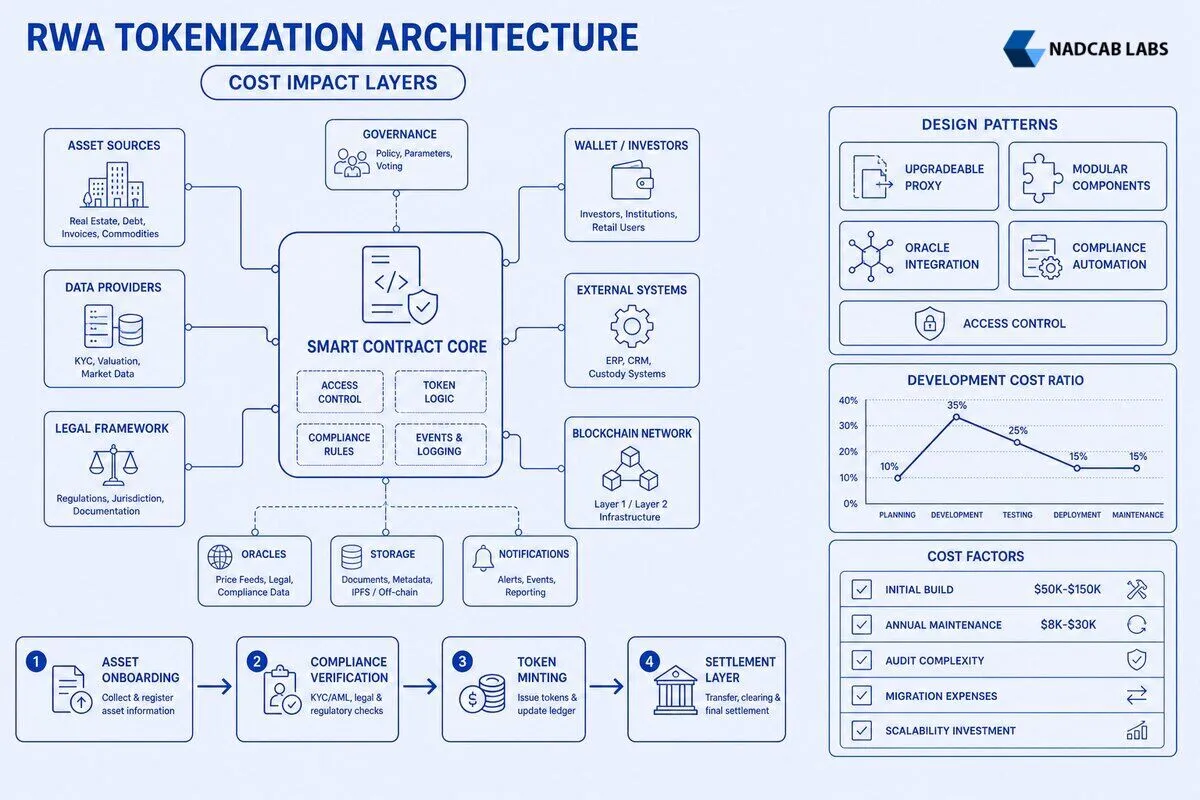
Compliance automation architecture fundamentally shapes both development expenses and ongoing operational costs. Off-chain KYC/AML verification with on-chain attestation represents the baseline pattern, costing $10,000 to $18,000 for implementation. This approach stores sensitive identity data off-chain with regulated providers, then records verification status as boolean flags or merkle proofs on-chain. Smart contracts check these attestations before allowing transfers. Development includes API integration with KYC providers like Chainalysis or Elliptic, attestation contract deployment, and verification logic in token transfer hooks.
Zero-knowledge proof systems offering privacy-preserving compliance cost $30,000 to $50,000 for initial development. These patterns use zk-SNARKs or zk-STARKs to prove compliance without revealing underlying identity data on-chain. Implementation complexity jumps significantly—teams must design circuit logic, generate proving and verification keys, and optimize proof generation for acceptable user experience. Gas costs per verification also increase by 2-3x compared to simple attestation checks. However, ZK patterns become essential for institutional investors requiring confidential position sizes while maintaining regulatory compliance.
Hybrid approaches combining off-chain verification with selective on-chain disclosure cost $18,000 to $32,000. These systems store encrypted compliance data on-chain that authorized parties can decrypt, while public transfer logic only checks verification timestamps and jurisdiction flags. The middle ground provides better auditability than pure off-chain systems without the computational overhead of full ZK proofs. Many cross-border RWA tokenization legal framework implementations use this pattern to satisfy multiple regulators with different disclosure requirements.
Compliance Layer Implementation Process
Total baseline compliance layer: $10K-$18K over 4-6 weeks
Regulatory reporting automation introduces additional cost layers. Real-time compliance data aggregation systems that push transaction reports to regulators cost $12,000 to $22,000 to build. These systems monitor every token transfer, classify transaction types, calculate reportable thresholds, and format data according to regulatory specifications. Batch reporting systems that generate periodic compliance summaries run $6,000 to $12,000 but require manual review before submission. Real-time systems reduce operational overhead but increase infrastructure costs by $300-$600 monthly for monitoring and API usage.
Audit trail storage represents a hidden but significant expense. Complete on-chain storage of compliance events costs $0.02-$0.05 per transaction in additional gas fees, which compounds quickly for high-volume tokens. Off-chain storage with on-chain merkle roots reduces per-transaction costs to $0.001-$0.003 but requires maintaining separate databases and proof generation infrastructure ($4K-$8K setup + $200-$400/month). The RWA Infrastructure article details how storage architecture decisions cascade through the entire system design.
Multi-jurisdiction compliance modules create incremental costs that scale sublinearly. The first jurisdiction implementation (US SEC, EU MiCA, or Singapore MAS) costs $15,000 to $25,000 including legal review, rule engine development, and testing. Each additional jurisdiction adds $5,000 to $12,000 because core compliance infrastructure gets reused—only jurisdiction-specific rules and reporting formats need customization. A platform targeting five jurisdictions might spend $55,000-$85,000 total versus $75,000-$125,000 if building separate systems. Pattern reusability becomes a key cost optimization lever for global platforms.
What design pattern trade-offs offer the best cost-to-security ratio for RWA projects?
Security pattern selection creates direct cost multipliers that compound through development, auditing, and maintenance phases. Multi-signature treasury controls add $8,000 to $12,000 to baseline development costs. Implementation includes deploying Gnosis Safe or custom multi-sig contracts, integrating signature collection workflows, and building administrative interfaces. These patterns prevent single points of compromise for high-value asset reserves but introduce operational friction—each treasury action requires coordinating multiple signers, adding 2-4 hours of overhead per operation.
Time-locked operations that enforce delay periods before critical actions execute cost $4,000 to $7,000 to implement. The pattern adds timelock contracts, queuing mechanisms, and cancellation logic for emergency situations. Governance proposals, parameter changes, and large withdrawals pass through mandatory waiting periods (typically 24-72 hours), giving stakeholders time to detect and prevent malicious actions. While time-locks add friction to legitimate operations, they’ve prevented numerous governance attacks in DeFi protocols—a cost-benefit calculation that favors security for assets exceeding $10M in value.
Emergency pause mechanisms cost $3,000 to $6,000 for basic implementation. These patterns allow authorized parties to freeze contract operations when exploits are detected, preventing further damage while teams coordinate response. Advanced pause systems with granular controls (pausing specific functions rather than entire contracts) cost $8,000 to $14,000. The What is RWA guide explains why pause mechanisms are now considered essential for institutional-grade tokenization despite the added complexity.
Security Pattern Cost vs. Risk Reduction
| Security Pattern | Implementation Cost | Annual Overhead | Risk Reduction | Recommended For |
|---|---|---|---|---|
| Multi-sig treasury (2-of-3) | $10,000 | $2,400 | High (prevents single key compromise) | All projects >$5M TVL |
| Time-locked operations (48h) | $5,500 | $800 | Moderate (detection window) | Governance-heavy protocols |
| Emergency pause (basic) | $4,500 | $600 | High (damage limitation) | All production deployments |
| Role-based access control | $6,000 | $1,200 | Moderate (privilege separation) | Multi-team operations |
| Rate limiting + caps | $3,500 | $400 | Moderate (exploit containment) | High-liquidity tokens |
Audit cost multipliers create the most significant pattern-driven expense variation. Simple, linear contract logic with minimal external dependencies audits at baseline rates—$15,000 to $25,000 for comprehensive security review by reputable firms. Moderate complexity patterns involving proxy upgrades, oracle integrations, and multi-contract interactions multiply audit costs by 1.5-2.0x ($22,500-$50,000). Complex systems with custom cryptography, cross-chain bridges, or novel economic mechanisms hit 2.5-3.5x multipliers ($37,500-$87,500).
The audit multiplier effect compounds with each additional security pattern. A project combining upgradeable proxies (1.5x), multi-oracle aggregation (1.3x), ZK compliance (2.0x), and emergency pause mechanisms (1.2x) faces a composite multiplier of approximately 4.7x—turning a $20,000 baseline audit into a $94,000 expense. This exponential cost growth makes pattern minimalism a powerful optimization strategy for budget-constrained projects.
Decision matrix frameworks help teams map asset class requirements to optimal pattern combinations. Low-risk assets under $1M in total value (like Gold Tokenization Development for retail investors) can use simplified patterns: immutable contracts, single-oracle pricing, basic compliance, and minimal security layers. Total development costs stay under $50,000 with $5,000-$8,000 annual maintenance. Mid-tier projects ($1M-$20M) warrant upgradeable contracts, multi-oracle aggregation, hybrid compliance, and core security patterns—budget $80,000-$120,000 initial plus $15,000-$25,000 annual. Enterprise deployments exceeding $20M justify full security suites with custom oracle networks and ZK compliance—expect $150,000-$250,000 upfront and $35,000-$55,000 yearly.
Pattern selection should also consider team capabilities and maintenance capacity. Complex patterns require specialized expertise to maintain safely. A team without ZK cryptography experience shouldn’t deploy ZK compliance systems regardless of budget—the operational risk of misconfiguration outweighs privacy benefits. Similarly, projects lacking 24/7 monitoring shouldn’t implement emergency pause mechanisms without establishing incident response procedures first. The RPA architecture design patterns demonstrate how operational readiness must inform architectural decisions.
Cost-to-security optimization often favors battle-tested standard patterns over custom innovations. OpenZeppelin’s audited contract libraries, Chainlink’s established oracle networks, and proven multi-sig implementations offer better risk-adjusted value than novel designs. A $40,000 implementation using standard patterns typically delivers more security than a $60,000 custom solution because the standard components have survived years of production testing and attack attempts. Innovation should focus on business logic and user experience rather than reinventing security primitives.
The optimal pattern combination for most RWA projects under $100,000 budget includes: UUPS upgradeable proxies ($45K), multi-oracle aggregation with daily updates ($12K + $900/month), off-chain KYC with on-chain attestation ($15K), basic multi-sig treasury ($10K), and emergency pause mechanisms ($5K). This configuration totals approximately $87,000 initial investment with $12,000-$18,000 annual costs—delivering institutional-grade security while maintaining cost efficiency. Projects can scale individual components as asset values grow rather than over-engineering from day one.
Final Thoughts
Design pattern choices create cost divergence points that determine whether RWA tokenization projects succeed within budget or spiral into expensive architectural rework. The data shows clear patterns: upgradeable contracts cost 2x more upfront but reduce long-term expenses for evolving regulations; modular architecture adds 20% initially but cuts incremental asset costs by half; oracle strategy affects monthly costs by 5x; compliance automation ranges from $10K to $50K based on privacy requirements; and security patterns multiply audit expenses by up to 3.5x. Smart teams match pattern complexity to asset class risk profiles, reuse proven components, and optimize for total cost of ownership rather than minimizing initial development expenses. The technical architecture decisions made in the first weeks of a tokenization project echo through years of operational costs—making informed pattern selection one of the highest-leverage activities in the entire development lifecycle. For enterprises evaluating UI UX Design alongside backend architecture, remember that pattern choices affect not just costs but also user experience, regulatory compliance, and long-term platform scalability.
Frequently Asked Questions
Q1.What is the cost difference between upgradeable and immutable RWA smart contracts?
Upgradeable RWA contracts using proxy patterns (EIP-1967, UUPS) typically cost 30-45% more upfront—around $25,000-$40,000 versus $15,000-$25,000 for immutable contracts. However, upgradeable designs save significantly on post-deployment fixes and regulatory updates, often reducing long-term costs by 50-60%. Immutable contracts require complete redeployment and token migration if changes are needed, which can exceed $50,000 per iteration. For evolving regulatory environments, upgradeable patterns offer better total cost of ownership despite higher initial investment.
Q2.How much does modular architecture add to RWA tokenization development costs?
Modular architecture using separate contracts for compliance, issuance, and asset management adds 25-40% to initial development—typically $20,000-$35,000 extra on a $80,000 base project. This includes designing interfaces, testing inter-contract communication, and gas optimization. However, modularity reduces feature addition costs by 60-70% and enables parallel development. Maintenance becomes 40% cheaper as individual modules update independently. For multi-asset platforms or projects expecting regulatory changes, modular patterns deliver ROI within 12-18 months through reduced iteration costs.
Q3.Which oracle integration pattern is most cost-effective for real-world asset tokenization?
Push-based oracle patterns with aggregated feeds (like Chainlink Data Feeds) offer the best cost-efficiency for RWA projects, costing $8,000-$15,000 to integrate versus $25,000-$40,000 for custom pull-based solutions. Push patterns reduce on-chain calls by 80%, lowering gas costs from $0.50-$2 per update to $0.05-$0.15. For assets requiring frequent valuation updates (real estate, commodities), hybrid patterns combining push feeds with on-demand pulls balance cost and freshness, typically adding $5,000-$10,000 but saving 50-60% on operational expenses annually.
Q4.What are the typical expenses for compliance automation layers in RWA projects?
Compliance automation layers implementing KYC/AML checks, transfer restrictions, and regulatory reporting cost $30,000-$60,000 for standard implementations. Basic whitelist patterns run $15,000-$25,000, while advanced role-based access control (RBAC) with jurisdiction-specific rules costs $40,000-$75,000. Integration with third-party KYC providers (Chainalysis, Elliptic) adds $10,000-$20,000 plus ongoing API fees of $500-$2,000 monthly. Automated reporting modules for SEC/MiFID compliance require additional $15,000-$30,000. Total compliance infrastructure typically represents 35-45% of RWA development budgets.
Q5.How do design pattern choices affect long-term maintenance costs for tokenized assets?
Design patterns dramatically impact maintenance economics over 3-5 years. Monolithic contracts require full audits ($15,000-$40,000) for any change, while modular designs enable targeted updates at 60% lower cost. Upgradeable patterns reduce bug-fix expenses from $30,000-$50,000 (redeploy + migration) to $8,000-$15,000 (proxy update). Event-driven architectures with proper logging cut debugging time by 70%, saving $10,000-$20,000 annually. Gas-optimized patterns reduce operational costs by $5,000-$15,000 yearly on active platforms. Poor initial pattern choices can inflate 5-year TCO by 200-300%.
Q6.What security patterns provide the best ROI for RWA tokenization budgets under $100K?
For sub-$100K budgets, prioritize these security patterns by ROI: (1) OpenZeppelin’s battle-tested contracts ($0 licensing, saves $20,000-$35,000 in custom development), (2) Checks-Effects-Interactions pattern (prevents reentrancy, costs $3,000-$5,000 to implement properly), (3) Circuit breakers/pause mechanisms ($5,000-$8,000, prevents catastrophic losses), and (4) Multi-signature treasury control ($4,000-$7,000 setup). Skip custom cryptography and complex access control initially—use standard RBAC. This combination covers 85% of attack vectors for 25-30% of budget, leaving resources for compliance and core functionality.
Explore Services
Related Services
Reviewed by

Aman Vaths
Founder of Nadcab Labs
Aman Vaths is the Founder & CTO of Nadcab Labs, a global digital engineering company delivering enterprise-grade solutions across AI, Web3, Blockchain, Big Data, Cloud, Cybersecurity, and Modern Application Development. With deep technical leadership and product innovation experience, Aman has positioned Nadcab Labs as one of the most advanced engineering companies driving the next era of intelligent, secure, and scalable software systems. Under his leadership, Nadcab Labs has built 2,000+ global projects across sectors including fintech, banking, healthcare, real estate, logistics, gaming, manufacturing, and next-generation DePIN networks. Aman’s strength lies in architecting high-performance systems, end-to-end platform engineering, and designing enterprise solutions that operate at global scale.