Ai Overview
Designing tokenomics for Decentralized Physical Infrastructure Networks (DePIN) requires balancing economic incentives with operational sustainability. A decentralized compute network might increase emission rates by 5% annually if total compute capacity grows above 20% year-over-year, signaling healthy demand that justifies additional operator rewards. Conversely, if capacity utilization falls below 40%, emission rates drop by 3% to prevent oversupply.
Designing tokenomics for Decentralized Physical Infrastructure Networks (DePIN) requires balancing economic incentives with operational sustainability. A well-structured DePIN tokenomics design integrates token supply models, reward distribution mechanisms, and governance frameworks that align the interests of infrastructure providers, consumers, and protocol stakeholders. The architecture must address both the physical layer—where hardware operators contribute bandwidth, storage, or compute—and the economic layer that compensates them fairly while maintaining token value stability.
Key Takeaways
- DePIN tokenomics architecture comprises utility definition, supply mechanics, and stakeholder role mapping across physical and economic layers
- Token supply models range from fixed caps with deflationary burns to dynamic inflation tied to network growth metrics
- Incentive structures use proof-of-coverage and tiered reward systems to ensure quality service delivery and geographic distribution
- Governance parameters integrate voting mechanisms, treasury management, and protocol upgrade thresholds into the economic model
- Risk mitigation strategies address price volatility, Sybil attacks, and the balance between early adopter rewards and long-term sustainability
- Successful implementation requires continuous monitoring of on-chain metrics and adaptive parameter tuning based on network performance
What are the core components of a DePIN tokenomics architecture?
The foundation of any DePIN token mechanics system rests on three pillars: utility definition, supply mechanics, and stakeholder role architecture. Token utility in decentralized infrastructure tokenomics extends beyond simple payment rails—it encompasses staking for quality assurance, governance rights for protocol evolution, and access credentials for premium service tiers. For example, a decentralized wireless network might require tokens to purchase data packages, stake collateral for operating nodes, and vote on coverage expansion priorities.
Supply mechanics determine how tokens enter and exit circulation. Fixed supply models cap total issuance at network launch, creating scarcity similar to Bitcoin’s 21 million coin limit. This approach suits networks where infrastructure demand is predictable and deflationary pressure from Token Burning mechanisms can offset early distribution. Inflationary models continuously mint new tokens according to emission schedules—linear release curves provide steady rewards, while exponential decay front-loads incentives to bootstrap network effects. The choice depends on whether your DePIN prioritizes rapid initial growth or gradual organic expansion.
Stakeholder roles in DePIN economic model design create the multi-sided marketplace dynamics. Node operators provide physical infrastructure—wireless hotspots, storage nodes, compute clusters—and earn rewards proportional to their contribution. Consumers pay for services using native tokens or stablecoins pegged to token value. Validators ensure service quality through proof-of-coverage verification, earning a percentage of transaction fees. Liquidity providers stake tokens in automated market makers, receiving trading fees while reducing price volatility. Each role must have clear economic incentives that align with network health.
The architecture must also define token flow between layers. At the protocol layer, smart contracts manage reward distribution, slashing penalties, and treasury allocations. The service layer translates physical contributions—gigabytes transferred, uptime hours, geographic coverage—into token-denominated rewards. The application layer enables end-users to interact with services without necessarily holding tokens, using payment abstractions like credit card on-ramps or gas-less transactions sponsored by the protocol. This layered approach separates infrastructure economics from user experience.
Consider a decentralized storage network where users pay 10 tokens per terabyte-month. Node operators receive 7 tokens as base rewards, 2 tokens flow to a validator pool for proof-of-replication checks, and 1 token burns to create deflationary pressure. If storage demand exceeds supply, Dynamic Fee Models automatically adjust pricing, signaling operators to add capacity. This feedback loop—where token price, service demand, and infrastructure supply interact—defines the core tokenomics architecture.
DePIN Tokenomics Component Breakdown
| Component | Function | Typical Allocation | Adjustment Mechanism |
|---|---|---|---|
| Base Rewards | Compensate infrastructure providers for service delivery | 60-75% of transaction fees | Supply-demand curve |
| Validator Fees | Incentivize quality assurance and proof verification | 15-25% of transaction fees | Governance vote |
| Treasury Reserve | Fund protocol development and ecosystem grants | 5-10% of transaction fees | DAO proposal |
| Burn Mechanism | Create deflationary pressure and align long-term value | 5-15% of transaction fees | Algorithmic based on inflation rate |
| Liquidity Mining | Bootstrap token liquidity and reduce price volatility | 10-20% of initial supply | Time-locked vesting schedule |
Integration with existing blockchain infrastructure follows patterns similar to private blockchain architecture design patterns, where permission layers and consensus mechanisms must accommodate physical-world constraints. A wireless DePIN cannot instantly slash a node operator’s stake if coverage temporarily drops due to power outages—the protocol needs grace periods and dispute resolution. Similarly, reward distribution must account for geographic variations in service value: urban coverage might earn lower per-device rewards than rural expansion, reflecting strategic network priorities.
How do you structure token supply models for long-term sustainability?
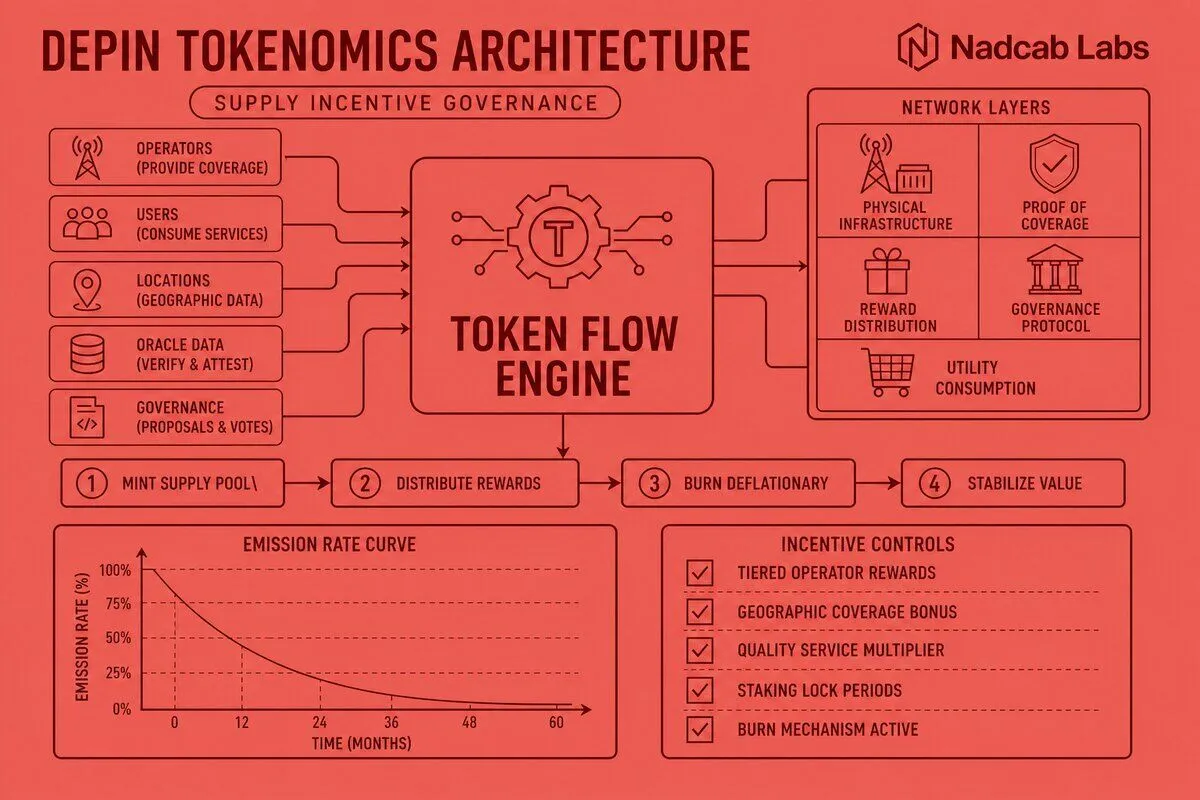
Token supply architecture in DePIN tokenomics design determines whether your network can sustain operations through multiple market cycles. Fixed supply models work best for infrastructure with predictable capacity limits—a satellite network with 1,000 orbital slots might mint 1 billion tokens at genesis, allocating 40% to node operators over 10 years, 20% to early investors with 4-year vesting, 15% to the treasury, 15% to the team with cliff periods, and 10% for liquidity. This distribution ensures sufficient circulating supply for market making while preventing dilution that undermines operator incentives.
Dynamic inflation approaches tie new token issuance to network growth metrics. A decentralized compute network might increase emission rates by 5% annually if total compute capacity grows above 20% year-over-year, signaling healthy demand that justifies additional operator rewards. Conversely, if capacity utilization falls below 40%, emission rates drop by 3% to prevent oversupply. This creates a feedback mechanism where the DePIN token supply model adapts to real-world infrastructure economics rather than following a rigid schedule divorced from operational reality.
Emission curve design shapes the incentive landscape over time. Linear emission schedules distribute tokens evenly—if a network allocates 400 million tokens to operators over 10 years, they receive 40 million annually regardless of network maturity. This simplicity aids financial planning but ignores the higher risk early operators assume when network effects are weak. Exponential decay curves front-load rewards: the first year might distribute 100 million tokens, the second 70 million, the third 50 million, following a half-life pattern that compensates pioneers while gradually reducing inflation as the network matures.
Halving schedules borrowed from Bitcoin create predictable scarcity events. A storage DePIN might halve operator rewards every 2 years—starting at 10 tokens per terabyte-month, dropping to 5 after 24 months, then 2.5, and so on. These events generate market attention and force operators to improve efficiency as nominal rewards decline. However, they require careful calibration: if service demand does not grow proportionally, operators may exit, reducing network capacity. The model assumes token price appreciation offsets declining emission rates, which depends on adoption velocity.
Emission Curve Comparison Process
Burn and deflationary mechanisms balance inflationary pressure from new token issuance. Transaction fee burns permanently remove tokens from circulation—if a network processes $10 million in monthly service fees at a 10% burn rate, 1 million tokens exit supply. This approach works when fee volume scales with network adoption, creating natural deflationary dynamics as usage grows. Alternative burn mechanisms include penalty slashing for quality violations, where tokens staked by underperforming operators are destroyed rather than redistributed, and buyback-and-burn programs where protocol revenue purchases tokens from the open market before burning them.
The sustainability equation requires that long-term token issuance does not exceed the sum of burn mechanisms plus organic demand growth. If a network emits 50 million tokens annually but only burns 20 million through fees and penalties, the remaining 30 million creates sell pressure unless new buyers—speculators, service consumers, or institutional adopters—absorb the supply. This is where Token Distribution strategies intersect with supply mechanics: vesting schedules for early allocations must stagger unlock events to prevent supply shocks that crash token prices and make operator economics unviable.
Real-world examples illustrate these trade-offs. Helium initially used aggressive inflation to bootstrap its wireless network, distributing millions of tokens monthly to hotspot operators. As the network matured, governance reduced emission rates while introducing data credit burns—users purchase credits with HNT tokens that are then burned, creating deflationary pressure proportional to network usage. This transition from growth-phase inflation to utility-driven deflation represents a common maturity path for DePIN projects, requiring governance flexibility to adjust parameters as network dynamics evolve.
What incentive structures drive participation in DePIN networks?
Incentive structures in DePIN reward distribution systems must translate physical-world contributions into token-denominated compensation that reflects service quality, geographic value, and network priorities. Proof-of-coverage algorithms verify that infrastructure operators actually provide claimed services—a wireless network might require nodes to periodically beacon their location and signal strength, with validators confirming coverage through challenge-response protocols. Operators who pass these checks earn base rewards, while those who fail receive reduced payouts or stake slashing penalties.
Proof-of-contribution extends beyond simple uptime metrics to measure actual value delivered. A decentralized CDN rewards nodes based on bytes served, request latency, and cache hit rates—a node serving 10TB monthly with 50ms average latency earns more than one serving 5TB at 200ms, even if both maintain 99% uptime. This granular measurement requires robust telemetry and verification systems, often implemented through trusted execution environments or cryptographic proofs that prevent operators from fabricating metrics. The challenge lies in balancing verification costs against reward precision: excessive validation overhead can consume more resources than it protects.
Staking requirements create economic security by forcing operators to lock collateral that can be slashed for misbehavior. A storage network might require operators to stake 1,000 tokens per terabyte of capacity, with 10% slashed for data loss events and 5% for excessive downtime. This aligns incentives: operators with significant stake have strong motivation to maintain service quality, while the slashed tokens either burn or redistribute to affected users as compensation. The staking ratio must balance accessibility—too high and small operators cannot participate—against security—too low and penalties become negligible.
DePIN Reward Distribution by Network Type
Percentage represents base operator rewards as share of total token emissions; remaining allocations include validator fees, treasury, and burns
Tiered reward systems create differentiated incentives based on service quality and strategic value. A three-tier structure might allocate 1x base rewards for standard service (95% uptime, average latency), 1.5x for premium service (99.5% uptime, low latency), and 2x for strategic coverage (underserved geographic areas or high-demand routes). This approach mirrors how DeFi Staking Rewards differentiate between pool tiers, using economic signals to guide resource allocation toward network priorities without centralized coordination.
Geographic coverage multipliers address the cold-start problem in new markets. A network expanding into rural Africa might offer 3x rewards for the first 100 nodes deployed in each region, declining to 2x for nodes 101-500, and normalizing to 1x thereafter. This bootstraps coverage in areas where organic adoption would lag, using temporary incentive boosts to overcome coordination failures. The multipliers must sunset as density increases, preventing oversupply that wastes resources on redundant coverage. Smart contracts can automate these adjustments based on real-time coverage maps and demand signals.
Reputation systems layer social capital onto economic incentives. Operators who consistently deliver high-quality service earn reputation scores that unlock benefits: priority in validator selection, reduced staking requirements, or bonus reward multipliers. These scores might decay over time, requiring sustained performance rather than resting on historical laurels. Reputation creates stickiness—operators invest effort to build standing and hesitate to jeopardize it through misconduct—while providing a non-financial dimension to network participation that can outlast token price volatility.
The DePIN incentive structure must also account for demand-side economics. If service prices are denominated in tokens, price volatility creates uncertainty for consumers who cannot predict monthly costs. Stablecoin payment rails solve this by letting users pay in USDC or DAI while the protocol converts payments to native tokens behind the scenes, distributing them to operators. This abstraction—similar to how ERC721 in Smart Contract implementations abstract NFT complexity from end users—separates infrastructure economics from consumer experience, enabling mainstream adoption without requiring users to speculate on token prices.
How should governance parameters be integrated into DePIN tokenomics?
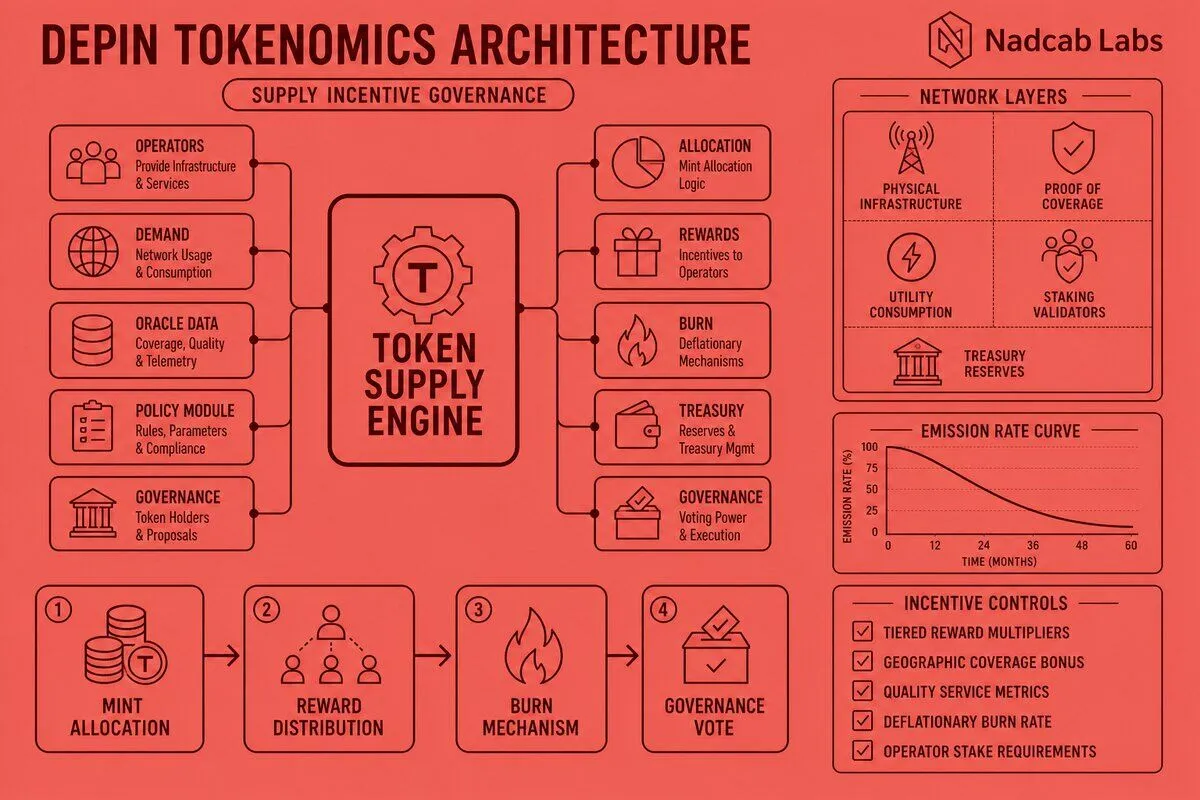
Governance integration in DePIN governance parameters determines how protocol evolution aligns with stakeholder interests while maintaining operational stability. Voting weight distribution establishes who controls decision-making power: token-based models allocate votes proportional to token holdings, creating plutocratic dynamics where large holders dominate. Reputation-based systems weight votes by historical contribution—operators who have reliably served the network for years earn more influence than new entrants, regardless of token holdings. Hybrid models combine both dimensions: a vote might require both 10,000 tokens staked and a reputation score above 80, preventing wealthy newcomers from immediately capturing governance.
The choice of voting mechanism shapes network evolution. Quadratic voting reduces whale dominance by making each additional vote exponentially more expensive—a holder with 10,000 tokens might cast 100 votes, while one with 1,000 tokens casts 31 votes, narrowing the influence gap. Delegation systems let token holders assign voting power to specialized delegates who actively participate in governance, addressing apathy among passive holders. Time-locked voting grants additional weight to tokens committed for extended periods, rewarding long-term alignment over short-term speculation.
Proposal and execution thresholds prevent hasty changes that destabilize the network. A typical framework requires proposals to pass three stages: discussion (community debate for 7 days), voting (token holders vote for 5 days with a 10% quorum requirement), and execution (automatic implementation if 60% approval is reached). Critical parameters like emission rates or slashing penalties might demand higher thresholds—75% approval with 20% quorum—while routine adjustments like fee structures use lower bars. Time delays between approval and execution give operators time to adapt to changes, preventing surprise disruptions.
Treasury management allocates protocol revenue and token reserves to fund development, ecosystem growth, and emergency reserves. A common split directs 40% of treasury inflows to core development, 30% to ecosystem grants for third-party builders, 20% to liquidity incentives, and 10% to an emergency fund for black swan events. Governance controls these allocations through quarterly budget proposals, with token holders voting on spending priorities. Transparent on-chain accounting—where every treasury transaction is publicly auditable—builds trust and prevents misappropriation, though it requires robust UI UX Design to make financial data accessible to non-technical stakeholders.
Governance Parameter Configuration Matrix
| Parameter Type | Approval Threshold | Quorum Requirement | Execution Delay |
|---|---|---|---|
| Emission Rate Adjustments | 75% approval | 20% of circulating supply | 30 days |
| Slashing Penalty Changes | 70% approval | 15% of circulating supply | 21 days |
| Fee Structure Modifications | 60% approval | 10% of circulating supply | 14 days |
| Treasury Spending Proposals | 55% approval | 8% of circulating supply | 7 days |
| Emergency Protocol Upgrades | 80% approval | 25% of circulating supply | 3 days (expedited) |
| Validator Set Expansion | 65% approval | 12% of circulating supply | 14 days |
Community fund allocation mechanisms distribute resources to accelerate network growth. Grants might fund hardware subsidies for operators in strategic regions, developer bounties for protocol improvements, or marketing campaigns to drive consumer adoption. A structured application process—where applicants submit proposals detailing objectives, milestones, and budget—combined with community voting ensures funds flow to high-impact initiatives. Milestone-based disbursement releases funds incrementally as grantees demonstrate progress, reducing risk of wasted capital on abandoned projects.
Governance must also address parameter tuning based on real-world performance. If on-chain data shows operator churn exceeding 15% monthly, governance might propose increasing base rewards by 10% to improve retention. If token velocity spikes above target levels—indicating excessive speculation rather than utility usage—proposals might introduce holding incentives or transaction fee adjustments. This adaptive governance requires robust analytics infrastructure, often leveraging Data Science and ML Model Development Services to identify trends and predict the impact of parameter changes before implementation.
The integration challenge lies in balancing decentralization with execution speed. Fully decentralized governance where every decision requires token holder approval creates bottlenecks that slow protocol evolution, potentially letting competitors gain advantages. Progressive decentralization offers a middle path: early-stage networks use multisig councils or foundation oversight for rapid iteration, gradually transitioning control to token holders as the protocol matures and governance processes stabilize. This mirrors patterns in RPA architecture design patterns, where systems evolve from centralized control to distributed autonomy as they prove robustness.
What are the key risks in DePIN tokenomics design and how to mitigate them?
Token price volatility poses the most immediate risk to DePIN economic model design, creating misalignment between service pricing and operator profitability. When token prices surge 10x in weeks, service costs become prohibitively expensive for consumers—a storage service priced at 10 tokens per terabyte becomes unaffordable if token value spikes from $0.10 to $1.00. Conversely, price crashes devastate operator economics: rewards denominated in tokens lose purchasing power, making it unprofitable to maintain infrastructure. The network enters a death spiral where operators exit, reducing capacity and service quality, which further depresses token demand and price.
Mitigation strategies include dual-token models that separate utility from speculation. A governance token captures speculative value and voting rights, while a stablecoin-pegged utility token handles service payments. Operators earn the volatile governance token as long-term incentives but receive stable utility tokens for operational expenses, insulating day-to-day economics from market swings. Dynamic pricing algorithms automatically adjust service costs based on token price movements—if the token doubles in value, service prices halve in token terms, maintaining dollar-equivalent costs for consumers. This requires oracle integration to feed reliable price data into smart contracts.
Sybil attack prevention addresses the risk of malicious actors creating multiple fake identities to claim disproportionate rewards. A wireless network vulnerable to Sybil attacks might see an attacker deploy 1,000 virtual nodes claiming coverage without actual hardware, draining rewards from legitimate operators. Economic penalties through staking requirements raise the cost of Sybil attacks: if each node requires 5,000 tokens staked, an attacker needs 5 million tokens to deploy 1,000 fake nodes, making the attack economically irrational unless rewards exceed the staked capital plus slashing risk.
Identity verification layers add non-economic barriers. Hardware attestation requires nodes to prove they possess specific physical devices through cryptographic signatures tied to secure enclaves. Geographic verification uses GPS coordinates and triangulation to confirm nodes are physically distributed rather than virtualized in a single data center. Proof-of-coverage challenges—where nodes must respond to random beacons from validators—ensure claimed coverage is real. These multi-layered defenses increase the cost and complexity of Sybil attacks beyond profitability thresholds.
Balancing early adopter rewards with long-term sustainability creates tension between bootstrapping network effects and preventing unsustainable inflation. Aggressive early rewards attract pioneers who take on high risk when network value is uncertain, but if these rewards continue indefinitely, late-stage operators receive windfalls without commensurate risk, while token inflation erodes value for all participants. The solution lies in time-based reward decay curves that front-load incentives during the growth phase and taper to sustainable levels as the network matures.
Risk Mitigation Framework Implementation
Centralization risk emerges when economic incentives concentrate resources among a few large operators. A storage network where the top 10 operators control 60% of capacity creates single points of failure and governance capture—these operators can collude to manipulate pricing, block protocol upgrades, or extract rent from smaller participants. Maximum stake caps limit how much infrastructure a single entity can operate: if each operator can stake at most 1% of total network capacity, at least 100 operators must participate to reach full scale, distributing control.
Geographic reward multipliers counteract natural centralization tendencies. Without intervention, operators cluster in regions with cheap electricity and favorable regulations, leaving vast areas underserved. By offering 2-3x rewards for coverage in strategic but challenging markets, the protocol incentivizes geographic distribution that improves network resilience and reach. These multipliers must be dynamic: as an underserved region reaches target density, rewards normalize to prevent oversupply, while new frontier markets receive boosted incentives.
Liquidity crises occur when token holders cannot easily convert to fiat or stablecoins, trapping value and preventing operators from accessing their earnings. Thin liquidity on decentralized exchanges creates high slippage—selling $10,000 worth of tokens might yield only $8,500 due to price impact—effectively taxing operators for participating. Protocol-owned liquidity solves this by using treasury funds to provide permanent liquidity on automated market makers, ensuring operators can always exit positions at reasonable prices. Liquidity mining programs further deepen markets by rewarding external liquidity providers with token emissions.
The interconnection of these risks requires holistic mitigation strategies rather than isolated fixes. A network addressing price volatility through dual tokens must ensure both tokens have adequate liquidity. Sybil prevention through high staking requirements must not inadvertently centralize the network by pricing out small operators. Early adopter rewards must decline gradually enough to maintain operator retention while preventing unsustainable inflation. This systems-thinking approach—where tokenomics design considers second and third-order effects—separates robust architectures from those that collapse under real-world stress.
Continuous monitoring and adaptive governance provide the final risk mitigation layer. On-chain analytics dashboards track key metrics: token velocity, operator churn rates, geographic distribution, reward-to-cost ratios, and governance participation. When metrics deviate from target ranges—operator churn exceeding 10% monthly, or token velocity dropping below 2 annual turns—automated alerts trigger governance discussions about parameter adjustments. This feedback loop, informed by real-world data rather than theoretical models, enables DePIN networks to evolve their tokenomics as market conditions and network maturity change over time.
For organizations seeking to implement these complex tokenomics architectures, partnering with experienced DePIN Development teams can accelerate time-to-market while avoiding common pitfalls. Professional development services bring domain expertise in smart contract security, economic modeling, and infrastructure integration that de-risks tokenomics deployment and ensures alignment between technical implementation and economic design principles.
Final Thoughts
Designing robust DePIN tokenomics requires integrating token supply models, incentive structures, and governance frameworks into a cohesive architecture that aligns stakeholder interests across physical and economic layers. The core components—utility definition, emission curves, reward algorithms, and governance parameters—must work in concert to bootstrap network effects while maintaining long-term sustainability. Success depends on balancing aggressive early incentives with gradual transition to utility-driven economics, implementing multi-layered defenses against Sybil attacks and centralization, and building adaptive governance that responds to real-world performance data.
The tokenomics architecture must anticipate and mitigate risks from price volatility, operator churn, and liquidity constraints through dual-token models, dynamic pricing mechanisms, and protocol-owned liquidity. By following structured design processes—defining supply caps, modeling growth scenarios, selecting appropriate emission curves, integrating burn mechanisms, and deploying with governance flexibility—DePIN projects can create economic systems that sustain operations through multiple market cycles. The implementation playbook outlined here provides a foundation for building decentralized infrastructure networks where economic incentives drive quality service delivery, geographic expansion, and community-driven protocol evolution.
Frequently Asked Questions
Q1.What is the difference between fixed and inflationary token supply in DePIN projects?
Fixed supply caps total tokens (e.g., 1 billion), creating scarcity and potential value appreciation but risking insufficient long-term incentives. Inflationary models continuously mint tokens to reward providers indefinitely, ensuring perpetual participation but potentially diluting holder value. DePIN projects often use hybrid approaches—fixed initial supply with controlled inflation (1-3% annually) or emission decay curves that reduce issuance over time while maintaining baseline rewards for critical infrastructure operators.
Q2.How do DePIN projects calculate rewards for infrastructure providers?
Rewards typically use proof-of-contribution algorithms measuring uptime, bandwidth delivered, storage provided, or compute cycles completed. Most DePIN networks implement tiered formulas: base reward × quality multiplier × scarcity factor. For example, a storage node might earn tokens proportional to gigabytes stored, adjusted for retrieval speed and geographic underserved regions. Smart contracts verify contributions via cryptographic proofs (Merkle trees, zero-knowledge proofs) before distributing rewards from emission pools or transaction fee splits.
Q3.What role does staking play in DePIN tokenomics design?
Staking serves three functions: collateral (providers lock tokens to guarantee service quality), Sybil resistance (minimum stake requirements prevent spam nodes), and alignment (stakers lose deposits for downtime or malicious behavior). Many DePIN networks require 10-50% of expected annual earnings staked upfront. Staking also enables governance participation and can earn additional yield from network fees, creating compounding incentives for long-term infrastructure commitment versus short-term extraction.
Q4.How can DePIN tokenomics prevent centralization of network resources?
Anti-centralization mechanisms include: capped rewards per entity (diminishing returns after threshold), geographic distribution bonuses (higher rewards for underserved regions), quadratic reward formulas (favoring many small providers over few large ones), and stake-weighted governance with delegation limits. Progressive taxation on large operators and minimum viable decentralization requirements (no single entity exceeds 15% network capacity) enforce distribution. Nadcab Labs implements reputation decay systems where dominant nodes gradually lose multiplier advantages.
Q5.What are common mistakes in designing DePIN token emission schedules?
Critical errors include: front-loading emissions (80% released in year one causes provider exodus later), ignoring network growth curves (fixed emissions when demand is exponential), no emission adjustment mechanisms (unable to respond to over/under-supply), and misaligned vesting (team tokens unlock before network maturity). Many projects fail to model token velocity—high circulation without burn mechanisms crashes price. Effective schedules match emission rate to projected infrastructure demand growth with governance-triggered adjustment parameters.
Q6.How do governance tokens integrate with utility tokens in DePIN networks?
Dual-token models separate governance (voting rights, protocol upgrades) from utility (paying for services, rewarding providers). Utility tokens handle high-frequency transactions while governance tokens remain relatively stable for decision-making. Integration occurs through: utility token holders earning governance tokens via staking, governance votes adjusting utility token emission rates, and revenue sharing where service fees buy-and-burn governance tokens. Single-token systems combine both functions but risk governance attacks when tokens concentrate among service users rather than long-term stakeholders.
Explore Services
Related Services
Reviewed by

Aman Vaths
Founder of Nadcab Labs
Aman Vaths is the Founder & CTO of Nadcab Labs, a global digital engineering company delivering enterprise-grade solutions across AI, Web3, Blockchain, Big Data, Cloud, Cybersecurity, and Modern Application Development. With deep technical leadership and product innovation experience, Aman has positioned Nadcab Labs as one of the most advanced engineering companies driving the next era of intelligent, secure, and scalable software systems. Under his leadership, Nadcab Labs has built 2,000+ global projects across sectors including fintech, banking, healthcare, real estate, logistics, gaming, manufacturing, and next-generation DePIN networks. Aman’s strength lies in architecting high-performance systems, end-to-end platform engineering, and designing enterprise solutions that operate at global scale.