Ai Overview
Binance Research found that over 80% of newly listed tokens declined in value after launch, largely because projects released tokens with extremely low circulating supplies, sometimes under 20% of total supply, while carrying inflated fully diluted valuations averaging $4. An estimated $155 billion in locked tokens is scheduled for release in the coming years, and without proportional buy-side demand, this supply wave threatens to crush prices.
The stakes are enormous. Binance Research found that over 80% of newly listed tokens declined in value after launch, largely because projects released tokens with extremely low circulating supplies, sometimes under 20% of total supply, while carrying inflated fully diluted valuations averaging $4.2 billion at listing. An estimated $155 billion in locked tokens is scheduled for release in the coming years, and without proportional buy-side demand, this supply wave threatens to crush prices. Understanding how token distribution works, and how different models create vastly different outcomes, is survival knowledge for founders, investors, and participants alike.
Key Takeaways
- Token distribution models fall into two broad types: paid models (SAFT, private sales, ICOs, launchpads) and free models (airdrops, staking rewards, team allocations).
- Over 80% of tokens launched with low float and high FDV have declined post-listing, revealing the dangers of poor token allocation strategy.
- Token vesting schedules are critical, large cliff unlocks have triggered 30% to 77% price drops across multiple projects.
- Sybil attacks captured nearly 48% of distributed tokens in some major airdrops, fundamentally undermining community token distribution.
- DAO token governance faces concentration risks, with the top 10% of holders controlling over 76% of voting power across 200+ DAOs.
- Sustainable tokenomics models prioritize fair allocation, controlled emissions, milestone-based vesting, and genuine community engagement.
What Token Distribution Actually Means
Token distribution refers to the complete strategy governing how a project’s total token supply is allocated among stakeholders, investors, founders, the team, advisors, the community, the treasury, and the ecosystem. It is not simply a technical step in launching a token; it is the economic architecture that determines how incentives flow, how power is distributed, and how sustainable the project’s economy will be. A well-designed token distribution strategy balances the needs of early supporters who take financial risk, builders who contribute labor, and community members who drive adoption.
The development of a token cap table, mapping every allocation pool, its percentage of total supply, and its release schedule, is one of the earliest and most consequential decisions any Web3 team makes. Once published, a token cap table becomes a public commitment. Smart investors scrutinize these structures for red flags like excessive insider allocation, short vesting periods, or missing community pools. Understanding cost to create a crypto token helps founders plan realistic allocation budgets before finalizing their cap table.
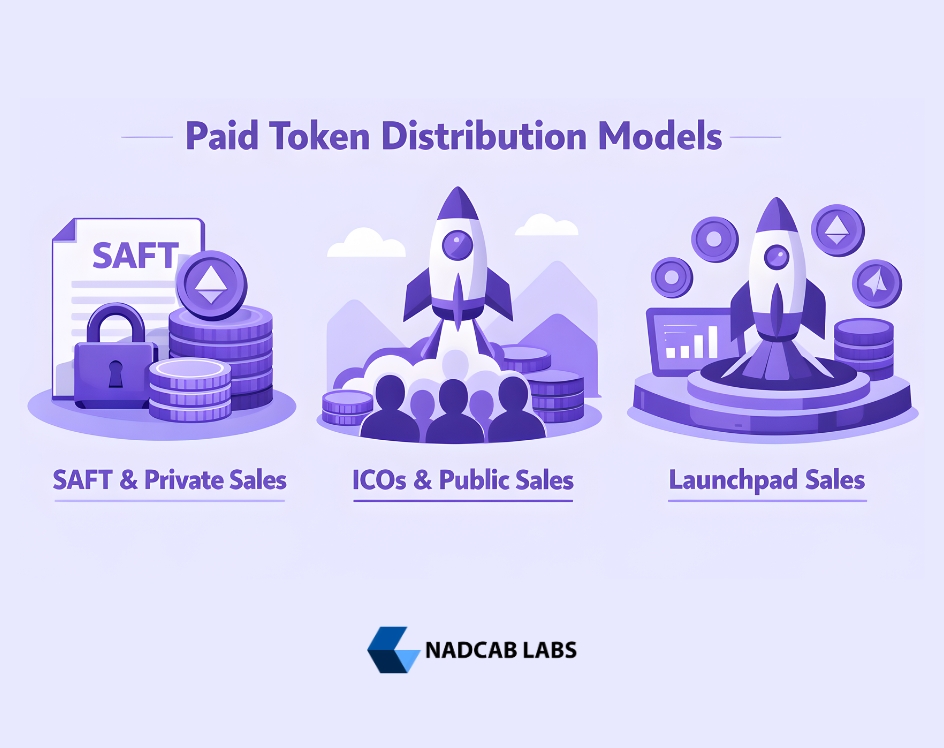
Paid Token Distribution Models
Paid models are how projects raise capital by selling tokens to investors or the public. These carry the heaviest regulatory requirements because money changes hands, and securities laws in most jurisdictions treat token sales with significant scrutiny.
SAFT and Private Token Sales
A SAFT (Simple Agreement for Future Tokens) is the most common fundraising instrument for pre-launch Web3 projects. Investors pay capital now in exchange for tokens delivered later, once the network launches. Because the token cap table is still forming, SAFTs specify allocations as percentages rather than fixed amounts. Private token sales occur when tokens already exist and are sold directly to selected investors. Both require rigorous investor verification to satisfy anti-money laundering regulations. The development of proper legal frameworks around these instruments has become essential as regulators worldwide tighten oversight of crypto fundraising.
ICOs and Public Token Sales
Initial Coin Offerings (ICOs) and public token sales allow projects to raise funds directly from the general public. While ICOs democratize access to early-stage investment, they carry substantial legal obligations, projects must analyze regulatory requirements in their jurisdiction, implement KYC and AML procedures, and ensure marketing materials comply with financial legislation. The model has evolved significantly, with Security Token Offerings (STOs), Initial Exchange Offerings (IEOs), and Initial DEX Offerings (IDOs) emerging as more structured alternatives addressing regulatory and accessibility gaps.
Launchpad Sales
Launchpad token sales represent a hybrid approach where a third party, typically a cryptocurrency exchange, organizes and manages the sale on behalf of the project. The exchange handles KYC verification, provides marketing infrastructure, and manages distribution. In return, projects undergo listing onboarding that includes providing a Token Legal Opinion. This reduces operational burden on founders but means ceding control over the sale process. For projects exploring how to create crypto assets from scratch, understanding which sale mechanism aligns with their regulatory profile is critical.
Free Token Distribution Models
Not all tokens are sold. A significant portion of any project’s supply is distributed without direct payment, to founders, team members, advisors, and the broader community. These free distributions serve different strategic purposes, from incentivizing core contributors to bootstrapping network effects. While they avoid direct regulatory burdens of paid sales, they introduce risks around fairness, manipulation, and value alignment.
Team and Advisor Allocations
Founders typically reserve a dedicated token pool for the team and advisors, distributed through Token Option Agreements. These agreements specify the token vesting schedule, when tokens accrue, along with performance milestones or tenure requirements that must be met before tokens become available. After vesting completes, a lockup period often follows to prevent immediate selling. This layered approach, vesting followed by lockup, prevents supply shocks that erode token value. Tokenomics research across gaming and DeFi projects shows that team and advisor allocations account for a meaningful but not dominant share of total supply, with gaming projects tending to allocate slightly less to teams than DeFi protocols.
Airdrops and Community Rewards
Airdrops distribute tokens for free to community members who complete specific tasks, testing the product, finding bugs, or being early adopters. The goal is viral growth through network effects. However, airdrops have become one of the most exploited community token distribution mechanisms. Sybil attacks, where single entities create thousands of fake wallets to claim disproportionate shares, have captured nearly 48% of distributed tokens in some major airdrops. The a Priori airdrop saw approximately 80% of its BNB chain tokens claimed by 5,800 interconnected wallets, while the IRYS airdrop lost roughly 20% of its supply to 900 coordinated wallets. The development of Sybil-resistant distribution mechanisms, tying rewards to verifiable on-chain spending rather than simple task completion, is rapidly reshaping how projects approach airdrops.
Staking and Liquidity Mining Incentives
Staking rewards and liquidity mining incentives distribute tokens to users who lock their assets in the network, either to secure the blockchain through proof-of-stake mechanisms or to provide liquidity on decentralized exchanges. These models improve network stability and trading depth, but require careful management to prevent inflation from outpacing demand. The connection between these incentives and liquidity pool tokens is direct, users who provide liquidity receive LP tokens representing their pool share, while also earning the protocol’s native token as an additional incentive layer.
Token Vesting Schedules and Their Market Impact
A token vesting schedule controls the pace at which allocated tokens become liquid and tradeable. It is one of the most powerful levers in tokenomics, directly influencing price stability, investor confidence, and holder behavior. The two primary structures are cliff vesting, where tokens release all at once after a waiting period, and linear vesting, where tokens unlock gradually. Most projects combine both, an initial cliff followed by monthly or quarterly linear releases.
The market impact of vesting events is well-documented and often severe. The SUI network released approximately $335 million in tokens during one cliff unlock, and combined with subsequent unlocks totaling over $419 million, its price plummeted more than 50% within months. Pi Network faced community alarm over a scheduled release of 337 million tokens, roughly 4.1% of its circulating supply, with analysts warning of potential 30% to 77% price drops. The development of milestone-based vesting, where unlocks are tied to achieving specific product or adoption goals rather than arbitrary time periods, is gaining traction as a more sustainable alternative.
The Low Float, High FDV Problem
One of the most damaging token distribution trends has been launching tokens with extremely low circulating supply, often under 20% of total supply, paired with inflated fully diluted valuations. This creates an illusion of high value benefiting early insiders while leaving retail investors exposed to massive dilution as locked tokens unlock. Nearly 80% of tokens listed under this model declined significantly after their initial listing.
The root cause is misaligned incentives between private and public markets. Venture capital firms invest at early valuations, tokens launch at multiples with minimal float, and public participants absorb selling pressure as insiders’ tokens unlock. This has pushed many retail users toward fully circulating tokens, not for their utility, but for their transparent supply. Projects pursuing fair token distribution in crypto are responding by reserving larger community allocations, increasing initial float percentages, and implementing token burn mechanisms to offset future supply expansion.
DAO Token Governance and Distribution
Many Web3 projects establish Decentralized Autonomous Organizations (DAOs) as their governance layer, distributing governance tokens that grant holders voting rights over protocol decisions. The distribution of these tokens directly determines who holds power. In theory, widespread distribution creates democratic decision-making. In practice, concentration remains a persistent challenge.
Data across more than 200 DAOs shows the top 10% of token holders control over 76% of voting power, far exceeding the 39% concentration typical in traditional public companies. Average voter participation sits around 17%, meaning a small minority makes decisions for entire ecosystems. The Arbitrum DAO faced a governance crisis when a single user spent just 5 ETH (approximately $10,000) to purchase 19.5 million ARB votes worth $6.5 million through a vote-buying platform, instantly surpassing major delegates.[1] Meanwhile, the Aave DAO rejected a significant token alignment proposal amid accusations that the founder’s $15 million token purchase was designed to inflate voting power. These incidents underscore why how investors evaluate tokenomics must include governance distribution as a primary risk factor.
How Token Distribution Impacts Long-Term Project Success
Tokenomics research consistently shows that token distribution at launch has a measurable, lasting impact on project outcomes. Projects that allocate disproportionately to insiders face persistent sell pressure as tokens vest. Projects with inadequate community pools struggle to bootstrap adoption. And projects without transparent vesting schedules invite panic around every unlock event.
Open-source tokenomics datasets covering dozens of gaming and DeFi projects reveal instructive patterns. DeFi and gaming are surprisingly similar in allocation structures, but gaming projects tend to allocate higher portions to ecosystem incentives and public sales, while DeFi skews more toward investors and teams. Across both sectors, private investor allocations consistently exceed public sale allocations. Most projects use a capped token supply, a critical design choice preventing unlimited dilution. The development of data-driven tokenomics tools enables teams to model these trade-offs before committing, running simulations across market conditions to stress-test allocation decisions.
Building a Sustainable Token Distribution Strategy
Constructing sustainable tokenomics models requires balancing multiple competing interests while maintaining flexibility for changing market conditions. The process involves legal preparation, technical implementation, and ongoing community engagement.
Defining Allocation and Objectives
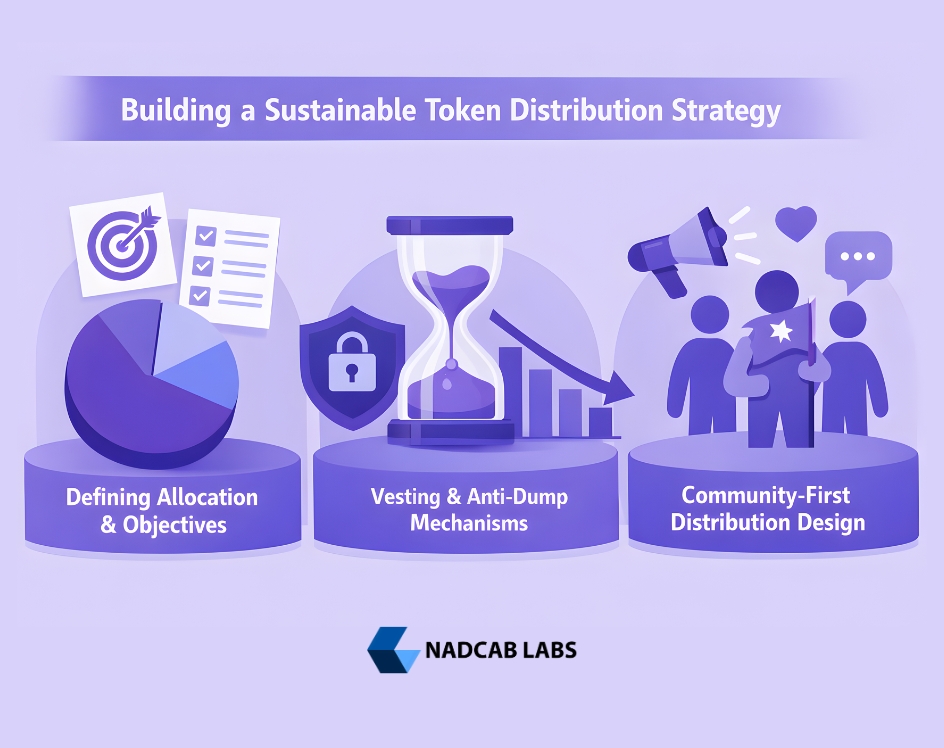
A strong token allocation strategy begins with clearly defining the purpose of each allocation pool. Investor allocations support product development and growth, community pools help accelerate adoption, treasury reserves ensure operational stability, and ecosystem pools encourage long term engagement. Each of these categories should have well structured vesting schedules, clear release conditions, and proper governance frameworks. At the same time, the allocation design must align with practical expectations around available crypto solutions for smart contract execution, since more advanced distribution models depend on reliable technical infrastructure, often provided by an experienced token development company.
Implementing Vesting and Anti-Dump Mechanisms
Effective token distribution requires layered release mechanisms. A standard approach combines cliff periods (typically 6 to 12 months) with linear vesting (monthly unlocks over 2 to 4 years) and post-vesting lockups for team and investor tokens. Milestone-based vesting adds another dimension, tying releases to verifiable on-chain metrics rather than calendar dates. Token burn mechanisms, where transaction fees permanently remove tokens from circulation, can offset the dilutive impact of ongoing emissions.
Community-First Distribution Design
The shift toward community-first distribution reflects hard lessons from the low float era. Projects that reserve meaningful allocations for genuine community participants, through carefully designed airdrops, staking rewards, and governance participation incentives, build more resilient ecosystems than those concentrating tokens among insiders. Sybil-resistant airdrop mechanisms, including on-chain activity scoring, reputation systems, and volume-based qualification, are becoming standard practice as projects work to ensure distributions reach real users rather than automated farming operations.
Need Expert Guidance on Token Distribution?
Nadcab Labs helps Web3 teams design fair token allocation strategies, build secure smart contracts, and implement vesting mechanisms that align with long-term project goals.
Critical Factors Often Overlooked in Token Distribution
Beyond the core allocation models, several interconnected factors shape whether a token distribution strategy succeeds or fails. These elements, from treasury management to blockchain selection and regulatory frameworks, often determine the difference between projects that build lasting ecosystems and those that collapse under structural weaknesses.
Treasury Token Management
A treasury pool acts as a project’s financial safety net, a reserve of tokens deployed for future development, partnerships, or market stabilization. Effective treasury token management requires clear governance rules defining who can authorize spending and what percentage can be deployed within a given period. Without these controls, treasuries become targets for insider extraction or governance attacks, as seen in high-profile DAO controversies where concentrated voting power redirected treasury funds.
Token Inflation, Dilution, and Supply Models
Whether a token uses an inflationary or deflationary supply model has profound implications for long-term holder value. Inflationary tokens continuously mint new supply, often to fund staking rewards or ecosystem incentives, which can erode purchasing power if demand does not keep pace. Deflationary tokens use burn mechanisms to permanently reduce circulating supply, creating scarcity that can support price appreciation. Many successful projects combine both approaches: Ethereum’s EIP-1559 burns a portion of transaction fees while still issuing new tokens to validators, creating a dynamic where network usage directly influences whether the supply is expanding or contracting. Projects with a capped token supply avoid unlimited dilution but must design their emission schedules to sustain incentives without exhausting the fixed pool.
Token Types and Their Distribution Implications
Not all tokens are distributed under the same rules because not all tokens serve the same function. Utility tokens provide access to a platform’s services and face lighter regulatory scrutiny in most jurisdictions. Security tokens represent ownership of an underlying asset and must comply with securities laws, making their distribution significantly more complex. Governance tokens grant voting rights within a DAO and carry the added responsibility of equitable distribution to prevent power concentration. The development of each token type demands a distinct distribution approach, what works for a utility token’s community airdrop would likely violate compliance requirements for a security token.
Blockchain Selection and Cross-Chain Distribution
The choice of blockchain platform directly shapes distribution mechanics and costs. Ethereum remains the most widely used chain for token distribution, particularly among DeFi protocols, due to its mature smart contract infrastructure and broad exchange support. Binance Smart Chain (BSC) and Solana offer lower transaction fees, making them popular for gaming tokenomics models and projects targeting high-volume micro-distributions. Increasingly, projects are pursuing cross-chain distribution strategies, issuing tokens natively on one chain while bridging to others, to maximize reach. However, fragmented liquidity across chains introduces complexity in treasury management, governance coordination, and ensuring consistent vesting enforcement across different network environments.
Regulatory Compliance and Global Frameworks
Token distribution for Web3 startups now operates within an increasingly defined regulatory landscape. The European Union’s MiCA regulation sets clear requirements for token issuers including transparency obligations and authorization procedures. In the United States, SEC guidance continues shaping how tokens are classified and distributed. Projects targeting global distribution must build compliance into their smart contracts, through whitelists, transfer restrictions, and KYC integration, rather than treating regulation as an afterthought.
Final Thoughts
Token distribution models are not a checkbox on a launch checklist, they are the economic constitution of a Web3 project. Every allocation decision ripples through the ecosystem for years, shaping price behavior, community loyalty, governance integrity, and regulatory exposure. The projects that endure treat distribution as a careful development exercise in incentive alignment: balancing the needs of capital providers, builders who create the product, and communities who generate adoption. In a market where most tokens fail and trust is scarce, getting distribution right is the most important thing a founder can do.
Frequently Asked Questions
Q1.What are token distribution models exactly?
Token distribution models are strategic frameworks that determine how a project’s total token supply is allocated among investors, founders, team members, advisors, community participants, and treasury reserves over time.
Q2.How do token vesting schedules work?
Vesting schedules gradually release locked tokens over predetermined periods using cliff structures for lump-sum releases or linear schedules for steady unlocks, preventing early holders from flooding markets immediately.
Q3.What is a SAFT agreement?
A SAFT is a Simple Agreement for Future Tokens where investors provide capital before token launch in exchange for receiving a specified percentage allocation once tokens are generated.
Q4.How do airdrops get exploited unfairly?
Sybil attackers create thousands of fake wallets to claim disproportionate airdrop shares, sometimes capturing over 48% of distributed tokens and undermining the fairness of community distributions entirely.
Q5.What makes fair token distribution important?
Fair distribution builds community trust, prevents insider dumping, ensures decentralized governance, and creates sustainable price stability — all essential factors that smart investors evaluate before committing capital.
Q6.How does governance token concentration affect DAOs?
When a small percentage of holders controls majority voting power, governance decisions favor whales over the broader community, enabling vote manipulation, value extraction, and erosion of decentralization principles.
Q7.What is the low float problem?
Low float occurs when tokens launch with minimal circulating supply but inflated valuations, creating artificial scarcity that benefits insiders while exposing retail investors to severe dilution during future unlocks.
Explore Services
Related Services
Reviewed by

Aman Vaths
Founder of Nadcab Labs
Aman Vaths is the Founder & CTO of Nadcab Labs, a global digital engineering company delivering enterprise-grade solutions across AI, Web3, Blockchain, Big Data, Cloud, Cybersecurity, and Modern Application Development. With deep technical leadership and product innovation experience, Aman has positioned Nadcab Labs as one of the most advanced engineering companies driving the next era of intelligent, secure, and scalable software systems. Under his leadership, Nadcab Labs has built 2,000+ global projects across sectors including fintech, banking, healthcare, real estate, logistics, gaming, manufacturing, and next-generation DePIN networks. Aman’s strength lies in architecting high-performance systems, end-to-end platform engineering, and designing enterprise solutions that operate at global scale.