Ai Overview
Token burn models & crypto supply management represent critical components of cryptocurrency economics determining long-term value sustainability and scarcity dynamics. Understanding what is token burning and how different burn mechanisms function proves essential for evaluating tokenomics quality, assessing investment opportunities, and designing sustainable cryptocurrency projects. For example, a token might burn 1% of every transaction, creating constant deflationary pressure proportional to trading activity.
Token burn models & crypto supply management represent critical components of cryptocurrency economics determining long-term value sustainability and scarcity dynamics. Token burning permanently removes digital assets from circulation through cryptographically verifiable mechanisms, creating deflationary pressure opposing inflationary issuance from mining rewards, staking emissions, or development allocations. Understanding what is token burning and how different burn mechanisms function proves essential for evaluating tokenomics quality, assessing investment opportunities, and designing sustainable cryptocurrency projects.
Cryptocurrency supply reduction through burn mechanisms ranges from simple manual burns where teams destroy treasury holdings to sophisticated automated systems linking burns directly to network activity. Projects implement token burn impact on price strategies attempting to create scarcity supporting value appreciation, though burns alone cannot guarantee positive outcomes without corresponding demand growth. Professional crypto token solutions providers help design balanced tokenomics incorporating appropriate burn mechanisms aligned with project economics and community expectations.
Key Takeaways
- Permanent Removal Mechanism: Token burning irreversibly eliminates cryptocurrency from circulation by sending assets to inaccessible addresses or destroying them through smart contract functions, verifiable through on-chain transactions.
- Multiple Burn Models Exist: Burn mechanisms include manual burns controlled by project teams, automatic burns triggered by transactions, fee-burn systems consuming network costs, and buy-and-burn programs purchasing then destroying tokens.
- Deflationary vs Inflationary Balance: Whether cryptocurrency is deflationary depends on net balance between token issuance and burns, with some protocols remaining inflationary despite regular burns if emissions exceed destruction.
- Usage-Based Burns Most Effective: Burn mechanisms tied directly to protocol activity create sustainable deflationary pressure scaling with adoption, while arbitrary burns disconnected from utility provide limited long-term impact.
- Supply Reduction Not Value Guarantee: Token burns decrease circulating supply but don’t automatically increase value, as prices ultimately depend on demand dynamics, utility growth, and market conditions beyond supply manipulation.
- Transparency Critical for Trust: Verifiable on-chain burn transactions enable community verification of burn claims, while opaque or discretionary burns create trust issues undermining intended economic effects.
- Tax Implications Vary: Burning cryptocurrency may trigger taxable events in some jurisdictions treating burns as disposal, requiring careful tax planning and record-keeping for compliance.
- Integration with Tokenomics Essential: Effective burn mechanisms integrate with broader tokenomics including emission schedules, staking rewards, governance rights, and value capture creating sustainable economic systems.
Understanding Token Burning Fundamentals
Token burning in crypto permanently removes digital assets from circulation through cryptographically verifiable mechanisms ensuring destroyed tokens can never be recovered or reused. This fundamental cryptocurrency supply management tool creates scarcity dynamics potentially supporting value appreciation when balanced against demand factors.
What is Token Burning
At its core, crypto token burn represents the permanent, irreversible elimination of cryptocurrency units from existence. Unlike temporary lockups or vesting schedules that delay token availability, burning mathematically and cryptographically ensures destroyed tokens can never reenter circulation regardless of future technological developments or governance changes.
Token burning achieves permanent removal through two primary mechanisms. First, tokens can be sent to burn addresses—blockchain addresses without known private keys making fund recovery impossible. Anyone can verify balances at these addresses confirming tokens remain permanently inaccessible. Common burn addresses include variations like 0x000…dead or 0x000…000 on Ethereum and similar networks.
Second, smart contract burn functions directly reduce token balances and total supply variables. When contracts execute burn operations, they decrease both individual holder balances and overall supply tracking, effectively destroying tokens rather than merely relocating them. This approach proves more elegant than burn addresses as supply metrics immediately reflect destruction.
Understanding how does token burning work requires recognizing these mechanisms create verifiable, transparent, and irreversible supply reduction auditable by anyone examining blockchain data. This transparency distinguishes cryptocurrency burns from opaque supply management in traditional finance.
Historical Context and Evolution
Token burning evolved from early cryptocurrency experiments with proof-of-burn consensus mechanisms where users destroyed coins to gain mining rights. This concept expanded as projects recognized burns’ potential for managing tokenomics, aligning incentives, and creating deflationary pressure opposing endless inflation.
Modern burn implementations became sophisticated following Ethereum’s London Hard Fork in 2021 introducing EIP-1559. This upgrade transformed transaction fee economics by burning base fees rather than distributing them to miners, creating direct link between network activity and supply reduction. Since implementation, over 4.5 million ETH worth billions of dollars has been permanently burned.
Burn Addresses and Dead Wallets
Burn address crypto utilizes specially designated addresses designed for permanent token destruction. These addresses follow specific patterns making them recognizable while ensuring no private keys exist enabling fund recovery. The most common Ethereum burn address 0x000000000000000000000000000000000000dead has received billions in token value across thousands of transactions.
Dead wallet addresses differ slightly from intentional burn addresses. While burn addresses are purposefully created for destruction, dead wallets may result from lost private keys or abandoned accounts. However, both serve similar functions in reducing circulating supply, though only intentional burns occur as deliberate tokenomics strategy.
Verifying burns requires examining blockchain explorers confirming tokens arrived at known burn addresses or reviewing smart contract code validating proper burn function implementation. This transparency enables community oversight ensuring projects execute burn commitments as claimed.
| Burn Method | How It Works | Verification | Examples |
|---|---|---|---|
| Burn Address | Send tokens to address without private key | Check burn address balance on explorer | Shiba Inu community burns |
| Smart Contract Function | Contract reduces balance and total supply | Review contract code and burn events | ERC-20 burn function calls |
| Protocol-Level Burn | Built into blockchain consensus rules | Analyze blockchain parameters | Ethereum EIP-1559, Avalanche fees |
Types of Token Burn Mechanisms
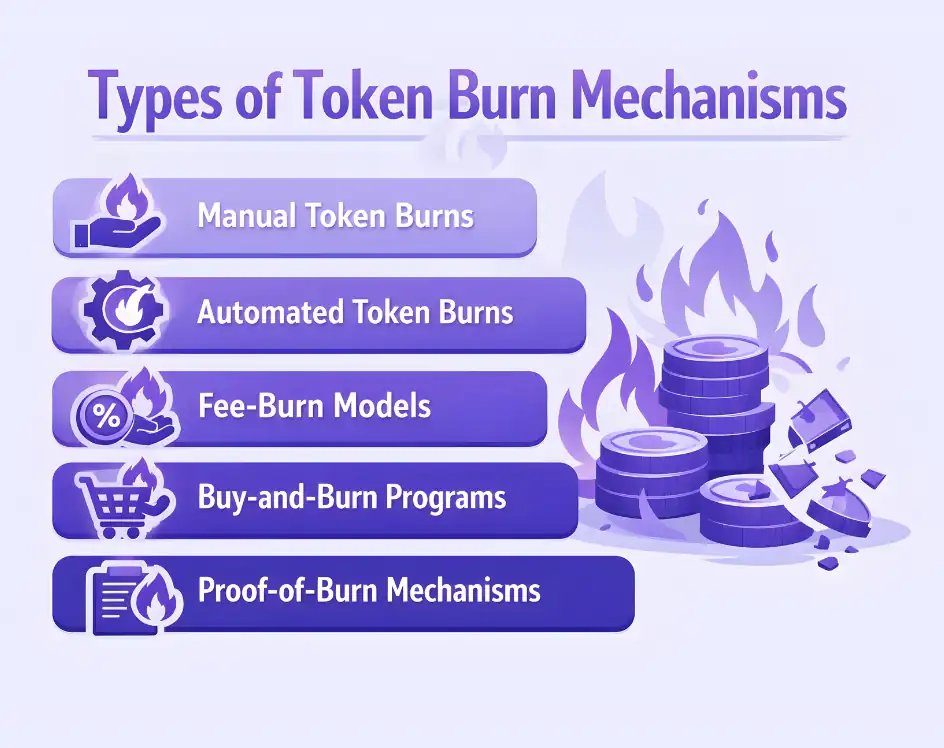
Token burn mechanism implementations vary significantly across cryptocurrency projects, with each approach offering different trade-offs regarding transparency, predictability, and economic impact. Understanding these variations helps evaluate tokenomics quality and sustainability.
Manual Token Burns
Manual token burn involves project teams or foundations explicitly deciding to destroy specific token quantities at designated times. These burns typically occur through public announcements followed by transactions sending tokens to burn addresses or executing smart contract burn functions.
Binance Coin exemplifies structured manual burns through quarterly BNB token burn events based on trading volume and profits. Since 2017, Binance has burned over 60 million BNB reducing total supply from 200 million toward target of 100 million. These predictable scheduled burns create expectations influencing market dynamics despite being discretionary rather than automated[1].
Manual burns offer flexibility enabling projects to adjust burn quantities based on market conditions, treasury health, or strategic objectives. However, this discretion requires community trust that teams execute burns as promised without manipulation. Transparency through advance announcements and verifiable on-chain execution helps maintain credibility.
Automated Token Burns
Automated token burn systems execute programmatically based on predefined smart contract logic without requiring manual intervention. These mechanisms increase predictability and remove discretionary control, though they sacrifice flexibility responding to changing circumstances.
Transaction-based automatic burns destroy fixed percentages of transferred tokens. For example, a token might burn 1% of every transaction, creating constant deflationary pressure proportional to trading activity. While simple to implement, this approach can discourage transactions and create friction for legitimate use cases.
Smart contract burn function implementations allow protocols embedding burn logic directly into core operations. DeFi platforms might burn portions of swap fees, lending interest, or protocol revenue automatically linking burns to genuine economic activity rather than arbitrary rules.
Fee-Burn Models
Fee burn model approaches consume network or protocol fees rather than distributing them to validators, miners, or treasury. This creates direct relationship between usage and supply reduction, with higher activity generating greater burns.
Ethereum’s EIP-1559 base fee burn represents the most prominent fee-burn implementation. Every transaction burns base fees proportional to network congestion, with only priority tips going to validators. During peak activity periods, Ethereum becomes deflationary with burn rates exceeding new issuance from staking rewards. This mechanism transforms transaction costs into supply reduction benefiting all holders rather than concentrating value in validator hands.
Avalanche implements similar fee burning where all AVAX used for transaction fees is permanently destroyed. Higher network activity directly increases burn volume, creating transparent link between adoption and supply dynamics. This approach aligns incentives encouraging network growth while managing inflation.
Buy-and-Burn Programs
Buy and burn program strategies involve protocols purchasing tokens from open markets then permanently destroying them. This two-step process injects buying pressure before elimination, potentially creating more immediate price impact than simple burns.
Projects typically fund buy-and-burn operations through protocol revenue, transaction fees, or treasury allocations. The purchasing creates demand supporting prices, while subsequent burning permanently reduces supply. This combination potentially produces stronger effects than either action alone.
However, buy-and-burn programs require sufficient revenue or treasury funding to execute meaningfully. Protocols with limited income may announce impressive burn percentages that translate to minimal absolute quantities. Evaluating these programs demands examining actual dollar values purchased and burned rather than focusing solely on token quantities or percentages.
Proof-of-Burn Mechanisms
Proof of burn represents a consensus mechanism where users burn cryptocurrency to gain mining rights, validation privileges, or access to protocol features. This burn serves functional purpose rather than purely economic supply management.
In proof-of-burn systems, destroying tokens demonstrates commitment similar to staking in proof-of-stake networks. Users sacrifice immediate value for longer-term participation rights, creating selection mechanism favoring committed participants over casual speculators. While less common than other consensus approaches, proof-of-burn finds application in specialized blockchain implementations and cross-chain protocols.
Economic Impact of Token Burns
Understanding does token burning increase price requires examining supply-demand dynamics, market psychology, and fundamental value drivers beyond simple scarcity narratives. While burns reduce supply, price appreciation depends on corresponding demand growth and utility expansion.
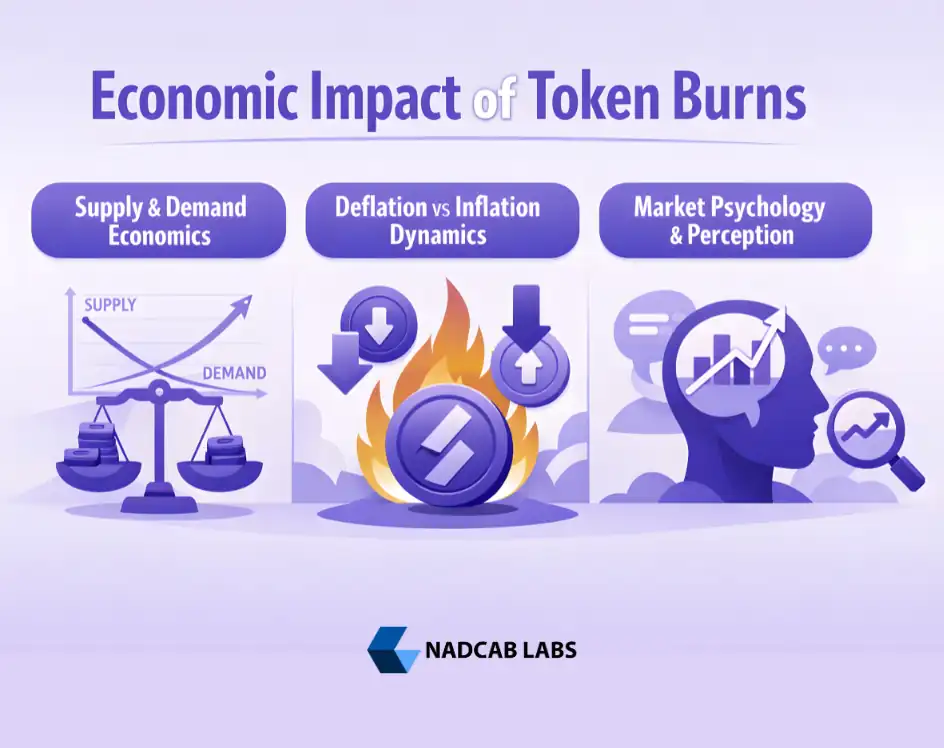
Supply and Demand Economics
Crypto supply and demand fundamentals suggest reducing supply while maintaining constant demand should support price appreciation. If market participants desire fixed quantity of tokens but available supply decreases, economic theory predicts upward price pressure as buyers compete for scarcer assets.
However, this simplified analysis overlooks critical factors. Demand rarely remains constant—it fluctuates based on market sentiment, technological development, competitive positioning, and macroeconomic conditions. Burns occurring during demand declines may fail offsetting sell pressure, while burns during demand surges amplify already-strong appreciation.
Circulating supply reduction proves more significant than total supply changes. Many cryptocurrencies have substantial locked or vested allocations not actively traded. Burns affecting these inactive holdings create minimal immediate market impact compared to reducing circulating trading supply. Understanding the difference between total supply and circulating supply helps interpret burn significance.
Deflation vs Inflation Dynamics
Deflationary cryptocurrency requires burn rates exceeding new issuance. Many projects implement burns while simultaneously emitting tokens through staking rewards, mining, or development allocations. Whether net supply increases or decreases depends on this balance.
Crypto inflation vs deflation analysis must examine complete tokenomics rather than isolated burn announcements. A project burning 5% of supply annually while issuing 10% through rewards remains inflationary despite regular burns. Truly deflationary projects like post-merge Ethereum during high activity achieve net supply reduction when burns exceed issuance.
Net token issuance tracking provides accurate picture of supply dynamics. This metric subtracts burns from new issuance revealing actual supply growth or contraction. Projects should transparently report net issuance alongside gross burn figures enabling informed evaluation.
Market Psychology and Perception
Token burn impact on price often stems more from psychological effects than fundamental supply changes. Burn announcements generate excitement signaling project commitment to supply discipline and long-term value creation. This narrative influences sentiment even when absolute quantities burned prove minimal relative to total supply.
Markets frequently price in predictable burn schedules, reducing reaction to expected events. Quarterly burns become routine rather than catalytic once established. However, unexpected burns or increased burn rates can trigger renewed interest as market participants reassess tokenomics and future trajectories. Understanding ROI in crypto helps contextualize how burns influence investment returns.
Real-World Token Burn Examples
Examining how major cryptocurrency projects implement burns provides practical insights into different approaches and their effectiveness at managing supply while supporting ecosystem growth.
Ethereum EIP-1559 Implementation
Ethereum EIP-1559 burn mechanism fundamentally transformed Ethereum’s economic model by introducing base fee burning. Implemented through the London Hard Fork in August 2021, this upgrade makes Ethereum deflationary during high network activity when base fees burned exceed new ETH issued to validators.
The mechanism works by splitting transaction fees into base fees (burned) and priority tips (paid to validators). Base fees adjust algorithmically based on block fullness, creating more predictable fee markets while removing ETH from circulation. During periods of sustained high activity, burn rates can exceed 10,000 ETH daily worth tens of millions of dollars.
This usage-based burn directly links network adoption to supply reduction. More transactions, DeFi activity, and NFT minting increase burns proportionally. This creates virtuous cycle where success begets scarcity potentially supporting further appreciation and adoption. However, during low activity periods, Ethereum remains mildly inflationary as issuance exceeds burns.
BNB Auto-Burn and BEP-95
Binance Coin combines manual quarterly burns with automated BEP-95 real-time burning. The quarterly burns remove BNB based on Binance’s profits and trading volumes, targeting eventual supply reduction to 100 million from original 200 million.
BEP-95 introduced automatic burning of portion of gas fees on BNB Chain, similar to Ethereum’s approach. This real-time mechanism supplements quarterly burns with usage-based destruction creating multiple deflationary pressures. The combination demonstrates how projects can layer different burn mechanisms creating comprehensive supply management strategies.
Shiba Inu Community Burns
Shiba Inu token burn initiatives primarily rely on community-driven efforts where holders voluntarily send SHIB to dead addresses. Various burn portals and partner platforms facilitate these burns, often incentivizing participation through gamification or rewards in other tokens.
While SHIB burns have destroyed trillions of tokens, the impact on price remains debated given the enormous total supply of hundreds of trillions. Community burns create engagement and demonstrate commitment, but their voluntary nature and inconsistent scale limit sustained economic impact compared to automatic protocol-level burns. This highlights importance of burn mechanism design rather than merely burn existence[2].
Avalanche Fee Burning
Avalanche AVAX fee burn destroys all transaction fees rather than distributing them to validators. Validators earn rewards through new AVAX issuance rather than fees, making the network’s fee structure purely deflationary regarding existing supply.
This design means every transaction, smart contract interaction, and cross-chain transfer permanently removes AVAX from circulation. Higher network adoption directly increases burn rates creating transparent relationship between usage and supply reduction. When to launch crypto token on Avalanche, understanding this fee structure helps projects plan token economics.
Designing Effective Burn Mechanisms
Creating sustainable token burn models requires careful consideration of tokenomics, community expectations, and long-term protocol sustainability. Effective burns integrate with broader economic design rather than serving as isolated features.
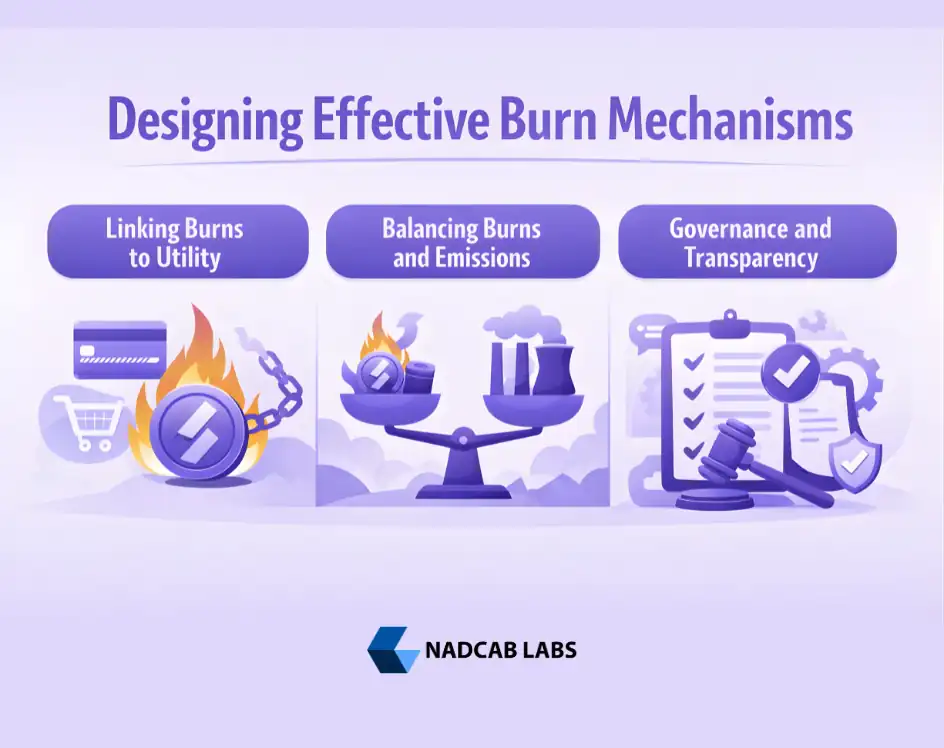
Linking Burns to Utility
Crypto projects burn tokens most effectively when burns correlate with genuine protocol usage, creating sustainable deflationary pressure. Usage-based burns automatically scale with adoption, intensifying during growth periods while moderating during quiet times. Partnering with a token development company can help design these mechanisms efficiently, ensuring that tokenomics align with real-world usage and long-term sustainability.
Fee-burning mechanisms exemplify this principle by consuming costs users already pay, transforming necessary expenses into supply reduction. This approach avoids artificial tokenomics requiring users to burn tokens for no functional reason, which typically fails gaining traction.
DeFi protocols can burn portions of swap fees, lending interest, or protocol revenue directly tying burns to value creation. As total value locked and transaction volumes increase, burn quantities grow proportionally reinforcing positive feedback between success and scarcity.
Balancing Burns and Emissions
Effective tokenomics balance burns against necessary emissions for rewards, development, and ecosystem growth. Pure deflationary models risk insufficient incentives for validators, developers, or community participation as rewards decline.
Optimal designs often target net-neutral or mildly deflationary long-term trajectories. Early growth phases might accept inflation incentivizing adoption, transitioning toward deflation as maturity reduces growth capital needs. This evolution enables bootstrapping networks while ensuring long-term sustainability.
Transparent token distribution models combined with clear burn schedules enable community evaluation of net issuance trajectories over multi-year periods. Projects should publish comprehensive tokenomics documentation showing projected supply evolution under various adoption scenarios.
Governance and Transparency
Blockchain tokenomics model transparency proves critical for burn mechanism credibility. All burns should be verifiable on-chain through public blockchain explorers enabling independent confirmation without trusting project claims.
Governance-driven burns allow communities collectively deciding burn parameters, schedules, or treasury allocations for buybacks. This decentralized decision-making prevents unilateral team actions while building consensus around supply management strategies. However, governance introduces complexity and potential delays requiring emergency procedures for time-sensitive decisions.
Regular reporting communicating burn statistics, net issuance, and economic impact helps communities tracking tokenomics performance. Dashboards visualizing cumulative burns, burn rates, and supply projections enable informed participation in governance discussions.
Design Sustainable Token Economics
Partner with experienced blockchain professionals to create balanced tokenomics incorporating effective burn mechanisms aligned with utility growth and long-term sustainability rather than short-term speculation.
Risks and Limitations of Token Burns
Despite potential benefits, token burning carries risks and limitations investors and projects must understand to avoid misplaced expectations or poor tokenomics design decisions.
Burns Don’t Guarantee Value
The most critical limitation involves burns’ inability to guarantee price appreciation without corresponding demand growth. Reducing supply by 50% while demand falls 75% still results in lower prices despite scarcity increases. Sustainable value creation requires improving utility, expanding adoption, and delivering real solutions to user problems.
Crypto scarcity model approaches focusing exclusively on supply reduction without utility development typically fail as initial excitement fades. Markets eventually recognize that scarcity of worthless tokens provides no value, requiring genuine demand drivers supporting prices long-term.
Misleading Burn Narratives
Projects sometimes emphasize massive burn percentages while obscuring tiny absolute quantities or continued high emissions. Burning 50% of supply sounds impressive until realizing total supply was arbitrary and emissions will replace burned tokens within months. Critical evaluation requires examining net supply changes rather than gross burn figures.
Marketing-driven burns announced for publicity without meaningful economic rationale create temporary excitement that fades quickly. What happens when crypto is burned depends entirely on implementation quality and economic integration rather than merely burn occurrence.
Liquidity and Market Impacts
Aggressive burns can reduce liquidity making markets less efficient and more volatile. When circulating supply becomes very small relative to demand, individual transactions create larger price impacts increasing slippage and trading costs.
Projects must balance scarcity benefits against liquidity requirements for healthy markets. Sufficient circulating supply enables efficient price discovery, supports exchange listings, and facilitates genuine use cases requiring transferability.
Tax and Regulatory Considerations
Is token burning taxable depends on jurisdiction and specific circumstances. In the United States, burning cryptocurrency might trigger capital gains or losses as disposal event even without receiving proceeds. Crypto burn tax implications require understanding local regulations and maintaining detailed records for compliance.
Some users voluntarily burning tokens for community initiatives may inadvertently create tax liability without economic gain. Professional tax guidance helps navigate these complexities ensuring compliance while minimizing unnecessary burdens. Implementing proper smart contract testing ensures burn mechanisms function as intended without unintended consequences.
Final Thoughts
Token burn models & crypto supply management represent powerful tools for cryptocurrency projects seeking to create deflationary pressure and align long-term incentives. Understanding token burning in crypto requires recognizing both mechanics—how burns permanently remove tokens—and economics—how burns interact with demand, utility, and market psychology affecting value.
Effective burn mechanisms link directly to protocol usage creating sustainable deflationary pressure scaling with adoption. Fee-burn models consuming network costs, automated burns triggered by genuine activity, and revenue-funded buyback programs demonstrate how burns can integrate with broader tokenomics rather than serving as isolated gimmicks.
However, crypto token burn alone cannot guarantee value appreciation without corresponding demand growth and utility expansion. Projects emphasizing burns while neglecting product development, user acquisition, and genuine problem-solving typically fail as markets recognize scarcity of worthless tokens provides no sustainable value.
The most successful implementations balance burns against necessary emissions for rewards and development, maintain transparency through verifiable on-chain transactions, and tie burns to real economic activity rather than arbitrary schedules. As cryptocurrency markets mature, sophisticated tokenomics incorporating thoughtful burn mechanisms alongside comprehensive economic design will increasingly separate sustainable projects from speculative schemes relying on supply manipulation narratives.
Frequently Asked Questions
Q1.What is token burning?
Token burning permanently removes cryptocurrency from circulation by sending tokens to inaccessible addresses or destroying them through smart contract functions. burned tokens cannot be recovered or reused, creating verifiable supply reduction auditable on blockchain.
Q2.Does token burning increase price?
Token burning reduces supply but doesn’t guarantee price increases. prices depend on demand dynamics, utility growth, and market conditions beyond supply. burns support prices only when accompanied by stable or growing demand for reduced supply.
Q3.How does token burning work?
Tokens burn through two methods: sending to addresses without private keys making recovery impossible, or smart contract functions reducing balances and total supply variables. both create permanent, verifiable, irreversible supply elimination.
Q4.What are different burn models?
Burn models include manual burns by teams, automatic burns triggered by transactions, fee-burn consuming network costs, buy-and-burn programs purchasing then destroying tokens, and proof-of-burn mechanisms requiring destruction for protocol access.
Q5.Is token burning taxable?
Tax treatment varies by jurisdiction. in the united states, burning cryptocurrency might trigger capital gains or losses as disposal event. users should consult tax professionals and maintain detailed records for compliance.
Q6.What is fee-burn model?
Fee-burn models consume network or protocol fees rather than distributing them to validators or treasury. ethereum’s eip-1559 and avalanche fee burning exemplify this approach directly linking usage to supply reduction.
Explore Services
Related Services
Reviewed by

Aman Vaths
Founder of Nadcab Labs
Aman Vaths is the Founder & CTO of Nadcab Labs, a global digital engineering company delivering enterprise-grade solutions across AI, Web3, Blockchain, Big Data, Cloud, Cybersecurity, and Modern Application Development. With deep technical leadership and product innovation experience, Aman has positioned Nadcab Labs as one of the most advanced engineering companies driving the next era of intelligent, secure, and scalable software systems. Under his leadership, Nadcab Labs has built 2,000+ global projects across sectors including fintech, banking, healthcare, real estate, logistics, gaming, manufacturing, and next-generation DePIN networks. Aman’s strength lies in architecting high-performance systems, end-to-end platform engineering, and designing enterprise solutions that operate at global scale.