For years, Bitcoin users who needed a transaction to go through faster had a straightforward option: replace it with a new one carrying a higher fee. This feature, called Replace-By-Fee or RBF, let wallets broadcast a signal to the network saying the user might want to swap the transaction for one with a bigger fee attached. Miners, incentivized by fees, would then prioritize the newer version.
It was a practical fix for a real problem. But some developers now believe the signal that makes this possible has overstayed its welcome — not because it does not work, but because it now does something it was never supposed to do.
What the Signal Actually Does Today
The issue is that the Bitcoin network itself changed. At some point, the default network policy shifted so that every transaction is treated as replaceable regardless of whether the wallet explicitly signals it. The signal is no longer what allows replacement to happen. The network handles that on its own.
That leaves the signal doing only one thing: identifying the wallet that sent the transaction. Different wallets set the signal in different ways, and those differences show up on-chain. Anyone watching the blockchain can look at that signal and make a reasonable guess about which wallet software was used. That is a fingerprint — and fingerprints are not good for privacy.
“The primary reason for its removal is that ever since full-RBF became a standard policy, this signaling has become redundant.”
Developer rkrux, posted to the Bitcoin Core developer mailing list
Why It Is Harder to Remove Than It Sounds
Removing a signal from one wallet is straightforward enough. The problem is that the Bitcoin ecosystem has dozens of different wallets, and if they each remove the signal in their own way, the result could actually make things worse.
Here is why. Sequence numbers — the technical field where the RBF signal lives — cannot simply be left blank. The protocol requires a value. If wallet A fills in that field one way and wallet B fills it in another, transactions from each wallet will look different on-chain. That makes them easier to sort and track, not harder.
Community contributor Murch laid this out clearly in a discussion on the topic, explaining that stopping the signal is not as simple as flipping a switch. Every wallet has to pick a number for that field, and the goal should be for all of them to pick the same one — so that transactions from any wallet are indistinguishable from each other.
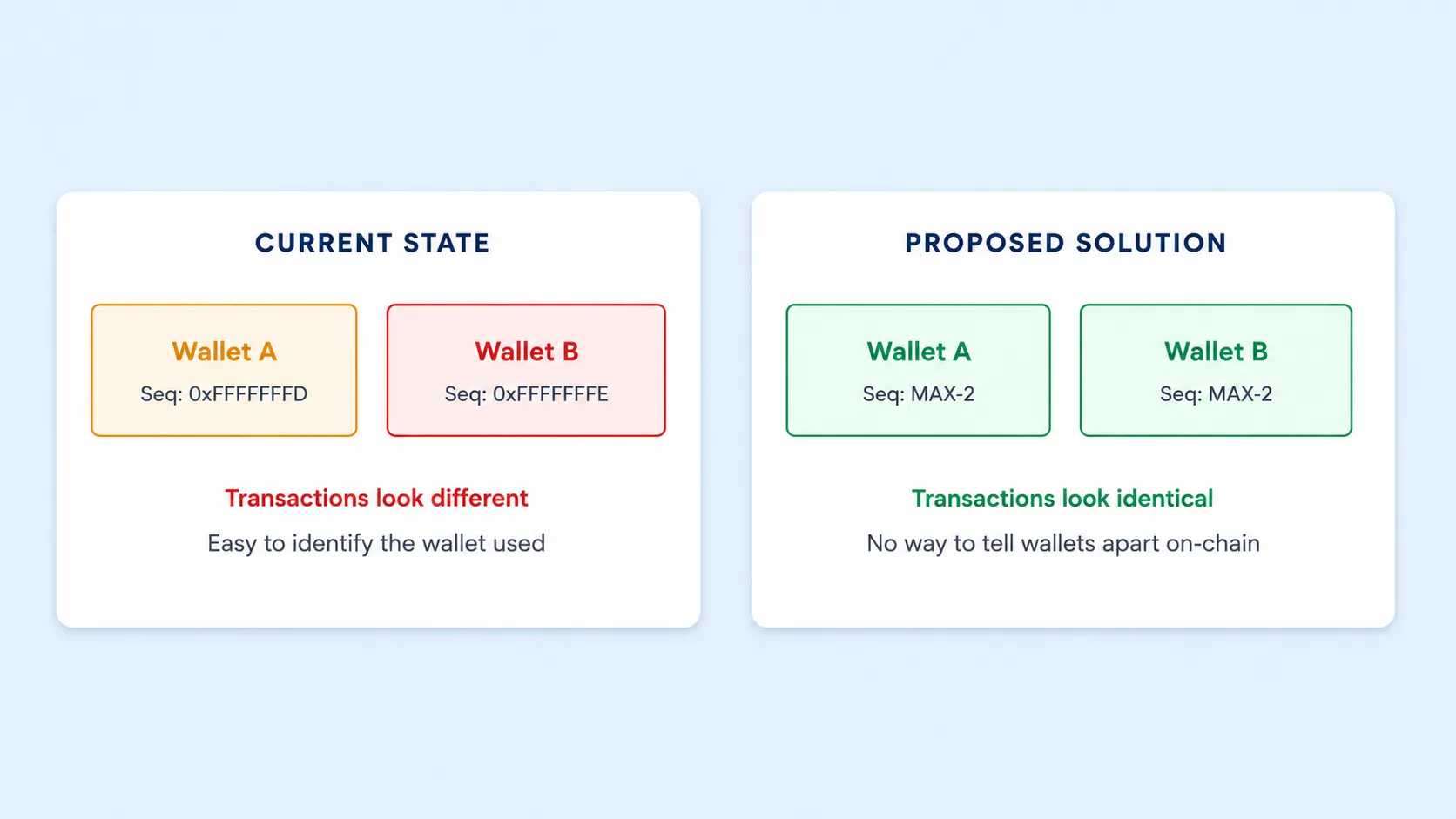
When wallets use different sequence numbers, transactions can be identified by wallet type. If all wallets agree on one standard value, that distinction disappears.
The Proposed Fix
The solution being discussed is for all wallets to adopt MAX-2 as the standard sequence number going forward. Since roughly 75 percent of wallets already use it, the gap is not enormous. But getting the remaining wallets to follow suit requires coordination — and that means discussion, agreement, and time.
The default sequence number, once agreed on by the broader wallet community, would make most transactions look alike on-chain. That is the goal. Not to remove functionality, but to remove the unintended side effect that makes users trackable.
What This Means for Regular Users
For most people who use Bitcoin, this change would not be noticeable at all. Transaction replacement would still work the same way. The network would still pick up higher-fee transactions and miners would still prioritize them. The only thing disappearing is the explicit flag in the wallet that announced the user’s intention to do so.
The benefit, if developers pull it off cleanly, is that your wallet becomes a little harder to identify based on what your transactions look like on the blockchain. In a space where on-chain surveillance is an increasingly discussed concern, that matters.