Ai Overview
DePIN (Decentralized Physical Infrastructure Networks) replaces centralized operators with blockchain coordinated resource markets where anyone can contribute compute, storage, wireless, or sensor capacity and earn tokens. A typical schedule mints 10% of total supply in year one, 7% in year two, 5% in year three, asymptotically approaching zero. If an attacker can buy 51% of staked tokens for $10 million and extract $50 million by double spending or censoring transactions, the network is insecure.
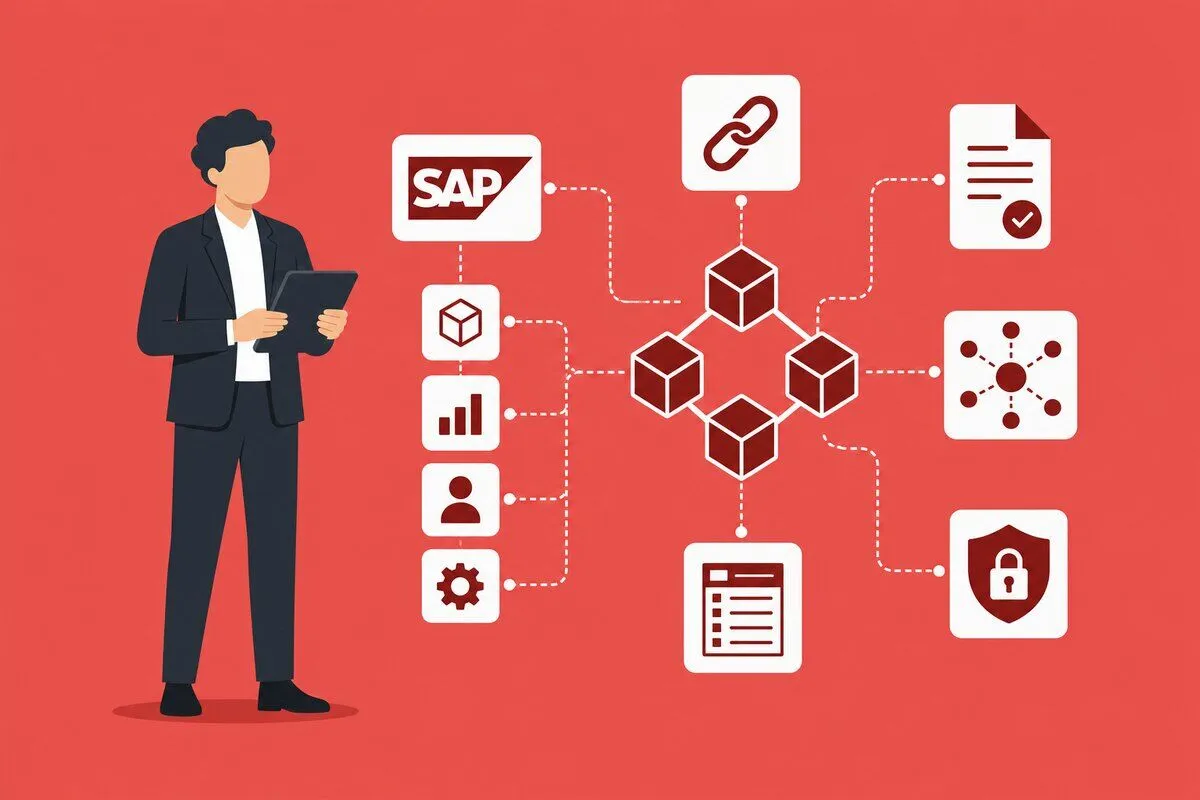
DePIN (Decentralized Physical Infrastructure Networks) replaces centralized operators with blockchain coordinated resource markets where anyone can contribute compute, storage, wireless, or sensor capacity and earn tokens. Instead of signing multi year contracts with AWS or Google Cloud, you deploy hardware, register on chain, and the protocol routes demand to your node based on proof of work or proof of coverage submissions verified by validators. For teams evaluating DePIN Development services, the decision hinges on three engineering realities: can your tokenomics sustain Sybil resistance, will your oracle bridge tolerate 12 second block times, and do your hardware failure modes fit on chain slashing logic? what is depin.
Key Takeaways
- DePIN coordinates physical hardware through blockchain incentives, eliminating single vendor lock in and enabling permissionless capacity markets where operators earn tokens for verified resource contributions.
- The architecture spans four layers: hardware (devices), coordination (blockchain consensus + smart contracts), incentive (token rewards + slashing), and application (user facing APIs), with oracles bridging off chain sensor data to on chain state.
- Tokenomics models use dual token or single token designs with inflation schedules, slashing penalties for false proofs, and economic defenses against Sybil attacks, collusion, and MEV exploitation.
- Production failures include hardware timeouts requiring work redistribution, oracle manipulation requiring cryptographic commitments, and gas cost explosions solved by zk SNARKs or optimistic rollups batching proofs off chain.
- Choose DePIN when you need censorship resistance or geographic distribution without vendor contracts; avoid if sub 100ms latency or strict SLAs are mandatory; integration requires auditing token contracts, testing slashing logic, and benchmarking proof generation time.
- Teams ready to build custom solutions should evaluate hardware SDKs, consensus trade offs, and how DePIN Development services accelerate testnet to mainnet migration with audited smart contracts and oracle infrastructure.
What Is DePIN and Why Does It Matter for Infrastructure Teams?
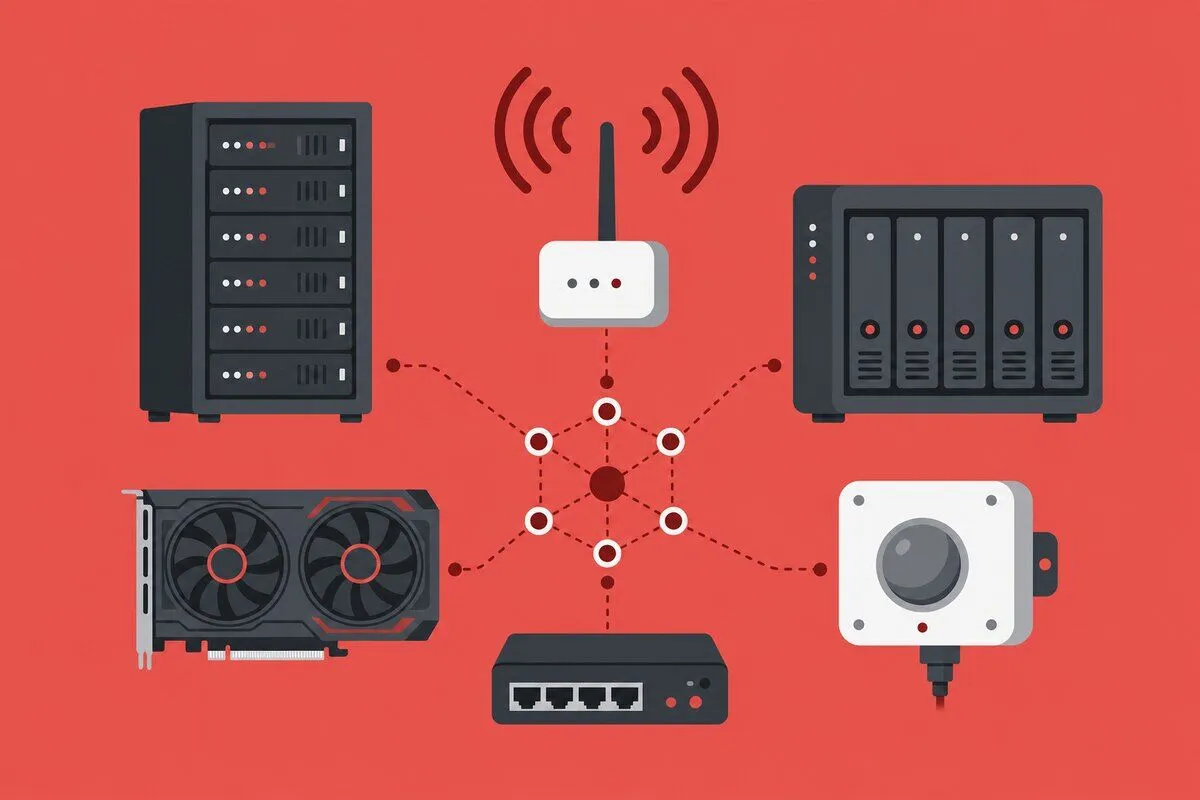
DePIN stands for Decentralized Physical Infrastructure Networks. The term describes systems that coordinate real world hardware (storage servers, compute nodes, wireless hotspots, IoT sensors, energy grids) using blockchain incentives instead of a single corporate operator. Traditional infrastructure requires you to sign contracts with AWS, Azure, or a telecom carrier; they own the data centers, set the pricing, and can terminate service. DePIN flips that model: anyone can plug in a compatible device, register it on chain, and start earning tokens when the network routes demand to their node. The protocol itself, governed by smart contracts and validator consensus, replaces the centralized operator. what is depin.
Core value proposition: you escape vendor lock in and gain permissionless resource markets. A storage provider in rural India can compete on equal footing with a data center in Virginia because the blockchain does not care about corporate relationships or geographic licensing deals. Demand side users pay in tokens, supply side operators earn tokens, and the protocol mints or burns tokens according to inflation schedules encoded in the smart contract. No sales team, no minimum spend, no multi year commitment. what is depin.
Why teams evaluating a DePIN Development Company care: feasibility and ROI depend on three engineering domains. First, tokenomics must sustain Sybil resistance (one operator pretending to be 100 nodes to harvest rewards). Second, consensus models determine finality time and gas cost; if your hardware submits proofs every 10 seconds but block time is 12 seconds, you will queue transactions and burn gas. Third, hardware software bridging requires oracles that translate sensor readings or storage proofs into on chain state without introducing a trusted intermediary that undermines the entire decentralization promise. Get any of these wrong and your DePIN network either bleeds capital to attackers or costs more per gigabyte than S3. what is depin.
Real world categories span wireless (Helium hotspots providing LoRaWAN coverage), compute (Akash leasing GPU cycles), storage (Filecoin or Arweave archiving data), energy (peer to peer solar trading), and mobility (decentralized ride sharing or EV charging networks). Each category inherits the same four layer stack and the same set of failure modes, but the proof of work mechanism differs: wireless nodes prove coverage via cryptographic beacons, storage nodes prove data retention via Merkle proofs, compute nodes prove execution via deterministic replays or TEE attestations. what is depin.
| Infrastructure Type | Proof Mechanism | Typical Block Reward | Slashing Trigger |
|---|---|---|---|
| Wireless (LoRaWAN) | Proof of Coverage (cryptographic beacon challenges) | 0.5 to 2 tokens per valid beacon | Fake GPS coordinates, repeated beacon spoofing |
| Storage (Filecoin) | Proof of Spacetime (Merkle inclusion proofs + time lock puzzles) | Variable per sector epoch, ~0.1 FIL per TiB day | Failed retrieval, missing Merkle proof, sector fault |
| Compute (Akash) | Deterministic execution replay or TEE attestation | Market driven lease payments in AKT | Downtime exceeding SLA, incorrect compute result |
| Energy (peer to peer solar) | Smart meter readings signed by TEE or multi oracle consensus | Per kWh traded, ~0.02 tokens per kWh | Meter tampering, false generation claims |
The table above shows that proof mechanisms and slashing triggers are tightly coupled to the physical task. A wireless hotspot cannot fake coverage forever because other hotspots challenge it with cryptographic beacons; if it claims to hear a beacon 500 km away, validators reject the proof. A storage provider cannot delete data and pretend it still holds the file because the protocol periodically requests Merkle proofs of random sectors; missing proofs trigger slashing. A compute provider cannot return garbage results because deterministic replay on a different node will produce a different hash, flagging the fraud. This cryptographic accountability is what separates DePIN from traditional cloud SLAs, which rely on legal contracts and customer complaints. what is depin.
How DePIN Architecture Works: Layers, Components, and Data Flow
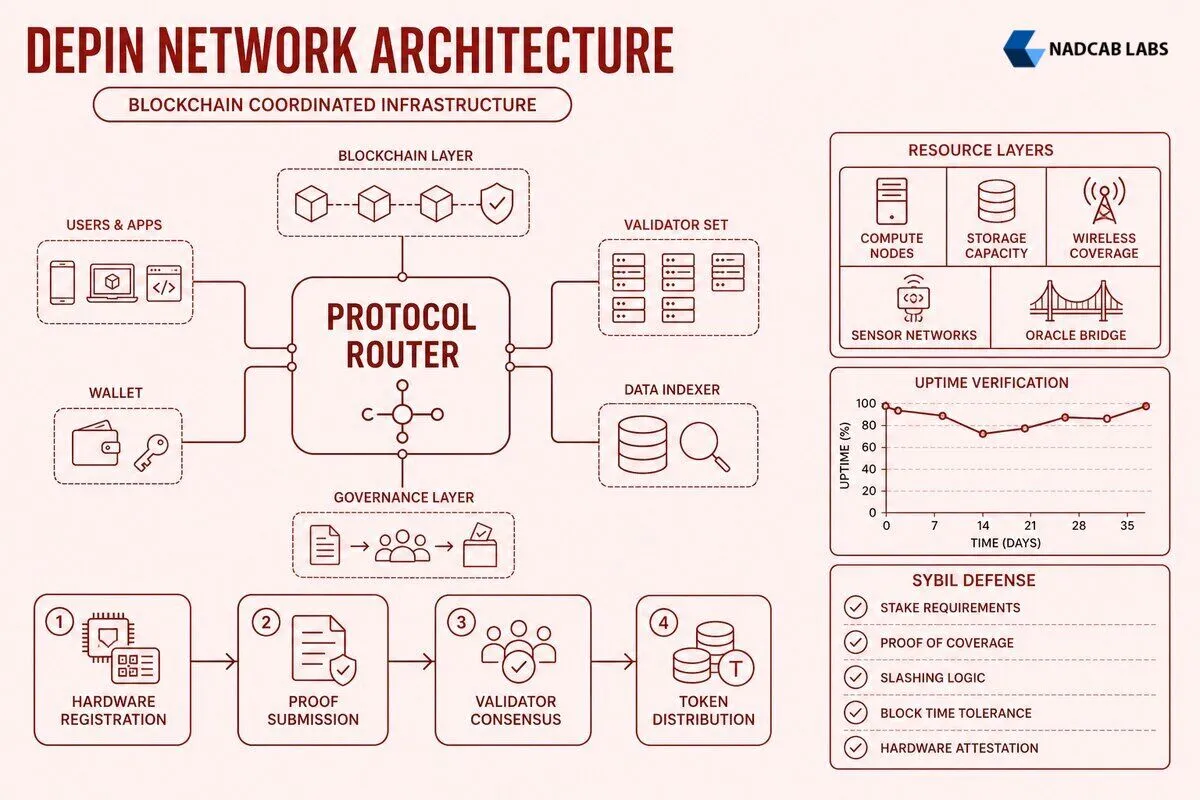
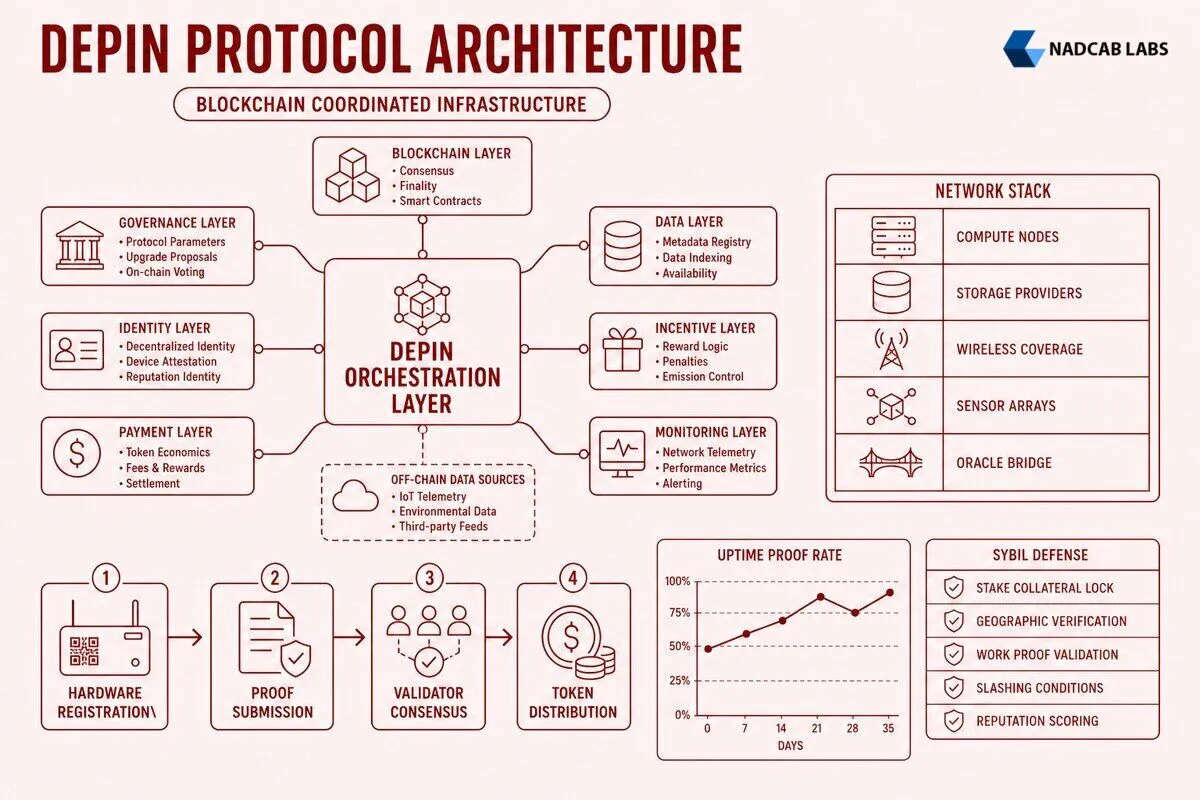
DePIN systems decompose into a four layer stack. At the bottom sits the hardware layer: physical devices (hotspots, servers, sensors, solar inverters) that perform real world work. These devices run client software that interfaces with the coordination layer, which is the blockchain itself (consensus algorithm, validator nodes, smart contracts). Above that is the incentive layer, which mints tokens for valid proofs and slashes stake for fraudulent submissions. At the top is the application layer, where end users interact via APIs, dashboards, or mobile apps without needing to understand the blockchain mechanics underneath. what is depin.
Data flow starts when a device registers on chain. Registration typically involves staking tokens (to disincentivize spam) and submitting a public key plus metadata (geographic coordinates for a wireless hotspot, storage capacity for a file server, GPU specs for a compute node). Once registered, the device begins submitting proofs. For a wireless hotspot, that means broadcasting beacons and listening for challenges from nearby hotspots; the client software packages these cryptographic receipts into a proof transaction and submits it to the blockchain. Validator nodes verify the proof (checking signatures, confirming timestamps fall within the valid window, ensuring the hotspot has not been slashed previously). If valid, the smart contract mints reward tokens and credits the hotspot operator’s account. If invalid, the smart contract slashes a portion of the staked tokens and may blacklist the device. what is depin.
Component diagram in prose: off chain oracles bridge sensor readings to on chain state. For example, an energy DePIN needs to know how many kilowatt hours a solar panel generated. The smart meter attached to the panel signs a reading with a private key stored in a Trusted Execution Environment (TEE). That signed reading is submitted to an oracle network (multiple independent oracles fetch the reading, verify the TEE attestation, and reach consensus). The oracle network posts a single aggregated transaction to the blockchain, which the smart contract accepts as ground truth. This architecture avoids putting every raw sensor reading on chain, which would explode gas costs. Instead, the blockchain stores only the oracle’s attestation, and dispute resolution contracts handle cases where an operator claims the oracle lied. what is depin.
Merkle proofs compress large datasets for gas efficiency. A storage provider holding 10 TB of user files cannot upload all 10 TB on chain every time the protocol requests proof. Instead, the provider builds a Merkle tree over the data chunks, stores the root hash on chain during the initial storage deal, and later submits a Merkle branch (a logarithmic sized proof) showing that a specific chunk still exists. Validators recompute the Merkle root from the branch and compare it to the on chain root. Match means the data is intact; mismatch triggers slashing. This same pattern applies to compute proofs (Merkle tree over execution trace) and wireless proofs (Merkle tree over beacon receipts). what is depin.
Dispute resolution contracts handle verification failures. Suppose a storage provider submits a Merkle proof but a validator claims the proof is invalid. The provider can escalate to a dispute contract, which runs a more expensive verification (possibly fetching the full data chunk from IPFS or another decentralized storage layer) and penalizes the losing party. This two tier verification (cheap optimistic check, expensive dispute resolution) keeps gas costs manageable while preserving cryptographic accountability. The same pattern appears in optimistic rollups for Ethereum Layer 2 scaling, and DePIN borrows the design because both systems face the same trade off: on chain verification is expensive, but off chain verification without slashing is untrustworthy. what is depin.
DePIN Data Flow: Device Registration to Reward Minting
Stake tokens, submit pubkey + metadata on chain
Device performs work, packages cryptographic proof
Nodes verify signatures, timestamps, no prior slashing
Mint rewards (valid) or slash stake (invalid)
The process flow above shows that every DePIN transaction cycles through these four steps. Failure at any step (device offline, proof malformed, validator unreachable, smart contract reverts due to insufficient gas) halts the reward cycle. Production systems must handle retries, queue transactions during network congestion, and monitor validator uptime. A device that misses one proof submission might forfeit that epoch’s reward but remain in good standing; a device that repeatedly submits invalid proofs accumulates slashing penalties until its stake drops to zero and the protocol ejects it. what is depin.
Latency and gas trade offs dominate architectural decisions. If your DePIN targets sub second finality (real time energy trading, autonomous vehicle coordination), you need a high throughput blockchain (Solana, Avalanche subnets) or a Layer 2 rollup on Ethereum. If finality can wait 30 seconds, you can use Ethereum mainnet and batch proofs every 10 blocks to amortize gas. If you need global state (a storage network where any user can retrieve any file), you pay for cross shard communication or accept higher latency. There is no free lunch: faster finality costs you decentralization (fewer validators can keep up with block production), and cheaper gas costs you security (lower validator rewards attract less honest stake). what is depin.
DePIN Tokenomics Models: Incentives, Slashing, and Economic Security
Tokenomics in DePIN serves three functions: incentivize supply (hardware operators), fund demand (subsidize early users), and secure the network (make attacks prohibitively expensive). Most DePIN projects use either a dual token model (utility token for network fees, governance token for protocol changes) or a single token model (one token does everything). Dual token designs let you tune inflation independently: mint more utility tokens to attract hardware during the bootstrapping phase, keep governance tokens scarce to preserve voting power concentration among long term stakeholders. Single token designs simplify user experience but risk runaway inflation if early rewards are too generous. what is depin.
Inflation schedules balance early adopter rewards with long term sustainability. A typical schedule mints 10% of total supply in year one, 7% in year two, 5% in year three, asymptotically approaching zero. Early operators earn outsized rewards because network effects are weak (few users, low demand), so the protocol must compensate them for taking risk. As the network matures and demand grows, operators earn more from user fees and less from block rewards. The crossover point (when fee revenue exceeds inflation) is the sustainability milestone; if the network never reaches it, the token price collapses and operators exit. what is depin.
Slashing mechanics punish validators who submit false proofs. The penalty severity scales with offense frequency: first offense might slash 1% of stake, second offense 5%, third offense 20%, fourth offense ejects the validator entirely. This escalation discourages persistent cheating while allowing honest mistakes (a device rebooted during proof generation, a transient network partition). Slashing also applies to validators who go offline for extended periods, because liveness failures degrade network reliability. For example, a storage provider who misses 10 consecutive proof challenges loses 10% stake and gets marked as unreliable; future storage deals route around that provider until they re stake and prove uptime.
Economic attack vectors fall into three categories. Sybil attacks occur when one operator spins up 100 virtual nodes to harvest 100x rewards. Defense: require proof of unique hardware (GPS coordinates for wireless, unique serial numbers for compute, cryptographic attestations from TEEs) and cross verify that nodes are not co located. Collusion attacks occur when multiple validators agree to pass invalid proofs (validator A submits a fake storage proof, validators B and C vote to accept it, they split the rewards). Defense: randomize validator assignment per proof, require supermajority consensus (67% of validators must agree), and run probabilistic audits where a random subset of proofs gets re verified by a different validator set. Front running attacks (MEV, miner extractable value) occur when validators reorder transactions to win resource allocation auctions. Defense: use commit reveal schemes (operators commit to a bid hash, reveal the bid later, validators cannot see bids before the reveal window closes) or run auctions off chain via a trusted execution environment.
Tokenomics Comparison: Dual Token vs Single Token
The bar chart above illustrates that dual token models trade user simplicity for governance flexibility. A project that expects rapid protocol iteration (changing reward curves, adding new hardware types, adjusting slashing parameters) benefits from separating governance voting (governance token holders decide) from day to day operations (utility token pays for transactions). A project targeting mainstream adoption (consumers who do not want to juggle two tokens) benefits from a single token model, accepting that governance changes require broader consensus because every token holder is also a user.
Economic security ultimately depends on the cost to attack exceeding the profit from attacking. If an attacker can buy 51% of staked tokens for $10 million and extract $50 million by double spending or censoring transactions, the network is insecure. DePIN networks mitigate this by requiring hardware collateral (an attacker must also buy 51% of physical devices, not just tokens) and by designing slashing penalties that destroy more value than the attacker gains. For example, if submitting a fake storage proof earns 10 tokens but getting caught slashes 100 tokens, rational attackers stay honest. The challenge is tuning penalties high enough to deter attacks but low enough that honest operators do not exit due to accidental slashing from software bugs or network issues.
For teams designing custom tokenomics, the integration checklist includes: audit the token contract for reentrancy (attacker calls reward function recursively before state updates), overflow (reward calculation exceeds uint256 max), and front running (attacker sees pending reward transaction and submits their own with higher gas). Test slashing logic in testnet by simulating device failures, network partitions, and malicious proofs. Benchmark inflation rate against comparable projects (Helium mints ~2.5% annually post halving, Filecoin mints ~15% in early years). Validate that the sustainability crossover (fee revenue exceeds inflation) is reachable within 3 to 5 years given realistic adoption curves. If the math does not work, either reduce inflation or increase fee capture (take a larger protocol cut of each transaction).
Production Pitfalls: Failure Modes and Validation Checkpoints in DePIN Systems
Hardware failures are the most common production issue. A storage server loses power mid task, a wireless hotspot reboots due to a firmware bug, a solar inverter disconnects from the network during a storm. The smart contract must detect the timeout (device did not submit proof within the expected window), redistribute the work to another provider, and slash a partial stake to compensate the user for degraded service. Timeout detection relies on block timestamps: if the device was supposed to submit proof by block N and we are now at block N plus 100, the contract marks the device offline and triggers redistribution logic.
Work redistribution is non trivial because the blockchain does not know which devices are online until they submit proofs. A naive approach (randomly assign work to any registered device) leads to cascading failures when the selected device is also offline. A better approach uses a reputation score: devices that consistently submit valid proofs on time earn higher scores, and the work assignment algorithm weights by reputation. This creates a positive feedback loop (reliable devices get more work, earn more rewards, can afford better hardware) but risks centralization if a few operators dominate the top of the reputation leaderboard. To counter that, some DePIN protocols cap the maximum work any single operator can receive (e.g., no more than 5% of total network load) or use randomized assignment with reputation as a tiebreaker.
Redundancy strategies increase cost but reduce single point failures. A common pattern is 3x replication: every file is stored on three independent providers, every compute task is executed by three nodes, every wireless beacon is verified by three nearby hotspots. If one provider fails, the other two maintain service continuity. The protocol pays three times the cost (three storage fees, three compute fees, three beacon rewards), but users get higher reliability. The trade off is economic: 3x replication makes DePIN three times more expensive than centralized cloud for the same task, so DePIN only wins on cost when the baseline unit price (per GB, per CPU hour, per beacon) is significantly lower than AWS due to utilizing idle hardware or avoiding corporate overhead.
Oracle manipulation is the second major failure mode. An attacker feeds false sensor data to the oracle network, hoping the smart contract will accept it and mint undeserved rewards. For example, an energy DePIN operator claims their solar panel generated 1000 kWh when it actually generated 100 kWh. If the oracle blindly trusts the smart meter reading, the attacker pockets 10x rewards. Defense requires multiple independent oracles plus cryptographic commitments. The operator submits a hash of the reading before revealing the actual value; if the revealed value does not match the hash, the proof is invalid. Multiple oracles (say, five independent services) fetch the reading from the smart meter, and the smart contract accepts the median value. An attacker would need to compromise three of five oracles to manipulate the median, which is prohibitively expensive if oracles are run by different entities in different jurisdictions.
Cryptographic commitments also prevent the operator from changing the reading after seeing the oracle’s response. The operator computes hash(reading, nonce), submits the hash on chain, waits for the oracle to post its attestation, then reveals the reading and nonce. If the revealed reading does not hash to the committed value, the smart contract rejects the proof and slashes the operator. This commit reveal pattern is borrowed from on chain auctions and voting schemes, where it prevents front running and ensures that participants cannot adapt their bids or votes based on others’ submissions.
Gas cost explosions occur when every device heartbeat or proof submission hits the blockchain. A DePIN network with 100,000 devices submitting proofs every 10 seconds generates 10,000 transactions per second, which exceeds Ethereum mainnet capacity (15 TPS) by three orders of magnitude. Even on high throughput chains (Solana 65,000 TPS), the gas fees add up: if each transaction costs $0.01 and you have 100,000 devices, that is $1,000 per second or $86 million per day. Clearly unsustainable.
Solution one: use zk SNARKs (zero knowledge succinct non interactive arguments of knowledge) to batch proofs. A device generates 1,000 proofs off chain, computes a zk SNARK that proves “I generated 1,000 valid proofs,” and submits only the SNARK (a few hundred bytes) on chain. Validators verify the SNARK (cheap, constant time operation) instead of verifying 1,000 individual proofs. This compresses 1,000 transactions into one, reducing gas cost by 1,000x. The trade off is complexity: generating zk SNARKs requires specialized hardware (GPUs or FPGAs) and adds latency (proving time can be seconds to minutes depending on circuit size).
Solution two: use optimistic rollups. Devices submit proofs to a Layer 2 sequencer, which batches them and posts a single state root to Layer 1 every few minutes. Validators assume the state root is correct (optimistic assumption) unless someone submits a fraud proof showing that a specific proof in the batch was invalid. Fraud proofs trigger on chain verification of that one proof, and if the fraud proof is valid, the sequencer gets slashed. This approach scales to millions of transactions per second off chain while keeping Layer 1 gas costs low, but introduces a fraud proof delay (users must wait 7 days for finality in case someone submits a fraud proof). For DePIN use cases where finality can wait (storage deals, long term compute leases), optimistic rollups work well. For real time use cases (wireless beacons, energy trading), zk SNARKs are better despite higher proving cost.
Validation checkpoints for production teams: (1) Deploy a testnet with 100 simulated devices and inject random failures (50% offline, 20% submit invalid proofs, 10% timeout). Measure how many epochs it takes for the protocol to stabilize (eject bad actors, redistribute work to good actors). (2) Benchmark proof generation time on target hardware. If your IoT device is a Raspberry Pi and generating a zk SNARK takes 5 minutes, you cannot submit proofs every 10 seconds. Either upgrade hardware, switch to optimistic proofs, or accept lower proof frequency. (3) Measure gas cost per device per day at target scale. Multiply by device count and by 365 days to get annual gas budget. If the number exceeds your token treasury or expected fee revenue, the economics do not work. (4) Audit oracle data sources for independence. If all five oracles pull from the same API endpoint, an attacker who compromises that endpoint controls the oracle network. Use geographically distributed oracles with diverse data sources (some read smart meters via local network, some via satellite, some via cellular).
When to Choose DePIN Over Traditional Cloud: Decision Criteria and Integration Checklist
Use DePIN when you need censorship resistance, geographic distribution without vendor contracts, or want to monetize idle hardware. Censorship resistance matters for applications that governments or corporations might block: peer to peer messaging, decentralized social media, privacy preserving analytics. A centralized cloud provider can shut down your instance if pressured by regulators; a DePIN network has no single point of control. Geographic distribution without vendor contracts matters for edge computing: if you need compute nodes in 50 countries but do not want to negotiate with 50 local data centers, DePIN lets anyone in those countries plug in hardware and join the network. Monetizing idle hardware matters for consumer grade devices: a home user with a spare hard drive or an unused GPU can earn passive income by contributing to a DePIN storage or compute network, whereas AWS does not accept consumer hardware.
Avoid DePIN if sub 100ms latency or strict SLAs are non negotiable. Blockchain finality (the time until a transaction is irreversible) ranges from 1 second (Solana) to 15 seconds (Ethereum) to 60 seconds (Bitcoin). If your application requires sub 100ms response times (high frequency trading, real time gaming, autonomous vehicles), the blockchain itself becomes the bottleneck. You can mitigate this with Layer 2 solutions or off chain execution (compute happens off chain, only settlement happens on chain), but then you lose some decentralization benefits. Strict SLAs (99.99% uptime, guaranteed bandwidth, penalty clauses for downtime) are hard to enforce in DePIN because the protocol cannot force hardware operators to stay online. Traditional cloud providers sign contracts with financial penalties; DePIN relies on slashing, which only works if the operator has sufficient stake. If an operator’s stake is $100 but the SLA penalty should be $10,000, slashing is insufficient and users suffer.
Cost comparison depends on baseline unit price and redundancy multiplier. DePIN wins on cost when idle hardware is cheap (a home user’s hard drive costs them nothing because they already own it) and corporate overhead is eliminated (no sales team, no support tickets, no compliance audits). For example, grovex btc infrastructure shows that decentralized storage can undercut S3 by 10x when aggregating consumer grade drives, because the marginal cost of storing one more gigabyte on an existing drive is near zero. But add 3x redundancy and the cost triples, erasing most of the advantage. DePIN also incurs token volatility risk: if you pay operators in tokens and the token price drops 50%, operators exit and network capacity collapses. Centralized cloud pricing is stable (AWS does not suddenly double prices), making budget forecasting easier.
Integration checklist for teams ready to build: (1) Audit the token contract for reentrancy, overflow, and front running vulnerabilities. Use tools like Slither or Mythril to scan for common bugs. Hire a third party auditor (Trail of Bits, OpenZeppelin, Quantstamp) to review the contract before mainnet launch. (2) Test slashing logic in testnet with simulated failures. Spin up 10 devices, make 3 of them submit invalid proofs, verify that the smart contract slashes exactly those 3 and does not false positive the honest 7. Test edge cases: what happens if a device submits a valid proof but the transaction reverts due to gas limit? Does the device lose its proof window and forfeit rewards, or can it retry? (3) Benchmark proof generation time versus block time. If proof generation takes 20 seconds and block time is 12 seconds, you will queue transactions and pay higher gas due to congestion. Either optimize the proof algorithm (use faster cryptographic primitives, parallelize computation) or batch multiple proofs into one transaction. (4) Validate that oracle data sources are independent. Do not use a single API endpoint or a single hardware vendor for all oracles. Geographic diversity (oracles in different countries) and vendor diversity (some oracles run on AWS, some on Azure, some on bare metal) reduce the risk of correlated failures. (5) Measure gas cost per device per day at target scale. Deploy a testnet with 1,000 devices, run it for a week, sum up gas fees, and extrapolate to 100,000 devices. If the annual gas budget exceeds your token treasury or expected fee revenue, the protocol is not economically viable. Either reduce proof frequency, switch to a cheaper blockchain, or implement Layer 2 batching.
Next steps: teams ready to build custom DePIN solutions should evaluate hardware SDKs (does the device manufacturer provide a client library for generating proofs, or do you need to write firmware from scratch?), consensus trade offs (Proof of Work burns electricity but is simple; Proof of Stake is energy efficient but requires staking infrastructure; Proof of Coverage is hardware specific and requires geographic verification), and how DePIN Development services accelerate testnet to mainnet migration. A specialized development company provides audited smart contract templates (token minting, slashing logic, dispute resolution), oracle infrastructure (pre integrated with Chainlink or Band Protocol), and hardware integration kits (firmware for Raspberry Pi, Arduino, or industrial IoT gateways). This reduces time to market from 12 months (building everything in house) to 3 months (customizing pre built modules), and reduces security risk because the templates have been battle tested on other DePIN networks.
For reference, ethereum token standards provide the foundation for DePIN tokenomics (ERC 20 for fungible tokens, ERC 721 for unique device NFTs), DePIN hardware requirements detail the minimum specs for different infrastructure types (CPU, RAM, bandwidth, storage), DePIN network architecture explains hub and spoke versus mesh topologies, and DePIN tokenomics design walks through inflation schedules and slashing parameter tuning. Cross referencing these resources helps teams avoid common mistakes (under spec’ing hardware, over generous inflation, insufficient slashing) that sink DePIN projects in the first year.
Final Thoughts
DePIN replaces centralized infrastructure operators with blockchain coordinated resource markets, enabling permissionless hardware contribution and token based incentives. The four layer architecture (hardware, coordination, incentive, application) bridges physical devices to on chain state via oracles and cryptographic proofs. Tokenomics models balance early rewards with long term sustainability, using slashing to deter fraud and staking to align operator incentives. Production pitfalls include hardware timeouts, oracle manipulation, and gas cost explosions, all mitigated by redundancy, cryptographic commitments, and Layer 2 batching. Choose DePIN when censorship resistance or geographic distribution outweighs the need for sub 100ms latency or strict SLAs. Integration requires auditing token contracts, testing slashing logic, benchmarking proof generation, validating oracle independence, and measuring gas costs at scale. Teams ready to build should leverage DePIN Development services for audited smart contracts, oracle infrastructure, and hardware SDKs that compress 12 month timelines into 3 month sprints.
Frequently Asked Questions
Q1.What does DePIN stand for in blockchain?
DePIN stands for Decentralized Physical Infrastructure Networks. It coordinates real world hardware like storage servers, wireless hotspots, GPU clusters, energy grids, or sensor arrays through blockchain incentives and cryptographic proofs. Token rewards align independent operators to contribute capacity, while smart contracts enforce SLAs and slash bad actors. Unlike pure digital protocols, DePIN bridges on chain logic with off chain physical assets, creating permissionless infrastructure markets.
Q2.How does DePIN differ from traditional cloud infrastructure?
Traditional cloud centralizes hardware under one entity (AWS, Azure) with opaque pricing and vendor lock in. DePIN distributes hardware across thousands of independent operators verified by on chain proofs. No single party controls uptime or data access. Pricing emerges from open market competition, and users pay per use via tokens. Cryptographic attestations (Proof of Coverage, Proof of Spacetime) replace trust in a corporate SLA, making capacity permissionless and geographically diverse.
Q3.What are the main layers in a DePIN architecture?
Physical Layer: actual hardware (miners, hotspots, drives). Proof Layer: cryptographic attestations (PoC, PoSt, PoW variants) submitted on chain to prove work. Consensus Layer: blockchain validators verify proofs, mint rewards, and slash fraud. Coordination Layer: smart contracts manage registry, staking, dispute resolution, and payment channels. Application Layer: APIs and SDKs let end users consume bandwidth, storage, or compute. Each layer enforces trustless operation without a central operator.
Q4.How do DePIN networks prevent hardware providers from cheating?
Cryptographic proofs force providers to demonstrate actual work: Proof of Coverage requires RF signal witnesses from peer devices; Proof of Spacetime demands Merkle challenges over stored data at random intervals; slashing conditions burn staked tokens if a node submits invalid proofs or misses heartbeat checks. Verifiable Delay Functions and trusted execution enclaves add tamper resistance. On chain arbitration and multi party witness consensus catch Sybil attacks or fake coverage claims before rewards are minted.
Q5.What types of physical infrastructure can DePIN coordinate?
Storage (Filecoin, Arweave), wireless connectivity (Helium LoRaWAN and 5G), GPU compute (Render, Akash), energy grids (peer to peer solar trading), environmental sensors (air quality, weather oracles), mapping and geolocation data, CDN edge nodes, and EV charging stations. Any resource with measurable output and verifiable delivery can be tokenized. The common thread: hardware operators earn tokens for provable uptime and quality, replacing centralized infrastructure monopolies with open markets.
Q6.When should a project choose DePIN over AWS or Google Cloud?
Choose DePIN when censorship resistance, geographic distribution, or cost arbitrage matter more than millisecond latency guarantees. Ideal for archival storage, edge compute in underserved regions, IoT data aggregation, or applications banned by cloud ToS. Trade off: DePIN nodes have variable uptime and require redundancy logic (erasure coding, multi region replication). AWS wins for enterprise SLAs and sub 10 ms response times; DePIN wins for permissionless scale and avoiding platform risk.
Explore Services
Related Services
Reviewed by

Aman Vaths
Founder of Nadcab Labs
Aman Vaths is the Founder & CTO of Nadcab Labs, a global digital engineering company delivering enterprise-grade solutions across AI, Web3, Blockchain, Big Data, Cloud, Cybersecurity, and Modern Application Development. With deep technical leadership and product innovation experience, Aman has positioned Nadcab Labs as one of the most advanced engineering companies driving the next era of intelligent, secure, and scalable software systems. Under his leadership, Nadcab Labs has built 2,000+ global projects across sectors including fintech, banking, healthcare, real estate, logistics, gaming, manufacturing, and next-generation DePIN networks. Aman’s strength lies in architecting high-performance systems, end-to-end platform engineering, and designing enterprise solutions that operate at global scale.