Ai Overview
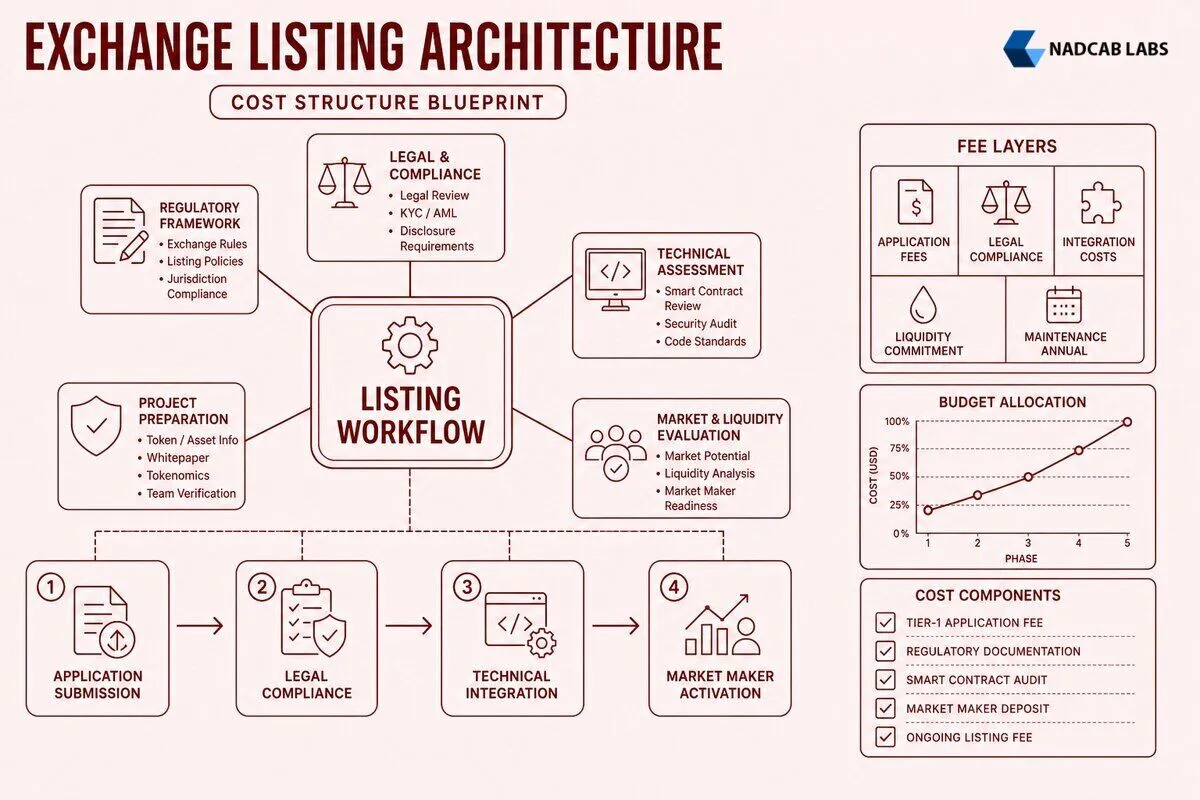
Listing a token on a major cryptocurrency exchange is one of the most significant financial commitments a blockchain project will face. The exchange listing cost breakdown reveals a complex ecosystem of fees spanning initial application charges, legal compliance expenses, technical integration work, market maker commitments, and ongoing maintenance costs.
Listing a token on a major cryptocurrency exchange is one of the most significant financial commitments a blockchain project will face. The exchange listing cost breakdown reveals a complex ecosystem of fees spanning initial application charges, legal compliance expenses, technical integration work, market maker commitments, and ongoing maintenance costs. Understanding this complete financial picture before approaching exchanges helps teams allocate budgets realistically, avoid surprise expenses, and calculate whether the investment will deliver meaningful returns through increased liquidity and market access.
Key Takeaways
- Tier-1 exchange listing costs typically range from $50,000 to over $1 million when combining application fees, legal work, technical integration, and market maker commitments
- Market maker engagement represents the largest ongoing expense, with liquidity commitments often requiring $100,000 to $500,000 in dedicated capital plus monthly service fees
- Hidden costs including expedited review charges, cross-border payment fees, and mandatory security audits can add 20-40% to initial budget estimates
- Ongoing maintenance fees, additional trading pair costs, and promotional requirements create recurring expenses that continue long after the initial listing
- ROI calculations must factor in volume projections, price discovery benefits, and institutional credibility gains beyond simple trading fee recovery
- Professional Crypto Exchange Listing Services help navigate the fee structure and optimize budget allocation across all cost components
What are the core components of exchange listing costs?
The foundation of any exchange listing budget begins with three primary expense categories that every project must address before a token appears on trading platforms. Application and review fees form the first major cost center, with Tier-1 exchanges charging non-refundable deposits ranging from $50,000 to $300,000 just to evaluate a listing request. These upfront payments cover the exchange’s due diligence process, technical review team time, and risk assessment work. Unlike smaller exchanges that may waive application fees in exchange for marketing partnerships or revenue sharing, top-tier platforms maintain strict fee structures as a quality filter and revenue stream.
Legal and compliance expenses represent the second critical component, often catching teams off-guard with their complexity and cost. Projects must obtain securities analysis opinions from qualified legal counsel, typically costing $15,000 to $75,000 depending on jurisdiction and token structure. KYC and AML documentation preparation adds another $10,000 to $30,000 for comprehensive compliance packages that meet exchange standards. Regulatory opinion letters from recognized law firms can run $20,000 to $100,000 when dealing with multiple jurisdictions or complex token classifications. These legal costs are non-negotiable for reputable exchanges that face increasing regulatory scrutiny.
Technical integration costs complete the core expense trio, covering the engineering work required to connect a token to exchange infrastructure. API development and testing typically requires $25,000 to $80,000 in specialized blockchain development work, ensuring smooth deposits, withdrawals, and balance tracking. Wallet integration for custom blockchain architectures adds $15,000 to $50,000 when exchanges don’t already support the underlying protocol. Node infrastructure setup and maintenance can cost $5,000 to $20,000 monthly for projects running on less common blockchain platforms, as exchanges require reliable node access for transaction verification and balance updates.
| Cost Component | Typical Range | Tier-1 Average | Notes |
|---|---|---|---|
| Application Fee | $50K – $300K | $150K | Non-refundable, paid upfront |
| Legal & Compliance | $45K – $205K | $95K | Varies by jurisdiction complexity |
| Technical Integration | $45K – $150K | $75K | Higher for custom blockchains |
| Security Audit | $15K – $50K | $28K | Often mandatory for smart contracts |
| Initial Market Maker Setup | $100K – $500K | $250K | Liquidity commitment capital |
The combined core components create a baseline crypto exchange listing fees structure that ranges from $255,000 to over $1.2 million before considering ongoing costs or hidden expenses. Projects developing complex applications may find parallels in the entertainment app development cost breakdown approach to multi-phase budget planning, where upfront technical work represents just the first stage of total investment.
How do market maker requirements impact total listing budget?
Market maker engagement fees constitute the single largest variable cost in most token listing budget calculations, often exceeding all other expenses combined. Professional market makers charge monthly retainer fees ranging from $5,000 to $50,000 depending on the number of trading pairs, target spread requirements, and minimum uptime guarantees. These service fees cover the operational costs of running sophisticated trading algorithms, monitoring multiple exchanges simultaneously, and maintaining 24/7 liquidity provision. Beyond the monthly retainer, market makers require substantial capital commitments—typically $100,000 to $500,000 in tokens and stablecoins—to maintain adequate order book depth and handle trading volume fluctuations without depleting inventory.
Minimum liquidity commitments represent locked capital that projects must dedicate exclusively to market making activities for contract durations of six to twelve months. A typical Tier-1 exchange listing might require maintaining $200,000 in combined bid and ask liquidity within 2% of mid-market price at all times. This means projects cannot use these funds for development, marketing, or other operational needs during the contract period. Volume guarantees add another layer of cost, with some exchanges requiring minimum daily trading volumes of $500,000 to $2 million to maintain listing status. Market makers charge performance bonuses of 10-25% above base fees when hitting these volume targets consistently.
The choice between self-managed liquidity and professional market maker partnerships creates fundamentally different cost structures. Self-managed approaches eliminate monthly service fees but require hiring specialized trading talent at $120,000 to $200,000 annual salaries, developing proprietary trading infrastructure costing $50,000 to $150,000, and dedicating senior team attention to ongoing strategy adjustments. Professional market makers bring established relationships with exchanges, proven algorithms, and risk management expertise, but their fees and capital requirements can consume 30-50% of a project’s total listing budget over the first year.
Market Maker Cost Comparison: Monthly Expenses
$15,000/mo
$35,000/mo
$20,000/mo
$42,000/mo
Spread maintenance costs create ongoing exchange listing expenses that vary with market conditions and token volatility. Market makers typically target spreads of 0.2% to 1.0% on major pairs, but maintaining these tight spreads during volatile periods requires additional capital and increases inventory risk. Projects often pay premium fees of 20-40% above baseline rates during periods when maintaining target spreads becomes challenging due to low overall market liquidity or extreme price movements. Similar to how dApp development cost breakdown analysis reveals ongoing hosting and maintenance expenses beyond initial build costs, market maker fees represent a permanent operating expense rather than a one-time investment.
What ongoing maintenance fees should projects budget for post-listing?
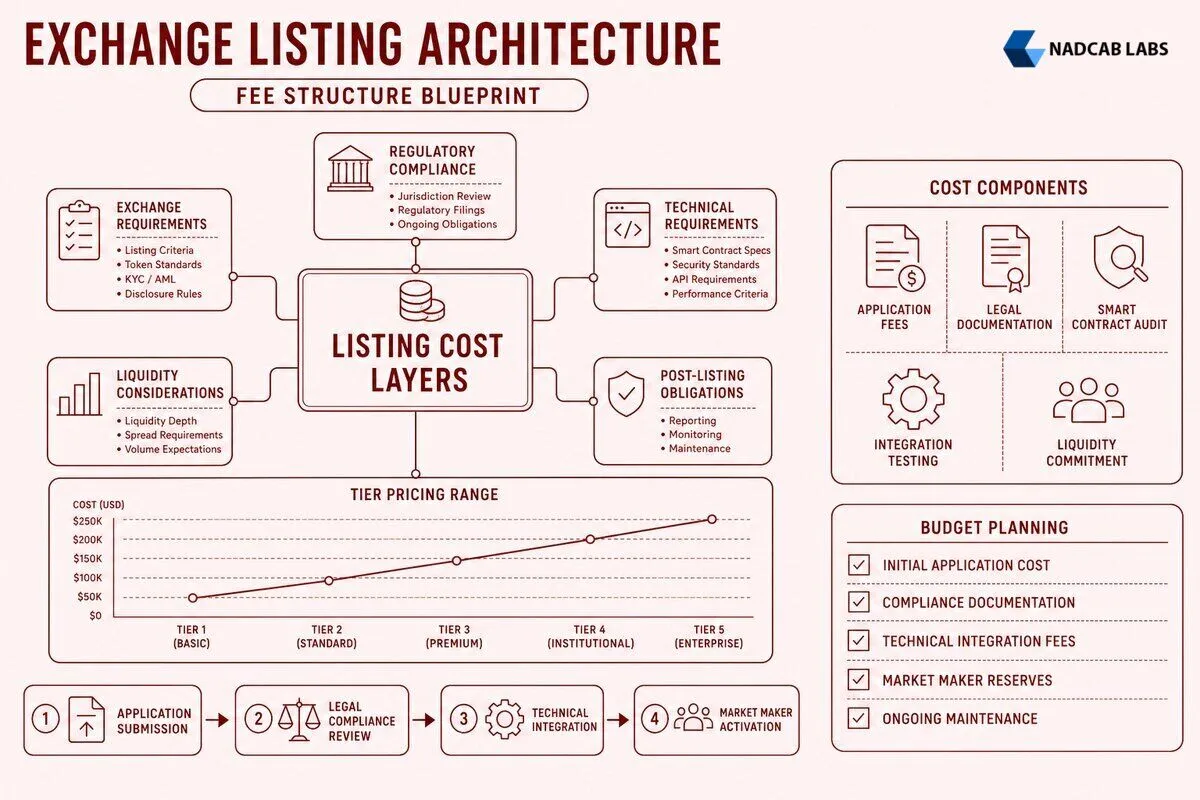
Monthly and annual listing maintenance fees represent the recurring baseline costs that exchanges charge to keep tokens actively tradable on their platforms. Tier-1 exchanges typically charge annual renewal fees ranging from $20,000 to $100,000, with some platforms implementing monthly billing structures of $2,000 to $10,000 instead. These maintenance fees cover exchange operational costs including server infrastructure for token storage, real-time price data feeds to market data providers, customer support for deposit and withdrawal issues, and ongoing compliance monitoring. Projects that fail to pay renewal fees face delisting, making these costs effectively mandatory for maintaining market presence.
Trading pair management costs multiply rapidly as projects seek to establish multiple market pairs for broader accessibility. While the initial listing might include one or two base pairs like TOKEN/USDT and TOKEN/BTC, adding each additional pair typically costs $10,000 to $50,000 in setup fees plus $1,000 to $5,000 monthly maintenance per pair. A project aiming for comprehensive market coverage with six trading pairs across stablecoin and major cryptocurrency bases could face $60,000 to $300,000 in additional pair listing fees, plus $6,000 to $30,000 monthly in ongoing pair maintenance. Each new pair also requires dedicated market maker liquidity, effectively doubling or tripling the capital commitment needed to maintain acceptable order book depth across all markets.
Marketing and promotional requirements create a third category of tier 1 exchange listing cost that projects must budget for to maximize listing visibility and trading volume. Featured listing placements on exchange homepages cost $15,000 to $75,000 for one-week promotions, while banner advertisements run $5,000 to $25,000 weekly depending on placement prominence. Exchange-sponsored events including AMAs, trading competitions, and promotional campaigns require participation fees of $10,000 to $100,000 plus prize pools funded by the project. Many exchanges offer tiered marketing packages bundled with listing agreements, creating pressure to commit to promotional spending that can equal or exceed the initial listing fee over the first year.
Typical 12-Month Post-Listing Cost Timeline
Data feed fees and API access charges represent smaller but persistent costs that accumulate across multiple services. Exchanges charge $500 to $3,000 monthly for premium API access that provides institutional-grade data feeds, historical trading data, and advanced order types. Projects wanting their token included in major market data aggregators like CoinMarketCap or CoinGecko premium tiers pay $1,000 to $5,000 monthly for verified listing status and enhanced visibility. These costs mirror the recurring infrastructure expenses seen in AR VR development cost breakdown scenarios, where initial deployment represents just the beginning of ongoing operational spending.
Which hidden costs catch token projects by surprise?
Emergency support fees and expedited review charges create unexpected budget pressure when projects face tight listing timelines or technical issues. Standard exchange review processes take four to twelve weeks, but projects needing faster turnaround can pay expedited review fees of $25,000 to $100,000 to compress timelines to two to four weeks. Emergency technical support outside normal business hours costs $500 to $2,000 per incident, with critical issues like wallet integration bugs or deposit processing failures requiring immediate attention. Re-submission costs after application rejections add another $15,000 to $50,000 when projects must address compliance gaps, technical deficiencies, or documentation issues identified during initial review.
Cross-border payment fees and currency conversion costs erode budgets through transaction friction that many teams overlook during initial planning. International wire transfers to exchanges based in different jurisdictions incur fees of $25 to $75 per transaction plus 0.5% to 2.0% foreign exchange spreads on currency conversions. A project making five separate payments for application fees, legal retainers, technical integration milestones, and market maker deposits could lose $5,000 to $15,000 purely to banking intermediaries and currency conversion. Cryptocurrency payment options reduce some friction but introduce volatility risk when exchanges require payments in specific tokens that may fluctuate significantly between commitment and actual payment dates.
Insurance requirements and security audit mandates represent hidden crypto listing compliance costs that exchanges increasingly enforce as standard listing prerequisites. Cybersecurity insurance policies covering potential smart contract exploits or exchange security breaches cost $15,000 to $75,000 annually for coverage limits of $1 million to $10 million. Third-party security audits from recognized firms like CertiK, Quantstamp, or Trail of Bits run $20,000 to $80,000 for comprehensive smart contract reviews, with some exchanges requiring multiple independent audits before approving listings. Bug bounty programs that exchanges expect projects to maintain add $10,000 to $50,000 in annual payout budgets plus platform fees to services like Immunefi or HackerOne.
| Hidden Cost Category | Typical Impact | When It Appears |
|---|---|---|
| Expedited Review Fees | $25K – $100K | When timeline pressure requires faster processing |
| Re-submission Costs | $15K – $50K | After initial application rejection |
| Cross-border Payment Fees | $5K – $15K | Spread across multiple international payments |
| Security Insurance | $15K – $75K/year | Required before listing approval |
| Multiple Security Audits | $40K – $160K | When exchanges require 2-3 independent audits |
| Bug Bounty Programs | $10K – $50K/year | Ongoing requirement post-listing |
| Legal Opinion Updates | $8K – $30K | When regulations change or new jurisdictions added |
Regulatory compliance monitoring and legal opinion updates create recurring costs as cryptocurrency regulations evolve across jurisdictions. Projects must budget $8,000 to $30,000 annually for legal counsel to review regulatory changes and update compliance documentation when new rules affect token classification or trading restrictions. Multi-jurisdiction projects face multiplied costs, with each additional regulatory regime requiring separate legal analysis and potentially modified token economics or trading mechanisms. These ongoing legal costs parallel the compliance considerations in Tokenization Cost Factors planning, where regulatory navigation represents a permanent operational expense rather than a one-time project phase.
How can projects calculate realistic ROI from exchange listings?
Volume projection models form the foundation of exchange listing ROI analysis, requiring realistic assumptions about trading activity based on exchange tier, community size, and broader market conditions. A typical Tier-1 listing might generate daily trading volumes of 0.5% to 2.0% of total token market capitalization in the first month, declining to 0.1% to 0.5% as initial excitement fades. Projects with strong community engagement and clear utility cases sustain higher volume ratios, while purely speculative tokens often see volume drop to negligible levels within weeks. Exchange tier dramatically impacts these projections—a Binance or Coinbase listing typically generates 10-50x the volume of a mid-tier exchange listing for the same token, justifying the higher upfront investment through superior liquidity and price discovery.
Break-even analysis frameworks compare total listing costs against expected trading volume benefits, liquidity improvements, and market access value. A straightforward calculation divides total first-year listing expenses by expected trading fee savings and spread capture benefits. For example, a project spending $400,000 on listing costs that generates $50 million in annual trading volume saves roughly $50,000 to $150,000 in reduced trading costs for treasury operations and market making compared to operating on lower-tier exchanges. However, this narrow calculation misses broader benefits including reduced price volatility from deeper liquidity, improved token holder confidence from Tier-1 credibility, and enhanced institutional access that unlocks partnership and investment opportunities.
ROI Calculation Framework: Key Metrics
Direct Financial Returns
- Trading fee savings from improved liquidity
- Reduced spread costs for treasury operations
- Market maker fee reductions through volume
- Arbitrage opportunity reduction benefits
Strategic Value Gains
- Price discovery improvement and stability
- Institutional investor access and credibility
- Partnership opportunities from visibility
- Community growth and holder confidence
Long-term value metrics extend beyond immediate trading volume to capture ecosystem credibility, institutional access, and price discovery improvements that compound over time. Tier-1 exchange listings provide legitimacy signals that reduce investor risk perception, typically supporting 15-40% higher token valuations compared to identical projects listed only on lower-tier platforms. This credibility premium translates directly to improved fundraising terms, stronger partnership negotiations, and enhanced talent acquisition as the project gains recognition. Institutional investors often restrict trading to Tier-1 exchanges due to custody, compliance, and liquidity requirements, meaning a Coinbase or Kraken listing can unlock entire investor categories previously inaccessible to the project.
Price discovery improvement represents a subtle but valuable benefit where deeper liquidity and tighter spreads enable more efficient market pricing that reflects true supply and demand dynamics. Projects on Tier-1 exchanges typically experience 30-60% lower price volatility compared to the same token on smaller platforms, reducing the risk premium investors demand and supporting higher sustainable valuations. This stability benefit compounds over time as the token becomes more useful for real-world applications where price predictability matters, similar to how Trust Wallet Listing provides ecosystem integration benefits beyond simple visibility.
Comparative analysis across different exchange tiers reveals distinct cost-benefit profiles that inform strategic listing decisions. A mid-tier exchange listing costing $75,000 to $150,000 might generate sufficient volume for projects with modest liquidity needs and regional focus, delivering positive ROI within six to twelve months. Tier-1 listings costing $500,000 to $1.5 million require significantly higher volume and longer time horizons to break even purely on trading metrics, but deliver strategic benefits including institutional access and ecosystem credibility that justify the premium for projects with growth ambitions. Projects should model scenarios across multiple exchange tiers, considering not just direct costs but also opportunity costs of capital locked in market maker commitments and management attention diverted to listing processes.
| ROI Metric | Measurement Approach | Typical Timeframe |
|---|---|---|
| Trading Volume Growth | Compare pre-listing vs post-listing 90-day average daily volume | 3-6 months |
| Price Stability Improvement | Measure volatility reduction using 30-day standard deviation | 6-12 months |
| Holder Base Expansion | Track unique wallet addresses and geographic distribution | 6-18 months |
| Institutional Adoption | Count qualified institutional investors and custody integrations | 12-24 months |
| Partnership Quality | Assess caliber of integrations and collaborations post-listing | 12-36 months |
| Market Cap Premium | Compare valuation multiples to similar unlisted projects | 18-36 months |
The complexity of calculating market maker fees crypto and total listing ROI parallels the multi-dimensional cost analysis required in SSI implementation cost scenarios, where upfront investment must be weighed against long-term strategic positioning and ecosystem value creation. Projects should develop comprehensive financial models that account for both direct costs and opportunity costs, realistic volume projections grounded in comparable token performance data, and sensitivity analysis showing how ROI changes under different market condition scenarios. Working with experienced Crypto Exchange Listing Services helps teams navigate these calculations and avoid common pitfalls where optimistic projections lead to budget overruns and disappointing returns.
Understanding the complete exchange listing cost breakdown and ROI framework enables informed strategic decisions about which exchanges to pursue, when to pursue them, and how to structure budgets that support successful listings without jeopardizing other critical project operations. The investment required for Tier-1 exchange access represents one of the largest single expenditures most blockchain projects will face, making thorough financial planning and realistic ROI modeling essential for sustainable growth and long-term success. Similar to how defi exchange development cost planning requires balancing feature ambitions against budget realities, exchange listing strategy demands careful prioritization of exchange targets based on comprehensive cost-benefit analysis rather than prestige alone.
Projects that approach exchange listings with transparent budget planning, realistic volume projections, and comprehensive ROI frameworks position themselves for successful market entry that delivers both immediate liquidity benefits and long-term strategic value. The investment in professional listing services, thorough legal preparation, and adequate market maker commitments pays dividends through smoother listing processes, stronger exchange relationships, and better post-listing performance that justifies the substantial upfront costs required to access premier trading platforms.
Frequently Asked Questions
Q1.What is the average cost to list a token on a Tier-1 exchange?
Tier-1 exchange listing costs typically range from $500,000 to over $3 million. This includes upfront listing fees ($100,000–$1,000,000+), legal compliance ($50,000–$200,000), market maker deposits ($250,000–$1,000,000), integration development ($20,000–$100,000), and ongoing maintenance fees. Exact pricing varies by exchange reputation, token type, jurisdiction, and negotiated terms. Premium exchanges may require additional marketing commitments or token lock-ups beyond base fees.
Q2.Do all Tier-1 exchanges charge upfront listing fees?
No, not all Tier-1 exchanges charge direct upfront listing fees. Some major platforms like Coinbase and Kraken follow application-based models with no explicit listing fee, focusing instead on compliance standards and project quality. Others like Binance historically charged fees but shifted toward selective, merit-based listings. However, even fee-free exchanges require substantial indirect costs: legal reviews, technical integration, market maker arrangements, and compliance documentation totaling $100,000–$500,000 minimum.
Q3.How much should a project budget for market maker services?
Projects should budget $250,000 to $1,000,000 for market maker services when listing on major exchanges. This includes initial inventory deposits (typically $200,000–$800,000 in tokens/stablecoins), monthly retainer fees ($5,000–$50,000), and performance-based spreads. Tier-1 exchanges often mandate professional market making to ensure liquidity. Contracts typically run 6–12 months minimum. Costs scale with trading pair count, volume targets, and spread requirements. Reputable market makers require transparent agreements and regulatory compliance.
Q4.What legal costs are involved in exchange listing compliance?
Legal costs for exchange listing compliance range from $50,000 to $200,000+. This covers securities law analysis, regulatory opinion letters, KYC/AML policy development, token classification reports, jurisdictional compliance reviews, smart contract audits (legal perspective), and ongoing counsel during exchange due diligence. Multi-jurisdiction projects face higher costs. Tier-1 exchanges require comprehensive legal documentation proving regulatory compliance. Costs increase significantly if token restructuring or entity formation changes are needed to meet exchange requirements.
Q5.Are exchange listing fees refundable if the application is rejected?
No, exchange listing fees are typically non-refundable regardless of application outcome. Most Tier-1 exchanges clearly state that application review fees, due diligence costs, and initial deposits are non-refundable even if listing is denied. This covers exchange resources spent on technical review, compliance checks, and legal analysis. Some exchanges charge separate application fees ($10,000–$50,000) before full listing fees. Projects should ensure they meet minimum requirements before applying to avoid losing substantial non-recoverable deposits.
Q6.How long do ongoing maintenance fees continue after listing?
Ongoing maintenance fees continue indefinitely as long as the token remains listed. Exchanges charge annual or monthly fees ranging from $10,000 to $100,000+ per year for infrastructure maintenance, security monitoring, wallet updates, compliance reporting, and customer support. Fees typically increase with trading volume or additional trading pairs. Some exchanges include 6–12 months of maintenance in initial listing fees, then charge separately. Projects must budget for perpetual costs; failure to pay can result in delisting.
Explore Services
Related Services

Reviewed by

Aman Vaths
Founder of Nadcab Labs
Aman Vaths is the Founder & CTO of Nadcab Labs, a global digital engineering company delivering enterprise-grade solutions across AI, Web3, Blockchain, Big Data, Cloud, Cybersecurity, and Modern Application Development. With deep technical leadership and product innovation experience, Aman has positioned Nadcab Labs as one of the most advanced engineering companies driving the next era of intelligent, secure, and scalable software systems. Under his leadership, Nadcab Labs has built 2,000+ global projects across sectors including fintech, banking, healthcare, real estate, logistics, gaming, manufacturing, and next-generation DePIN networks. Aman’s strength lies in architecting high-performance systems, end-to-end platform engineering, and designing enterprise solutions that operate at global scale.