Ai Overview
Building an entertainment app requires careful budget planning across multiple technical layers, from content delivery infrastructure to blockchain-powered ownership features. The entertainment app development cost breakdown typically ranges from $40,000 for a minimal viable product to over $250,000 for a feature-rich platform with Web3 integration, AR/VR capabilities, and advanced personalization engines. Streaming platforms like Netflix clones or niche OTT services typically cost $60,000-$120,000 for an MVP.
Building an entertainment app requires careful budget planning across multiple technical layers, from content delivery infrastructure to blockchain-powered ownership features. The entertainment app development cost breakdown typically ranges from $40,000 for a minimal viable product to over $250,000 for a feature-rich platform with Web3 integration, AR/VR capabilities, and advanced personalization engines. Understanding how each feature tier, development phase, and technology choice impacts your budget helps teams allocate resources strategically and avoid costly mid-project pivots.
Whether you’re launching a streaming service, building a blockchain-enabled gaming platform, or creating an immersive social entertainment experience, the cost structure varies dramatically based on your technical architecture decisions. This guide breaks down real-world budget allocations, hidden expenses, and the premium costs associated with emerging technologies like decentralized storage, NFT minting, and AI-driven content curation.
Key Takeaways
- Entertainment app costs vary from $40,000 (basic streaming MVP) to $250,000+ (full-scale Web3 platform with AR/VR)
- Core development and integration consume 50-60% of total budget, while UI/UX design claims 15-20%
- Blockchain features (smart contracts, NFT minting, decentralized storage) add $15,000-$60,000 depending on complexity
- Hidden costs include content licensing, legal compliance, scalability provisions, and annual maintenance (15-25% of initial build)
- Multi-platform deployment (iOS, Android, Web) increases budget by 40-70% compared to single-platform builds
- Real-time interaction features (live streaming, multiplayer gaming) require 30-50% higher infrastructure investment than on-demand content
What Drives Cost Variation Across Entertainment App Categories?
The type of entertainment application you build fundamentally shapes your budget structure. Streaming platforms demand robust content delivery networks and adaptive bitrate streaming, while gaming apps require real-time synchronization engines and complex state management. Social entertainment apps prioritize user-generated content moderation and community features. Each category carries distinct infrastructure requirements that directly impact development expenses.
Streaming platforms like Netflix clones or niche OTT services typically cost $60,000-$120,000 for an MVP. This budget covers video encoding pipelines, CDN integration (Amazon CloudFront or Cloudflare), basic recommendation algorithms, and user authentication. Gaming apps, especially those with multiplayer capabilities, start at $80,000 due to real-time server infrastructure, physics engines, and anti-cheat systems. Social entertainment platforms with live streaming features fall in the $70,000-$150,000 range, accounting for chat systems, content moderation AI, and user profile management.
Real-time interaction requirements significantly elevate costs compared to on-demand content delivery. Live streaming infrastructure demands WebRTC implementation, low-latency CDN configurations, and autoscaling server clusters to handle concurrent viewers. A basic live streaming feature adds $12,000-$25,000 to your base budget. Multiplayer gaming synchronization, which requires sub-50ms latency and conflict resolution algorithms, increases backend development costs by 35-50%. On-demand platforms avoid these real-time complexities, making them 20-30% cheaper to build at equivalent feature parity.
Blockchain integration introduces tiered cost structures based on functionality depth. NFT ticketing systems for virtual events require smart contract development ($8,000-$15,000), IPFS integration for metadata storage ($3,000-$6,000), and wallet connectivity ($4,000-$8,000). Content ownership models using blockchain add $20,000-$40,000, covering royalty distribution smart contracts, decentralized content registries, and proof-of-ownership verification systems. Tokenized reward programs with staking mechanisms and governance features push blockchain costs to $35,000-$60,000. These investments make sense for platforms where decentralized ownership, transparent royalties, or community governance provide competitive differentiation. For traditional entertainment app development, blockchain remains optional but increasingly expected by Web3-native audiences.
| App Category | Base MVP Cost | Key Cost Drivers | Blockchain Premium |
|---|---|---|---|
| Streaming Platform (OTT) | $60,000 – $120,000 | CDN integration, video encoding, DRM | +$18,000 – $35,000 |
| Gaming App (Multiplayer) | $80,000 – $180,000 | Real-time sync, physics engine, anti-cheat | +$25,000 – $50,000 |
| Social Entertainment (Live) | $70,000 – $150,000 | Live streaming, chat, content moderation | +$20,000 – $40,000 |
| AR/VR Experience Platform | $120,000 – $250,000 | 3D rendering, spatial audio, motion tracking | +$30,000 – $60,000 |
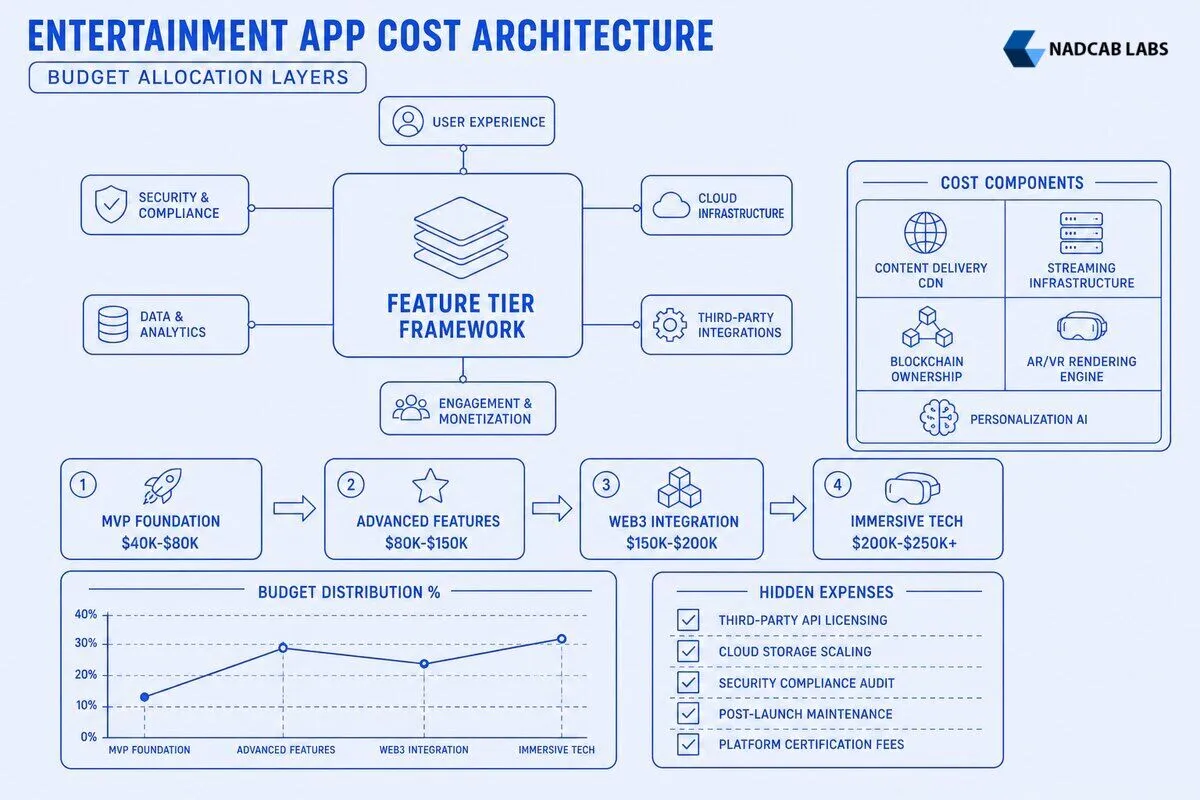
How Do Development Phases Allocate Budget in Entertainment Projects?
Discovery and planning consume 10-15% of your total budget, translating to $6,000-$18,000 for a $120,000 project. This phase includes user research interviews with 15-25 target users, competitive analysis of 5-8 similar platforms, technical architecture design documents, and API specification drafts. Teams conduct market validation through prototype testing, identify content licensing requirements, and map out third-party integrations (payment gateways, analytics platforms, cloud infrastructure providers). Skipping thorough discovery leads to costly feature rewrites later—we’ve seen teams waste $15,000-$30,000 rebuilding core architecture because initial planning missed scalability requirements.
UI/UX design and prototyping claim 15-20% of the budget ($18,000-$24,000 for a $120,000 build). Entertainment apps demand pixel-perfect interfaces because user engagement directly correlates with visual appeal and interaction fluidity. Design deliverables include wireframes for 20-30 screens, high-fidelity mockups, interactive Figma prototypes for user testing, and design system documentation. Streaming interfaces require custom video player controls, content browsing grids, and personalized recommendation carousels. Gaming apps need HUD design, inventory systems, and achievement notification patterns. Investing adequately here reduces development rework—poorly designed interfaces can add 20-30% to development time when developers must interpret ambiguous mockups.
Core development and integration represent the largest budget slice at 50-60% ($60,000-$72,000 for a $120,000 project). Backend infrastructure includes API development (RESTful or GraphQL), database schema design (PostgreSQL, MongoDB, or Redis for caching), authentication systems (OAuth 2.0, JWT tokens), and cloud deployment configuration (AWS, Google Cloud, or Azure). Third-party integrations cover payment processing (Stripe, PayPal), analytics (Mixpanel, Amplitude), push notifications (Firebase Cloud Messaging), and content delivery networks. Blockchain entertainment apps add smart contract development in Solidity or Rust, wallet integration (MetaMask, WalletConnect), and decentralized storage setup (IPFS, Arweave). A typical dApp development cost breakdown shows smart contract work alone consuming $12,000-$20,000 of this phase.
Testing, deployment, and post-launch activities require 15-20% of the budget ($18,000-$24,000). Quality assurance includes automated testing suites (Jest, Selenium), manual testing across 8-12 device types, performance optimization (load testing with 1,000-10,000 concurrent users), and security audits. App store submission involves preparing metadata, screenshots, demo videos, and navigating review processes for iOS App Store and Google Play Store. Post-launch reserves cover critical bug fixes in the first 30-60 days, server monitoring setup, and initial user support infrastructure. Many teams underestimate this phase and face $8,000-$15,000 in unexpected expenses when production issues arise without allocated fix budgets.
What Are the Cost Tiers for Core Entertainment App Features?
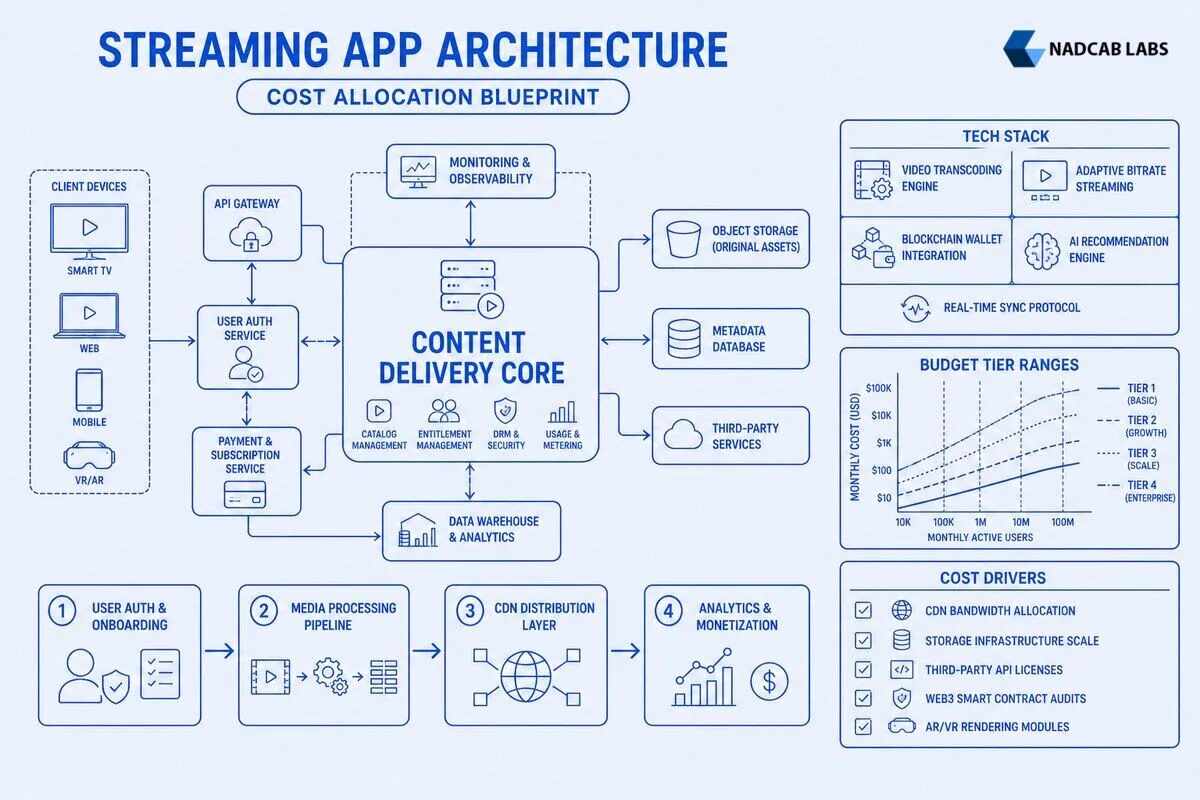
Content delivery and streaming infrastructure costs vary dramatically based on quality requirements and scale expectations. Basic video streaming with single-bitrate delivery costs $8,000-$12,000, covering AWS S3 storage integration, CloudFront CDN setup, and basic HLS (HTTP Live Streaming) implementation. Adaptive bitrate streaming, which adjusts video quality based on user bandwidth, adds $6,000-$10,000 for encoding pipeline development and multi-resolution storage. DRM (Digital Rights Management) implementation for content protection ranges from $10,000-$18,000, including Widevine or FairPlay integration, license server setup, and encrypted manifest generation. High-volume platforms serving 50,000+ monthly users need additional CDN optimization ($3,000-$6,000) and origin shield configurations to reduce bandwidth costs by 30-40%.
User engagement features form the retention backbone of entertainment apps. Personalization engines using collaborative filtering or content-based algorithms cost $12,000-$22,000, including user behavior tracking, preference modeling, and recommendation API development. AI-driven recommendation systems using machine learning models (TensorFlow, PyTorch) increase this to $25,000-$45,000, factoring in model training infrastructure, feature engineering, and continuous learning pipelines. Social sharing features (share to Twitter, Instagram, TikTok) run $4,000-$7,000 for OAuth integration and metadata optimization. In-app chat systems range from $8,000 (basic text messaging with Firebase) to $20,000 (real-time video/audio chat with Agora or Twilio integration). These features directly impact daily active user metrics—apps with robust personalization see 40-60% higher retention rates.
Monetization infrastructure determines revenue capture efficiency. Subscription management systems cost $10,000-$18,000, covering recurring billing logic, payment gateway integration (Stripe Billing, Recurly), subscription tier management, and cancellation workflows. In-app purchase systems for virtual goods or premium content run $8,000-$15,000, including product catalog management, receipt validation, and purchase restoration across devices. Ad integration (Google AdMob, Facebook Audience Network) costs $5,000-$9,000 for basic banner and interstitial ads, scaling to $12,000-$18,000 for rewarded video ads and programmatic bidding. Blockchain payment gateways supporting cryptocurrency transactions add $12,000-$20,000, covering wallet connectivity, transaction signing, and gas fee optimization. Platforms exploring diverse entertainment app monetization models often implement 2-3 revenue streams simultaneously, increasing this budget component by 50-80%.
Advanced capabilities command premium pricing due to specialized expertise requirements. AR experiences (filters, virtual try-ons, spatial games) start at $25,000 for basic implementations using ARKit or ARCore, reaching $60,000-$100,000 for custom 3D asset creation, motion tracking, and environmental understanding. VR applications for immersive entertainment cost $50,000-$120,000, including Unity or Unreal Engine development, 360-degree content integration, and spatial audio implementation. Detailed AR VR development cost breakdown shows hardware compatibility testing alone consuming $8,000-$15,000. AI-driven content curation using natural language processing for metadata tagging and sentiment analysis ranges from $18,000-$35,000. Live event streaming with multi-camera switching, real-time graphics overlays, and interactive audience features costs $30,000-$55,000. Multi-device sync enabling seamless content continuation across phones, tablets, and smart TVs adds $12,000-$20,000 for state management and cloud synchronization infrastructure.
How Does Blockchain and Web3 Integration Affect Entertainment App Budgets?
Smart contract development for entertainment apps varies by use case complexity. Content ownership contracts that mint NFTs representing digital collectibles, concert tickets, or exclusive media access cost $8,000-$15,000 for basic implementations on Ethereum or Polygon. These contracts include minting functions, transfer logic, and metadata URI management. Royalty distribution systems that automatically split revenue among creators, platforms, and rights holders range from $15,000-$28,000, incorporating payment splitter contracts, withdrawal mechanisms, and audit trails. Advanced NFT minting platforms with generative art algorithms, rarity calculations, and whitelist management push costs to $25,000-$45,000. Gas optimization becomes critical—poorly optimized contracts can cost users $5-$20 per transaction, directly impacting adoption. Teams should budget $3,000-$6,000 for professional smart contract audits from firms like CertiK or OpenZeppelin to prevent vulnerabilities that could drain contract funds.
Decentralized storage integration offers cost-efficiency advantages over traditional cloud storage at scale, but requires upfront development investment. IPFS (InterPlanetary File System) integration for storing video files, images, and metadata costs $6,000-$12,000, covering node setup, pinning service integration (Pinata, Infura), and content addressing logic. Arweave permanent storage implementation ranges from $8,000-$15,000, including transaction bundling, wallet integration for storage payments, and retrieval optimization. Traditional cloud storage (AWS S3, Google Cloud Storage) appears cheaper initially—$0.023 per GB monthly for S3 versus $5-$8 per GB one-time for Arweave—but decentralized options eliminate recurring fees. A platform storing 10TB of content pays $2,300 monthly ($27,600 annually) on S3, while Arweave’s one-time cost of $50,000-$80,000 breaks even after 2-3 years. Hybrid approaches using IPFS for hot content and Arweave for archival storage optimize both cost and performance, adding $10,000-$18,000 to development budgets.
Wallet integration, token economics design, and DAO governance features create Web3-native user experiences. Wallet connectivity supporting MetaMask, WalletConnect, and Coinbase Wallet costs $8,000-$14,000, including transaction signing flows, network switching, and balance display. Token economics design for utility tokens (governance rights, premium features, creator tips) requires $12,000-$22,000 for tokenomics modeling, vesting schedules, and distribution mechanisms. DAO governance features enabling community voting on platform decisions range from $18,000-$35,000, covering proposal submission systems, voting weight calculations, and execution contracts. These features attract Web3-savvy users willing to pay premium subscriptions—platforms with token-gated content see 25-35% higher average revenue per user compared to traditional subscription models. Budget an additional $5,000-$10,000 for legal consultation on token classification and regulatory compliance, especially for platforms operating in multiple jurisdictions.
What Hidden Costs Should You Account for in Entertainment App Development?
Content licensing and rights management represent significant ongoing expenses often overlooked in initial budgets. Music streaming apps pay $0.006-$0.0084 per stream to rights holders, meaning 1 million monthly streams cost $6,000-$8,400 in licensing fees alone. Video platforms licensing third-party content pay $500-$5,000 per title for limited-time distribution rights, with premium content commanding $10,000-$50,000 per title. Legal compliance consultation for GDPR (Europe), COPPA (children’s content in the US), and CCPA (California) costs $8,000-$18,000 for initial policy drafting and implementation. Ongoing compliance monitoring and updates run $3,000-$6,000 annually. Privacy-focused apps implementing SSI implementation cost structures for self-sovereign identity add $12,000-$25,000 but reduce data liability risks significantly.
Scalability provisions prevent performance collapse during viral growth. Load balancing infrastructure using AWS Elastic Load Balancer or Nginx costs $4,000-$8,000 to configure, plus $200-$800 monthly operational costs depending on traffic. Database optimization including query indexing, connection pooling, and read replica setup ranges from $6,000-$12,000. Server auto-scaling configurations that spin up additional instances during traffic spikes cost $5,000-$10,000 to implement, with cloud costs scaling proportionally to usage. A platform experiencing 10x traffic growth overnight without auto-scaling faces 6-12 hours of downtime and $15,000-$30,000 in emergency infrastructure fixes. Budget 15-20% of initial infrastructure costs for scalability enhancements that handle 5-10x current capacity.
Ongoing maintenance, security updates, and feature iteration consume 15-25% of initial development costs annually. A $120,000 entertainment app requires $18,000-$30,000 yearly for maintenance. This covers dependency updates (React Native, Flutter, backend frameworks), security patches, OS compatibility fixes (new iOS/Android versions), and cloud infrastructure costs ($500-$2,000 monthly for moderate traffic). Feature iteration based on user feedback costs $10,000-$25,000 per quarter for meaningful enhancements like new content categories, improved recommendation algorithms, or additional payment methods. User support infrastructure including help desk software (Zendesk, Intercom), community management tools, and support staff salaries adds $8,000-$20,000 annually for small to mid-size platforms. Platforms with blockchain components face additional costs—smart contract upgrades using proxy patterns cost $8,000-$15,000 per major version, while modular blockchain cost structures for layer-2 scaling solutions add $12,000-$25,000 annually.
Multi-platform development significantly impacts total budget. Building for iOS and Android simultaneously increases development costs by 40-70% compared to single-platform builds due to platform-specific UI components, testing requirements, and app store management. A $70,000 iOS-only streaming app costs $98,000-$119,000 when adding Android. Web applications add another 30-50% ($29,000-$42,000) for responsive design, browser compatibility testing, and progressive web app features. Cross-platform frameworks like React Native or Flutter reduce this premium to 25-40% but introduce performance trade-offs for graphics-intensive gaming apps. Smart TV and streaming device support (Roku, Fire TV, Apple TV) adds $15,000-$30,000 per platform for custom UI adaptations and remote control navigation. Teams should prioritize one platform for MVP launch, validate product-market fit, then expand—sequential platform rollout reduces upfront risk while maintaining expansion optionality.
| Hidden Cost Category | Initial Investment | Annual Recurring | Impact if Ignored |
|---|---|---|---|
| Content Licensing & Legal | $8,000 – $18,000 | $6,000 – $50,000+ | Legal liability, platform suspension |
| Scalability Infrastructure | $15,000 – $30,000 | $6,000 – $24,000 | Downtime during viral growth |
| Maintenance & Updates | N/A | $18,000 – $30,000 | Security vulnerabilities, OS incompatibility |
| Multi-Platform Expansion | $29,000 – $119,000 | $8,000 – $15,000 | Limited market reach, competitive disadvantage |
| User Support Infrastructure | $5,000 – $12,000 | $8,000 – $20,000 | Poor user retention, negative reviews |
Security considerations deserve dedicated budget allocation beyond basic development. Penetration testing by third-party security firms costs $8,000-$18,000 for comprehensive vulnerability assessment. Bug bounty programs offering rewards for discovered vulnerabilities run $5,000-$15,000 annually. DDoS protection services (Cloudflare, AWS Shield) add $200-$1,000 monthly depending on traffic volume. Blockchain applications require smart contract audits ($3,000-$6,000 per audit), multi-signature wallet setup for treasury management ($2,000-$4,000), and on-chain monitoring tools ($100-$500 monthly). Entertainment apps handling payment data must achieve PCI DSS compliance, costing $10,000-$25,000 for initial certification and $3,000-$8,000 for annual recertification. Platforms integrating with Top NFT Marketplaces face additional security requirements for wallet custody and transaction signing, adding $6,000-$12,000 to security budgets.
Analytics and business intelligence infrastructure enables data-driven optimization but requires upfront investment. Basic analytics integration (Google Analytics, Mixpanel) costs $3,000-$6,000 for event tracking setup and dashboard configuration. Advanced analytics platforms (Amplitude, Segment) with user cohort analysis and funnel visualization run $6,000-$12,000 for implementation. Custom data warehousing using BigQuery or Snowflake adds $8,000-$15,000 for ETL pipeline development and reporting infrastructure. Machine learning-powered analytics for churn prediction and lifetime value modeling costs $15,000-$30,000. These investments pay dividends—platforms using advanced analytics see 20-30% improvement in user retention through targeted interventions and personalized content recommendations.
The total cost picture for entertainment app development extends far beyond initial build estimates. A comprehensive $120,000 streaming platform actually requires $150,000-$180,000 when accounting for content licensing, legal compliance, scalability provisions, and first-year maintenance. Blockchain-enabled platforms with NFT features and decentralized storage push total costs to $180,000-$250,000. Teams should maintain a 20-30% contingency buffer for unexpected technical challenges, scope adjustments, and market-driven feature additions. Phased rollout strategies—launching with core features, validating market fit, then adding premium capabilities—reduce upfront risk while preserving strategic flexibility. Understanding these hidden costs upfront prevents mid-project budget crises and enables realistic timeline planning for sustainable platform growth.
Entertainment apps represent significant technical and financial investments, but strategic budget allocation across discovery, design, development, and post-launch phases maximizes ROI. Whether building a streaming service, gaming platform, or blockchain-enabled social entertainment app, understanding the cost drivers for each feature tier helps teams make informed trade-offs between functionality, timeline, and budget constraints. By accounting for hidden costs like content licensing, scalability infrastructure, and ongoing maintenance from day one, you position your platform for sustainable growth and competitive differentiation in the rapidly evolving entertainment technology landscape.
Frequently Asked Questions
Q1.What is the average cost range for developing a basic streaming entertainment app?
A basic streaming entertainment app typically costs between $40,000 and $80,000. This includes essential features like user authentication, content library, video playback, basic search, and payment integration. Costs vary based on platform choice (iOS, Android, or both), backend infrastructure complexity, and third-party API integrations. Nadcab Labs recommends starting with an MVP to validate market fit before scaling.
Q2.How much does blockchain integration add to entertainment app development costs?
Blockchain integration adds approximately $25,000 to $60,000 to entertainment app development costs. This includes smart contract development, wallet integration, NFT minting capabilities, and decentralized storage solutions. Complexity increases with features like tokenized rewards, royalty distribution systems, or DAO governance. Nadcab Labs specializes in efficient blockchain architecture that optimizes both security and cost-effectiveness for entertainment platforms.
Q3.What percentage of the budget should be allocated to UI/UX design for entertainment apps?
Allocate 15-25% of your total budget to UI/UX design for entertainment apps. Quality design directly impacts user retention and engagement. This covers wireframing, prototyping, visual design, user testing, and iterative refinements. Entertainment apps demand intuitive navigation and visually appealing interfaces. Nadcab Labs emphasizes design-first approaches, ensuring seamless user experiences that drive adoption and minimize post-launch redesign costs.
Q4.How do AR and VR features impact the total development cost of entertainment applications?
AR features add $30,000-$70,000, while full VR implementation ranges from $80,000-$200,000+ to entertainment app development. Costs depend on complexity, 3D asset creation, spatial computing requirements, and hardware compatibility. VR demands specialized development skills, performance optimization, and extensive testing. Nadcab Labs assesses project scope to determine whether AR/VR features align with ROI expectations before committing resources.
Q5.What are the ongoing maintenance costs after launching an entertainment app?
Ongoing maintenance typically costs 15-20% of initial development expenses annually. This covers server hosting, security updates, bug fixes, OS compatibility updates, third-party API maintenance, and performance monitoring. Entertainment apps with blockchain components require smart contract audits and network upgrades. Nadcab Labs offers structured maintenance packages ensuring reliability, security compliance, and continuous optimization for evolving user demands.
Q6.How does multi-platform development (iOS, Android, Web) affect the overall budget?
Multi-platform development increases costs by 50-80% compared to single-platform builds. Native development for iOS and Android separately costs more but delivers superior performance. Cross-platform frameworks like React Native or Flutter reduce costs by 30-40% while maintaining quality. Adding web support requires additional 20-30% budget allocation. Nadcab Labs evaluates target audience distribution to recommend the most cost-effective platform strategy.
Explore Services
Related Services
Reviewed by

Aman Vaths
Founder of Nadcab Labs
Aman Vaths is the Founder & CTO of Nadcab Labs, a global digital engineering company delivering enterprise-grade solutions across AI, Web3, Blockchain, Big Data, Cloud, Cybersecurity, and Modern Application Development. With deep technical leadership and product innovation experience, Aman has positioned Nadcab Labs as one of the most advanced engineering companies driving the next era of intelligent, secure, and scalable software systems. Under his leadership, Nadcab Labs has built 2,000+ global projects across sectors including fintech, banking, healthcare, real estate, logistics, gaming, manufacturing, and next-generation DePIN networks. Aman’s strength lies in architecting high-performance systems, end-to-end platform engineering, and designing enterprise solutions that operate at global scale.