Ai Overview
Self-sovereign identity implementation cost varies dramatically based on blockchain network selection, user scale, and feature complexity. The choice between Ethereum mainnet, Layer-2 solutions, or Hyperledger Indy fundamentally changes your cost structure, with transaction fees ranging from $0.
Self-sovereign identity implementation cost varies dramatically based on blockchain network selection, user scale, and feature complexity. A small-scale deployment for 1,000-10,000 users typically requires $45,000-$85,000 in initial development plus $800-$2,500 monthly operational costs, while enterprise systems serving 100,000+ users demand $180,000-$350,000 upfront investment with $8,000-$25,000 monthly infrastructure expenses. The choice between Ethereum mainnet, Layer-2 solutions, or Hyperledger Indy fundamentally changes your cost structure, with transaction fees ranging from $0.02 per DID operation on Polygon to $15-$45 on Ethereum mainnet during peak congestion.
Key Takeaways
- SSI infrastructure costs split into one-time setup ($45K-$350K) and recurring operational expenses ($800-$25K monthly) depending on user volume and blockchain choice
- Blockchain network selection creates 200-700% cost variance: Ethereum mainnet averages $15-$45 per DID transaction versus $0.02-$0.15 on Polygon or Layer-2 solutions
- Development budgets require $35K-$120K for wallet applications, $25K-$90K for issuer/verifier portals, and $15K-$45K for credential schema design at different scales
- Five-year TCO analysis shows SSI systems achieve 35-60% cost savings versus traditional IAM platforms like Okta or Auth0 for organizations above 5,000 users
- Hidden costs including smart contract audits ($8K-$25K), compliance consulting ($12K-$40K annually), and credential schema migrations add 18-30% to initial budget estimates
- ROI break-even typically occurs 18-36 months post-deployment through reduced KYC processing costs ($8-$25 per verification saved), fraud prevention value, and compliance automation
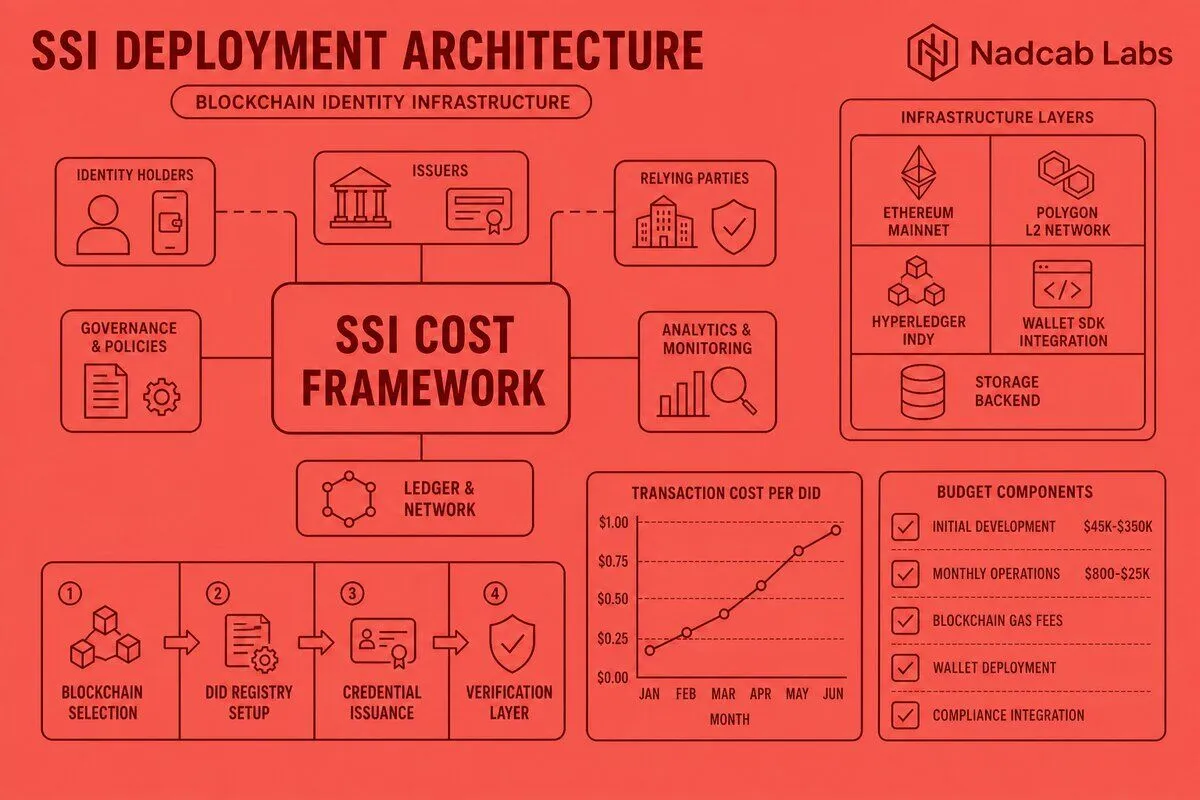
What Are the Core Cost Components of SSI Implementation?
Understanding self-sovereign identity budget allocation requires breaking down expenses into three distinct categories that behave differently as your system scales. The financial architecture mirrors the technical architecture, where upfront infrastructure decisions create long-term cost implications that many organizations underestimate during planning phases.
One-time setup costs represent the largest initial investment, typically consuming 65-75% of first-year budgets. Blockchain network selection drives this category, with Ethereum mainnet requiring $8,000-$15,000 for smart contract deployment versus $1,200-$3,500 for Hyperledger Indy network setup. DID method registration involves publishing resolver specifications and establishing trust anchors, costing $2,500-$8,000 depending on whether you’re joining existing networks like Sovrin or creating private implementations. Smart contract deployment for credential schemas, revocation registries, and verification logic ranges from $12,000-$35,000 including security audits. Initial infrastructure provisioning covers node hosting setup, storage configuration, and network connectivity, adding $5,000-$18,000 to deployment costs.
Development expenses form the second major cost pillar, where technical complexity meets user experience requirements. Wallet application development for iOS, Android, and web platforms demands $35,000-$120,000 depending on feature richness and security requirements. A basic wallet with DID generation, credential storage, and QR-code presentation costs $35,000-$55,000, while advanced implementations with biometric authentication, multi-signature support, and offline credential verification reach $85,000-$120,000. Issuer portal creation for organizations granting credentials requires $25,000-$65,000, encompassing admin dashboards, batch issuance workflows, and credential template management. Verifier portal development adds $18,000-$45,000 for building interfaces that request, validate, and record credential presentations.
Credential schema design represents specialized work often underestimated in initial budgets. Creating W3C-compliant schemas with proper JSON-LD contexts, establishing semantic interoperability, and defining revocation mechanisms costs $8,000-$22,000 per major credential type. API integration connecting SSI infrastructure to existing enterprise systems (HR databases, CRM platforms, authentication services) ranges from $15,000-$55,000 depending on complexity and legacy system constraints. Testing environment setup including staging networks, automated test suites, and security penetration testing adds $12,000-$28,000 to development budgets.
Recurring operational costs create the ongoing financial commitment that determines long-term viability. Node hosting expenses vary dramatically by blockchain choice: Ethereum validator nodes cost $180-$450 monthly for dedicated servers with 32 ETH staking requirements, while Hyperledger Indy steward nodes run $120-$280 monthly for cloud infrastructure. Layer-2 solutions like Polygon reduce hosting costs to $45-$120 monthly for equivalent transaction capacity. Transaction fees represent the most variable operational expense, directly tied to user activity and blockchain congestion. Organizations processing 1,000 credential issuances monthly pay $20-$50 on Polygon versus $15,000-$45,000 on Ethereum mainnet during high gas price periods.
Storage costs scale with credential volume and retention policies. Decentralized storage solutions like IPFS or Arweave charge $0.008-$0.025 per GB monthly for credential documents, schemas, and revocation lists. A system managing 50,000 active credentials with average 15KB credential sizes requires 750MB storage, costing $6-$19 monthly plus retrieval bandwidth charges. Maintenance expenses including software updates, security patches, and infrastructure monitoring run $2,500-$8,500 monthly for enterprise deployments. Compliance audits for SOC 2, ISO 27001, or GDPR verification cost $15,000-$45,000 annually depending on scope and certification body. Technical support infrastructure covering help desk operations, developer documentation, and user training materials adds $3,000-$12,000 monthly to operational budgets.
Organizations implementing Blockchain Identity Management systems must account for hidden integration costs that emerge during deployment. Legacy system compatibility issues often require custom middleware development adding 15-25% to initial estimates. Data migration from existing identity databases to DID-based systems costs $8,000-$35,000 depending on record volume and data quality. Change management programs ensuring user adoption and staff training typically consume 10-18% of total project budgets but deliver critical ROI through reduced support costs and faster implementation timelines.
How Do Blockchain Network Choices Impact SSI Infrastructure Costs?
Blockchain selection creates the single largest cost variance in SSI implementations, with infrastructure expenses differing by 200-700% between networks for equivalent functionality. The decision extends beyond initial deployment costs to fundamentally shape operational economics, scalability constraints, and long-term maintenance burdens that persist throughout the system lifecycle.
Ethereum mainnet represents the most expensive SSI infrastructure option but offers maximum decentralization and security guarantees. Current gas prices averaging 25-45 gwei create DID operation costs of $15-$45 per transaction during normal network conditions, escalating to $80-$200 during congestion spikes. A typical SSI deployment processing 10,000 credential issuances monthly incurs $150,000-$450,000 annual transaction costs on Ethereum mainnet. DID document updates cost $18-$52 each, while revocation registry modifications range from $25-$75 depending on batch size and smart contract optimization. Organizations choosing Ethereum mainnet must budget $180,000-$550,000 annually for transaction fees alone at moderate scale, making this option viable primarily for high-value credentials where maximum security justifies premium costs.
Layer-2 solutions dramatically reduce SSI operational expenses while maintaining Ethereum security guarantees through rollup technology. Polygon PoS processes DID operations for $0.02-$0.15 per transaction, reducing monthly costs from $150,000 to $200-$1,500 for 10,000 credential issuances. Arbitrum and Optimism offer similar economics with $0.05-$0.25 per transaction, though DID method support varies by network maturity. The cost structure shifts from variable transaction fees to more predictable infrastructure expenses: running a Polygon validator node costs $45-$120 monthly versus $180-$450 for Ethereum, while maintaining equivalent throughput capacity. Organizations processing 50,000+ credentials monthly achieve 95-98% cost reduction versus Ethereum mainnet, with five-year TCO dropping from $2.1-$3.8 million to $85,000-$180,000 for equivalent transaction volumes.
| Blockchain Network | DID Operation Cost | Monthly Cost (10K Credentials) | Node Hosting | 5-Year TCO |
|---|---|---|---|---|
| Ethereum Mainnet | $15-$45 | $150,000-$450,000 | $180-$450/month | $2.1M-$3.8M |
| Polygon PoS | $0.02-$0.15 | $200-$1,500 | $45-$120/month | $85K-$180K |
| Hyperledger Indy | $0 (permissioned) | $0 transaction fees | $120-$280/month | $95K-$215K |
| Sovrin Network | $0.10-$0.50 | $1,000-$5,000 | $0 (steward model) | $125K-$285K |
Hyperledger Indy eliminates per-transaction costs through permissioned network architecture, shifting expenses entirely to infrastructure hosting and governance participation. Validator node operations cost $120-$280 monthly for cloud infrastructure meeting recommended specifications (16 vCPUs, 32GB RAM, 500GB SSD storage). Organizations joining existing Indy networks as stewards pay annual governance fees of $5,000-$15,000 plus technical participation requirements. Private Indy deployments require minimum four validator nodes for Byzantine fault tolerance, creating $480-$1,120 monthly hosting costs before scaling considerations. The absence of transaction fees makes Indy economically attractive for high-volume credential issuance, with predictable costs regardless of activity levels.
Indy maintenance expenses include ledger backup storage ($25-$85 monthly for redundant copies), monitoring infrastructure ($180-$450 monthly for validator health tracking), and periodic software upgrades requiring 8-16 developer hours quarterly. Network coordination costs for multi-organization deployments add governance overhead: establishing transaction author agreements, managing steward onboarding, and coordinating protocol upgrades consume 15-30% of technical staff time. Organizations processing 100,000+ credentials monthly find Indy’s fixed-cost model delivers 40-65% savings versus Layer-2 solutions, with five-year TCO of $95,000-$215,000 compared to $180,000-$380,000 for equivalent Polygon deployments.
Polygon ID infrastructure combines Layer-2 economics with purpose-built SSI tooling, offering optimized cost structures for identity-specific operations. The platform processes credential issuances for $0.02-$0.08 per transaction, with batching capabilities reducing costs to $0.005-$0.015 per credential in high-volume scenarios. Infrastructure requirements include running a Polygon full node ($45-$95 monthly) and IPFS pinning service for credential storage ($15-$45 monthly for 100GB capacity). Polygon ID’s state transition model reduces on-chain data requirements, lowering storage costs 60-75% versus full credential publication approaches. Organizations benefit from pre-built smart contracts eliminating $12,000-$28,000 in custom development costs, though customization requirements may restore portions of these savings.
Sovrin Network operates as a public-permissioned hybrid, charging transaction fees while maintaining governance controls. Write operations cost $0.10-$0.50 per transaction depending on operation type and network congestion. The steward model eliminates direct node hosting costs for most organizations, who instead pay annual membership fees of $8,000-$25,000 for transaction privileges. This structure suits organizations wanting public network benefits without infrastructure management burdens. Five-year TCO for Sovrin deployments ranges from $125,000-$285,000 for moderate transaction volumes, positioning between pure permissioned and public blockchain economics. Governance participation requires attending quarterly meetings and contributing to protocol development, adding soft costs of 5-12% of technical staff time.
Network selection must account for compliance requirements that influence infrastructure costs. GDPR right-to-be-forgotten implementations cost $5,000-$15,000 additional development on immutable public blockchains requiring off-chain storage architectures, versus $2,000-$6,000 on permissioned networks supporting data deletion. Multi-region deployments for data residency compliance add 35-60% to hosting costs when replicating nodes across geographic boundaries. Organizations should model costs using realistic transaction volumes: a university issuing 50,000 diplomas annually plus 200,000 verification requests creates vastly different economics on Ethereum ($750,000-$2.2M annually) versus Polygon ($1,000-$3,500 annually) or Indy ($1,440-$3,360 annually in hosting only).
What Are Realistic Development Budgets for Different SSI Deployment Scales?
Development budgets scale non-linearly with user volume due to architectural complexity thresholds that trigger infrastructure redesigns and feature additions. Small deployments optimize for speed and cost efficiency, medium implementations balance scalability with budget constraints, and enterprise systems prioritize reliability and compliance over initial cost considerations.
Small-scale implementations serving 1,000-10,000 users represent the entry point for most organizations exploring SSI technology. These deployments typically require 4-6 month development timelines with lean teams comprising two full-stack blockchain developers ($85-$135/hour), one UX designer ($75-$115/hour), and part-time DevOps support ($95-$145/hour). Total development costs range from $45,000-$85,000 including basic wallet applications, simple issuer portals, and foundational verifier interfaces. Feature prioritization focuses on core functionality: DID generation and management, credential issuance workflows, QR-code based presentation, and basic revocation support.
2-3 weeks, $8K-$12K
3-4 weeks, $12K-$18K
8-10 weeks, $18K-$35K
2-3 weeks, $5K-$12K
1-2 weeks, $2K-$8K
Wallet development for small deployments costs $15,000-$35,000 covering single-platform implementation (typically web-based progressive web app) with essential features. This includes DID wallet initialization, secure key storage using browser crypto APIs, credential reception and storage, presentation request handling, and basic UI/UX design. Organizations requiring mobile applications add $12,000-$25,000 per platform (iOS or Android) to support native biometric authentication and offline functionality. Issuer portal development ranges from $12,000-$25,000 for administrative interfaces allowing credential template creation, individual credential issuance, and basic analytics dashboards tracking issuance volumes and verification events.
Credential schema design at small scale costs $3,000-$8,000 per major credential type, covering JSON-LD context creation, semantic mapping to existing standards (Schema.org, industry vocabularies), and revocation mechanism implementation. API integration connecting SSI infrastructure to existing systems requires $8,000-$18,000, typically focusing on single-sign-on replacement and basic user provisioning workflows. Testing environments including automated test suites and staging network setup add $4,000-$9,000 to small-scale budgets. Security considerations remain critical despite smaller scope: basic smart contract audits cost $5,000-$12,000, while penetration testing of wallet applications runs $3,000-$8,000 for limited scope assessments.
Medium enterprise deployments serving 10,000-100,000 users require substantially more sophisticated architecture and development rigor. Development timelines extend to 8-14 months with expanded teams: 3-5 blockchain developers, 2-3 frontend developers, dedicated backend engineer, UX/UI designer, DevOps engineer, and part-time security consultant. Total development costs range from $120,000-$220,000 reflecting increased complexity, multi-platform requirements, and enterprise integration demands. Integration complexity dominates medium-scale budgets as SSI systems must connect with HR databases, CRM platforms, authentication services, and compliance monitoring tools through robust API layers.
Multi-platform wallet development costs $45,000-$85,000 covering iOS, Android, and web applications with feature parity and synchronized state management. Advanced capabilities include biometric authentication, hardware security module integration, multi-credential management, selective disclosure interfaces, and offline verification support. Issuer infrastructure expands to $35,000-$65,000 encompassing batch issuance workflows processing thousands of credentials daily, role-based access controls for multiple issuing departments, credential template versioning, and comprehensive audit logging. Verifier portal development reaches $25,000-$45,000 adding policy-based verification rules, integration with access control systems, and detailed verification analytics.
Scalability investments become critical at medium scale, adding $18,000-$45,000 to development budgets for implementing credential caching layers, distributed storage architectures, and load-balanced API gateways. Database optimization for DID resolution and credential metadata storage requires specialized expertise costing $8,000-$18,000. API development expands to $25,000-$55,000 supporting RESTful interfaces, webhook notifications, and GraphQL endpoints for complex credential queries. Security audits intensify with $12,000-$25,000 for comprehensive smart contract reviews and $8,000-$18,000 for application penetration testing covering expanded attack surfaces.
Large-scale systems serving 100,000+ users demand enterprise-grade architecture with high availability, disaster recovery, and regulatory compliance built into foundational design. Development timelines span 12-20 months with full teams: 6-10 blockchain developers, 4-6 frontend developers, 3-4 backend engineers, 2 DevOps engineers, dedicated security engineer, UX team, and project management. Total development costs range from $280,000-$480,000 before ongoing maintenance commitments. These budgets reflect requirements for 99.9%+ uptime, multi-region deployments, advanced security controls, and integration with complex enterprise technology stacks.
High-availability architecture costs $45,000-$95,000 implementing redundant node infrastructure, automated failover mechanisms, and distributed credential storage across geographic regions. Load balancing and caching layers add $25,000-$55,000 for CDN integration, Redis clusters, and intelligent request routing. Distributed node networks running validators in multiple availability zones cost $35,000-$75,000 for infrastructure automation, monitoring systems, and orchestration tooling. Advanced security audits reach $25,000-$65,000 for comprehensive reviews including threat modeling, formal verification of critical smart contracts, and red team penetration testing simulating sophisticated attack scenarios.
Compliance infrastructure costs $35,000-$85,000 implementing GDPR controls, SOC 2 audit trails, data residency enforcement, and regulatory reporting interfaces. This includes building consent management frameworks, data subject access request handling, credential lifecycle audit logs, and compliance dashboard interfaces. Integration with enterprise identity providers (Active Directory, Okta, Azure AD) costs $28,000-$65,000 for bidirectional synchronization, attribute mapping, and migration tooling. Organizations implementing SSI alongside existing IAM systems rather than replacing them entirely add 25-40% to integration costs supporting hybrid identity architectures during transition periods.
Understanding modular blockchain cost principles helps optimize large-scale SSI budgets by separating consensus, data availability, and execution layers. This architectural approach can reduce infrastructure costs 30-50% compared to monolithic blockchain deployments while improving scalability and flexibility. Similarly, lessons from defi exchange development cost analysis apply to SSI systems requiring high transaction throughput and complex state management, particularly around database optimization and caching strategies that reduce blockchain interaction frequency.
How Do SSI Operational Costs Compare Across User Volume Tiers?
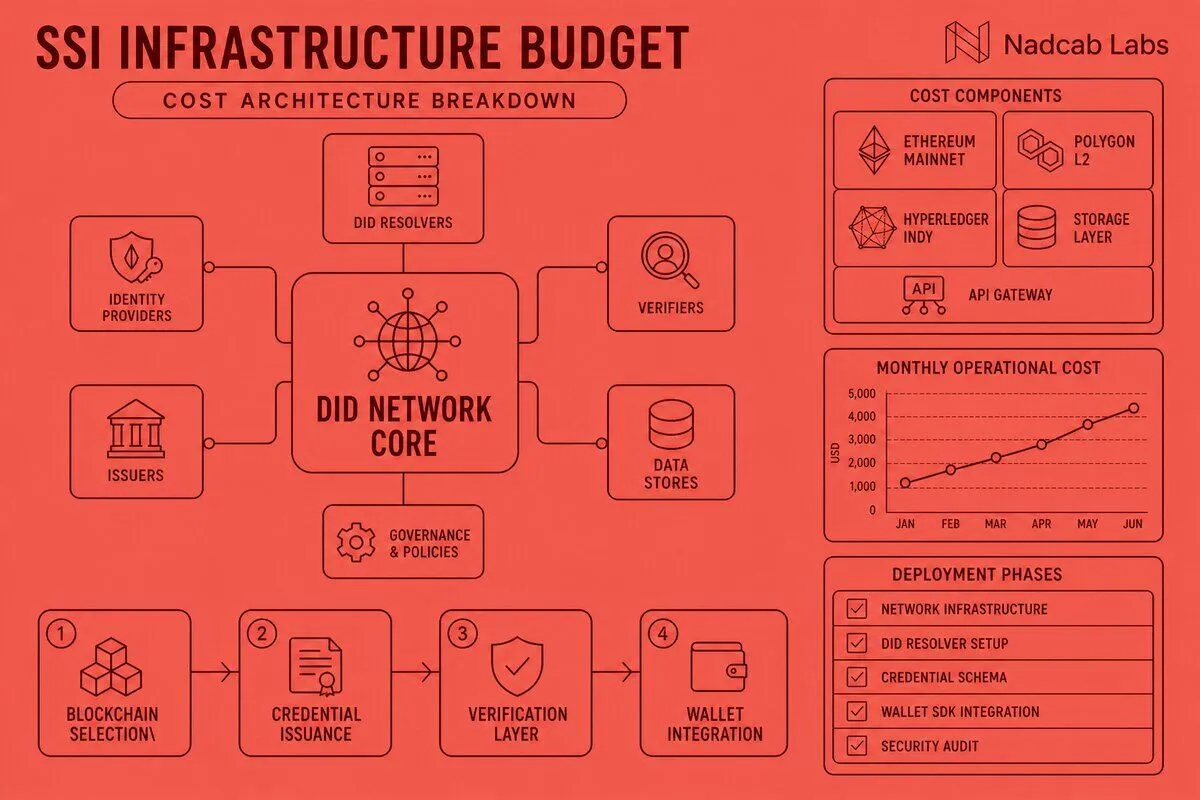
Operational cost structures shift dramatically as SSI systems scale from thousands to millions of users, with different expense categories dominating at each tier. Understanding these patterns enables accurate long-term budget forecasting and identifies optimization opportunities that become viable only at specific volume thresholds.
Monthly cost models for small deployments (1,000-10,000 users) range from $800-$2,500 depending on blockchain selection and activity patterns. Transaction volumes average 150-500 credential issuances monthly plus 300-1,200 verification requests, creating blockchain costs of $3-$75 on Polygon versus $2,250-$22,500 on Ethereum mainnet. Organizations choosing Hyperledger Indy eliminate per-transaction costs but pay $120-$280 monthly for validator node hosting. Credential issuance frequency directly impacts costs: educational institutions issuing diplomas quarterly show different patterns than healthcare providers issuing vaccination credentials daily. Storage requirements remain modest at 15-50GB for credential schemas, revocation registries, and backup data, costing $1.20-$4 monthly on IPFS or $8-$25 on traditional cloud storage with redundancy.
Bandwidth consumption averages 80-250GB monthly for small deployments, covering DID resolution requests, credential presentation protocols, and schema retrieval. Cloud egress charges add $7-$22 monthly on AWS or $4-$15 on cheaper providers. Infrastructure monitoring using services like Datadog or New Relic costs $45-$120 monthly for basic observability covering node health, transaction success rates, and API performance metrics. Technical support requirements remain minimal with 10-25 hours monthly of developer time for incident response, user assistance, and minor feature updates, costing $850-$3,375 at standard rates.
Medium-tier deployments (10,000-100,000 users) see operational costs rise to $3,500-$12,000 monthly as transaction volumes and infrastructure complexity increase substantially. Monthly credential issuances reach 2,000-15,000 with 8,000-60,000 verification requests, generating blockchain costs of $40-$2,250 on Polygon or Layer-2 solutions. Organizations still using Ethereum mainnet face unsustainable $30,000-$675,000 monthly transaction fees, forcing migration to cheaper alternatives or fundamental architecture changes. Storage requirements expand to 200-800GB for accumulated credentials, revocation lists, and audit logs, costing $16-$64 monthly on decentralized storage or $120-$380 on enterprise cloud storage with backup policies.
Bandwidth consumption jumps to 1.2-4.5TB monthly as verification frequency increases and more applications integrate with SSI infrastructure. Cloud egress costs rise to $120-$450 monthly, making CDN implementation economically attractive at this scale. Node infrastructure expands to multiple validators for redundancy, increasing hosting costs to $280-$850 monthly for cloud-based deployments or $450-$1,200 for dedicated servers with enhanced performance characteristics. Database costs for DID resolution caching and credential metadata storage reach $180-$650 monthly for managed PostgreSQL or MongoDB instances handling query loads.
Hidden operational expenses emerge prominently at medium scale. Smart contract upgrades required for bug fixes or feature additions cost $8,000-$22,000 per major update including testing and migration planning. Credential schema migrations when updating credential formats or adding fields require careful coordination costing $5,000-$15,000 in developer time plus potential re-issuance expenses. Wallet application updates releasing every 6-8 weeks demand $12,000-$28,000 quarterly for iOS/Android development, testing, and app store submission processes. Ongoing security monitoring expands to $850-$2,500 monthly for continuous vulnerability scanning, threat intelligence integration, and security incident response capabilities.
Large-scale deployments (100,000-500,000 users) face operational costs of $8,000-$18,000 monthly with transaction volumes reaching 15,000-75,000 credential issuances and 60,000-300,000 verifications monthly. Even on cost-optimized Layer-2 solutions, blockchain fees reach $300-$11,250 monthly without aggressive batching strategies. Storage requirements balloon to 2-8TB for credential archives, revocation registries, and comprehensive audit logs mandated by compliance frameworks. Decentralized storage costs $160-$640 monthly while enterprise cloud storage with multi-region replication reaches $1,200-$4,800 monthly.
Infrastructure complexity at large scale demands dedicated DevOps resources consuming 120-200 hours monthly for node management, performance optimization, and incident response, costing $11,400-$29,000 monthly for senior engineering time. Database infrastructure splits into read replicas and write primaries with costs reaching $850-$2,800 monthly for managed services handling millions of queries daily. Caching layers using Redis or Memcached add $280-$950 monthly for reducing database load and improving response times. Load balancers and API gateways cost $450-$1,500 monthly for managing traffic distribution and implementing rate limiting.
Enterprise deployments exceeding 500,000 users require $15,000-$25,000+ monthly operational budgets reflecting 24/7 support requirements, multi-region infrastructure, and stringent SLA commitments. Transaction batching becomes mandatory, with specialized optimization reducing per-credential costs to $0.001-$0.005 on Layer-2 networks through aggregated state updates. Storage architectures implement tiered approaches: hot storage for active credentials ($2,500-$6,500 monthly), warm storage for recent archives ($800-$2,200 monthly), and cold storage for compliance retention ($180-$650 monthly). Total storage costs reach $3,500-$9,500 monthly for comprehensive data lifecycle management.
Cost optimization strategies deliver 25-45% savings at scale through technical and operational improvements. Transaction batching aggregates multiple credential operations into single blockchain transactions, reducing costs from $0.02-$0.15 per credential to $0.001-$0.008 per credential on Polygon. Layer-2 migration from Ethereum mainnet saves 95-98% on transaction fees while maintaining security through rollup mechanisms. Open-source tooling selection eliminates licensing costs: using Hyperledger Aries frameworks instead of commercial platforms saves $25,000-$85,000 annually in licensing fees, though requiring additional development expertise.
Phased feature rollout approaches spread development costs over time while validating user demand before investing in complex capabilities. Starting with basic issuance and verification, then adding selective disclosure, then implementing zero-knowledge proofs allows organizations to match investment pace with adoption rates. This strategy reduces initial development costs 30-50% compared to building full feature sets upfront. Geographic infrastructure optimization places nodes and storage near user concentrations, reducing latency and bandwidth costs 15-30% through intelligent routing. Comparing these patterns with Tokenization Cost Factors reveals similar optimization opportunities around transaction batching and storage tiering strategies applicable across blockchain applications.
What Is the ROI Timeline for SSI vs Traditional Identity Management Systems?
Return on investment analysis for SSI implementations requires comparing five-year total cost of ownership against traditional centralized identity management platforms while quantifying operational savings and risk reduction benefits that materialize over time. Most organizations achieve break-even within 18-36 months depending on user scale, credential volume, and specific use case economics.
Five-year TCO comparison reveals SSI cost advantages emerging after initial investment recovery. Traditional IAM platforms like Okta charge $3-$15 per user monthly depending on feature tier, creating $180,000-$900,000 annual costs for 5,000 users. Auth0 pricing ranges from $240-$1,680 per month for 1,000-10,000 external users, scaling to $8,400+ monthly for enterprise deployments. Azure AD B2C costs $0.00325 per authentication plus $0.0325 per monthly active user, generating $1,950-$9,750 monthly for 50,000 active users performing 10 authentications each. Over five years, traditional platforms cost $1.08-$5.4 million for moderate deployments before integration, customization, and migration expenses.
SSI five-year TCO for equivalent user volumes ranges from $285,000-$1.2 million including initial development ($120,000-$280,000), ongoing operational costs ($3,500-$12,000 monthly), and periodic upgrades ($35,000-$85,000 over five years). The cost structure inverts traditional IAM economics: SSI requires higher upfront investment but lower recurring costs, while traditional platforms minimize initial expense but accumulate substantial licensing fees. Organizations exceeding 5,000 users typically see 35-60% TCO reduction with SSI, while smaller deployments may find traditional platforms more economical due to development cost amortization challenges.
| Cost Category | Traditional IAM (5 Years) | SSI System (5 Years) | Savings |
|---|---|---|---|
| Initial Setup | $25,000-$85,000 | $120,000-$280,000 | -$95,000 to -$195,000 |
| Annual Licensing (10K users) | $180,000-$900,000 | $0 | +$180,000 to +$900,000 |
| Operational Costs (monthly avg) | $2,500-$8,500 | $3,500-$12,000 | -$1,000 to -$3,500 |
| Integration & Customization | $85,000-$250,000 | $45,000-$120,000 | +$40,000 to +$130,000 |
| 5-Year Total | $1.08M-$5.4M | $285K-$1.2M | +$795K to +$4.2M (35-78%) |
Quantifiable savings from SSI implementation accumulate through multiple operational improvements. Reduced KYC processing costs represent the most immediate benefit: traditional identity verification costs $8-$25 per user through third-party services like Jumio or Onfido, while SSI systems enable credential reuse eliminating repeated verification expenses. An organization onboarding 10,000 users annually saves $80,000-$250,000 yearly after credentials become reusable across services. Financial institutions processing 50,000 KYC verifications annually achieve $400,000-$1.25 million in direct cost avoidance within three years.
Fraud prevention value quantification requires estimating current fraud losses and SSI’s impact on attack vectors. Identity-related fraud costs average 5-8% of revenue for financial services and 2-4% for e-commerce platforms. SSI implementations reduce credential stuffing attacks by 85-95% through eliminating shared passwords, phishing susceptibility by 70-90% through cryptographic verification, and account takeover attempts by 60-85% through stronger authentication. A mid-size e-commerce platform with $50 million annual revenue experiencing 3% fraud losses ($1.5 million) could save $900,000-$1.35 million annually through 60-90% fraud reduction, achieving SSI investment payback within 8-15 months.
Compliance automation benefits emerge from credential-based audit trails and automated policy enforcement. Organizations spending $120,000-$450,000 annually on compliance reporting, access reviews, and audit preparation reduce these costs 40-65% through SSI’s cryptographic audit logs and automated verification records. Healthcare providers meeting HIPAA requirements save $85,000-$280,000 annually on access control documentation and patient consent management. Financial institutions addressing KYC/AML regulations reduce compliance staff time 30-50%, saving $150,000-$550,000 annually in operational costs.
Customer onboarding efficiency gains deliver measurable time and cost savings. Traditional onboarding requiring 15-45 minutes of user time and 25-60 minutes of staff processing drops to 3-8 minutes with credential reuse. Organizations onboarding 20,000 customers annually save 7,000-18,000 staff hours worth $210,000-$810,000 at blended rates. Improved completion rates from streamlined processes increase conversion 12-28%, generating additional revenue that amplifies ROI calculations. A financial services firm with $500 average customer lifetime value gains $120,000-$280,000 annually from 2,000-4,000 additional completed onboardings.
Break-even analysis framework helps organizations model their specific scenarios. Calculate total implementation cost (development + first year operations), then project annual savings from KYC reduction, fraud prevention, compliance automation, and operational efficiency. Divide total implementation cost by annual savings to determine payback period in years. Most organizations achieve break-even within 18-36 months, with high-volume credential issuers reaching payback in 12-18 months and lower-volume deployments requiring 30-48 months. Cost-benefit modeling should include risk reduction value: avoiding a single major data breach costing $3-8 million justifies substantial SSI investment even without operational savings.
Financial justification templates for enterprise decision-makers should present three-year projections showing year-over-year cost evolution. Year 1 shows negative ROI due to development costs and limited operational savings during rollout. Year 2 approaches break-even as user adoption increases and operational savings materialize. Year 3 delivers positive ROI as full savings realize while operational costs stabilize. Include sensitivity analysis showing ROI under different adoption rate scenarios and quantify risk reduction benefits separately from operational savings to present comprehensive value proposition.
Organizations implementing comprehensive Blockchain Identity Management solutions benefit from consulting services that optimize cost structures and accelerate time-to-value. Professional guidance reduces development costs 15-30% through architecture best practices, avoids common implementation pitfalls that cause budget overruns, and ensures scalability planning prevents costly future migrations. Comparing SSI economics with other blockchain applications like Blockchain Based Models reveals similar patterns where higher initial investment delivers long-term operational advantages and risk reduction benefits that justify upfront costs for organizations with sufficient scale and long-term commitment to decentralized architectures.
Final Thoughts
SSI implementation cost analysis reveals a fundamental economic trade-off between upfront development investment and long-term operational savings that favors organizations with sufficient user scale and multi-year planning horizons. Small deployments serving 1,000-10,000 users require $45,000-$85,000 initial investment plus $800-$2,500 monthly operations, while enterprise systems exceed $280,000 development costs with $15,000-$25,000 monthly operational budgets. Blockchain network selection creates the largest cost variance, with Layer-2 solutions like Polygon delivering 95-98% transaction cost savings versus Ethereum mainnet while Hyperledger Indy eliminates per-transaction fees entirely through permissioned architecture. Five-year TCO analysis shows SSI systems achieving 35-60% cost reduction versus traditional IAM platforms for organizations above 5,000 users, with break-even typically occurring 18-36 months post-deployment through quantifiable savings in KYC processing, fraud prevention, compliance automation, and operational efficiency. Organizations must carefully model their specific use case economics, considering credential volume, verification frequency, compliance requirements, and fraud risk profiles when evaluating SSI investment decisions. The technology delivers strongest ROI for high-volume credential issuers, organizations facing substantial identity fraud losses, and enterprises with complex compliance requirements where SSI’s cryptographic audit trails and automated verification reduce regulatory overhead. Understanding these cost dynamics enables realistic budget planning and accurate ROI projections that support informed investment decisions in self-sovereign identity infrastructure.
Frequently Asked Questions
Q1.How much does it cost to implement self-sovereign identity on blockchain?
SSI implementation on blockchain typically ranges from $150,000 to $800,000 depending on scope. Core expenses include DID infrastructure setup ($40K-$120K), verifiable credential schema design ($30K-$80K), wallet development ($50K-$200K), resolver and registry deployment ($20K-$100K), and smart contract audits ($15K-$50K). Enterprise-grade solutions with custom governance frameworks and multi-ledger support push costs higher. Proof-of-concept pilots start around $50K-$100K for organizations testing feasibility before full deployment.
Q2.What are the ongoing costs of running an SSI system?
Annual SSI operational costs range from $60,000 to $300,000. Major expenses include blockchain transaction fees ($10K-$50K annually depending on network), node infrastructure hosting ($15K-$80K), credential revocation registry updates ($8K-$30K), security audits and compliance reviews ($12K-$50K), developer maintenance ($25K-$90K), and user support operations. Public permissionless chains like Ethereum incur higher transaction costs while permissioned networks reduce fees but increase infrastructure overhead. Scaling user base directly impacts transaction and storage expenses.
Q3.Is self-sovereign identity cheaper than traditional identity management?
SSI becomes cost-effective at scale, typically breaking even after 18-36 months. Traditional IAM systems cost $50-$200 per user annually for licensing, storage, and breach mitigation. SSI eliminates centralized database costs, reduces breach liability (average data breach costs $4.45M), and cuts credential verification expenses by 60-80%. Initial SSI investment is higher, but decentralized architecture removes recurring database licensing fees and reduces compliance overhead. Organizations managing 10,000+ identities see ROI faster through eliminated password reset costs ($70 per incident) and streamlined KYC processes.
Q4.What blockchain is most cost-effective for SSI implementation?
Hyperledger Indy and Sovrin offer the lowest SSI-specific costs with transaction fees under $0.001 per DID operation. Polygon provides Ethereum compatibility at $0.01-$0.10 per transaction versus Ethereum mainnet’s $5-$50. Cardano and Algorand balance decentralization with sub-cent transaction costs. For enterprise deployments, permissioned Hyperledger Fabric eliminates per-transaction fees but requires node infrastructure ($2K-$8K monthly). Choice depends on decentralization requirements—public chains cost more per transaction but eliminate infrastructure overhead, while private chains invert that equation with higher hosting costs.
Q5.What are hidden costs in SSI projects that organizations miss?
Organizations commonly overlook credential schema governance ($20K-$60K annually), cross-chain interoperability development ($40K-$100K), regulatory compliance adaptation ($30K-$80K), user education and change management ($25K-$70K), legacy system integration middleware ($50K-$150K), and DID method migration contingencies. Revocation registry scaling costs spike unexpectedly as user base grows. Key recovery mechanisms require secure backup infrastructure ($15K-$40K). Third-party verifier onboarding and API maintenance add $10K-$30K annually. Underestimating wallet UX iteration costs leads to adoption failures requiring expensive redesigns.
Q6.What is the ROI timeline for self-sovereign identity systems?
SSI ROI typically materializes within 24-48 months for mid-to-large organizations. Financial services see fastest returns (18-30 months) through reduced KYC costs ($15-$50 per verification saved) and fraud prevention (average fraud loss reduction of 40-65%). Healthcare organizations achieve ROI in 30-42 months via interoperability gains and HIPAA compliance cost reductions. Key ROI drivers include eliminating password reset tickets (70-85% reduction), decreasing data breach liability, automating credential verification (saving 15-40 staff hours weekly), and reducing third-party identity verification fees by 50-75%. Break-even accelerates with user base above 50,000 identities.
Explore Services
Related Services
Reviewed by

Aman Vaths
Founder of Nadcab Labs
Aman Vaths is the Founder & CTO of Nadcab Labs, a global digital engineering company delivering enterprise-grade solutions across AI, Web3, Blockchain, Big Data, Cloud, Cybersecurity, and Modern Application Development. With deep technical leadership and product innovation experience, Aman has positioned Nadcab Labs as one of the most advanced engineering companies driving the next era of intelligent, secure, and scalable software systems. Under his leadership, Nadcab Labs has built 2,000+ global projects across sectors including fintech, banking, healthcare, real estate, logistics, gaming, manufacturing, and next-generation DePIN networks. Aman’s strength lies in architecting high-performance systems, end-to-end platform engineering, and designing enterprise solutions that operate at global scale.